A Review of the Golden Universal Tarot

IMG_1384

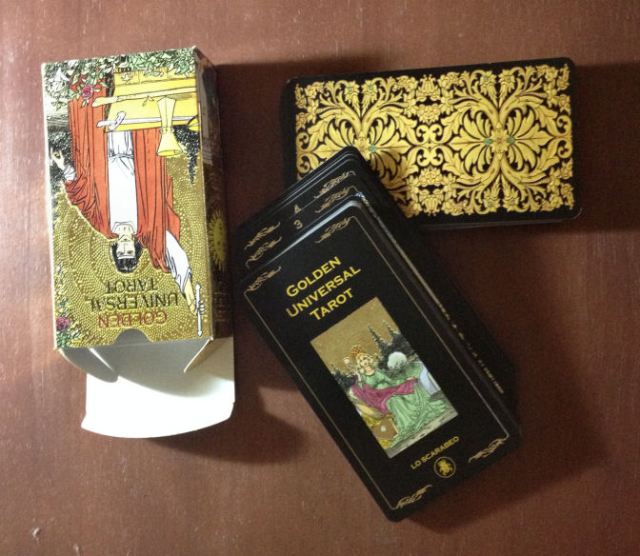
Imma not even gonna make excuses. I bought the Golden Universal Tarot (illustrated by Roberto De Angeles and published by Lo Scarabeo) because it is shiny. I guess I’m a magpie in that respect. I like shiny.

It isn’t a bad deck. For public readings where complete strangers will be handling my tarot cards, I wouldn’t mind bringing this one. And while that speaks positively of the deck’s versatility, function, and imagery, it also shows it’s not one of my favorites. For collectors, I don’t think this is worth adding to a collection, if one is truly on a budget. Also, for teaching tarot, I would stick with the classic Rider Waite Smith. All that said, for the professional tarot reader who does a lot of public readings and lets their clients handle the decks, this is a great one and definitely worth getting for that purpose.
Golden Universal Tarot

The deck is mostly beautifully gilded (I’ll get to why I say “mostly” in a bit) and per the current trend this past year, the borders are black rather than white. The backs are reversible, so for those who read with reversals, this deck works to that end. The cards are approximately 4.25″ x 2.5″, which means they’re very easy to shuffle, cut, and work with, unlike many of the big, fancy decks that have been released as of late. That is in part why I say this deck is great for public reading usage. Quality of stock, like almost all decks I’ve been coming across in the last few years, is going down from what they used to be in the 80s and 90s but what can you do. Thus, while noticeably flimsier than the RWS decks of yore, it’s not so bad. You’ll work just fine with these. And if it matters to anyone, the box says this deck was made in Italy.
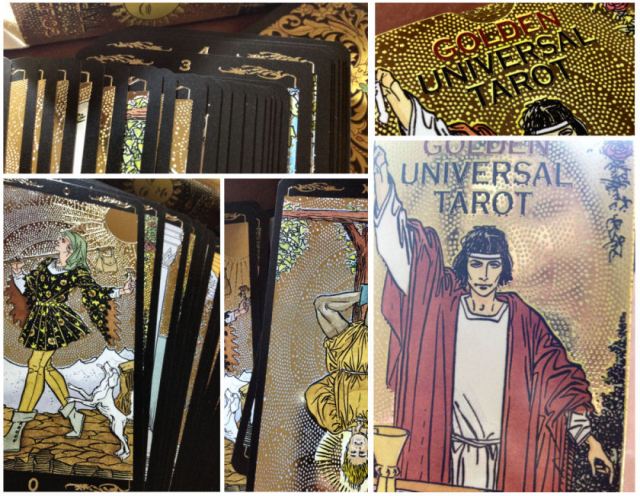
Golden Universal Tarot - snapshots

(Look how shiny the gilded cards are! In the above bottom right photo, you can see my face reflected behind the Magician!)

For those who can’t connect to the classical RWS deck because of its rudimentary artwork, the Golden Universal is a viable alternative. However, I appreciate Waite and Smith’s original version for its symbolism and rely heavily on every detail, the precise coloring of the sky and the clothing worn by the characters, and every little leaf and bird in the backdrop. As a result, working with the Golden Universal means I miss out on some of the details. Some of what seems to be minor changes doesn’t work for me particularly well.

Continue reading “A Review of the Golden Universal Tarot”

Minchiate Cards for Divination: My Review

minchiate

It is said that like tarot, the origins of the minchiate are not verifiable, but was probably a card game played in the late medieval period. The version I have at home is a reproduction of the Etruria deck from 18th century Florence. Like tarot, the imagery on the cards and scope of the depictions seem extraordinarily well suited for spiritual, metaphysical, or divination work and in many ways, the minchiate even more so than tarot.

There are 97 cards in total, consisting of trumps like tarot, 22 with the addition of 4 cards representing the theological virtues, 4 cards representing the elements, and 12 cards representing the zodiac signs. That’s 41 trumps and 56 numbered cards, with the numbered cards similar to tarot: 4 suits, Ace through Ten, and then 4 court cards.

The photograph below shows the unnumbered Madman (corresponding with tarot’s The Fool) and Keys I, II, III, IIII (IV), and V. Key I is the Performer, which corresponds with tarot’s The Magician. Keys II, III, and IIII (IV) in the minchiate are the Grand Duke, the Western Emperor, and the Eastern Emperor, which some say correspond with tarot’s Empress, Emperor, and Hierophant respectively. Key V is Love, corresponding with tarot’s Key VI, The Lovers.

The numbering of the keys in the Minchiate is significantly different from the tarot. For example, in minchiate the Temperance card is Key VI while in tarot it is Key XIV. There is no Hermit card per se, but there is Father Time, which is said to correspond with the Hermit. Most notably, the final card of the Trumps is not The World as in tarot, but rather the Trumpets, corresponding with the tarot Judgement card.

Minchiate_Trumps0to5

After the minchiate Key XV The Tower, there are the four theological virtues: Key XVI, Hope; Key XVII, Prudence; Key XVIII, Faith, and Key XIX, Charity. See below.

Minchiate_4Virtues

Although there is no direct correspondent in minchiate to the tarot High Priestess card, some speculate that the Faith card corresponds with the High Priestess. For me, in the Etruria deck, the illustrations are confusing. The picture on the first card above calls to mind Faith for me, but it’s the Hope card. The second card (left to right) reminds me of vanity for some reason, rather than a virtue, and yet it’s Prudence. The third card shows a woman, likely from the laboring class, looking at or reading something. It only somewhat fits my conception of Faith. The last card, Charity– either you know the meaning or you don’t. Little about the card’s imagery strikes me as denoting charity. But hey, this is all just me.

Michiate_4Elements

Following the four theological virtues are the four classical elements in the following order: Fire, Water, Earth, and Air. (Compare that to the order of the elements per the contemporary majority view in tarot practice: Fire, Water, Air, and Earth.) When the Fire card appears in a reading, it suggests the relevance of innovation, passion, ambition, and leadership. The Water card denotes alliances, intuition, and compassion. The Earth card, stability, conservatism, conviction, and resourcefulness. Air, idealism, intellectualism, communication, and also ambition, though the Fire-based ambition usually relates to progress while the Air-based ambition relates to conquest.

Minchiate_12ZodiacSigns

In the minchiate there are also cards for the 12 signs of the zodiac. Pictured above in the numerical order they appear in the trumps:

Top Row (L to R): Libra, Virgo, Scorpio, Aries, Capricorn, Sagittarius

Bottom Row (L to R): Cancer, Pisces, Aquarius, Leo, Taurus, Gemini

After the Trumps, the 56 numbered cards in the minchiate are similar to the tarot. There are four suits and their correspondences are as follows: Wands for work or career; Chalices (Cups) for emotions and relationships; Pentacles for money matters; and Swords for the abstract and philosophical. Among the court cards, Knaves (or Pages) denote education and learning; Knights about courage, action, and choice; Queens about a relationship; and Kings about decision-making and authority. Note further that the minchiate correspondents to the Pages are specifically 2 Knaves for the active suits (Fire and Air) and 2 Maids for the passive suits (Water and Earth).

Continue reading “Minchiate Cards for Divination: My Review”

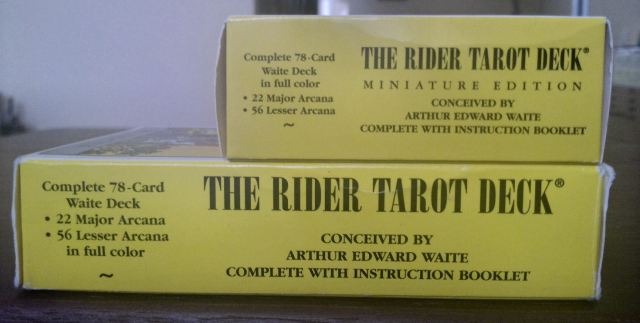
The Rider Tarot Deck Miniature Edition

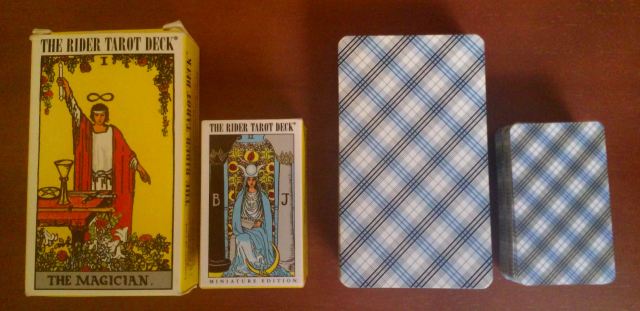
RWS_vs_RWSmini_4

My 20-year-old Rider Tarot is my go-to reading deck. Since I’m often mobile and now doing tarot readings online, which I can do from my portable tablet from, well, anywhere, I found that I needed to get a tarot deck that was equally portable. I found it. The Rider Tarot Deck Miniature Edition. I love it!

RWS_vs_RWSmini_1

Cute, though it does bother me to have The Magician on the big version and The High Priestess on the mini. Not very feminist. But moving on. The above photo offers a size comparison.

The original box is 2.9″ x 4.75″ x 1.2″. The mini box is 1.9″ x 3.0″ x 1.2″. Heck, I can toss the mini into my clutch!

Continue reading “The Rider Tarot Deck Miniature Edition”

The Lenormand: Nutshell Summary of the Petite Lenormand, from History to Practice

lenormand1

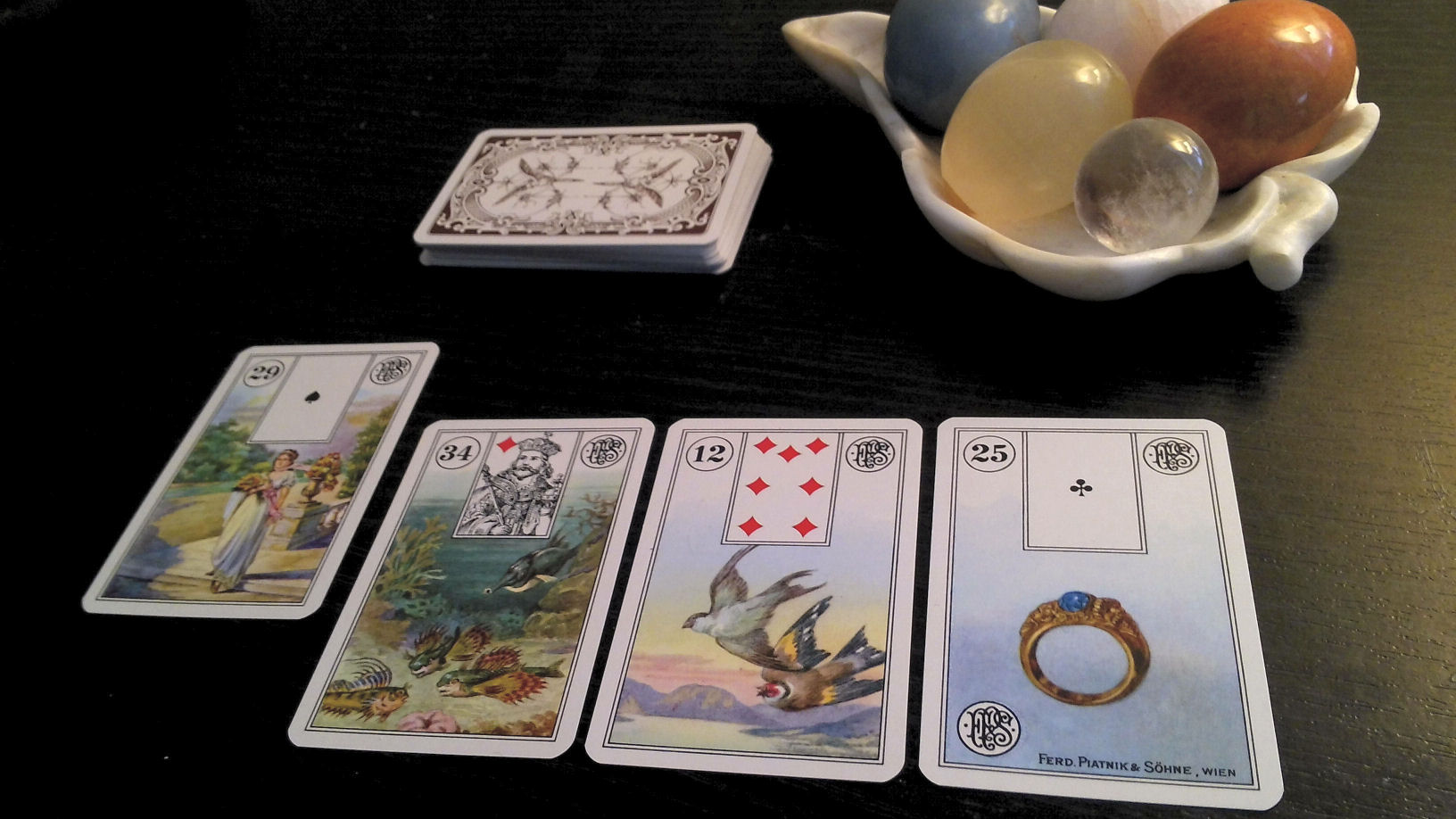
The popularity of Lenormand cards seem to have been revived for contemporary times, at least here in the U.S. Lately it seems that every tarot enthusiast will go through a phase of intrigue for these Lenormands. Well the other day a student asked me to guide her studies of the Lenormands. From there, I decided to write this nutshell summary. For the tarot enthusiast who has now suddenly taken on an interest in Lenormand cards, this post will serve as an introduction.

Overview

They’re oracle cards, not tarot, and generally speaking, they’re sub-divided into 2 kinds: the Petit Lenormand, with 36 cards total, which is the more popular version here in the U.S., and the Grand Jeu Lenormand, with 54 cards. I have not yet dabbled with the Grand Jeu Lenormand due to difficulties in getting a deck where I live (that is, for an economically reasonable price…because, sure, you can buy anything via the Internet these days), so I’ll focus on the Petit Lenormand only.

The oracle cards are named after Marie Anne Lenormand, who is considered one of the greatest and most influential French cartomancers of all time. However, the cards were not conceived by her. They were conceived after her death and may or may not have even been based on any of the cards used by Marie Anne Lenormand. They’re called “Lenormand cards” pretty much for marketing purposes. In fact, they may not even be French. Johann Kaspar Hechtel, a German businessman and factory owner, is credited with designing the Petit Lenormand cartomancy deck, initially as a parlour game called “The Game of Hope.” So in many ways, the name “Lenormand cards” might be a bit misleading.

Continue reading “The Lenormand: Nutshell Summary of the Petite Lenormand, from History to Practice”

In Defense of the Rider-Waite

riderwaitedefense

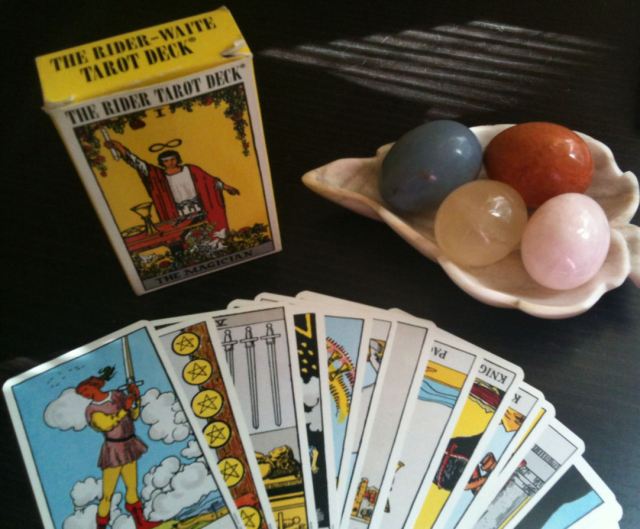
I am grateful that I did not access the Internet during my formative years of learning tarot. Communities of self-proclaimed advanced tarot practitioners have brought into being the supercilious notion that the Rider-Waite or Rider Waite Smith (RWS) tarot deck is a “beginner’s deck” and that a high level practitioner will have moved beyond the RWS into another more specialized deck.

What hooey.

These practitioners need to revisit the RWS and re-evaluate for themselves how well they truly understand the RWS. Are they really using the symbology contained in the deck to its full extent? Do they understand the elemental influences, astronomical, seasonal, and the nuances of every last bird in the sky, leaf, and blade of grass?

As I have said, as of the present there are three prevailing tarot deck systems. The Marseille with the pip cards, the RWS, and the Thoth. The three are very different from one another and every practitioner should be fluent with reading all three. From there, you will find that you gravitate more toward one of those three. That will most likely become your primary reading deck.

The three systems have inspired numerous contemporary derivative decks. These decks are generally based on one of the foregoing three systems, or are a hybrid. Most of these derivative decks are created to reconcile an omission in one of the three main systems. A basic example of that are the fancy, beautifully illustrated RWS decks that are aesthetically more pleasing to the eye than the original RWS. There are decks that attempt to better flesh out the interpretive methods of the Golden Dawn. Others fuse the foundation of the tarot with imagery that is more specific to a particular faith, philosophy, or culture. All of these decks are legitimate reading decks and if you find yourself connecting to one more so than the RWS, then that’s really great for you.

However, it does not mean you’re now more advanced. People start with the RWS not because it’s a beginner’s deck, but because it is a traditional system. The Marseille is another traditional system, but not everyone has developed and honed their intuitive abilities to a point where they can read pip cards meaningfully. The RWS is like Tchaikovsky’s Violin Concerto in D Major while the Thoth is like Stravinsky and the classical musician will have attempted to master both, but neither one is hardly considered “beginner” stuff. Playing Vyacheslav Artyomov or Gheorghi Arnaoudov doesn’t make you more advanced than the fellow working on the Tchaikovsky piece.

So please do not listen to the snobbery, my dear RWS reader. If that was your first reading deck and still remains your only reading deck, then that is what works for you. That shouldn’t even be said in a patronizing way. Seriously. RWS is an incredibly complex deck and anyone who thinks it’s the training wheels of tarot is someone who still has a beginner, rudimentary understanding of the study.

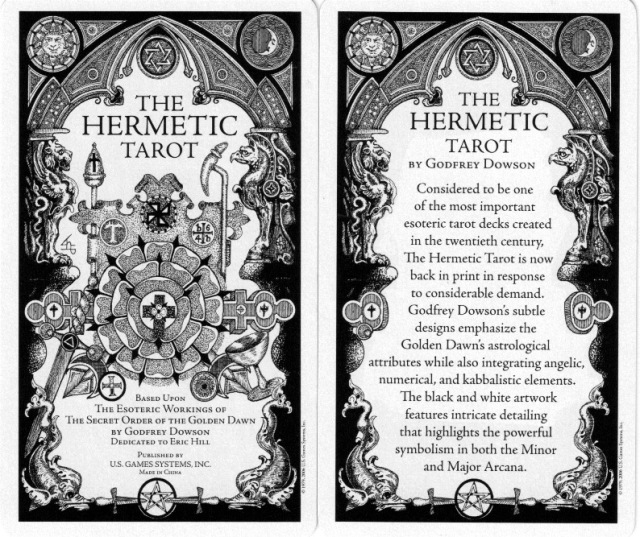
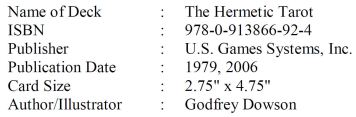
The Hermetic Tarot by Godfrey Dowson: A Powerful Divination Deck and a Suggested Triquetra Spread

bellwen-HermeticTarot2

hermetic

The Hermetic Tarot by Godfrey Dowson is a masterpiece. The tone of the deck and Dowson’s artwork invokes the full spectrum of powers within the tarot practitioner for spiritual divinatory work. As a Golden Dawn study deck, the card images are fundamentally focused on alchemical and astrological references such as the decans in the Minor Arcana, with the deck outfitted for theurgy. It can be integrated into personal rituals, meditations, and ceremonies and in fact is probably far better suited for such work than, say, the Marseille, Rider-Waite-Smith, or even the Thoth decks.

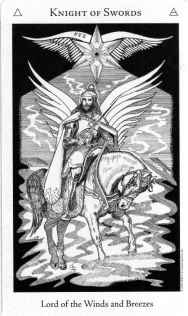
bellwen-Hermetic-KnightGodfrey Dowson draws heavily from elemental dignities and affinities, Western astrology as interpreted by the Golden Dawn, and the Qabalah. Corresponding alchemical symbols for the four elements and astrological symbols are embedded into each card to denote the attributions. In the Major Arcana, the Key’s corresponding Hebrew letter appears on the top left corner. In the court cards, the alchemical symbol corresponding with the classical element that the card itself represents appears on the top left and the symbol for the element corresponding with the suit appears on the top right. The Knight of Swords, for example, represents Fire (for the Knight) on Air (for the suit of Swords). For practitioners who adopt interpretive methods reliant on elemental dignities and affinities, that is a godsend. The backs of the cards are illustrated with the Hermetic Rose and hexagrams. As they are non-reversible, it may not be an ideal deck for reading with reversals. That being said, the little white booklet that accompanies the Hermetic Tarot provides the meanings of the cards in the “ill-dignified” position, as reversals are called in the booklet, which suggests that the deck is nevertheless intended for reading with reversals.

The anatomy of the Hermetic Tarot is the same as the Rider-Waite-Smith (RWS) (e.g., VIII is Strength and XI is Justice or their equivalents) and there is substantial crossover of subscribed card meanings to render the Hermetic Tarot user-friendly for anyone familiar with the RWS. At the end of this deck review are correspondence tables that compare the RWS with the Hermetic Tarot. Note the card titles assigned to each card in the Hermetic deck. The essences of the cards as denoted by the titles are almost transferrable onto the RWS.

Continue reading “The Hermetic Tarot by Godfrey Dowson: A Powerful Divination Deck and a Suggested Triquetra Spread”

I Ching Dead Moon Oracle Deck: Gothic Asian?

Name of Deck : I Ching Dead Moon Oracle Deck
ISBN : 978-0738732602
Publisher : Lo Scarabeo
Publication Date : March 5, 2012
Card Size : 2.5” x 4.5”
Authors/Illustrators : Luis Royo
Total No. of Cards : 64

I love the I Ching Dead Moon oracle deck by Luis Royo… As a collector’s item, that is.

Royo’s artwork in Dead Moon is what I’ll describe as East Asian post-punk gothic rock that borrows imagery from Japanese samurai culture and imperial China, altogether with lots of blood, wild black hair, and intricate tattoos. And the consistent depiction of inclement weather in the backdrop.

In other words, awesome.

Sure, there’s some hypersexualization and exotification of Asian women in there, but let’s just agree that post-colonial social politics will be beyond the scope of this deck review.

Without question Royo’s Dead Moon deck is one of the best on the market when it comes to art. It is an oracle deck, however, and not tarot in the traditional sense. As it is based on the I Ching, the oracle deck has 64 rather than 78 cards, each corresponding with one of the hexagrams from the I Ching. However, the Dead Moon I Ching deck is haphazard with the illustrations. They don’t necessarily correspond with the hexagram it’s supposed to represent. Other I Ching oracle decks, such as the I Ching Tarot by Kwan Lau, depict images that the illustrator believes represents the meaning of the hexagram. If that was Royo’s intention, then it may have failed, at least for me.

deadmoonhx2

For example, Hexagram 2, Kun, or Earth, represents stability, support, strength, fertility, nourishment, etc. It’s a hexagram that reminds us to be calm and receptive to the natural world around us. In other I Ching oracle decks I’ve come across, Hexagram 2 is usually represented by a tree or a Mother Earth type figure. In the Dead Moon deck, we’ve got a half-naked forlorn looking woman who is kneeling, looking down. There may or may not be a waterfall in the background. It’s an incredible work of art, no question, but perhaps not the most comprehensive image to symbolize Hexagram 2. Not to mention there are no words on any of the cards to suggest what the hexagram you’re looking at is, other than the number. So either you know it or you don’t. No hints, anywhere.

As a result I found it difficult to use. When the I Ching is used on its own for divination, you consult the book after yarrow stalks or tossing coins or what have you. When the tarot is used on its own for divination, you interpret the meaning through the imagery and symbolism on the cards. A divination fusion of I Ching and tarot, one would think, would mean the ability to interpret the meaning of the hexagram via the imagery and symbolism on the oracle card. For Dead Moon, not so much.

deadmoon4

For instance, Hexagram 9, Shiao Chu, is about restraint and propriety. I just don’t get that from the card’s imagery. In fact, the woman on that card looks sexually inviting. Hexagram 11, Tai, is about reaping the fruits of your labor; success. Stunning artwork in Hexagram 11, but it makes no sense as applied to the meaning of Hexagram 11. Hexagram 22, Bin, is about grace and beauty. The image of the woman depicted therein kind of works for me but also kind of doesn’t. If I didn’t know the meaning of Hexagram 22 prior to encountering that card, I would not have guessed “grace and beauty.” Maybe melancholy.

The deck did not work for me when I applied traditional I Ching divination techniques and it did not work when I applied it to my go-to tarot and cartomancy spreads. I know I said that that post-colonial social politics is beyond the scope of this review, but the scantily clad, sexually objectified Asian women were offensive to me. Aren’t we beyond that kind of antifeminist and racist behavior yet?

deadmoon3

What’s more, to use Dead Moon as an oracle deck, the practitioner would need to be quite advanced and highly knowledgeable already of the 64 hexagrams. With no keywords, no card titles, illustrations that for the most part have little to do with the hexagrams, none of the symbolism of the original I Ching, and a barebones booklet that offers a shallow interpretation of Tao, if you don’t know the I Ching going into the Dead Moon, you won’t learn much about it after using the deck. Truth be told, I found the artsy-gothic-lots-of-sexy-Asian-women-and-hot-warriors deck of cards unappealing as a representation of the Tao, which I deeply regard.

deadmoon2

Dead Moon is not a tarot deck in the traditional sense and will be a leap for tarot readers to use. So from a marketing standpoint, who exactly is Royo targeting?

Collectors.

The I Ching Dead Moon is going to be a favorite in any tarot/oracle deck collection. The art is beautiful and the dark ambiance of the deck is altogether thrilling. However, for me, that is where the Dead Moon’s purpose ends. It does not work for divination under either of the two esoteric paradigms it claims to be inspired by, tarot or I Ching. It is pretty to look at and that is about it.