Why is the word “feminist” triggering? Disappointing realizations.

So I posted this video yesterday:

When I made this video, I genuinely did not think there’d be anything controversial about it. I will even continue the assumption now and say that if you actually watch it in the entirety, you, too, would not reach the conclusion that it’s trying to be anti-male. Nor will you find it laced with any ulterior motive of gender politics.

Heck, now in retrospect, I probably could have titled the video “Tao Te Ching & the Divine Feminine.” Right? It’s just that I have a complicated relationship with the concept of “divine feminine” hence I went with “feminist metaphysics.”

Within hours of its posting, I received the following comments:

This blog post starts with my reaction to the above responses, but then I’ll go off on a tangent to share some unfiltered ramblings with respect to Eurocentric Taoism and cultural appropriation.

Continue reading “Why is the word “feminist” triggering? Disappointing realizations.”
Dragon Gods, Land Spirits; the Hakka

I’m compounding several different topics into one video and probably should have done separate videos for each topic, but for me, they’re all related to each other, and so I guess from that personal perspective, it makes sense for me to be presenting them in one bundle.

Upfront, let’s clarify: I’m not teaching, I’m sharing. I wanted to learn more, went out and attempted to learn more, and this video and companion blog post is just me passing on to you what I’ve learned.

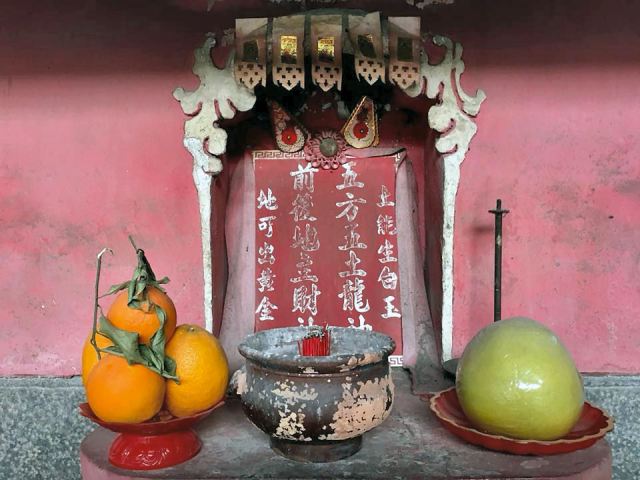
Dragon Gods of the Earth 土地龍神

Image Source: 香港古蹟行腳

Dragon god(s) (土地龍神, tǔ dì lóong shén ) are personifications of the land, where mountains and rivers meet, and thus from a feng shui perspective, reveal dragon veins (龍脈, lóong mài).

Rituals (such as 化胎, Huàtāi; in Hakka, it’s pronounced Fā Tói) can be performed to harness the qi or powerful essence from these dragon veins to bless a home and bless lands that the Hakka now occupy to ensure good harvests, prosperity, safety, protection, and good health.

What’s distinct about Hakka dragon spirits veneration is its association with the earth rather than water. Traditionally in Chinese lore, dragon spirits/gods 龍神 and the Dragon King 龍王 are associated with the temperaments of the seas.

Continue reading “Dragon Gods, Land Spirits; the Hakka”

Your Inner Palace 元辰宮 and the Akashic Records

This blog post is an addendum and continuation after what I discuss in the video linked above.

The Akashic Records is very much a Western conception, right? The Theosophists of the 19th century formulated a mash-up of Eastern and Western esoteric traditions and from that mash-up came its most popular legacy– the Akashic Records.

Most of us get that the “Akashic” part was inspired by the akasha, a fifth element or essence found in various Asian traditions, associated with the sky, space, aether, and in Buddhism, even a state of mind. But what about the “Records” part?

But first, I’d like to start with the discussion on akasha and godhead.

Continue reading “Your Inner Palace 元辰宮 and the Akashic Records”

The Esoteric Buddhism of Japan Oracle Cards (Yuzui Kotaki and Miki Okuda)

The Esoteric Buddhism of Japan Oracle Cards is so beautiful, so awe-inspiring that I treat it as I would a sutra — all the Buddhist etiquette applied to sacred texts I apply to how I handle this deck.

Acharya Yuzui Kotaki is a Shingon Buddhist teacher and a vice-chief priest of the Maginosan Ren-join Temple in Kanagawa, Japan. Miki Okuda is a painter, both in traditional and digital media who specializes in Buddhist religious art. The deck was first released in 2021, and I don’t know how it flew so under the radar in the tarot community.

Continue reading “The Esoteric Buddhism of Japan Oracle Cards (Yuzui Kotaki and Miki Okuda)”

Home is Here: Practicing Antiracism with the Engaged Eightfold Path by Rev. Liên Shutt

Rev. Liên Shutt is a Sōtō Zen Buddhist priest, educator, and licensed social worker who was born into the Pure Land traditions in Vietnam, then did their meditation training in North American Zen and Insight (Vipassana) Buddhism.

A co-founder of Buddhists of Color and Access to Zen, Rev. Shutt facilitates the Engaged Four Noble Truths program, a restorative framework for meeting any given critical need, especially when applied to oppressive forces and systems. In 2020, that program was called upon to help meet critical needs emerging as a result of the pandemic, and after the murder of George Floyd, to help facilitate ways Buddhist practice can address racial justice.

“This book is for all who have been hurt and harmed by the system of white supremacy and other systemic wrongs,” writes Shutt, “and for those seeking restoration and healing.”

Continue reading “Home is Here: Practicing Antiracism with the Engaged Eightfold Path by Rev. Liên Shutt”

Nine Years on TarotTube/Pagan YouTube

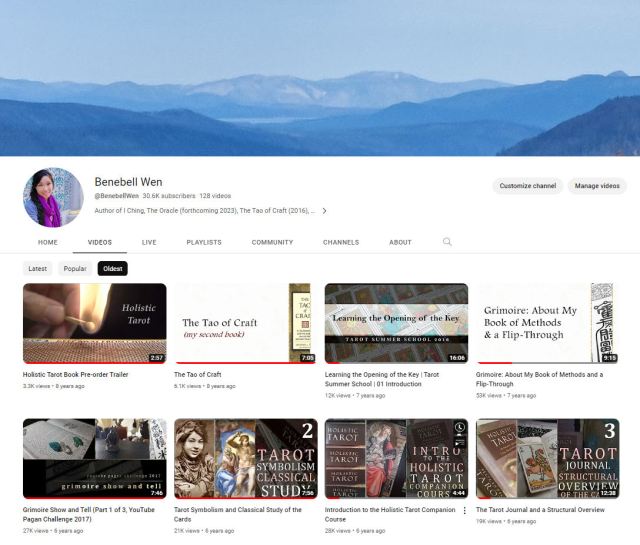
Fun fact: That blue-toned banner of mountains was taken in Miaoli, Taiwan, from my ancestral lands. ❤

The very first video I posted to YouTube was in October, 2014. It’s been 9 years. And I thought I’d take a pause from regularly scheduled programming to reflect on those 9 years.

To do so, I’m combining several TarotTube or Pagan Youtube (Occult Tube?) community tags on the subject. If you loiter in any of those networks then you may have seen some. I’m going to do my response as a blog post. And I think that in and of itself probably says something.

Continue reading “Nine Years on TarotTube/Pagan YouTube”

Descent into the Underworld: Guan Luo Yin, a Wu shamanistic practice

Guan Luo Yin 觀落陰 is a practice of wu shamanism 巫術 found primarily in the South Pacific. While methodologies will differ, one approach is as an astral journey to the underworld to see the spirits of those who have passed on; another is as a method of “remote viewing.”

Some traditions conceptualize the descent as beginning from the entrance to a cave at the base of a mountain (associated with the Kunlun Mountain). Others conceptualize it as a palace with many floors descending (as opposed to ascending the way floors of a building are constructed in the physical earthly world).

This video serves as an introduction to the practice.

See also:

Refuge in the Storm: Buddhist Voices in Crisis Care (ed. Nathan Jishin Michon)

Refuge in the Storm is a collection of 24 essays by Buddhist chaplains, spiritual leaders, psychotherapists, medical providers, and scholars who share their perspectives on crisis counseling, be that personal or global crisis.

We begin with a poem by Mushim Ikeda, “Five Irises for Mary Oliver.” One line in particular might resonate with you:

We aren’t always reduced to our entangled thoughts, our anguish.

Praying with my friend this morning, he said Thank you, he asked Help– we bow down and rise up.

Crisis is a disruptive event or relationship. A disaster, per the definition published by the American Red Cross, is “an event of such destructive magnitude and force as to dislocate, injure, or kill people, separate family members, and damage or destroy homes.” Disasters produce a ripple effect– the numbers of people affected on a fundamentally spiritual level is far greater than the number of people killed or injured.

When faced with crisis or disaster, how do we lean in to Buddhist tenets to help us emerge from it?

Continue reading “Refuge in the Storm: Buddhist Voices in Crisis Care (ed. Nathan Jishin Michon)”

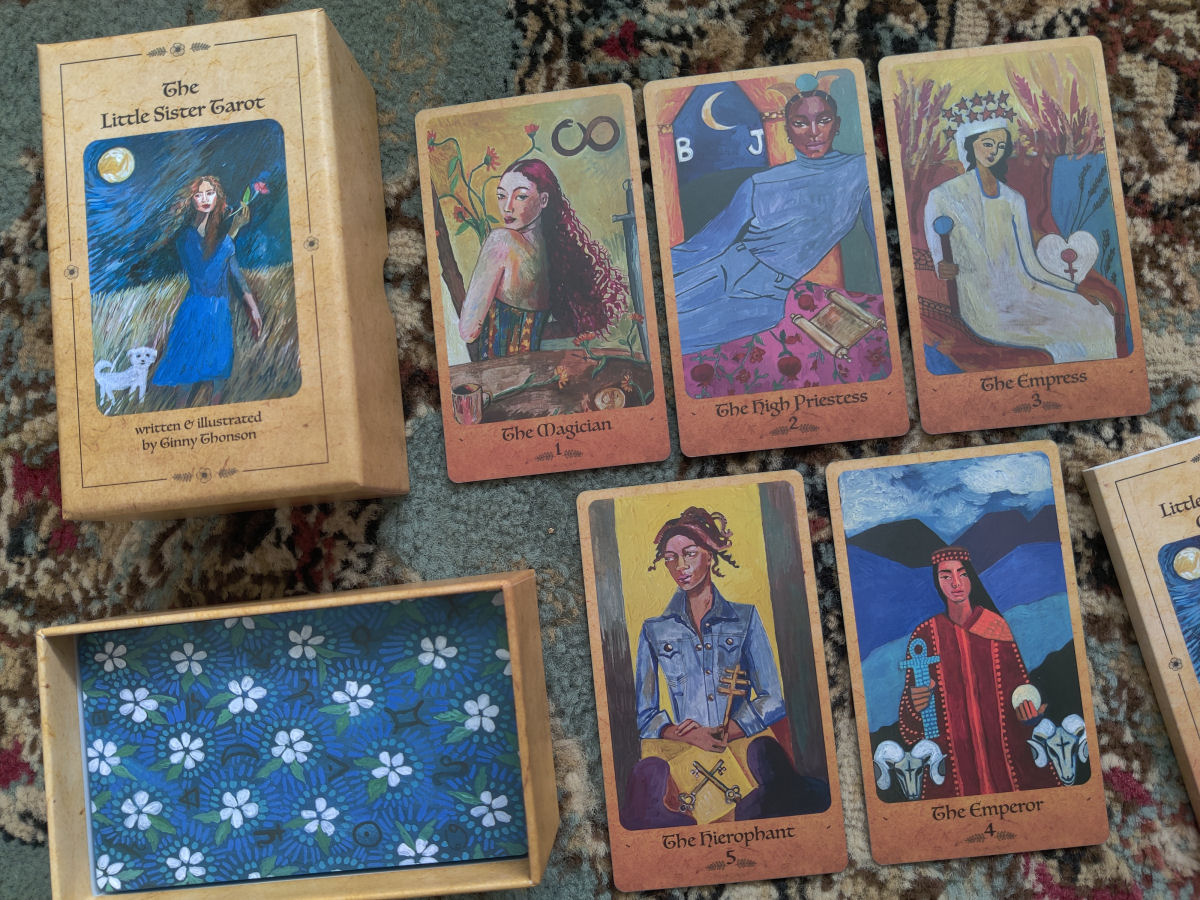
The Little Sister Tarot by Ginny Thonson

The Little Sister Tarot is a tribute to the cycle of life, what we gain from that cycle, and the heartbreak of loss. It is a deck about rebirth, illustrated by an artist who descends from a legacy of artists and art professors, and paints from the rugged north coast of California.

Ginny Thonson is a little sister. She lost her big brother to leukemia and later, her big sister to a tragic accident. Their spirits accompany her always, though, and so she perpetually embodies that role of the little sister.

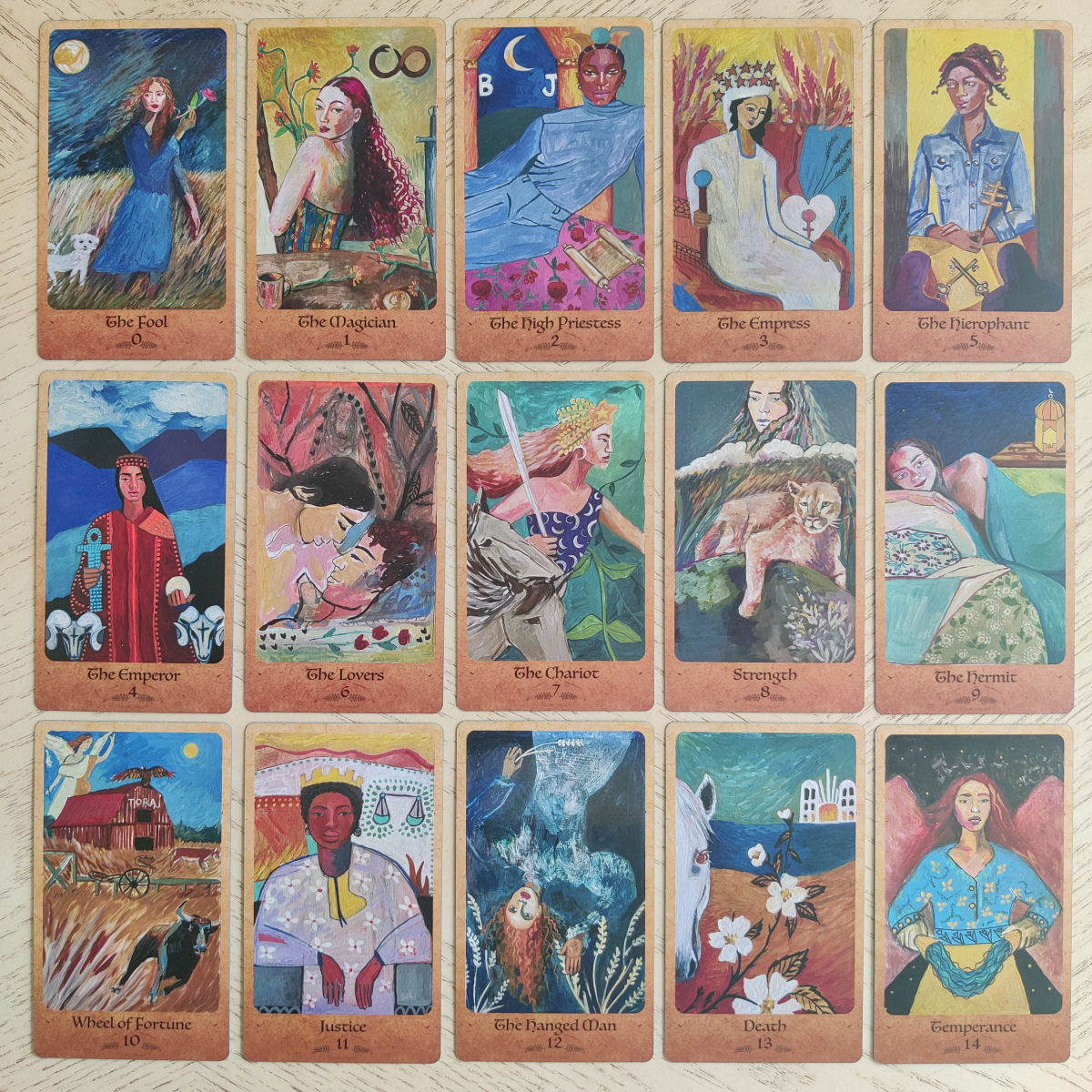
The RWS-based deck follows the narrative of Eden Gray’s The Fool’s Journey, though here The Fool is represented by the little sister. We follow her journey, documented through encounters with wise spirit guides and vignettes of her life experiences.

The Fool here is naive yet fearless in the face of the challenges that lie ahead in her journey. She is not motivated by materialism, but rather, is lifted by her innocence and playful nature.

Continue reading “The Little Sister Tarot by Ginny Thonson”

Lark and Legend’s Black Salt Lenormand and Pink Sugar Lenormand

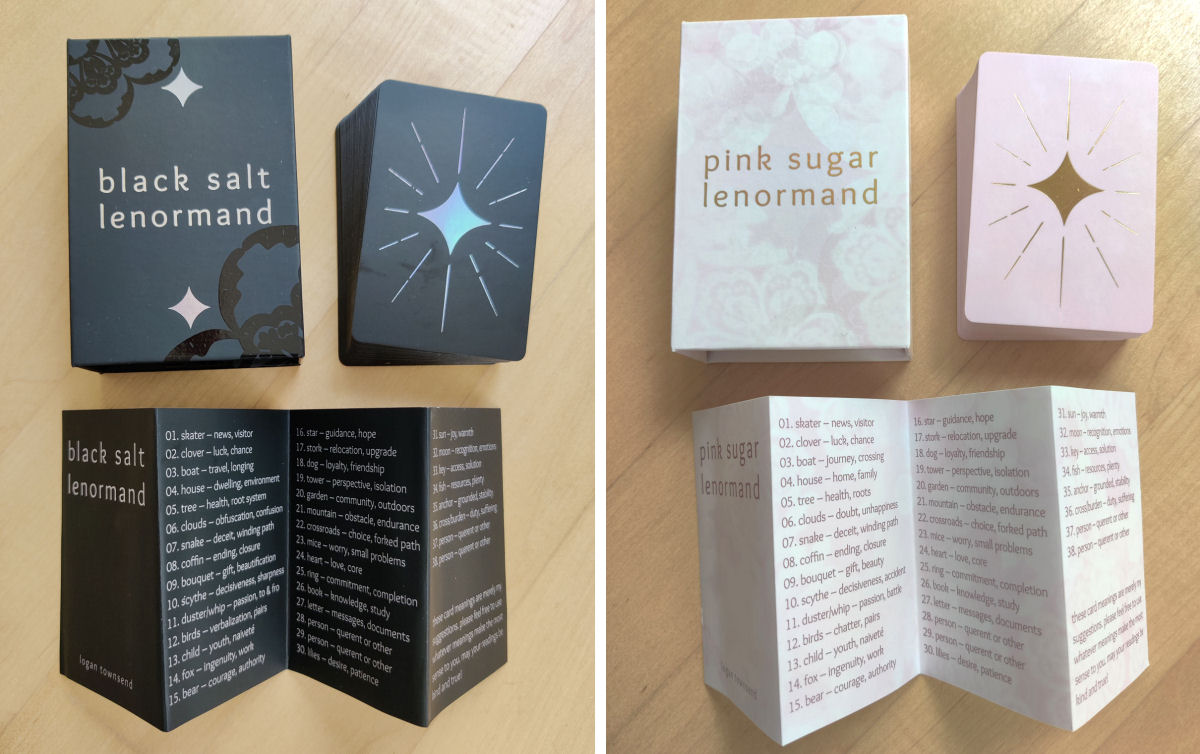
These are snapshots of two sibling Lenormand decks by Logan Townsend of Lark and Legend, who also has a fantastic TarotTube channel.

If you’d like to see a video walk-through of both decks side by side, check out this video by the creator.

The Black Salt Lenormand has the emblems printed in metallic silver while the Pink Sugar Lenormand has the emblems printed in metallic gold, though both have that rainbow holographic effect. Both come with a fold-out pamphlet of keywords for card meanings and a beautiful magnetic clasp keepsake box.

There is a nostalgia to this deck for 90s kids. I love that the first card is Skater instead of Rider, reminiscent of the skating rinks we’d hang out at in junior high and high school.

Now let’s take a look at each deck.

Continue reading “Lark and Legend’s Black Salt Lenormand and Pink Sugar Lenormand”