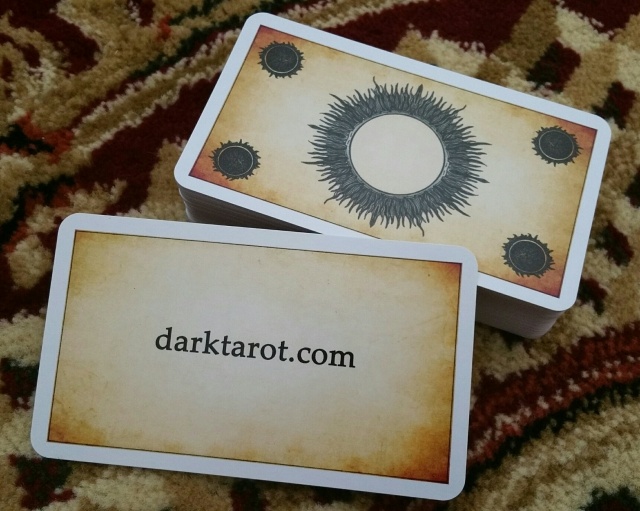
The Dark Tarot is a Tarot de Marseille based deck designed by M. over at darktarot.com. I say “M.” because I don’t know whether this person wants to be identified, so there we go. I’ve been working with this deck for a few months now and just love it.
M. reached out and gifted me with this deck and not for any promotional purposes either. This deck isn’t for sale. In fact, digital files to the cards are available for free download at darktarot.com and you can use those files to print out your own copy of the deck. Free! Yet M. gifted me with a hard copy of the deck just because. And I am so glad to have become acquainted with this TdM deck!
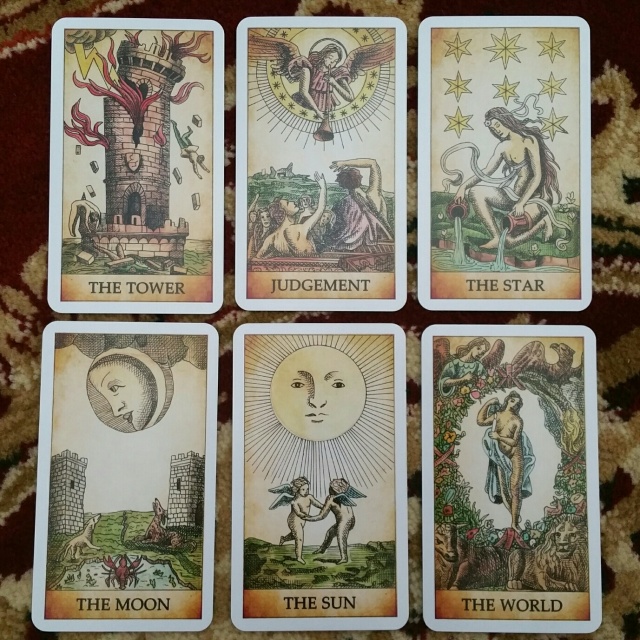
Above, just look at the beautiful imagery in the Majors.
I don’t know a lot about the deck so I’m not able to give a lot of information, but I can tell you it reads beautifully. It’s a piecemeal of several public domain TdM-based decks. I’ve been working with the deck in client readings, for my Learning the Opening of the Key master class over at Tarot Summer School, and for those who follow me on Instagram, posting tons of lovely photos of the deck over there. Also, stay tuned to the end of this post for details on a giveaway. M. and I are giving away a free copy of this deck.
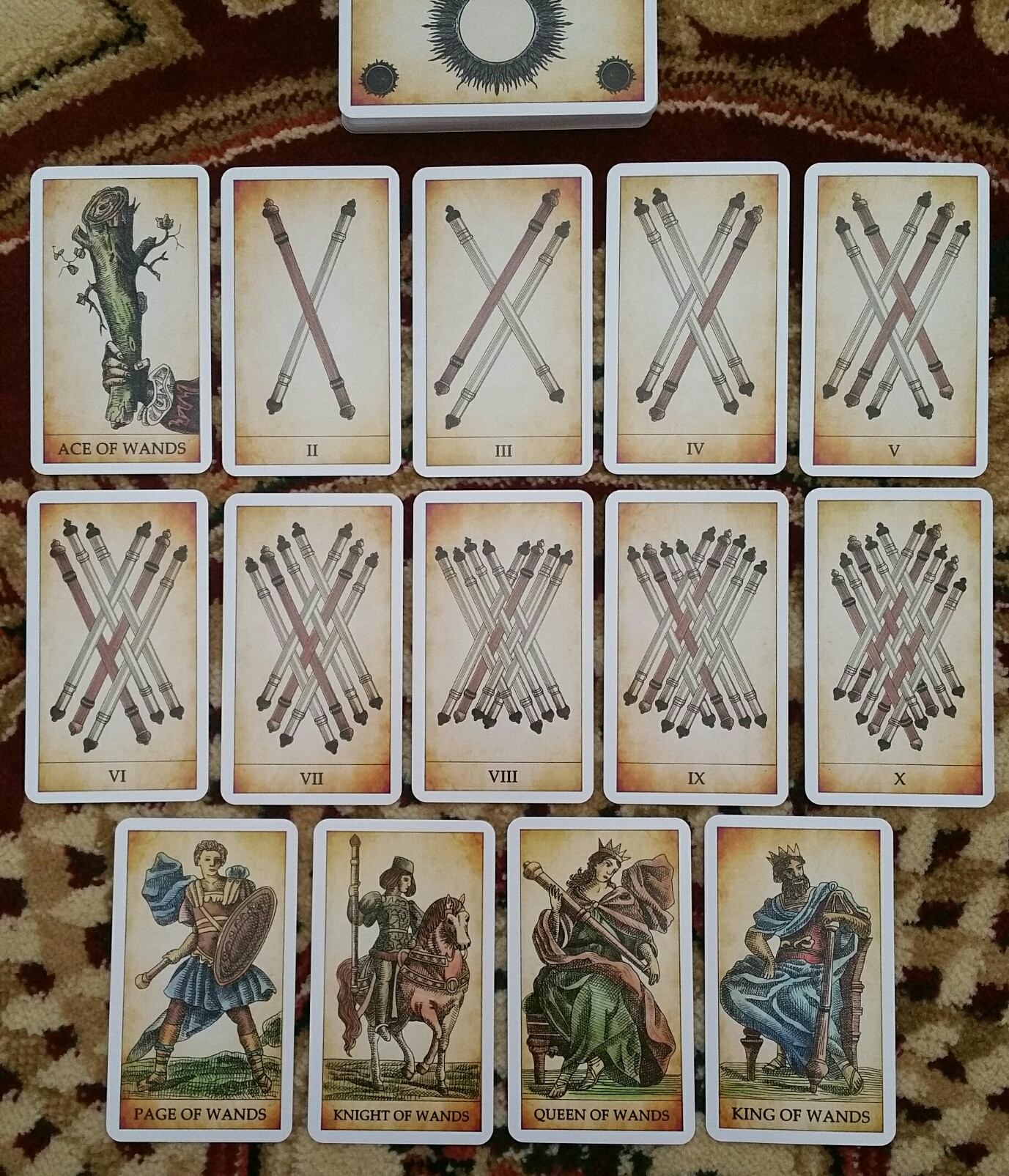
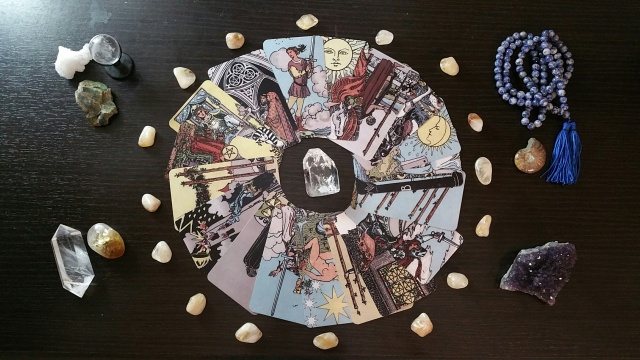
These cards look absolutely beautiful in a spread, and if you’ve been wanting to learn to read the Tarot de Marseille, the Dark Tarot is an ideal deck to learn on. In some of the Marseille decks, the suit of Wands and the suit of Swords can look alike and get confusing for novices. Not here.
There are white borders here but it’s easy to trim this deck if you so choose to. I love the faux antiqued look here and this will easily be a beloved deck by any Marseille (TdM) reader.
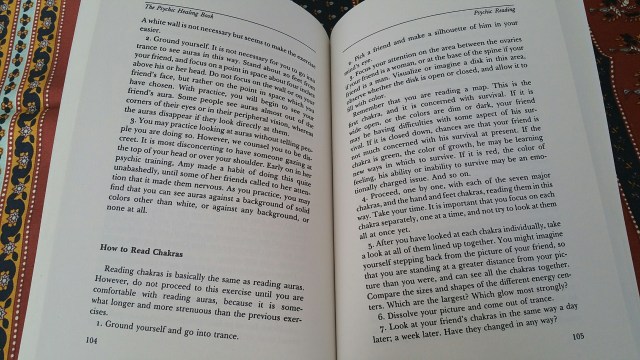
The Psychic Healing Book by Amy Wallace and Bill Henkin has been around since the late 70s, with several updated editions released over the decades. This one is the 25th anniversary updated version. Psychic is a cult classic. It’s one of those oft-cited New Age books you hear a lot about. So it was high time I read it for myself.
First, a few interesting updates in this 25th anniversary edition. Wallace explicitly notes that she wishes she could rewrite the book and not mention spirit guides. “[I]f I could do it differently today I would rewrite or delete entirely the chapters pertaining to the use of spirit guides. I have come to believe that spiritism leads to many mishaps and disappointments, and I would prefer not to even dabble in it.”
She also talks about ch’i kung (or qigong) and chakras, and how qigong should be used to strengthen the lower chakras before a practitioner tries to work with the sixth and seventh (or third eye and crown) chakras.
Henkin also offers fascinating new information. “When we use our psychic abilities we enter the same hallowed grounds of the mind or soul that give rise to creativity and psychosis.” I love that line. It’s worth reading over a few times.
Psychic is an easy to read 208-page classic on developing psychic ability. It’s a practical how-to guide formulated after the teachings of Wallace as she learned them from her psychic teachers. Much of it, I found, is in direct line with the spiritual pedagogy of the Berkeley Psychic Institute, a school for psychic development that’s been around since the 70s, on a street in downtown Berkeley I frequently walk on.
A lot of ground is covered in this book, though the authors skate across the surface of these subjects. Animism, Spiritism, the chakra system, the astral body, color healing, auras and reading auras, karma, dream interpretation, contacting spirit guides, ESP, and future telling are all covered, albeit in a few succinct paragraphs per topic. The book is therefore a starting point, not a treatise.
Psychic also covers practical training for developing psychic healing abilities. Whether they work or not, I’m not sure since I can’t report on any successful personal results, but I will say it’s comprehensive in its articulation of how to train yourself in the ways of psychic healing. Specific exercises are provided, visionary techniques, and personal success stories provided by the author on how these exercises and techniques will hone your psychic healing abilities.
For me, it was a fascinating read and I believe one must be open-minded to many perspectives of the woo.
In the spirit of learning many perspectives, The Psychic Healing Book is an incredible read and worth investing in for your personal library.
If you’re intrigued about a course like Psychic Ability 101, then get this book. It’s practical, full of exercises and training techniques, covers a lot of ground and inspires further reading of the individual topics covered, and most importantly, is written in accessible plain English. Wallace and Henkin also offer fascinating personal accounts and stories of psychic work at play.
I’ve heard of this book many times over before finally getting a copy and reading it for myself. Funny enough, I didn’t know it was published by my publisher, North Atlantic Books. The Psychic Healing Book is considered a New Age cult classic and even when you flip through the pages of the book, the aesthetics and design of it is reminiscent of books from the 70s and 80s. If you count yourself a psychic or are interested in honing your inner psychic, then get this book. It’ll easily become one of your favorite go-to resources.
FTC Disclosure: In accordance with Title 16 of the U.S. Code of Federal Regulations Part 255, “Guides Concerning Use of Endorsements and Testimonials in Advertising,” I received The Psychic Healing Book from North Atlantic Books for prospective review. Everything I’ve said here is sincere and accurately reflects my opinion of the book.
Originally offered at the Tarot Readers Academy in 2016 for the Tarot Summer School
Course Description:
This is a FREE ONLINE video-led course taught through concise installments that endeavor to de-mystify the Opening of the Key (OOTK) divinatory technique as detailed by Paul Foster Case, MacGregor Mathers, and Aleister Crowley, augmented with commentary from contemporary masters like Chic & Tabatha Cicero and Paul Hughes-Barlow.
Much like how the Celtic Cross spread has become a golden standard, we will learn how to integrate the OOTK into personal practice. Along with deconstructing the five operations of the OOTK, we will learn about elemental dignities, Kabbalistic basics, traditional card counting, Western astrology basics, and what all of these studies combined with tarot divination can teach us about the cornerstone principle in Western occultism–“as above, so below.”
It’s no secret that I’m one of Christine Payne-Towler’s biggest fans and the Tarot of the Holy Light (THL) is my personal reading deck. While I may not reach for the THL for readings I do for others (though those who’ve gotten readings from me know that from time to time, I do), it’s almost always the first deck I reach for when reading for myself. So naturally, I eagerly awaited both Volume 1 and Volume 2 of the companion texts that go along with the THL.
I reviewed the THL deck here (first edition of it) and Volume I of the companion text, Tarot of the Holy Light: A Continental Esoteric Tarot here. This will be my review and overview of Volume II, Foundations of the Esoteric Traditions, pictured above alongside the newest version of the THL deck, which I also have. Wherever you all seem to think my smartness is, multiply that by one thousand and that’s Christine Payne-Towler.
Foundations begins by explaining why the THL focus is on Jacob Boehme, a seventeenth century occultist. Boehme’s works are said to have heavily influenced later Rosicrucians, Freemasons, and Martinists, and then the early esoteric tarot deck by Etteilla. While Volume I was a study of each individual card from the THL, Volume II takes us back to the source theoretical principles behind the THL. What was the purpose behind conception of the THL deck? What are the foundational gnostic premises that the deck is built upon? In fact, what are the foundational gnostic premises that all esoteric tarot decks to come are built upon? These are the questions Volume II explore.
Volume II provides interdisciplinary instruction on various esoteric theoretical models from Western mystery traditions and ultimately synthesizes it with the continental tarot deck. This is the kind of book you sit at a desk to read, because you have pen and paper ready for notetaking.
Since I am not well-learned in Western mystery traditions or the Kabbalah, this was slow reading for me, but wholly enjoyable slow reading. I loved how Payne-Towler compels me to explore the Kabbalah further. Alchemy and esoteric astrology are also explored in detail and depth.
If you work with the THL deck, then you must have this book. If you don’t work with the THL deck but possess an active interest in Western esotericism, then get this book with or without the deck, because there’s so much in here that will enrich your own metaphysical studies.
Payne-Towler does enter with a distinct religious point of view and I don’t think the THL books are intended to be strict, objective scholarly research. There’s a great deal of scholarly research in here, but pulled in such a way to support a very clear religious thesis. For me, I don’t mind that at all, but it’s worth noting nonetheless.
Anyone with occult leanings who want to study the Western mystery traditions should have a copy of this book in their personal library. This is just one of those incredible, rich texts that I cherish having access to.
Foundations of the Esoteric Traditions is 260 pages of Western theosophic exploration keyed to the incredible THL tarot deck, though it’s not an operation manual the way Volume I was. Here, Volume II is a treatise that explores the roots, foundation, and backstory of the mystery traditions that the deck and, beyond the THL deck, esoteric tarot in general is founded upon. Foundations will deepen your pool of knowledge. In many ways, this book is about teaching you how to think, and how to process information found on a tarot deck through the filters of Western occult history.
Volume I and Volume II are both self-published and can be ordered at Christine Payne-Towler’s site, Tarot University. Also be sure to check out the new version of the THL deck. I have both. To be honest I prefer the earlier version, but the new version is more functional. It’s easier to shuffle, easier to transport around with you, and all around more practical as a user-friendly deck. The earlier deck is more of a collector’s item and for someone with my size hands, forces slow shuffle and meditation. With the new deck, I can shuffle faster. Anyway, go check out Tarot University.
The Hezicos Tarot by Mary Griffin is a self-published Rider-Waite-Smith based deck that blends a multicultural point of view with fairytale fantasy. It is a versatile, readable, and easily accessible tarot deck for novices, beautiful imagery that is fit for professional readers, and artwork that will tempt any tarot deck collector.
My favorite artistic style for tarot decks is unembellished hand-rendered line art, and that’s exactly what we have here. The Hezicos Tarot is done in watercolor and ink. There is a contemporary style to Griffin’s art. The imagery here leans feminine, storybook, with a fable and fantasy tone that works really well with a modern tarot deck.
Photograph that is unrelated to the topic at hand but posting here for the visual effect notwithstanding because your eyeballs need there to be a photo here and I couldn’t source one that would be related.
First off, naturally I will be speaking in generalizations.
People my age are sandwiched somewhere in between the Old Guard and the Millennial Readers.
Although my mother is not a tarot reader, she’s a metaphysical reader/practitioner of sorts and I’m super sure that had tarot been accessible to her as a young one, she would have totally become a tarot reader. Instead, she reads other stuff. Like your face. No, I kid, but oh no, I don’t. She really does.
I can see her attitude reflected in many of the Old Guard tarot readers. “I’m not normal. Tarot is not normal. Damn straight this is fringe. Deal with it.”
There’s an unabashed embrace of marginalized culture. There’s no embarrassment with dressing woo-woo as you walk among normal society. You can almost see traces of a hedge witch mentality.
Although she has never come outright to say so, I get the distinct sense that she doesn’t want everyone and the mainstream to become diviners, mediums, shamans, and practitioners of craft. There is a tacit yet clear exclusionary attitude. Or at least that’s always been the impression I got. She doesn’t want (let alone buy in to the ideas of) Mediumship 101, “everybody’s psychic,” or “pay me $300 and I will certify you as a bona fide tarot master.” (Hi. Certified tarot master here.)
Meanwhile millennial readers apply general business and marketing tactics to tarot–e.g., general PR and marketing principles to tarot business, coaching anyone and everyone to become diviners, mediums, shamans, and practitioners of craft, if you so choose. There are efforts to establish tarot into mainstream culture.
There is a pop psychology approach to tarot (which I have been pegged and critiqued as adopting, so apparently I’m in this camp) that strives to normalize divination practices or astrology, and to talk about spell-crafting as the law of attraction and “yay for positive thinking.”
However, at the heart of the millennial approach is the notion of accessibility, a socialist attitude toward the metaphysics. We can all have equal access to the Divine, to metaphysical energy work. (I confess, that is the attitude I adopt. That line sums up my opinion.) Metaphysics is for everyone. This is not paranormal, it’s normal. You don’t need anybody else to help you connect to the Divine. You only need you.
Okay, so as circumstances would have it, I’m now only a couple paragraphs in and I’ve already changed my mind.
Maybe I haven’t changed my mind exactly, but it is for sure vacillating. Is it really a generational thing? Or is it just a two-different-schools-of-thought thing? Is my personal anecdotal evidence and direct observations even reliable?
I’m in effect just looking around me, only to the point I am able to physically see, and making gross generalizations about what else is out there based on only what I see. Is what I happen to see an accurate microcosmic sampling of the macro? I don’t know. I really don’t.
However, there is for sure a determined voice among the occultists and metaphysicians who say that “occult” means concealed, and we are not to remove the veil for all. Only those who choose the path should or even can go beyond that veil to see for themselves what is there, and then come back with divinatory or revelatory information as needed, like an appointed messenger.
Is that way of thinking a bit reminiscent of limiting literacy to the elite so that the proletariat must rely on figures of authority (like a priest or priestess) for Divine insights? That was the way of institutionalized Western religion for ages. Is it hypocritical when metaphysicians repudiate that kind of authoritarian approach to religion, pursue occultism because they’re anti-authoritarian and want the answers for themselves, but then once they’ve found those answers, act in the same exclusionary manner?
I’ve observed that the Old Guard, Mom inclusive, have this sense that what they do “isn’t for everyone.” She would probably opine that not anyone can just pick up a grimoire, follow something in there, and yield results. Only certain people can do that. As I said, there’s a staunch exclusionary attitude. I’m also sure if I introduced her to the 21st century spiritual coaching power of manifestation business model, she’d find it absurd.
Actually, she wouldn’t. She’s pretty open-minded. She’d be surprised at first, but then come around. “Okay, all right, I get it. I wouldn’t have thought of that but I get it.” For instance, it might take her some time to grasp the idea that, say, I’m holding an online webinar course on Learning the Opening of the Key for Tarot Summer School and teaching occult theories to a whole bunch of people I’ve never even met, all at once. Perhaps in her view, spirituality, divination, and woo-based teaching is done one pupil at a time, a single teacher to pupil relationship that is honed over several years, not in 60 minutes.
Whereas maybe I do have a more “free love” attitude here. We’re entering a social era where notions once reserved in the New Age or even occult category run as an undercurrent through mainstream society. Corporate offices pay for yoga classes and meditation retreats for their employees. Businesses far from the woo will consider feng shui tips and tricks. Law firms invite in tarot and palm readers for their company Christmas party. Silicon Valley high-tech companies will hire a witch to cast a circle of protection around their computers, protecting them from hackers. All true stories here. I doubt any of this would have happened even 20 years ago. Things are changing.
As woo practitioners such as tarot readers converge more with the corporate and mainstream worlds, they adopt corporate and mainstream commercial strategies to advance their tarot business. Corporate and mainstream businesses converge more with woo practitioners and adopt woo into their environments because hey, “anything to help us earn more money. If that’s a spell or feng shui, then let’s do it.”
So admittedly, there was no point or core thesis to this post. I just thought I’d ramble on some thoughts of late.
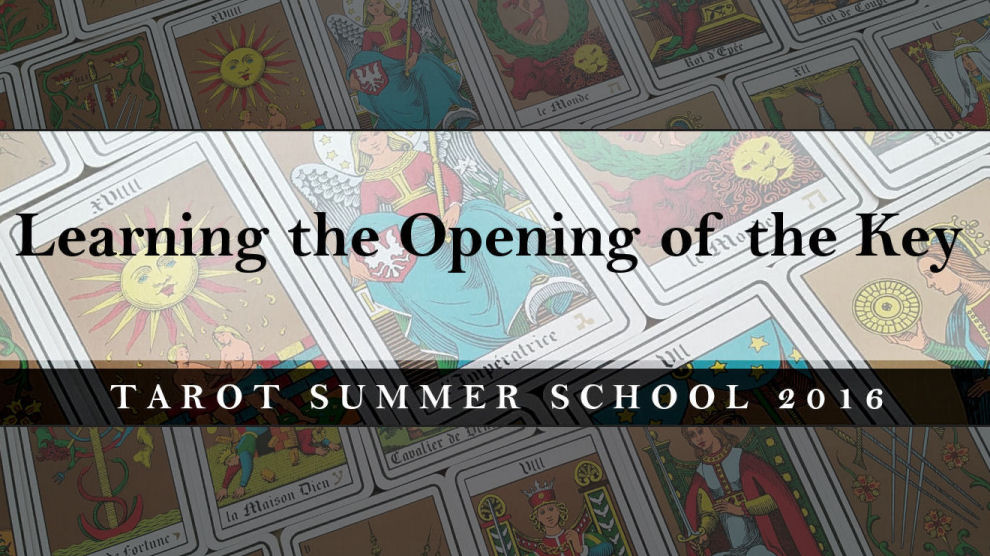
Whether you’re a tarot beginner (in which case may I suggest you check out “Introduction to Intuitive Tarot,” “Tarot and Pop Culture,” or “Unlocking the Major Arcana through Yoga”), proficient with tarot but looking to take your practice to the next level (ooh–check out my class on “Learning the Opening of the Key” *tooting my own horn*) or you’re aspiring to become a professional tarot reader (check out “Party Readings for Tarot Professionals” or “Tarot, from Hobby to Profession”), the first ever Tarot Summer School is a magnificent trove of tarot studies. A complete list of all course offerings is here, via this link. I’ll be a student, just like you, sitting in on all the courses. So many of them are getting me super excited!
There will also be campfire Q&A sessions where all enrolled students can come together (over the Internet; I don’t know how it works; it’s magic; you’ll have to ask headmistress Ethony) and I will try very hard to make it to one of those campfire sessions so if you want to chat with me, ask me your tarot questions, or whatever, you’ll want to enroll and gain access to the campfire Q&A.
Check out the below link to read all the course listings, meet the faculty, and watch everybody’s course introduction videos. It’s a really diverse group of tarot personalities.
And to give prospective students a free preview of my course, “Learning the Opening of the Key,” I’ve uploaded and made available the first video installment of the lecture series, the Introduction. Check it out:
If that sneak peek into my full course piqued your interest, then enroll today! It’s only $24 USD per course. Or get the lifetime access season’s pass for $199, which gets you all the courses this semester.
And if I did not manage to pique your interest, then… *shrug* doh. I did my best.
But do check out everybody else’s course offerings even if mine isn’t your cup of tea. I know at least one of those master classes is making you go “ooh!!” Embrace that “ooh!!” and your woo, and we the instructors at Tarot Readers Academy will see you at Tarot School this summer.
Module 3 accompanies you from drafting your book proposal to querying traditional publishers. We’ll cover the big publishing houses (and how you’ll need a literary agent if you want to approach these publishers) and also the small to medium publishers (where you won’t need a literary agent).
There will be 5 audio lectures (total run time about 40 minutes), 3 workbooks, and supplementary handouts that you will want to go through in the order noted below.
Modules I and II are being posted consecutively this week working toward the new moon in Taurus so that maybe everything will be aligned just so and this weekend you’ll be motivated to get to work on that book you’ve always meant to write.
Do not proceed with Module II until you’ve completed the audio lectures and workbooks from Module I. I mean, you can if you want, it’s not like I can stop you, but it won’t make sense. Module II will make more sense if you’ve completed Module I.
Module I: Introduction
Refer back to the post on Module I here. You can also download all files for Module I via Dropbox by clicking below.
Assuming you’ve completed Module I, you now have a solid book idea, you know how and where it would be positioned in the current market, and you are prepared to finish your book manuscript.
Module II will offer some insights and guidance for completing your manuscript.
Module II: Completing Your Manuscript
Module 2 helps you grow your seed of a book idea and walks you through the process of nurturing that seed to full bloom, achieving a completed book manuscript. Let me tell you how I managed to stay on track and finish my books while working full-time and tending to family responsibilities. Let’s talk about the daily grind. How do you structure the chapters of your book? How do you schedule your weeks to make sure you get your target writing done? What are some of my personal tips and tricks? The handouts in this module will help you to track your progress. Also, how can you tell if a work is in the public domain? What exactly constitutes fair use? I’ve got handouts for both questions.
There will be four audio lectures (for a total of about 35 minutes play time), two workbooks for you to complete, and supplementary handouts that you will want to go through in the order noted below.
I’m putting together a multi-media web series on writing and publishing nonfiction, placing emphasis on nonfiction in the spirituality and New Age category. I was going to wait until I finished the entire course, all proposed modules, but then I was like F it. Let’s just play this by ear. Throw the spaghetti against the wall and see what sticks.
As each new installment is published here, I’ll link everything together so no matter when you stumble upon these posts, you can trace back to the beginning and follow the steps in consecutive order. All installments will be tagged with the “book writing” category, so you can simply click on that category label and every installment will pop up.
This independent study course will consist of a bunch of downloads, some free and some not so free, pretty much depending on my mood that day that I’m putting the installment together and posting it. There may be some jumping around, however. So for instance, the next installment I have scheduled is out of the order of modules and instead, is a single workbook on publishing contracts. Then we’ll get back to the modules, for Module II.
All right. Why don’t you read on to see what this is all about.










 benebell wen