Am I Creating a Fluffy Tarot Deck?

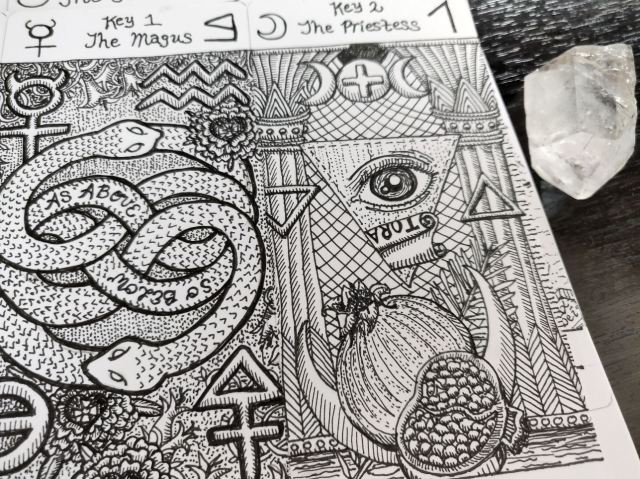
Ongoing working draft of the cards.

Nevermind that the premise of the Major Arcana for Spirit Keeper’s Tarot is to connect you to your Holy Guardian Angel, and therefore by definition is an angel tarot deck, which we all know occultists immediately giggle at, but now as I study how some of the imagery for the cards are coming along, I can’t help but giggle to myself and confess: oh man, I’m creating a fluffy tarot deck.

Maybe I can defend such an accusation by saying it’s not fluffy, it’s just a strong statement in favor of self-empowerment and an expression of religious faith. (But isn’t that what all designers of fluffy decks say? Crap.) Take The Tower, for instance. More commonly, the focus here is on a punishing Act of God, or having to tear down what you’ve so meticulously and painstakingly built, because you’ve built it wrong. There’s typically a forceful sense of calamity when you consider The Tower.

Yet here I’ve added a talisman to The Tower: I’ve given the Seeker an axe. There’s also blood dripping from the axe, suggesting that you’ve done this before; this isn’t your first time at the rodeo, so you know what you’re doing–you can do this. Also, if you consider the bigger picture here, we see that the serpent tail of the Demon is coiled around this tower, along with chains binding this tower to the Demon, so this destruction also destroys servitude to the Demon. There’s an element of liberation here.

Is that nice-washing The Tower card?

Continue reading “Am I Creating a Fluffy Tarot Deck?”

Drawing My Own Tarot Deck: Ruminations on the Court Cards

READ PREVIOUS POST IN THE SERIES

Rumination Notes:

Aces to Threes

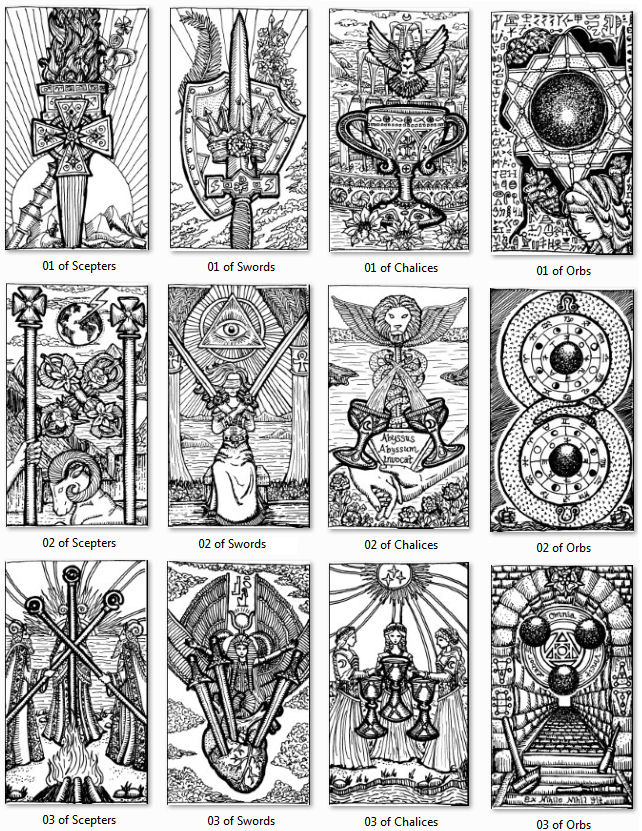
Drawing the cards in sets of three, actual card size. This is how I begin.

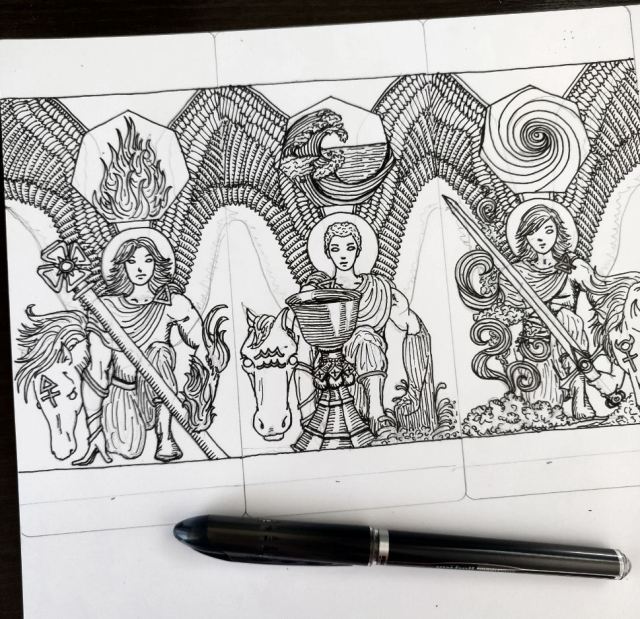
I’ve been struggling with how to depict the tarot courts since back when I was still doing the Majors. And the whole time, I’ve been reading, brainstorming, researching, thinking– though no drawing– how the heck am I going to do this, and do this with any semblance of justice.

The more texts I studied on angelic correspondences to the elements, directions, and/or astrology, the more confused I got. Do I go Golden Dawn since up to this point so much of my point of view with the deck has been GD-influenced, or do I follow the lead of religious scholars turned mystics who say some of the Golden Dawn attributions for the Kabbalah are anti-Semitic in their source origins? How do I reconcile Christian mysticism, Jewish mysticism, and Islamic mysticism when it comes to angels? How do I also do it all with resonant subtext to Chinese, Taoist, and Buddhist ideas of angelic(-like) realms?

Also, when deck creators want to incorporate multiculturalism, they typically follow– shit–what’s his face–I can’t think of the name without looking it up. I’ve got it in an end note citation in Holistic Tarot if you really care. Anyway, Eden Gray followed what’s-his-face and everybody after Eden Gray followed Eden Gray so we go with this whole notion of Wands medium-hair, fair-eyed, Cups light-hair, light-eyed (or those two swapped), Swords dark-hair, medium-eyed, and Pentacles dark-hair, dark-eyed, so we typically end up with Asian or Middle Eastern for Swords and then Middle Eastern, Native American, or African for Pentacles. I opted not to go that route.

Agrippa made note of correspondences between geography, directionality, and the four elements, though he kept it relatively vague. Crowley then gave his thoughts on geography, directionality, and the four elements. His directionality conflict with Agrippa’s, but the geography and four elements kind of lined up. Well, lined up close enough to work for me. So that’s what I went with instead of what has become the more popular and trending ethnic associations for the four courts.

And that was just the tip of the iceberg of daunting considerations for the courts.

Drawing angel wings on the knights assembly line style…

The more I thought into it, the more stressed and nervous I got. And I did not want to go the direction of “screw everything and everyone, I’m gonna follow my intuition and channel it from my own higher consciousness” or whatever it is people say when they don’t want to listen to precedent or read books. How do I honor precedent and still acknowledge my intuition?

The art style for the deck I opted for is in the spirit of Renaissance humanism, a time when Christian mysticism and paganism merged in eclectic ways and mystics of that time were far more cosmopolitan and worldly than we folks today give them credit for being. I think the louder establishment voices of that time in history for structured Catholicism and the Church came as a knee-jerk reaction of the establishment to the subversive undercurrent of diverse thoughts that were emerging at the time.

Click to enlarge for viewing.

Continue reading “Drawing My Own Tarot Deck: Ruminations on the Court Cards”

Drawing My Own Tarot Deck: Rumination Notes Aces to Threes

READ PREVIOUS POST IN THE SERIES

Rumination Notes:

Fours to Aces

Annnnd…. I’m done with the pips. Phew!

Let’s recap. On June 13 of this year, I got into my head this fantastical idea of drawing my own tarot deck. It was supposed to be a ha-ha fantasy but then I couldn’t shake the ha-ha fantasy out of my head, so immediately I got to work.

Continue reading “Drawing My Own Tarot Deck: Rumination Notes Aces to Threes”

Drawing My Own Tarot Deck: Rumination Notes Fours to Aces

READ PREVIOUS POST IN THE SERIES

Ritual Coloring of the

Major Arcana

I shared all my digital files for the Major Arcana from the tarot deck I’m currently drawing at the end of June, 2018 here: Spirit Keeper’s Tarot (Majors Only). Then went on to explain the purpose for ritual coloring of the Majors, among other thoughts, here in a subsequent video and blog post: Ritual Coloring of the Major Arcana, though there I share some draft images from the Minors as well. If you’re not subscribed to my Instagram, then you probably don’t know that I’ve been sharing progress photos of my work as I go along. In the event that interests you, subscribe here, IG: @bellwen.

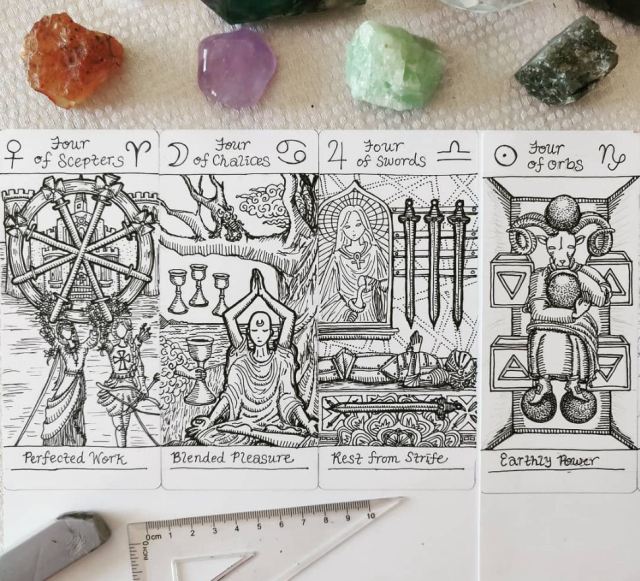
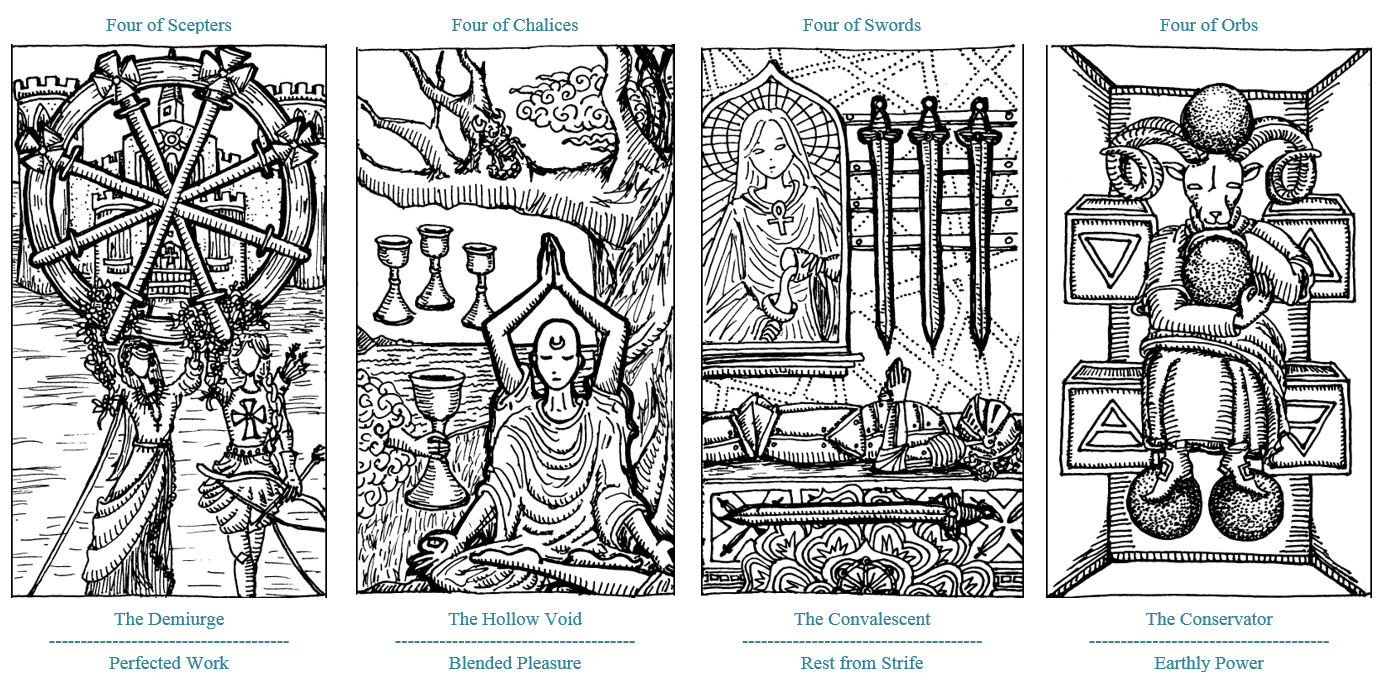
So as I explained in the last blog post on drawing my own deck, after completing the Majors and beginning on the Minors, I started with the Fours. And the suit order I’m going in for each number set is Wands, Cups, Swords, and Pentacles, which I’ve renamed to Scepters, Chalices, Swords, and Orbs. Lots of really specific reasons for the renaming. I definitely didn’t do it just for shits.

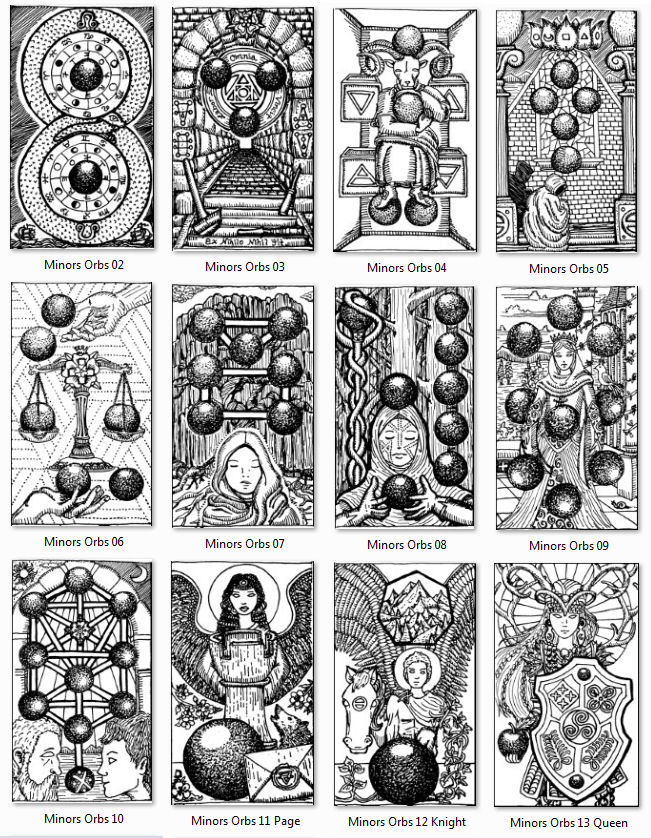
The above thumbnail snapshot does not show the cards in the order I completed them. Because of the digital filenames, when I take a screen shot of the file folder that the scans of these images are in, they’re in alphabetical order. Also, these screen shots don’t include the titles and captions.

Continue reading “Drawing My Own Tarot Deck: Rumination Notes Fours to Aces”

Ritual Coloring of the Major Arcana

I posted a video over the weekend in which I ramble in many different directions. It was supposed to be a video in which I introduce you to the black and white line drawings of the Major Arcana from the Spirit Keeper’s Tarot, which are now available for your free download. It was also supposed to be me making a case for undertaking a ritualized process of coloring in the black and white line drawings.

And instead, I went off on a tangent about God, the Devil, my lifelong love of art, and the role of religion in occult study. I do at a couple points keep to topic and mention the tarot deck and coloring in a tarot deck, but I’m afraid most of it is just a winding road of rambles.

Yes, you can tell I’ve cut and edited the clips because the original rambling was even longer, which all but turned into an unfiltered incoherent video diary of what I did for each Key. When I went to edit the video clips, I thought, yeah, I’m not going to post a one hour video, so I literally cut about half of the footage. Hence the noticeable heavy-handed cutting here. Don’t worry, I promise you, you’re not missing out: the cut ramblings were very boring.

If you haven’t already downloaded the Majors-only black and white line drawings (all umteen zip file folder versions of them…) and the companion guidebook (your operation manual), go here:

Download the Majors from the Spirit Keeper’s Tarot

Original pen and ink art on white heavyweight cardstock, 100 lb. cover (270 gsm) at 8.5″ x 11″, so I draw three cards per sheet.

I’m now at work on the Minors, but it’s going to take a lot longer to complete than what it took for the Majors, because I need to return my focus to other projects in the pipeline, both professional and personal.

For the Majors, I worked on them pretty much during every single millisecond of non-day-job-work time I had for sixteen days (new moon in Gemini to the full moon in Capricorn). I won’t be able to commit that full-force on the Minors, so the time allotted for the Minors will need to be distributed out more evenly and in a more balanced way with my regular schedule.

Like I did with the Majors, my process for the Minors is to first read Mathers, Papus, Waite, and Crowley, find the common denominator (not easy at all; really struggled with this), then factor in my point of view, philosophy of life, and how I’m sensing that common denominator energy in today’s collective unconscious, and then depicting that personalized and updated extrapolation, all while attempting to keep with that medieval grimoire woodblock print art style.

Continue reading “Ritual Coloring of the Major Arcana”

Spirit Within Tarot by Steven Bright

The Spirit Within Tarot by Steven Bright and published by Schiffer Publishing blends tarot with shadow gazing to produce a powerful cartomantic tool that reads into your inner sanctum. I love the modernity of this deck, the color symbolism that comes out strong, and the aesthetic value of the contrast.

The card trim size is not a typical or standard tarot size and feels more oracle to me. Every aspect of this deck’s presentation feels fresh, modern, and outfitted to attract popular appeal.

Steven Bright of Tiferet Tarot has been a fixture in the tarot community who I’ve always looked to for his deck reviews and his social media posts, Tarot Thoughts. I love that this deck, which has been many years in the making, has come to fruition and not only that, has exceeded all expectations. It’s unique, it’s innovative, and you can tell it was designed by an experienced master tarot reader.

Continue reading “Spirit Within Tarot by Steven Bright”

The Modern Spellcaster’s Tarot by Melanie Marquis and Scott Murphy

I learned a very important lesson from this deck: don’t knock it ’til you’ve tried it. The Modern Spellcaster’s Tarot was part of the free swag I got from Readers Studio 2018. When I first saw a few samples of the card images and read the back of the box, I shrugged and said to myself, “meh, not for me, pass.”

Wrong. I realized how wrong I was as soon as I unwrapped the deck and sifted through the cards.

Modern Spellcasters is that acquaintance you didn’t get a good first impression from because you’re an asshole set in your ways but then you actually take the time to have a couple of heart to heart chats and suddenly you realize holy crap, this is a kindred spirit and an amazing one at that.

Continue reading “The Modern Spellcaster’s Tarot by Melanie Marquis and Scott Murphy”

Tarot, Occultism, and Modern Witchcraft (Online Course)

Lecture + Practicum Series

$25 USD

Originally offered at the Tarot Readers Academy in 2018 for the Tarot Summer School.

This course is structured after a graduate-level seminar with a series of lectures plus guided tarot readings ritualized and crafted to show rather than tell you about tarot in witchcraft. We’ll mimic an oral tradition where you listen to me talk about the who, the what, and the why, alongside my perspectives on the how. You may want to take notes throughout the course, for both the lecture and training modules, so that beyond this course, you’ll have a consolidated reference file on occult tarot.

Continue reading “Tarot, Occultism, and Modern Witchcraft (Online Course)”

Quick Tutorial: YouTube Video Making Tips I’ve Learned

Previous Quick Tutorial Posts:

This is another post from my Quick Tutorial series for YouTubers and those who are looking to create video content.

It’s worth reiterating: I am not an expert (by any stretch of the imagination) when it comes to video production, I don’t own or use any fancy equipment and tech, I have no background in video production or photography, and actually, I think that’s kind of the point. The point here is to show you that yeah, you can do it, and you can do a halfway decent job at creating video content as a total amateur.

Instead of trying to collect all the latest gadgets that the YouTubers with million+ subscribers are telling you to get, work with what you’ve got. I hope that’s what this Quick Tutorial series is about: maxing out the capabilities of what you’ve got.

This post in particular will consolidate some tips and tricks I’ve learned about YouTube video making at the amateur level.

Record Your Videos During the Magic Hour

In photography, there’s this thing called the golden hour, or the magic hour. Fortunately, there are two each day. The first is the hour after sunrise, and the second is the hour before sunset.

I’m lucky because that conforms to my work schedule. The first golden hour is just before I leave for work, so actually, my makeup is freshly done. Most days I make it home before the second golden hour, just before sunset, so as soon as I’m back from the office, I go straight to recording the video.

If you don’t have lighting equipment, then I would urge you to try your best at scheduling video recording time during one of the golden hours. Afternoon sunlight can be too harsh, and after sunset, it’s often too dark. Cameras tend not to like artificial lighting, so then your videos get that grainy quality.

When you record during the golden hour, you can get away with a lesser-quality camera. I’m using a 1.3 megapixel webcam for both the video footage and the audio. For comparison, most professional YouTubers opt for a 50.6 megapixel resolution camera. These days, your smartphone camera is around 12 megapixels.

So yeah, given the drastic difference, the pixel quality of my current portfolio of YouTube videos is still shitty compared to what most people are shooting at these days, but it isn’t so offensive in quality as it could be (given the 1.3 megapixel resolution) because I’m shooting during the magic hour. Shooting at the magic hour compensates for that drastic resolution difference.

For me, I’ve also found that recording during the morning magic hour by an east-facing window is the best, and recording during the evening magic hour by a west-facing window is best.

Guys, if you can, follow the magic hour in photography. It truly is magical. You get that soft diffused light on your face and that perfect balance of light and shadow in the frame. You know those expensive ring lights that makeup and beauty gurus get? Yeah, the whole point of those things is to recreate the lighting of the Magic Hour. You get two for free each day, so if you don’t want to invest in a ring light, then try to schedule your recording time to the Magic Hours.

Continue reading “Quick Tutorial: YouTube Video Making Tips I’ve Learned”

Quick Tutorial: MovieMaker for YouTubers

Previously I shared a Quick Tutorial on using PowerPoint to create animated video footage with voiceover narration earlier, here. This Quick Tutorial is on Windows MovieMaker.

Basically, this Quick Tutorial series for newbie YouTubers like me demonstrates how to make video content on a shoestring budget, or no budget at all. The premise is to be as low-tech as possible, using what you probably have on hand already. It’s all about being smarter with what you have.

Before reading further, can we both acknowledge that I am not an expert, not sufficiently experienced or skilled to the level where I should be giving anybody advice, and have literally only been doing this for about a year. On the other hand, to make a case for myself, I think this makes the Quick Tutorial series all the more endearing. It’s me saying to you, hey look, I don’t know what the heck I’m doing but I still manage to get stuff up and running, so you can, too.

Note: MovieMaker was discontinued effective 2017 and replaced with something called Windows Story Remix. Since my computer and my set video-making ways pre-date 2017, I’m going to proceed with MovieMaker. Assuming at some point in the future I upgrade to Windows Story Remix, I’ll make a Quick Tutorial for that then.

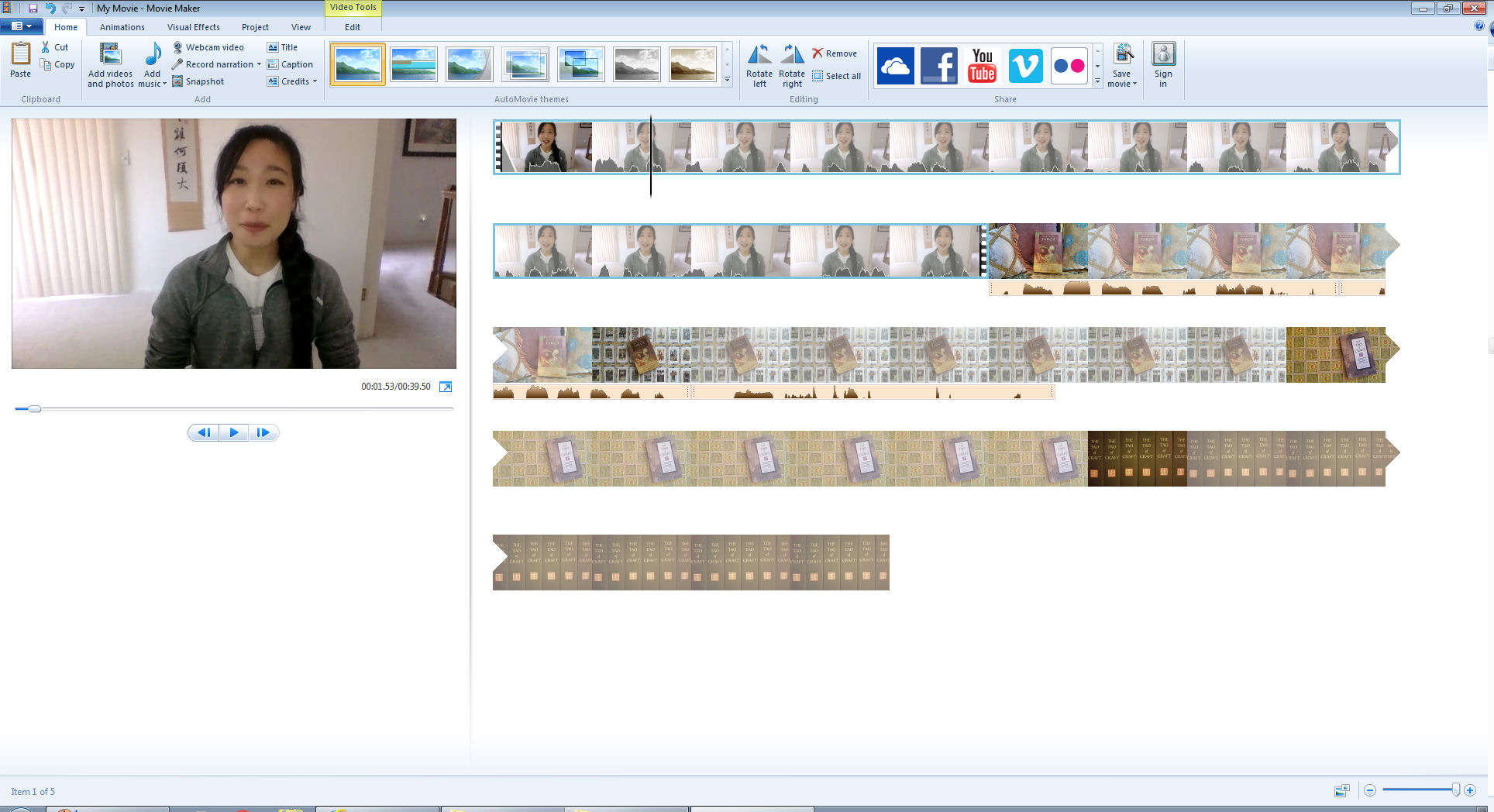
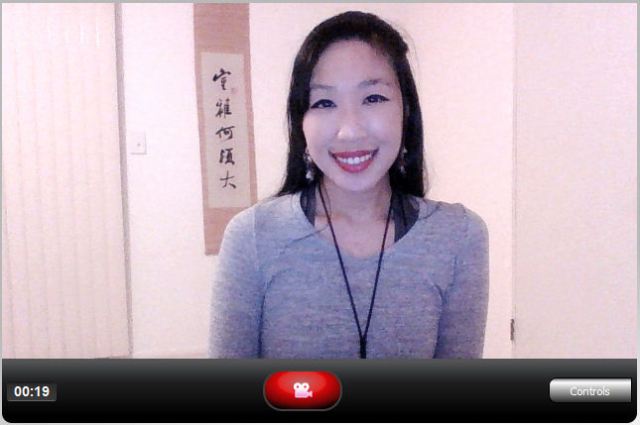
The first thing I do is set up my laptop on a stack of books to get the angle and positioning just right. (I’ll get into how to angle and position your camera lens in the subsequent post.) The laptop came with a video camera recording program, so that’s what I use. I click the red record button, and then just go.

I like to use jump cuts (also explained in subsequent post) so that it’s easier for the final video product to look like I stay on point the whole time and don’t wander off on irrelevant tangents or have you all sit there watching me think, on camera, about what next thing I want to say.

Continue reading “Quick Tutorial: MovieMaker for YouTubers”