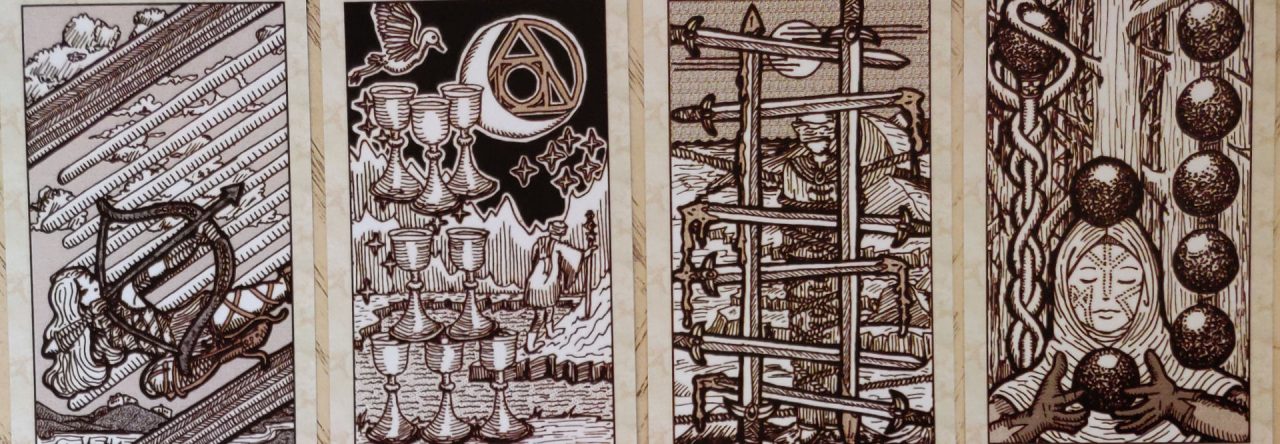
Let’s explore the Taoist and Chinese folk religious concept of Hun-Po soul dualism, which is found throughout East Asian spirituality, mysticism, shamanism, Traditional Chinese Medicine, and spirit mediumship traditions.
Drawing from more than two millennia of primary source texts– from the Zhou dynasty through medieval Taoist classics– we’ll examine the belief that the human soul consists of two complementary yin-yang aspects: Hun, an ethereal, heavenly principle that is the source of inspiration, destined purpose, and cultivated wisdom, and Po, a dense, corporeal instinctive principle that stabilizes us and keeps us grounded, encompassing our adaptive drives (self-preservation, being territorial, our attachments, our appetite, emotional reactivity, fight or flight response).
We’ll see how this system of the soul complex became the foundation for practices such as soul retrieval, ancestor veneration, spirit mediumship, shamanic healing, TCM, and Taoist cultivation.
This is tentatively Module I of Introduction to Soul Retrieval: Theory and Practice, a course on the Han Chinese folk tradition of healing soul fragmentation. I say “tentatively” because we’ll wait and see what the level of interest is for such a course series.
READING ASSIGNMENT: For those who plan on going through the entire Soul Retrieval course, you’re going to want to have fully read through the below study outline before starting the subsequent Module II, because it will be set up assuming you’ve read through this document.
STUDY OUTLINE
PDF | DOCX
And (ugh) before some uninformed bad faith person screeches “AI! AI!,” no. I’ve been sharing wordy stuff like this since forever. See, for example, my downloadable law outlines, like this 96-page outline on U.S. Trademark Law & Unfair Competition from 2005. I know I’ve posted my copyright law one somewhere on here as well, also from the early 2000s, though I can’t seem to keyword-search locate it at the moment. Or check out any of the other free downloadable PDFs I’ve been sharing on this site since 2013.
Initially I had done a master class on soul retrieval for ConVocation 2025 in Michigan, only to realize after-the-fact that it wasn’t the optimal venue for the scope of content I wanted to put together and share. So I’ve been working on reorganizing the master class materials and turning them into YouTube videos.
Now, a couple of points I want to discuss further, beyond that video.
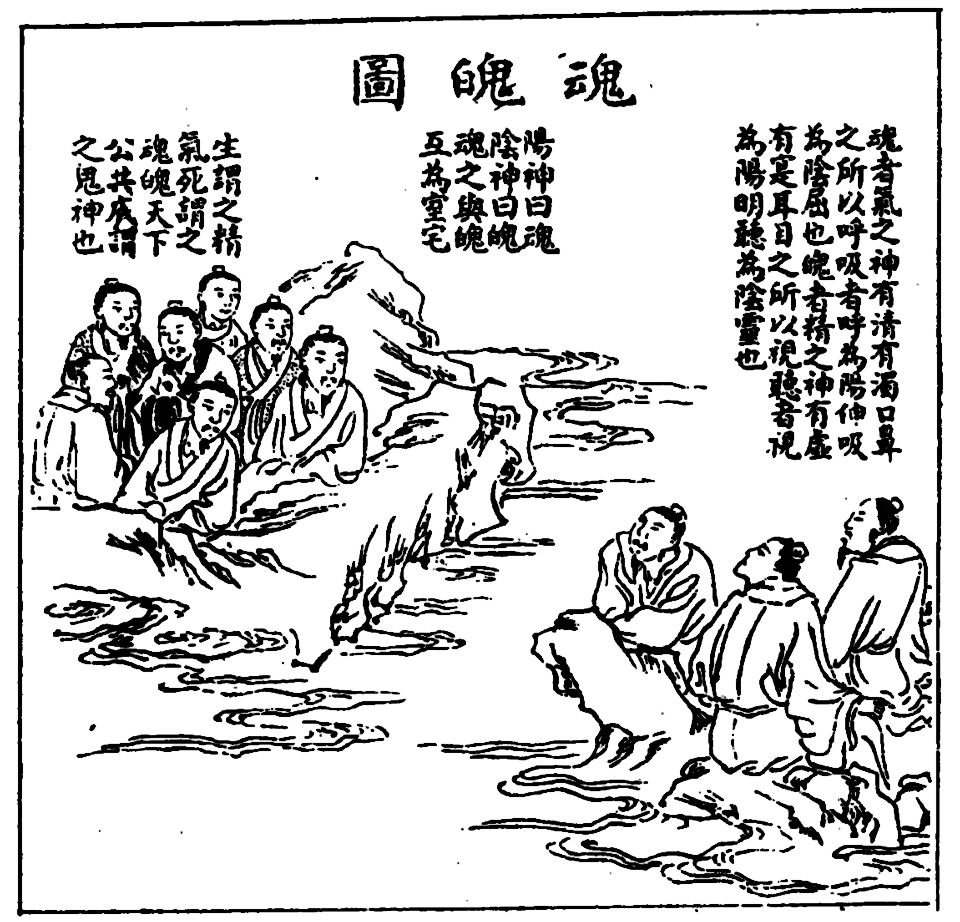
Summarizing the Hun-Po 魂魄 for the Subsequent Modules
In the same way medical science has an anatomical model of 11 (or 12) major organ systems, but we fully understand it as one single complex — the body — and all of these systems are interdependent, and in many ways, inextricable from one another (impact one, another will be impacted), Traditional Chinese Medicine has (A) an anatomical model of organ systems for the physical body, and (B) an anatomical model of 10 functional aspects of the soul.
The soul is one single complex, like the body, but also, it’s 10 interdependent systems, and in Taoist metaphysics, that’s expressed as 3 Hun (yang aspects) and 7 Po (yin aspects), though Hun isn’t pure yang, and Po isn’t pure yin. It’s yang dominant and yin dominant, respectively.
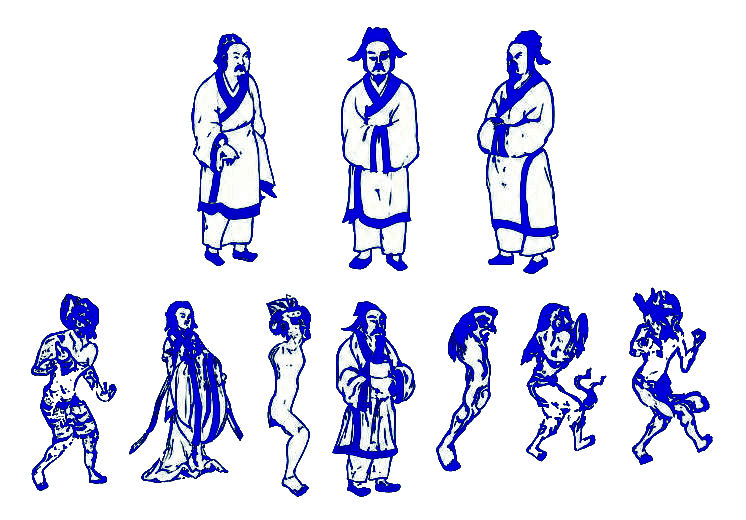
I’ve noticed that across various Taoist texts, the 3 Hun when personified and depicted in human-like form, are portrayed as prim, proper, gentlemanly, at peace, whereas the 7 Po are depicted as wild, more animal-like, primal, and with highly-expressive emotional facial expressions. So take from that what you will.
Soul retrieval is a folk practice where the spirit-medium starts by assessing which aspect of soul fragmented, which part of Hun-Po is weakened, detached, overactive, deficient, stagnant, or otherwise causing the Hun-Po system to be out of balance. In the account from the video of Wu Yang 巫陽 the shamaness, first a divination was performed to help determine the nature of the soul fragmentation. Today, divination is still used by spirit-medium healers, though those with a Traditional Chinese Medicine background, will incorporate that body of knowledge into how Hun-Po is assessed.
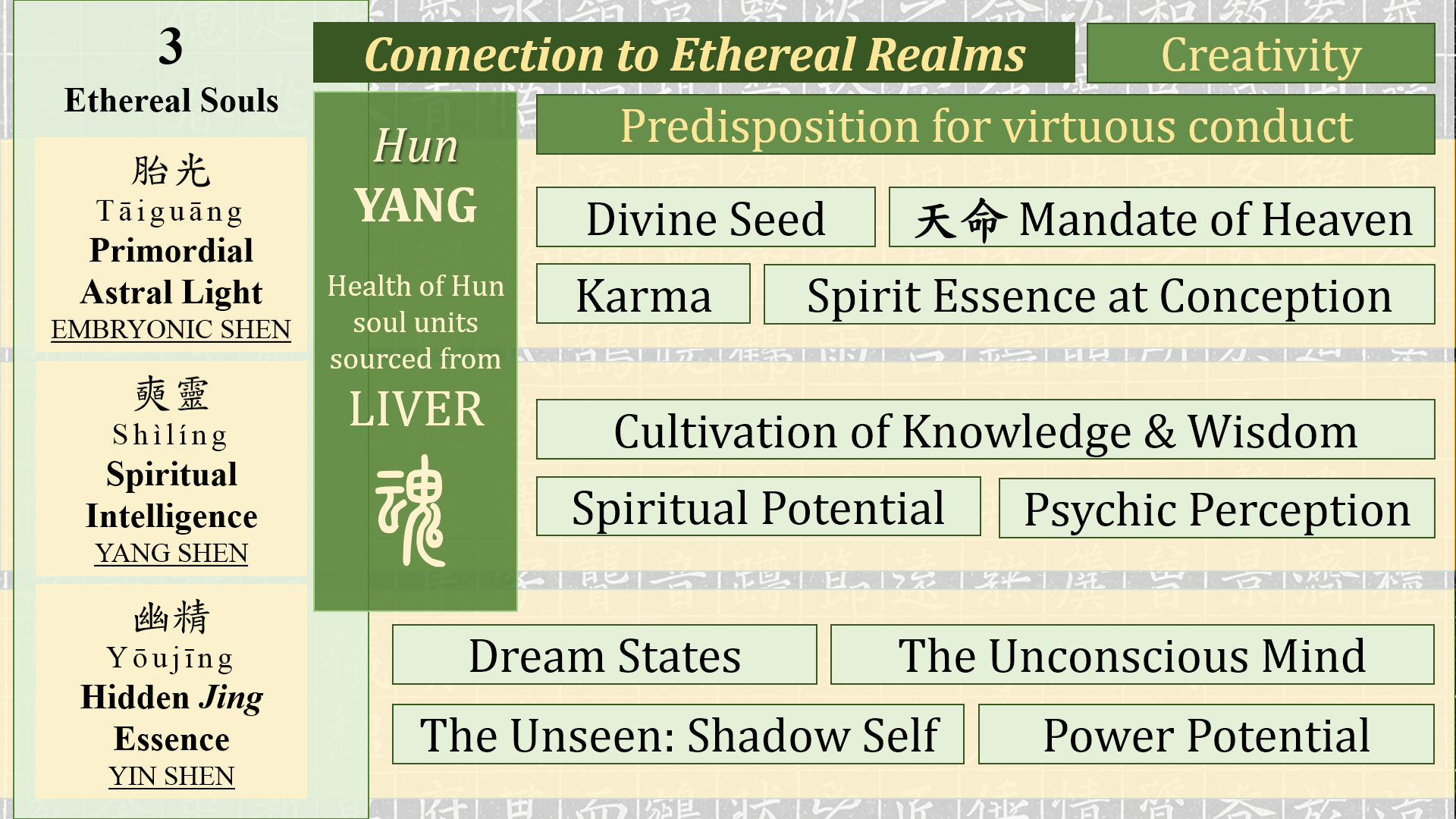
The Three Hun (Inner Yang Balance)
The Hun is the yang aspect within, though it isn’t pure yang; there are still elements of yin in the Hun. The Hun is magnetized to go East and corresponds with the Wu Xing element Wood. Wood strengthens the three Hun.
Hun is the source for our connection to the ethereal realms, our creativity, divine genius, and vision. It fuels our dreams, intuition, imagination, and psychic abilities. An overactive Hun can result in personal instability, someone not feeling very grounded and rooted in material reality, and who has a difficult time navigating the physical world, i.e., have you ever been told “your head is in the clouds”?
Yet overactive Hun can cause your inner soul to attempt self-correction, causing your Po to go off balance, which is the explanation for many of the behavioral health symptoms those with an overactive Hun tend to experience, at a much higher rate than those with a typical balance of Hun.
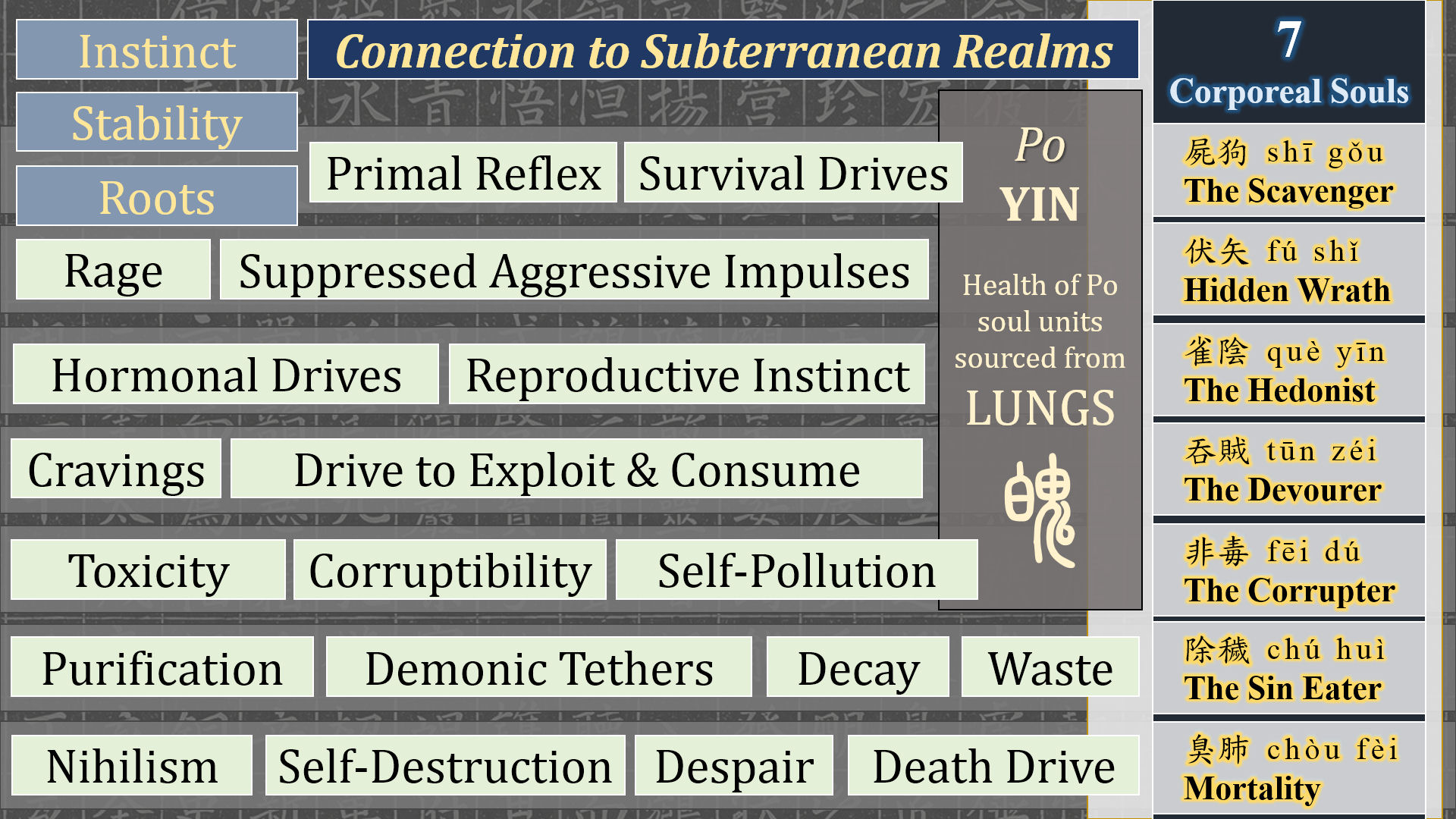
The Seven Po (Inner Yin Balance)
The Po is the yin aspect within, though it isn’t pure yin; there are still elements of yang in Po. The Po is magnetized to go West and corresponds with the Wu Xing element Metal. Metal strengthens the seven Po.
Po is what keeps you stabilized, gives you a sense of roots, and these seven aspects are your body’s primal instincts and survival drives.
Hun governs or “leads” Po. Therefore the health of your Po is determined by the health of your Hun, although it is interdependent, so imbalanced Po further exacerbates imbalance in the Hun.
PRACTICUM #1
The above meditative recitation is an abridged English variation of the “Incantation for Mastery of All Inner Spirits” from the Yunji Qiqian 雲笈七籤 (1016 AD), Seven Tablets of Sacred Writings, which features a “Method of Body-Spirit Immortality 存身神法” used as a soul healing ritual. The practitioner is to wear white and face east while reciting the sutra. The full-length version of the sutra in Chinese and its more literal English translation is provided in the description box of the above video.
As a form of simple personal energy clearing, on the day of a full moon, follow the video recitation while facing east, palms pressed together in closed prayer position to keep your energy circuit closed and sealed. Just to follow grimoiric tradition, wear white. =) It’s short, low commitment, and just gives you this sense that you’ve cleansed your breath and now you feel slightly more rejuvenated.
Keeping Vigil on Gengshen Eve 庚申: The Three Vermin and the God of Destiny
We talked about this old ritual practice found in both Chinese Taoism and Japanese Shugendo 修験道 (syncretized esoteric Buddhism and Shinto) called Keeping Vigil on Gengshen Eve 庚申守夜.
It was premised on the belief in Three Vermin or Three Corpse Spirits resident within your three dantian: the vermin in the upper dantian corresponds with vanity; the central dantian was home to indulgence; and the lower dantian was home to desire. Gengshen 庚申 is one of the 60 days in the lunisolar calendar. In other words, every 60 days, the Three Vermin leave your body while you’re asleep and report your transgressions to the God of Destiny 命神. Hearing the Three Vermins’ reports, the God of Destiny will shorten your life span accordingly, in penance for the transgressions.
Ritual practices arose where people would not sleep on Gengshen Eve, and instead perform all-night meditations, ritual purification, ritual fasting, or group religious observances, believing that as long as they were awake, the Three Vermin could not leave their bodies, and therefore would miss their check-in with the God of Destiny.
There were even magical practices involving talismans and spells intended to permanently sever the Three Vermin from your body entirely.
I think there is still some value to observing Gengshen Eve, not just to honor and uphold tradition. Even if you don’t take the Keeping Vigil on Gengshen Eve for subduing the Three Vermin literally, it’s still a generally positive self-reflection practice every 60 days to just think about whether you’ve been keeping your ego, vanity, unnecessary extravagances, and compulsive cravings in check.
I don’t think anyone disagrees that self-destructive thoughts and self-destructive behavior can fragment our sense of personal wholeness.
And so this Keeping Vigil practice every 60 days is kind of an incredible personal ritual for being accountable to yourself, fostering self-awareness, and catching yourself before things go haywire so you can course-correct.
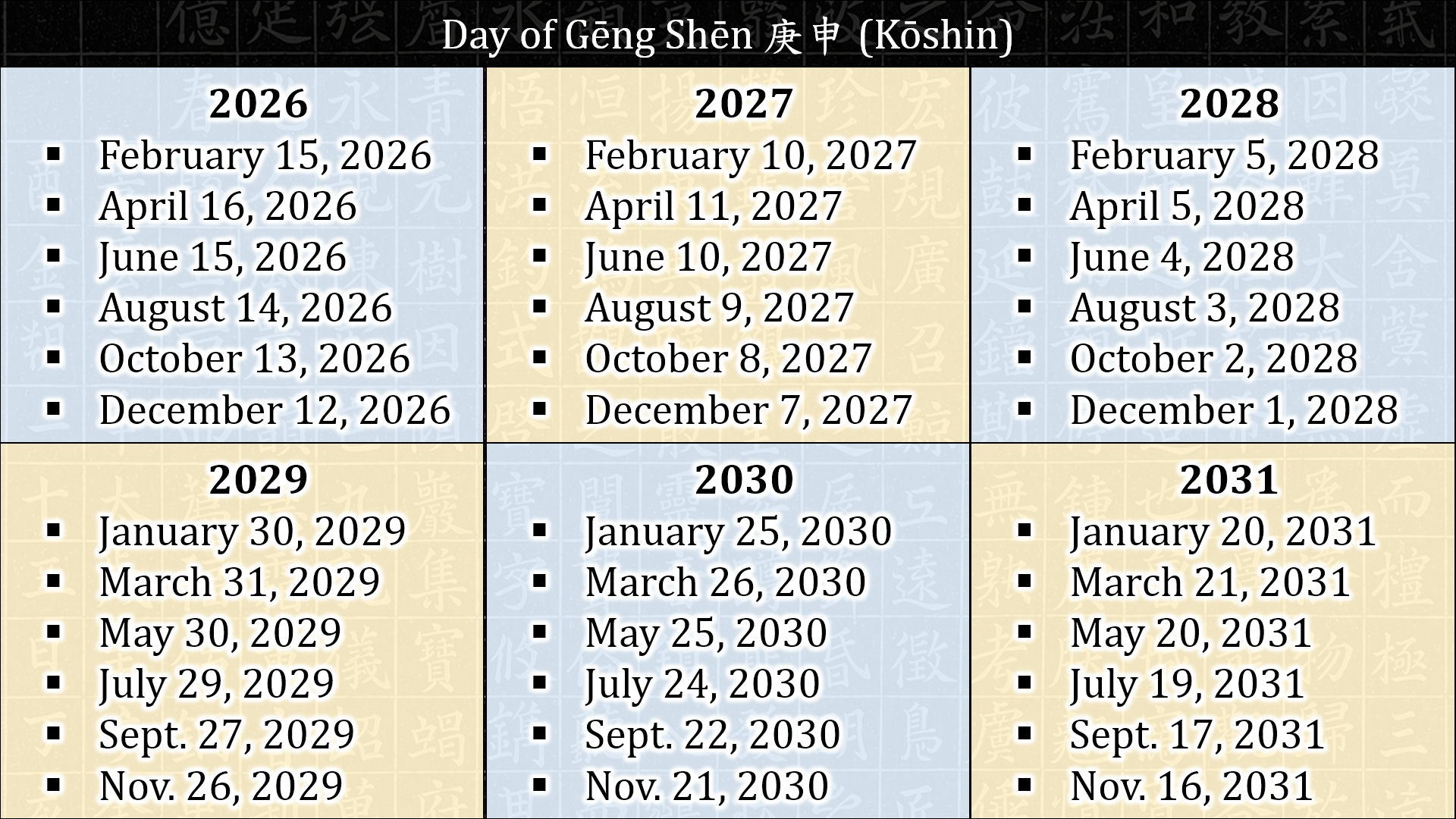
PRACTICUM #2
For the rest of this year, on each Day of Gengshen, or in Japanese, Kōshin, reserve some time in an evening hour to self-reflect on what you might need to overcome and do better for the next 60 days in terms of neutralizing the Three Vermin.
Commit to habit and mindset changes, or maybe do a little magic, so that, you know, the God of Destiny will bless you with good health and fortunes.
Depending on your appetite for the mystical and unverified, calendar in the above dates, every 60 days, to do what can range from journaling self-reflections on where you’re at in terms of vanity, keeping your ego in check, and curbing unhealthy indulgences and cravings, to Taoist alchemical cultivation practices or spell-crafting to placate the Three Corpse Spirits.
To See One’s Own Hun-Po: The 金水分形 (Jin Shui Fen Xing) Ritual
“金水分形” (jin shui fen xing) means “separating Metal and Water into their distinct separate forms.” Metal and Water are referring to the Wu Xing elementals, Metal for white and light luminosity, Water for darkness and opaqueness. Together they represent the polarity of light and dark. As noted in Ge Hong’s Baopuzi, performing this ritual successfully enables you to visualize the ten spirits that are your Hun-Po, the seven Hun and three Po.
While the term “Separate the Forms of Metal and Water” in its original intended meaning was in the scope of outer alchemy, it became a symbolic term used in folk magic, for visualization practices that employ mirrors, and specifically, a ritual using a mirror to see one’s ten Hun-Po as spirit entities or energy bodies within.
PRACTICUM #3
I learned this particular method back in my 20s in Taiwan, no citations, no “this is where it came from,” just “follow me and do as I say.” Now as an adult, I tried to trace the steps backward to see if I could source its origins. It seems like it’s based word for word on lines from Ge Hong’s Baopuzi but doesn’t appear exactly in Baopuzi.
Here’s a video clip of what the wording sounds like:
People will have varying opinions on what language you “must” use for the incantation to work. My approach is to focus on the objective, and work backward, discerning what means will be most effective for you to achieve the end goal. If you’re going to stumble and fumble and feel weird over the pronunciation of the Chinese, then go with a poetic translation of it in your native tongue. If going with a language other than the one you speak everyday in the mundane helps facilitate change to a heightened, transcendent state, then go with the Chinese.
The full step-by-step write-up “To See One’s Own Hun-Po” is in the study outline.
In the video lecture I mentioned my strong recommendation that you not try this unless you have some foundational experience in ritual magic already. It doesn’t have to be Taoist. You just need to have a working toolkit for basic cleansing, consecration, creating sacred space, and monitoring the situation. You integrating your know-how from that working toolkit into this culture-specific ritual approach is totally fine because those core competencies are transferable.
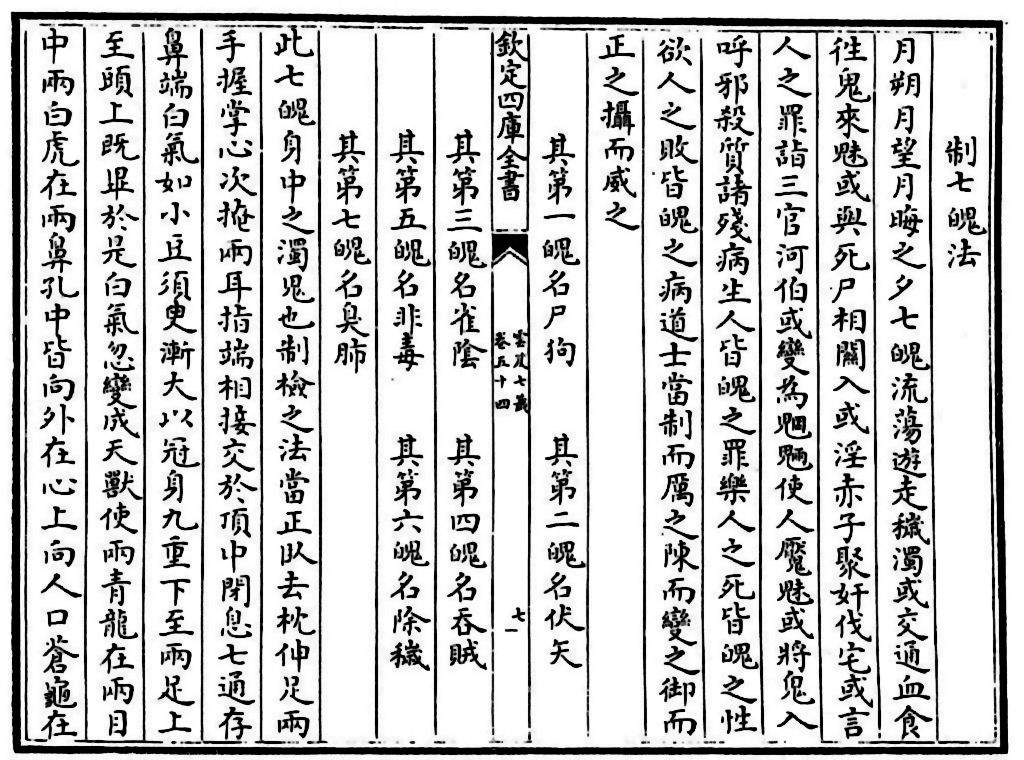
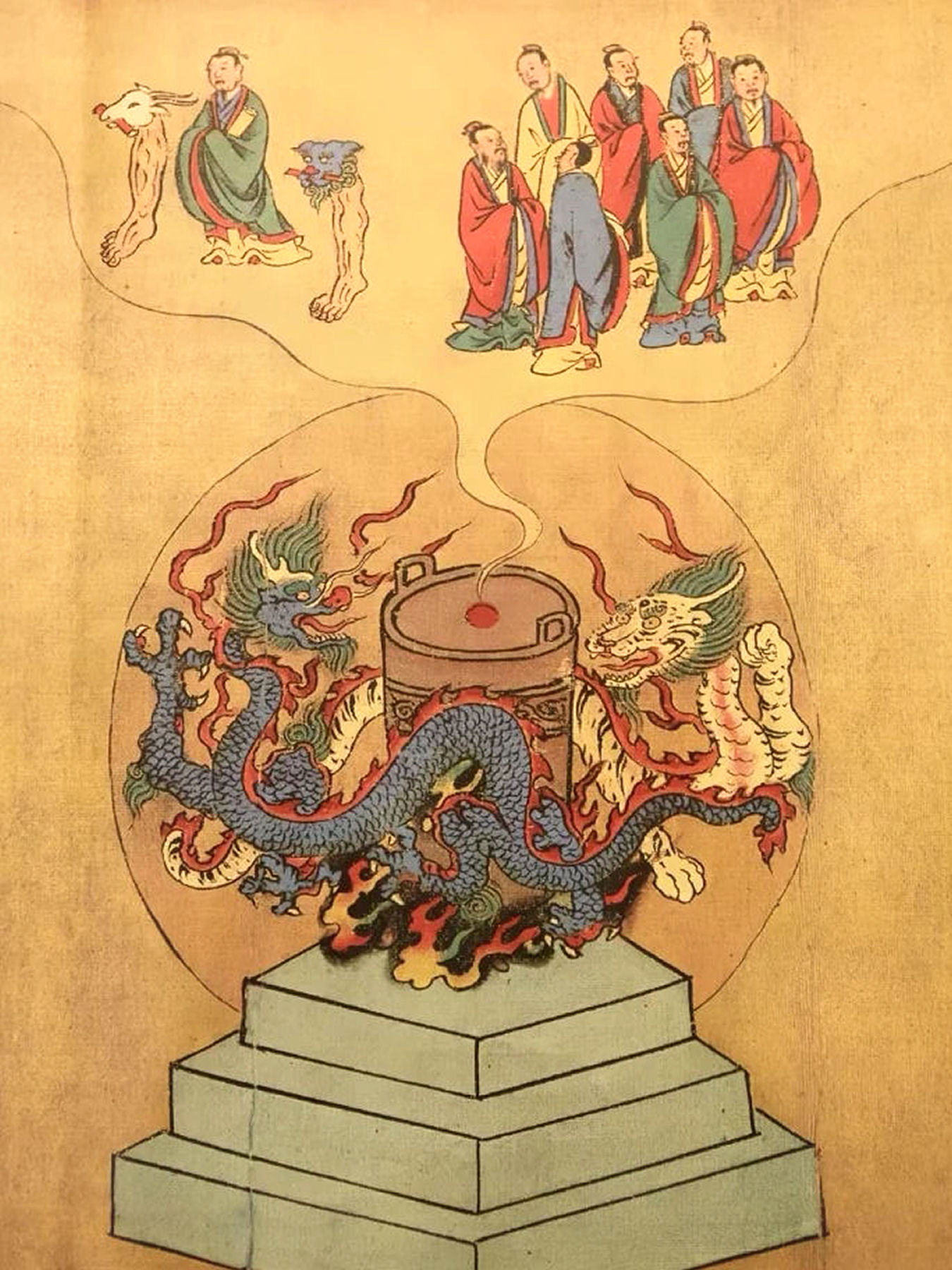
The above is a page from Yunji Qiqian (Seven Tablets) titled “Method for Regulating and Controlling the Seven Po” that enumerates the names of the Seven Po (the names given in that downloadable outline), and then provides instructions for a visualization and breathwork practice intended to give you perception and control over the Po aspects of soul.
The instructions start with the practitioner lying flat on your back, entering a meditative state through breath retention and internal visualization. You visualize white Qi transforming into celestial beasts– two azure dragons where your eyes are, and then two white tigers where your nostrils are. (Random interesting note: Those with extreme astigmatism might see two azure dragons that look rather different from one another.) They signify the Hun and Po respectively, east and west, yang and yin. The practice is presented as a method for being able to see and visualize your inner Po, and then regulating them into harmony.
Instructions and guides on visualization techniques for how to see your Hun-Po are aplenty, because being able to see them is the crucial, required Step One to, well, all aspects of Taoist cultivation, and, as noted in the esoteric interpretation of Verse 10 from the Tao Te Ching, for knowledge and understanding of the Hidden Code (i.e., the Sacred Mysteries). Once you’re able to see the spirit map formed from your Hun-Po aspects, you’re able to begin soul healing work.

RELATED CONTENT:
- A Thought Tour of Chinese Occultism (mentioning soul dualism), 2019 Feb. 2
- Soul Dualism in Esoteric Buddhism, 2023 Feb. 17
- Ancestral Power and the Witch (mentioning soul dualism and the power of the ancestral pillar), 2019 Oct. 29
- Most Influential Grimoire in Taoist Practice: Baopuzi, 2024 Aug. 25
- Descent into the Underworld 觀落陰 (Wu Shamanism), 2023 Oct. 28
- Your Inner Palace 元辰宮 & the Akashic Records, 2023 Nov. 3
- Ritual Magic & Shamanism in Pre-Qin China, 2024 Feb. 18
- The Lo Shu 雒書 Magic Square, 2023 Jan. 14
- Ku or Taoist Poison Magic (from the Tinkering Bell series), 2017 Oct. 27
 benebell wen
My tea has gone cold and I’ve overcooked the soup while reading 😃. Your videos and your written work are so beautifully articulated. Thank you and bless you, one million times over.
LikeLiked by 1 person
🪔
LikeLike
Thank you so much! I mean sorry your tea went cold and you overcooked the soup 🤣😭 but thank you for your kind note. ❤️
LikeLike
1
LikeLike
1*1
LikeLike
1*38*33*0
LikeLike
1+43-38-5
LikeLike
1*301*296*0
LikeLike
1+306-301-5
LikeLike
1*243*238*0
LikeLike
1+248-243-5
LikeLike
1*818*813*0
LikeLike
1+823-818-5
LikeLike
1*739*734*0
LikeLike
1+744-739-5
LikeLike
1*896*891*0
LikeLike
1+901-896-5
LikeLike
1*731*726*0
LikeLike
1-1; waitfor delay ‘0:0:15’ —
LikeLike
1*696*691*0
LikeLike
1+736-731-5
LikeLike
1-1); waitfor delay ‘0:0:15’ —
LikeLike
1+701-696-5
LikeLike
1*574*569*0
LikeLike
1+579-574-5
LikeLike
1-1 waitfor delay ‘0:0:15’ —
LikeLike
1′”
LikeLike
http://e
LikeLike
http://e
LikeLike
http://e
LikeLike
http://e
LikeLike
http://e
LikeLike
http://e
LikeLike
-1′ OR 5*5=25 —
LikeLike
-1″ OR 5*5=25 —
LikeLike
-1′ OR 5*5=25 or ‘JTWyVEwg’=’
LikeLike
-1″ OR 5*5=25 or “TC9qlJlK”=”
LikeLike
-1 OR 5*5=26 —
LikeLike
-1 OR 3*2>999 —
LikeLike
-1 OR 3*2>5 —
LikeLike
-1 OR 5*5=26
LikeLike
-1 OR 3*2>999
LikeLike
-1 OR 3*2>5
LikeLike
-1′ OR 5*5=26 —
LikeLike
-1′ OR 3*2>999 —
LikeLike
-1′ OR 3*2>5 —
LikeLike
-1″ OR 5*5=26 —
LikeLike
-1″ OR 3*2>999 —
LikeLike
-1″ OR 3*2>5 —
LikeLike
-1′ OR 5*5=25 or ‘Rh7tsW5f’=’
LikeLike
-1″ OR 5*5=25 or “vrVLj6Qq”=”
LikeLike
-1′ OR 5*5=25 or ‘6CluAmiD’=’
LikeLike
-1″ OR 5*5=25 or “rFEI8wfZ”=”
LikeLike
‘”
LikeLike
À§À¢%2527%2522\’\”
LikeLike
(select 198766*667891)
LikeLike
‘”
LikeLike
À§À¢%2527%2522\’\”
LikeLike
(select 198766*667891 from DUAL)
LikeLike
‘”
LikeLike
À§À¢%2527%2522\’\”
LikeLike
Thank you for all the amazing work you give us 🙂
“Introduction to Soul Retrieval: Theory and Practice, a course on the Han Chinese folk tradition of healing soul fragmentation.”
I for one would be very interested in such a course.
LikeLiked by 1 person
me too I am interested in your course Soul Retrieval
LikeLike
Amazing, thank you. We’ll be delighted if you create a full psychological and emotional course through this kind of taoist approach. There is a big gap inside this studies.
LikeLiked by 1 person
1
LikeLike
1
LikeLike
1
LikeLike
1*1
LikeLike
1-1; waitfor delay ‘0:0:15’ —
LikeLike
1-1); waitfor delay ‘0:0:15’ —
LikeLike
1-1 waitfor delay ‘0:0:15’ —
LikeLike
1′”
LikeLike
Mille Grâces Benebell
Evita
LikeLike