The Six Syllable Mantra (Om Mani Padme Hum 唵嘛呢叭咪吽) is the foundational entry point for Asian folk magic traditions. This is a mini-course where we’ll be covering both the doctrinal Buddhist foundations and the practical applications.
Part 1 focuses on Doctrine; Part 2 focuses on Ritual. The subsequent Video 2 is for ritual, to convey a direct empowerment so you can experience the magic and the Mystery for yourself. Both videos are now up on my YouTube channel and also linked in this companion article, where I’ll highlight some of the key points from the video and also drop in the references you might need for the recommended practicum.
Buddhist Mysteries emphasize the distinction between conceptual understanding (which Video 1 strives to deliver) and direct realization (which Video 2 strives to deliver). Dedicated, repetitive, sincere resonance with the Mantra itself, which Video 2 helps to facilitate, is how you receive direct realization and actualization.

Personal Reflection, on “Oh Mommy Bring Me Home,” continued from Video 1
I can’t believe I forgot to mention in the video how my personal chant as a kid was “Oh Mommy bei 背 me home,” chanting in Chinglish. Bei 背 means carry, and in this context as a child, means carry me home by piggyback.
The context was, we were a bunch of little international kids from all over the world getting tutelage from the monks and nuns at the monastery. Our parents would drop us off at this monastery atop some remote mountain in central Taiwan, and peace out for the month. At the time, many of us didn’t want to be there. And so during chantings of “Om Mani Padme Hum,” the kids from English speaking parts of the world would chant, “Oh Mommy bring me home.”
Funnier yet, the nuns would teach us that if we ever needed saving, to recite this mantra, and Kuan Yin would come to save you. So we were all like, all right, I need saving right now. Mommy, please come get me and take me home, back to the States so I can play with my friends.
Also in retrospect, as I reflected in the video, it’s unintentionally deep and sentimental. Like saying to Mother Buddha, I am exhausted, I don’t have the strength to carry myself, please save me, hold me in your arms and carry me home, to the Pure Land.
In the pronunciation of the Mantra, “Pad-” in Padme has a sound somewhere between a “P” and “B” like Pbuht. But then in actual delivery you’ll hear a whole range from closer to P to a hard B. I think I automatically do the harder B from decades of chanting “Oh Mommy bei 背 me home.”
From a practitioner perspective, a routine meditation practice that incorporates this mantra really helps to deepen your reservoir of power to be able to tap in to psychic abilities without exhaustion.
Kuan Yin (Avalokitesvara)
The Six Syllable Sutra is associated with one particular manifestation of Kuan Yin (Avalokitesvara).
Per the Lotus Sutra 妙法蓮華經, there are 33 different manifestations of Kuan Yin.
With the Six Syllable Mantra, per scriptural tradition derived from the Karandavyuha Sutra 佛說大乘莊嚴寶王經 (circa 4th and 5th c. AD), you’re invoking the manifestation of Kuan Yin as Mother Buddha 母佛, who gave birth to the five gods: the sun god, moon god, wind god, water god, and fire god; the king of heaven and the king of hell; and the four heavenly kings or lords of the four gates (the four directional deities).
The Sutra also describes a mandala of six hues: sapphire blue, emerald green, ruby red, crystal, silver, and gold. At the center of the mandala is Amithaba Buddha 阿彌陀佛, who is accompanied by Sadaksari Mahavidya, who is a manifestation of Avalokitesvara representative of the mantra Om Mani Padme Hum.
And so this particular manifestation of Kuan Yin, meaning what Om Mani Padme Hum invokes, is a cosmic and maternal aspect of Kuan Yin consciousness. All of Buddhist dharma is contained and encoded within these Six Syllables, and that itself is the Mystery to contemplate. Doctrinally, “Om Mani Padme Hum” also corresponds with the Six Perfections (Six Paramitas), though for this study, we’re going to focus narrowly on the Mantra’s applications in folk magic, and not necessarily spiritual or religious cultivation.
Continuing with the Karandavyuha Sutra, Sadaksari Mahavidya is described as having four arms, feminine, wearing white like an autumn full moon, and holding a lotus in her left hand, and embedded within the lotus blossom, a jewel.
Whereas the Great Compassion Mantra 大悲咒 is associated with Kuan Yin as the Thousand-Armed Thousand-Eyed Avalokitesvara (though in most East Asian religious art, you’ll still see depictions of Kuan Yin, even associated with the Great Compassion Mantra, in that more familiar white-robed serene-looking maternal figure).
We delve further into doctrine and theory in Video 1, namely the esoteric doctrines on how mantras are the divinities themselves, in the form of Sacred Sound, and how their powers are thus transmitted through Sacred Sound. In other words, when you’re able to produce the Sacred Sound (which goes beyond the words themselves, or pronunciation, but is itself a specific attuned personal embodiment), you’re able to invoke the literal presence of that divinity. That Sacred Sound, in Chinese, is called a zhou 咒, meaning both “Mantra” and “spell.”
咒 (zhou) = Mantra = Spell
“Om” and “Hum” are seed syllables, which we explain and delve into in Video 1. “Mani” is Jewel, in reference to the Cintamani (pronounced “chintamani”) in Sanskrit, and “Padme” is Lotus. It’s an invocation of the Jeweled Lotus, a manifestation of Kuan Yin. But also, it’s so much more than that, and the explications of the Mantra has become a source of Buddhist scholarship, and also, spiritual wisdom. I’ll be sharing the interpretations of its meaning specifically applicable to folk magical practice.
While the words themselves are an essential formula, what empowers the Mantra (Spell) is the holistic mind, body, spirit engagement of the practitioner. The repetition is just what helps to induce the needed state of mind, body, and spirit engagement.
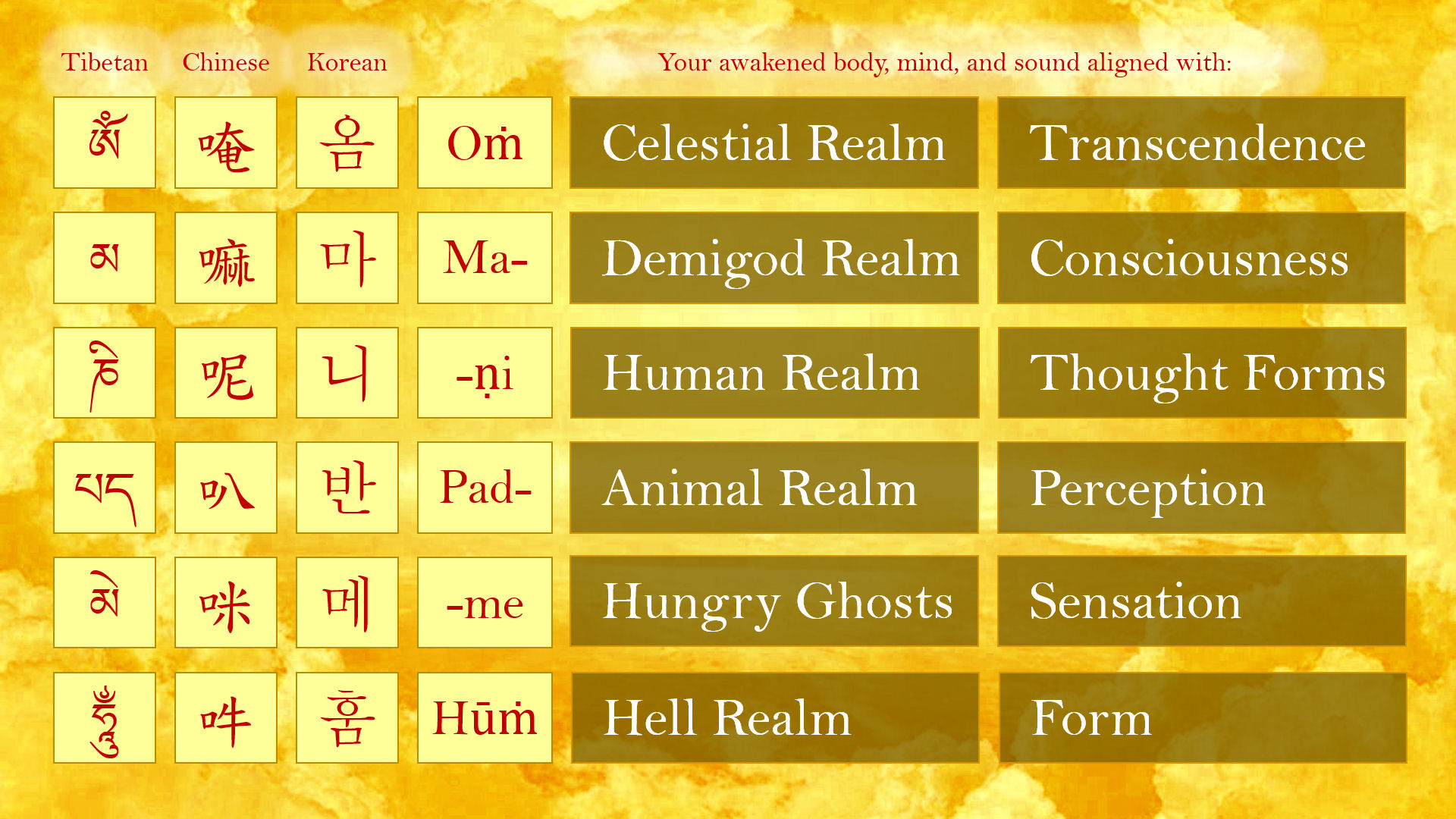
Each of the Six Syllables connects to one of the Six Realms, and therefore attunement to the Mantra gains the practitioner access to them. With respect to us humans already in the human realm, this is command over thought forms that dwell in this world, created by humans. (And my brain short-circuits a bit when I start philosophizing on what this might mean with respect to AI…)
The power wielded with this Mantra can placate restless or agitated spirits, because per Buddhist cosmology, spirits that are restless, agitated, baneful, and wreaking havoc are that way due to their suffering. The Mantra eases their suffering, and therefore eases their wrath. Or, if the malefic spirit isn’t ready to let go of their pain (like they’re making their pain their whole personality…), then the sound of the Mantra is so agitating to them, so “facing my own shadow” for the shadow that they peace out on their own accord, because they don’t want to be in the vicinity of the sound that is reminding them of who they really are.
Thus, the power of the Mantra quiets disturbances. In that sense, it’s a spell 咒, or at least in Chinese, the word we use for “magical spell” is the same word we use for “Mantra,” just applied in different contexts.
In the context of Asian folk magic, “Om Mani Padme Hum,” cross-culturally, is considered a practitioner’s tool– it’s an incantation that can help you to cast spells. This Mantra + specific intention + holistic embodiment of the Mantra’s energy imprint = unstoppable. =)
Notably, you see Om Mani Padme Hum used, in folk magic, in three key contexts, though it’s by no means limited to these three applications:
- Exorcisms and Soul Retrievals
- Consecration or Purification Rites, and
- Spiritual or Psychic Protection
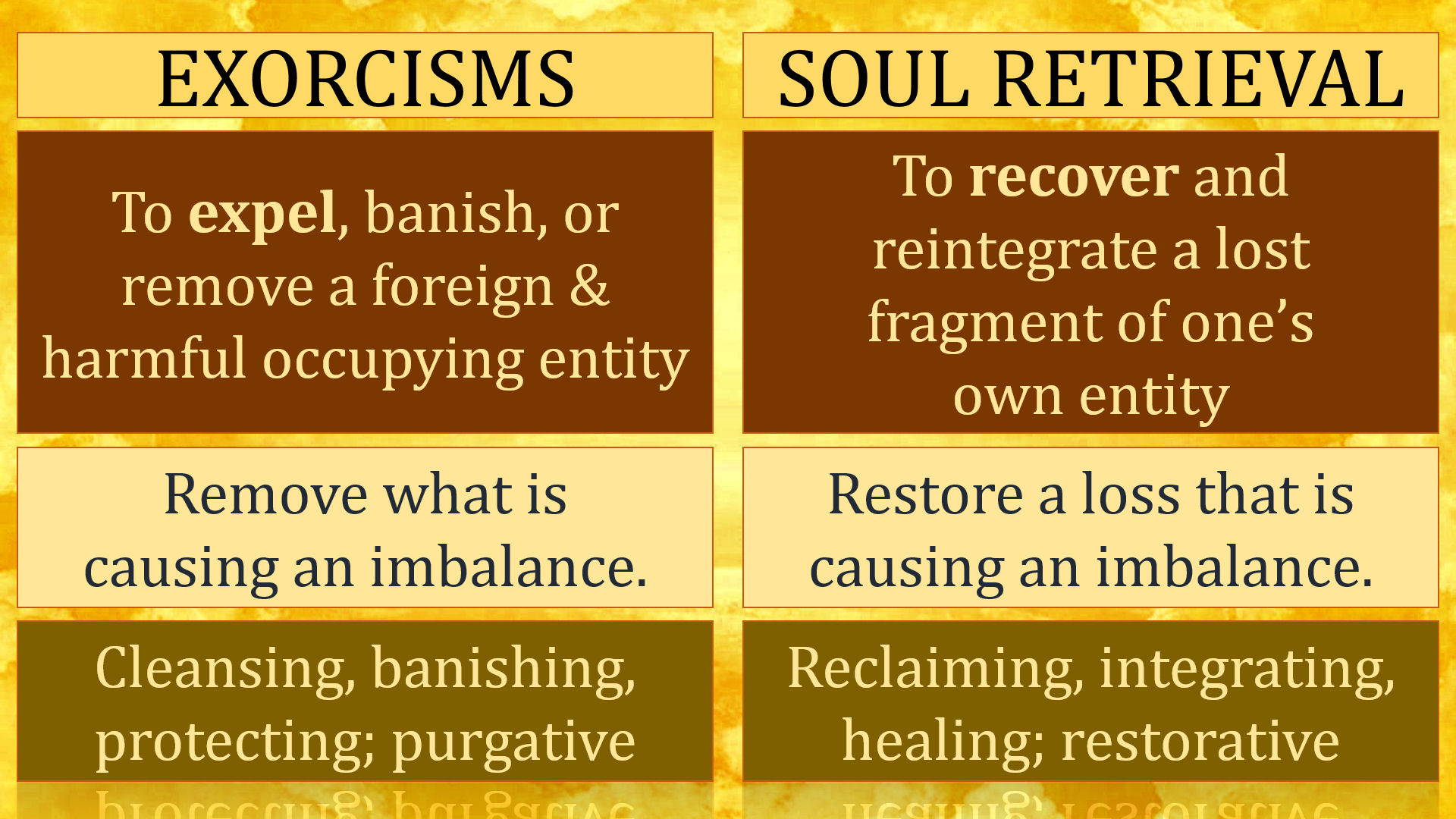
Where I would say the meatier aspect of the Mantra applied in folk magic is in both exorcism and soul retrieval rituals. To clear a haunting, a priest or practitioner first plays a blessed or consecrated audio recording of the Six Syllable Mantra (typically, the recording itself is done in a specific ritualistic manner) while utilizing other tools and methods to clear the space, such as with incense, talismans, and joss burnings. This is usually followed by a sutra or dharani recitation, such as the Great Compassion Mantra.
Likewise, you’ll find application of the Mantra, both in recited and stylized written form, in soul retrievals. I have something in the works that deep-dives into this topic.
Tangmi 唐密, Tang Dynasty Esoteric Buddhism
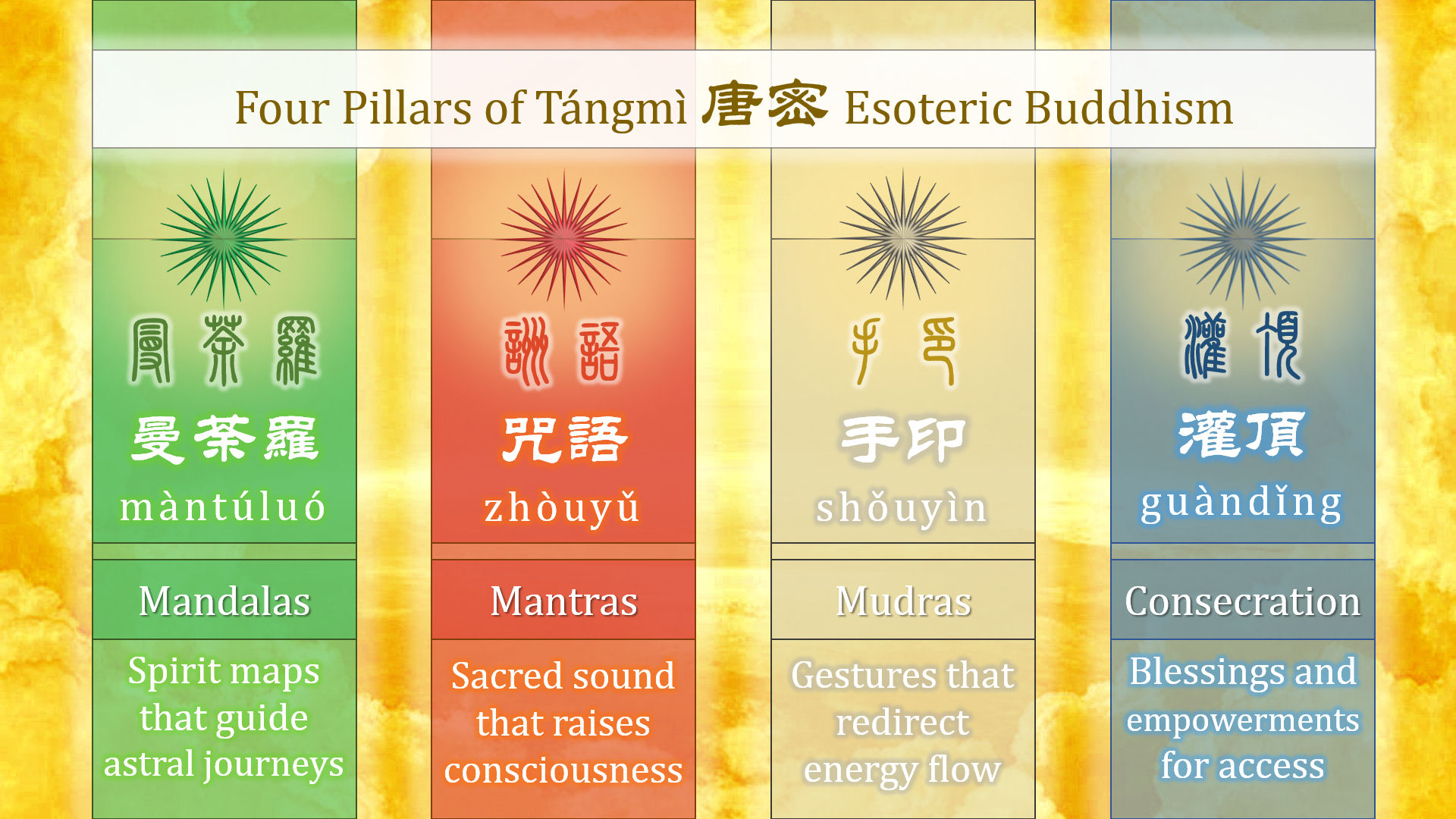
While tantric Buddhist practices were already in China well before the Tang dynasty, with Chinese translations of dharanis, spells and incantations incorporating Buddhist elements, mandalas, and manuals on mudras as early as the 3rd century, the imperial Tang sponsorship of esoteric Buddhist scholarship drove its advancements and popularity.
Esoteric Buddhism and practices of Buddhist magic traced back to the Tang became the backbone of many new variations of folk magical practices across Asia.
While prongs of Buddhist mysticism flourished during the Tang dynasty, and even during different pockets of time before that, there was a Great Anti-Buddhist Persecution that took place in the 9th century, which brought the decline of Tangmi 唐密 and related mystical and occult practices 密教.
Tangmi hid beneath the cloak of Taoism, fragmented and integrated into various traditions and lineages of Taoist mysticism. Aspects of it also merged into Pure Land Buddhism. Fortunately, a lot of it was preserved in Japan through Shingon Buddhism, and much of what you see in Shingon Buddhism today reflects medieval Tangmi practices. Whereas to find remnants of Tangmi in China today, you’d be looking at regional folk practices.
A Unifier of Asian Magical Traditions
From a pan-Asian perspective, I also wanted to present how the Mantra is a common ground we share across many otherwise very different folk traditions. Across East and Southeast Asia, Buddhist mantra practice became deeply integrated into local folk religions, spirit medium practices, and magical systems.
In Korea, the indigenous shamanic tradition incorporates this Mantra, invocation of Gwaneum (Avalokitesvara), and chanting the Heart Sutra, Lotus Sutra, or Great Compassion Mantra ceremonies to purify spirits, consecrate land or businesses, and guide the deceased through the afterlife.
In Vietnam, the spirit medium tradition of Dao Mau, among others blend Taoist talismanic practices, spirit possession, soul retrieval, and healing rites with the Mantra and devotion to Quan Am (Avalokitesvara).
In Japan, the esoteric Buddhist schools of Shingon and Tendai, derived from Tangmi heritage, would integrate the Mantra into ritual systems for embodying the enlightened state of Kannon (Avalokitesvara). Mandalas as cited in the Mahavairocana and Karandavyuha were used in visualization meditation to transport one’s consciousness to Buddha and bodhisattva realms. The Mantra can also be found in shamanic rites and spirit mediumship practices blending Mahayana Buddhism and Shinto, notably in traditions such as Shugendo.
In predominantly Theravada regions such as Thailand, Cambodia, and Laos, magical traditions such as Thai Saiyasat, Khmer and Lao occult practices, as noted in the video lecture, work with this Mantra in protection rites, soul retrieval and spirit exorcism rituals, home and business blessings, and crafting talismans. The Mantra is also used to help enter trance states in spirit mediumship practices, similar to its application in spirit mediumship practices found in southern China, Taiwan, and other regions of the South Pacific.
The widespread presence of these ritual elements across Asia can be traced to Indian tantric Buddhism entered China during the Tang dynasty (618 – 907 AD), which merged with Taoism. Tantric scriptures such as the Karandavyuha Sutra, Vajrasekhara and the Mahavairocana advanced magical and occult practices integrating mandalas, mantras, mudras, and empowerment or initiation rites.
On Mantras and The Secret School in Buddhism
Chapter 8
The Secret School
Click to download PDF
The following is an excerpt from Buddhism: A Brief Introduction, based on the teachings of Venerable Tripitaka Master Hsuan Hua, translated by the faculty at the Sagely City of 10,000 Buddhas in Talmage, California. The book was first published in 1996 by the Buddhist Text Translation Society. This version is a 2014 updated edition.
The excerpt is from Chapter 8, titled “The Secret School.” The Secret School, or Mizong 密宗 (also referred to as Esoteric Buddhism) is one of the five major schools of Buddhism, alongside Zen Buddhism 禪宗, Pure Land Buddhism 淨土宗, etc. The Secret School (Mizong 密宗) is the legacy of Tangmi 唐密 Tang dynasty esoteric Buddhism.
In that chapter, there’s a section on mantras, and it explains “Om Mani Padme Hum.” Per that text, recitation of mantras harmonize relationships between us and the unseen realm of spirits and energies, and can help to prevent spirit disturbances. However, it’s not just the words, though it is that too; it’s also alignment and sincerity. The text also emphasizes that the practitioner must also uphold Buddhist morality to be able to wield the power of mantras.
You’ll note that Ven. Hsuan Hua, whose tradition is Zen (Chan) Buddhism, is a bit critical of The Secret School. Nonetheless, that chapter contains useful content.
The Practicum
Try working with the Six Syllable Mantra for yourself. This is an open practice, and well-suited for syncretizing with other practices and traditions in a manner that honors the intent of Avalokitesvara and the people who practice this faith.
I give one example of a practicum in the video. You can start before the new moon, but definitely “officially” start then. For about 15 days, from new moon to full moon, recite Mantra at least 108 times per day (about 5 minutes). The 15-minute video provided here is 108 recitations tripled, so you can play the audio and recite alongside. In traditional folk practices, even listening the audio with your mind and body attuned to the sacred sounds is just as effective as reciting it yourself.
Recitation, even pronunciation, is less important than sincerity of intention while the Sound of the Six Syllables is being made.
This 15-day period of daily chanting is to strengthen your energy bodies for the actual Working.
On the day of the full moon, create a mantra talisman. Light incense (candles optional, I really like candles) to set the ritual atmosphere. Copy, by hand, the written script of the Mantra. You can write it freehand or trace a template if the languages are too unfamiliar to you.
Here are the script references:
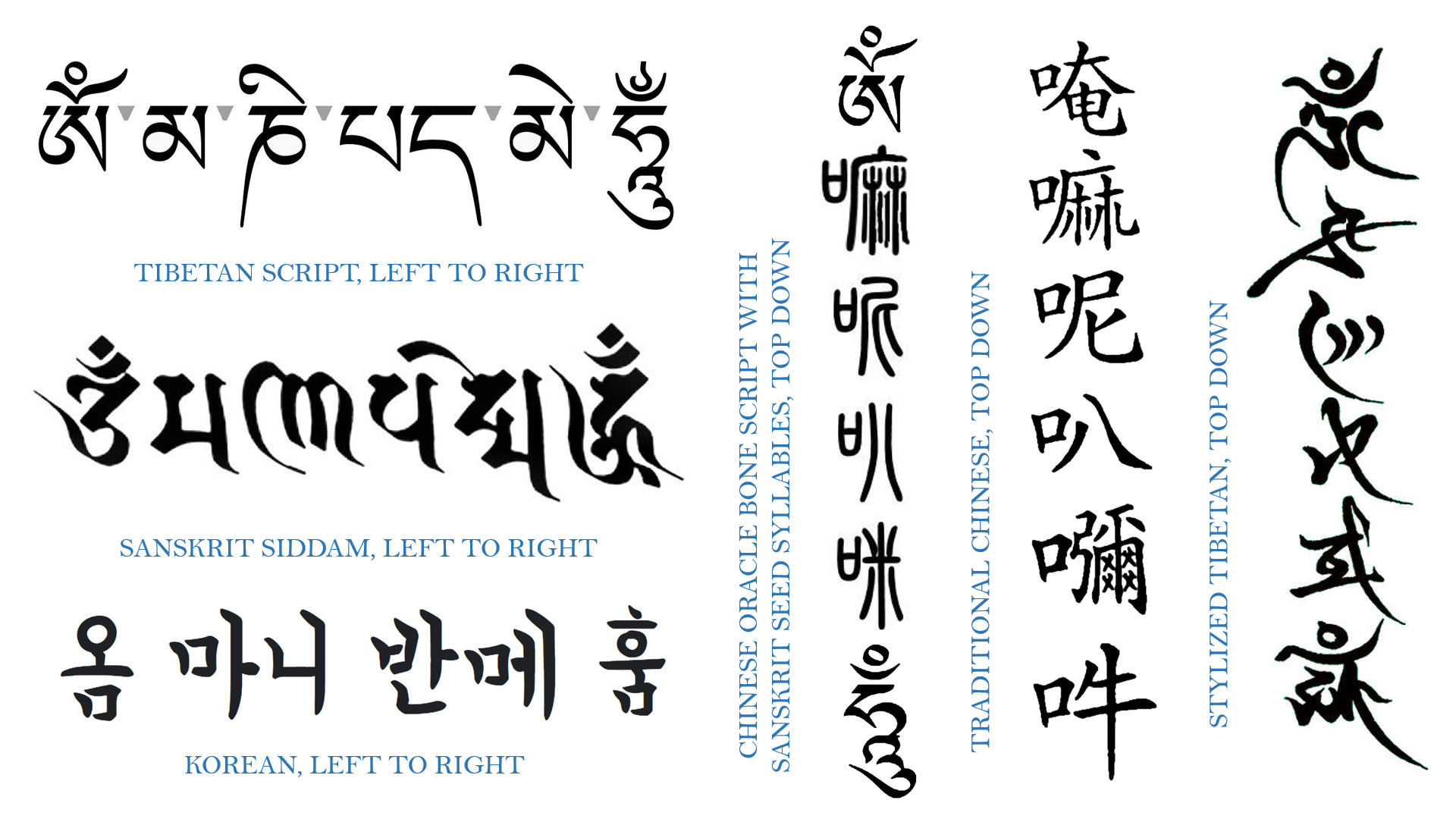
Note that the Chinese oracle bone version doesn’t have native equivalents for the two seed syllables “Om” and “Hum.” In Traditional Chinese, “Om” becomes “唵” and “Hum” is “吽.” However, when writing in oracle bone or seal script, you use the Sanskrit character for “Om” and “Hum.”
Also, preemptively, I apologize that I couldn’t be fully inclusive with all the different Asian scripts. I’m just going with the ones I personally see most often.
Before you begin, set a clear intention. What are you channeling and directing all of this energy toward to achieve? This intention needs to align with the cosmic force represented by Kuan Yin, however. So that’s spiritual protection, healing and wellness, helping to restore soul fragmentation if applicable, prosperity that enables you to help others, etc.
Then hold that intention while writing the Mantra. Also, play the Mantra chant in the background. (Hence, me providing the Video 2 recording.) If 15 minutes is too short, download the mp4 file and you can set it to play on a loop.
Then carry the paper in your wallet as a personal talisman, an energy amplifier. If it was for some form of protection, you could modify the instructions slightly, make many of them, and then roll each into a scroll, to tuck out of sight above each window and door frame in your home. Alternatively, you could place it on a study desk, in a drawer in your nightstand if it’s to safeguard you during your vulnerable hours of sleep, or on your altar. Lean in to your intuition and follow your gut instincts.
For Experienced Practitioners. If you already have an established magical or spiritual practice, get creative, follow what fusion approach calls to you, and experiment with how you might graft this Mantra practice into something you already do.
As I said in the video, let your own experience become your teacher.
Video #2 focuses on transmission of empowerments and direct experience. You can download the mp4 file of it here: Om Mani Padme Hum (390 Recitations).mp4
If you download the file directly, rather than rely on the YouTube upload, you can play it in a way that loops continuously.
And yep, that’s my voice doing the chanting. I recorded three separate layers of audio, my voice at three different pitches, then used Windows MovieMaker to layer them into a single recording.
Video #2 content is dedicated freely to the public domain. You can convert this mp4 file into an mp3 audio file for any purposes per your prudent discernment. Attribution or credits are nice, but not necessary.
However, note that for the video version, the six-petal Om Mani Padme Hum lotus image with seed syllable “Hri” in the center in Tibetan script is by Christopher J. Fynn under a Wikimedia Commons / Creative Commons Attribution license.
The 15-minute harmonic recitation of the Sacred Six Syllable Mantra is designed to build a protective spiritual energy field around the space in which it is played. Om Mani Padme Hum is a foundational sacred formula transmitted through esoteric Buddhism and Taoist mysticism. Across many different traditions of Buddhism across North, South, Southeast, and East Asia, and indigenous folk practices of magic, shamanism, and spirit mediumship, this Mantra is revered for its powers of spiritual protection, clearing poisonous or baneful energy, and consecrating ritual space.
No matter where or how you branch off from here, this is the common ground many of us as pan-Asian practitioners of mystery traditions will start from.
In Buddhist and Taoist magic, your ability to channel the divine powers that the Six Syllable formula unlocks is instrumental to how you craft talismans, perform healing rituals and exorcisms, and petition spirits. Daily recitation of this Six Syllable Mantra is the best place for the beginner to start building and developing that requisite baseline power. Your tether to this channel will also be critical as you advance in practices involving altered states of consciousness and trance, as this is what with stabilize you.
Single Recitation Download
And in case this is helpful for those interested in producing their own creative works integrating the chant, you can download the single recitation. I have two versions, one with a blue background, the other gold:
CLICK HERE to download the BLUE field.
CLICK HERE to download the GOLD field.
Want to Learn More About Asian Folk Magic?
- Introduction to Chinese Esotericism: A Lecture Series on History, Culture, Metaphysics, Practice
- Taoist Magic for Beginners: How to Get Started
- Five Core Skills in Chinese Folk Magic
- Crafting with a Ba Gua Mirror (in Traditional Asian witchcraft)
- On Thunder Rites – Lei Fa
- Ku (Taoist Poison Magic) – Gu Dao
- Chinese Shamanism Meets Taoism: The Hidden Link in 3,000 Years of Magic
 benebell wen

Such amazing timing for this video and lesson! I have just begun chanting the mantra for the first time in my life this week and love that you have provided support for further practice. One question, and I hope it’s not too much to ask… what mudra or mudras would you recommend for a healing heart and dwveloping compassion with the mantra? Thank you so much!
LikeLike
Hi! Going to re-post my response to your question here (from YouTube), in case it’s helpful to anyone else: I don’t know the English name for it, and in general am bad at knowing the standardized names for mudras since that wasn’t the way I learned them. It’s the one that you most often see in Kuan Yin depictions, be that religious paintings or statues/figurines for Buddhist altars — one hand is in this position as if having a finger pointing upward toward Heaven, showing us the mudra for that hand to receive from Heaven, and the other cupped near our heart, as if saying, direct and store this received divine energy here. In other words, replicating Kuan Yin’s mudra.
Though for me, I just do the prayer hands mudra when petitioning with specificity, and the dhyani mudra when meditating/spiritual cultivation with the Mantra.
LikeLiked by 1 person
Very informative article! I’m really looking forward to the deep-dive on soul retrieval. This is something I’ve been thinking about, but am struggling to find useful information for. Most articles I find strip it of any mysticism and present it as psychology-lite, with no cultural specificity. But if soul retrieval doesn’t actually root you in your ancestors and spiritual practices, can we still even call it that?
“And my brain short-circuits a bit when I start philosophizing on what this might mean with respect to AI…” Same. It’s reflecting our art back to us, right? So there’s a collective subconscious element to it. But then it also only learns on what programmers feed it, so the collective is limited. It’s interesting to think about.
LikeLiked by 1 person
💜🦁👑👁️👑🦁💜
Natarikailum
Quantum Architect of Love
Lyran 🌞
🛎️👁️🛎️
This is the call you have been waiting for
Thank you for the Tarot deck
it was a key to my freedom
definitely thee most powerful occult technology I had ever come across
Source congratulates you for your hard work!
Let’s cocreate the most powerful occult technology that has the power to free thee quantum architects and the 144,000💥🥳🥳🥳🥳🥳🥳
YouTube – @LOVEquantumanimal
LikeLike
“the power to free thee quantum architects and the 144,000”, I would love for you to elaborate on this. =)
LikeLike