
$40
A Cultivation Practicum
This is an introduction to Taoist inner alchemy, by way of cultivation work with the Zhou Tian, or Mandalas of Heaven, grounded in canonical source texts and living tradition. Key features of this curriculum are:
- A 200+ page structured textbook and workbook (that serves as a companion and book of your study notes, personal reflections, and log of experiences)
- Primary canonical texts translated into English (I don’t believe I’ve ever seen this obscure text translated into English before) with annotations
- Practice instructions that go beyond the free, publicly available lectures and guided experience prompts
- Structures the free, publicly available material into theoretical foundations and practical application
- Emphasis on ethical grounding and safety
- Participant Question & Answer feature (a password-protected FAQs page tailored to you)
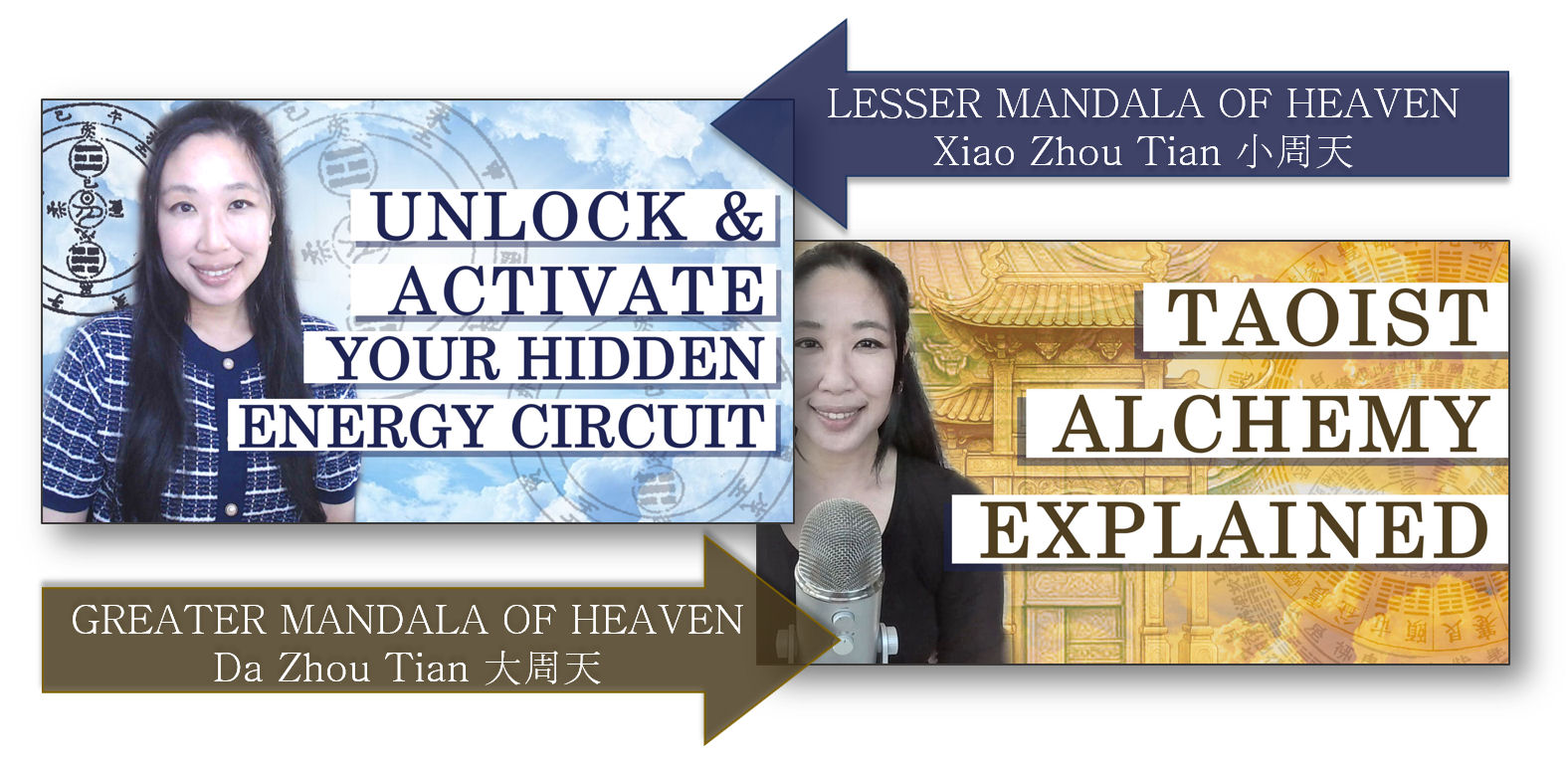
The two core lectures on the Lesser Mandala of Heaven 小周天 and Greater Mandala of Heaven 大周天 are already available free to the public, which you can access:
- A Taoist Secret to Cultivating Personal Power: On the Lesser Mandala of Heaven, Xiao Zhou Tian 小周天
- Advanced Introduction to Taoist Alchemy: On the Greater Mandala of Heaven, Da Zhou Tian 大周天
This deeper-dive cultivation practicum organizes what was introduced in those two lectures into a sequential system that becomes praxis-oriented.
The course book, which is a workbook, is a guide on how to integrate those core practices.
In other words, the two free lectures introduce the ideas. This course is where the cultivation actually happens. It is a structured container for the teachings.
The coursework expands the scope in depth and breadth, curating a curriculum to study, practice, and self-reflect on the Mandalas over a period of 100 days, guided by a 200-page course textbook, through which you will:
- Notably increase your internal vitality, awakening and actualizing otherwise untapped core powers, &
- Master the foundational principles and symbolic systems shared among many lineages of folk magic across Asia, essential in Taoist mysticism and esoteric Buddhism.
Deliverables
- A 200+ page cultivation manual and workbook (digital PDF delivered to your email inbox; you can order a printed spiral-bound copy of the book via a third-party print-on-demand site at-cost). Your course text becomes your one-stop consolidated resource with all of the following and more:
- Authoritative reference tables and diagrams
- Organized sections with clear, beginner-accessible explanations of core Taoist principles, especially in the area of inner alchemy
- Step-by-step guided practice instructions
- Canonical sources and textual translations, so that you know where these practices come from and how they were historically understood
- Reflection prompts and line space for you to log your insights and experiences right next to the reference materials– this helps to reinforce your learning, and also serves as a journal– you’ll be able to refer back what you wrote in here and assess your own progress
- MP4 downloads of just the guided meditation. I’ll send you two versions: one that has Heart Sutra musical incantations in the background layered beyind my voiceover narration, and a version that’s the voiceover narration only.
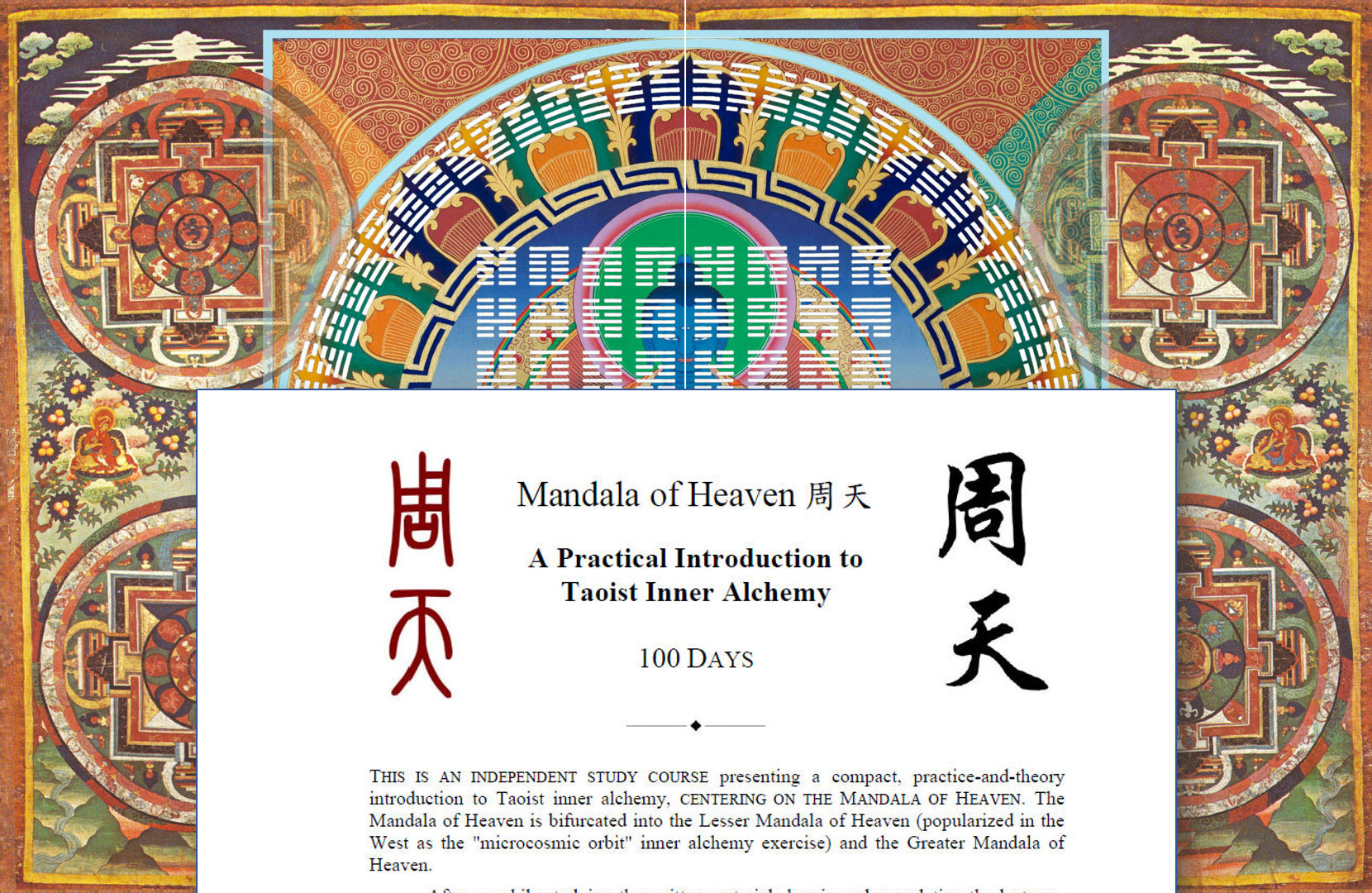
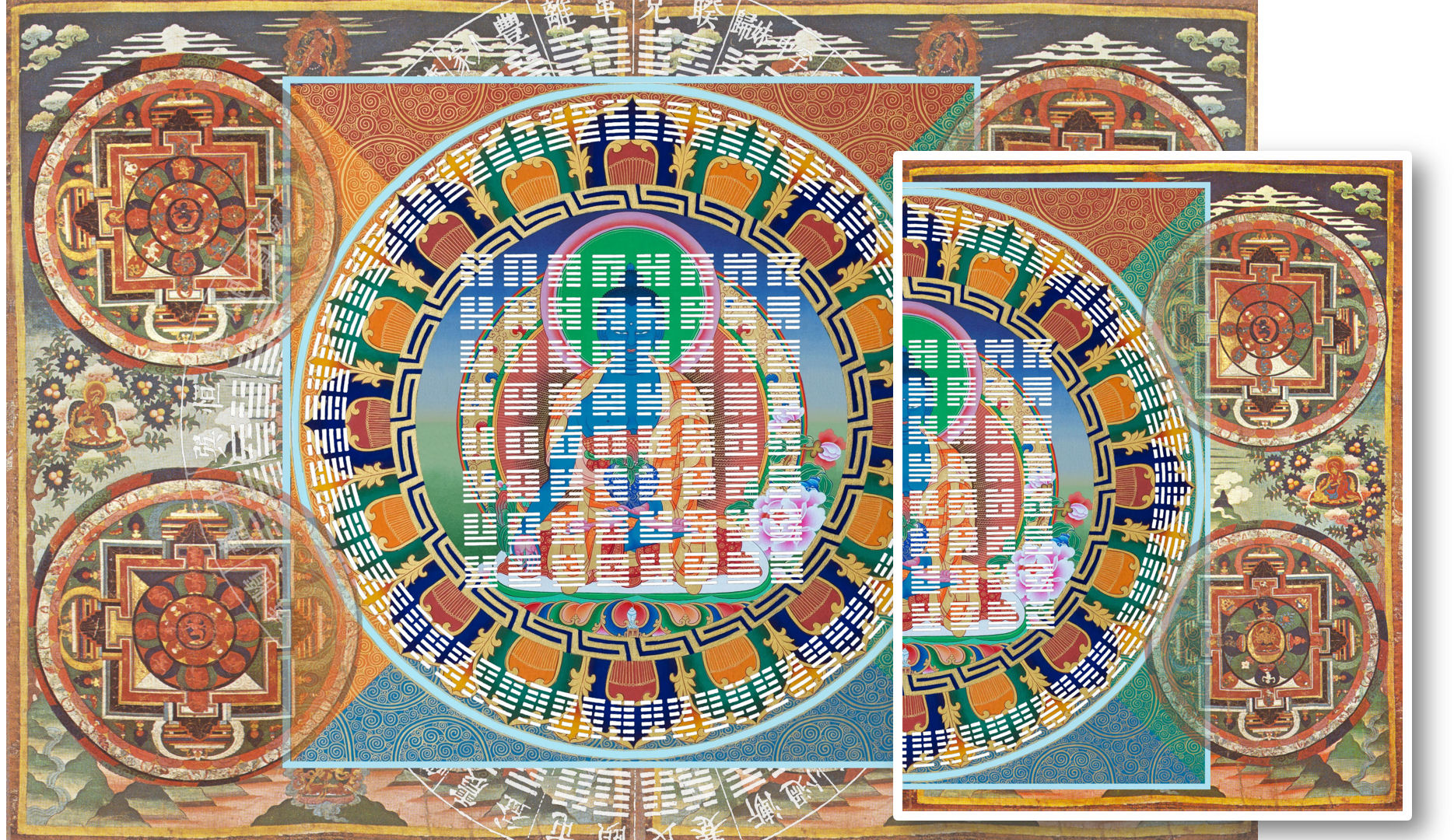
- 300-dpi resolution digital image of the cover design (17.25” x 11.25”), which can be be used for art prints, wall hangings, etc. In Taoist and various Eastern esoteric traditions, such a design would be called a form of Spirit Map (靈圖, líng tú) or magical painting (術畫, shù huà).
- Cover design features four mandalas from the post-Geluk era (circa 17th c.) representing the canonical four Buddha families and generally symbolic of a four-fold cosmological system of protective guardians.
- The central seal that spreads across both the front and back covers is the Blue Medicine Buddha. The 64 hexagrams appear both as an 8×8 square diagram and as a full circle.
- Original translations and annotations of excerpted chapters from the Dao Men Yu Yao 道門語要 (Fundamentals of Taoist Alchemy), circa 1271 – 1325, specifically the two chapters on the Lesser Mandala “運小周天之法” and the Greater Mandala “行大周天之功” with explanatory annotations
- Fundamentals is a collection of much older canonical essays compiled by Huang Shang 黃裳, a Taoist priest of the Zhongpai 中派 (Middle Pillar Lineage), a tradition of Taoist inner alchemy
dated back to the Yuan dynasty founded by the master Li Daochun 李道纯. - The essays date back to the Yuan dynasty, received texts of the Lineage, while the date of Huang Shang’s compilation is unclear, though speculated to be the Qing dynasty.
- The Middle Pillar Lineage was known for its syncretizing of Taoism, Buddhism, and Confucianism.
- The term “黃裳,” Huang Shang’s namesake, is a direct reference from Hexagram 2, Line 5 of the I Ching.
- Fundamentals is a collection of much older canonical essays compiled by Huang Shang 黃裳, a Taoist priest of the Zhongpai 中派 (Middle Pillar Lineage), a tradition of Taoist inner alchemy
- QUESTION & ANSWER WITH BELL | Course Participants Only FAQs Page. Email me your questions and I’ll compile the Q&As into a password-protected page for course participants only. This is your opportunity to ask me any questions you have related to these subjects.
- Admittedly I’m not great at responding to emails, especially ones with questions that may involve a thoughtful, thorough reply. But the questions submitted through this course curriculum will be prioritized, and I’ll answer them via multimedia formats on a password-protected FAQs page.
- You can ask anything related to this subject matter. Or ask how I personally practice, or apply certain principles. Feel free to ask about my perspective, or ask the questions on Taoist mysticism that you can’t seem to find anywhere else in English.

Download the
Course Syllabus
Through the framework of the Lesser and Greater Mandalas of Heaven, this course introduces the foundations of classical Taoist inner alchemy. It will consist of studying translations and annotations of canonical source texts on the Mandalas of Heaven, guided practice, and reflective work.
Download an Excerpt
Read the First 49 Pages
For a sampling of what’s in the course book, click on the above link to a PDF to read the first 49 pages, which outlines your learning objectives, gives you the table of contents, and introduces the premise of this Work.
Who This Course is For
What I love so much about this coursework and why I’m enthusiastic about offering it is its versatility. While it is clear that I am talking about Taoist alchemy, the practices can be universally applicable. Because at the end of the day, this is about strengthening your core.
Also, you’ll see that we’re often talking about Taoist alchemy through a Buddhist framework, which is common in the indigenous practice of Taoist inner alchemy. (Likewise, you’ll find Taoist metaphysical principles integrated into Mahayana or Zen Buddhist practice.)
This is For Practitioners Seeking Personal Mastery
No matter what your spiritual path is or tradition of work, these core practices will augment your core strengths as a practitioner – as a person – and help guide you to cure your own weaknesses.
In fact, learning about a tradition that’s very different from your own might help you to think outside the box about your own tradition, and arrive at new insights and revelations, or come up with new ways to augment your current practices.
This is For Those Wanting Greater Personal Power, Control, and Spiritual Insight
Complete this coursework and you will come out the other side with much greater control and command of your own core strengths, powers and abilities. It can help you to reexamine your own traditions from a different angle, and thus think outside the box more creatively, arriving at heightened insights about your own Work.
This is For Students Interested in Eastern vs. Western Approaches
Western medicine — and, I find, western ceremonial and folk magic — tend to focus on immediate impact and results. Eastern medicine and magical practices tend to focus on preventive care, preliminary work, prerequisites, and building strong foundations. (“Wax on, wax off…”)
This is For Practitioners of Any Tradition Seeking Universal Foundations
So even if your spiritual or magical practice does not stem from Eastern traditions, many of the foundational principles of inner alchemy (such as energy cultivation, purification of the subtle body, harmonizing polarities, aligning personal will with the greater cosmic flow, etc.) are universal.
This is For Qi Cultivation, Martial Artists, and East Asian Esoteric Practitioners
Practitioners and enthusiasts of qi gong, tai chi, martial arts, East Asian meditation practices (be that Buddhist or Taoist traditions), Taoist folk magic or ritual magic, and anyone who wants a historically-grounded, practice-oriented introduction to Taoist inner alchemy will advance significantly after working through this material.
This is For Diasporic Asians Reconnecting with Ancestral Heritage
I hope Diasporic Asians, especially those originating from the Sinospheric regions, who seek closer connection to their cultural heritage and ancestral roots will find that through engagement with core Taoism. This coursework is an easy-to-follow yet comprehensive introduction into your ancestral magic — it will help you to remember. So much of the knowledge I’m sharing through this coursework is already inside of you, hardwired into your spiritual DNA, and now it’s just a matter of your own self-awareness. And also, I think learning about Taoist inner alchemy demonstrates and shows you just how cool our cultural heritage is. =)
This is For Those Seeking Canonical Structure and Primary Sources
The canonical teachings in this course offer a millennia-established framework through which to understand alchemy. By studying Taoist alchemy, you can start to see parallels, find common denominators, and thus better articulate first principles. Inner alchemy in particular is how you amplify your core strengths, and then you can take that as far as you want to go, be that simply improved overall health and wellness, physical and mental, or the spiritual path to immortal Return (還丹, huan dan), attainment of the Golden Elixir (金丹, jin dan), knowledge and understanding of the secrets of the Golden Flower (金華, jin hua).
This is For Anyone Seeking to Integrate Taoist Alchemy Into Their Existing Path
This course provides a way to integrate these traditional insights into your own existing path, enriching your practice through a comparative lens and offering tried-and-true methods to complement and deepen your current spiritual work.
We expand upon the practical element introduced in Part I by explaining the theory behind those practical elements. The fundamentals taught in Part II builds the conceptual scaffolding for the Greater Mandala by covering:
- the ultimate spiritual purpose of Taoist alchemy,
- symbolic numerology,
- transition from unit circle (the orbit) to a figure-eight (lemniscate) pathway,
- the directional guardians and the Mysterious Gate 玄關, and
- the functions of a merit-based visionary practice.
To round out the discussions, we’ll be covering:
- Jupiter as the Greater Mandala & Tai Sui 太岁
- Eight Essential Circulatory Meridians 奇經八脈
- Do You Have Free Will?
- Transmission of the Elixir (chuan dan, 傳丹); textual vs. oral instructions in Taoist inner alchemy traditions
- Movement of the inner deities (nei shen, 內神); function of deity as symbolism in Taoist alchemy
- The “Five Dragons Supporting the Sage” 五龍捧聖
Course Objectives
- Strengthen your physical, mental, and spiritual core through the Lesser Mandala cultivation practice
- Learn the symbolic, cosmological, and also ethical logic behind the Greater Mandala cultivation work
- Integrate classical principles in Taoist inner alchemy into your line of work, to enhance and empower your capabilities
This course is not guru or master centered; it is source text centered, but don’t mistake it as being academic. We are working directly from canonical source material and showing how to operationalize these teachings. At all times our emphasis is on ethics, safety, and gradual, effortless refinement, guided by the Six Classical Omens.
A Note on “Dangers”
You may have heard warnings about microcosmic orbit practices. The warnings are fair, because there are a lot of bad faith teachers (or more accurately, profiteers) out there.
This guided cultivation course work very carefully and in great painstaking detail codifies safety precautions and methodologies. Basically, read this workbook, follow its guidance, and yes, you avoid the pitfalls.
We emphasize breath regulation over force; we talk about visualization strain and delusions or hallucinations; and we spend a whole lot of time (maybe more than you’d like) on ethical grounding.
The course is intentionally not guru or master centered, though is very much still in alignment with Mahayana Buddhist and canonical Taoist traditions. This is source-text centered, and may upon first impression feel like it’s a bit “academic,” but it’s wholly practice-oriented, I assure you.
Instead of learning from a guru or master who is interpreting (if even that…but I’ll stop here and not derail into a critical rant…) the tradition for you, I am presenting the primary source texts to you, and hand in hand, together, side by side, we will interpret those primary source texts together, glean our own insights from them, and apply our own insights to establishing a practice.
Which is a reminder to say, sure, in many places I share my thoughts and perspectives, how I interpret the source material, but it’s in the form of a conversation, not a dictation. I’m not saying it from a position of authority; I’m saying it as a friend and colleague, but maybe one who’s super-nerdy and has spent an inordinate amount of time deep-diving into these texts, commentaries on these texts, practiced the methodologies taught in these texts since early childhood, learning from multiple lineaged masters and renowned spiritual teachers in both Taoism and Buddhism, and who was born and raised in the cultural tradition these practices come from who will happily be your English-speaking guide.
I’ve spent almost a full year mulling over how best to curate this content in a way that will be highly effective for you, and is also spiritually responsible for me. And this was what I came up with.
The 100-Day Framework
For 100 days, weave these practices and studies into your everyday life, to whatever extent makes the most sense for you.
Also, the “100 days” is not gospel — maybe for you, the period of time will be less than 100 days, maybe it’ll be more. “100 days” is just an easy, memorable reference point, but also, if you actually commit to this for a full 100 days, you’re going to make leaps and bounds in your developmental progress, physically, mentally, and spiritually.
Follow as you will day by day, or compress it into just 30 days for a total immersion, or simply study the contents purely for the theoretical and cultural knowledge. Work with the contents at your own pace.
Is the Full 100 Days Required?
While I encourage your personal commitment to yourself to run this through a 100-day guided course because that’s how you will reap the most benefits and maximize its offerings, I also wasn’t born yesterday.
So at every turn of the guided coursework, I’m being mindful of how it can still be utilized in fully personalized, individualized ways and in less time.
You don’t have to approach the content as a 100-day practicum; you can adapt it to a seven-day immersion just to trial-test the principles, or simply read through the workbook and take notes, just for the theoretical and contextual understanding of Taoist alchemy, which truly is the foundation of any other Eastern metaphysical branch of study you might pursue, from Traditional Chinese Medicine, martial arts, or feng shui to Taoist ritual magic, divination methods, and indigenous folk shamanistic practices. It is also the practical, hands-on application of the I Ching cosmology.
Journaling Prompts
Yeah, yeah, some of you who self-identify as “oh so serious” practitioners poo-poo journaling prompts, but here’s why I include them. In traditional pedagogy, the master teacher will ask open-ended questions of the student, and the student answers. Having gone through this method of tutelage myself as a student, I can attest that it’s basically journaling prompts, except instead of writing it out for myself, I’m saying it aloud to the master teacher.
The master teacher will rarely give feedback or be responsive, so it’s not like we’re having a conversation anyway. It’s just like journaling, because as soon as I answer, the teacher asks another question, which I have to answer, and again, no direct responsive feedback. (Unless I really, really mess up. No feedback is good feedback. Actual feedback means you messed up somewhere.)
And so I think journaling prompts is not an equivalent but a good enough substitute for the traditional approach. The teacher’s objective for asking questions, but not necessarily giving responsive feedback, is to get you to start critically thinking about your own experiences and reflecting on your insights. If the teacher gives too much feedback, there is a risk of leading you down a particular path, and most wise teachers want you to find your own path. So they won’t want to do too much talking anyway.
Zhou Tian 周天 (Mandala of Heaven) is classical doctrine in Taoist alchemy, both inner (neidan) and outer (waidan) cultivation. This expanded workbook to the two free public lectures goes more in-depth, designed as a 100-day period of study and spiritual cultivation practice.

How to Order
$40 USD
- Send the tuition cost noted above via PayPal to the e-mail address abelldelivers@gmail.com. Yes, it’s going to say “James Zhang from Castro Valley.” That’s the Hubby. Also, this is the preferred method of payment. (~or~)
- Pay with your credit card by following this link: https://www.paypal.me/benebell. (~or~)
- Only if (1) and (2) are impracticable for you, pay by ordering me an Amazon Gift Card, sent to abelldelivers@gmail.com. Direct link to Amazon gift card orders here.
- When you send payment, please include:
- Your name or a name identifier for me to reference you by,
- The course name you are ordering, (~and~)
- Your e-mail address, so I know where to send your ordered course materials to.
That’s it!
But if any of that sounds confusing or you just don’t know, no worries. Email me at abelldelivers@gmail.com to let me know you want to place an order. We’ll take it from there together.
Once I receive your payment as the purchase order, your course materials will be delivered to the e-mail address you specified within 5 business days.
If you don’t receive the course materials in the e-mail inbox specified within the two business days, then something went wrong. Doh! Please email me at the below address asap.
abelldelivers@gmail.com
DELIVERY NOTE: So far I’ve been good about getting the course materials to you in less than 48 hours from when I receive the PayPal payment, so if that time has gone by and you haven’t received anything from me, first check your Spam folder. Second, check to see the e-mail address associated with your PayPal account. I may have sent it to that account if no e-mail was provided in the notes section of the transfer. If still nothing, then something went wrong somewhere, so contact me at the above e-mail addy ASAP so we can get things squared away.
Pricing Philosophy
The core lectures that the course content is structured around are all publicly available on my YouTube channel and will remain free. It is my belief that these teachings should be accessible, and what’s going on economically in your life right now should not be a barrier to access to esoteric knowledge.
What this supplemental course offering does is provide structure for active, applied practice of the course content. The textbook gathers, organizes, and systematizes the information into a more coherent step-by-step cultivation path, in addition to providing the direct translations of the primary source text so you can experience the “source of truth” for yourself.
Also, this supplemental course’s main organic feature is the Q&A (or FAQs). As you deep-dive into the course content, when questions arise, now you have someone you can ask the questions to directly. The FAQs will be presented in multimedia form — sometimes I’ll provide the response written out in text, other times I might find it makes more sense to turn on the camera and record a quick (maybe?) video response.
And then, for all that, the idea behind the $40 is, in exchange for the extra effort, you’re buying me a nice dinner. =)
 benebell wen
The FAQ post is password protected. I can’t read the FAQ post.
LikeLike
Same problem. I thought I knew the blog password.
Is the password specific to those that have already purchased the program?
LikeLike
Hi, yes, apologies for the confusion. The way WordPress site design is set up means there’s no other way for me to set up such a password-protected course-only page other than as a “blog post” with those features.
Yes, the FAQs page is for course participants only, where I provide Q&As on the course content.
If you have specific questions about the course prior to purchase, please feel free to leave them here! ❤
LikeLike
Hi, yes, apologies for the confusion. The way WordPress site design is set up means there’s no other way for me to set up such a password-protected course-only page other than as a “blog post” with those features.
Yes, the FAQs page is for course participants only, where I provide Q&As on the course content.
If you have specific questions about the course prior to purchase, please feel free to leave them here! ❤
LikeLike
Hi! I want to get the spiral bound physical copy of the textbook. Where can we order it?
LikeLike
In the email with all the course content, you’ll see a lulu.com direct link. Click on that link and it’ll take you to the third-party print-on-demand site where you can order a physical spiral-bound copy of the textbook at-cost. Thanks!
LikeLike
I have purchased the Mandala of Heaven Taoist Inner Alchemy course. How do I access the online materials, the password protected FAQ page, etc.? Thanks
LikeLike
I have purchased the inner alchemy course. How do i access the FAQ page and the MP materials etc?
LikeLike
Pingback: Crisp and Blossoming – ~ Singing Gecko