
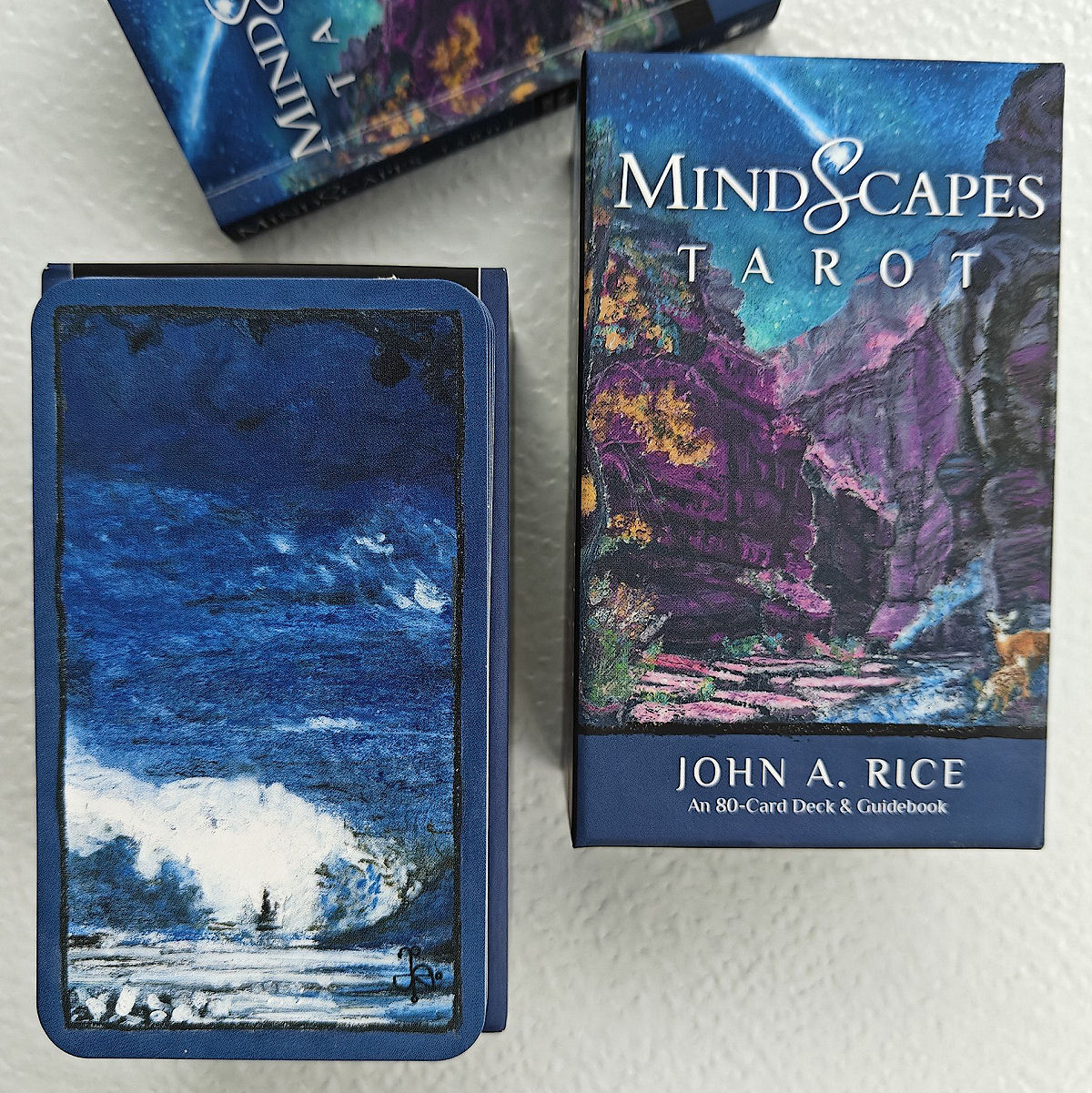
The Mindscapes Tarot by Jon A. Rice reimagines the seventy-eight archetypes of the tarot as genii locorum, spirits of place. Each card becomes a landscape imbued with its own consciousness, where the environment itself embodies the message. Rather than relying on human figures, Rice lets terrain, light, atmosphere, and color palette serve as the language of the archetype. The result is a meditative exploration of how spirit expresses through land, with each card a window into an immersive world.
Like many tarot decks conceived in recent years, Mindscapes Tarot was birthed during the pandemic. It feels especially poignant that a deck devoted to landscapes and many worlds was born during a time when we were all sheltered-in-place. When travel was restricted and the physical world felt distant and uncertain, the artist turned inward, journeying through imagination rather than geography. The resulting images captures a longing for openness and connection.
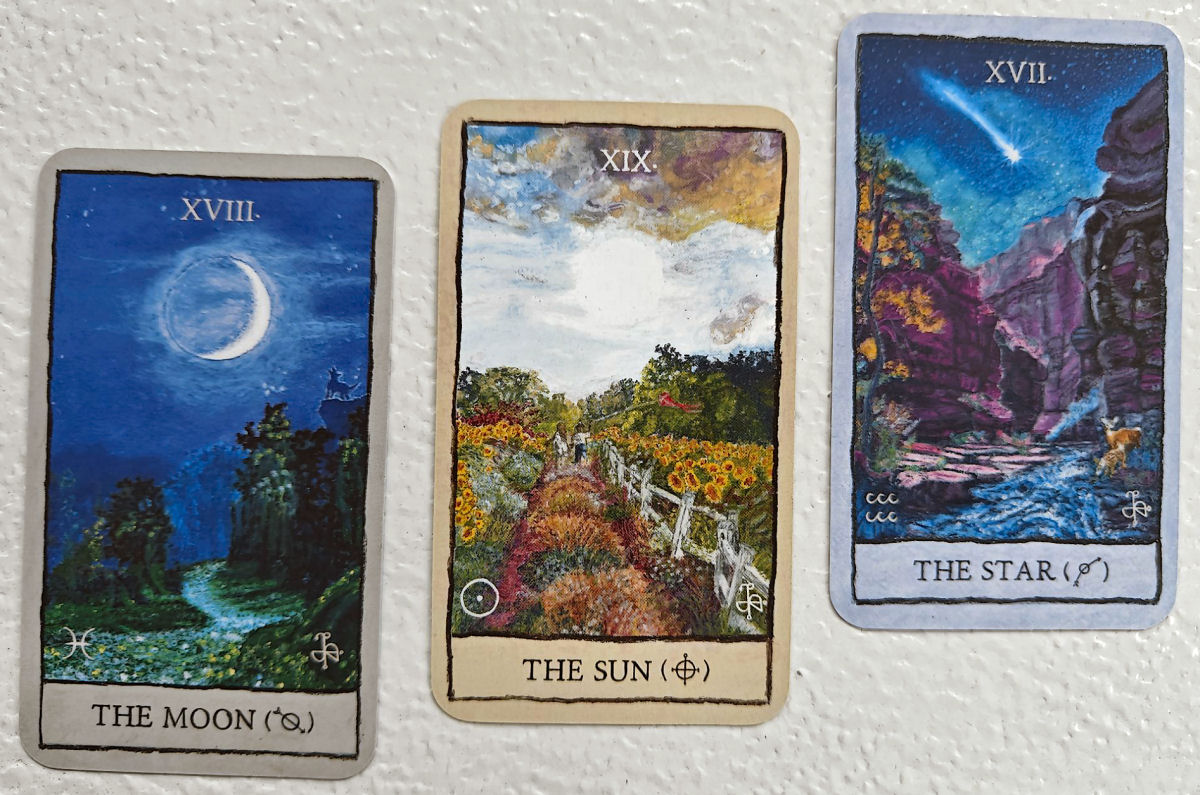
He started the project with The Moon, and then The Sun, and then The Star, that Celestial Trio. Over the next five years, this complete deck that became the Mindscapes Tarot. Each card opens a window onto a vast space, some untamed, and some tamed, depicting mountains, valleys, coastlines, forests, meadows, and town and city scapes.
Mindscapes is a fully hand-drawn deck in oil pastels, brought into being in defiance of our digital age. I love the richness of the textures and raw, tactile presence in the medium. This grainy surface gives the deck art life, expressive of its qi life force. Rice’s background in filmmaking can be seen in these cinematic vistas. You feel as if you can step into any of these scenes.
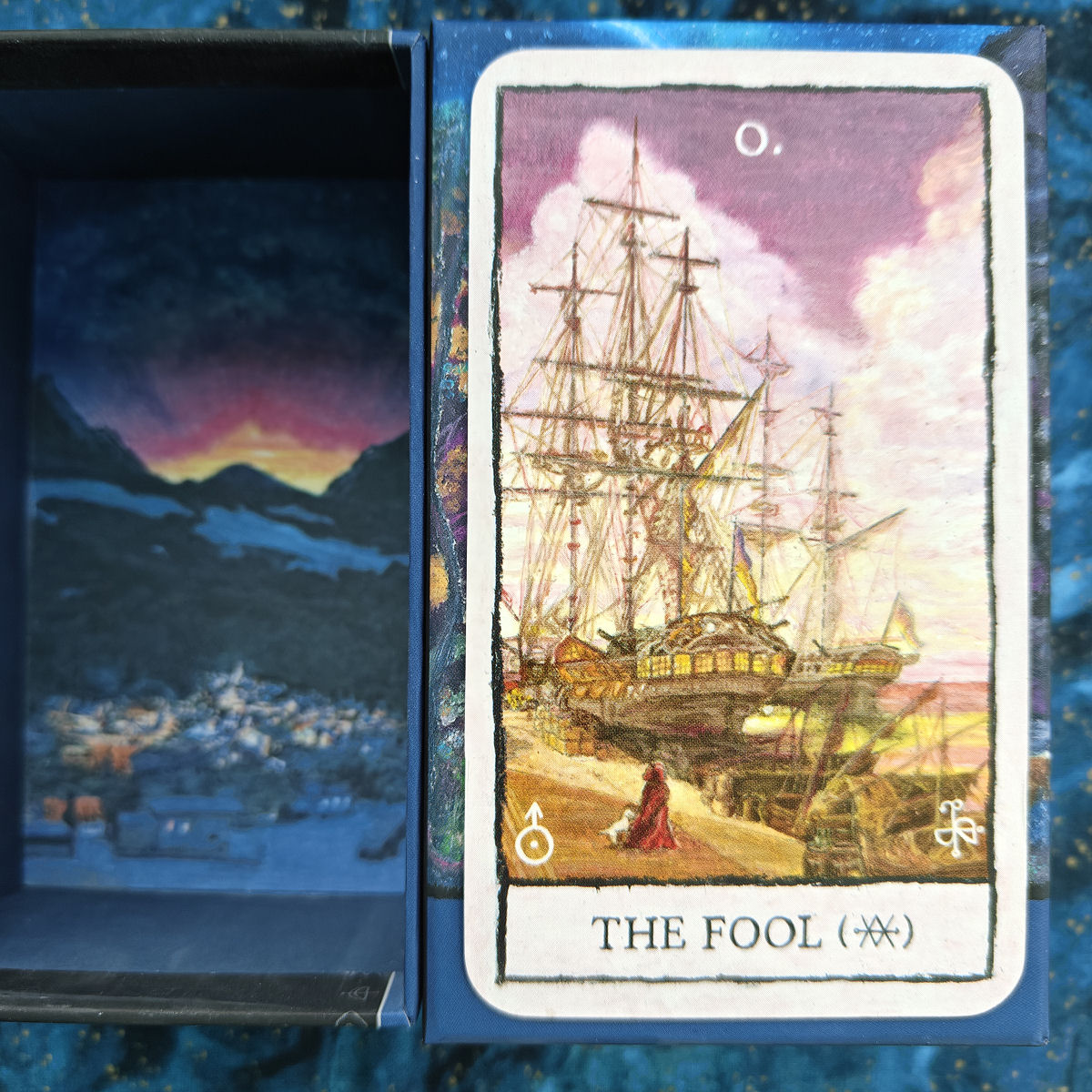
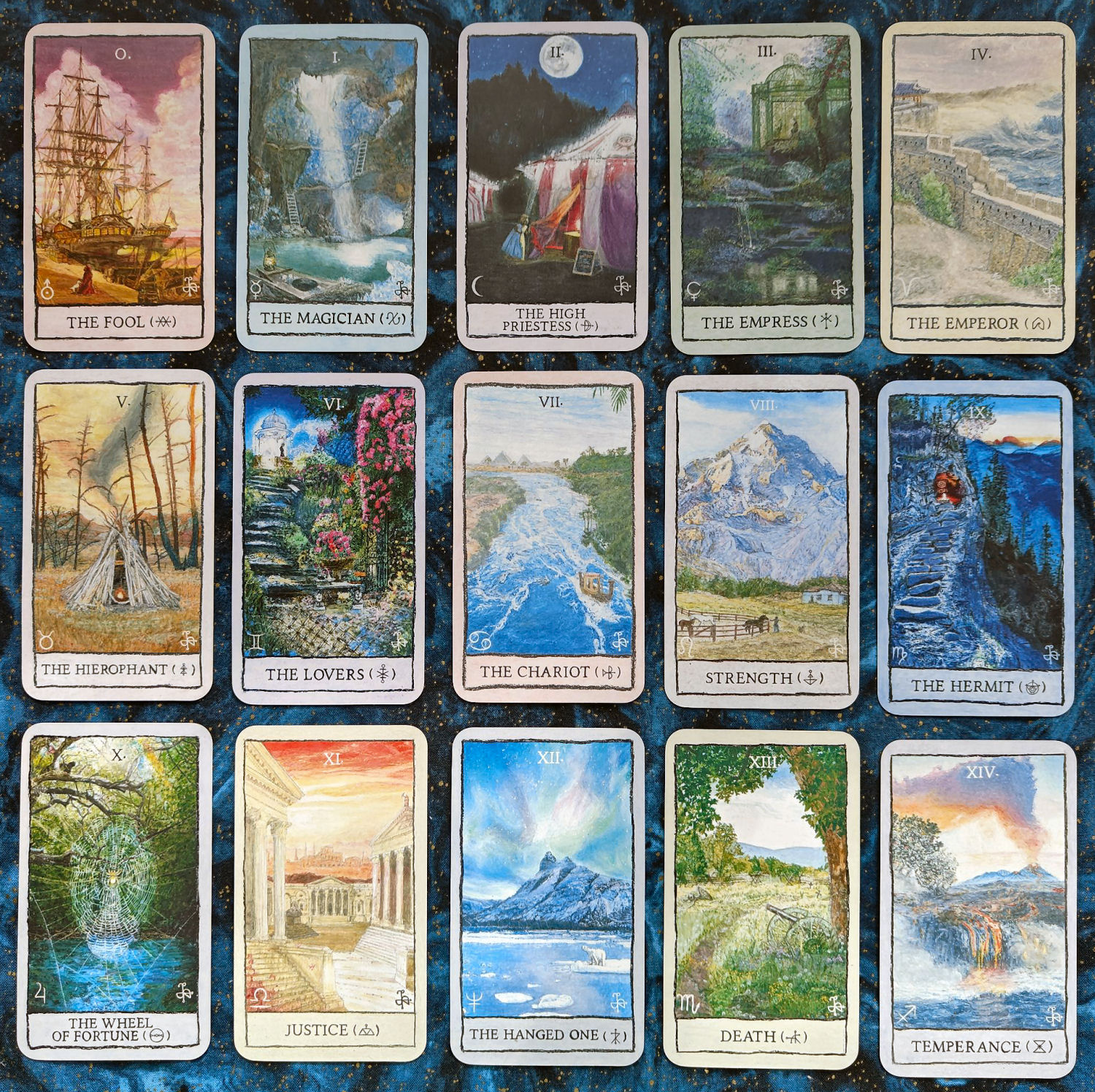
The story this deck narrates begins with The Fool card, with an unseen stowaway (the red-cloaked figure at the bottom foreground with the iconic white dog). Each subsequent card represents a stop along that stowaway’s journey.
As for art style, it is perhaps best described as a blend of Romantic and Symbolist influences, with Impressionistic undertones. Each landscape feels so emotionally charged, suffused with atmosphere and mood. The sharpness or fluid lines of the landscape, the colors of the sky, light and shadow, flow of water all seem to be metaphors that express inner states. The velvety strokes and layered gestures from the pastels medium is sublime.
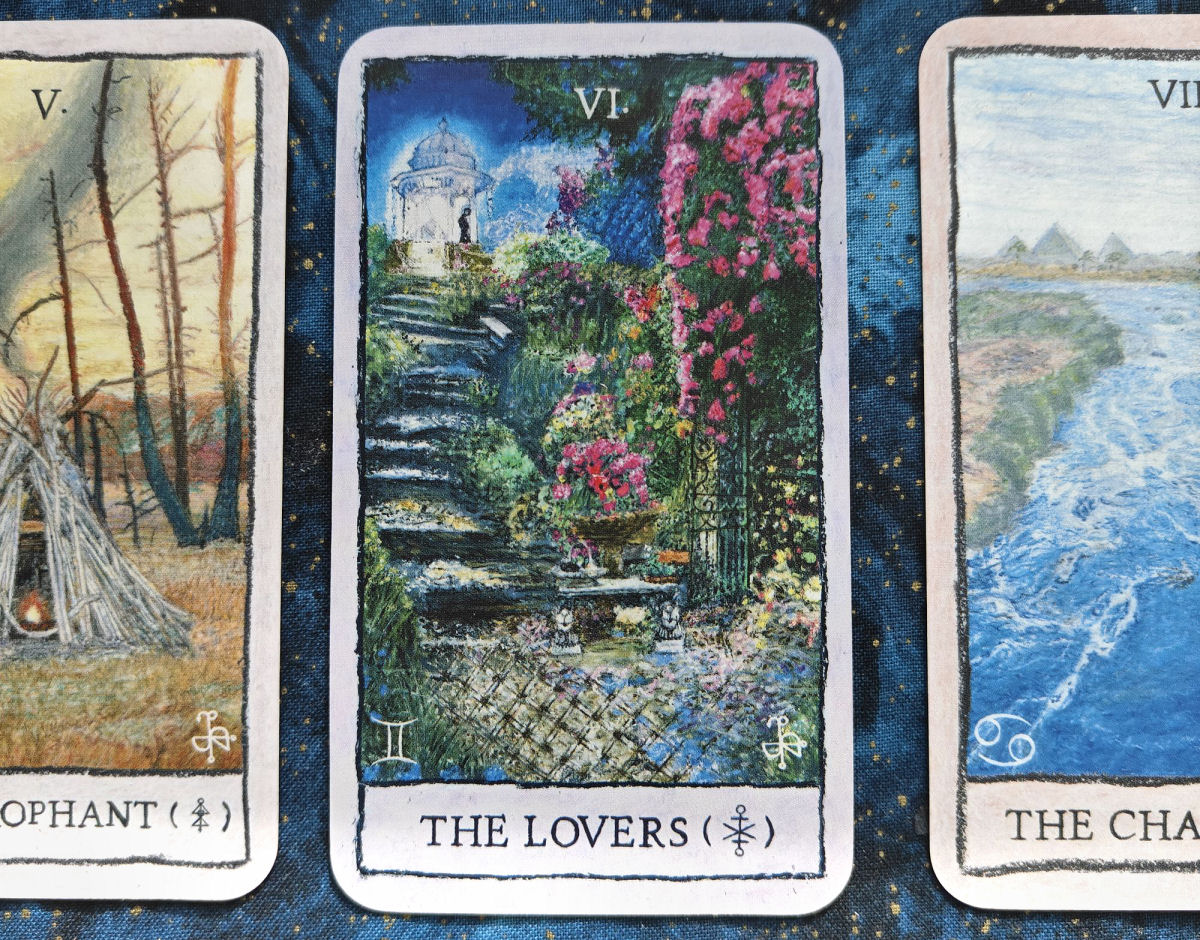
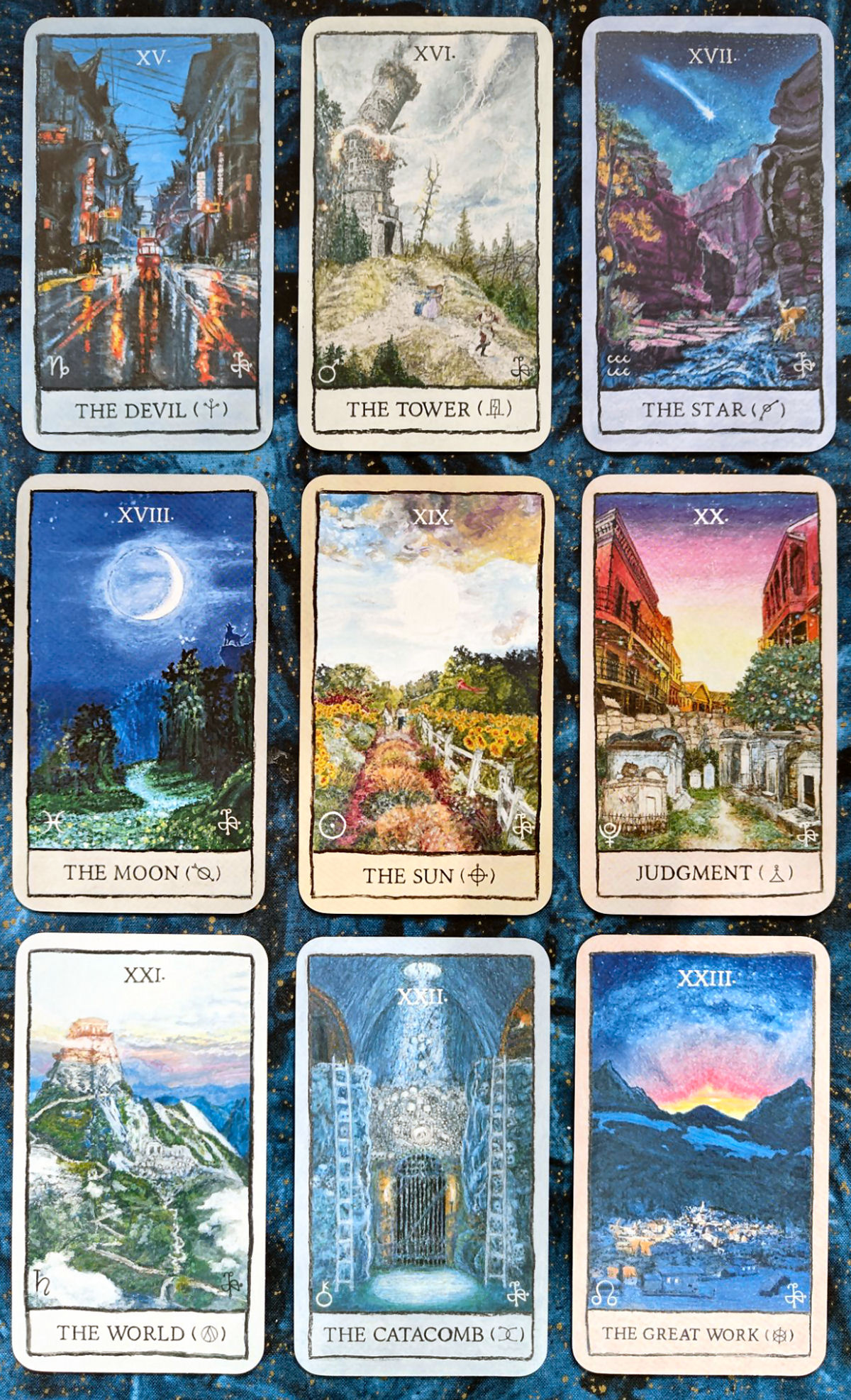
You’ll notice sigils on the Major Arcana cards. In the bottom left hand corner is the astrological correspondence, and alongside the card title or caption line, the artist’s own conceived sigil for each tarot card archetype, revealed to him through personal ritual, journaling, and meditations. The artist’s signature sigil for his name is found in the bottom right corner, a bit reminiscent of Pamela Colman Smith in the RWS.
The Minor Arcana suits are expressed through four different categories of landscapes: Branches, Tides, Spires, and Stones. In creating a deck centered on these elemental forms, Rice provides both a meditation on our connection to the natural world and a visual escape that transcends physical limitations and restrictions.
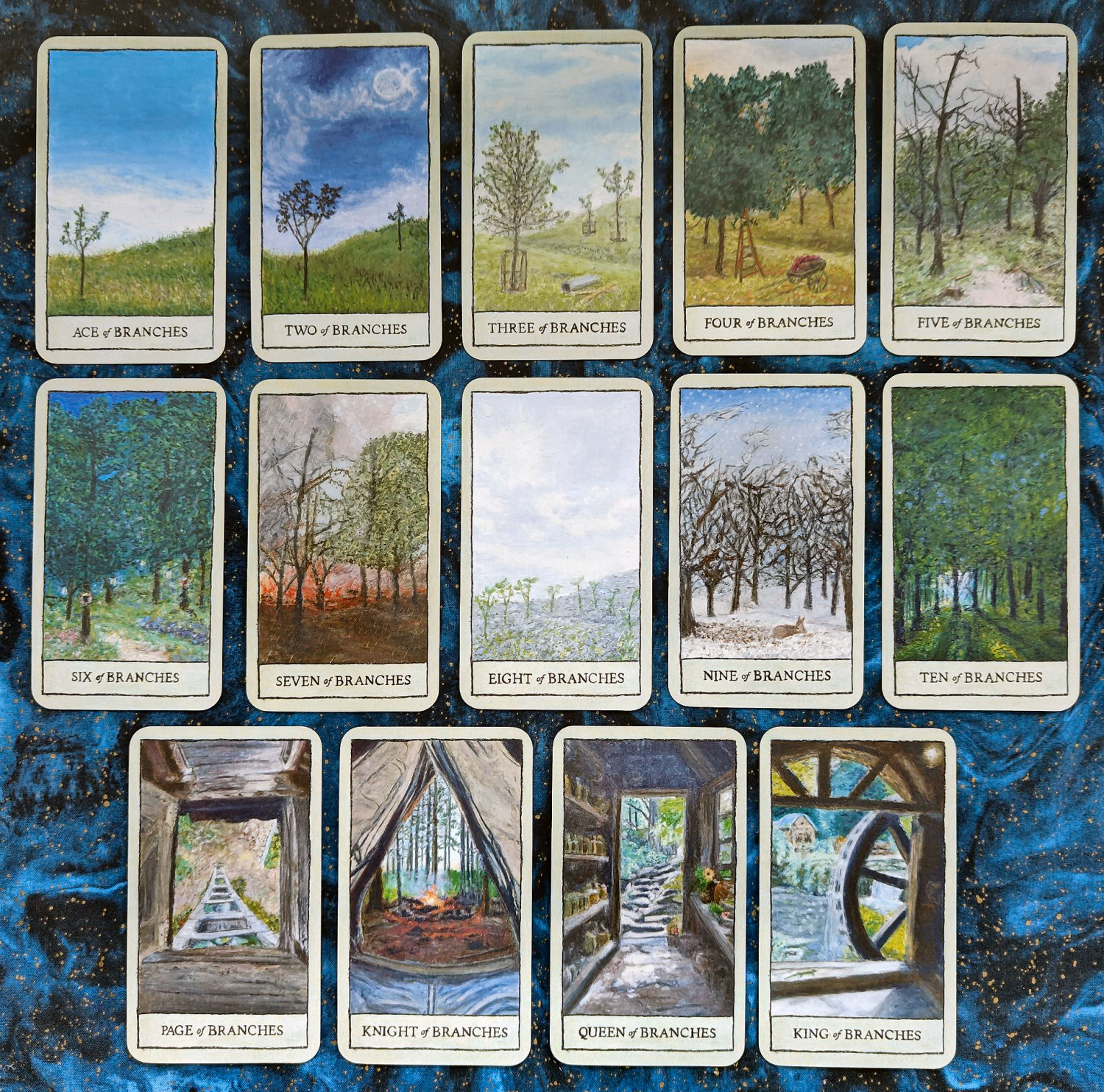
The Suit of Branches (corresponding to the Wands) unfolds through the imagery of trees and forests, symbolizing inspired action and the creative Will in motion. From the tender sapling of the Ace to the lush, mature woodland of the Ten, we watch the full arc of growth, the life cycle of a forest mirroring the journey of a vision or creative idea developing from spark to fulfillment. Along the way, we see the trees ravaged by wildfire in the Seven, the aftermath in the Eight, snowfall in Nine, and then growth and renewal in the Ten.
The Page of Branches features a tree house, the Knight of Wands is the scene of a campfire in the woods, the Queen of Wands depicts a root cellar, a metaphor of the hidden self, and the King of Wands is a pastoral scene at a mill. There’s a fun little eager egg here, too– a salamander basking in the sunlight on the window ledge.
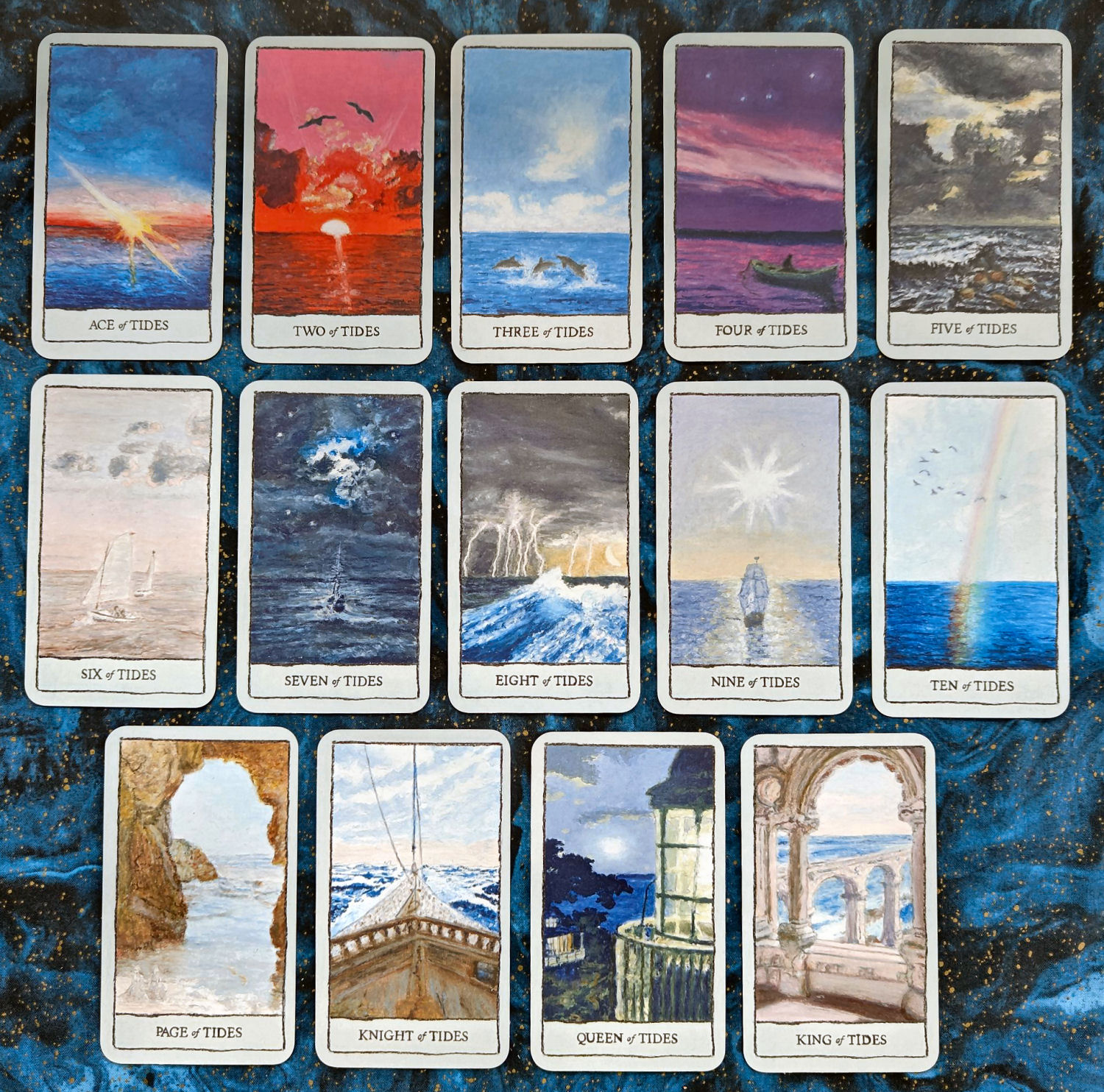
The Suit of Tides, corresponding to Cups, charts the ebb and flow of the ocean as a mirror of our emotional lives. Through a series of luminous seascapes, the artist luminously captures both the vastness and volatility of feeling, expressive of how our human emotions rise, recede, and transform like the tides.
The Ace of Tides opens with a sunrise over the open ocean, a moment of pure potential. By the Two of Tides, that same horizon glows with reds and pinks, the warmth of connection and reciprocity. Each card feels like a fleeting, deeply felt moment suspended between sea and sky, rendered with striking emotional resonance.

By the Nine of Tides, the sun has begun to set, a scene of return and quiet fulfillment– a homecoming. The Ten of Tides brings that journey to culmination, a masterful interplay of light and shadow: the ocean below in descent to ever opaque and dark, the horizon above luminous and translucent, evoking both completion and transcendence.
Among the court cards, the Page of Tides features a rocky alcove framing a view of the oceans; Knight of Tides stands at the bow of a ship, the Queen of Tides watches steadfast from a lighthouse, and the King of Tides reigns from a seaside castle, each one a facet of emotional mastery and navigation through the waters of the heart.
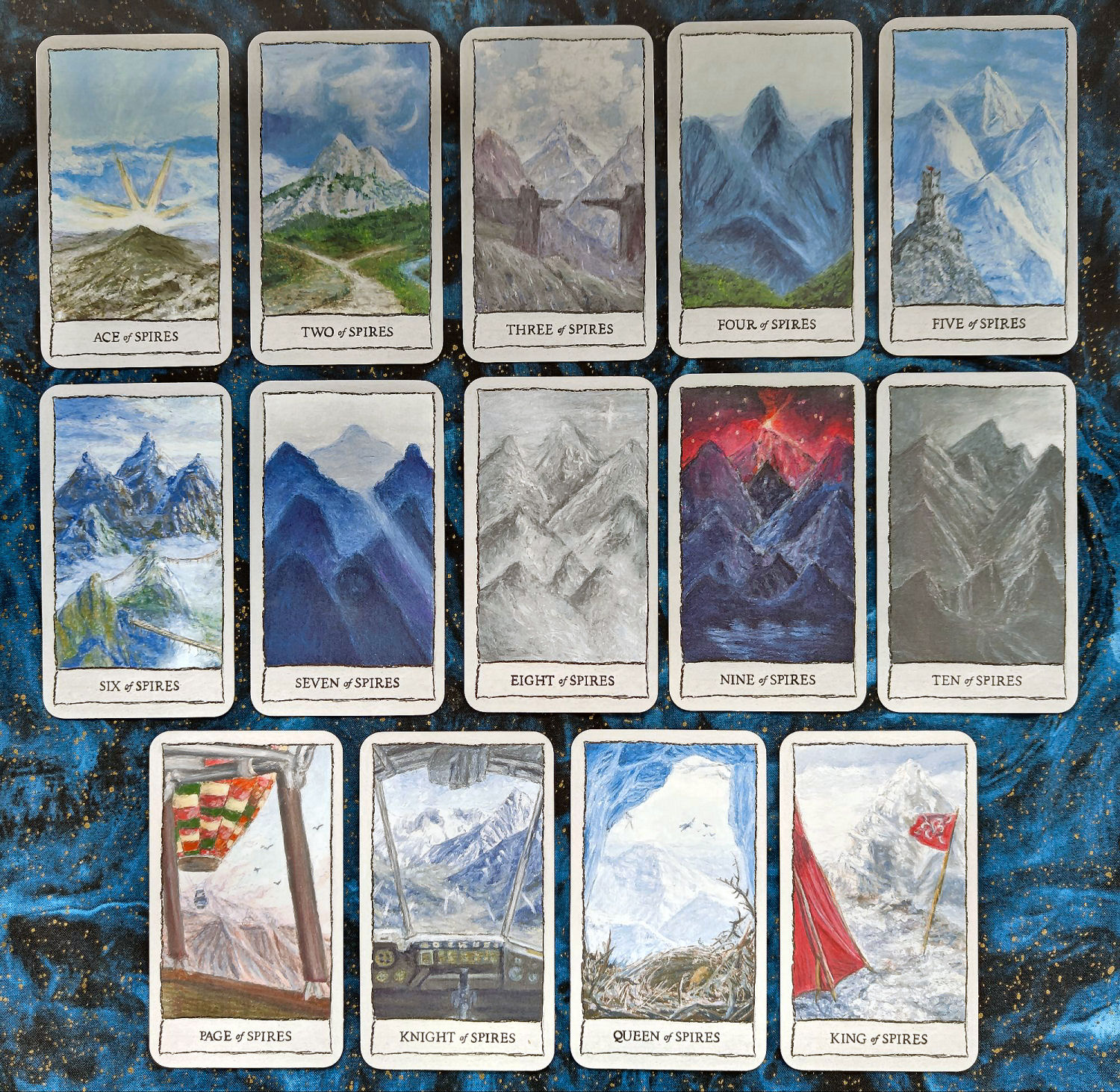
The Suit of Spires, corresponding to Swords, ascends into the realm of Air, intellect, and the mind. Here, Rice renders lofty mountain peaks that range from serene to foreboding, embodying both the clarity and turbulence of thought. I especially appreciate the interpretive structure of this suit: from Ace through Ten, we encounter untouched, elemental landscapes, like pure expressions of nature in its grandeur. Then, in the court cards, traces of human presence begin to appear, subtly suggesting our evolving relationship with knowledge and mastery.
The Page of Spires shows the landing of a hot air balloon, a symbol of curiosity and exploration; the Knight of Spires depicts a lone jet navigating through storm clouds, courage meeting adversity; the Queen of Spires depicts an eyrie nestled in a craggy cave overlooking crystalline peaks, and the King of Spires has claimed the mountain summit.
If I have one gentle critique, it would be that the imagery in this suit, particularly Seven through Ten, can feel somewhat repetitive in composition. While each is beautifully rendered, they echo similar forms and tonalities. A bit more visual variation might have heightened the narrative arc of ascent and challenge that defines this suit. Even so, the overall effect remains cohesive, and the Spires succeed in conveying the intellectual rigor and atmospheric power emblematic of the Swords.
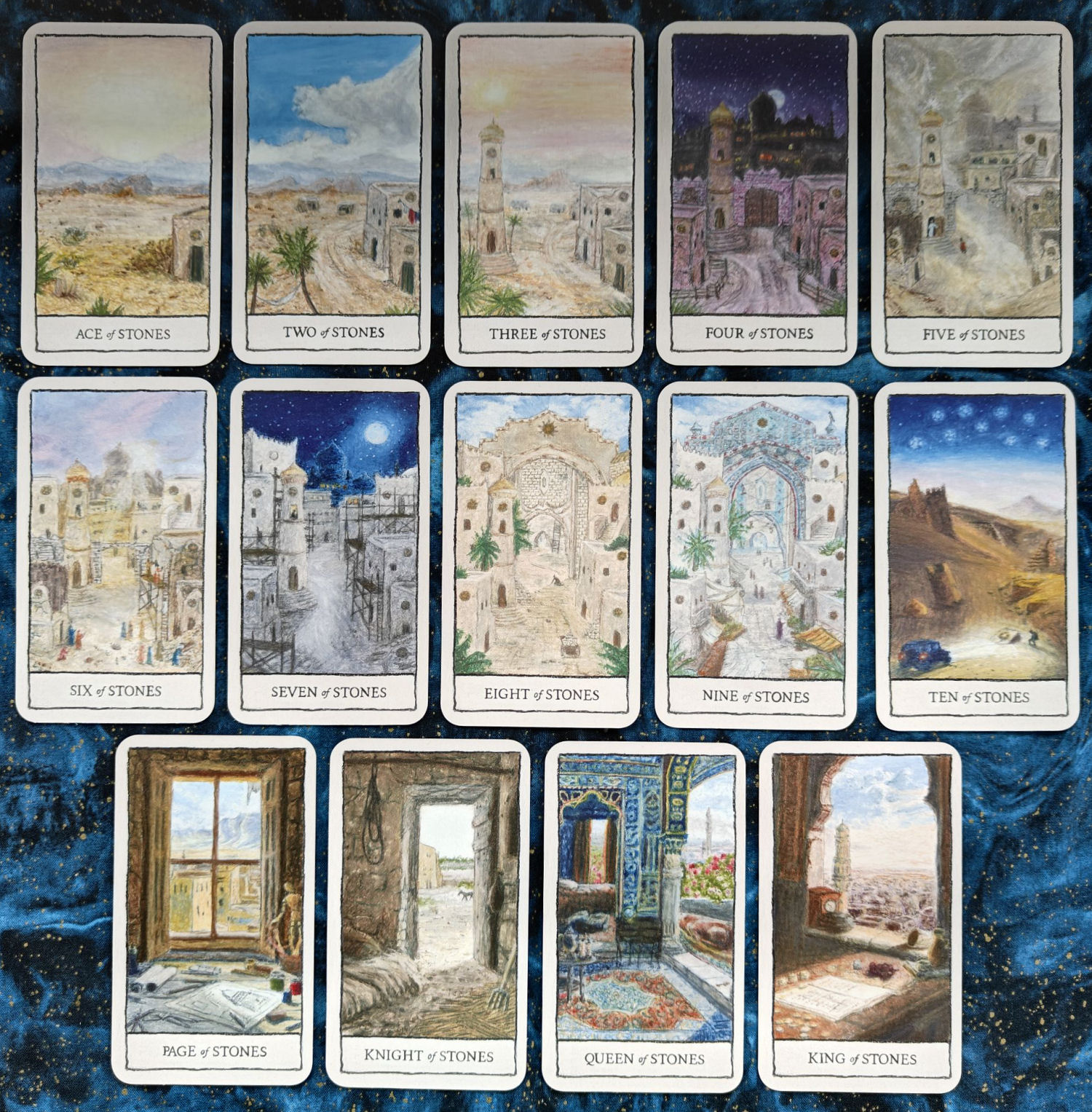
For the Pentacles, here we have the Suit of Stones. Here, the scenes turn our gaze from the natural to the constructed world, exploring the evolution of human civilization and the structures that give shape to our lives. Rice envisions the landscape as the foundation upon which culture rises, tracing the development of cities across millennia. The suit unfolds as a meditation on endurance, craftsmanship, and the human impulse to build meaning into matter.
From the Ace of Stones, where the first signs of habitation emerge against an untouched horizon, to the Two of Stones, where a second dwelling appears and community begins to take form, we witness civilization slowly awakening. By the Five of Stones, the settlement faces hardship, weathering a sandstorm that tests its resilience, and in the Six of Stones, villagers gather to rebuild.
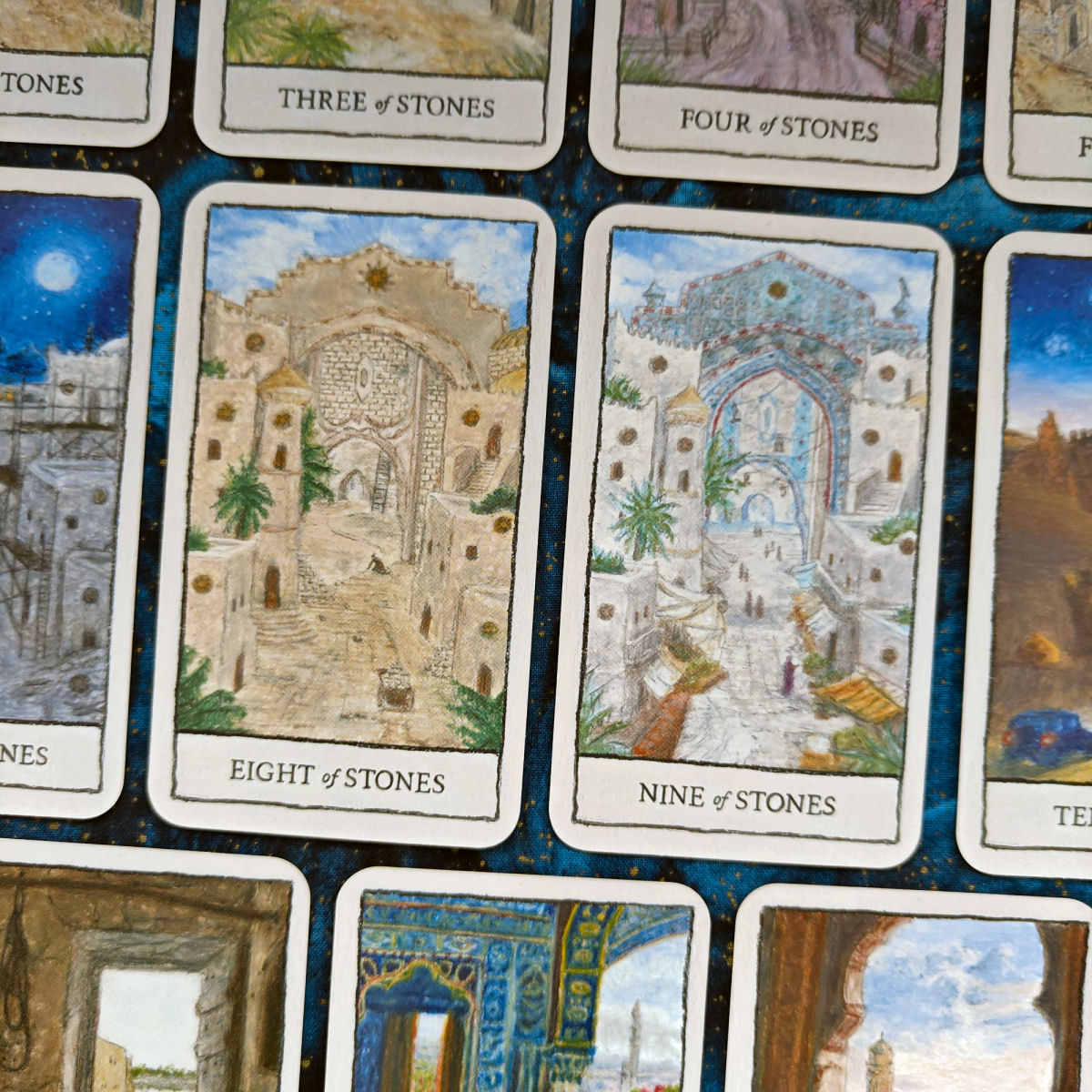
The city has been rebuilt in the Eight of Stones, sturdier than ever, yet the stark colors note its focus on the pragmatic and practical. It’s then in the Nine of Stones that we see the city in full bloom and glory, thriving in the golden light of its prime. Finally, the Ten of Stones transcends time itself: a lone explorer in a Jeep approaches the ruins of that once-great city beneath a starry night sky. It’s a quietly moving image with a beautiful, moving, and emotional color combination – the deep blues and the sandy browns. This is the modern world paying homage to its ancient foundations, the living recognizing their ancestors in the stones.
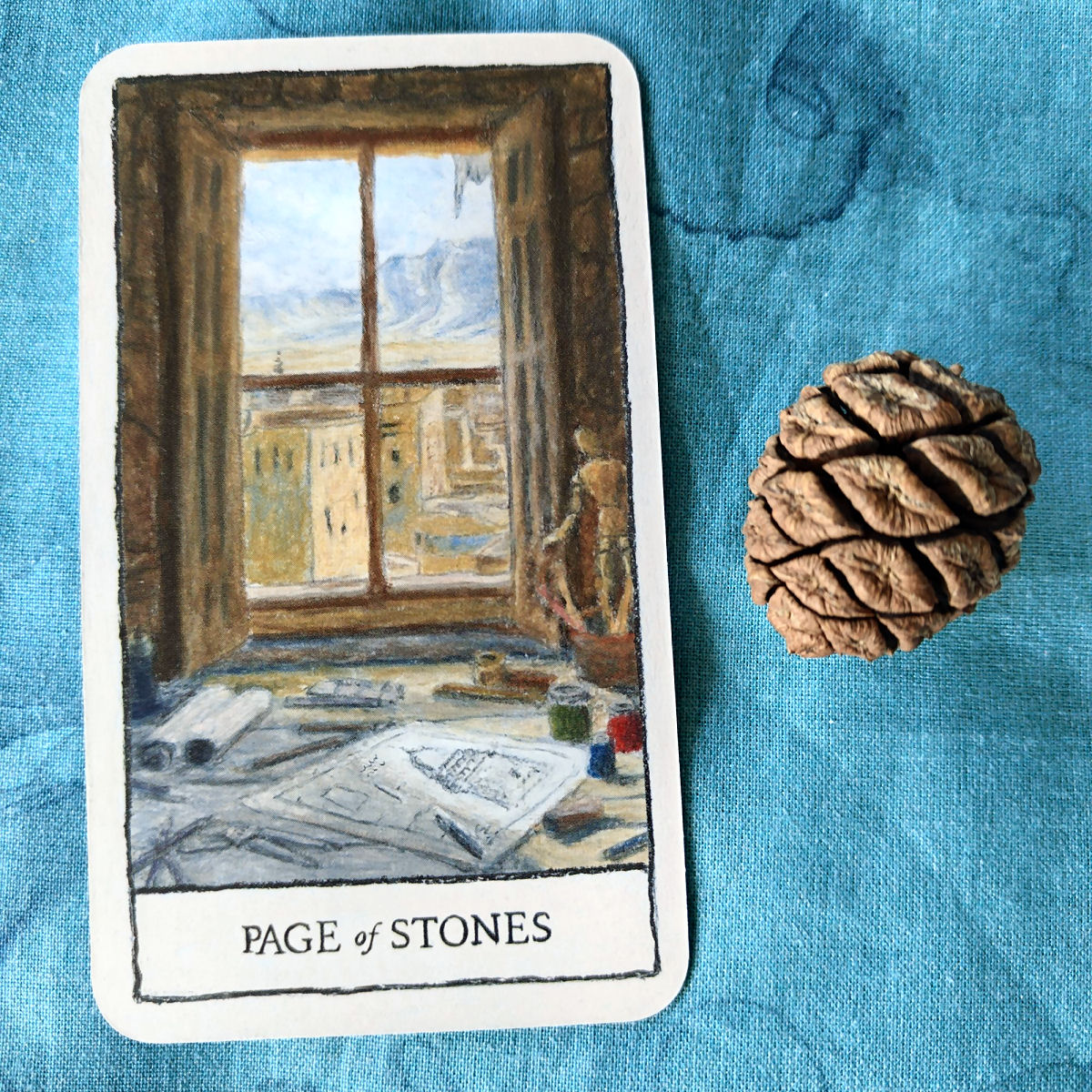
And it is such a beautiful way to close out the epic story, and journey, these cards took us on. We have gone through the cyclical nature of human endeavor, reminding us of the greater continuum we are all a part of, of creation and decay. The Page of Stones (Page of Pentacles) is a scene from inside a schoolhouse; the Knight of Stones is inside a horse stable; the Queen of Stones from within a palace bedroom; and the King of Stones featuring a different view from that same palace.
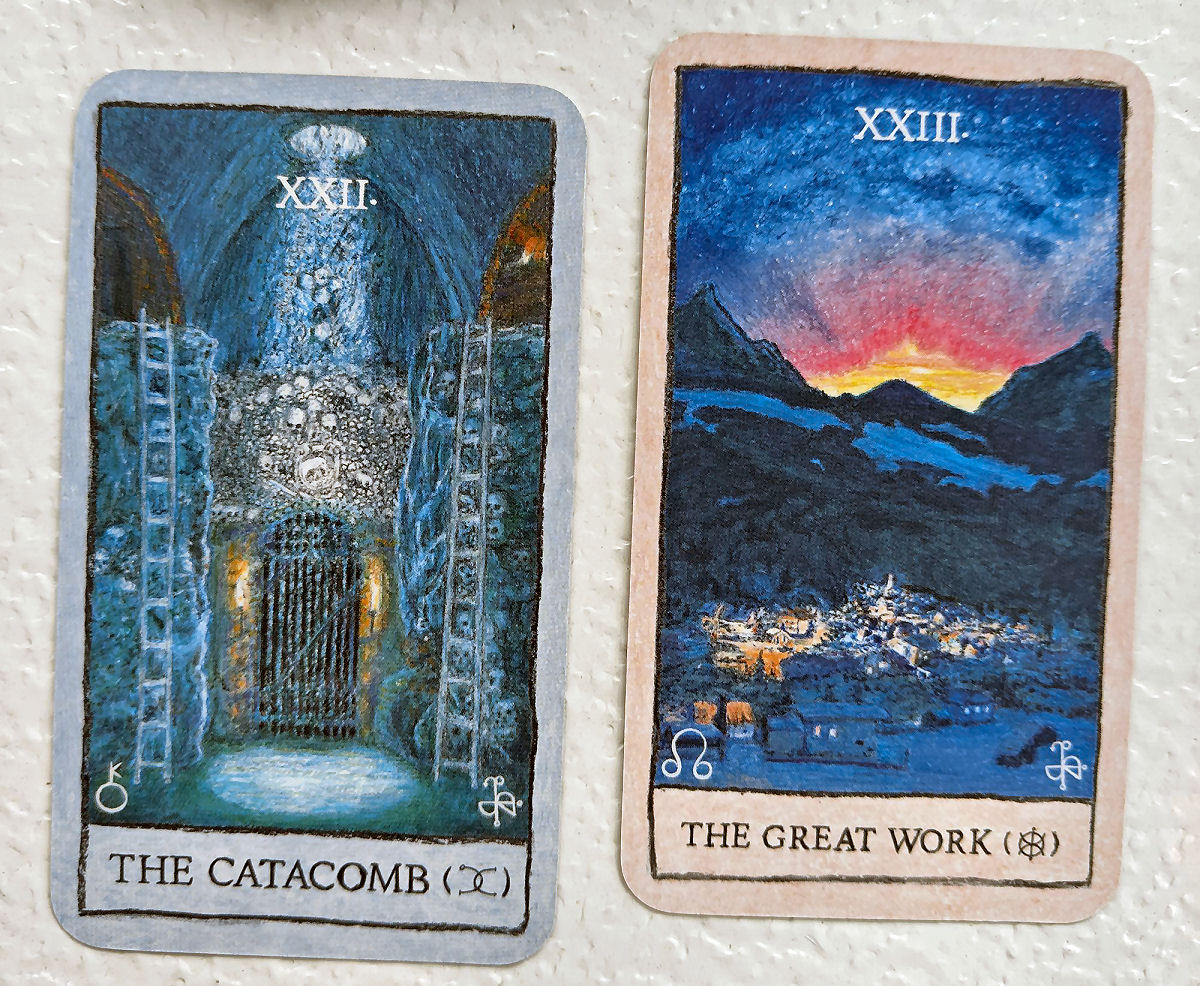
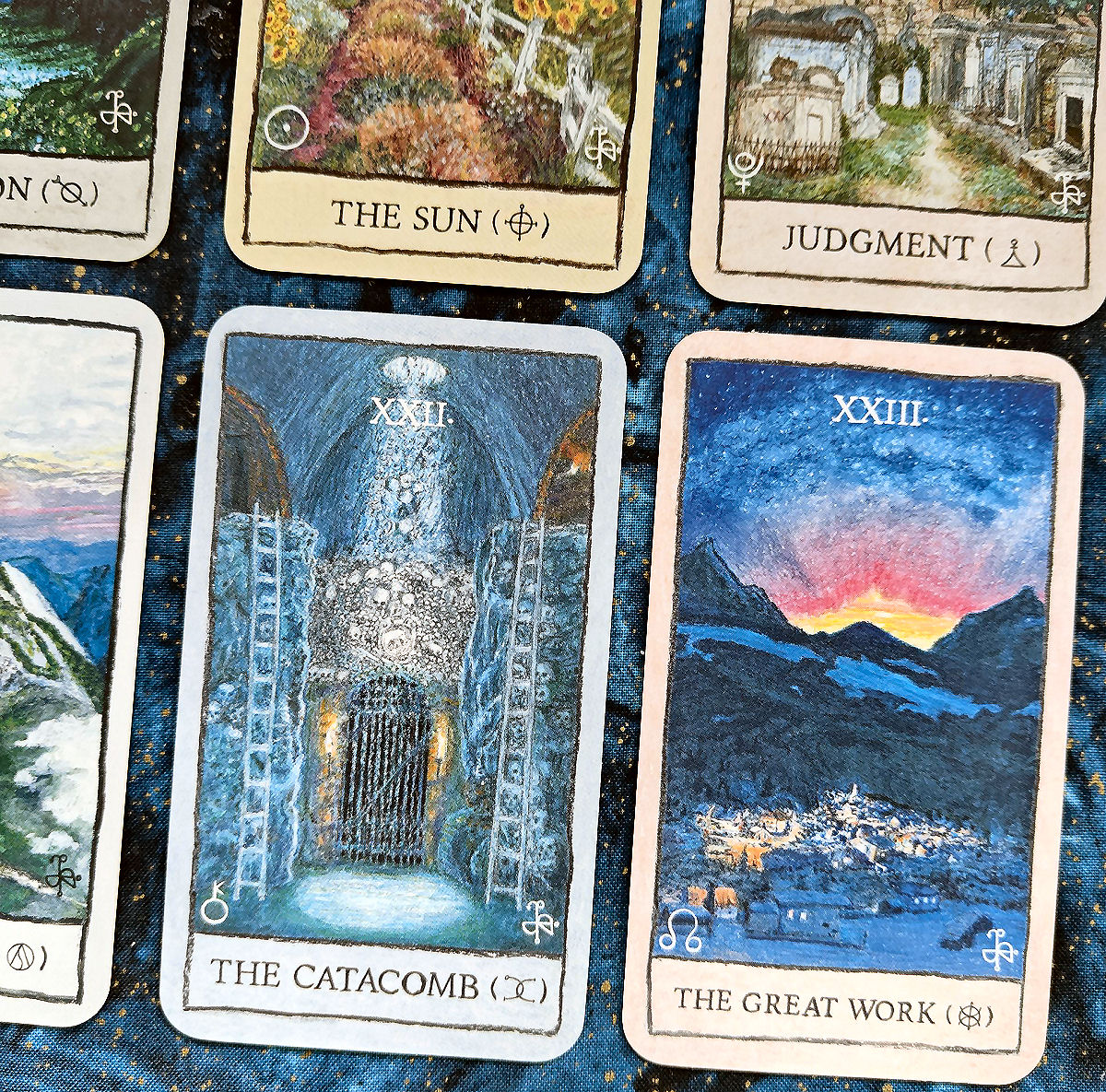
As a coda to this deck, there are two bonus cards: Key XXII, The Catacomb and Key XXIII, The Great Work. Rice corresponds The Catacomb with Chiron and The Great Work with the north node.
The Catacomb is about legacies, history, and birthright — it’s the stories that came before us that inform our own personal story. It’s about ancestors and ghosts past. The Great Work is about what you contribute to the greatness of the world around you.
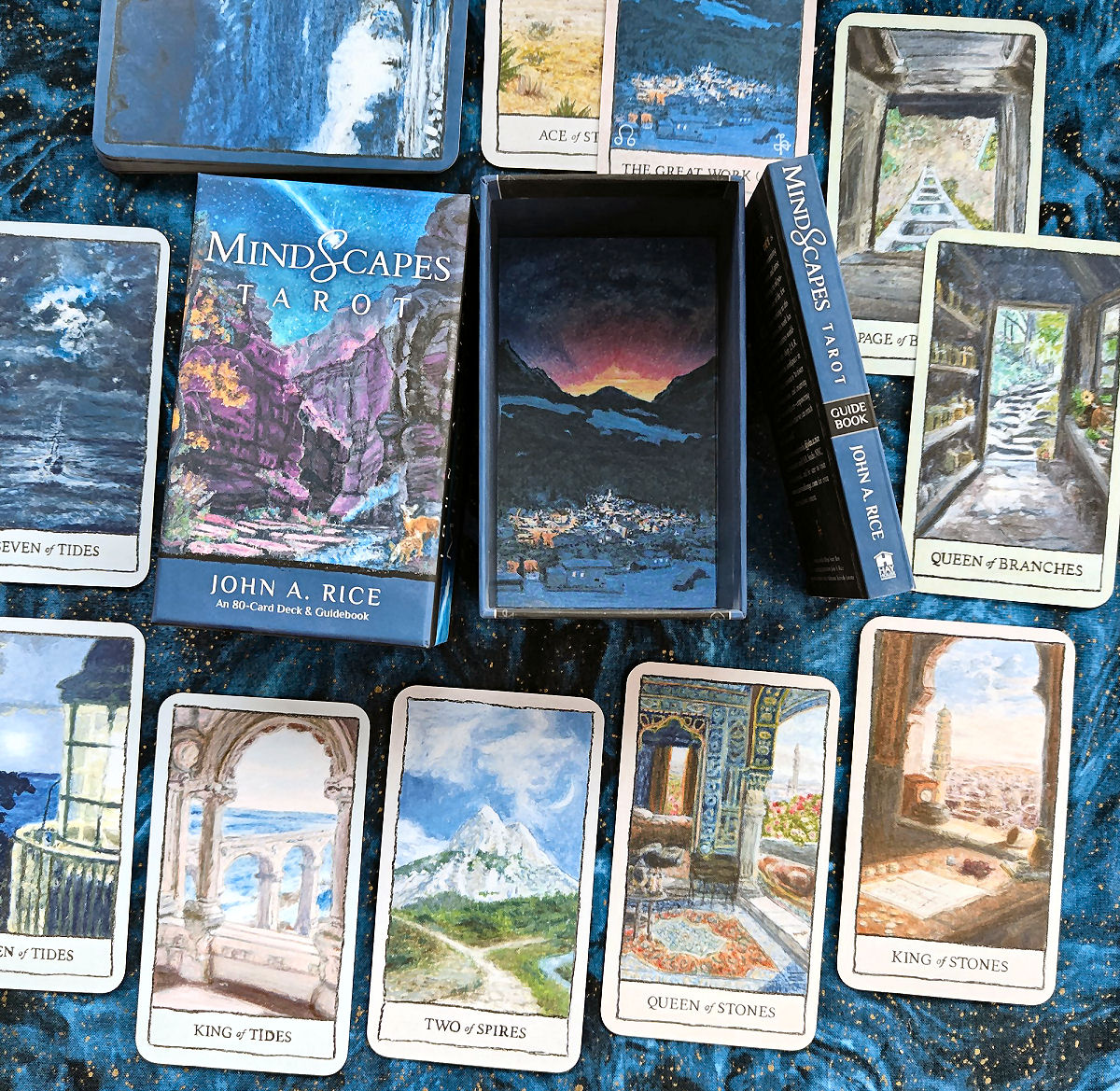
Finally, in terms of production quality, I did want to mention that fresh out of the box, I felt a microscopic powdery yet slightly tacky film or finish on the matte cards, which I’m guessing is from an anti-set-off spray powder (typically a starch or calcium carbonate). Or it’s extra residue from the matte varnish coating; matte finishes can often give the cards a velvety, powder-dusted texture, which is what it feels like when handling this deck.
The good news here is all you gotta do is shuffle the cards, a lot. The more frequently you shuffle and use the deck, the more of that powdery sticky dust gets buffed off. A few gentle wipes with a microfiber cloth can also speed up that process of mechanically removing the set-off spray powder.
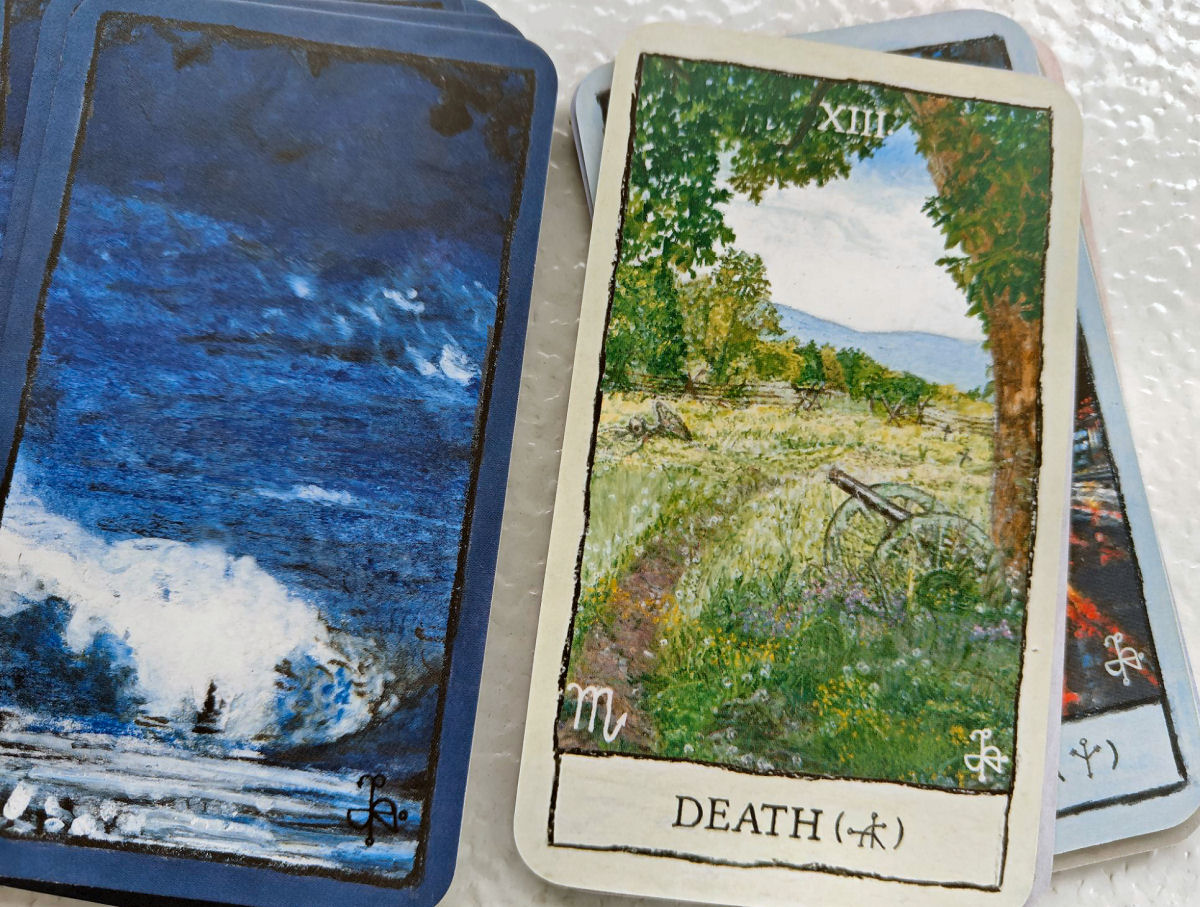
I pay particular attention to how artists render Keys 13 and 14, Death and Temperance. And here, the Death card holds special importance. Key XIII, Death in the Mindscapes Tarot is the hallmark piece, according to Rice, encapsulating the creation of this deck in the midst of the pandemic. The card features a war-scarred battlefield where wildflowers have grown. It is both a scene of suffering and strife, and also of the triumph of natural cycles over man-made conflict
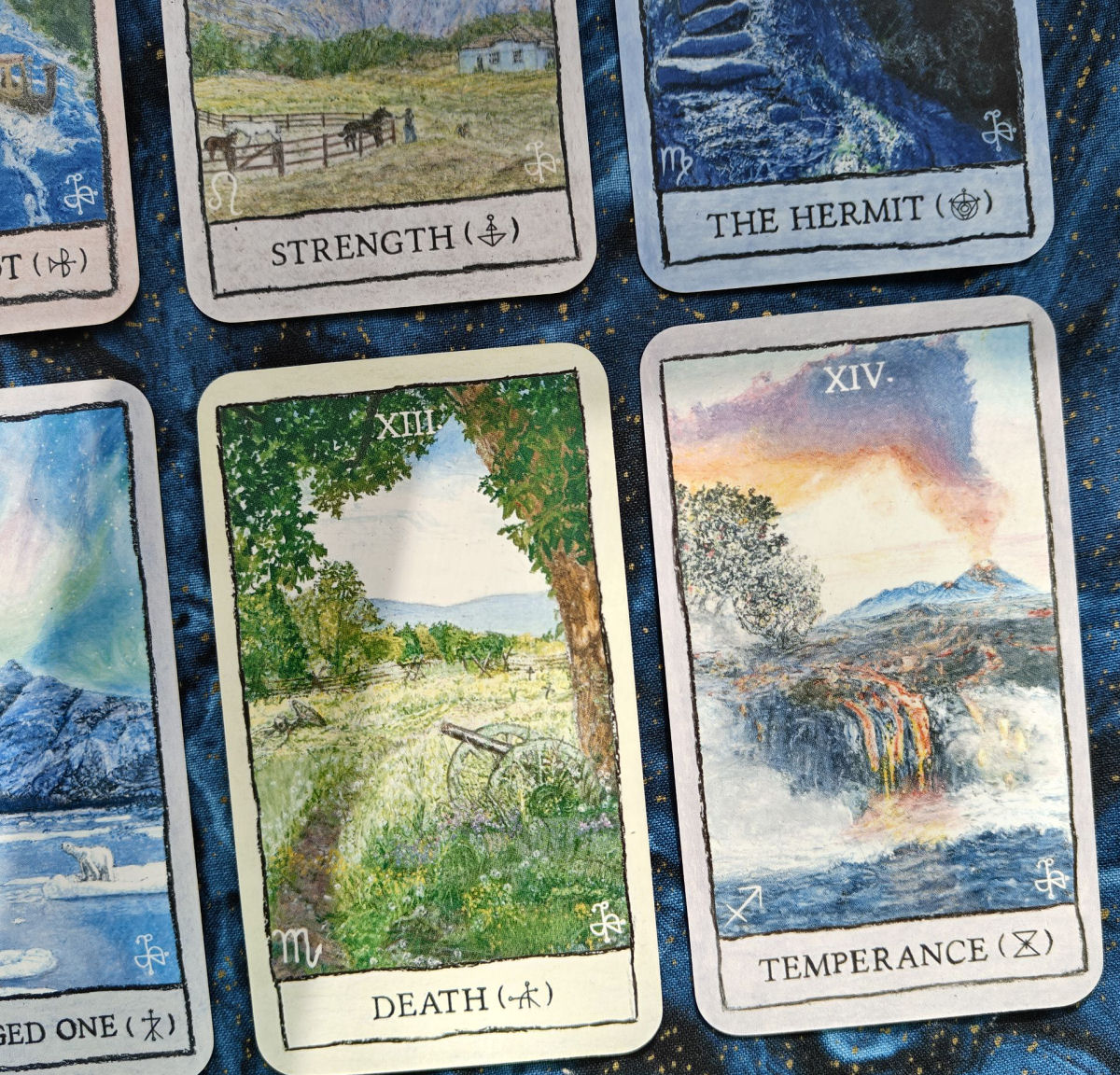
In its neighbor card Temperance, we see a place in nature where fire meets water. An active volcano in the distance spews smoke into the sky, and in doing so, paints a rainbow in the sky. Here we see an ʻōhiʻa lehua tree, which are resilient to the burn and thrive in spite of the scorched earth. The ʻōhiʻa lehua is an evergreen endemic to Hawai’i.
The tarot Death card more commonly gets a stark treatment, but here, Rice focuses on renewal, and appreciating the life that springs forth from death. That theme continues in Temperance with the depiction of an active volcano, which brings death and destruction, and yet volcanic ash is the nutrient-rich soil that gives the land such abundance and fertility. And similarly, whereas the tarot Temperance card is more commonly given a beautified treatment, here, Rice shows a Temperance that is harrowing.
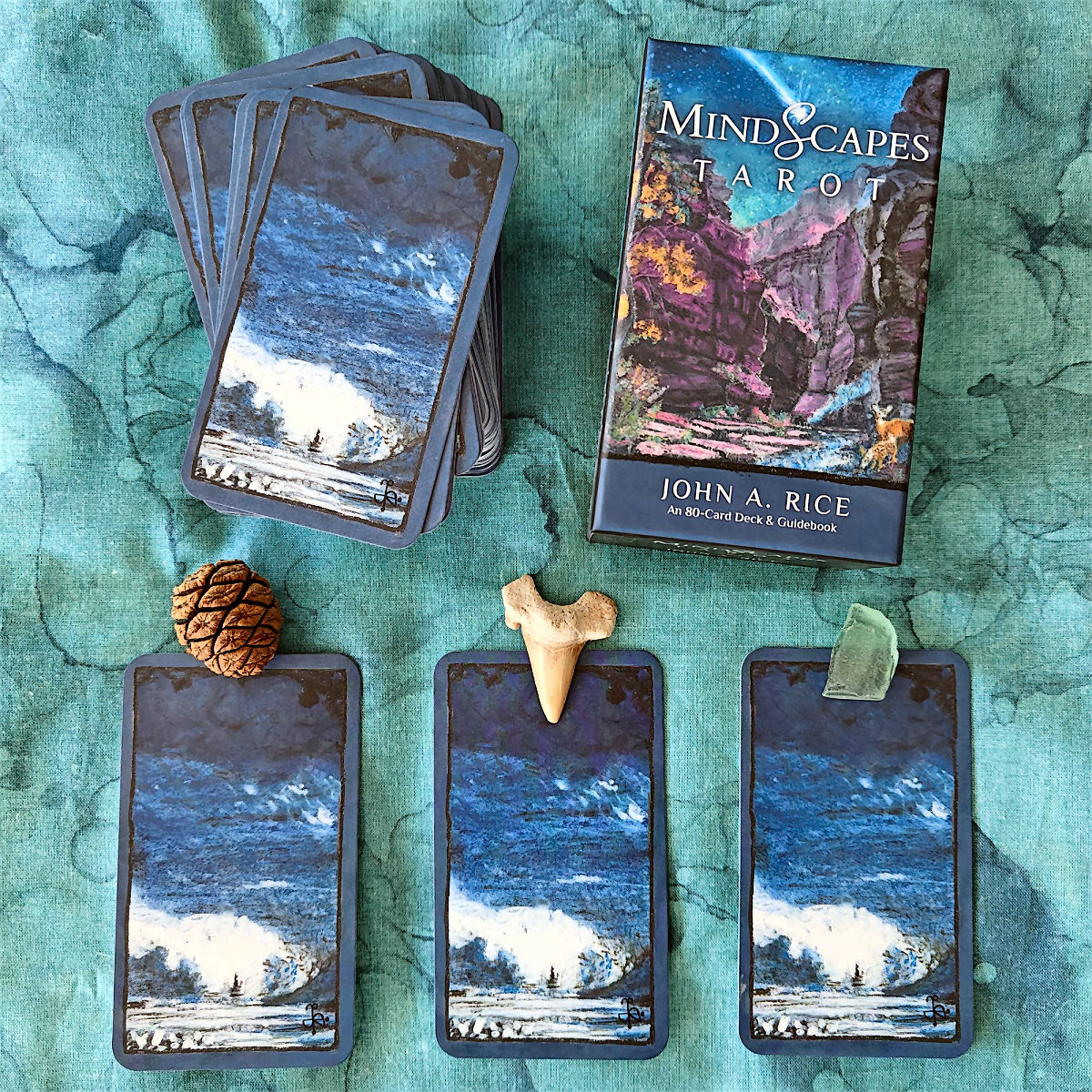
Without a doubt the artwork in this deck is top tier easily one of my all-time favorites. The landscape art is breathtaking, immediately pulling you in. Its pacing, slow and meditative, even reminds me of how the world slowed down a bit during the pandemic, and turned inward. These topographies are like inner landscapes, with the imagery of forests, seas, mountains, and buildings as metaphors for our own inner chambers.
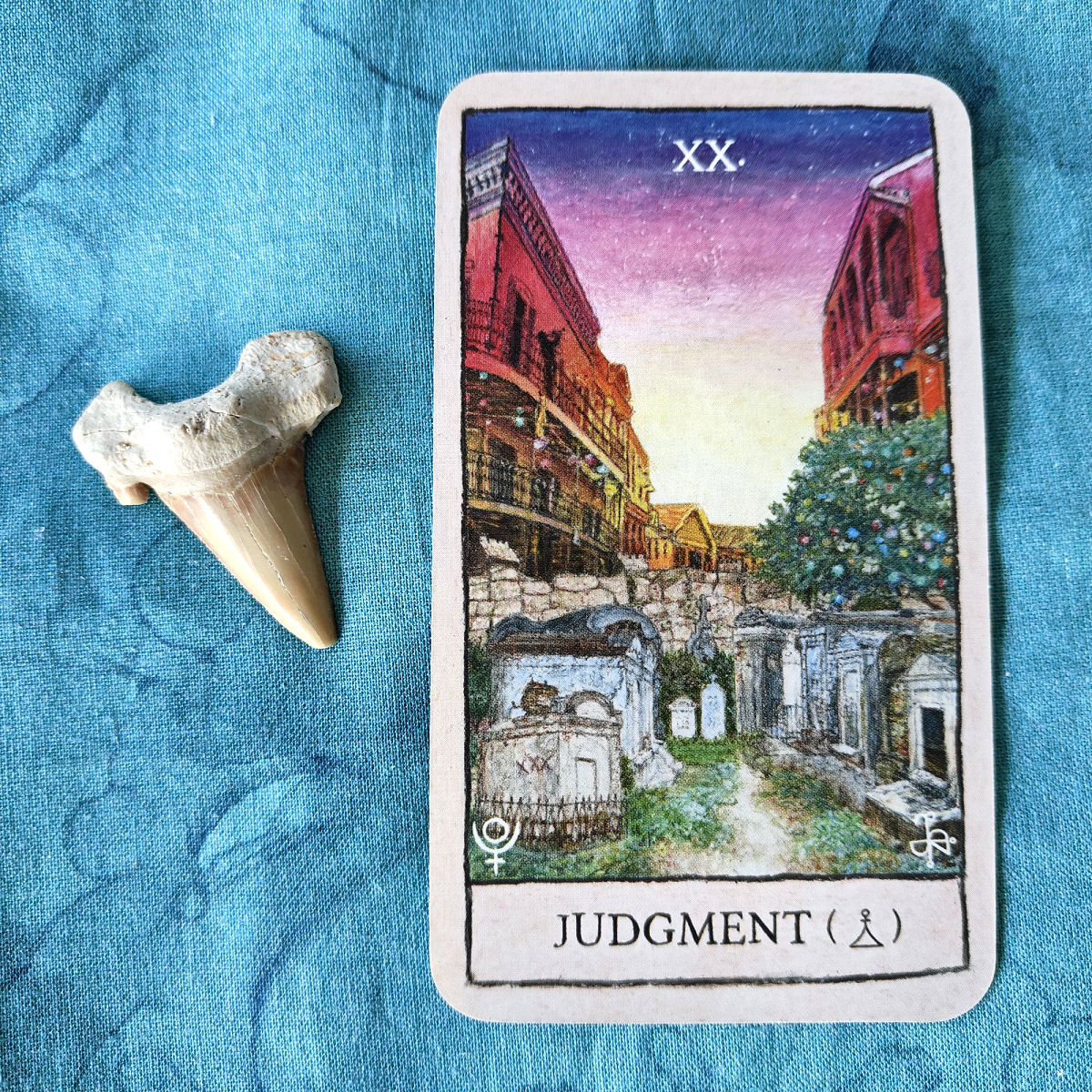
It is so refreshing and rewarding to see fine arts in tarot illustration. Even cooler is when that traditional artist is proficient with the tarot and can do it justice, as Rice has done here. Truly a masterpiece of a deck to behold.

FTC Disclosure: In accordance with Title 16 of the U.S. Code of Federal Regulations Part 255, “Guides Concerning Use of Endorsements and Testimonials in Advertising,” I received this deck from the publisher for prospective review. Everything I’ve said here is sincere and accurately reflects my opinion.
 benebell wen
Yes, during pandemic. No one wants to remember or talk about it. These moments of isolation and horror with many losses, where the art of these cards expresses beautifully. Even the card XIII where the green field at the first glimpse suppose to mean full of life and joy but, its the battle field, between life and death, no people there, only places.
LikeLike