
This is Part I of a two-part video lecture that introduces a Taoist secret breathwork practice known as the Lesser Mandala of Heaven, or Xiao Zhou Tian 小周天.
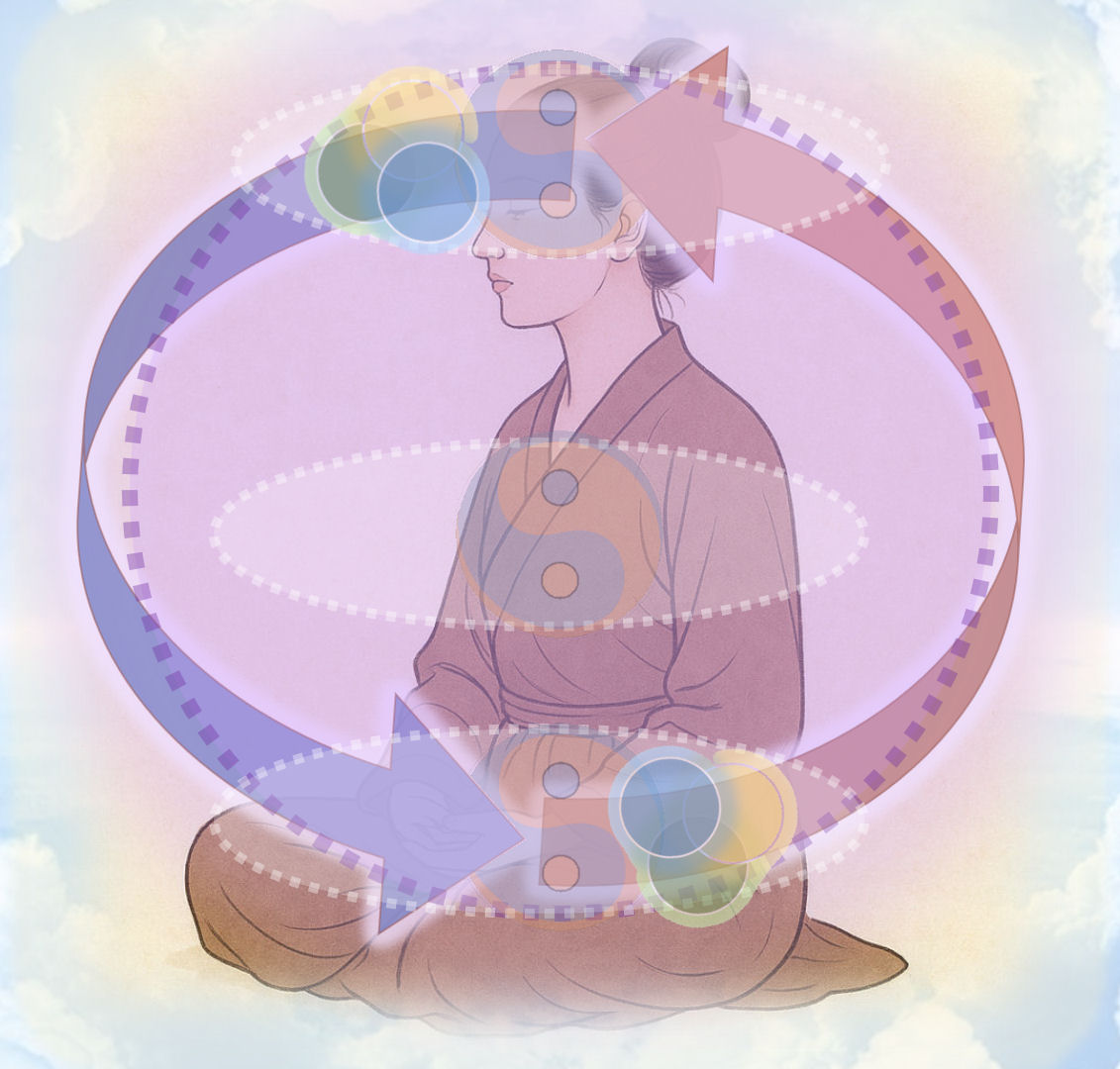
Rooted in classic Taoist inner alchemy (內丹, neidan), it teaches you to unlock a hidden energy circuit that runs through your body, up the spinal Du 督 meridian and down the frontal Ren 任 meridian, forming a continuous loop of vitality.
By circulating the triple treasures along this hidden energy path, you harmonize the body’s three dantian 丹田, or energy centers, with the three realms and cycles of the universe. Taoist masters believe this alignment refines your essence, restores internal balance, and elevates your personal power.
To round out the discussions, we’ll be covering:
- Guarding the Center 守中 baseline Taoist practices and their textual/historical origins
- The Guarding of the One 守一冥想 guided meditation
- Principle of Union of Heaven and Humanity (Tian Ren He Yi, 天人合一)
- Ethical foundations (de, 德) and the Three Virtues as the basis of cultivation
- Lifestyle precepts
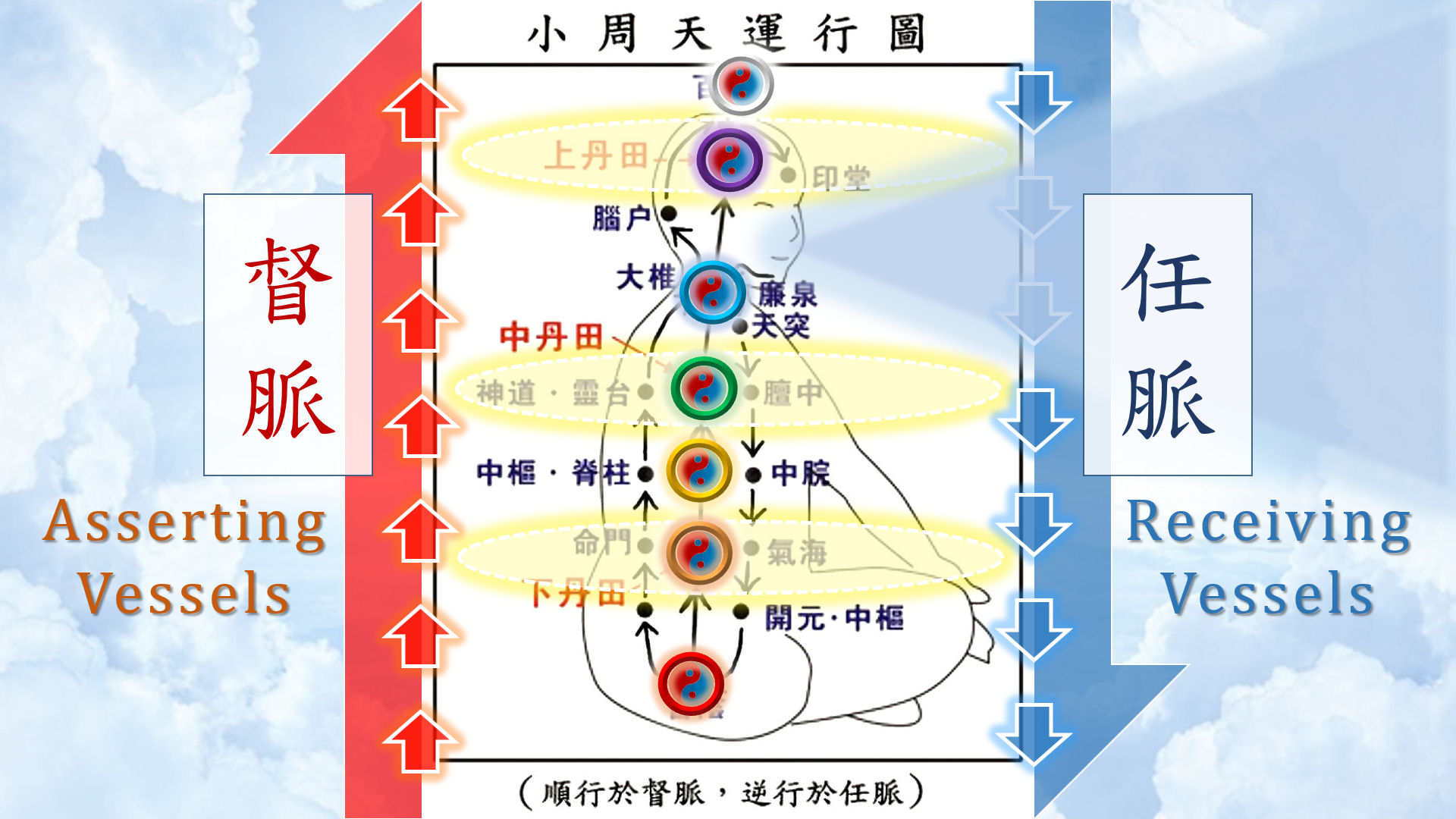
- The Du 督 and Ren 任 meridians
- Jing, Qi, Shen 精氣神: The Triple Treasure
- About Your Dantian (Three Internal Fields)
- The Internal Body Clock & Wu Xing
- Personal ritual space mirroring Taoist cosmology and numerology
- The Six Omens of spiritual awakening, confirming readiness for Greater Mandala of Heaven work
- Study of the translations and annotations of the Fundamentals of Taoist Alchemy 道門語要 (1271 – 1325) source text
The video is timestamped, and you’ll find a step-by-step guided practice on how to direct breath up and down this internal orbit, transforming your body into a living mandala and tuning it to the rhythmic cycles of nature.
This practice is more typically transmitted from teacher to disciple, but here, let’s see if we can offer a more direct and more easily accessible method.
Whether your goal is improved health, increasing your energy reservoir so you can get more done in a day, or to unlock your mystical potential, this is a cultivation technique worth your while to learn.
“What Do You Mean By Secret?”
The Lesser Mandala of Heaven practice and certainly the Greater Mandala of Heaven are considered “secret” due to the nature of the transmission. In the canonical sources, we find general outlines, metaphoric language, and poetic descriptions of the practice, but not a detailed step-by-step instruction. Instead, we get the cosmological and philosophical framework, and then the specifics of the practices, by tradition, are transmitted only from master to disciple, teacher to student, tailored to the lineage’s traditions and to the individual disciple’s capacity, temperament, and energetic condition (i.e., TCM body constitution).
In that sense, these practices are considered hidden or esoteric knowledge. Arcana. Not necessarily openly available or widely accessible. These practices have been traditionally guarded as a treasure of Taoist inner alchemy, revealed only when the student is ready.
Also, chill. Use of the word “secret” in the title is solely for internet click-ability.
Why “Mandala”?
Previously the English translation for the practice of Xiao Zhou Tian 小周天 was “Microcosmic Orbit.” You can find a Wikipedia entry on it, which I won’t link to because it’s got a whole bunch of factual inaccuracies and/or Western interpretations of the tradition that departs significantly from how a native born and raised into the living tradition would interpret it.
I don’t know who exactly we should be crediting for the English translation “Microcosmic Orbit,” but “Mandala” as the translation for “周天” is the best way to fully communicate the spectrum of metaphysical implications that are important for understanding this practice.
The loan word “mandala” better preserves the religious-ritual, symbolic, and topographical meaning of “周天” that we find within the cultural and spiritual context of Taoist practice. “Mandala” meaning-matches, which is to say it conveys that “周天” is a sacred enclosure, a microcosmic cosmos encoded into a diagram. Using the loan word “mandala” also communicates and preserves the cross-cultural kinship and historical pathways between South Asian and East Asian spiritual practices.
Also, referencing Mandala circles back to how I describe the I Ching in my book, I Ching, The Oracle, and the I Ching is the foundational premise of Xiao Zhou Tian. See the chapter in my book, “Circling the Square: The I Ching Mandala.” The I Ching is a mandala of the universe, and similarly, these Lesser Mandala and Greater Mandala cultivation practices are about recognizing your body as a universe by locating and then learning how to regulate and control that inner mandala.
Finally, the most important reason for using “mandala” in this context is what I noted earlier: rather than going with a Sinocentric term or a mundane English/Western translation, I want to honor the historical bridge and rich, centuries-long exchange between the Indian and Chinese civilizations. When Buddhism, Vedic philosophy, and early Indic cosmology traveled eastward into China, it became integrated and syncretized with Taoism, Confucianist and yin-yang schools of philosophy, and early Taoist cosmology, so much so that what we now recognize as Chinese metaphysics and internal alchemy evolved from that intercultural dialogue.
Choosing “mandala” is not just a linguistic convenience, but a conscious homage, recognizing the shared lineage of cosmological thought that threads together Vedic, Buddhist, and Taoist views of the universe as a living, breathing pattern, breaking down superficial barriers to get to that common denominator between the two, and what truly, at that core, “mandala” and “zhou tian” mean to its practitioners. “Zhou tian” as “mandala” is acknowledging that these Chinese/Taoist practices emerged not in isolation, but in deep conversation with their Indian/Vedic counterparts, and that our modern understanding of Taoist cultivation continues to benefit from cross-cultural exchange.
Claimed Benefits
If you want to dismiss all the woo, you can totally do that. This is, at its essence, a form of controlled breathwork, and there are plenty of evidence-backed medical studies on the benefits of controlled breathwork or diaphragmatic breathing. It helps you to regulate your nervous system, lowers anxiety and overall stress levels, enhances your lung capacity so there are respiratory benefits, can increase oxygen delivery to your cells, supporting energy metabolism and immune support, improves sleep quality, and slowly, gradually, because of its ability to regulate your nervous system, can even help you to manage chronic pain. Lesser Mandala is basically controlled breathwork. That’s it.
Now if you want to get into the woo… ceremonial magicians and ritualists who undertake the Lesser Mandala practice routinely are going to quickly notice huge advancements in their craft, in their shamanic journeying, in their ability to tap in to psychic realms and the unseen, their four clairs seem to have gotten enhanced, and most importantly, ritual doesn’t wipe them out. They’ll find that after intense ritual, they hold on to their energies better; they’re not completely exhausted from it. That’s because you’ve significantly increased your strength and capacity.
The Du 督 and Ren 任 Meridians
The Lesser Mandala exercise is about controlling and guiding flow of energy via inhale up along your back, spinal Du 督 meridian, and then your frontal Ren 任 meridian via inhale. Upwards rising, you’re managing your internal yang, aligning with how warm air rises and expands, and then downward descending, you’re managing your internal yin, aligning with how cool air falls and contracts, due to its density after the ascent.
| 1.) Du 督脈 Meridian – Asserting Vessel | 2.) Ren 任脈 Meridian – Receiving Vessel | |
| Direction & Path | Posterior midline (perineum) up to the spine, up toward the crown | Anterior midline (perineum) down the frontal midline, to the abdomen |
| Governance | Yang; optimizes brain functions | Yin; optimizes digestive and reproductive functions |
| TCM Healing Principle | Tonifies yang; strengthens spine and marrow; neurological regulation | Tonifies yin; regulates organs, gynecological and digestive support |
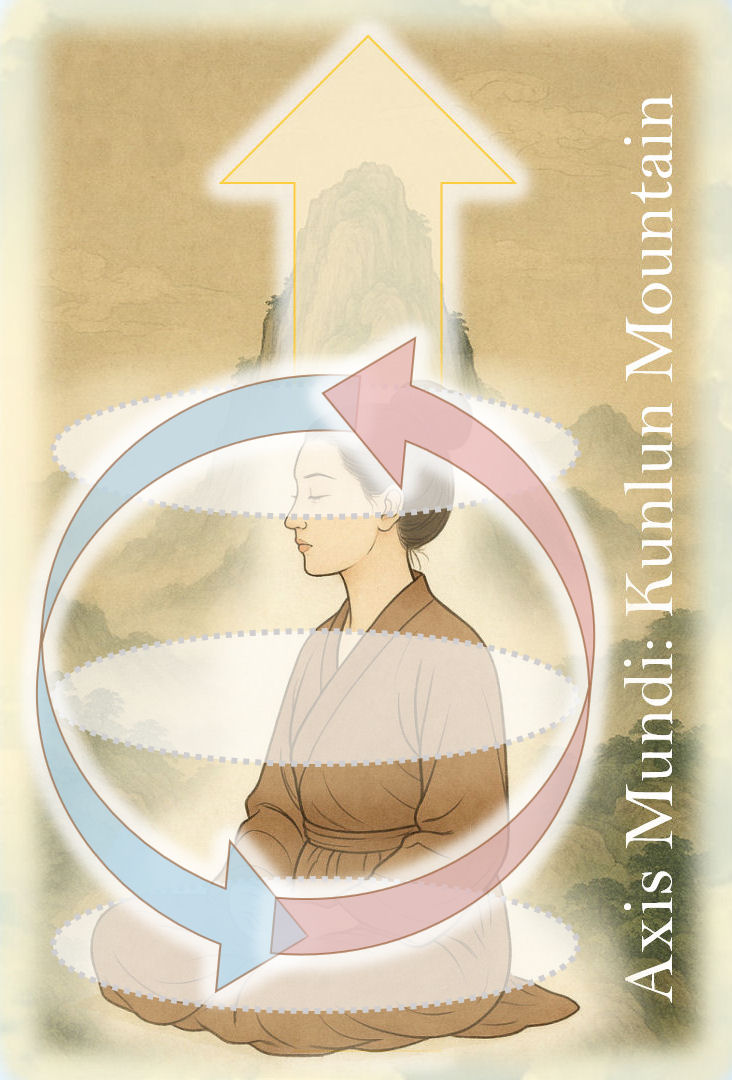
While the Lesser Mandala exercise seems to be only focusing on these two yin and yang longitudinal meridians, by achieving temperance of the two meridians through this exercise, the implied benefit is to a Zhong 中脉 Meridian, a central pillar. In various Taoist mystical or esoteric traditions, this central meridian is also called or referred to as the Golden Pillar 金柱. You’ll also commonly find links between discussions about this central meridian or pillar and Xuan 玄, or Mysteries.

It is this central pillar that directly aligns the individual practitioner with the Axis Mundi of the universe, per Taoist cosmology. That central pillar will eventually be realized, by the practitioner, to be a bit like a spinning compass needle, and as it spins, aligns with the four directions, and also the eight directions, which is how the Greater Mandala practice invokes the I Ching cyclical structure.

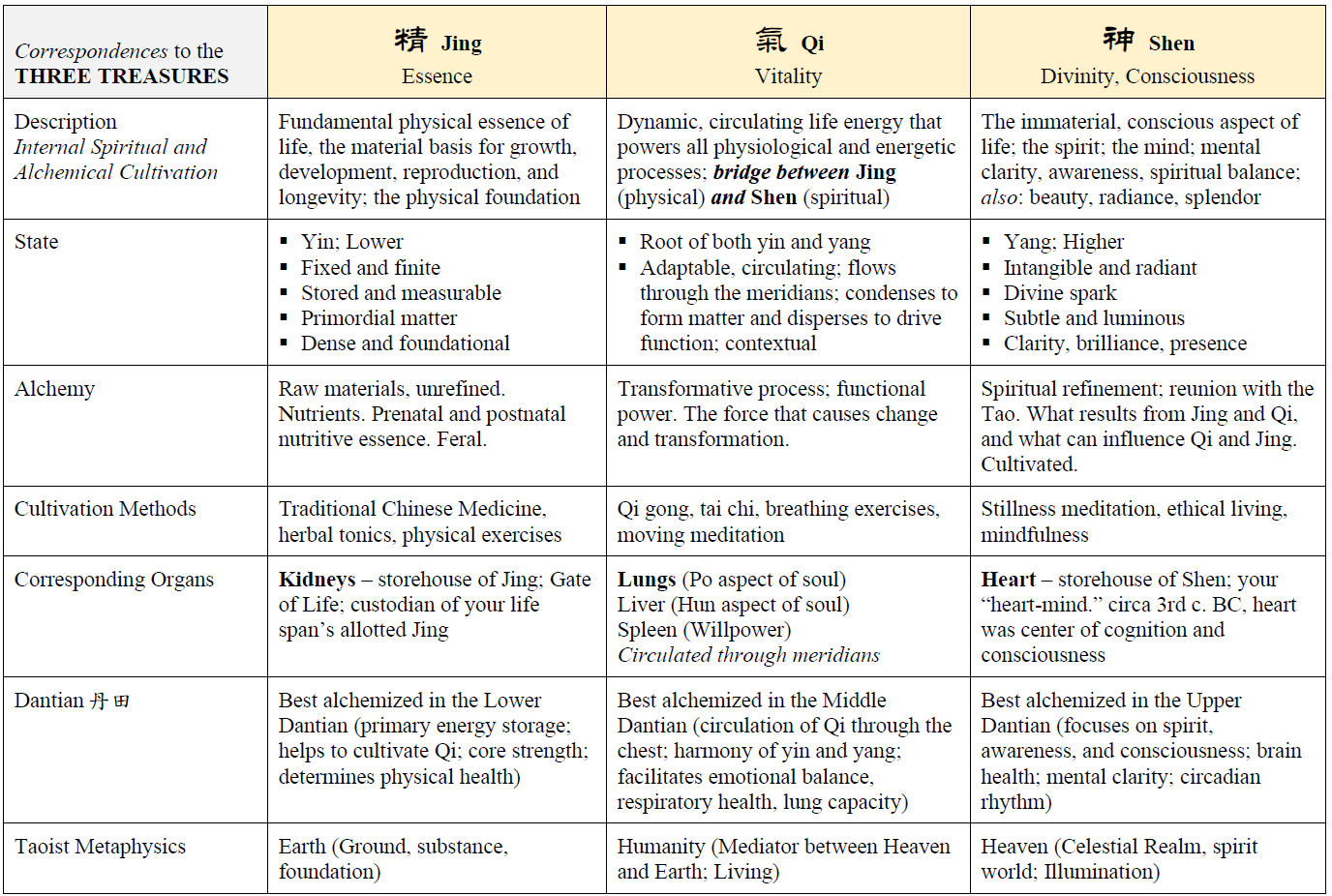
Jing, Qi, Shen (PDF Download)
Click on the above hyperlinked title to download the PDF handout of a Jing, Qi, and Shen 精氣神 correspondences table.
In classical Taoist texts, Jing 精, Qi 氣, and Shen 神 are known as the Three Treasures, the trinitarian foundation of inner alchemy. Jing 精 is a generative, nutritive force that governs growth, reproduction, and determines longevity. Qi 氣 is the dynamic life force that animates the physical world, and is the key driver of change. Shen 神 is spirit, luminous consciousness, and inner divinity; it’s awareness and that which transcends the material, physical world.
A cultivation technique like the Lesser Mandala transforms Jing 精 into Qi 氣, refines that Qi 氣 into Shen 神, and then that Shen 神 can either: (i) optimize Jing 精 or (ii) transcend even further and become one with the Tao, the numinous void.

About Your Dantian (Three Internal Fields)
Dantian 丹田 are three internal alchemical fields within the body. They’re like three crucibles where active alchemy of Jing, Qi, and Shen 精氣神 can take place. Jing is not per se associated with the Lower Dantian, but if you want to alchemize Jing, that’s where you’d do it; likewise Shen is not per se associated with the Upper Dantian, but if you want to refine your Shen, that’s where you’d do it.
Also, when you’re focusing your breath in the Lower Dantian 下丹田 during this qi gong exercise, you’re also working on your core strength, which is crucial for mobility and independence, especially as we age.
Likewise, when you’re focusing your breath in the Middle Dantian 中丹田, you’re cultivating the flow of life forces that improve respiratory health, cardiovascular health, your lung capacity, and heart function.
When you’re focusing your breath in the Upper Dantian 上丹田, you’re working on your pineal gland, brain health and function, improving mental clarity and cognition, sleep health (the pineal gland produces melatonin), circadian rhythm, and brain=-centered health.
The flow of energy along the spinal Du 督 meridian is strengthening and tempering the inner yang aspect and the energy flow along the frontal Ren 任 meridian is strengthening and tempering the inner yin aspect.

How Long Do You Do the Exercise For?
It depends on your goal. There’s no one “right” answer here. The duration and how frequently you do this practice should be tailor-fit to your body constitution, physical, mental, and spiritual health levels, your lifestyle, and your needs.
To really see a noticeable improvement in your overall wellness, and assuming someone with a clean bill of ordinary health, between 5 and 10 minutes, at least once everyday, and optimally, 2 to 3 times per day. Though most people notice an immediate internal balancing effect after a single session.
Thus, if one can commit to up to 20 to 30 minutes per day, as noted, you’ll really start to see improvements in blood pressure, oxygen efficiency, a more regulated nervous system, which can help you with pain management, reduced stress levels, and therefore a noticeable peace of mind.
By raising your baseline physical, mental, and spiritual health with dedicated, routine practice of the Lesser Mandala, your body becomes a strong, well-tuned instrument for more advanced esoteric or mystical practices, and which when performed, won’t compromise your perception, personal energy levels, and safety.
In my younger years I was trained to practice this technique in a focused, dedicated way, a bit like meditation practices. You would sit in meditation position to do this practice and a qi gong teacher would monitor you as you performed the breathwork.
These days, I don’t set aside dedicated time for this, but rather, I do it anytime I have a few moments in my seat to sit up straight, rectify my posture, engage my core and three dantian, and re-align my breathing to the meridians. So maybe I’m sitting in a waiting room by myself and have a few minutes, or I’m seated at my office desk, or I’m watching TV and want to multi-task. Which is to say it’s become second nature to me.
An Instructive Example of “Ziran”
In a previous video lecture, I covered the Taoist principle of ziran. This practice is a great instructive example of what ziran means.
It takes a very focused, dedicated, and for some challenging, laborious amount of effort to learn how to get your internal energy flow to be attuned and in resonance with the external universal energy flow of nature. Once you achieve it, yes, it becomes the path of least resistance, but to describe the effort it takes to learn that, you certainly wouldn’t call it the “path of least resistance!” =)
Ziran is to achieve an effortless flow in alignment with the flow of nature. But it doesn’t mean exerting no effort to achieve that effortless flow.
In short, ziran — and this Mandala cultivation practice — is about being in harmony with nature.
Guidance for Safe Practice
You want to enter this practice in a calm and relaxed state, so don’t jump right into it while you’re agitated. The practice involves “driving a car,” in a manner of speaking (at least that’s the analogy I like), driving the flow of your internal energies along the two meridians, guiding along that pathway in a specific, focused way. Or it’s like steering a chariot that’s carrying three treasures (your Jing, Qi, and Shen) along a specific route.
So if you enter in a state of agitation, you’re probably not properly controlling that “vehicle.” It’ll be harder to guide the flow down the two meridians.
If you’ve never practiced inner alchemy of any sort before, then yes, the first few times you put in a full effort doing the Lesser Mandala, you may experience mild dizziness, nausea, soreness or tightness around the chest area, or minor headaches, or even ringing ears.
It’s not unlike weightlifting for the very first time, or right after a prolonged period of inactivity — you’re going to be sore the next day. But it’s a good sore. Slowly as you build up your strength, the mild soreness goes away. I find ginger to be really healing here, or a topical application of a camphor oil or balm.
On the other hand, if you experience very strong emotional surges in a negative way, or sharp, significant physical or mental pain, stop immediately. Taoist teachers emphasize that such reactions may point to a deeper imbalance in the body. It might not hurt to also get a full medical eval just to rule out any issues you might not have been aware of, like abnormal growths or blockages.
So is the Lesser Mandala energy cultivation practice safe? I’d say so, yes. But it’s not unlike hiking or running — they’re healthy forms of exercise, but not if you’re doing them on a broken leg. The same applies here– address and heal any underlying serious issues first, then return to the practice as part of a balanced, healthy routine.
In short, people in acute medical or psychiatric crisis should be focusing on that immediate crisis and not engaging with any esoterica at all. It’s not about the microcosmic orbit practice potentially being “dangerous” — it’s any and all esoterica, full stop.
Everyday Practice
Start with the Step-By-Step Guided Practice at timestamp 12:44 in the video. Spend a few minutes every day for a full moon cycle following this exercise, keeping it short yet consistent, to build familiarity and lay the foundation for deeper practice.
Then, observe. Do you notice any improvements in your physical, mental, or even spiritual strength, resilience, and stamina?
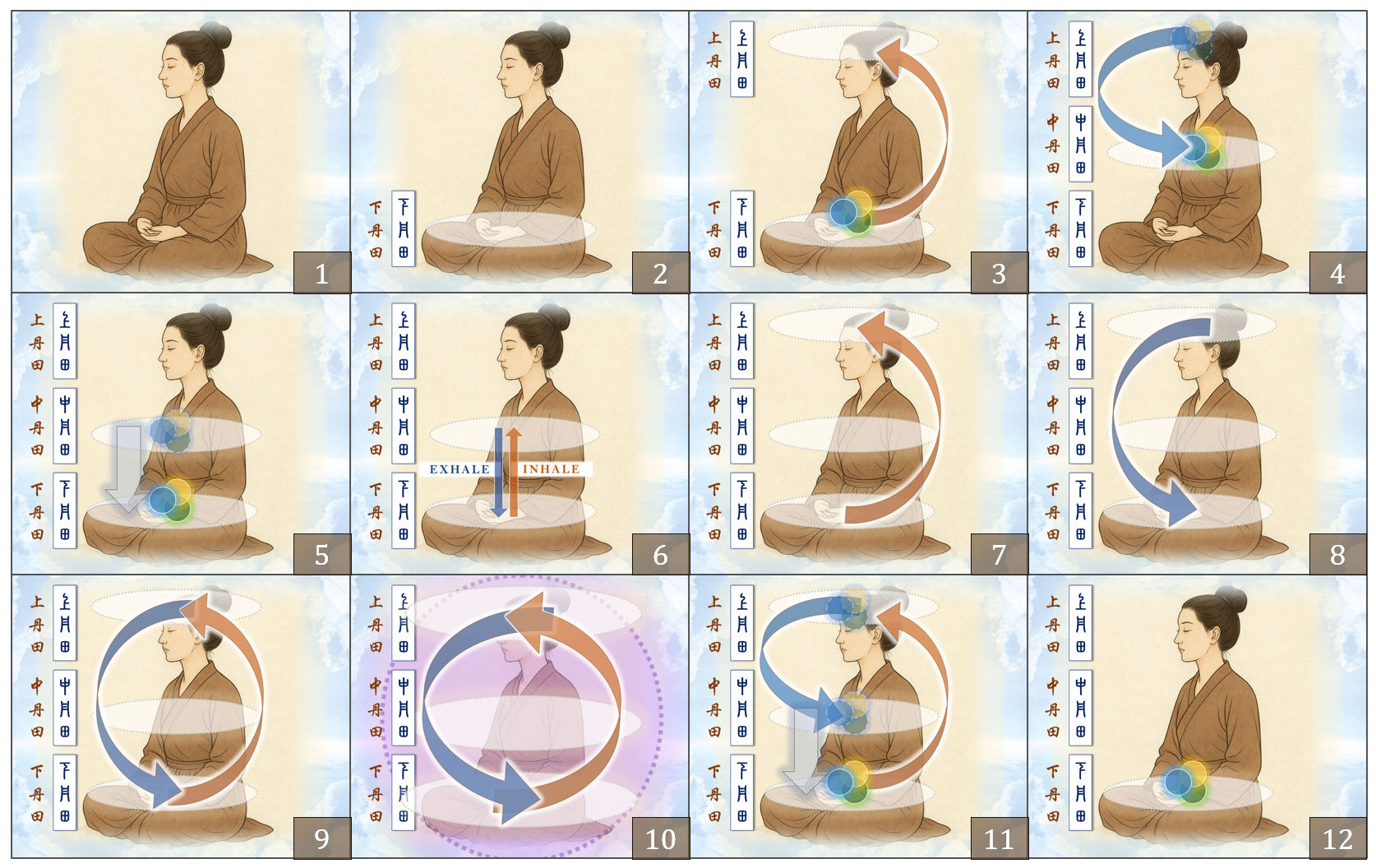
As a supplement, here are the instructions written out, step by step:
Lesser Mandala of Heaven, Step by Step (PDF Download)
Canonical References
Our understanding of the Lesser Mandala of Heaven cultivation practice is sourced from two seminal Taoist alchemical texts:
The first is Zhouyi Cantong Qi 周易参同契, which gets translated to The Seal of the Unity of the Three. Zhouyi, meaning the I Ching, and also Seal of Changes, the Cycle of Change — Mandala. It is widely regarded as one of the most important Chinese texts on Taoist alchemy and the root source that later Neidan lineages look back to. We believe it dates to around the Eastern Han, or 1st or 2nd century AD.
The second is Wuzhen Pian 悟真篇, which has been translated to Awakening to Reality, a Taoist classic from 1075 AD. According to lore, it was transmitted from the Taoist immortal Han Zhongli 漢鍾離, who (according to lore) lived between 200 BC and 200 AD, to another of the Eight Immortals, Lu Dongbin 呂洞賓, around 600 to 900 AD. Like the first text, it’s premised on an inner microcosmic I Ching mandala that mirrors the macrocosmic I Ching mandala representative of the universe.
The third, and the most instructive of the texts here, is the Dao Men Yu Yao 道門語要, Fundamentals of Taoist Alchemy (1271 – 1325) contains the most comprehensive and popularly accepted description of both the Lesser Mandala of Heaven (Scroll 7) and the Greater Mandala of Heaven (Scroll 8). The text dedicates an entire scroll (i.e., chapter) to each. As part of the curriculum, you will be reading through the English translation and annotations of both Scrolls.
While the text itself is dated to the Yuan dynasty, the version we’re sourcing the essays (Scrolls) from are from a Qing dynasty compilation, given some of the textual references to events that happened in the 16th century. The versions of Dao Men Yu Yao that we now have are likely piecemealed from much older texts, as many the passages can be found in texts dating back to the Jin dynasty (265 – 420 AD), preceding the Yuan by almost a millennia.
You can find what is essentially a 13th century encyclopedia entry on the two Mandala practices: “On the Lesser Mandala of Heaven Cultivation Practice 運小周天之法” and “Performing the Greater Mandala of Heaven 行大周天之功.” It’s this treatment on the subject that has been most influential on modern approaches to the practice in the Sinosphere.
Finally, a popular inner alchemy text The True Transmissions (Teachings) of the Great Tao (大道真傳, Da Dao Zhen Chuan) is a transcription of oral transmissions given in the form of a series of lectures. Lecture 4 addresses the Mandala cultivation practices. The Lesser Mandala is described as a basic practice of consciously directing the movement of your breath and awareness of Qi circulation through the meridians, and in doing so, purify and stabilize. Once it is mastered, the Greater Mandala is where true transformation takes place.
On the Lesser Mandala of Heaven Cultivation Practice 運小周天之法
Let’s summarize the chapter “On the Lesser Mandala of Heaven Cultivation Practice 運小周天之法.” That last character “法” is descriptive of what the “Xiao Zhou Tian 小周天” is — it’s a regulated methodology, something that helps to bring order. The practice is also known as the “河車,” which can be translated to River Wheel or Chariot/Vessel Upon the River, and yes, it’s an implied reference to the He Tu River Map, and this is how we get into the Milky Way when talking about the Greater Mandala of Heaven, as I noted in the video.
The text starts by describing the Lesser Mandala as a simple, basic, but vital practice, and the easiest or at least most fundamental all-purpose of the 周天之法 (zhou tian zhi fa), or Mandala of Heaven Methods. For intermediate practitioners, you can certainly move on to other cultivation practices (and it names a few), but otherwise for most, this is where you ought to begin.
Emphasized is effortless, easy, natural flow. Don’t force energy along the pathway; don’t compel it; don’t force your breathing. If you feel like you need to fight yourself to push the flow forward, then stop the practice altogether and see a healthcare professional to work through what internal blockages might need to be treat ed medically first.
The text very specifically details yang energy rising up the back meridian and yin energy rising down the front meridian. Doing so nourishes your immortal embryo 養胎 and is what gets your internal forces to alchemize 丹.
While what I instructed on in the video is the Lesser Mandala in its most basic form, tailored to a general audience consisting of diverse backgrounds and body constitutions, for those interested, here are a few more really specific points canonical texts such as the one referenced here call out:
You can optimize the cultivation practice if you do it twice a day, timed to high noon and midnight. At high noon, this advances your internal yang and solar forces; at midnight, the practice advances your internal yin and lunar forces.
From two, perhaps you want to advance on two six times per day, since there are six yin ascendant hours and six yang ascendant hours per day (total twenty-four), which is to say, time your practice to the zodiac signs.
You’ll know that you’ve achieved all that you can achieve with the Lesser Mandala cultivation practice when these six omens arise:
- There is a golden glint in your eyes,
- Your sense of smell has heightened,
- “You can hear the wind” (the meaning is you attain clairaudience),
- You can sense the phoenix (or the hawk) at the back/crown of your head,
- You can sense the flaming pearls in your three dantian (the three inner fields), and
- You can sense the thunder in your abdomen.
Once you’ve experienced the six omens, you are ready to initiate the seven-day Greater Mandala of Heaven practice. (Which is to say the first time you have been given the green light to advance on to the Greater Mandala, it’s going to be a seven-day initiatory practice, according to canon.)
Tongue’s Resting Position
My apologies for an oversight, where it didn’t occur to me (at all) that some people might not be doing this naturally, automatically, all the time already?
You may notice that in the comments section of the YouTube video, quite a few folks (I’m guessing Westerners who learned Taoist techniques as an adult, and not native practitioners born into these traditions…) noting that your tongue “must” be resting against the roof of your mouth during this exercise.
Yes, sure. Though let’s expand upon that and say that’s the default resting position for your tongue at all times, no matter what, anyway, period. Like, what?
Medically, the tongue resting against the palate is the optimal way for stabilizing your airways, promoting breath, optimizing oxygen efficiency, balancing your facial muscles and jaw, and if that’s your default setting, will significantly improve sleep quality. The long-term impact is also improved health for your nervous system, in addition to your respiratory system.
Whether in meditation, while you’re watching TV, lifting weights, on the treadmill, stuck in traffic, or doing the microcosmic orbit cultivation practice, yah, please rest the tip of your tongue along the front palate of your mouth. To reiterate, it’s not just part of the instructions for the Lesser Mandala of Heaven practice; it’s best practices for life instructions. =)
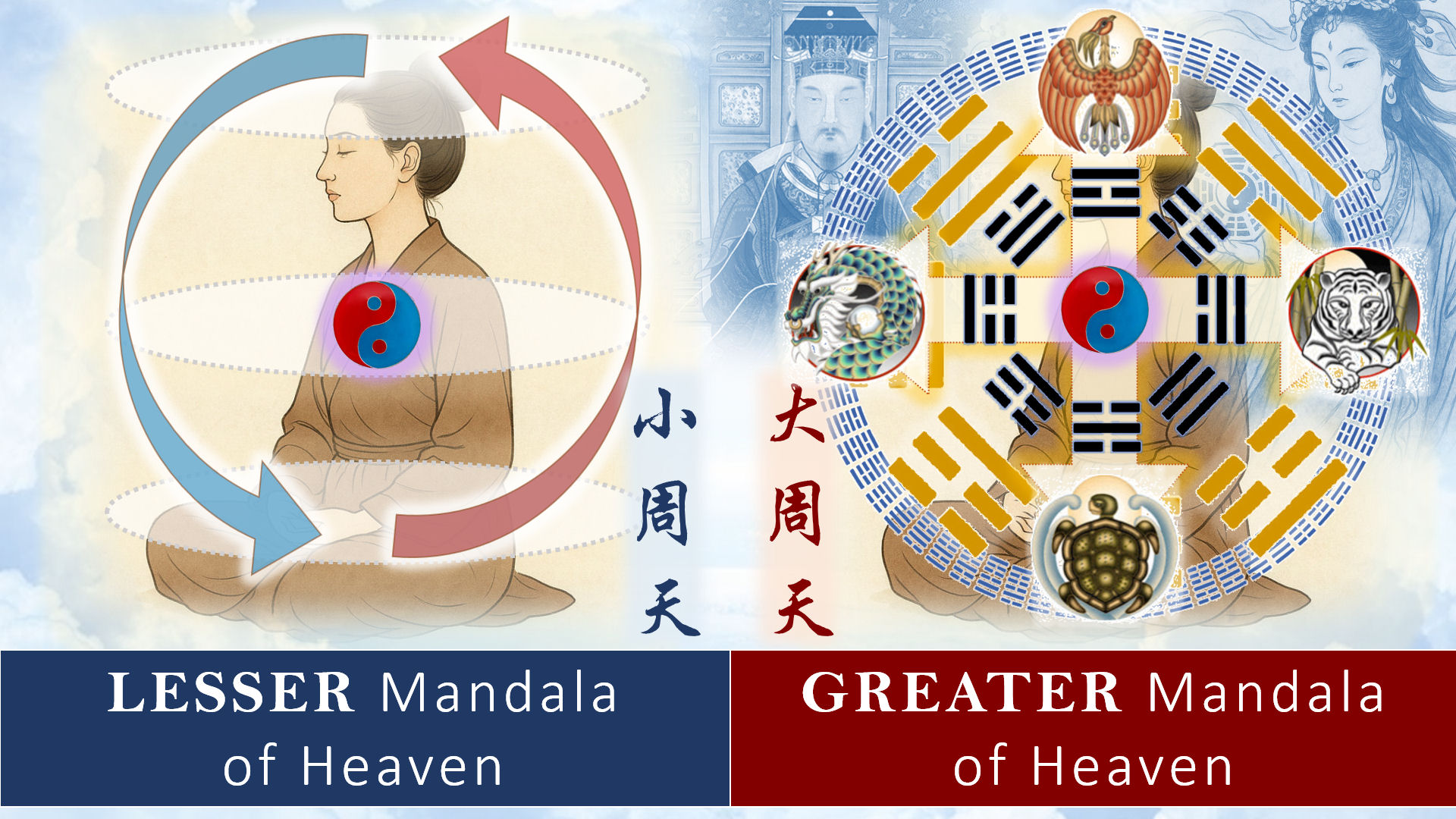
Lesser Mandala & Greater Mandala; Minor Circuit & Major Circuit
I’m still debating whether it’s prudent, or even feasible, to do a video lecture and companion write-up on the Greater Mandala of Heaven 大周天 cultivation practice.
While the beginner-friendly Lesser Mandala 小周天 is considered the first and most foundational practice you do before you do Other Stuff, the advanced Greater Mandala is considered what you do after you’ve done the Other Stuff.
So, for example, it’s assumed you’re seasoned in other inner alchemical cultivation practices, that you’re following some sort of specific diet or fasting ritual, you meditate on the regular, and you observe moral discipline (their perspective, not mine; well, not not mine, I’m just saying I’m not making this stuff up).
The Greater Mandala of Heaven goes beyond the front-back loop that you focus on in the Lesser Mandala, and expands the circulation to the entire meridian network, aligning it with the cosmological cycles and structural organization of the I Ching, starting with the Ba Gua eight trigrams.
While the yin and yang attributions of the Lesser Mandala focus on lunar and solar, water and fire, the yin and yang attributions of the Greater Mandala focus on Earth and Heaven as the polarity. The Lesser Mandala prepares you for the Greater Mandala, and the Greater Mandala helps you to prepare the Elixir of Life, achieving the true aspiration of Taoist cultivation.
Also, whereas in more basic energy cultivation practices, refined Qi 氣 into Shen 神 can be used to return to and optimize Jing 精 for general personal growth and maintaining your physical and mental wellbeing. But in the Greater Mandala, the refinement of Qi 氣 into Shen 神 always continues transcendentally, to unite with the numinous void 虛, the Tao.
As noted in the video, the Greater Mandala visionary meditation exercises can generate vivid experiences that feel real, but are not always aligned with reality, i.e., the practitioner “hallucinates.” The belief goes that if you haven’t mastered all that Other Stuff before undertaking the Greater Mandala, you’re more susceptible to encountering, well, inner demons would be my best translation for “xin mo 心魔.” Oversight from an experienced master can help the practitioner navigate between reality and illusion when advancing in inner alchemical practices.
On the Greater Mandala of Heaven 大周天
Our studies continue on to the Greater Mandala of Heaven, which we’ll explore in Part 2 of this two-part lecture. Click on the above hyperlink for the video and companion write-up.
Behind the Scenes
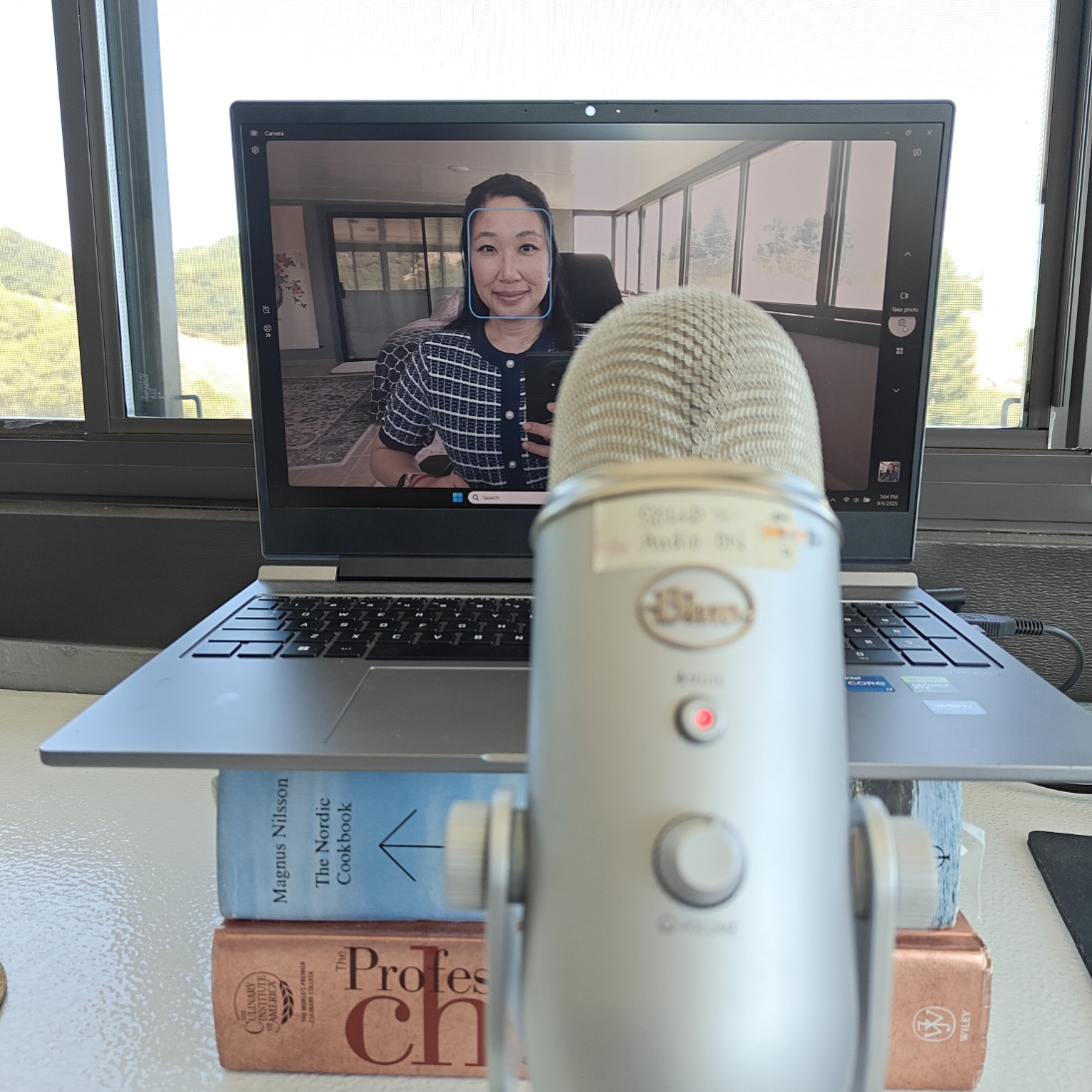
So I haven’t made a video for YouTube in a while. And I swear you really do get out of practice and lose your groove. I started by trying to record the video via my laptop, by plugging my Yeti into said laptop, but that didn’t work. I ended up having to re-record all the talking head parts the old way at my desktop, which produced really bad audio quality. Hence the audio quality issues with the featured video.
I had hoped that this could be my new video recording area and setup:
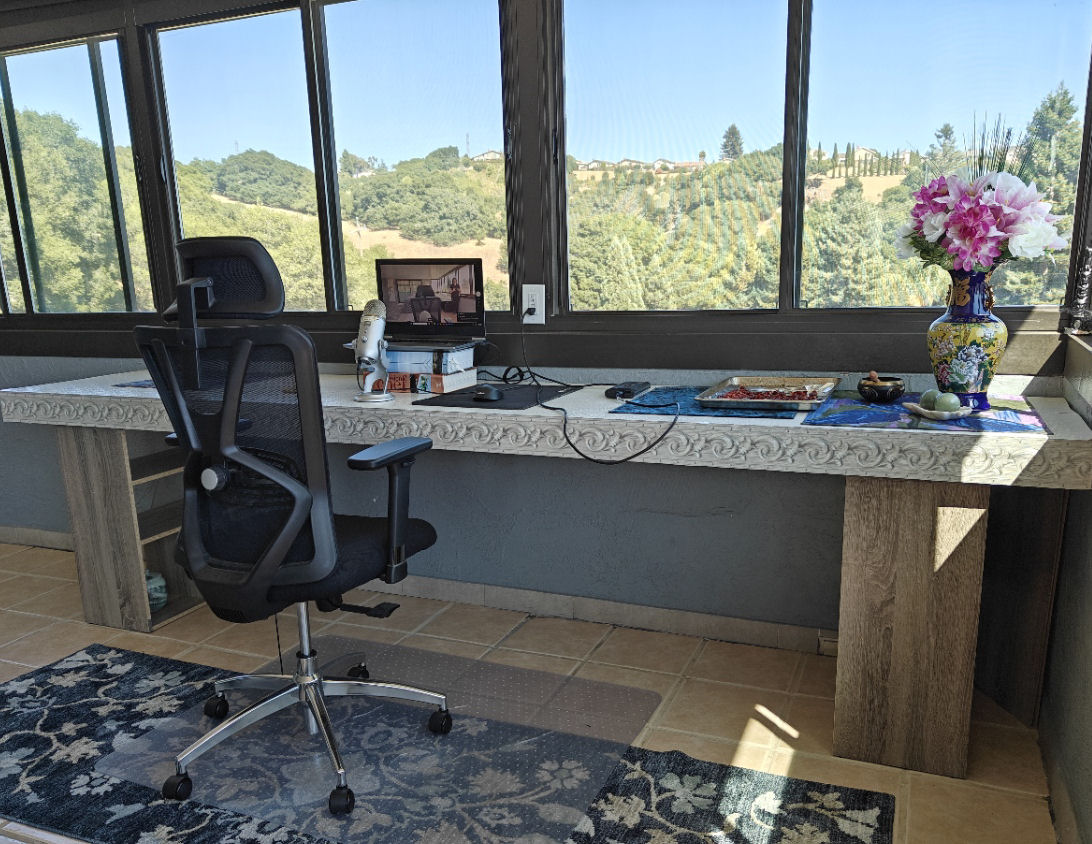
But sadly it did not work out. So it’s back to the same old, same old, no improvement in production quality. Here’s my same old, same old space:
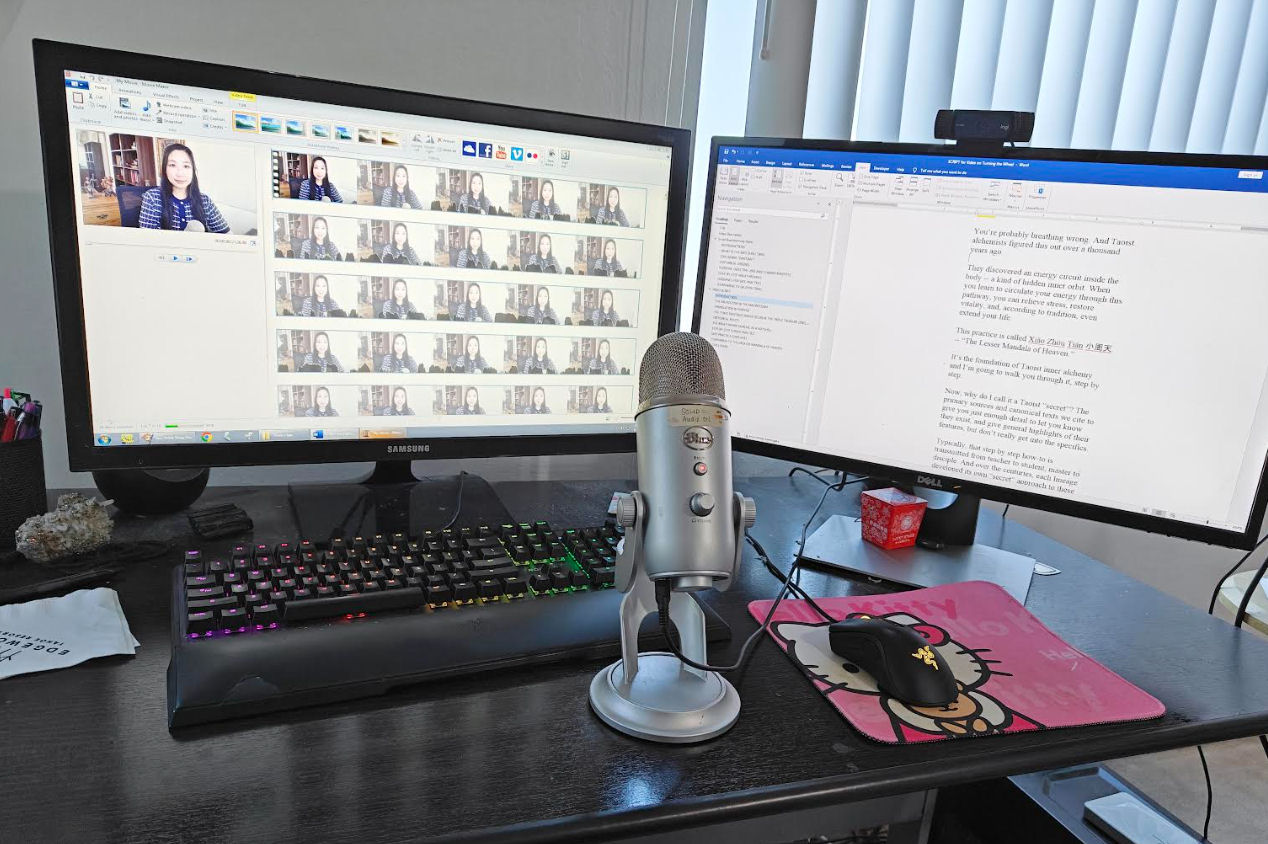
There you go. A glimpse into how the sausage is made.
Who am I?
For those coming across this one companion article to the video, who have not previously engaged with my work, and who know nothing about me or my background, hello! Hi! I am the author of I Ching: The Oracle, a translation of the Book of Changes annotated with cultural and historical references, restoring the hexagrams to their shamanic origins.
I’m also the author of The Tao of Craft: Fu Talismans and Casting Sigils in the Eastern Esoteric Traditions. My debut book was published back in 2015, which was Holistic Tarot.
I love art and had I not gone to law school, I would have gone to art school, so in my spare time, I illustrated a full tarot deck, the Spirit Keeper’s Tarot, and I’m currently at work on another deck based on the Etteilla system, the Tarot of Thoth-Hermes.
I’m still a full-time practicing corporate law attorney licensed in both California and New York, working in the healthcare sector.
I have been immersed in Taoist mystical practices and Buddhism since early childhood, growing up surrounded by master teachers whom my mother and her circle regularly invited into our home for instructions. Many summers were spent at monasteries, receiving firsthand training in contemplative practices and sitting in on hours (… and hours…) of lecture. This lifelong exposure has provided me with a deep, experiential understanding of these traditions. After earning my juris doctorate degree, I sought to understand these living traditions from a more scholarly and academic perspective.
 benebell wen
Thank you for the video and blog post! I’m going to attempt this for daily to see how well it goes. Your content always seems to be perfectly timed so I’m excited 🙂
LikeLiked by 1 person
Thank you so much and I’m very glad to hear!
LikeLike
I’ve been practicing QiGong together with my TaiJi Quan practice for many years and Xiao Zhou Tian has always been part of my routine.
Thanks for your clear and fascinating explanation, that is (as usual) able to clarify many connection about several aspects of Daoism.
I’ve also avoided practicing Da Zhou Tian for kind of same reason you explained, but I hope I’ll be able to reach that level one day, so I can experiment also this other level of connection with the Dao.
Thanks for all the job you do online and all your articles and videos
LikeLiked by 1 person
“I’m still debating whether it’s prudent, or even feasible, to do a video lecture and companion write-up on the Greater Mandala of Heaven 大周天 cultivation practice.”
Oh please do! I’m interested to see how it further aligns with the practice of Vipassana. Because of what you do already describe (“hallucinations”) it’s spot on.
I already have the Lower Mandala covered in my Xingyi practice.
LikeLiked by 1 person
Another Fantastic Discourse on the essential essential.
Whether the inhale or the exhale is the One or Zero in the binary chain only an ascended self may know.
Moments and interactions are not really the sum of minutes but the sum of breaths. Raise… Lower… Stabilize…
Even Expand… directionless really – shin Peng chi He
This is SOBill – sorry… I did not realize my comments were from anonymous but perhaps that is best except in the case of those who troll a topic with nothing to add but nonsense
非常感谢您慷慨分享的精彩见解和个人旅程智慧。您的慷慨让我倍感荣幸和谦卑。
为了生活而徒步,为了徒步而生活。
“路遥知马力,日久见人心”
Again… a thousand
谢谢
LikeLike
Is it okay for an outsider to the culture/tradition to learn and practice this? I always feel iffy about appropriating or messing up in the process of learning about other cultures, languages, traditions and practices.
LikeLike
Çok değerli çalışmalar yapıyorsunuz
Sizi takip ediyorum, sayenizde öğreniyorum yeni bilgiler
Ben de İ CHİNG hexagramları ile kutsal kitapları karşılaştırıyorum
Teorim;
5 element 5 peygamber 5 kitap
Su=Nuh=İ Ching
Toprak, Tora, Musa
Ağaç, İncil, İsa
Metal, Davut, Zebur
Ateş, Kur’an, Muhammed
Hexagram 1-KEY
SURE 1-Fatiha – Anahtar
Hexagram 2- Kısrak
SURE 2-Bakara-Sarı İnek…
LikeLike
Thanks so much for all your blog posts and videos! (and books!)
I have a little question about step 4, if you don’t mind:
At this point, you guide the energy from the upper dantian not toward the lower dantian or the middle dantian, but somewhere in between (at the belly button)? Am I right? Is there a specific meaning for this move?
Thanks!
LikeLike
are you still teaching? I paid $79 thru PayPal & they said they do not monitor that site anymore
LikeLike
Pingback: Advanced Introduction to Taoist Alchemy – benebell wen
Hello Benebell
This is the nicest aesthetic lesson on behaviour I`ve heard. Thank you
Zi ran
LikeLiked by 1 person
Pingback: Mandala of Heaven 周天: Taoist Alchemy Course – benebell wen
Hi Benebell, I’m a new subscriber to your YT channel, and am very excited to have found you. Close to 30 years of delving into so many different esoteric paths, yet it still feels like I’ve only ever been skating across the surface of any of them. I feel I am a bit out of my depth when I listen to your talks, but I’m drawn to commit to one path at last. Have started by following your directions for the lesser mandala meditation several times daily. You describe a feeling of warmth as you breathe up the spine and coolness exhaling down the front, yet I can’t seem to help feeling the exact opposite of that, I think because the feeling of the fresh air entering nostrils on inhale is cool, then once warmed by the body it feels warmer on the exhale. Or am I getting too hung up on the sensation of the breath and missing a different sensation altogether?
LikeLike
I try not to be concerned about Phenomenon (sensations) but rather concentrate on the practice. Any Phenomenon such as warmness/coldness etc. is really not the issue. Just continue the practice with openness and trust in the process. In the science of happiness, The First Habit of the Highly Happy is: Prioritizing, but not Pursuing Happiness. Apply this axion to your practice and all will be well. I promise =)
LikeLike