Essential Oils: My (Hopefully) Holistic Perspective

Two of my current go-to blends. “Anti-Itch Oil” consisting of tea tree oil, eucalyptus, and lavender really does (at least for hubby and me, and all the friends and family I give this to) alleviate minor itching and bug bites. It also clears my sinuses, and helps with congestion. The blend of frankincense, rosemary, and peppermint smells like petrichor! That after-rain scent! This one’s a great massage oil to soothe tense muscles, carpal tunnel, and I also use it as a hair and scalp treatment oil.

Essential oils get a really bad rep these days, and for good reason. Beyond the scams and pyramid schemes, its contemporary New Age associations with “this can cure cancer” claims and people replacing evidence-based healthcare with fragrance blends is why people are – and should be – skeptical.

Not only is there insufficient scientific and medical research to conclusively make claims, but often it’s misused, or people are uninformed about how to use plant extract essences. They definitely can cause skin irritation, allergic reactions, and in extreme cases of misuse, adversely interfere with your body’s regular functions (this is why those who are pregnant, trying to get pregnant, and young developing children need to heighten their discernment around use of essential oils). Some concentrated plant essences can also interact adversely with prescription medications.

Then of course there are the sweeping claims in the realm of magical thinking. This oil blend will bring you luck in love and romance, or this will exorcise demons, or this will help you to manifest wealth. This oil is for glamour magic. That oil is a cure-all.

The historical origins of the term “snake oil” is synchronistically telling here, actually. When Chinese laborers immigrated to the United States to work on the Transcontinental Railroad in the 1800s, they used a traditional Chinese medicine containing actual snake oil. Per TCM, fat extracted from non-venomous water snakes rendered into an oil, mixed with ginger and camphor extracts was a legitimate medicinal remedy for joint pain and muscle inflammation, which the railroad workers would use. Americans then capitalized on that idea by selling fake snake oil as a magical, mystical ancient Chinese remedy for all ailments. Hence the term “snake oil” came to mean a fraudulent health hype, when actually, the original source material wasn’t fraudulent at all.

Similarly, there are bona fide legitimate uses for essential oils, but capitalistic bad faith sellers of fake stuff give essential oils a bad name. Sadly.

Continue reading “Essential Oils: My (Hopefully) Holistic Perspective”

Overview of Western Art Movements: Art History Timeline (Handout Download)

Back in 2021 after completing SKT the Third, I shared a scan of my personal art study notes here, “Download My Art Study Journal.”

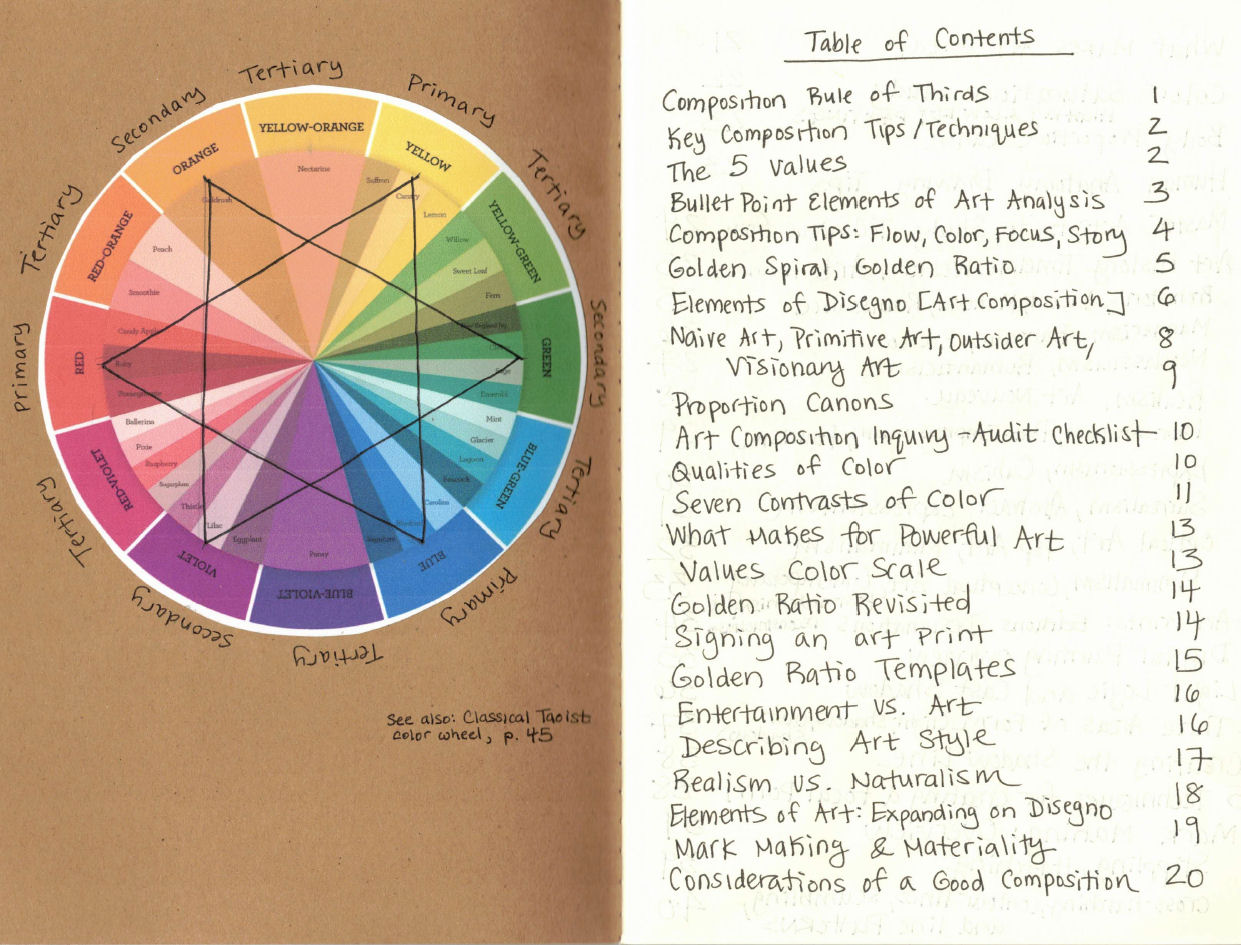
I converted the handwritten notes from pages 25 – 33, and integrating notes from other pages in that notebook into the following cleaned-up and expanded handout:

Download Handout

Art History Timeline

PDF

DOCX

The PDF file will be easier to work with. However, for those who want to cut and paste or edit the contents in the handout to create something more custom-tailored to your own needs and purposes, feel free to do so from the DOCX file.

Continue reading “Overview of Western Art Movements: Art History Timeline (Handout Download)”

Critiquing Your Own Art (Handbook)

I’ve written about my self-taught art journey during the pandemic here. I found a bunch of MFA art program syllabuses online and aggregated them together into my own curriculum, then scoured the interwebs for online courses, video lectures, tutorials, books, blogs, anything and everything I could get my hands on to learn composition and the core principles of art making.

You can also download my art study journal here, which is what this handbook, a free download, is based on.

Critiquing Your Own Art

PDF Download

It reads as if after you’ve produced a work of art, you’re supposed to run through the checklist of items for review page after page in this handbook and self-audit how well you did in each of the categories. Yes and no.

It’s funny, whenever I endeavor to unpack something into its parts to analyze, people accuse me of being too analytical at the cost of creativity and intuition.

But if you observe me in the everyday, you’d think me a hypocrite, because in life, I very much operate off intuition rather than pure, cold logic. I go off my feelings way more than I go off rational deduction.

Yet rational analysis is the necessary checks and balances to your supposed intuition. Your intuition can get tainted by bias. So you have to be hyper self-aware and mindful.

While I would be the first to agree that you do not need a checklist to determine and define what is or is not great art, there is some value to deconstructing why we consider certain pieces “great art” and others not.

And if you can deconstruct that, can you then use it as elements to construct “great art”? I don’t know, but why not try? Even if you fail, you’re going to learn valuable lessons from that failure, so I welcome it, don’t you?

If anything, this sort of guided checklist helps you to more likely spot areas for improvement in your craft.

Anyway, that’s how this handbook got started, and you’ll see that the contents are extracted from that art study journal from 2021, which I kept as reference throughout 2020 while I was working on the Spirit Keeper’s Tarot. I converted the content into, well, a bunch of concrete, tangible points for consideration when critiquing your own art.

It’s not like every single one of the points in this handbook will be 100% applicable to you. It’s more about using it as a general reference, to help you navigate self-assessment of your craft.

Here’s the MS Word doc version for those who want to cut and paste around, and change it up to make it personalized:

Critiquing Your Own Art

DOCX Download

The content within this handbook is free for you to use, share, adapt, and build upon in any way that serves you, be that for personal or commercial purposes. Whether you distribute the PDF or DOCX as-is, remix it into your own content, my goal is for this to reach those who will benefit from it. So do whatever you Will with it.

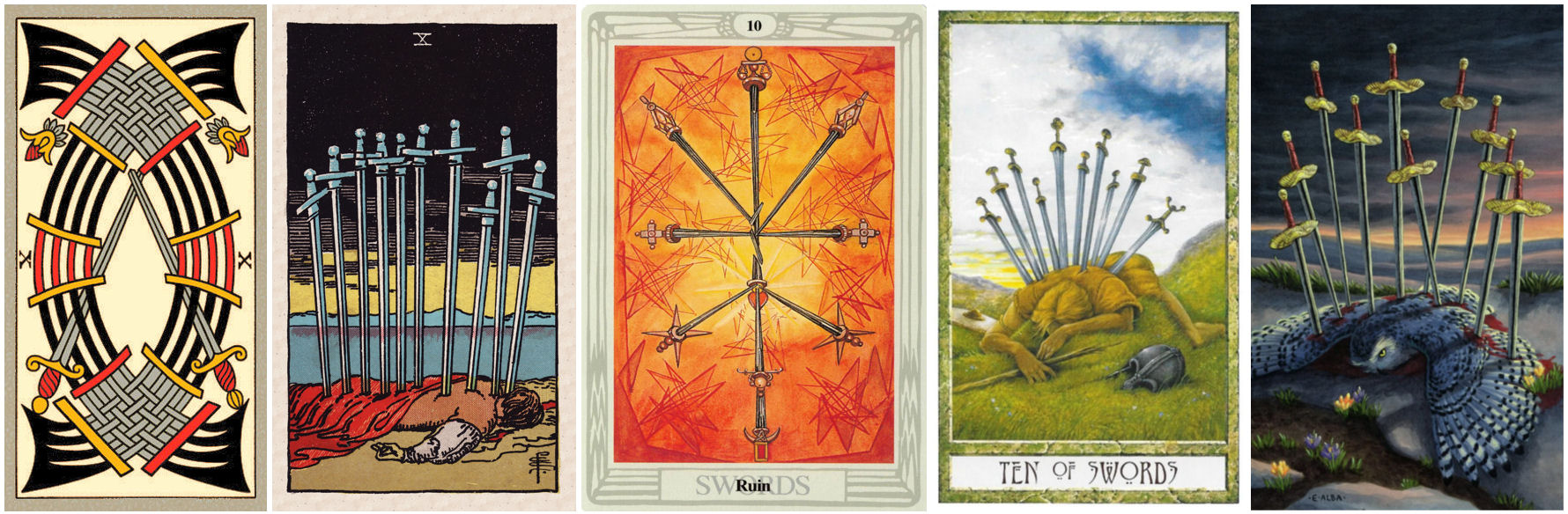
The Ten of Swords. Ego-Death. Soul Wound. The Double-Cross.

Left or Right – Which one do you prefer? The left G-rated version that leans more into psychological pain? Or the right bloody version that leans more into the physical manifestation of our suffering?

First three left to right are representative of the TdM, RWS, and Thoth, respectively; fourth is from the DruidCraft Tarot, and fifth is from the Tarot of the Owls by Elisabeth Alba and Pamela Chen

The Ten of Swords in tarot has come to be associated with betrayal, treachery, backstabbing, the pain of being double-crossed, and the breach of trust. So how a deck creator illustrates the Ten of Swords reveals a lot about their unconscious processing of these themes.

It’s also the soul wound, a crisis of faith, where faith and reason are at war. It’s the mob mentality vs. individuality. Seeing an artist’s rendering of the Ten of Swords will reveal to you that artist’s relationship to the archetype of the ego-death.

At least that’s always been my impression.

Continue reading “The Ten of Swords. Ego-Death. Soul Wound. The Double-Cross.”