

I would rather not share this publicly, except geez do I wish someone had spared me so many failures and missteps simply by sharing something like this with me earlier, back when I was just starting out in my career, and life.
When you come from an immigrant family…
From a lower socioeconomic background and then suddenly for your career leap into an environment where everyone comes from so much more privilege and status than you ever knew…
When you’re a person of color and what goes for communication and people skills in your culture is not at all the same as what goes for communication and people skills in this society…
When you’re the only woman in a male-dominated industry…
When you’re neurodivergent and an introvert…
…when any of these situations are familiar to you, often a big obstacle that holds you back from the level of success you would otherwise enjoy is this: you’re terrible at corporate-friendly communication and people skills.
I know I am.
In my head I think I’m smiling, warm, affable, speaking clearly, slowly, and concisely, in a structured organized manner…
…in reality I’m looking nervous, shifty, I’m rambling off on tangents, I’m info-dumping on you, and I can’t seem to get to the point.

Because I never had a workbook like this, my growth and improvement rate was slooooow. Like how many times did many, many people have to tell me I speak way too fast and am rambling and info-dumping before I made any effort to speak slower and enunciate better. How often did I cross my arms and slouch and avoid eye contact at important social gatherings and as a result made terrible first impressions with a load of very important people. Either I over-share or I under-share, and can never seem to “strategically share to present micro-vulnerability as a signal of authenticity.” (Like, did you even know that is a thing someone has methodically and intentionally thought through??)

This is a free downloadable workbook based on strategic communication skills development and pattern-rewiring for executive leadership presence, with pretty easy-to-follow actionable techniques, skill development, and practice exercises to improve your people skills, your “executive presence,” and just all around be better at communicating to others.

I deconstructed, tweaked, aggregated with other learnings, and re-assembled a self-guided handbook for me to print out and work through any time I need a “system reboot” (corporate lingo…).
Which is to say first and foremost I put this together for me. Something I could reprint double-sided and tape together into a mini workbook-handbook and run through the exercises, review the tips and techniques, cover to cover as a refresher.
I didn’t make this for you. This started out as a private aggregation of my notes taken during various leadership conferences I’ve had the privilege of attending, most memorable learnings from leadership coaching, and then fleshing all of that out into something organized and structured via ChatGPT. The result = this workbook that I planned on keeping private, because it’s kinda “trade secret”-ish, ya know?

Then it occurred to me that almost all the executive leaders at the biggest corporations making the seven figures have someone teaching them these skills. They are being trained on these methods, and then they just appear effortlessly charismatic, with gravitas, confidence, and presence. When really there’s a step by step approach to you achieving the same, too, if only someone would let you in on these secrets. Inequitable access may be a reality of life, but that doesn’t mean it’s okay, and it doesn’t mean I have the pass to be complacent.

That’s when I realized, yah, I kinda have no other choice but to share this with you. So here you go. No matter what you do, there is absolutely something in this workbook that could be of benefit to you. I’m serious. So do me a favor, do you a favor, and at least read through the document — skim through it beginning to end.
Although if you are an extrovert with a knack for mainstream people skills, then this workbook is probably going to be “no, duh” to you. But for those who are neurodivergent or particularly prone to unintentionally sending the wrong social signals, this handbook is kind of a godsend. It really trains you to be intentional and thoughtful about how your communications, body language, everything is being perceived.

For example, I’ve had to learn the hard way over the decades that I process information at a different pacing than is conventional. My nonverbal communications also don’t always align with neurotypical social expectations. I really feel like I need to willfully, artificially program myself to engage in small talk; otherwise I’m just awful at it and come across as cold and disinterested.
I have the bad habit of frequently closing out my sentences with “you know what I mean?” or “does that make sense?” I say “um” as if hesitating before the moment I deliver an important assertion. Why. Why do we do that and unintentionally diminish our own impact and de-value our authority.
Working through intentional exercises and drills gives you an opportunity to audit your own communication weaknesses and thus improve upon them. Watching back a video of yourself doing public speaking is extremely painful but also now you have no choice but to address the areas for improvement.

I’m naturally an info-dumper. Which is totally not the way you communicate with executives. Having to organize communications in a way that isn’t info-dumping is genuinely difficult for me, so I have to be super intentional and even forceful about it. (Also, thank goodness for AI. I know the majority of people reading this hate AI with a loathing passion, but hear me out on this one point — if you’re a neurodivergent info-dumper, one great hack for faking strong corporate communication skills, especially when it counts and is high-stakes, is to first info-dump into ChatGPT, then ask it to rewrite your message so it’s clear, concise, and executive-ready.)

Dammit I just info-dumped and over-explained, which goes to show you I need to review my own workbook again and go through the material again. 😛
Though that segues nicely into my obligatory reminder to you that–
–this is not me teaching you anything, this is just me sharing with you in real time what I’ve been learning.

You start with the Preliminary Self-Assessment and how much you get out of this workbook is contingent on how self-aware and honest you are with yourself. Highlight the categories of communication and people skills that you’ve marked as “Needs Improvement” and focus your efforts on those particular sections of this workbook.

You also want to take the quiz to determine your Communication Archetype, and then based on your communication archetype, understand how people often perceive you, and how you can improve your communication skills based on your current strengths and weaknesses.
Sure, a lot of the info in here is going to be common sense, and once you read it, you’ll think, well of course. Except you also realize you weren’t really intentional or mindful about that point, were you. So calling out this “common sense” stuff helps you to be a lot more strategic, and consistently effective.

Also, the content in this workbook gave me the language and tools to spot colleagues who were, like me, sending all the wrong social cues and I could now observe how they were being negatively perceived and exactly why they weren’t being effective communicators. For example, observing how it’s much harder for people with high pitched voices to climb up the corporate ladder, because lower pitched voices are perceived as more authoritative.
Or witnessing in real time just how negatively nervous laughter while delivering bad news gets perceived, even though many of us unconsciously do it. This is called incongruent expression, and it’s particularly common among older generation immigrants from war-torn countries or poverty. It’s a subconscious coping mechanism and form of trauma adaptation, and also a subconscious signal of powerlessness. However, that mannerism gets passed on to the younger generations trying to assimilate into, say, a modern American workplace and their learned default setting of incongruent expression is being perceived as poor people skills.
I could also identify, with specificity, why certain executive leaders were coming across so charismatic, confident, and well-spoken. And even more scary– what everybody else is perceiving as warm and competent because the leader is sending well-rehearsed heavily coached signals, now you are able to pierce through the illusion and see what’s going on. Why are some people so popularly likeable (the steady eye contact, open gestures, and well-timed smiles) and others come across as crabby (arms crossed, not enunciating, muttering, looking down or away a lot). This content helps you to deconstruct, identify, and name.
More critically for people of color, this type of workbook is a bit like learning the rules of the game. No one is saying you must conform and assimilate. But it’s an uphill battle in this society when you don’t. There isn’t a single POC I know who doesn’t, to some extent, have to learn how to code-switch.
Same for being a woman. Women’s (general) default communication style differs from men’s default communication style (as many memes on the internet humorously and stereotypically highlight). But the standard for success is the masculine communication style. So that immediately puts women at a disadvantage. You have to re-set your own communication style if you want to get ahead in a male-dominated world.
For example, tailing something you’ve just said with “does that make sense?” comes from a subconscious consideration for the other side, wanting to make sure you are accommodating to what the listener needs from you for comprehension, whereas the coached rule of thumb now is to never tail with “does that make sense?” and instead tail with “let me know if you have any questions” because it projects more confidence. Sure, but also that latter approach comes from the assumption that everyone should be at your level, rather than you needing to meet others at their level.
If you’re coming from a culture where directness and expressiveness is preferred, because that’s what conveys authenticity, you’re going to quickly find yourself constantly misinterpreted as aggressive or confrontational. Likewise, the deferential practice of avoiding eye contact in some East Asian cultures can be misread as evasive, lacking confidence, or not to be trusted. Quietness and modesty that is favored in one culture is often misread as lacking leadership potential, disengagement, and even incompetence in a Western culture.
For example, prefacing what you’re about to say with, “I could be wrong…” – at least from my cultural perspective – doesn’t mean I genuinely think I could be wrong; it’s a form of polite speech. Culturally the Asians I grew up with would have done copious amounts of due diligence and fact-checking before they’d speak up and say what they’re about to assert, but they’ll still preface the assertion with “I could be wrong” or “if I may…” not because they’re unsure of themselves, but because that’s just etiquette.
Coming from a culture that taught you to avoid open disagreement can be mistaken as dishonesty or lack of transparency. Being raised in a society that encourages storytelling, nonlinear styles of communication, which you find in many Indigenous communities, can be misinterpreted as lacking efficiency, going off-topic, even unprofessional. In some Eastern cultures, prefacing what you’re about to say with an apology is part of social etiquette that everyone understands as etiquette. It’s an obligatory social signal and if you don’t begin with an apology, you come across as rude. Whereas here in Western corporate culture, apparently, prefacing what you’re about to say with an apology is perceived as submissive beta behavior.
Or consider the coaching advice for executive leadership presence on dressing in neutral tones only, implying that very colorful, vibrant clothing can be perceived as unprofessional. But many non-white cultures around the world hold a very different perspective around the implications of vibrant color. And so in white-dominant corporate culture, you either assimilate and “tone down” your wardrobe to bland beige neutrals to cultivate that “executive leadership presence” or you risk wrong presumptions and hit the glass ceiling.
While Diversity, Equity, and Inclusion training helps us all to be more culturally competent, and helps to dismantle rather than reinforce systemic biases, we, as people from marginalized communities, must also take proactive ownership of our success by learning the unspoken rules of power, communication, and presence as defined by dominant cultural norms. That is why I am sharing this workbook. Because maybe you haven’t had access to information like this. Maybe this turns out to be a game-changer for you and integrating these skills is how you level-up in the professional world.

Since I did whip this workbook together mainly for my own benefit, based on a loose gathering of notes from different workshops and master classes plus using AI, it’s not perfect, or complete, and to make it really work for you, you may need to tweak it. Which is why I’m also giving you the Word document. That way you can change it up however you see fit.
By the way, your feedback is very valuable to me. Let me know if it was worth my trouble to put this thing together and share it on this blog.
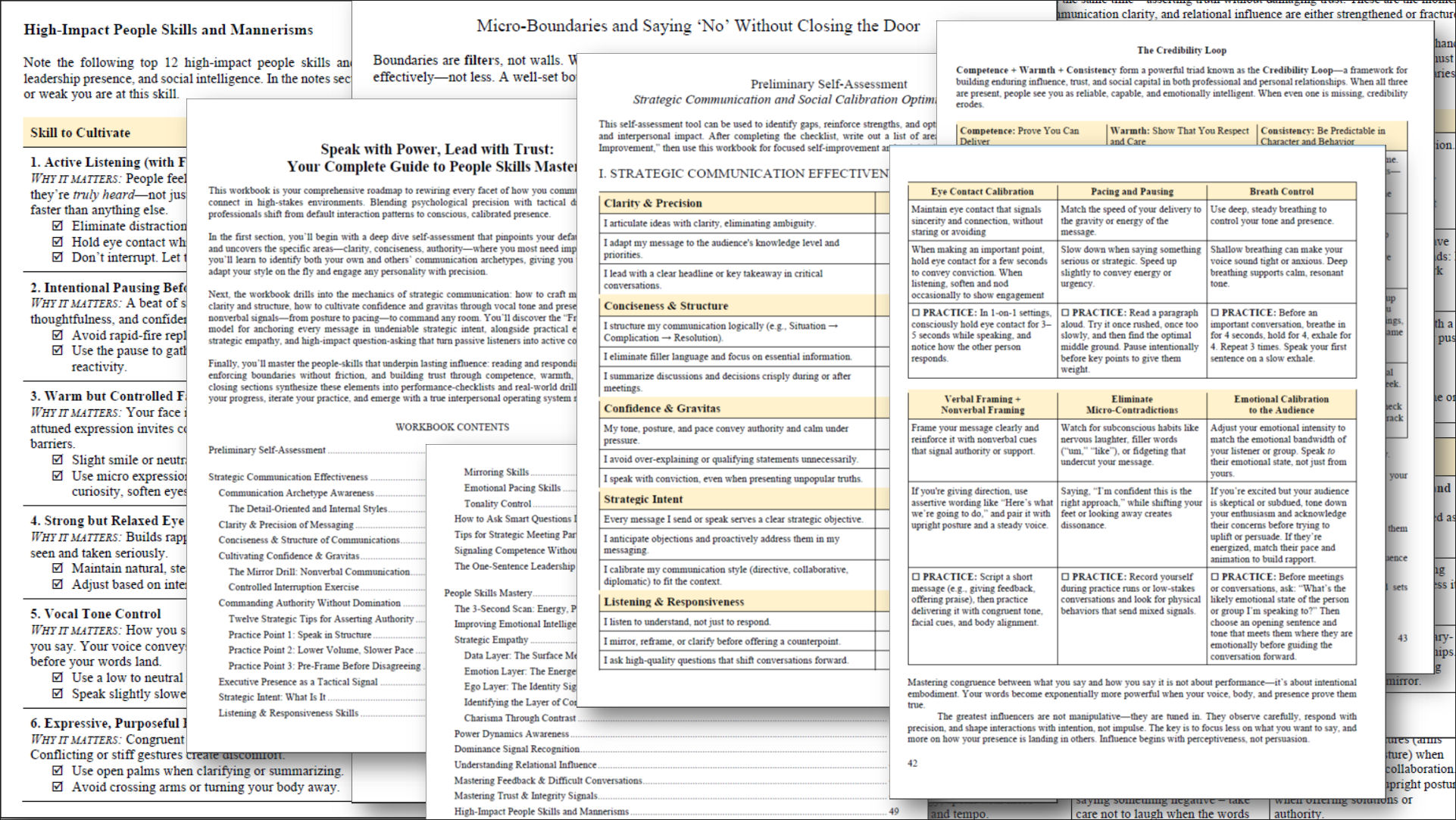
In closing, while the workbook itself is a guide to mastering strategic communication and people skills, I hope this write-up leading to the download serves as a crash course on diversity, equity, inclusion, and cultural competency when it comes to understanding your diverse colleagues and communication styles that diverge from the standard.
While these are the tried-and-true rules and guidelines to know for your own ability to master strategic communication and people skills according to standardized norms, at the same time, please be understanding of how and why people from different backgrounds than you might communicate differently, and how to be adaptive and understanding of that in organizational culture.
Speak with Power, Lead with Trust (Workbook)
PDF | DOCX
A workbook for mastering strategic communication, executive presence, and people skills. These techniques and skill development exercises help you to rewire default communication patterns to build influence, authority, and trust in high-stakes environments. useful to those seeking personal or professional growth, executive leadership skills, and mastery of strategic influence and interpersonal effectiveness.
If you want to print out the workbook so you can actually work through it, then download and print the PDF. (There may be wonky formatting issues with the MS Word version, if your version of MS Word is different from mine.)
If you want to re-purpose any of the content to create your own stuff, then it’s probably easier to cut and paste from the DOCX file. Just note that if you’re viewing the DOCX file, and there may be formatting and spacing issues you have to contend with. How you see it on your computer is not what I saw on my computer. 😊

The content within the workbook is free for you to use, share, adapt, and build upon in any way that serves you or those you serve. I wholeheartedly invite you to integrate this content into your personal practice, educational or coaching materials that you produce, workshops, or any other endeavors, commercial or non-commercial, I don’t care. Whether you distribute the PDF or DOCX as-is, remix it into your own content, my goal is for this knowledge to reach those who will benefit from it. So do whatever you Will with it.
 benebell wen
Benebell, you are so generous! Thank you for this.
Long-time follower, Patti
LikeLike
Good stuff, Benebell! ❤️ Keith
LikeLike
Dear miss Wen..I normally read with interest all of your works..I cannot say that I did not noted the idea that you occasionally express concerning the white male predominance and color pregiudice as well as being a woman fighting against all of these scenarios…so please allow me to express as well some ideas on these subjects…when a person could not “properly” choose it’s “own” destiny like being in a immigration flow perspective or living in a extremely materialistic or spiritualistic society…a big question remains suspended..and in the deep of us we can choose at least to enquire..is it not the idea of why me? Or what did I do to live in such place? Or what is the purpose of my life? That itself could be the deviating point…who am I? Why do we think I am this or that or what should I do to get out of this or that or even how to reach success or recognition? That is the real question of enquiry! We are everything! But not the “I” the I is how we all seem to accept not to touch..it’s sacred..I am!!! It became the absolute truth! when in reality it’s that the real challenge instead of learning how to speak in a convincing way to show that we are able to do anything we should start demolishing what we were taught to believe or even to fight against (which feeds even more what we are refusing) so as in most ancient scriptures of knowledge,we find parts of this fantastic enquiry..which in simple words we can grasp the idea..Lao Tzu said words that can be said,can never reach the truth… Socrates said all I know is that I don’t know, Rig Veda says .this world is for habitation not for possession..start from the I…Azriji said,in the nothing there’s space for everything but in the everything is really difficult to find a nothing space… and Mr Shakespeare when he said To be or not to be this is the question..was meant.. if you are your true self it will be a problem for others but if you are not your true self it will be a problem for you…these thoughts also represent that when we build an I we have to learn how to demolish it otherwise our evolution or fusion with the universe will require to start always from scrap wether born as a men or a woman or a animal…we should not identify with anything less than the universe …Sukhi Bhava…
LikeLike
Dear Benebell, You’re delightful writing a contradiction, and I hope you haven’t given up on the Lao Tzu translatoin either. My Wednesday’s archetype was actually moonsinger, which is admittedly kind of a ramble about Radhe and Krishna, hearing and feeling, fearing and healing. Then we stumble into an executive class bar fight, and all the sudden there’s one move of action on the job application (which should honestly have gone through the right way). Thanks again. This makes a nice birthday present for anyone drowning in unemployment.
LikeLike
thank you very much for this workbook.
I am sure it will be helpful for me.
LikeLike
A lot of this applied when I was younger (MBTI: INTJ). Now it no longer matters since I am retired.
It was not helped by my being repeatedly beaten in younger days because of the color of my skin (white).
It also wasn’t helped by my being sexually harassed by female superiors in my not male dominated business.
I realized that I had no store of victim points.
Now I automatically block people who make racist or misandrist comments, no matter their skin tone or pronouns.
But thanks for the communications tips anyway. I’m sure they will help some people.
LikeLike
Thank you Benebell Wen for sharing your life experiences.
LikeLike
Thank you for your continued generosity. This is gold.
LikeLike
Thanks for sharing
your gifts are always useful and helpful in our development process
LikeLike
thank you, thank you, and BRAVO from this late-diagnosed neurodivergent white lady who’s built a career in tech. I will be sharing this invaluable resource with as many people as I possibly can. Bravery is being afraid and doing the right thing anyway — and you were brave a million different times in a million different ways to put this together and now share it. Again, THANK YOU
LikeLike
You are a gift to humanity especially English speakers and I’m sure in the other language(s) you speak. Thank you so very much for your generosity, your hard work, your authenticity, your vulnerability, and for your existence. Thank you, Benebell, from the bottom of my heart! Long time follower too.
LikeLike
Your generosity of spirit is awe inspiring!! Thank you for this!! Thank you for your artwork!! But really thank you for being yourself. I for one would love to read more of your writing that is without AI. I understand how many people use that platform. But it is becoming so very obvious how AI is programmed. You Tube is completely loaded now with AI slop junk! It is really bad & it is just stealing people’s ideas & spitting out horrible, complete junk. The tech bros don’t seem to care whatsoever. Please have more content straight from your own voice!!! No need to clean it up with AI. Pushing 72 shortly, I have watched how people are so busy looking at screens all day, that they can’t even talk anymore, in any form. So what if you ramble, at least it is real, & from someone who cares about humanity. Look at this world now-how good is all this tech??? I ramble on as well, so you aren’t the only one for God’s sake. When one speaks, since nobody listens anymore, you only have so much time before someone looks at their phone or their computer & turns away, so small wonder everyone rambles on. Write more articles right off the cuff & draw away with all the imperfections!!! It is real then, from a born writer & a born artist such as yourself, that gives generously of their creations!!!! Look what this so-called great tech world has brought us in the US!!! You won’t even be able to buy a new car or even a used car now. The wealthy class that refused to retool the auto industry in Detroit took their money elsewhere because they did not want to pay a decent wage & take care of their employees. Look at what they are doing now to the immigrants & us citizens??? Who wants to be part of this corporate class anyway?? How is that for some rambling & info dumping??? Please, just keep being your true self!!! Forget the AI clean up. I would have rather read your real words. Thank you for your generosity, your artwork & yourself. This world needs the real people to stand up.
LikeLike
I love this workbook!
As a fellow neurodivergent (tho much MUCH slower!), couple q’s.
1 – I took a work soft skills course in a large software company once. Self-assessment plus an assessment sent to a few chosen colleagues. I chose ones I worked close with at the time, ans well as ones I found especially difficult. The results were humbling. Kinda like learning a huge shadow. But they had 4 quadrants with the diagonals as conflicting types. Driven vs Amicable, and Analytical vs Expressive. It fit – I’m expressive and the anylitical peer drove me nuts!
Where did learn of 10 types? A guess – the 5 elements? But which 5 as they’re different: Taoist or Buddhist?
Q2 – What sorts of questions did you ask chatgpc to create a workbook? I found teacher quizzes tutorials… Did you find a tut online on how to do it? Knowing you, you just naturally mastered it. 😀
Ideally I’d love to make a workbook to discover my unconscious drivers running my show. I tried tarot but I bet the drivers ran my interpretations. Plus I never finished the deeper nuances before falling ill.
LikeLike
Hi Benebell,
Your email always goes to Social and I often happen to just chance to see it. This communication workbook is very timely for me as I’m looking for a job for my new career advancement.
I’m so grateful for you to share these valuable teachings and ideas.
Sincerely yours,
Shelly
LikeLike
Thank you so much ! this is extremely helpful !
LikeLike
nice! New Study Shows Benefits of Plant-Based Diets 2025 enthralling
LikeLike
Your energy is so bright!
Thank you so much, for this is very helpful.
Bless you!
LikeLike
Thank you so much. You are wonderful!!! Kisses from Brasil.
LikeLike
This is perfect for my line of work, thank you Benebell! You never cease to amaze me!
LikeLike
The above was posed by me but I don’t know how to log back on. ~Nikitta~
LikeLike
I am starting a grieve coaching course and to work with people in trauma. Thank you for your free booklet, it is awaizing which i will use with my course as it contains much relevant information.
LikeLike