
This blog post is an addendum and continuation after what I discuss in the video linked above.
The Akashic Records is very much a Western conception, right? The Theosophists of the 19th century formulated a mash-up of Eastern and Western esoteric traditions and from that mash-up came its most popular legacy– the Akashic Records.
Most of us get that the “Akashic” part was inspired by the akasha, a fifth element or essence found in various Asian traditions, associated with the sky, space, aether, and in Buddhism, even a state of mind. But what about the “Records” part?
But first, I’d like to start with the discussion on akasha and godhead.
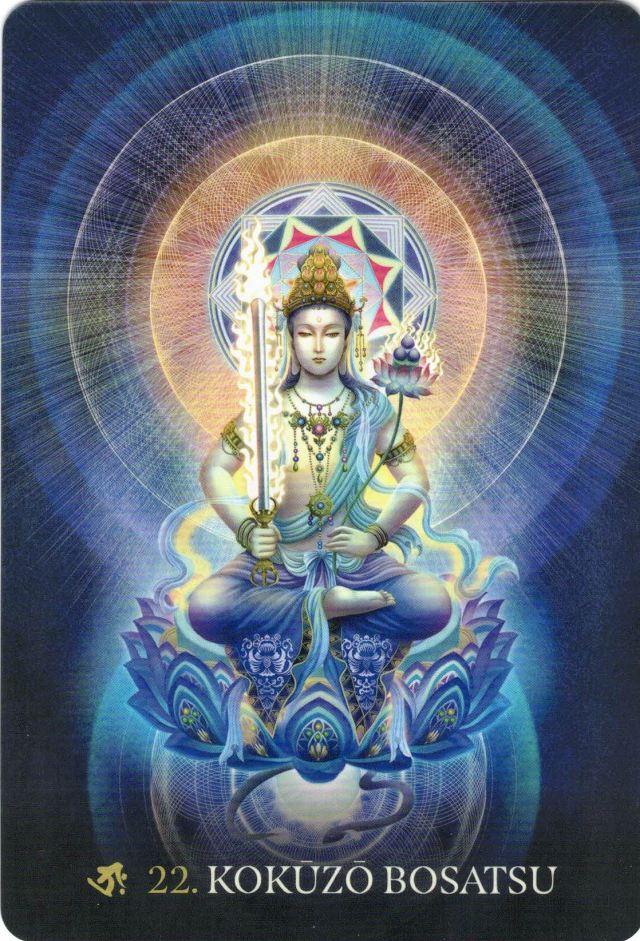
The Akashagarbha 虛空藏菩薩 is the Buddha/bodhisattva associated with the akasha, the bodhisattva of infinite sky and space, whose magical powers are boundless, wielding a sky jewel and a flaming sword of truth and knowledge. Akashagarbha also presents through five manifestations of the Akashagarbha, which are in turn directional emanations of the Five Wisdom Buddhas.

If the Akashagarbha is the Buddhist divine manifestation of the Akasha, then the Five Emanations of Akashagarbha in the five directions conveys five purposes of accessing the Akasha, five of its key attributes:
- It is the nothingness, and therefore equated to the Taoist Realm of Nothingness.
- It is a mirror of knowledge, as expressed in the magical bronze mirror one finds in the Inner Palace.
- You can access the Akasha to heal and cure suffering.
- It is Light.
- And it is a reservoir of all memory imprints of the universe, an accounting of the universe’s karma.
The Inner Palace (元辰宮, Yuán Chén Gōng) is the legacy of the Palace of Mysteries 玄宮 (xuán gōng) referenced in Zhuangzi, Baopuzi, and other canonical Taoist texts. Per these texts, it is situated in the Mysterious, Numinous Void 玄空 (xuán kōng), which equates to the Buddhist concept of Akasha is 虛空 (xū kōng). The markers describing these realms match up across multiple texts over hundreds, now thousands, of years.

Perhaps the Palace of Mysteries is a broader umbrella term used in Taoist mysticism, whereas the Yuán Chén Gōng, which I’m referring to as the Inner Palace, is a designation specific to the Lushan 閭山派 lineaged Taoist traditions of the south. Those traditions blended Taoism and esoteric Buddhism with the shamanistic witchcraft of the Min-Yue people (閩越巫法), circa 300 to 100 BC.
Per general consensus, there are five main areas of the Inner Palace you’d want to explore, where key items are located:
| Wu Xing | Five Locations in the Inner Palace | Correspondence |
| Wood | Library | Status, records-keeping, personal history; ancestry; location of the Book of Life and Death 生死簿 |
| Fire | Kitchen | Wealth, prosperity; happiness, fulfillment |
| Earth | Courtyard; Garden | Health, guanxi, social or external affairs; physical health, vitality, charisma, beauty |
| Metal | Main Hall; Living Room (location of the altar) | Karma, sources of power; divine blessings; personality or psyche; location of the Mystical Bronze Mirror 神奇銅鏡 |
| Water | Bedchambers | Romance; domestic or internal affairs |
The premise of Inner Palace readings is on symbolic content. The materials you see your inner palace constructed of, the furnishings, the temperature of the room, the amount of light and dark, all of it is interpreted as meaning something specific about your life.
The folk belief is that the Inner Palace exists on an astral plane, and that astral plane is constructed of light and energy. The astral plane is a spiritual parallel to the physical universe, and just as our physical bodies navigate the material world, mental states within are how we navigate the spiritual/astral world.
I wonder if, in modern-day psychological terms, that’s just saying that meditation practices are triggering symbolic content to rise from our unconscious state of mind to our conscious state, and that each of these visual cues represent something about what’s happening in our life that we need to deal with. Thus, the “Inner Palace reading” is just a method for realizing that which we might have otherwise been previously unaware of.


The Huangdi Neijing (Inner Canons of the Yellow Emperor)
What’s so remarkable about the Inner Canons is that well over 2,000 years later, two millennia, this text remains relevant in modern acupuncture, qi gong, Taoist healing cultivation, and medical theory.
The overarching philosophical premise of the text is that what you eat, your lifestyle, your emotions and state of mind, your environment, and your life experiences will determine your physical health. And those factors can be calculated from your birth chart, your innate born lucks and fortunes, for better and for worse.
Inner Canons defined the discourse on yin and yang medical theory. In doing so, the text itself contains dual planes of interpretation: one yang for the medical theory that everyone reading it is “supposed” to get, and one yin hidden or concealed meaning for those who endeavor to delve deeper.
This is also one of the early texts we have fully explaining the Wu Xing. The Wu Xing Five Movements are expressed in this text as the Five Carriers, Wǔ Yùn, and the Six Classifications of Qi (Wǔ yùn liù qì, 五運六氣), which are based on the Ten Heavenly Stems. For a short [free] course on the Wu Xing, click here.
As for the Six Classifications, they are: wind, cold, heat, dampness, dryness, and fire. In Traditional East Asian epidemiology, all diseases, illnesses, and physiological weaknesses can be sourced back, in some way to the Five and the Six.
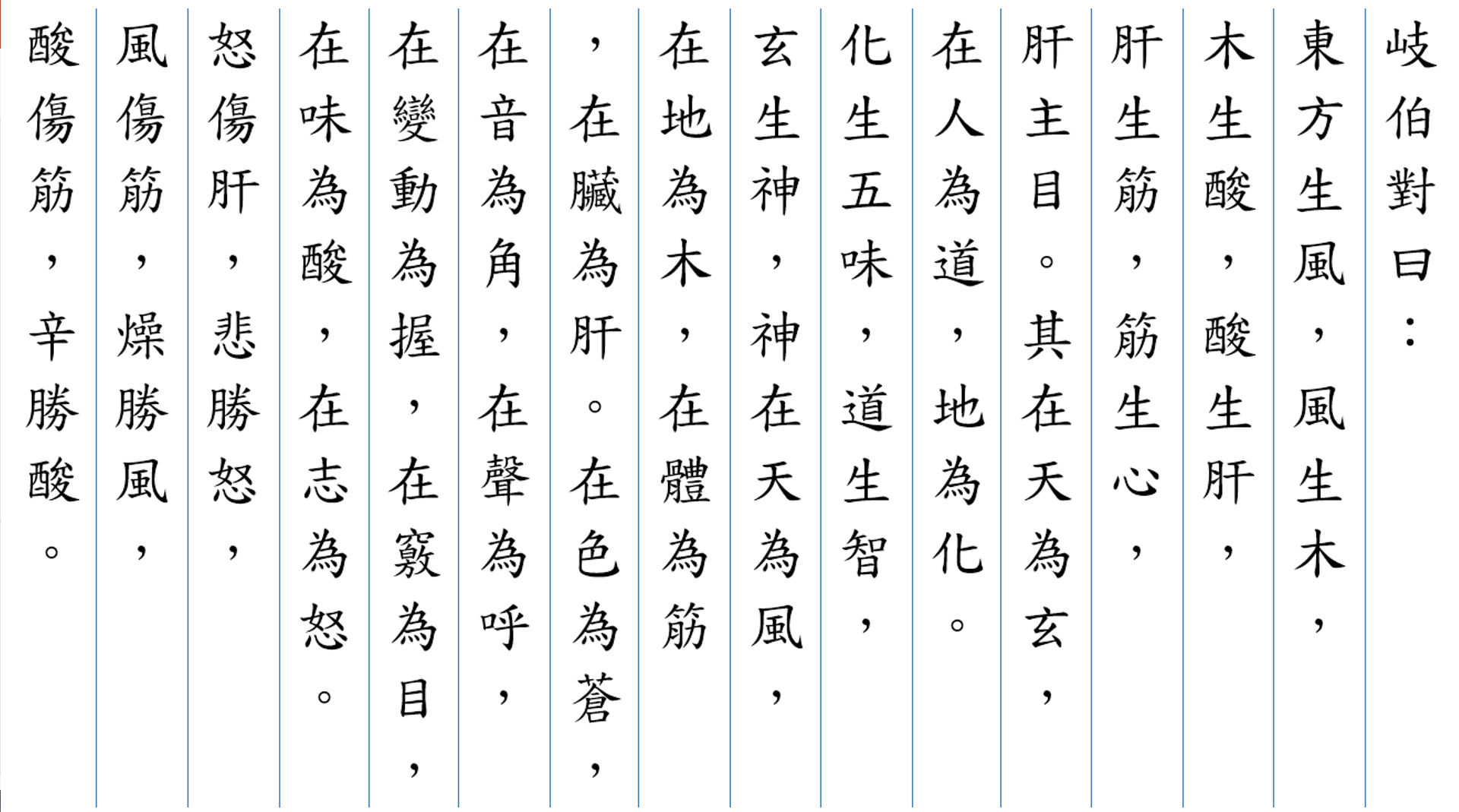
Specifically of note to this topic, the hidden yin meaning of the above text reads: “The Mysteries xuan gave birth to the gods shen. The purpose of the numinous and infinite sky is to support the Mysteries and the gods. The gods dwelling in the heavens set forth the winds.” Implicit within the subtext of that passage is that wind, the first of the Six Classifications of Qi, is what forms the trigram Wind from the Ba Gua eight trigrams.
帝曰:何謂神
歧伯曰:請言神,神乎神。 耳不聞,目明心開,而志先,慧然獨悟,口弗能言,俱視獨見,適若昏,昭然獨明,若風吹雲,故曰神。
It’s in the Huangdi Neijing that, through the series of syllogisms I presented in the video chat, we can infer that shen 神 is the akasha 虛空, the numinous void, through the common connecting points, fēng 雲 and yún 風.
From there, we take the given that shen 神 is the Tao 道, and the Tao is Wújí 無極 and Tàijí 太極. The I Ching conveys to us that the Wújí 無極 and Tàijí 太極 created the Si Xiang 四像, four faces of god, which begets the eight trigrams, which begets the hexagrams, and the whole of this is shen 神. That, then, connects the I Ching to the Akasha…
Oh, and another sidebar: What’s more, the Si Xiang 四像 are personified as the four directional deities, and how those four directional deities are presented varies from tradition to tradition– the four celestial animals, four gods, four dragon spirits, etc.
Quotable Quote from the Zhuangzi
無思無慮始知道
無處無服始安道
無從無道始得道
“When you can cultivate the Tao to such an extent that you no longer have any yearnings or concerns, no allegiance to place, and when you follow no set Path, that is when you will find the Path; that is the Path that leads to the Tao.”
The foregoing is also not directly related to the topic at hand, but in the course of my research for this video, stumbled upon that passage and just really loved it. I felt it was worth sharing with you.
Shen Jian 申鉴
In Chapter 3 of Shen Jian (titled Sujian, 俗嫌), the Taoist and Confucian philosopher Xun Yue 荀悦 (148 – 209 AD) warns on the necessity of applying wisdom and restraint when utilizing the occult arts and sorcery.
In this chapter he describes “元辰” (the same terminology Yuan Chen as the Inner Palace, Yuan Chen Gong) as a methodology used by former holy kings to ensure that humanity could inherit all the offerings of Heaven and Earth, and connects it to both the yin and yang arts and to astrology/astronomy.
Though off topic, there are a few highlights in this section worth noting. The text is structured as a dialectic, a conversation between a student and a sage master teacher. The student asks, “What is the reason for illness and disaster?” The master responds, “It is not the body; it is the body of the spirit” that is the source of illness and disaster.
Another curious passage is one where the student asks, “Do you believe that humans can become immortal?”
The master’s response: “Though I have never personally known a human to become an immortal, I have heard of men who can transform into women, and there are people who can resurrect the dead.”
Make of that what you will. =)
Finally, I want to share the closing passage. There are four tenets to remember, that should guide you at every turn:
- Words must have purpose.
- Skills must be contained within codes of ethics.
- One must have integrity.
- Finish what you start.

Fun background: Initially all this stuff about the Akashic Records, first returning it to Eastern traditions rooted in source material, and then how one might gain access to the Inner Palace or anywhere else in the Realm of Numinous Void (aka Akashic Records) was a whole dedicated chapter in I Ching, The Oracle.
You know how Akashagarbha manifests as the five directional Akasha protection divinities to form the mandala representation of the astral realm, and the I Ching is a mandala so you can use the I Ching to access the Akasha and all sites in the realm that is the Akasha?
In that chapter I noted that the Akasha, xū kōng 虛空 is the numinous nothingness that is Wújí 無極 per Taoist cosmology. Wújí is the supreme ultimate that is Tàijí 太極, from which arise the four faces of god, from which arise the eight trigrams, the fundamental building blocks of all life… and of the I Ching.
So… If xū kōng 虛空 is Wújí 無極 and Tàijí 太極, and Wújí 無極 and Tàijí 太極 are the totality of the Yi, the Book of Changes, then by basic syllogisms, xū kōng 虛空 is the Yi, as in the I Ching, the Book of Changes.
The I Ching is a manifestation of the concept of the Akashic Records, a condensed codex that diagrams the Akasha. The Book of Changes is the card catalog system that registers all that is the Akasha.
If we connect the dots between shen (the godhead, and also a state of consciousness) to the Akasha, then the concept of the Akashic Records would be the mind of god (shen), and by god, if we’re talking about the I Ching, then I am referring to the Tao– Shangdi. The sixty-four hexagrams of the I Ching is what helps us to navigate the labyrinth that is the mind of the godhead.
You can thus access the Akashic Records by way of the I Ching.
Or at least that was what a whole end chapter of I Ching, The Oracle was going to be about. =) But ultimately I made the editorial decision to take it out. So instead, here’s a video and blog post on the subject. =P
Word List:
- Book of Life and Death 生死簿: Believed to be a book of records you can read from when you enter the Inner Palace; book contains every accounting of the past, all past incarnations of you, your ancestral history, every one of your deeds, through the present, and is ever changing, ever calculating, and therefore also contains accounting of the calculated future. Book of karma.
- Inner Palace 元辰宮: A term to describe an inner temple situated in the astral or spirit realm that can be accessed by way of a changed state of consciousness; part of a greater body of magical practices attributed to the Lushan lineage 閭山派, a Taoist magical tradition found in southern China, Taiwan, and southeast Asia. The tradition blends Taoism, esoteric Buddhism, and the shamanistic witchcraft of the Mǐn and Yuè people.
- Mysterious Waters 玄水: Referenced in the Zhuangzi 莊子; one must first cross the Mysterious Waters to reach the Palace of Mysteries.
- Palace in the Land of Nothingness 无之宫也: In Ge Hong’s Bàopǔzi 抱樸子, he notes of a palace in the Land of Nothingness, whose shape is the house of god, image is the house of god, which arises from nothingness, and whose form is established by spirit.
- Palace of Mysteries 玄宮: A term found in the Book of Supreme Mysteries (Tài Xuán Jīng), described as a place where yin embraces yang, and yang embraces yin, and also found in the Zhuangzi 莊子, as a place in the northern region, where the immortals live, beyond the Mysterious Waters.
- Realm of Nothingness (Wǔhéyǒu) 無何有: Referenced in the Zhuangzi 莊子 as a dream-like realm, a utopia and yet a place that is like a mirage, that which looks like something but perhaps is actually nothing. The text goes on to say that there is a palace located in this Realm of Nothingness (“無何有之宮”).
- Shamanistic witchcraft of the Mǐn and Yuè people 閩越巫法: The indigenous mystical practices of the southern Mǐn and Yuè, dating back to 300 to 100 BC that later migrated to the island of Taiwan.
Texts Referenced:
- 475 – 9 BC: Inner Canons of the Yellow Emperor (黃帝內經, Huángdì Nèijīng) – on the akasha 虛空, the aether within and the many inner meridians of the akasha; and on the meaning and implications of shen 神 [Link: Scan of the Inner Canons from the Jin dynasty: Huang di nei jing su wen 黃帝內經素問 (1115 – 1234 AD), Library of Congress]
- 350 – 250 BC: Zhuangzi 莊子, Inner Chapters, 大宗師 – on the Palace of Mysteries 玄宮 in the north, beyond the region of the Mysterious Waters 玄水; that Palace is situated in the Land of Nothingness 無何有之宮; Taoist concept of the Land of Nothingness 無何有, an astral dream realm, akin to a utopia [Link: ctext.org – 莊子]
- 33 – 18 BC: Book of Supreme Mysteries (太玄經, Tài Xuán Jīng) – on the Golden Imperial Palace 黃宮 and the Palace of Mysteries 玄宮. [Link: Scan of 太玄經 , 十卷 (ten volumes), courtesy of the Berkeley Library Digital Collections, University of California & ctext.org – 太玄經]
- 196 – 220 AD: Shēn Jiàn 申鑑, Chapter 3, Sú Xián 俗嫌, by Xun Yue 荀悅 – on applying wisdom and restraint when utilizing techniques in Taoist sorcery [Link: ctext.org – Chapter 3, 俗嫌]
- 283 – 364 AD: Bàopǔzi 抱樸子 by Ge Hong 葛洪 – on the Palace in the Land of Nothingness 无之宫也, the house of the gods, in the image of the gods, and a form established by spirit [Link: ctext.org – 抱朴子]
 benebell wen
Hi, Benebell,
Awesome blog post, as usual.
So, in reference to the cut chapter from I Ching: The Oracle – are you planning to release that text, maybe as a pdf version? That would be a great appendix for the book. I am sure there is more detail and context in the text than can be included in your video.
Thanks for all your awesome work.
Paul Todd
LikeLiked by 2 people
Actually several chapters got cut from the final version. So still trying to figure out what I want to do with the excess. 😊
LikeLike
please share 🙂
LikeLike
This is some kind of synchronistic – since I was just revisiting my record of ancestors and thought about what their lives must have been like and what led to certain decisions and circumstances.
Actually I find myself surrounded by and talking to more spirits than the living at this moment. Not only ancestors, but also friends that passed on.
By the way, the artwork of that Esoteric Buddhism oracle deck is just beautiful!
LikeLiked by 1 person
Cool!
LikeLike
What I still don’t understand is the correspondence of the Buddhas and Wuxing. One can find correspondences for the western and Japanese elements. Thus it was earth in the south, air in the north, water in the east, fire in the west and void/spirit in the middle. However, this would conflict with Wuxing correspondences for the cardinal directions, with fire in the south, water in the north, wood to the east, metal to the west and earth in the middle.
I’m confused.
LikeLike
Hm, specifically what do you mean? I don’t see the conflict?
LikeLike
Well, for example water (western or Japenese) corresponds with water (Wuxing). But one would put it to the east, the other to the north.
Void/spirit either corresponds with earth (yin yang in balance) or with metal (heaven) of the Wuxing. If it was earth – ok, both would be placed into the middle, but wich other element would correspond with Wuxing earth then? And if it was metal, one would be placed into the middle, the other in the west.
LikeLike
Wu Xing directional correspondences, majority view across various East Asian traditions:
E. Wood
W. Metal
N. Water
S. Fire
C. Earth
LikeLike
Yeah, I know that. But the Buddhas in a mandala according to their elemental correspondence are placed like earth in the south, water in the east, fire in the west, air = metal (if based on the trigrams) or wood (if based on natural phenomena) and void = earth (if based on yin yang balance, but also corresponds with earth, which corresponds with Ratnasambhava, which corresponds with south) or metal (if based on connection with the celestial realm, which however also already corresponds with air, which is in the north).
So, just to pick one of the five: Does Amitabha correspond with Wuxing fire for it relates to western element of fire or does he correspond with metal for he is usually located in the west?
LikeLike
Sorry, I did not intend it to make it such a big issue. And sorry, if I couldn’t properly express what I wanted to ask.
It’s just that I could only find correspondences to the Japanese elements for the five Buddhas, but they do not align in placement when I try to relate the Japanese elements to the Wuxing.
LikeLike
Different traditions will have different correspondences, so I would say consistency is the key to focus on. Also, not all of the correspondences are intended for public knowledge. Lineages often have their own, and it is closed to their own.
LikeLike
Pingback: Benebel Bel’s Post about the Akashic Record | Librarian's Guide to the Multiverse!
Hi Benebell. I’m curious to learn more about the origins and evolution of the “Records” aspect within the Akashic concept. How did the Theosophists interpret and integrate the notion of records into this metaphysical framework? Additionally, how has this concept evolved over time and found resonance in contemporary spiritual practices?
LikeLike
Probably a question to ask a Theosophist. =)
LikeLike
Pingback: The Akashic Records and the I Ching correspondances | Tara Greene,Tarot Reader, Astrology Psychic
Hi Benebell, this post of yours caught me on the Book of life and death (生死簿), from my thin understanding, the book will be recorded by those they called it 庫官. Would you be interested to do a blogpost or YT video about this 庫官?
As i tried to find details into it, I wish to know if the 庫官 is similar or what the western refer it to Spirit Guide. I have limitation as I can’t read chinese.
I admire your works on the correlation reference between eastern and western and other part of world on metaphysics.
LikeLike
you are correct.
Read or watch Journey to the West
also keep in mind that different deitys keep different records.
LikeLike
Thank You for all your passion and work on this subject. It’s such expert-level work that is should run a University program. Since ’98, I’ve been only able to get details from the common texts, but it needs personal insight. ~*~
LikeLike
Pingback: Buddhist Perspective on Death and Rebirth – benebell wen
Pingback: Soul Dualism in Eastern Mysticism: Three Hun Seven Po 三魂七魄 – benebell wen