Recording the Intro to the I Ching Audiobook

Ready! I’ve got my reading glasses on!

I had such a great experience recording the first chapter of my audiobook that I had to share, and memorialize in a blog post. My publisher North Atlantic Books arranged for me to record at Live Oak Studio in Berkeley, a truly fantastic place. This is for the third book, I Ching, The Oracle.

To be standing where music legends and NYT bestselling authors once stood! ::faints::

Boyz II Men, Alicia Keys, Destiny’s Child, Vanessa Williams, En Vogue, Chaka Khan, Lenny Williams, just to name a few of the familiars, have all recorded at this studio before. Destiny’s Child recorded their very first album here! ::fangirl scream:: Instagram has this fun feature where you can tag the location, and then if you, the viewer, click on that location tag (in this case, Live Oak Studio in Berkeley), you can see everybody else’s photos tagged from that location, i.e., in this case, see all the other recording artists and authors narrating their own books sharing photos from the studio!

Now I kinda wish I had the backbone to ask if I could take some photos of the engineer’s setup, you know, that station in front of the glassed-in studio space with all the colorful levers and buttons. =) But it seemed like his space and I didn’t want to intrude. So, womp, womp, sad face, no impressive sound-engineer’s-giant-keyboard pics for my social media. (Do blogs even count as social media anymore?)

This was my first time in a recording studio,* and certainly my first time recording my voice narrating my own book. I left the experience with a lot of admiration for professional voice actors and audiobook narrators. Like the voice actor we chose for narrating the I Ching audiobook — he sounds like one of those National Geographic or History channel voiceover guys! It’s a skill, and maybe dare say even a talent.

* Technically, I’ve been in a recording studio before, with an entire symphony, as one violinist in a sea of violinists in the violin section of said symphony. But for sure this was my first time in a recording studio for totally-me reasons.

Just because you wrote the Thing doesn’t mean you can competently read the Thing aloud, especially since I would not call my writing style “conversational.” So when you read it aloud and your writing style departs from your personal “conversational” style of speaking, it comes across as awkward.

Fortunately, the sound engineer was fantastic. He coached me really well, telling me when I was speaking 10% too fast and needed to slow down, when my energy wasn’t matching my last paragraph, and flagging words that had just the most subtle stumble, or even when I was getting a bit too loud with my breathing (lol). I have confirmed that audiobook narration is not necessarily the best profession for you if you have asthma (I have asthma).

This audiobook recording experience left me with the unequivocal acknowledgement that I write very long run-on sentences. The sound engineer had to stop and teach me how to breathe. If you come to a really long sentence, even if it doesn’t have punctuation, put in breath marks as if it did have periods, otherwise you’ll run out of breath, as I did when I was reading my own damn book.

More fun tips I’ve learned: Apparently, eat a crisp apple before you start recording voice narration. I don’t know if that’s just folklore or if it’s scientifically legit, but a lot of voice actors swear by it, and believe it’s a thing. It’s supposed to help your voice be at its tip-top condition.

And don’t wear “loud” clothes while you’re recording. So for instance James was wearing a nylon jacket and sporty pants or something that goes swish swish every time he moved even a little, so he wasn’t allowed in the recording booth. Fortunately I’m a nerd who reads all the homework assignment materials ahead of time, so I knew to wear “soft, quiet” clothes.

To be a competent voice actor, you almost have to over enunciate words. So many of us lay people don’t realize that we mumble when we speak. There were several instances when the sound engineer stopped me and offered guidance on how to over-enunciate, because I was jumbling my words and it wasn’t as crisp as it could or should be.

For I Ching, The Oracle, I’ll be doing the voice narration for Chapter 1, the Introduction only. A pro audiobook narrator, Wyntner Woody, will be narrating the rest of it, speaking both the classical Chinese text of the Zhouyi and the English translation and annotations.

The Hubby (a native Beijingnese speaker) and I listened and re-listened– and re-listened– to the finalist list of audition reels. We debated, we re-listened, we looked up each one of their bios… which is to say we put a lot of heavy thought into who to choose. There were many different and competing factors for consideration, hence the debating and long deliberation time as we wracked our brains over who to go with.

For the audition, each voice actor recorded about a page or two from one of the introductory expository chapters and then recorded Hexagram 1, both the classical Chinese and the English. We (and particularly Hubby, because he’s the native standard Chinese speaker; the Mandarin I speak is not standard) ultimately went with Wyntner because of his more precise standard Chinese pronunciation.

Why didn’t I want to narrate the entirety of my own book? This is the analogy I give. Since I grew up listening to southern Taiwanese people (deep south) whose primary tongue is Minnan/Hokkien speaking Mandarin Chinese, my Mandarin pronunciation is not “standard Chinese.” If I had narrated my own I Ching book, it would be akin to listening to someone narrate Shakespeare with a heavy southern drawl. If you’re looking to voice Shakespeare, you’re looking for a particular way of pronunciation, right? Same here.

That and time constraints. I think the total was going to be something like 20 hours of straight narration, which means lord knows how many hours buffered around those core 20 to get those final 20 hours right.

Due to my full-time job, I would only be able to work weekends, and then you would have to coordinate with the studio’s schedule and available time slots. So ultimately it did not make sense for me to narrate my own book, and for the publisher to hire a pro.

Oh by the way, I learned that reading aloud 9,000 words equals about 1 hour of studio time. So the way they estimate how much studio time to book is based on word count. It’s not an exact accurate science, but ballpark more or less, 9,000 words is 1 hour of recorded audio.

Hubby, wearing “loud” clothes, and therefore banned from the recording booth.

Plus, James (the hubby) is more of an audiobook listener than I am, and he says that any time he sees that the book is narrated by the author, he skips it and won’t listen, because it has been his experience, as a consumer of audiobooks, that the author’s narration tends to be a bit too amateur to listen comfortably to for dozens of hours on end, and that you really do need a pro to do it. Voice acting is totally a skill. Not just anybody can or should be narrating audiobooks.

There are other interesting issues that come up with bilingual (even multilingual) narration. So, for example, Wyntner pronounces “I Ching” as you would in Mandarin Chinese, per pin yin, even when it’s in the context of an English sentence, whereas when the context is English, I just pronounce “I Ching” and even “yin and yang” the way a typical American would pronounce those words.

But then in other instances, mid-sentence while speaking English I’ll hop over and pronounce it as you would in Chinese. Wyntner is super consistent with his stylistic approach, whereas I, a lay speaker, am very inconsistent. Sometimes I pronounce “Tao Te Ching” the way you would in Chinese, per pin yin, and then other times, without explanation or rationale, I’ll pronounce it the way average Americans might pronounce it.

It’s a phenomenon you’ll observe — native Chinese speakers and non-Chinese expat/foreign speakers speaking Chinese will switch pronunciation midstream in English, and try to pronounce Chinese words as you would per pin yin, but Asian Americans do not. Asian Americans pronounce in the Chinese way when speaking Chinese, and then pronounce it the white people way when speaking English.

For example, when James pronounces his own Chinese surname in English, he’ll kind of give it a proper Chinese pronunciation to it. Whereas when I pronounce my own Chinese surname in English, I’ll just pronounce it the way white people might pronounce it, and don’t bother giving the proper pronunciation. But obv. will pronounce it the “right” way when I’m speaking Chinese. Or how you’ll hear Wyntner pronounce yang as “yahng,” with the soft-A like “ah,” which is correct, whereas I just go with the Americanized hard-A “yayng,” like “yay,” which is incorrect but has become normalized.

In any case, Hubby and I are both super glad we went with Wyntner, and we cannot wait for the final result to be out in the world!

James is currently proofing Wyntner’s narrations, listening to the entire audiobook, and he reports that my book is actually very, very interesting! =) Yay! James says that my I Ching book is so interesting to listen to that he even paused between sections to go look stuff up and read more on the history! I’ve earned myself a new fan, in the form of Hubby! =D [I mean, it’s not like he read a single page of Holistic Tarot or The Tao of Craft, so this is ah-mazing!]

As for the I Ching audiobook, it is going to be significantly different from the printed book, for many reasons. One, the audiobook omits all the exercises (basically the whole “grimoire” part of the book), the entire divination how-to section (so the audiobook has nothing in there that teaches you how to do the divination procedure, whereas the printed book dedicates a big whopping chapter to all the ways), and any passages that reference tables, charts, or images had to go, or be rewritten so that you’re not making references to phantom visuals.

My justification for omitting the how-to-actually-do-an-I-Ching-divination chapter from the audiobook version is (1) I couldn’t get it to make sense as pure audio, because you can’t see anything, which is why the printed book was chock full of photos and diagrams, and (2) I have free I Ching divination tutorial videos on my YouTube channel; such tutorials make more sense as videos than as audio-only. And most of the “grimoire” parts are already up on this website as downloadable supplemental worksheets.

The I Ching audiobook’s purpose, as I see it, is to hear the classical Chinese recitations of the hexagram verses side by side with the English translation and then my annotations. The chapters that cover the history, mythology, and cultural lore of the I Ching also makes sense as an audiobook. But the more practical hands-on elements, I feel, need to be either in printed book form, with the written instructions plus illustrative images, or as a video tutorial.

Also, the audiobook does not include any of the end notes. In a few select instances, Wyntner recommended that he include a few additional statements to integrate some of what I wrote in the end notes, as he felt the explanatory material in the end notes would help provide clarity to the text, and we agreed.

I rewrote a lot of the annotations and commentaries to the Zhouyi translations (the actual I Ching text) so it would read better as an audiobook. Also, I totally rewrote the Introduction that I narrated. About half of it stayed the same as the printed version of the Intro, but then about half of it is net new. Even two hours before heading to the recording studio I was still on my computer rewriting passages!

In any event, unlike the challenges, obstacles, and frustrations I encountered during the publisher-author collaboration phase of the print book for I Ching, I really, genuinely enjoyed my experience during the publisher-author collaboration phase for the audio book version.

The Cantigee Oracle: An Ecological Spiritual Guide to Spark Your Creativity

The Cantigee Oracle by Rae Diamond and illustrated with watercolor art by Laura Zuspan is a deck that inspires mindfulness, compassion, and creativity. It seeks to motivate evolutionary change in both the individual and the collective. You’ll find homages to Buddhism, Taoism, Yoga, animism, and science.

This is a 52-card circular deck with standard cardstock and a slight laminate finish. Some of the oracle messages are omens, such as “A Swarm of Bees,” “The Coiled Snake,” or “The Exploding Star.” You’ll get messages like “Your Ears Become a Butterfly” and “Clouds Pass but the Mountain Remains,” evocative of the pithy figurative language often found in Taoist texts.

Continue reading “The Cantigee Oracle: An Ecological Spiritual Guide to Spark Your Creativity”

Sirian Starseed Tarot by Patricia Cori and Alysa Bartha

The Sirian Starseed Tarot by author Patricia Cori and illustrator/designer Alysa Bartha is premised on the esoteric (some would say New Age) belief that walking among us humans are a handful of aliens, or aliens-that-look-just-like-humans, or ancient aliens (?), and I think it’s different from what Scientologists believe but I can’t be sure because to an ignoramus like me, they sound the same. Both indigenous Native American and esoteric Buddhist belief systems include an idea similar to starseed people, so maybe there’s a grain of truth in it all somewhere.

The Sirian Starseed Tarot was channeled to Patricia Cori and there is a fascinating workshop she did, hosted by North Atlantic Books, the deck’s publisher, that you can watch here on YouTube. I highly recommend that you check out the webinar, especially if you will be working with the Sirian Starseed Tarot.

The Major Arcana in this deck is breathtaking to view and eerily accurate to work with. Check out Keys 0 through XIII above (Death becomes Transition…I know some old school tarot readers aren’t too fond of the “Death becomes Transition” interpretation of Key XIII…). However, what you need to do when working with this particular deck, especially if you’re a seasoned tarot reader, is to check your tarot knowledge at the door and work with this deck within its own universe of a system. You’re going to have a much more enriching experience with the Sirian Starseed if you do just that. Otherwise, you’ll have a lot of hang-ups, biases, and cognitive dissonance.

Continue reading “Sirian Starseed Tarot by Patricia Cori and Alysa Bartha”

Book Review of Shamanic Astrology by Lucy Harmer

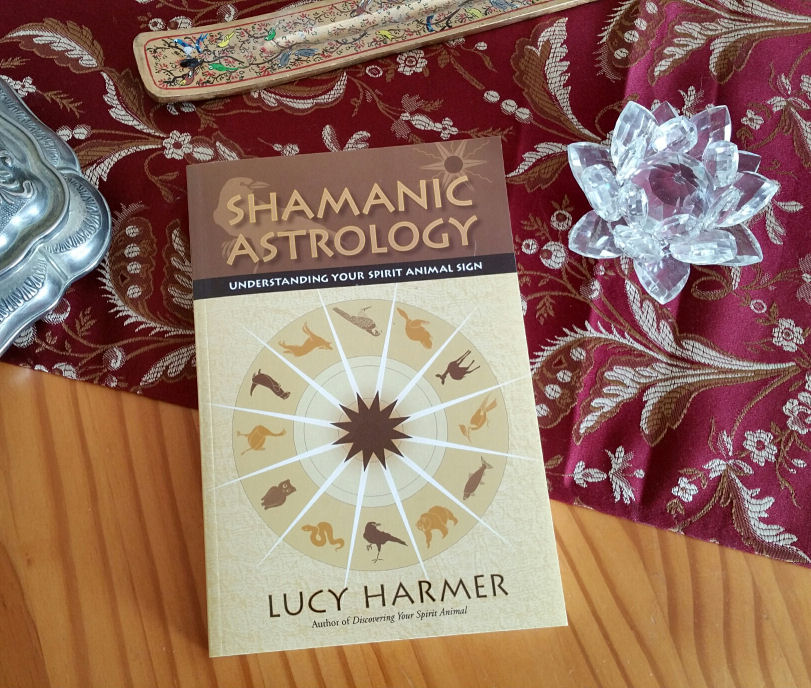
shamanic-astrology-lucy-harmer-01-book-cover

When I cracked open the front cover of this book, I didn’t even know what shamanic astrology was. I didn’t even know spirit animal signs were a thing. So that’s where I’m coming from as a book reviewer– not a place of knowledge or expertise, but the place of a beginner and how this book might serve the beginner.

Shamanic Astrology: Understanding Your Spirit Animal Sign by Lucy Harmer (North Atlantic Books, 2009) introduces the twelve spirit animal signs of the Native American medicine wheel and how these animal signs correspond with our date of birth. Prominent public figures in the metaphysical community, such as Judy Hall (The Crystal Bible) and astrologers Derek and Julia Parker, Dr. Steven Farmer (Earth Magic and Animal Spirit Guides), Vicki Noble, creator of the Motherpeace Tarot, and so many more have thrown their positive weight toward Shamanic Astrology to give their endorsements.

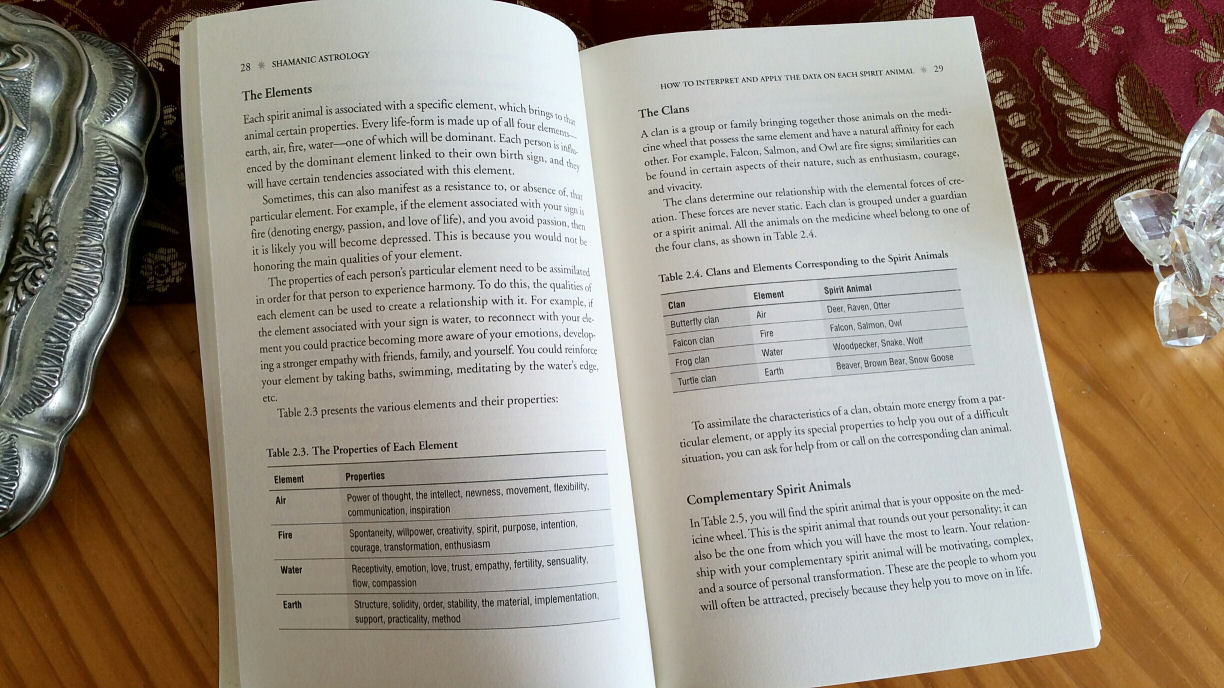
shamanic-astrology-lucy-harmer-02-interior-page

The book is delightfully comprehensive. An introductory chapter acquaints you with shamanic astrology, the medicine wheel, and both the solar and lunar cycles. Then Harmer dives into the background of how spirit animals are interpreted, i.e., seasons, cycles, winds and directions, elements and clans, metaphysical correspondences, life paths, etc. Each of the twelve animal signs are covered, starting with a profile chart, description of personality, key metaphysical correspondences and influences, and then general insights into that sign’s luck– career, money, health, and then love. In the love section, compatibility with the other animal signs is provided. Shamanic Astrology closes with advanced material on the medicine wheel and the lunar calendars.

Now let’s take a look at the twelve spirit animal signs. Later in this review, check out Table 2.10 from Shamanic Astrology, which outlines the strengths and weaknesses of the twelve spirit animals.

Table 1.1 from Shamanic Astrology. Click image for closer viewing.

Continue reading “Book Review of Shamanic Astrology by Lucy Harmer”

Review of Healing with Whole Foods by Paul Pitchford

Healing_with_Whole_Foods_by_Paul_Pitchford

Healing with Whole Foods: Asian Traditions and Modern Nutrition by Paul Pitchford (North Atlantic Books) is one of those reference tomes every holistic healing practitioner will want to have in the personal library. I’ll be reviewing the Third Edition published in 2002. It was first released in 1993 and since then, over 500,000 copies have been sold and no wonder.

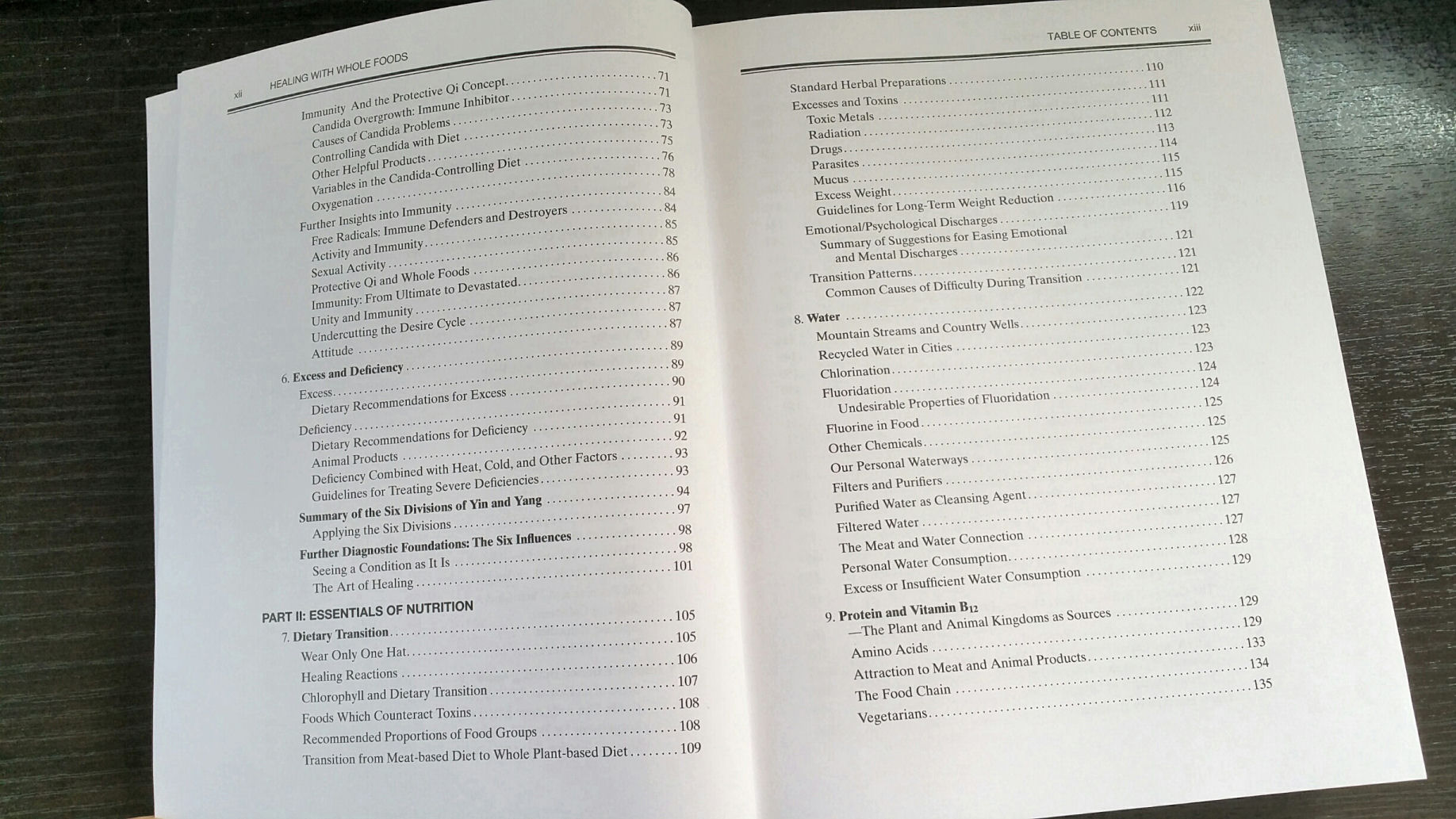
Click image to enlarge.

Healing is well-organized, which is a prerequisite for any reference book. He begins where every holistic healer using traditional Chinese medicine would begin: covering Qi vitality and the binary of yin and yang, which he then expands on to cover hot/cold temperaments; interior/exterior physical conditions; and diagnosing for excess versus deficiency.

Continue reading “Review of Healing with Whole Foods by Paul Pitchford”

Review of The Psychic Healing Book

The Psychic Healing Book Amy Wallace Bill Henkin 10 (1)

The Psychic Healing Book by Amy Wallace and Bill Henkin has been around since the late 70s, with several updated editions released over the decades. This one is the 25th anniversary updated version. Psychic is a cult classic. It’s one of those oft-cited New Age books you hear a lot about. So it was high time I read it for myself.

First, a few interesting updates in this 25th anniversary edition. Wallace explicitly notes that she wishes she could rewrite the book and not mention spirit guides. “[I]f I could do it differently today I would rewrite or delete entirely the chapters pertaining to the use of spirit guides. I have come to believe that spiritism leads to many mishaps and disappointments, and I would prefer not to even dabble in it.”

The Psychic Healing Book Amy Wallace Bill Henkin 10 (4)

She also talks about ch’i kung (or qigong) and chakras, and how qigong should be used to strengthen the lower chakras before a practitioner tries to work with the sixth and seventh (or third eye and crown) chakras.

Henkin also offers fascinating new information. “When we use our psychic abilities we enter the same hallowed grounds of the mind or soul that give rise to creativity and psychosis.” I love that line. It’s worth reading over a few times.

Psychic is an easy to read 208-page classic on developing psychic ability. It’s a practical how-to guide formulated after the teachings of Wallace as she learned them from her psychic teachers. Much of it, I found, is in direct line with the spiritual pedagogy of the Berkeley Psychic Institute, a school for psychic development that’s been around since the 70s, on a street in downtown Berkeley I frequently walk on.

The Psychic Healing Book Amy Wallace Bill Henkin 10 (2)

A lot of ground is covered in this book, though the authors skate across the surface of these subjects. Animism, Spiritism, the chakra system, the astral body, color healing, auras and reading auras, karma, dream interpretation, contacting spirit guides, ESP, and future telling are all covered, albeit in a few succinct paragraphs per topic. The book is therefore a starting point, not a treatise.

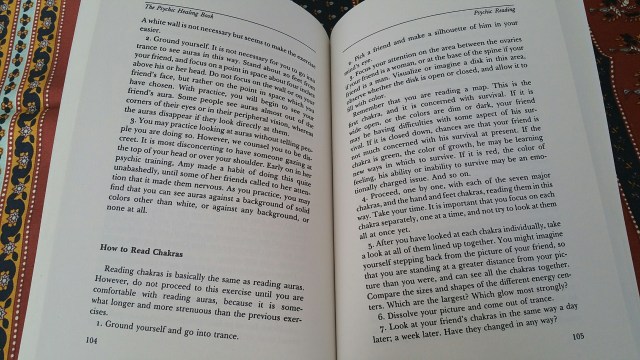
The Psychic Healing Book (Wallace and Henkin) Interior

Psychic also covers practical training for developing psychic healing abilities. Whether they work or not, I’m not sure since I can’t report on any successful personal results, but I will say it’s comprehensive in its articulation of how to train yourself in the ways of psychic healing. Specific exercises are provided, visionary techniques, and personal success stories provided by the author on how these exercises and techniques will hone your psychic healing abilities.

The Psychic Healing Book Amy Wallace Bill Henkin 10 (3)

For me, it was a fascinating read and I believe one must be open-minded to many perspectives of the woo.

In the spirit of learning many perspectives, The Psychic Healing Book is an incredible read and worth investing in for your personal library.

If you’re intrigued about a course like Psychic Ability 101, then get this book. It’s practical, full of exercises and training techniques, covers a lot of ground and inspires further reading of the individual topics covered, and most importantly, is written in accessible plain English. Wallace and Henkin also offer fascinating personal accounts and stories of psychic work at play.

The Psychic Healing Book (Wallace and Henkin) Light

I’ve heard of this book many times over before finally getting a copy and reading it for myself. Funny enough, I didn’t know it was published by my publisher, North Atlantic Books. The Psychic Healing Book is considered a New Age cult classic and even when you flip through the pages of the book, the aesthetics and design of it is reminiscent of books from the 70s and 80s. If you count yourself a psychic or are interested in honing your inner psychic, then get this book. It’ll easily become one of your favorite go-to resources.

line

FTC Disclosure: In accordance with Title 16 of the U.S. Code of Federal Regulations Part 255, “Guides Concerning Use of Endorsements and Testimonials in Advertising,” I received The Psychic Healing Book from North Atlantic Books for prospective review. Everything I’ve said here is sincere and accurately reflects my opinion of the book.

Reading Spiritual Balancing by Diana Burney

Spiritual Balancing by Diana Burney

I’m currently reading Spiritual Balancing: A Guidebook for Living in the Light, which was just released February 16, 2016. It’s by Diana Burney, who is also the author of Spiritual Clearings (2009). Both books are published by North Atlantic Books, who also publishes my books. Spiritual Balancing falls into the category of New Age spirituality and alternative medicine. It explores energy healing and reads like a 21st century manifesto on self-engaged spirituality.

Spiritual Balancing, as it is packaged and presented, seems to diverge from my normal trajectory of metaphysical reading, but I couldn’t help but find this book to be well-written, organized, and most important of all, practical.

Continue reading “Reading Spiritual Balancing by Diana Burney”

Visiting North Atlantic Books

2014.12.03 At NAB - All Pics

I had a ton of fun yesterday meeting with all the editors and staff at North Atlantic Books. Love reading (tarot reading) for creative folks. As a tarot practitioner, you really can feel the difference. The air and general vibes have this pulse of energy you just don’t get in any other reading venue. There’s me with the lead editor behind Holistic Tarot, Leslie.

Everyone at NAB needs to be thanked, however. Authors always get all the credit for a book, but based on what I’ve witnessed over the last year, me writing the book was the easiest part of it all! What these people do to take my submitted manuscript and transform it into what you see above–and what you’ll be buying, I hope–is truly a miracle of birth. Except, really, it’s no “miracle,” like some sort of divine intervention. (Sorry, Divine!) It was a ton of brute hard work, human effort, picking away at details, editing and editing again… and editing again… and layer after layer of very personalized attention from each and every single person who laid hands on this manuscript. The one Divine part was connecting my book to North Atlantic Books. Everything else was a lot, a lot of love and labor.

Okay. That’s enough sap for one day.