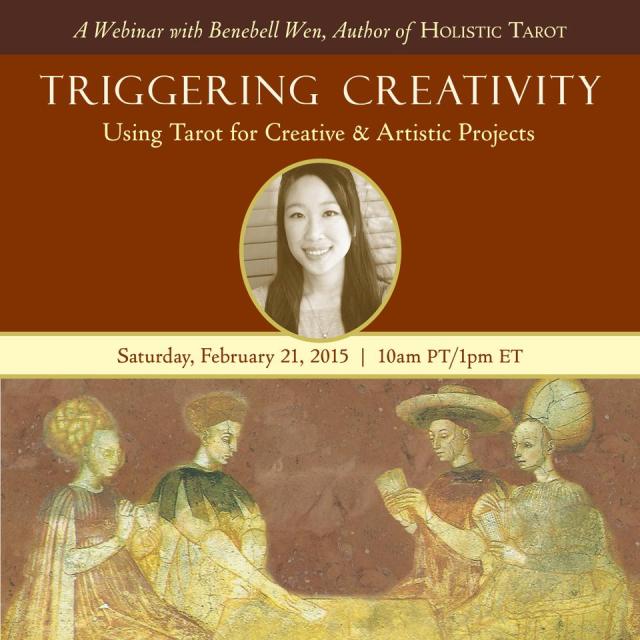
Join me on February 21, a Saturday, at 10 am Pacific Time (12 pm Central or 1 pm Eastern) for a free webinar sponsored and hosted by North Atlantic Books and NAB Communities.
No prior knowledge or experience in tarot is required. If you don’t own a tarot deck before this webinar, then my goal is to persuade you to go out and get a tarot deck immediately after! Tarot folks: please share with your artist and writer friends!
* * *
Albert Einstein attributes his most ground-breaking insights not to logic or mathematics, but to intuition and inspiration or, as artists and writers often express it, to the muses. However, the one trait believed about the muses, about how intuition and inspiration hits us, is that it comes only when it comes, almost divinely, and the artist or writer cannot call upon it at will.
Yet through tarot, learn how to harness intuitive-creativity at will. Tarot facilitates the transcendent experience needed for the muses to speak to us. Learn how to use tarot to trigger your intuitive-creativity and apply the tarot fundamentals taught in Wen’s new book, HOLISTIC TAROT to remove creative blockages.
In this 45-minute webinar that will be invaluable to any artist or writer, I’ll be lecturing about how to use tarot cards as an intuitive and inspirational tool for creative and artistic passion projects. The lecture will cover attunement, how to exercise the intuition muscle, and specific techniques for using tarot spreads to read about your creative projects.
When I say “intuitive-creativity,” I’m talking about the muses, about divine inspiration, about that “a-ha” moment. Learn how to use tarot to identify your creative focus, mind-map your project trajectory, perform character analysis if you’re writing a novel, explore the themes of your project in greater depth, and generally trigger your own inspiration with tarot card imagery.
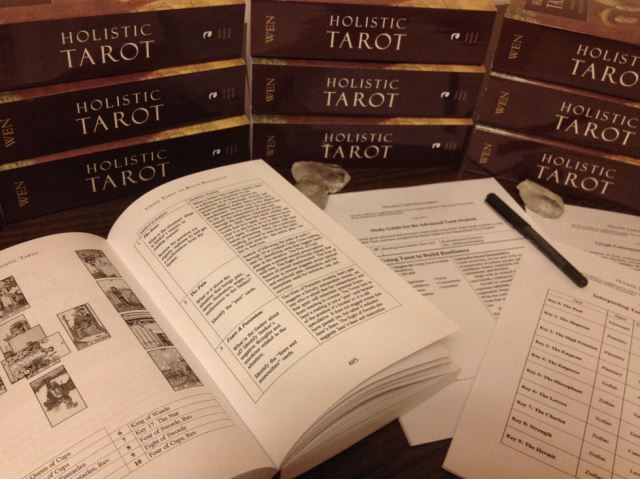
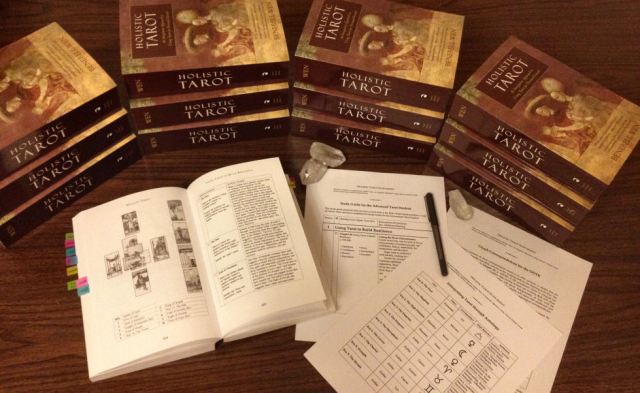
Okay, people, I get it. I’ve heard it. Holistic Tarot is a big book. How does one even wade through that thing? Fear not! I’ve got study guides! To demonstrate how the book can be used as a textbook for the independent study of tarot, I’ve created study guides that will help you navigate the book at a beginner level, intermediate, and advanced. Here are the first two study guides:
Now I bring you the Study Guide for the Advanced Tarot Student, and also for the tarot practitioner who is seeking to go professional. If your objective is to go professional, however, this study guide alone (and the Holistic Tarot text) is not going to suffice. That’s why I have several great book recommendations in the study guide that I know will be indispensable to the aspiring professional.
Who might find the Advanced study guide helpful?
The Advanced study guide may be right for you if…
you have been reading Holistic Tarot by following along through the Beginner and Intermediate study guides and now see there are still chapters that the guides didn’t cover and you want to cover those chapters, or
you’ve been studying tarot for some time under the Rider-Waite-Smith system, are proficient at the Intermediate level, and now you want more, or
you’re thinking about going professional with tarot and offering your reading services to the public.
If that sounds like you and you want to continue your studies with Holistic Tarot, then download this study guide and the recommended supplements.
STUDY GUIDE FOR THE ADVANCED TAROT STUDENT
Click on the radio button below to download the PDF.
The Study Guide for the Advanced Tarot Student presumes that you have completed the Study Guide for the Intermediate Tarot Student, are proficient with the Rider-Waite-Smith tradition, and have a copy of the Holistic Tarot book. For Session 4 in the Advanced Study Guide, it is also recommended that you have a Tarot de Marseille deck and a Thoth deck to work with. Click on the above button to download the PDF. Also be sure to download and save the below supplements. Note: In traditional esoteric tarot teaching approaches, astrology and the Qabalah basics would be taught at the beginner’s level concomitant with the tarot basics. The approach here is to integrate these areas of knowledge after a strong foundation in tarot has been built.
Supplemental Downloads
Sample Code of Ethical Conduct for Tarot Professionals
All Holistic Tarot study guides and supplements are available for free download here on this website at HOLISTIC TAROT STUDY GUIDES. I hope these study guides are helpful in your learning and if you do use the Advanced Guide, please let me know about your experience with it!
If you’re plugged in to the online tarot community in any way, even minimally, then you’ve been hearing buzz about this deck. It’s self-published and I’ve got to say, recently the self-published decks have been beating the traditional publishers. Hey traditional publishers: what are you people doing? Get with the program.
Even non-tarot people (many from the fashion world) have been getting into the Wild Unknown tarot deck. Imagery from the cards are just freakin’ everywhere. I remember first seeing an Instagram photo of someone’s tattoo and thinking, “That kind of looks like a tarot card” only to realize it was. What is going on?!
But the few glimpses of cards I saw here and there made me think that this deck would be one of those “its own unique system” decks where I’d have to do a lot of learning before I did any reading. And I’m getting to that age (sadly) where I don’t know if I want to learn any more “new tarot traditions.” So at first I thought I was going to pass.
And then the imagery. The card’s artwork kept drawing me in, beckoning. “You want me.” No I don’t! Go away. “You want me.”
Then a few weeks ago I set a goal for myself (unrelated to this deck, and totally unrelated to tarot) and said if I met that goal, I’d reward myself with the Wild Unknown tarot deck. I met the goal and the first chance I could, bolted for the computer and placed my order.
And wow. WOW. Best decision ever. The Wild Unknown is easily one of my favorite tarot decks now.
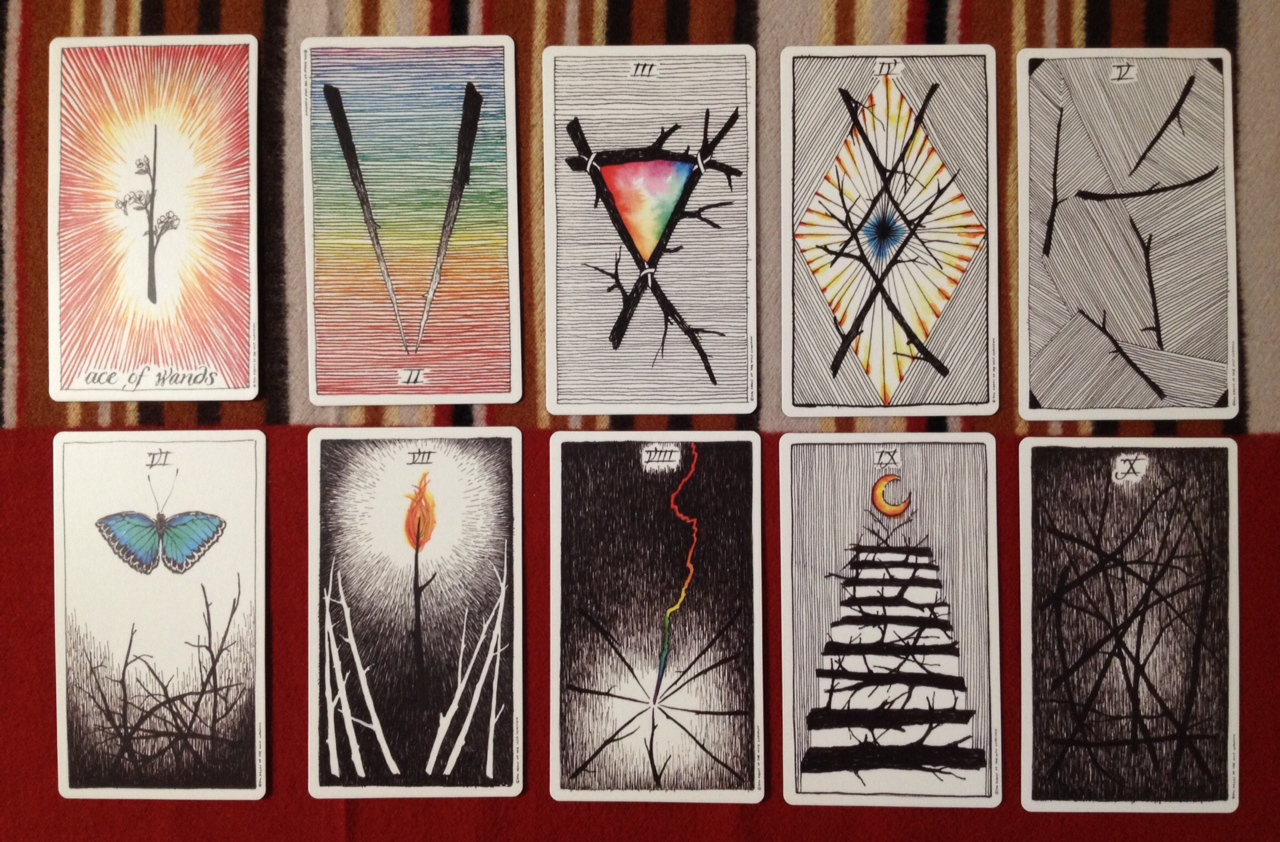
This is one of the highest quality decks I have come across in a long time in terms of the cardstock, the matte finish, and the box packaging. Kim Krans renders the images in hand-drawn black ink illustrations, with just a touch of color here and there so beautifully and intuitively done that they are sure to activate chakras while you read with this deck.
Wild Unknown, Suit of Wands, Ace to Ten
I’d categorize the Wild Unknown as a Marseille-based tarot deck. After all, Key 8 in the Wild Unknown is Justice and Key 11 is Strength (as opposed to the standard RWS, which is 8/Strength, 11/Justice). However, going through The Wild Unknown Tarot Guidebook that Krans graciously included when I purchased this deck, I see a lot of card interpretation crossover from both the Rider-Waite-Smith and Thoth. In that sense, the Wild Unknown would work very well as a beginner’s deck, though such a beginner would have some work to do if she were to later try to learn the traditional Tarot de Marseille, Rider-Waite-Smith, or Thoth. So in that sense, the tarot practitioners who are calling this deck its own interpretive system have a point.
I should tell you something. I’m not that into mermaids, or sailors, or ships, nautical imagery, or 18th century colonial dress (you’ll see– like in the Two of Wands, Nine of Cups, Page of Cups, Page of Swords, Ten of Cups, etc., pictured below).
And yet I’m VERY INTO Dame Darcy’s Mermaid Tarot deck. My fingers and my head are bursting with excitement as I type this. I don’t know how she did this, how she can get someone like me to be so enamored with this tarot deck.
I first saw the deck’s vibrant images in a vlog deck review by The Four Queens, and while watching, didn’t realize it was called the Mermaid Tarot. I just saw the images and said with quite a bit of conviction and brattiness, “I want that. Now.”
Then I watched Elora Tarot’s vlog on it and, learning more about the deck, realized it’s all about mermaids and sailors and stuff. I kind of thought to myself, “but I’m not that into mermaids and sailors and stuff.”
Whatever, it didn’t matter. There was something drawing me to this deck. I don’t know what kind of spell Dame Darcy put on this deck but hey, it worked on me. It was a bit pricier than most commercial decks out there and with self-published tarot decks you don’t always know what you’re getting into, but you don’t understand– I needed to get this deck.
So I got it, and now I don’t know whether to be a good Samaritan and use it as a professional reading deck to share the beauty of Dame Darcy’s artwork with everyone who gets readings from me or be selfish and horde this deck all to myself and not let anyone else touch it, ever.
Usually with tarot decks I hear word of it buzzing about for months and then at some point, I buy. With Dame Darcy’s Mermaid Tarot, it went from “I’ve never heard of it” to clicking “Add to Cart” in, like, I think less than an hour.
The above photo shows what I got with my purchase order. Two extra cards came–an extra Ace of Cups and an extra Wheel of Fortune, which is why they’re set off to the side like that. More on that later. No box, but that’s totally okay with me. I love the black velveteen drawstring bag. It’s even got a sailor’s anchor on it, going with the theme. *Love*
As she noted in her review of the deck, Kelly-Ann of The Four Queens got a stunning handwritten, hand-drawn page with a vegetarian recipe while Elora Tarot got one on seed sprouting, so that kind of got me excited about the prospect of a freebie, but alas, I guess the freebies only go to the VIP. I, however, non-VIP that I am, got no handwritten, hand-drawn page. Aww. Shucks.
This is so cool. I stumbled across some fascinating home footage of a professional tarot reading done in Taipei, Taiwan. There are no subtitles, so for those who don’t understand Mandarin, I’m going to provide a recap. I found the reading session quite fascinating, mostly because it’s cool to see how other practitioners approach readings, especially from other cultures. (Well, for me, it’s the same culture in a way, since I’m Taiwanese, but you know what I mean.) The practitioner did this reading for 250 NT, which is about $8.00 USD. That is cheap! Holy cow!
He started by telling the seeker, who blogs as The Chindian Chronicles that she could ask four questions. Each tarot deck can answer four questions at a time, he tells her. (Interesting!) She chooses her Studies, her Family, her Health, and Love. He’s also using the RWS system, though not any reproduction of the RWS that I’m familiar with. Actually, from some of the screen shots, it looks like a version of the Universal Tarot (which closely follows RWS and is considered an RWS clone) by Roberto De Angelis. I love that there’s the dharma wheel on the backs.
I also think it’s cute how the girls are nervous about the reading, though I love that he reassures them and is really overall doing a great job at this. I’m going to do my best to translate the reading session, since I’m sure my practitioner friends are very interested.
Hubby and I have a pomegranate tree in our front yard, and it’s pomegranate season. We’ve got pomegranates filled with juicy, blood-red seeds, tangy but still with a touch of sweetness. I’ve been making iced tea/juice with the pomegranates (I’m not sure whether to call this a tea or juice. I’m leaning toward tea, but I don’t brew it with any tea leaves. It’s just pomegranate.) And I’m posting this because pomegranates sort of relate to tarot.
Across many cultures, East through West, pomegranates symbolize fertility and abundance, and the importance of the pomegranate is expressed in the tarot. You have the pomegranate motif in Key III: The Empress in the Rider Waite tarot, symbolizing fertility, fruition, and abundance, and also righteousness, themes also taken from Judeo-Christian mythos. The Chinese also believe that pomegranates symbolize fertility.
In Key II: The High Priestess, the pomegranates represent knowledge, learning, and wisdom. The imagery in that card also calls to mind 1 Kings 7:13-22 in the Holy Bible, describing the twin pillars in front of King Solomon’s temple in Jerusalem as being adorned with pomegranates. Some Biblical scholars speculate that the forbidden fruit was in fact the pomegranate. The manifestation of the pomegranate symbolism progresses from Key II to Key III: knowledge, learning, and wisdom begets fruition and natural abundance.
Today, folks are into pomegranates because they’re rich in vitamins and antioxidants. They can help increase blood flow to the heart (in traditional Ayurvedic medicine, pomegranate seeds and juice are used as a healing, medicinal tonic for treating the heart and also strengthens blood flow; it’s very pitta, for fire energy) , decrease the levels of bad cholesterol, prevent and repair DNA damage, reduce the risk of prostate cancer, and, interestingly enough (since metaphysically it symbolizes fertility), great for those who are pregnant (the juice, that is). The juice in the pomegranate seeds contain many of the nutrients women need to maintain health and wellness through their pregnancy. Recent studies show that pomegranate juice can help reduce the risk of damage to the placenta.
I’ve been making pomegranate juice (but based on methodology, is probably more of a tea) with our home-grown pomegranates and turning the process into a form of meditation. It’s meditation with instant results… sweet, delicious, fabulous pomegranate juice!
I’ve been observing dozens of professional tarot readers conduct their readings. The observations prompted me to think about the practice of describing the tarot cards to the querent (or seeker).
For example, if a seeker asks whether she will find love in the coming year and you the tarot reader draw Key III: The Empress, which of the below better reflects your response?
[ A ] . “I drew The Empress, the card of fruition. Venus rules over this card. The Empress is a sign of love, fertility, and family. See the laurel wreath on her crown? That symbolizes your victory. The Empress is also of the Earth. Seems like not only will you find love, it could be one that finally grounds you and brings a sense of stability in your life. The number 3 here suggests to me that all good things will be amplified this year. 3 is the number of creativity. The stars on her crown symbolize hope, and there are 12 of them, which suggests creativity and artistic expression. The 12 stars also symbolize the 12 constellations of the zodiac. There might be something karmically fated about the love you will meet this year.”
or…
[ B ] . “Yes, it seems you will be having quite a fruitful year in love. You may even meet someone you end up marrying. It’s going to be a plentiful year of romance for you, and, by the way, a year filled with creativity.”
Method A takes longer because you are identifying and describing the card first before interpreting it for the seeker. It also got me wondering: how many seekers really care about the cards? Are they requesting a reading to learn the names of the tarot cards? Does knowing that you pulled a Seven of Swords or Nine of Pentacles really mean anything to them? Or do they just want the answers to their questions?
If, however, you subscribe to the notion that the signs and symbols of the cards are the language of the unconscious and as a tarot reader, you are just an interpreter, then by providing the signs and symbols to the seeker, that person might be able to get more from the meaning than you were able to see. So why wouldn’t you provide the signs and symbols on the chance they might see something you didn’t? Any bilingual person understands this concept on an intimate level.
As for Method B, it is more direct. It answers the seeker’s question right away, which I have to assume is what most seekers want from you–a straight answer. I wonder if they really care about the elemental dignities of The Empress, the planetary influence, or what the empress depicted on the card is wearing.
from the CBD Tarot de Marseille by Yoav Ben-Dov (cbdtarot.com)
I grew up trained to fear the number 4. In any scenario where I had to be assigned a number, I would sit there praying that the number 4 would not appear in my assignment and dreading that it would. If my seat number in the exam room had a 4 in it, I’d take it as an omen of impending failure.
I’m not the only one. There’s a name for it: tetraphobia. If they’ve got a name for it, it means I’m not alone. The Taiwanese and South Korean navies avoid assigning the number 4 to their ships. In Hong Kong, Taiwan, Japan, and many other parts of East Asia, you’ll hardly ever see a 4th floor. It’s the 1st floor, 2nd, 3rd, and then 5th. For a race stereotyped to be good at math you’d think they’d know how to count. Hospitals don’t have a 4th floor for sure, and no room number in those hospitals will have a 4 in it.
To the Chinese, 4 means death. 4 means bad luck. 4 means misfortune. 4 means you’re going to suck at life. 4 means you are not a Chosen One. Chosen Ones never get number 4. They get, well, 1. Or 8. Chinese people love the number 8 the way tarot readers love the Ace of Cups or The World card. As for The World card, by most counts it is the 22nd card in the Majors and the theosophic reduction of 22, 2 + 2, is 4 and so take that tetraphobic Chinese people!
I guess back in the day in Chinese grammar schools, the concept of homonyms got glossed over. Everybody there missed the lesson on how a homonym is when two words sound the same but have different meanings. Different. So even though pronouncing the number 4 in most East Asian languages and dialects sounds the same way one might pronounce the word for death, the two words should still retain their different meanings.
Not so to the Chinese. Just because the number 4 sounds like the word for death, suddenly 4 means death. There’s some serious issues with logical reasoning there, which is hilarious to me, because in the Western tradition, 4 means logic, rationality. More on that later.
When I first started study of the tarot, especially when reading with a Marseille deck, numerological associations for the number 4 tripped me up. The numerological association for 4 seemed all too clear: you were doomed. 4 in batons? You’re doomed to fail at work. 4 of cups? You’re doomed to fail in love. You get the pattern. Growing up in the Chinese culture meant I hyperventilated just a little when the number 4 appeared in my life.
Tarot helped me overcome that fear of the number 4. Don’t laugh. I’m serious.
The Emperor might not be all sunshine and rainbows, but it is still a strong card with an empowering message. In western numerology, 4 symbolizes stability, like the four legs of a table or chair, the four corners of the universe, the four elements, the telegrammaton YHVH. 4 is the number of rationalism. Hey, I like rationalism– 44 means great power and physical vigor. 444 is said to be an omen of the Divine’s presence.
When four Fours appear in a tarot spread, there will be peace and order. The Four of Wands in the Rider Waite Smith deck is all about prosperity. The Four of Cups: introspection. Introspection is hardly death and doom. Four of Swords: repose, recuperation; not your preferred state of being but there is a positive message latent in the card–the loved ones awaiting your return depicted in the stained glass window, the secret weapon underneath you– whereas the number 4 according to the Chinese is straight up bad, no nuances.
Those of Life Path 4 are indispensable to a society. They’re our builders, our planners, our architects, the designers of all social constructs. People of Life Path 4 make things happen. Donald Trump, Oprah Winfrey, and Bill Gates are all 4s. Leonardo da Vinci, Mark Twain, J. P. Morgan, Paul McCartney? All 4s with 4s littered throughout their numerology charts.
Even more intriguing is how 4 is so not a big deal even in traditional Chinese metaphysics. Take the I Ching hexagrams. Hexagram 4 suggests naiveté, not death. Hexagram 14 is abundance, validation, all good stuff, like the Four of Wands. Hexagram 24 hints at progress. Hexagram 34 is a powerful, positive omen. So okay, Hexagram 44 is getting a bit darker. Entropy ain’t great news, but still. Hexagram 54 is back to positive again. I’m using the terms positive and negative very loosely here, by the way, as neither tarot nor the I Ching can be characterized with absolutes. And Hexagram 64 is like the Judgement card, give or take huge liberties with the interpretation.
The Four Pillars of Destiny (四柱命理學), which is said to date back to the Song Dynasty, is founded on the idea that there are four components to mapping out a person’s destiny chart. That destiny chart, based on month, day, year, and time (the four pillars) of birth, is supposed to be a playbook of your life. Four for life, people, not four for death!
Understanding quells fears. It is now my dedicated mission to alleviate tetraphobia among the Chinese. Or– okay– at the very least, the Chinese in my arm’s length social network…
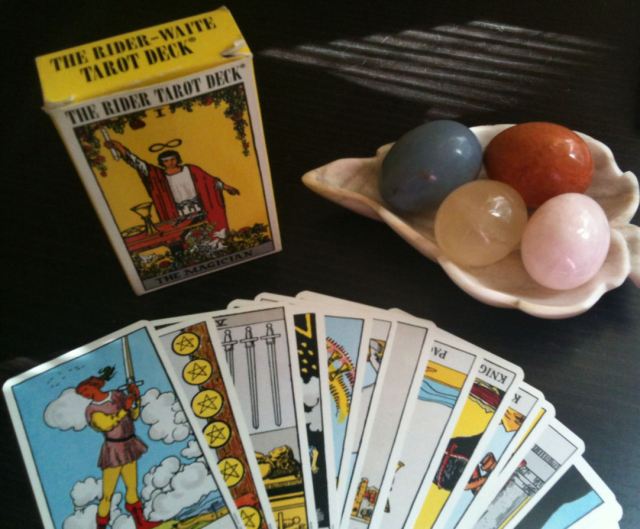
I am grateful that I did not access the Internet during my formative years of learning tarot. Communities of self-proclaimed advanced tarot practitioners have brought into being the supercilious notion that the Rider-Waite or Rider Waite Smith (RWS) tarot deck is a “beginner’s deck” and that a high level practitioner will have moved beyond the RWS into another more specialized deck.
What hooey.
These practitioners need to revisit the RWS and re-evaluate for themselves how well they truly understand the RWS. Are they really using the symbology contained in the deck to its full extent? Do they understand the elemental influences, astronomical, seasonal, and the nuances of every last bird in the sky, leaf, and blade of grass?
As I have said, as of the present there are three prevailing tarot deck systems. The Marseille with the pip cards, the RWS, and the Thoth. The three are very different from one another and every practitioner should be fluent with reading all three. From there, you will find that you gravitate more toward one of those three. That will most likely become your primary reading deck.
The three systems have inspired numerous contemporary derivative decks. These decks are generally based on one of the foregoing three systems, or are a hybrid. Most of these derivative decks are created to reconcile an omission in one of the three main systems. A basic example of that are the fancy, beautifully illustrated RWS decks that are aesthetically more pleasing to the eye than the original RWS. There are decks that attempt to better flesh out the interpretive methods of the Golden Dawn. Others fuse the foundation of the tarot with imagery that is more specific to a particular faith, philosophy, or culture. All of these decks are legitimate reading decks and if you find yourself connecting to one more so than the RWS, then that’s really great for you.
However, it does not mean you’re now more advanced. People start with the RWS not because it’s a beginner’s deck, but because it is a traditional system. The Marseille is another traditional system, but not everyone has developed and honed their intuitive abilities to a point where they can read pip cards meaningfully. The RWS is like Tchaikovsky’s Violin Concerto in D Major while the Thoth is like Stravinsky and the classical musician will have attempted to master both, but neither one is hardly considered “beginner” stuff. Playing Vyacheslav Artyomov or Gheorghi Arnaoudov doesn’t make you more advanced than the fellow working on the Tchaikovsky piece.
So please do not listen to the snobbery, my dear RWS reader. If that was your first reading deck and still remains your only reading deck, then that is what works for you. That shouldn’t even be said in a patronizing way. Seriously. RWS is an incredibly complex deck and anyone who thinks it’s the training wheels of tarot is someone who still has a beginner, rudimentary understanding of the study.






 benebell wen