I’m a huge fan of T. Susan Chang’s work. I loved Tarot Correspondences, which I’ve reviewed before here, have and cherish my copy of Tarot Deciphered, co-authored with M. M. Meleen, creator of the Rosetta Tarot and Tabula Mundi Tarot, two of my all-time favorite decks, ever.
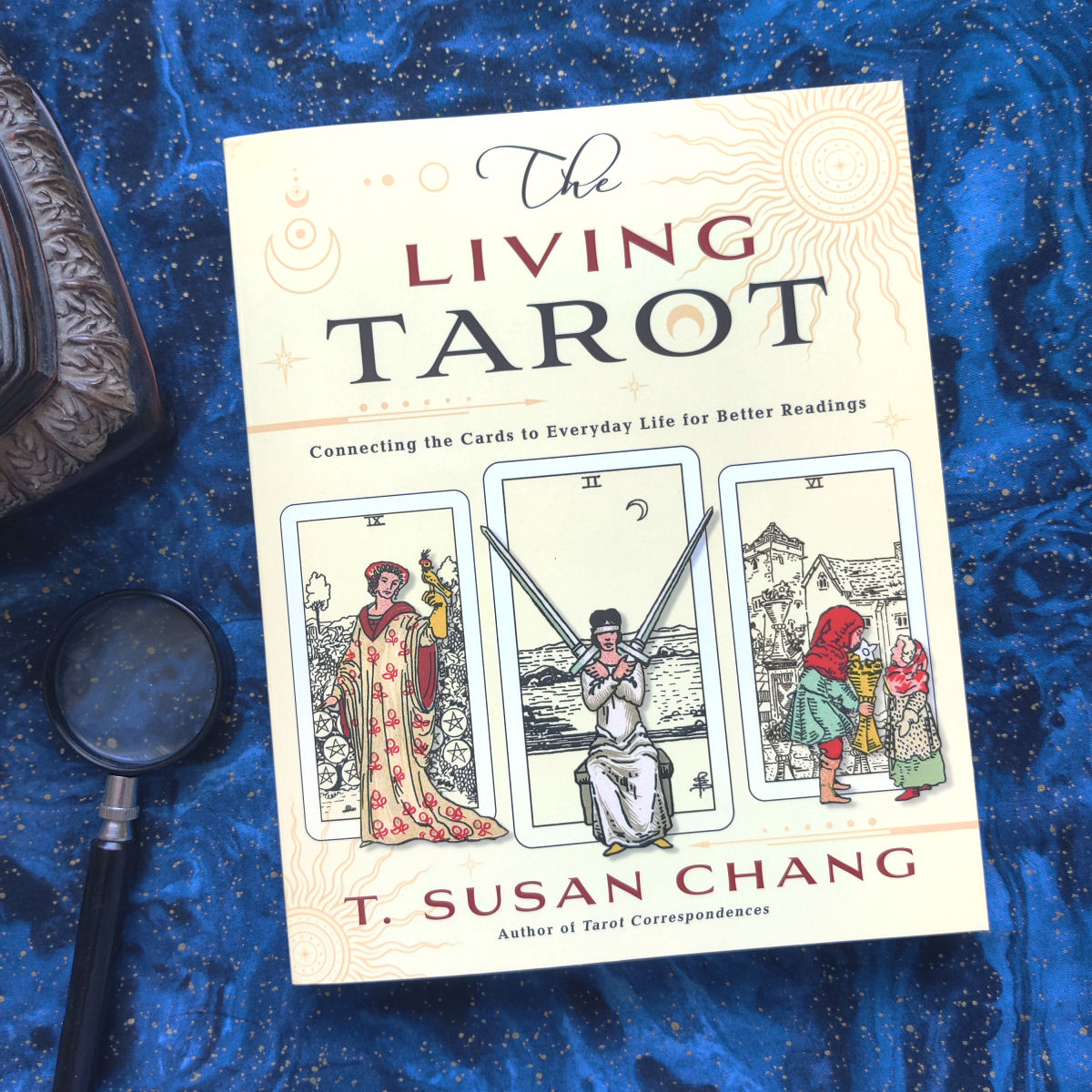
So I’m thrilled about the opportunity to review Chang’s latest book, The Living Tarot published by Llewellyn Books. Unlike her previous publications, The Living Tarot is written with the beginner in mind, and more pertinently, how the modern reader can find personal, everyday meanings to the 78 cards.
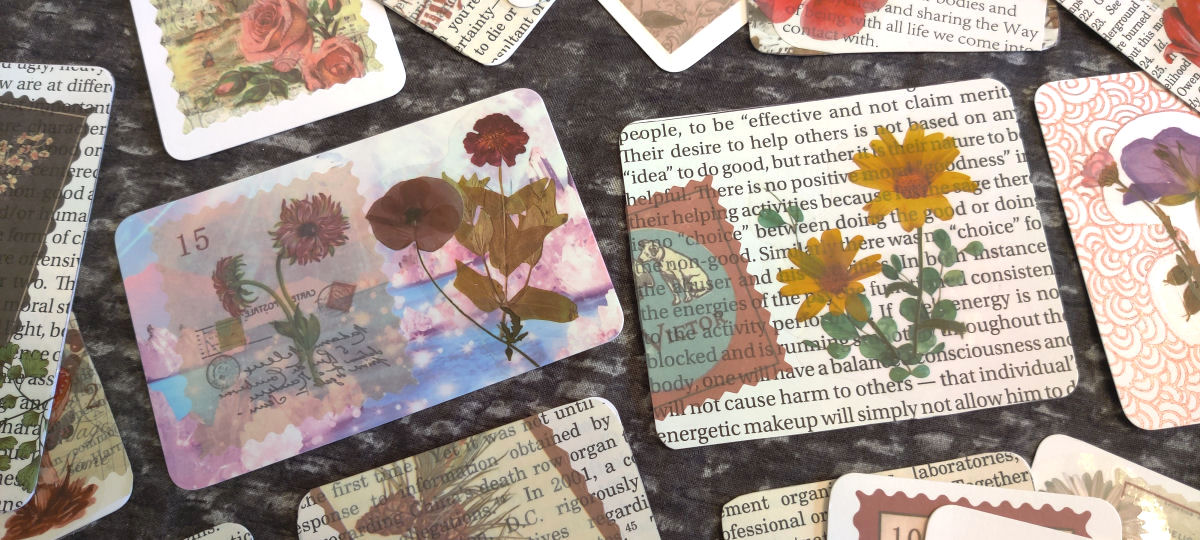
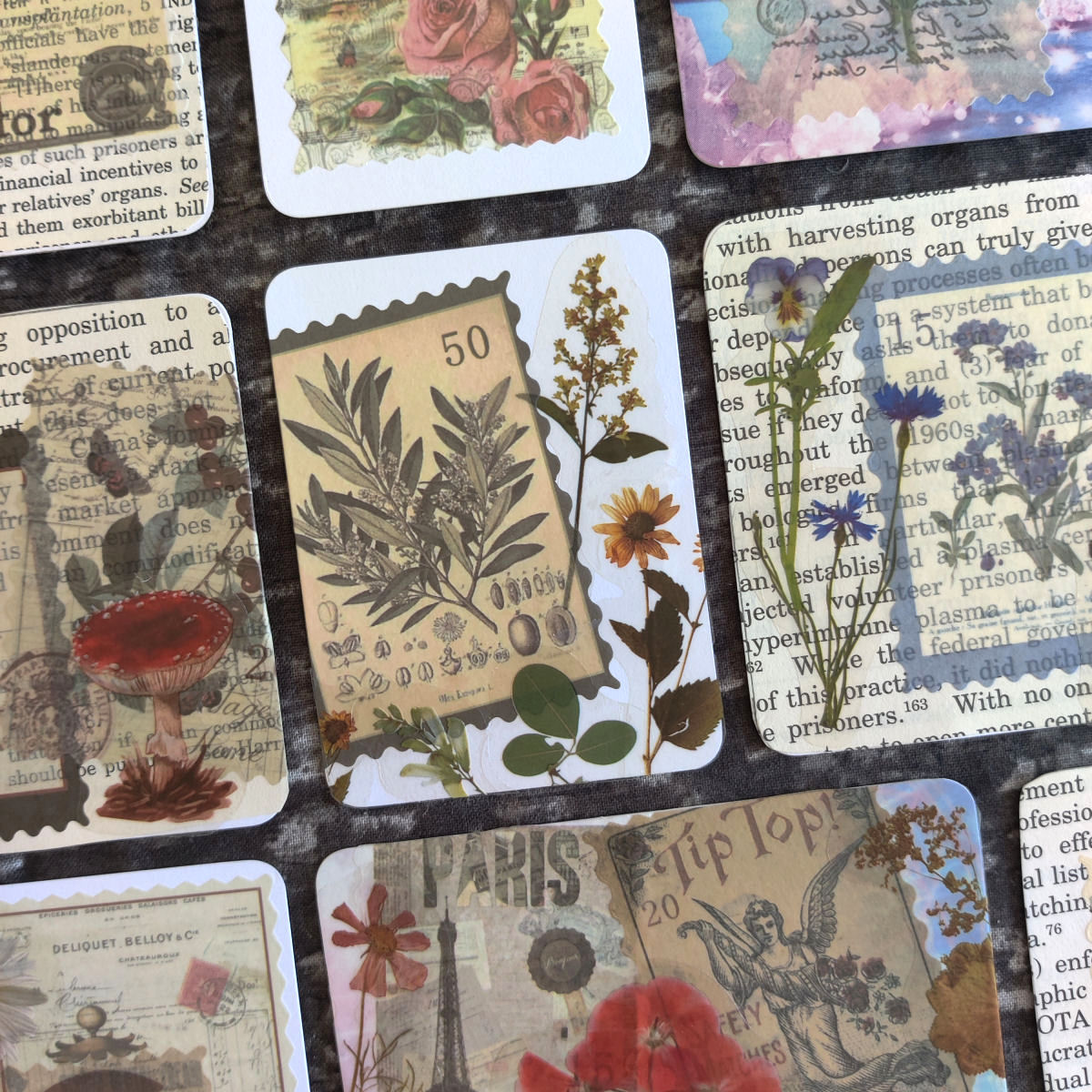
The real reason this post is going up is because I want to show off my cute little arts and crafts project. Otherwise there is no other purpose to them. So permit me to flaunt and brag about my accomplishment. This is where you ooh and ahh, or at least pretend this matters to you. =)
Like, I’m not going to sell them or turn them into an oracle deck (although you totally can, and what a great idea that is!) so what am I going to do with these scrapbook collage art cards I made… oh, I know, flex about it on my personal blog.
I mean. They’re pretty cute, aren’t they? You can give me that much. =)
But I will try my best to force out a more meaningful message for the collective, something you might be able to get out of my personal arts and crafts dabblings. This is a really, really easy craft project you can do at home, and I’ll explain why I believe it’s worth your while.
If you have arthritis, there are arthritic scissors you can use, or invest in one of those sliding paper cutter things. And then instead of collaging with magazine cut-outs, do what I did and buy a ton of stickers. All you’ll be doing is collaging with stickers.
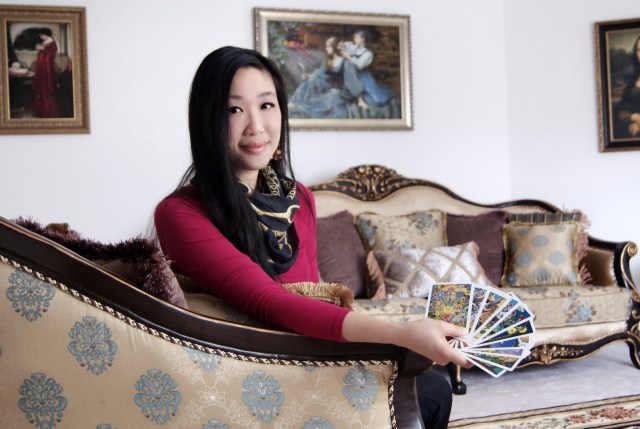
Random old photo to accompany the commentary. I’m holding the Tarot of the Holy Light by Christine Payne-Towler, which at some point long, long ago I received for free. Do I need to disclose that?
Psst… I have a “TL;DR Short Summary for the Not-Readers” that summarizes this otherwise very long blog post. So if you don’t have the time or you’re only a little bit interested and not that interested, then scroll all the way down to the end for the TL;DR Short Summary.
I’m reviving and sharing a blog post I drafted in 2019 that has sat in my WordPress saved file for the last 3+ years. It’s about FTC-issued disclosure guidelines (“Rules”) for social media influencers, and key takeaways to glean from the Rules if you’re creating content in the Mind, Body, Spirit spheres. I never got around to finishing and posting that 2019 draft, back when the FTC disclosure guidelines first gained traction, but I think now is a good time to reopen the discussion.
What’s of note to me is how the legal minds who are often the ones drafting these Rules seem to be people who have no personal experiences or insights into the communities they’re drafting the guidelines for. Even when they employ subject matter experts, those SMEs tend to be biased, or come from a very particularized segment of the community, and therefore do not fairly represent all interested parties.
There’s consumer protection, which nobody’s against. But then there’s untenable rules of compliance that aren’t clear enough for practical application by the people the rules are demanding compliance from.
By the way, none of this is my legal opinion, and do not rely on it as such. All of this is personal commentary in reaction to the FTC disclosure guidelines as someone who considers herself a deck reviewer but who could potentially be categorized as an “influencer.”
Eastern Ink Tarot was conceptualized by Zhong Ling, a Chinese tarot reader and founder of the Chengdu Arcana Culture Communication Company, the publisher of this deck. She’s also the founder of a tarot school in China, established in partnership with Lo Scarabeo.
Zhong Ling teamed up with award-winning artist Zi Kang, who studied under renowned Chinese masters and trained in traditional Chinese painting styles. For the paintings you see in Eastern Ink Tarot, he sourced his inspiration from ancient books, traditional Chinese culture, and philosophy, specifically the yin-yang school of Eastern philosophy.
Both Zhong Ling and Zi Kang are seasoned tarot scholars, and that’s something I really appreciate from deck creators. They’re passionate and learned about the tarot, and then decided to create a deck. In Eastern Ink, you can see that knowledge come through in which RWS symbols they preserve and where in the art they take creative liberties.
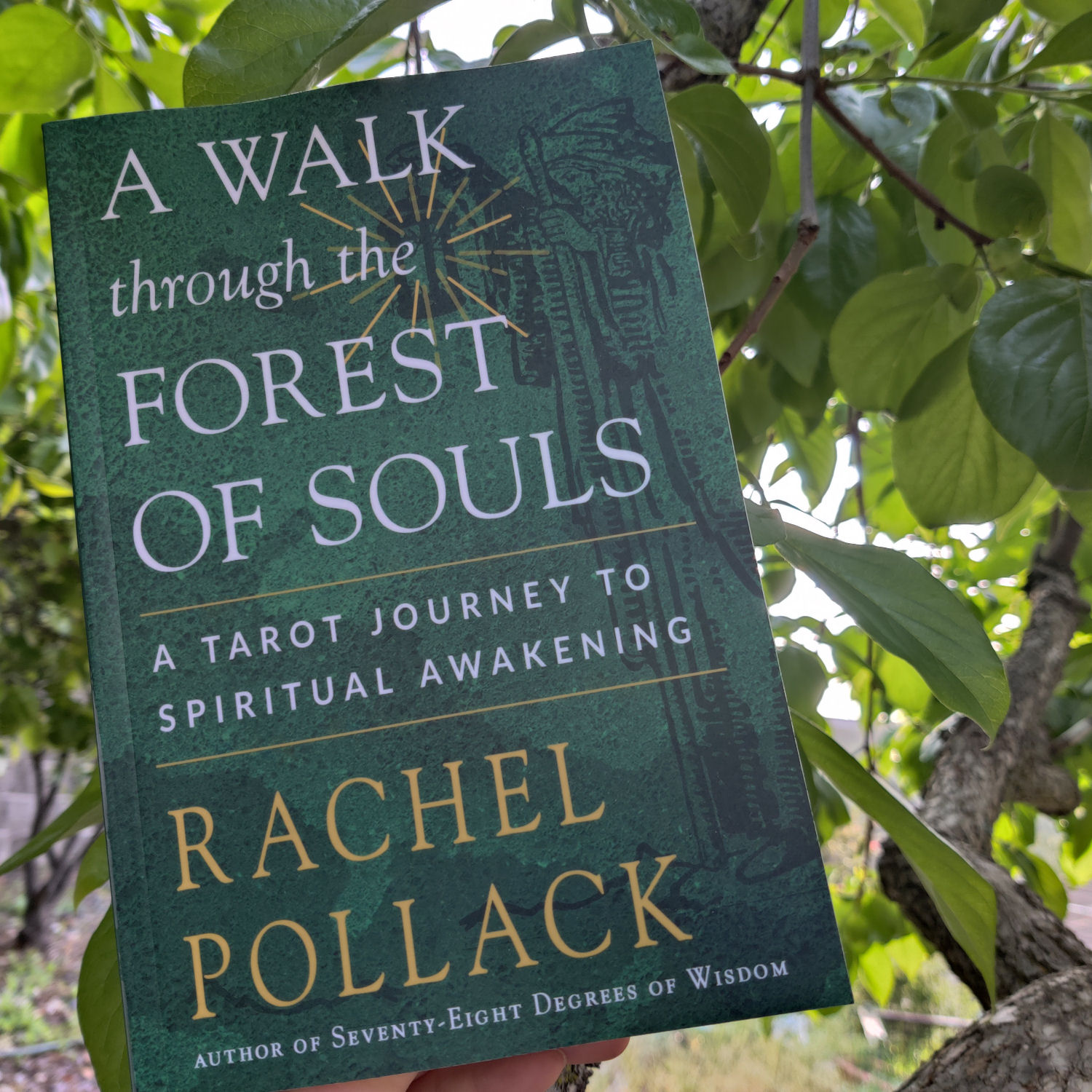
Carolyn Cushing and Jenna Matlin, in collaboration with Weiser Books, are hosting a series of content to celebrate the late Rachel Pollack’s re-release of A Walk Through the Forest of Souls. This is a day-long event for the tarot community, and you’ll find many contributors to this celebration.
My interest in this particular consideration piqued earlier in 2023 when I noticed a sharp change in the gender demographics of who views my Yutube channel, which appears to have shifted just as the subject matter of my channel’s content shifted, from being tarot dominant to more I Ching.
Though I don’t have any screenshots to show, back in 2018 and well into 2019, the gender demographics for my Youtube channel was something closer to 20% Male and 80% Female, and that checks out for most of Tarot Tube and witchy content creators, especially among witchy content creators who present as female. I did notice that after 2019 when I started making more Taoist occultism content on the channel, the demographics shifted slightly to 30% Male and 70% Female.
(For clarification, when we say Male or Female, these are per the identifications opted in by the users.)
I didn’t follow the analytics too closely, so I can’t pinpoint exactly when the shift happened, but in early 2023, per the screenshot image above, I noticed suddenly that the demographics were closer to 50/50, which is in fact strange for the tarot and witchy communities and stranger yet for female-presenting content creators like me. You don’t typically see 50/50 demographics for viewership when it comes to tarot and witchy content. There’s typically an underrepresentation of men.
In my head I’ve been mulling over a candid video chat I’ve been wanting to make for some time now, but it’s only these last few weeks of stirrings in our tarot community that concretized my motivation to just go ahead and do it. =)
I’ve only chosen one comment to read as an example of a recurring common critique I get, and the three recurring common critiques I’m chatting about in this video are as follows:
I’m pretentious and elitist, and also an opportunist,
My work is imbued with negative, demonic entities and/or I am possessed by or consort with negative, demonic entitles (evil, dark energy, etc., take your pick of descriptive), and
I say insensitive things at all the wrong times (as interpreted from the writings I’ve put out there).
In the video I also reflect on authenticity, the perception of virtual authenticity, and how true, sincere human authenticity will come back to bite you in the ass online, and the only way to appear authentic is to fabricate and manufacture the illusion of authenticity.
The photos interspersed throughout this post are totally random, just for Pretty.
It would have made more sense for me to present this topic in video form on my YouTube channel, but I’ve been a bit under the weather with the flu, so my voice is scratchy, my nose is stuffed, and I don’t feel like putting on makeup. A blog post will have to suffice.
You’ll have to watch these videos first because what they have to say is what I’m referencing throughout this write-up. By the way I hope you’ll like and subscribe to them all as I have. ❤
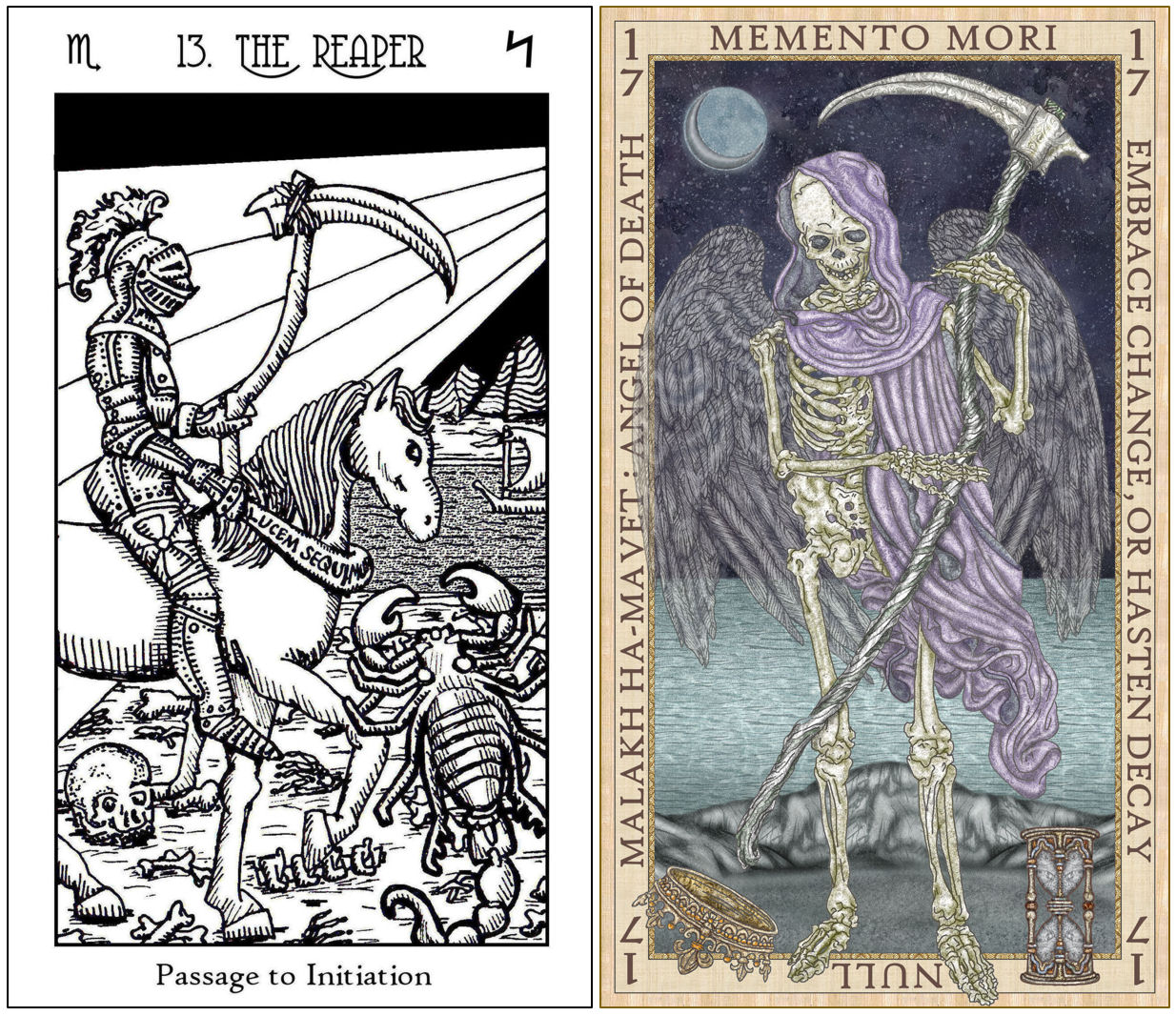
Left: RWS-based Key 13 Death card drawing, entirely by hand pen and ink sketch. Right: Etteilla-based Card 17 Death card drawing, mostly digital, including hand-drawing with a digital paintbrush.
The above side by side isn’t a fair comparison, but let’s compare anyway. The left was entirely hand-drawn in pen and ink back in 2018 when I first picked up drawing after not having done anything artsy for over 20 years. Well, I did do technical drawings in fashion design, but like creative artsy art. That I hadn’t done in decades.
The above right began as a thumbnail sketch by hand (I still feel better doing it that way, even after going digital), I scan in the rough sketch and then clean it up digitally. Then the illustration is colored digitally as well.
Gradually, I’m doing less and less by hand analog and more and more digitally in software. For example, even near the tail end of completing SKT Revelation art, I was finalizing almost the entire composition of each card by hand, scanning it in, and then digitally coloring, tweaking, etc.
At this point of the Etteilla project, however, there’s less than 1 hour of drawing by hand analog before everything goes digital and I take it to the finish line in Paint Shop Pro.
I will say, though, notwithstanding the boost you get from tech, my actual line drawing by hand has improved a great deal over the last 5 years. Almost every day for the last 5 years, but for a few exceptions, I’ve been practicing my drawing skills. I keep a sketchbook and make sure I draw something every day.
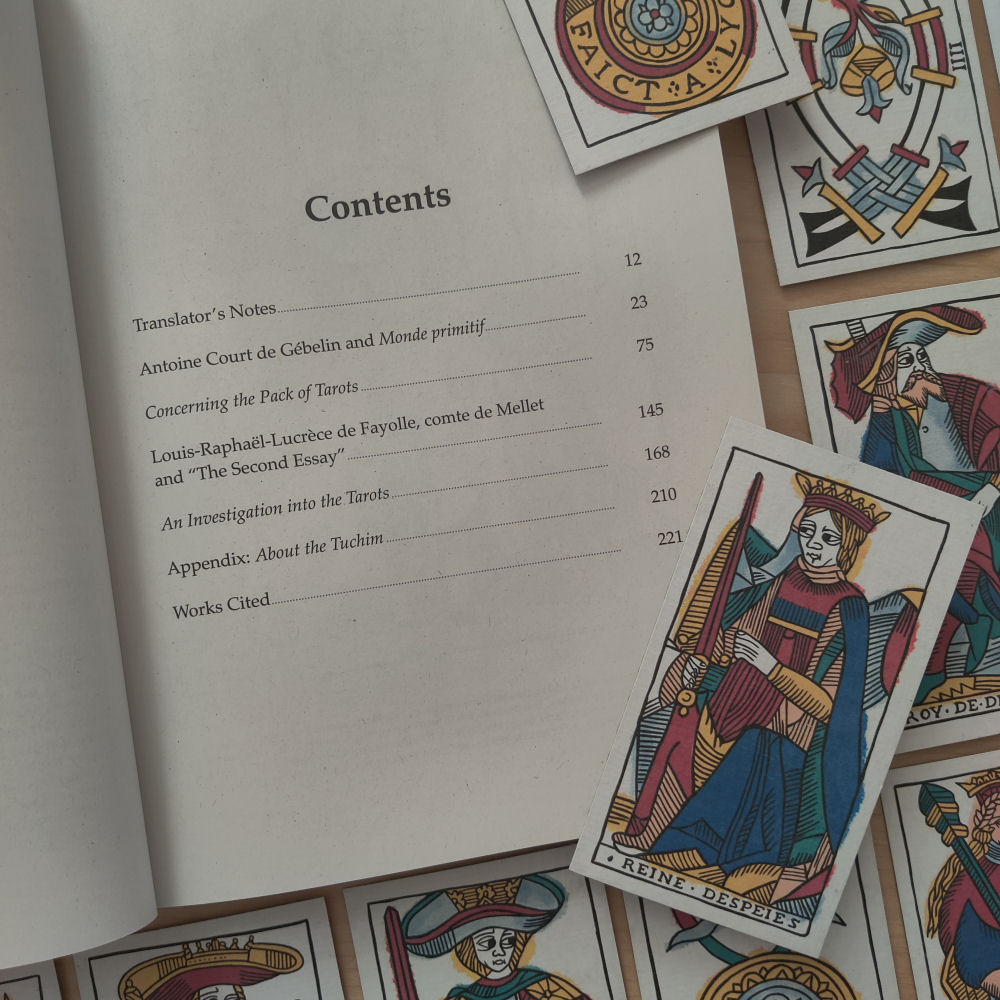
David Vine is one of those rare treasures in the tarot community. Combining his academic training, knowledge of the classical languages, medieval literature, and art history with a passion for the tarot, Vine has translated several seminal French-language tarot texts, and Vintage Tarot Texts, Volume 1, is one such treat.
Just a random comment– A beautiful touch in this edition are the captioned historical illustrations throughout, such as this print of an array of ancient sistra and rattles. I so appreciate the added illustrations.
Volume I consists of seminal essays on the tarot by Court de Gebelin and comte de Mellet. The first text to address tarot at length in a symbological context was by comte de Mellet, and thus in one sense, his work is the foundational document for everything we have come to understand about the esoteric tradition of the cards.









 benebell wen