Are You Psychic? The Sum of Intuition and Ego

candle-up-close

As children my younger sister would say she was psychic and tell me about her psychic experiences. I recall, for better or worse, vehemently discouraging such a line of thought. I would tell her that she is not a psychic and if she continued to say she was, then she was a liar. Dismayed, she eventually stopped announcing that she was a psychic to us sisters and maybe even stopped letting herself acknowledge so-called “psychic” experiences when she had them. In retrospect I regret my harsh and ignorant stance, but at the time (and I was a tween myself) I believed it was for her own good: she couldn’t run around in public telling people she was psychic. How would people take her intellect seriously if she did?

Now I have always been convinced that my sister may have had strong intuitive abilities for what may be beyond the five physical senses, not unlike the way all the women from my maternal line are drawn to the preternatural. My grandmother, my mother, my first cousins descending from my grandmother, and my sisters all display a heightened awareness of the logically inexplicable. But psychic?

I saw it this way: when you are a voracious reader, at some point you will want to give it a try and become a writer yourself. Likewise, if you’re fascinated by metaphysics and occult phenomenon, at some point you will want to be part of it, and maybe even convince yourself that you’re psychic. Not too different from how I try to convince myself that I’m a writer even though I have yet to publish a damn thing.

Sure, I am convinced that intuition is real. Intuition is the perception of a truth, occurring incident, circumstance, or event independent of any logical reasoning, actual knowledge, experience, or cognitive deductive process. It is synchronicity. It is a prickling of what is about to happen before it happens. It is the sensation of energies that you can’t physically see, hear, smell, touch, or taste, a sensation for when those energies are in balance and when they are out of balance, and the enigmatic knowing of how you might be able to balance it if you were to try.

Being intuitive is like being detail-oriented, or organized, or calculating differential equations. Not everybody is detail-oriented, organized, or able to do math, but anybody can be with enough effort. It is just a skill, albeit a remarkably empowering one when we use it. It might also be a trait. Some seem naturally disposed to it and others need to really work to acquire the skill. I guess somehow those who seem naturally disposed to being intuitive have come to be referred to as psychic.

My question is: where on the continuum of intuitive ability must one be for that person to qualify as “psychic”?

Continue reading “Are You Psychic? The Sum of Intuition and Ego”

Tarot on Shahs of Sunset?

shahsofsunset1

Okay, so it looks more like straightforward cartomancy than it does tarot, but still. Also, it looks like I have to own up to a guilty pleasure before proceeding: yes, that’s right, I’ve been watching BravoTV’s Shahs of Sunset, a reality show that follows a cast of socialite Persian Americans in Beverly Hills.  In Season 2, Episode 2, two of the main cast members, Asa and Reza consult with a Persian psychic, Shohreh.

shahsofsunset2

Sitting in a Los Angeles cafe, Habibi Cafe to be exact, Shohreh uses a deck of oversize cards to read about Reza. From what I could see, there are pip cards, as opposed to the pictured suits of the RWS, Thoth, or other contemporary decks.

shahsofsunset3

Also, whatever it was the psychic told Reza, he seemed thoroughly impressed. And where did she get that oversize deck? I want one.

Yes, this was a meaningless post. Just happy to see cartomancy get some air time.

Asians and Tarot Reading

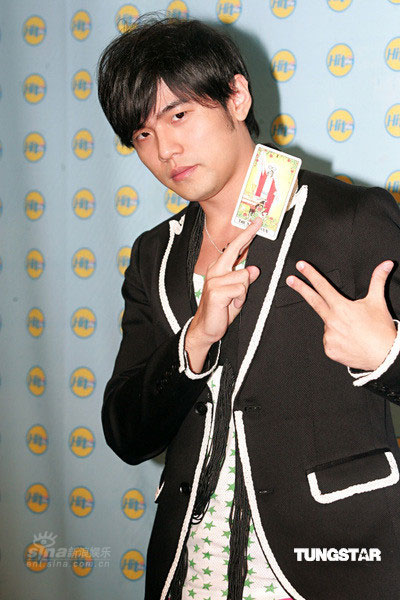
Photo Credit: Tungstar via Sina.

Where are the Asian Tarot Readers? I wrote an article for 8Asians.com that addresses the intersection of tarot reading and Asians/Asian Americans. Link: http://www.8asians.com/2013/04/29/where-are-the-asian-tarot-readers/ (last visited 4/30/2013).

People of color, especially Asians, form associations around their race for every topic– blogging, voting, golfing, farming, realtors, lawyers, doctors, chess players, musicians, journalists, kidney donors, Republicans, Democrats, pole dancing, basketball, you name it, there is probably a group of Asians who have formed an association. Yet there are no Asian American tarot associations, no gatherings of Diasporic Asians who are interested in tarot. Why not?

The experience of writing it was the most amazing part, because I had the blessed opportunity to interview Joanna Ash of Sun Goddess Tarot, Zach Wong, the creator of the Revelations Tarot deck, and Deedra Wong of Tarot Perspectives, three really amazing individuals in the tarot community. I love what they’re doing, each one of them walking a slightly different path through tarot studies and practice.

I was surprised to find that tarot is more common in Asia than I first expected. For those not in the know, the above photo is of a Taiwanese celebrity, Jay Chou, a music, singer-songwriter, and actor. He was in the 2011 film Green Hornet. Chou purportedly consulted the tarot to ask about the success of his forthcoming music albums. Link: http://jaychoustudio.com/archives/jay-chous-career-and-love-told-through-tarot-cards-deeply-influenced-by-rumours/900 (last visited 4/30/2013).

Jolin Tsai, another Taiwanese pop sensation, features tarot divination in one of her music videos. Seems like it isn’t quite as taboo for mainstream public figures in East Asia to associate themselves with tarot as it seems to be here in the U.S. We seem to be irrevocably Puritan when it comes to our open-mindedness to such practices.

I ended the article with this, and a silly quoted statement from my friend:

[Asian tarot readers] see no problems with the few individual Asian tarot readers who exist to assimilate into the greater tarot associations at large rather than group-identifying with Asians only.

“That’s because only white-washed Asians do tarot,” said one of my friends. “Asian Americans who are anchored solidly in the Asian American community aren’t into that kind of stuff. If they were, there’d be an Asian American tarot group like the one you’re asking about. The absence of such an Asian American tarot group is your proof that activist Asian Americans aren’t into it.”

. . . Have you had any experiences with the tarot? With Asians who practice tarot? And why the heck isn’t there an Asian American tarot association?

In spite of how common and acceptable tarot practice is in East Asia and its seeming endorsement from Asian celebrities, in the States, Asian Americans consider tarot to be “white-washed,” meaning Asians who reject their ethnic heritage to act as whitebread as possible are the ones who are thought to be tarot practitioners. Interesting juxtaposition there.

One of the commenters below the post, Jonathan V, an Asian American male tarot reader, pointed out an authenticity and exotification issue that I immediately related to, since I also practice both tarot and I Ching. There tends to be doubt about the “authenticity” of my tarot readings, but then non-Asians seem to love it when I use I Ching. I’m suddenly an “authentic” I Ching divination practitioner simply because of how I look. I look the part, i.e., I’m Asian. Nevermind that I was born and raised here and just as competent and just as inept as the next John or Jane Doe I Ching student over.

In any event, I hope that article expands the dialogue of Asian American tarot practitioners and the correlation of tarot to race and culture.

A Tarot Deck Library: The Hobby of Collecting

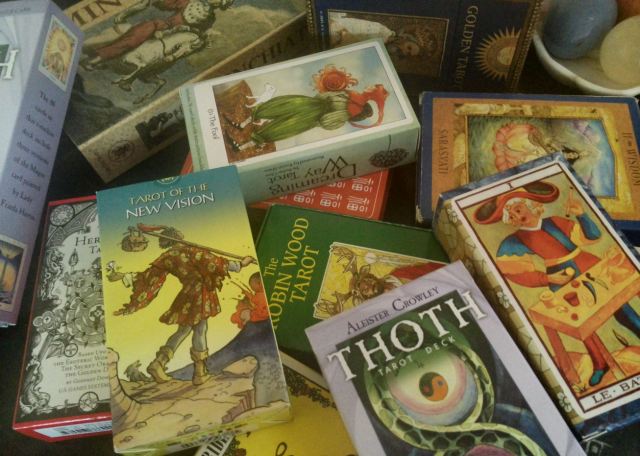
alldecks

I will start by saying that you only need one tarot deck to be a practitioner. Every deck over one is excess. That being said, if you’re a tarot enthusiast, there will be no convincing you to stop hoarding tarot decks. I mean, you probably only need one pair of shoes, and yet I have fifty. I like to collect. So if you, too, must collect, then at least try to keep your collecting focused. This post will offer tips on building a tarot deck library.

Continue reading “A Tarot Deck Library: The Hobby of Collecting”

30 Day Tarot Challenge Meme (Questions 11-15)

It is Day 3 of the meme, which should correspond with Days 11 through 15, since each question is supposed to take up a full day of contemplation. Instead, I’m truncating it down to 5 questions per day to finish off the challenge.

See previous postings:

Questions 1-5 (Day 1)

Questions 6-10 (Day 2)

11. What spread do you use most often/prefer and why?

I used to have a strong preference for the Celtic Cross, but really the only reason for that was habit. I knew the spread like the back of my hand and it was comfortable. My practice has evolved and now there is no single spread that I use most often. I listen carefully to the client’s needs and usually custom-tailor a spread for that client.

12. Have you ever created your own spread? If so, how effective is it? (Feel free to show the spread.)

Yes. All the time. If it would serve the client, then I will incorporate the client’s religious beliefs, faiths, traditions, culture, or just his or her specific inquiry needs into the spread that I devise. My spreads are generally based on some sort of cross or sigil. I have found that these tailor-made spreads are astonishingly effective when applied in the most precise way to both the client and the question.

Here is one example of a spread I recently devised, called The Insight Cross:

Insight_Cross_Spread

13. Is there a card that continuously stumps you when it is drawn? Why do you believe this to be so?

Key 18, The Moon often stumps me. When it is the only card drawn, I get the meaning. However, when I need to understand it in the context of other cards, or even in the context of a client’s specific question, it is often difficult for me to explain The Moon as it pertains to our everyday life. Intellectually most of us can understand The Moon, but extrapolating its application is a little more elusive for me.

14. For what purposes do you usually use the Tarot?

These days, only to read for others. I do not read tarot for myself. Instead, I will patron another professional tarot practitioner for a reading. It supports their tarot business and I feel it’s more objective than me reading for myself.

15. How much emphasis do you put on the textbook meanings for cards, and how much stress do you place on the “feeling” you get from cards through their artwork/symbolism, etc. Do you do both, or one or the other?

My analysis begins with the classical meanings for the cards. However, I cannot stress enough how important it is to look at the overall landscape of a spread and see how the cards relate to one another. From there, exercise intuition to truly understand the holistic meaning of the card as it directly pertains to the client’s inquiry. How that can be done artfully and accurately is learned only through practice, practice, and more practice. You need to gain a great deal of experience before you understand the depths of intuitive reading.

Subsequent Updates:

Questions 16-20 (Day 4).

Questions 21-25 (Day 5).

Questions 26-30 (Day 6).