Together, let’s walk through a tarot reading method instructed by S. L. MacGregor Mathers in The Tarot, Its Occult Signification, Use in Fortune-Telling, and Method of Play (1888). He describes this reading technique as “a very ancient mode of reading the tarot” that “will be found reliable.”
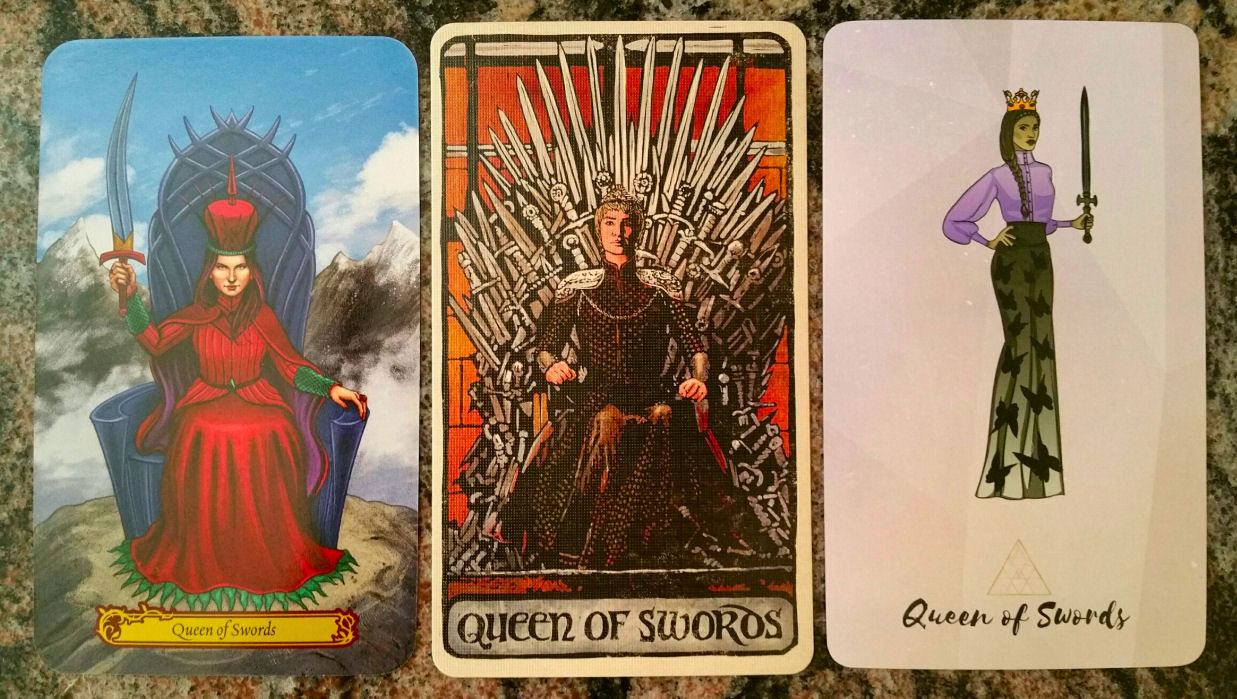
Queen of Swords from the Tarot in Wonderland (Barbara Moore); Game of Thrones Tarot (Liz Dean and Craig Coss); Bad Bitches Tarot (Ethony Dawn)
Even though I don’t personally buy in to generalizations about astrological sign compatibility, they sure are fun to read (and write). Instead of zodiac signs, I’m going even broader and exploring elemental compatibility between the tarot courts. Zodiac signs aren’t the only way to determine tarot court correspondences, but it’s the one I’m going to go with for the purposes of this blog post.
Since there are differing elemental correspondences for tarot out there, here’s the one I’m working with:
Those who are Fire signs are part of the Wands court, Water signs are Cups, Air signs are Swords, and Earth signs are the court of Pentacles. Psst… I’m the Queen of Swords by both sun sign and rising.
To determine your elemental court, you can use your sun sign (what is commonly referred to as your horoscope sign), but for some relationships, you may want to go with moon sign. Checking compatibility points for moon signs, rising, and Venus signs in addition to sun signs can bring a more well-rounded insight to a very specific romantic pairing. Closeness of friendships can also be determined through an account of the moon signs in addition to the sun.
The relationship compatibility I want to explore here is not limited to love. These considerations can be applied to friendships, acquaintances, or professional partners, or heck, even which public figures seem to resonate with you and which for some inexplicable reason just don’t.
Let’s talk about card reversals. No, not how to read card reversals. I mean why some practitioners read with card reversals and some do not. There’s the succinct answer of “to each his or her own; since we’re all different, we all approach tarot differently,” but I mean beyond that, why?
Some practitioners would feel remiss to not consider the energy of card reversals in a reading. For others, an upside down card image drives them mad and thus interferes with their intuitive abilities. You end up with a camp of tarot readers who read with reversals and a camp who does not, leaving beginners who are entering the tarot forum for the first time wondering what the heck they should do. When “just do what feels right to you” sounds too vague of an answer, let’s try to get down to some specifics.
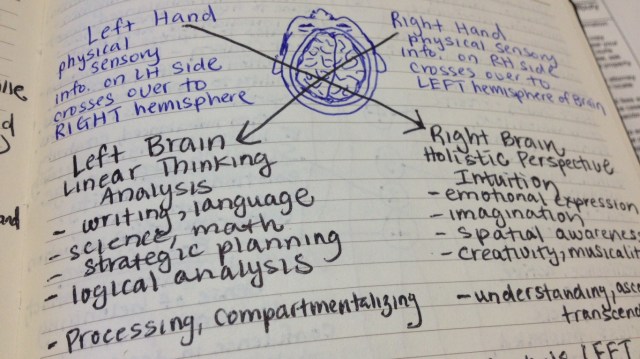
So like reading with reversals vs. reading without reversals, we’ve got two camps of mental dispositions: the left-brained and the right-brained.



 benebell wen