Did I get your attention with that gimmicky blog title? Let me get even more specific with my gimmick. Learn how to earn $50K or more from working 27 hours per week.
After being bombarded by online gurus claiming they could teach people how to earn six figures from a home business, most of them offering spiritual services, and believing that there is such a code to earning those six figures, I challenged myself to crack that code and see if I could engineer such a formula.
I couldn’t.
But, I did figure out how to earn 50K, actually I contend to you more than that, from working what is essentially a 27 to 30 hour part-time work week, from home, as an entrepreneur.
At least I think I did. Anyway, I’ve written up my findings.
Whether you decide to go crazy and tack on 27 hours of extra work to your current working schedule to launch a spiritual service venture part-time (technically, a 27-hour work week counts as “part time”) or you’re aspiring to go full-time as a professional reader offering spiritual services and want some tips, I’ve put together a little handbook that instructs on a formula I came up with for achieving the targets I listed: $50K in earnings from a spiritual business service by putting in a 27 hour work week.
Intrigued?
Then download the handbook. I offer it in both PDF and DOC file formats.
It’s targeted only at spiritual service professionals.
So unless you are a professional tarot reader, astrologer, life coach, divination mentor, or are engaged professionally in a similar form of spiritual business, this post will not be of much interest.
I’m posting it kind of as a PSA so that it is available to any spiritual entrepreneur who manages to find this page.
If you teach business tips and strategies to spiritual entrepreneurs, then I ask of you to incorporate the contents of this post into your educational materials. Screw credit or no credit or infringement wtf ever– just get your people informed, will you? Who the hell cares who came up with the idea first. Just get the information out there to fellow spiritual service professionals.
Photograph that is unrelated to the topic at hand but posting here for the visual effect notwithstanding because your eyeballs need there to be a photo here and I couldn’t source one that would be related.
First off, naturally I will be speaking in generalizations.
People my age are sandwiched somewhere in between the Old Guard and the Millennial Readers.
Although my mother is not a tarot reader, she’s a metaphysical reader/practitioner of sorts and I’m super sure that had tarot been accessible to her as a young one, she would have totally become a tarot reader. Instead, she reads other stuff. Like your face. No, I kid, but oh no, I don’t. She really does.
I can see her attitude reflected in many of the Old Guard tarot readers. “I’m not normal. Tarot is not normal. Damn straight this is fringe. Deal with it.”
There’s an unabashed embrace of marginalized culture. There’s no embarrassment with dressing woo-woo as you walk among normal society. You can almost see traces of a hedge witch mentality.
Although she has never come outright to say so, I get the distinct sense that she doesn’t want everyone and the mainstream to become diviners, mediums, shamans, and practitioners of craft. There is a tacit yet clear exclusionary attitude. Or at least that’s always been the impression I got. She doesn’t want (let alone buy in to the ideas of) Mediumship 101, “everybody’s psychic,” or “pay me $300 and I will certify you as a bona fide tarot master.” (Hi. Certified tarot master here.)
Meanwhile millennial readers apply general business and marketing tactics to tarot–e.g., general PR and marketing principles to tarot business, coaching anyone and everyone to become diviners, mediums, shamans, and practitioners of craft, if you so choose. There are efforts to establish tarot into mainstream culture.
There is a pop psychology approach to tarot (which I have been pegged and critiqued as adopting, so apparently I’m in this camp) that strives to normalize divination practices or astrology, and to talk about spell-crafting as the law of attraction and “yay for positive thinking.”
However, at the heart of the millennial approach is the notion of accessibility, a socialist attitude toward the metaphysics. We can all have equal access to the Divine, to metaphysical energy work. (I confess, that is the attitude I adopt. That line sums up my opinion.) Metaphysics is for everyone. This is not paranormal, it’s normal. You don’t need anybody else to help you connect to the Divine. You only need you.
Okay, so as circumstances would have it, I’m now only a couple paragraphs in and I’ve already changed my mind.
Maybe I haven’t changed my mind exactly, but it is for sure vacillating. Is it really a generational thing? Or is it just a two-different-schools-of-thought thing? Is my personal anecdotal evidence and direct observations even reliable?
I’m in effect just looking around me, only to the point I am able to physically see, and making gross generalizations about what else is out there based on only what I see. Is what I happen to see an accurate microcosmic sampling of the macro? I don’t know. I really don’t.
However, there is for sure a determined voice among the occultists and metaphysicians who say that “occult” means concealed, and we are not to remove the veil for all. Only those who choose the path should or even can go beyond that veil to see for themselves what is there, and then come back with divinatory or revelatory information as needed, like an appointed messenger.
Is that way of thinking a bit reminiscent of limiting literacy to the elite so that the proletariat must rely on figures of authority (like a priest or priestess) for Divine insights? That was the way of institutionalized Western religion for ages. Is it hypocritical when metaphysicians repudiate that kind of authoritarian approach to religion, pursue occultism because they’re anti-authoritarian and want the answers for themselves, but then once they’ve found those answers, act in the same exclusionary manner?
I’ve observed that the Old Guard, Mom inclusive, have this sense that what they do “isn’t for everyone.” She would probably opine that not anyone can just pick up a grimoire, follow something in there, and yield results. Only certain people can do that. As I said, there’s a staunch exclusionary attitude. I’m also sure if I introduced her to the 21st century spiritual coaching power of manifestation business model, she’d find it absurd.
Actually, she wouldn’t. She’s pretty open-minded. She’d be surprised at first, but then come around. “Okay, all right, I get it. I wouldn’t have thought of that but I get it.” For instance, it might take her some time to grasp the idea that, say, I’m holding an online webinar course on Learning the Opening of the Key for Tarot Summer School and teaching occult theories to a whole bunch of people I’ve never even met, all at once. Perhaps in her view, spirituality, divination, and woo-based teaching is done one pupil at a time, a single teacher to pupil relationship that is honed over several years, not in 60 minutes.
Whereas maybe I do have a more “free love” attitude here. We’re entering a social era where notions once reserved in the New Age or even occult category run as an undercurrent through mainstream society. Corporate offices pay for yoga classes and meditation retreats for their employees. Businesses far from the woo will consider feng shui tips and tricks. Law firms invite in tarot and palm readers for their company Christmas party. Silicon Valley high-tech companies will hire a witch to cast a circle of protection around their computers, protecting them from hackers. All true stories here. I doubt any of this would have happened even 20 years ago. Things are changing.
As woo practitioners such as tarot readers converge more with the corporate and mainstream worlds, they adopt corporate and mainstream commercial strategies to advance their tarot business. Corporate and mainstream businesses converge more with woo practitioners and adopt woo into their environments because hey, “anything to help us earn more money. If that’s a spell or feng shui, then let’s do it.”
So admittedly, there was no point or core thesis to this post. I just thought I’d ramble on some thoughts of late.
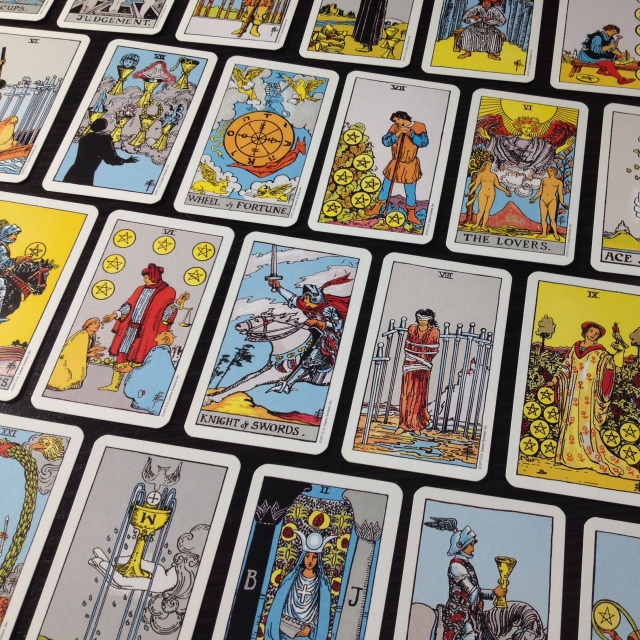
The Rider Tarot Deck, Miniature Edition (U.S. Games).
The archetypal imagery of tarot teaches us many lessons, and lately I’ve been thinking about what business lessons the Major Arcana might teach us. The following is by no means an exhaustive list and it would have gotten excessive for me to address every single Major Arcanum. For sure, each of the twenty-two cards has a lesson to be learned, but here are the key cards I found most pertinent.
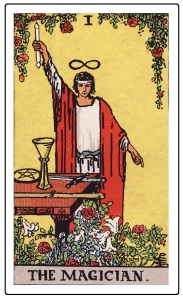
The Magician: Creating Change with Available Resources
The Magician card is about using the limited material resources and assets availed to us to create progressive change. One of the first business lessons an entrepreneur learns is how to create product and run a business with only what is on hand. The Magician is the master of manifestation, and inspires the entrepreneur to model an attitude after the magus.
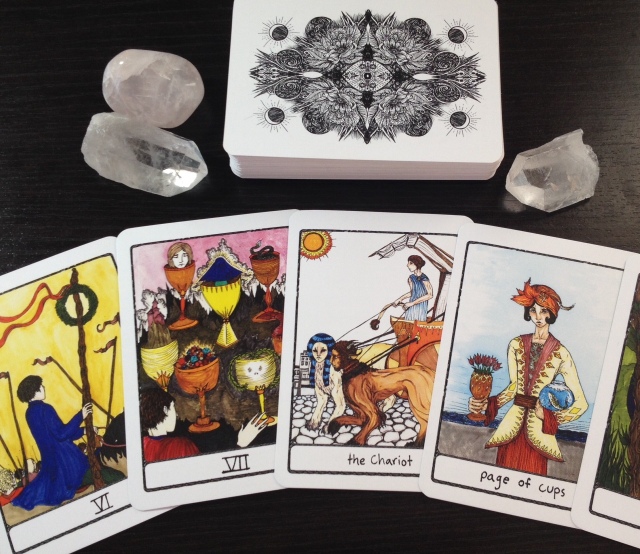
The Efflorescent Tarot by Katie Rose Pipkin (Self-Published)
Note: What synchronicity. Theresa Reed of The Tarot Lady asked me to contribute to a really cool piece, “Best Tarot Business Advice from 22 Tarot Pros.” And I had scheduled this post to go live in the same week. Definitely check out Theresa’s blog. It’s one of my favorites.
* * *
So you’ve always been kind of a weirdo. An intuitive weirdo, no less. You read tarot cards. Scrying with a crystal ball is not out of your realm of conceivable possibilities. Also, for the last who-knows-how-long, your friends and family have been asking you to divine for them. You hear the calling to do this as a professional now. That’s right. You want to launch a professional service in divination. Although you’re no computer whiz, you do know your way around the Internet. So you’re thinking, gee, I think I could launch an online business where I do tarot readings for people from home.
“The Fortune Teller” by Georges de La Tour (circa 1630s).
I would say this is the dark or shadow side of professional tarot practice. To not face it, to intentionally withhold it from public scrutiny is to practice tarot with your head buried in the sand or worse yet, to intentionally misrepresent what happens or could happen in professional tarot. Everything here makes me uncomfortable. It makes me squirm. It makes me feel icky. I loathe that any little part of my personal tarot practice– always unintentionally– mirrors anything I’m about to address in this post (or in the downloadable PDF I’m providing).
St. Anne Conceiving the Virgin Mary, by Jean Bellegambe (1480 -1535 )
Tarot readers often jest about the inevitable reading request, one that most tarot teachers instruct to be outside the bounds of tarot ethics to answer matter-of-factly, that one question that is so easy to postulate as the stupidest possible question to ask the tarot, and that is the question, “Am I pregnant?”
Inside, we smirk and giggle, and ask, “Why don’t you just take a pregnancy test?” and hoot a little at how ludicrous it is for someone to ask that question to the tarot, or to any divinatory medium. Even I have been guilty of thinking that response when such a question is presented. I mean, who in their right minds would go to a tarot reader and ask “am I pregnant?” How stupid do you have to be?
About as stupid as me.
Okay, actually, I’ve never presented that question to a tarot reader. But I am here to ask all of you tarot professionals who might not have experienced this side of life to hear me out and maybe, in the future, in your head and among your emotions, be sincerely able to show compassion.
You’re probably thinking that this whole premise liability thing is not a big deal. If you’ve bought business insurance that covers premise liability claims, then you may be right. However, the typical startup professional tarot reader these days isn’t operating out of his or her own storefront (and if you are, then my post is not likely to pertain to you because you’ve already got insurance to handle this). You’re probably reading out of your home, meeting clients at a local shop or café, or meeting clients at their homes. And you’re going at it without insurance coverage because you’re a maverick. Eeps. What could possibly go wrong?
I say any time you’re doing business, you better get insurance to cover every aspect of your business operations. But if nothing I say is going to convince you to pay out for insurance coverage, then read on and at least half-cover your butt.
Inviting Clients to Your Home for Readings
When you invite a client to your home for a paid tarot reading, that client is a business invitee and by law in most U.S. jurisdictions, you owe a very high duty of care to that client. The classic hypothetical is a faulty stair on a staircase or a loose floorboard that you let the client walk on. It’s not enough for you to simply warn the client about the faulty stair or floorboard and then hope the client will be careful. You owe a duty to that client to fix the issue. If there are hanging plants from your ceiling and one of those plants falls on your client’s head, then you may find yourself in a legally dicey game of “who’s to blame.”
Win or lose such a case, the sheer cost of having to play the blame game in the first place should be enough to get you to pay attention right now. Or what if there’s an electrical cord or cable wire running across a room and your client somehow manages to trip over it? You thought it was fine because it ran under a rug and what idiot can possibly trip over a cord or cable running under a rug but your client just manages to be that idiot. And now that idiot has broken her leg and expects you to pay for it. What do you do? What if you’ve got clutter everywhere and your client trips and falls over a stack of books in the middle of the hallway and got badly injured and for whatever reason, now wants to sue? What if your kid spills a drink on the kitchen floor, ignores it, runs off, the spouse sees it but decides to “clean it up later” and before “later” comes, your client walks into the kitchen and slips? The client then dislocates her hip from the slip and fall, doesn’t have health insurance, and now is asking you to pay for the medical bills.
Not likely to happen so why worry? Is that what you’re going to tell yourself?
Yeah, I don’t know. I needed a picture to go with this post. I didn’t have one. So here is what I came up with. Don’t judge me.
I posted an article a while back, “9 Easy Ways to Increase Publicity for Your Professional Tarot Services” here on this blog. That was for budding or startup tarot professionals. Let’s talk about taking that up a notch and going over some intermediate publicity tips. These tips are going to be most helpful if you’ve been actively pursuing a tarot reading business service for at least 3 years and have been a tarot practitioner for much, much longer than that. If that description applies to you, then read on.
Let’s talk about your professional platform.
Why You Need a Platform
For starters, if you have any aspirations for publishing a book on tarot someday, you’re going to want an established professional platform before querying agents or editors. Even if you have no book aspirations, if you’re in the tarot business to succeed (and I have to presume you are), then having an established platform will enable you to set higher fees. And people will actually pay those fees because they trust your expert experience.
If you’ve ever wondered why another fellow tarot reader seems to be a ton more successful than you and begin to wonder if maybe that reader is better than you as a reader, then stop right there. No, fool! That reader isn’t better than you in any way except maybe better at marketing and self promotion. Marketing and self promotion, at its most effective, is related to your platform.
So. Okay. Now you’re interested in hearing me out on this point. How do you establish your professional platform?
So today I am going to talk about something no tarot reader has ever, ever talked about before. A novel topic, one not yet addressed by anyone. (Okay, truth: I am like the 39,458,323,492,345th tarot reader to talk about this issue. But I want to talk about it anyway.)
As a budding tarot practitioner, you will have done countless free tarot readings for folks, friend and stranger, before a light bulb goes off in your head and you realize you’re good at reading tarot and could go pro with it. So you do. Now you’re a professional tarot reader, or at least that’s what you’re telling yourself and everybody else. You have a price list up and you’ve sent out a press release or announcement notice to everyone you know that you’ve launched your own tarot business.
Okay, back to the topic at hand. As you can see in the sample announcement notice, assuming yours was something like it, you’ve clearly given out your pricing list and everyone knows you’re now a business. This isn’t just a hobby and your friends know that because you’ve told them. Complete strangers oughta know it, too, considering it’s clearly posted on your website.
Yet you would be a unicorn if you didn’t get any audacious requests for free tarot readings. It’s a plight every tarot reader deals with.
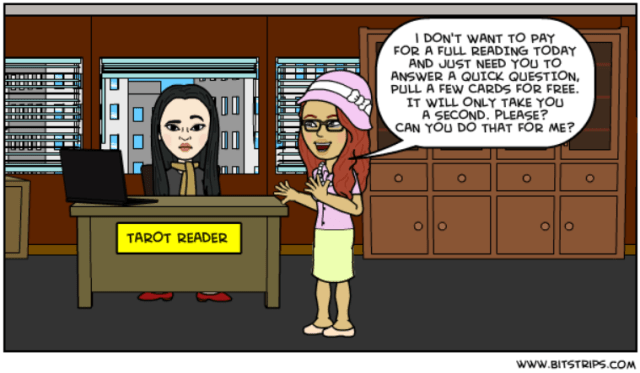
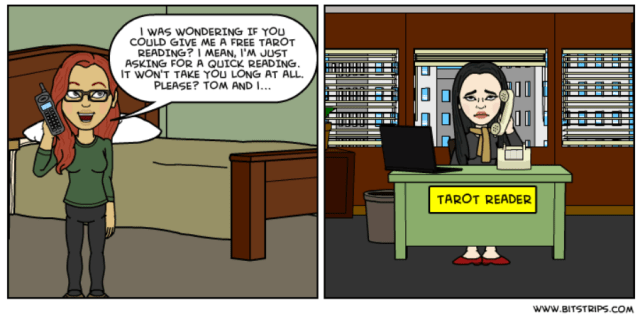
The Friend Who Wants You to Just Pull a Few Cards, Please, This is Important
Now that you’ve disseminated the announcement notice for your tarot business launch, the pro is lots of people are aware of your service and you are now on their radar. The con is at least a bunch of them are going to try to haggle a free reading out of you.
You’ll want to know what your own professional policy will be for handling such situations. Most professional tarot readers would probably advise you to say no and not step foot onto the slippery slope of giving out free readings. I would say it depends on how much free time you have, what makes you happy, and whether you have bills to pay.
If you say yes, then you’re enabling that person to come back to you again in the future for more free reading requests. And then what? What if you say yes for the first free reading and no for the second request? That friend will–whether she admits it or not–feel betrayed by you (because it’s basic psychology) and resent you for saying no because, after all, you said yes before. Now the appreciation for that first free reading is shot and your friend can’t believe you’re now saying no to her.




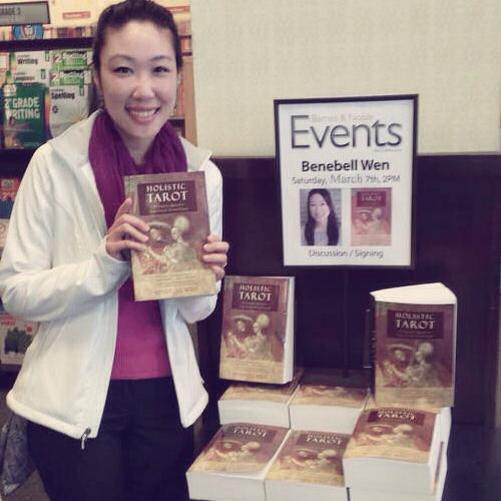
 benebell wen