Cory Thomas Hutcheson, author of New World Witchery: A Trove of North American Folk Magic (2021), has brought together an incredible assembly of folk practitioners from across North America– Mexico, the United States, and Canada.
You will get an own voices insider perspective of Appalachian mountain magic, brujeria, curanderismo, Detroit hoodoo, Florida swamp magic, French Canadian sorcellerie, Irish American folk magic, Italian American magic, Melungeon folk magic, New England cunning craft, New Orleans voodoo, Ozark folk magic, Pennsylvania powwow and braucherei, Slavic American folk magic, Southern conjure, and more.
North America stretches five thousand miles across, nestled in between two great oceans, and within that space, frozen tundra, glaciers, pine forests, deciduous rainforests, blooming deserts, prairies, and towering groves of redwood.
This is the homeland of hundreds of Indigenous nations for millennia, a land ravaged with invasions and displacements, of dark legacies but also a hope for and collective effort to forge a brighter future.
Click on the above image file to download and use freely (but reverently, please). The image file is in 400 dpi and should print okay at 9.5 inches x 9.5 inches. So don’t go much larger than that, but you can go smaller. Actually 11″ x 11″ should still be fine.
All the extra border is to allow for bleed margins.
I thought it would be fun to share my personal journey going through the Book of Readings so that even though you might be undergoing your journey at a different place and time, we can still share the journey and connect in this nonlinear way.
Since I made reference to some of these regions, below is an excerpted Appendix E from I Ching, The Oracle (North Atlantic Books, forthcoming 2023).
While the maps are not drawn to scale (I did them myself, by hand…) at least they help to give you a mental reference of where these kingdoms or states are located in geographical relation to one another.
Excerpt from Appendix E of I Ching, The Oracle (June, 2023):
Now that I think about it some more, “witchcraft” is probably not even the right term to be using. “Folk magic” might be the better descriptive? What do you think?
Don’t forget– if it helps, turn the closed captioning on! =)
When I say “open tradition,” I mean a culture-specific practice of a magical system and set of doctrinal beliefs integrated into that practice that anyone at all can work with for themselves, that it’s free and open to the public.
When I say “closed tradition,” I mean a culture-specific practice of a magical system and set of doctrinal beliefs integrated into that practice that can only be honorably accessed if certain conditions are met, such as initiation, heredity, clan or ethnic group membership, or a formally established master-student bond.
Esoteric Taoist practices, broadly speaking, are openly accessible to anyone and all, but not anyone and not everyone who seeks it will find alignment with this Path. It’s for anyone, but it’s not for everyone.
But when we’re having this conversation about esoteric Taoist traditions here in the West, then to be clear, the conversation is probably more about cultural appropriation, spiritual gatekeeping, and how to engage respectfully with living traditions.
Taoism is, by the nature of the philosophy, even occult philosophy, is syncretic. It absorbs indigenous shamanic traditions, other established religious traditions, and in terms of the values that are the compass for how to navigate the syncretism, it’s nature. It’s the study and understanding of qi in nature.
It’s about nature, but humans are part of nature, and humans have minds that formulate ideas that become aggregated into establishments, you can’t ignore the establishments. So in reality, a human – the practitioner – will study how the many establishments engage with the qi in nature and then work with what works, for them. Since that’s Taoist mysticism in a nutshell, it’s an open practice.
Lineaged traditions, on the other hand, are unequivocally closed. Some are initiatory. Some are hereditary. Some are a combination of both. The premise is a group of people have cultivated an elite access to potent qi in nature through a highly-specialized methodology, and they aren’t about to share that methodology with just anyone. So there are very limited ways to access that specific methodology. Some form of ritualized transmission must take place to receive access.
But what about non-lineaged individuals crafting, say, Fu talismans, performing Taoist rituals, be that ones they’ve made up themselves or followed step by step from a canonical grimoire, or working with Taoist ritual tools? To be fair, that’s where it gets a bit more complicated, and political.
You’re going to encounter folks who say no, unless you’re lineaged, you cannot. That or it’s more of a warning that if you’re just chaotically doing it on your own, it’s way too easy and too high a risk of going off the rails and getting yourself into spiritual hot water. There’s a kernel of truth there, in my opinion, which is why I believe strongly in being religious and cultivating a strong moral compass and code of ethics first before dabbling with the occult. If there isn’t going to be a teacher there to rap your hands with a stick when you’ve been bad, then you’ve got to be disciplined enough to self-monitor.
Whereas I’ve always made my personal opinion clear. It’s open access with an asterisk. It won’t be me (and I don’t believe it should be another human) who puts up walls or locks the gate to keep you out. It’s gonna be the gods. It’s The Craft itself. The Esoteric Tao lets in who it lets in.
As for cultural appropriation, I’ve always taken the view that, you’ll know it when you see it. It’s hard to come up with a one-definition-applies-to-all-case-analyses metric for determining what’s okay and what’s not okay. Not to mention each person’s appetite for something possibly appropriative is gonna vary. Plus, overly-worrying about whether you yourself are culturally appropriating is more demonstrative of caring too much about yourself than actually caring about the cultural tradition you’re working with. If truly your heart is with the culture, you’ll naturally focus on its people, its communities, with an organic passion to learn as much as you can. I don’t have to tell you to be reverent; you just will. And if somebody has to remind you to be reverent, then buddy, I think you’re already in the wrong.
My third book, I Ching, The Oracle: A Practical Guide to the Book of Changes, published by North Atlantic Books, is forthcoming mid-2023. It’s my translation and annotations of the Oracle with cultural and historical references that honor the shamanic origins of the I Ching.
What it really is, though, is a magical grimoire. I began with an aspiration to write a grimoire on Taoist mysticism and magical practices, and then decided to do so through the framework of the I Ching. This is going to be a practical hands-on primer on East Asian modalities of witchcraft and folk magic. A deep-dive learning experience into the history and mythological references found in the Book of Changes is the bonus.
Leading up to the release of I Ching, The Oracle will be this series of videos where I lay the foundation for working with this third book. If this is of interest to you, stay tuned! ❤
In my previous blog post recapping NWTS 2022, I talked about how much I enjoyed the “Which Witch is Which” lunch panel discussion. So that you don’t have to click between pages, here’s what I said about it:
The best part of all? Hands down, the Which Witch is Which lunch panel discussion. Each practitioner on the panel represented a different perspective on witch identity and witchcraft, from whether they identify with the moniker “witch” (some yes, some no), what is witchcraft anyway, and their takes on covens, solitary practice, closed vs. open traditions, altars, ancestor work, and more.
Thank you, Mat, for giving a shout-out to Taoist ceremonial magic! And wish the incredible Onareo, who was present in the audience with me, could have also been up there on the panel to represent brujeria.
In this Bell Chimes In video chat, I wanted to ruminate on my own responses to the questions “Do you identify as a witch?” and “What is witchcraft, to you?”
Answers to those two questions are not at all easy to arrive at.
I’ve had a working draft of this blog post, on this topic, started in 2020, and already I was feeling late to it, since it was a topic trending in 2019. Life and other priorities got in the way so I left this draft unfinished.
In 2021 I started seeing this topic discussed with fervor again. It inspired me to reopen this post. I worked on it some more, but again, just didn’t care to finish my train of thought, for whatever reason.
Now it’s 2022 and this same exact topic of conversation in the tarot community is still going strong.
Maybe this time I can finally finish what I was trying to say. I’ll divide up my thoughts by the recurring subtopics or points of argument you hear when community members start talking about tarot deck collecting, culling, and consumerism.
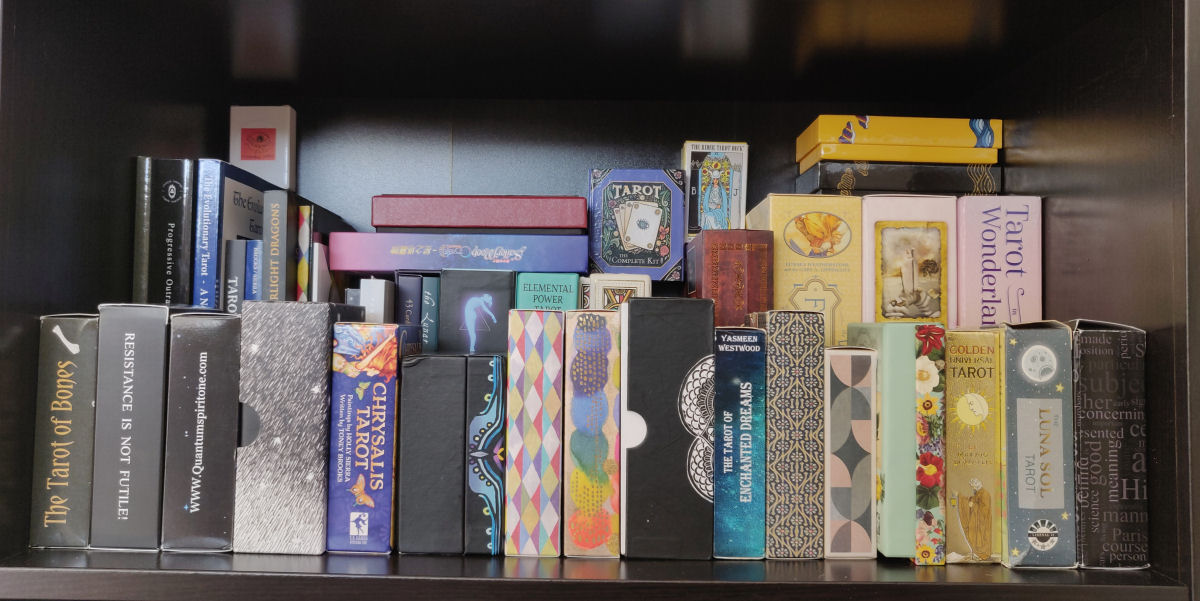
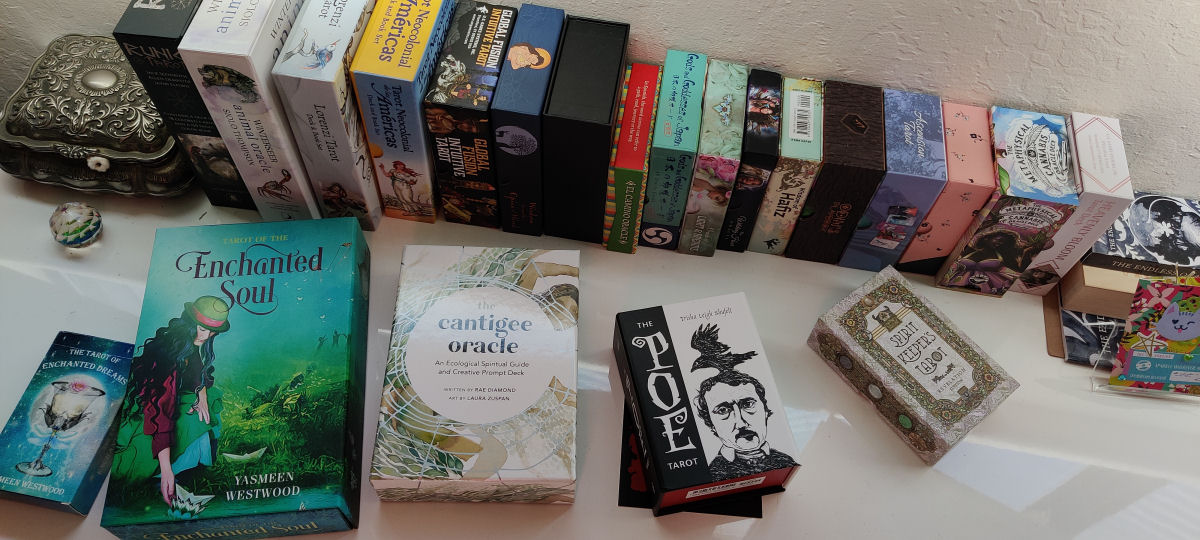
To balance out the paragraphs of text, I’ll be sharing random photos of decks you’d spot around my house.
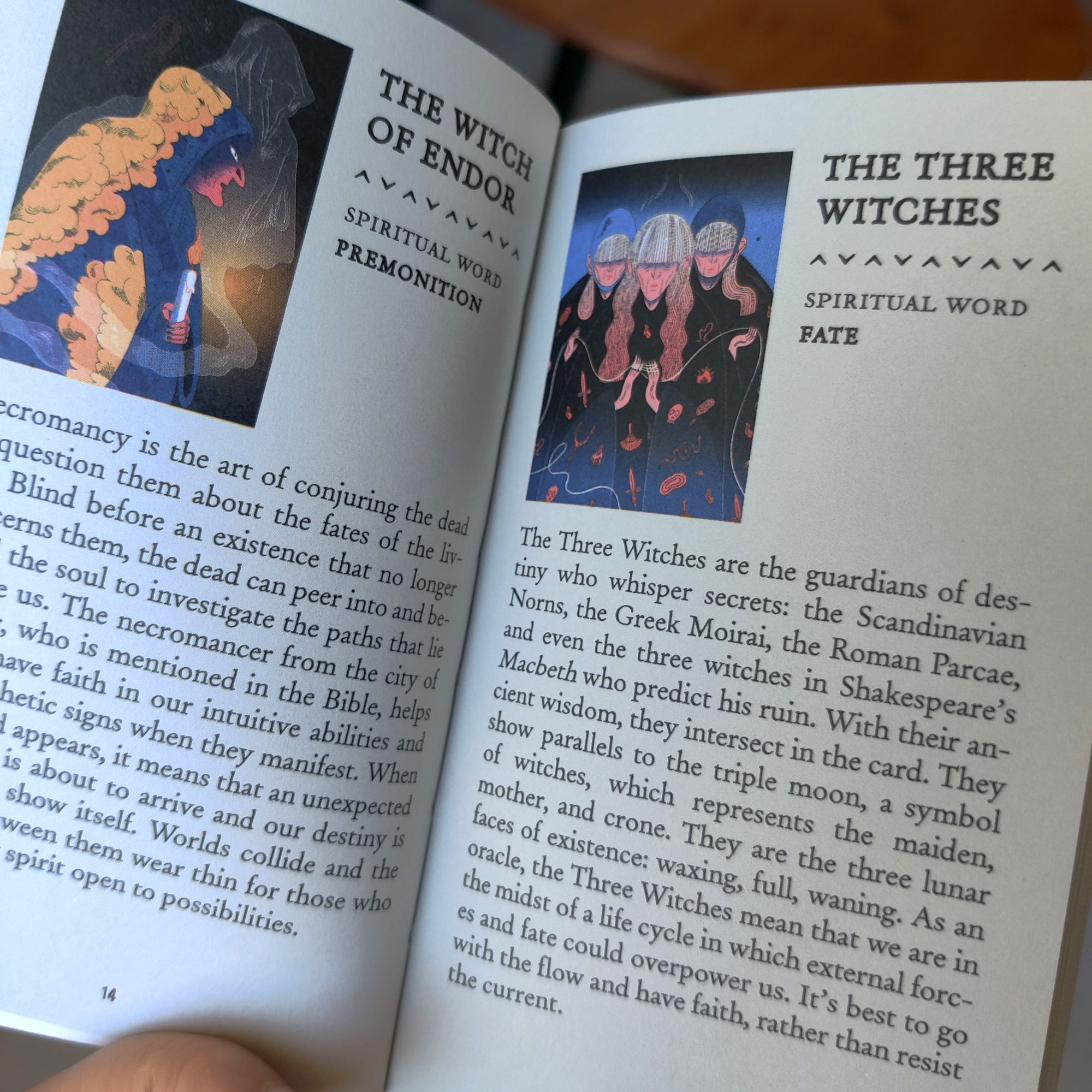
Oracle of Novice Witches is a 50-card deck featuring 24 witches and wizards from history and folklore, 13 tools of the craft, and 13 animal familiars. The deck was created by Francesca Matteoni and with art by Elisa Macellari.
The full-color guidebook accompanying the cards features a profile summary of every witch and wizard depicted. Entries for the tools of craft define each tool’s purpose and how it’s generally used. For the familiars, animal symbolism and correspondences are provided.






 benebell wen