Spirituality and Politics: Light Worker, Shadow Worker

“Prometheus stole fire from Zeus and gave it to mortals” (2011) by Manuel Marín. Via Flickr.com @manuelmarin. Creative Commons.

Recent social events and divisive politicians have motivated many public figures in the spiritual communities to step forward and comment about politics. Almost every single one will receive a vitriolic remark about staying “within your own lane” and just stick to spirituality; don’t be “low vibe and low energy” by talking politics or social consciousness.

Likewise, there are an equivalent number of public figures in the spiritual communities who have built their branding and image on compassion, love, and lightworking, and yet they have remained eerily silent on issues of social injustice, hate, hate crimes, and, well, quite frankly, political issues that they don’t think personally affects them, but are literally killing others. Which is odd, for someone spiritual who believes as above, so below, as within, so without, and we are all One…

Those who actively seek to walk a spirituality-dominant path for personal development have two options. First, they can develop spirituality inward, and focus on themselves. The goal here is personal transcendence. How can you, you, transcend? The second option is to develop spirituality outward, and focus on the collective. The goal here is collective or social transcendence, to use what Divinity has gifted you with to make a difference in the world around you so that the world can, collectively, transcend, or at least take another positive step toward transcendence. Those are the two core objectives of spirituality. It’s either about your transcendence or it’s about your collective’s transcendence

To talk about which one of the two paths everybody should take is an unproductive conversation. Both paths serve a larger purpose beyond what we are able to understand in our moment. Also, one path is the other, and vice versa. Evolve yourself and you do evolve the collective. Evolve the collective and you will evolve yourself. So both are equally compelling spiritual paths.

That’s why for someone to say to a spiritualist that you should not involve yourself in politics or comment on political matters is, well, short-sighted. It’s in effect asserting that the first path is superior (personal transcendence) and spiritualists need not and should not seek collective or social transcendence.

If you’re seeking self-improvement at the moment and using the vehicle of personal spirituality to do so, which by the way is the definition of shadow work, then yes, perhaps turning inward and detaching from the political and social landscape of your world at the moment is the prudent path. If, however, you are a lightworker, or a self-professed lightworker, well then, lightwork is defined by shining your light out into the world so that you can uplift your community. The lightworker cannot do that effectively by summarily ignoring politics and social issues. Politics and social issues are intertwined with the conditions of your community.

To heal a body, you have to find what is rotting, diagnose the problem, and eradicate the problem area so that the healthy part of the body can begin the healing process. No one disagrees with that or finds such an assertion divisive. Yet when our society is sick and everyone, no matter which side of the aisle you stand on, can acknowledge something is rotting, why aren’t we working toward diagnosing the problem and eradicating the rot? Sure, we can disagree on what the problem is and what the solution ought to be, and that’s common in any area of expertise. But if the team of medical experts are going to heal the patient, then even when they disagree with the diagnosis, they had better do so by working together, collaboratively and in harmony, or else that patient is going to die on the operating table.

Let’s also address how spiritualists take many forms, and serve different roles. Some are rhetoricians, the messengers. Others are warriors, our gladiators. We’ve got those who are physical healers, who heal us mind, body, and soul, one by one. There are those who traverse to other realms or channel entities from other realms, and bring to us important messages so the rest of us can do our jobs better. Then we’ve got the teachers, who preserve the body of wisdom we’ve attained up to this point by passing it on to the next generation of messengers, warriors, healers, and mediums. Understood in that way, it seems silly for the rhetorician to tell the warrior not to fight, or that the healer should take up arms and slay on the battlefront. That being said, if one is a self-proclaimed warrior, then one had better take up the cause and fight the war when called. You can’t call yourself a warrior and then run away from the draft.

To be political and social is part of some of our spiritual paths. Let’s honor that. Likewise, certain defined spiritual paths necessitate its adherents to be political, and yet so many of those who profess to follow such paths are too afraid of their own shadows to do what needs to be done. You cannot be an adequate lightworker if you do not walk out of your own comfort zone in search of the darkness, to find where you most need to shine your light. Do you have to be a lightworker if you are spiritual? No, you don’t. Not all spiritualists are lightworkers. But I am perplexed by those who say they are and yet who refuse to engage in political discourse.

A Lawyer’s Perspective on Why Copyright Infringement is So Hard to Fight

Terence Ward over at The Wild Hunt wrote a great piece, “You call it sharing but pagan authors call it stealing,” on copyright infringement in the pagan community and more specifically, pagans thinking it’s okay to upload the entire books of pagan authors and sharing it on Facebook.

A Facebook group called The Wiccan Circle has uploaded the digital files to hundreds maybe thousands of books by pagan authors and are disseminating those copyrighted books for free download. I wanted to get to the bottom of it on my own, so I put in a request to join the group. Unfortunately, I still haven’t been let in, hehe, so truth be told, at this point I don’t actually have any personal knowledge of the allegations. I’m relying entirely on Ward’s reporting of the facts.

For this particular post, I want to address why copyright infringement claims under the DMCA (Digital Millennium Copyright Act) are so difficult to follow through with, from a lawyer’s perspective. I’m a corporate transactions attorney who works in-house at a venture capital firm in the Silicon Valley, so I know my way around intellectual property law. I’ve tried major copyright infringement, trademark, and patent suits in both state and federal court, some of those cases making headlines in the news. I’ve worked in entertainment law and represented independent artists and writers against major production companies in Hollywood, major cosmetics companies, and more. That’s the background context I’m coming from in writing this post.

Continue reading “A Lawyer’s Perspective on Why Copyright Infringement is So Hard to Fight”

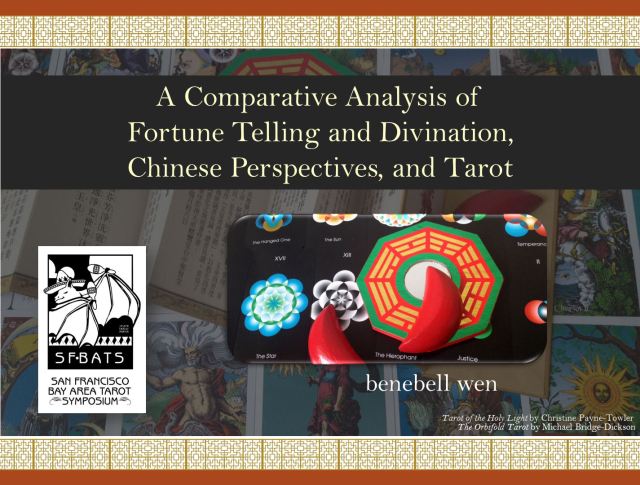
A Comparative Analysis of Fortune Telling and Divination: Free Lecture

Click on image for direct link to unlisted YouTube video.

A Free Online Course Presentation

Is there any value to making a distinction between fortune telling and divination? How might Chinese perspectives compare to or inform Western perspectives? This free video (or audio) lecture will examine the etymological origins of the words for “fortune telling” and “divination” in the Chinese language, apply medieval esoteric Taoist texts to tarot reading, and propose a theoretical framework through which to read tarot, as either a fortune teller or a diviner, though the two are not mutually exclusive. We will then run a comparative analysis of that with Western perspectives and examine Western esoteric texts on the subject.

The video lecture is about 34 minutes in length. Click on the below to begin watching. Although it is in video form, you can also listen to it as an audio.

Continue reading “A Comparative Analysis of Fortune Telling and Divination: Free Lecture”

The Generation Gap Between Tarot Practitioners

Photograph that is unrelated to the topic at hand but posting here for the visual effect notwithstanding because your eyeballs need there to be a photo here and I couldn't source one that would be related.
Photograph that is unrelated to the topic at hand but posting here for the visual effect notwithstanding because your eyeballs need there to be a photo here and I couldn’t source one that would be related.

First off, naturally I will be speaking in generalizations.

People my age are sandwiched somewhere in between the Old Guard and the Millennial Readers.

Although my mother is not a tarot reader, she’s a metaphysical reader/practitioner of sorts and I’m super sure that had tarot been accessible to her as a young one, she would have totally become a tarot reader. Instead, she reads other stuff. Like your face. No, I kid, but oh no, I don’t. She really does.

I can see her attitude reflected in many of the Old Guard tarot readers. “I’m not normal. Tarot is not normal. Damn straight this is fringe. Deal with it.”

There’s an unabashed embrace of marginalized culture. There’s no embarrassment with dressing woo-woo as you walk among normal society. You can almost see traces of a hedge witch mentality.

Although she has never come outright to say so, I get the distinct sense that she doesn’t want everyone and the mainstream to become diviners, mediums, shamans, and practitioners of craft. There is a tacit yet clear exclusionary attitude. Or at least that’s always been the impression I got. She doesn’t want (let alone buy in to the ideas of) Mediumship 101, “everybody’s psychic,” or “pay me $300 and I will certify you as a bona fide tarot master.” (Hi. Certified tarot master here.)

Meanwhile millennial readers apply general business and marketing tactics to tarot–e.g., general PR and marketing principles to tarot business, coaching anyone and everyone to become diviners, mediums, shamans, and practitioners of craft, if you so choose. There are efforts to establish tarot into mainstream culture.

There is a pop psychology approach to tarot (which I have been pegged and critiqued as adopting, so apparently I’m in this camp) that strives to normalize divination practices or astrology, and to talk about spell-crafting as the law of attraction and “yay for positive thinking.”

However, at the heart of the millennial approach is the notion of accessibility, a socialist attitude toward the metaphysics. We can all have equal access to the Divine, to metaphysical energy work. (I confess, that is the attitude I adopt. That line sums up my opinion.) Metaphysics is for everyone. This is not paranormal, it’s normal. You don’t need anybody else to help you connect to the Divine. You only need you.

Okay, so as circumstances would have it, I’m now only a couple paragraphs in and I’ve already changed my mind.

Maybe I haven’t changed my mind exactly, but it is for sure vacillating. Is it really a generational thing? Or is it just a two-different-schools-of-thought thing? Is my personal anecdotal evidence and direct observations even reliable?

I’m in effect just looking around me, only to the point I am able to physically see, and making gross generalizations about what else is out there based on only what I see. Is what I happen to see an accurate microcosmic sampling of the macro? I don’t know. I really don’t.

However, there is for sure a determined voice among the occultists and metaphysicians who say that “occult” means concealed, and we are not to remove the veil for all. Only those who choose the path should or even can go beyond that veil to see for themselves what is there, and then come back with divinatory or revelatory information as needed, like an appointed messenger.

Is that way of thinking a bit reminiscent of limiting literacy to the elite so that the proletariat must rely on figures of authority (like a priest or priestess) for Divine insights? That was the way of institutionalized Western religion for ages. Is it hypocritical when metaphysicians repudiate that kind of authoritarian approach to religion, pursue occultism because they’re anti-authoritarian and want the answers for themselves, but then once they’ve found those answers, act in the same exclusionary manner?

I’ve observed that the Old Guard, Mom inclusive, have this sense that what they do “isn’t for everyone.” She would probably opine that not anyone can just pick up a grimoire, follow something in there, and yield results. Only certain people can do that. As I said, there’s a staunch exclusionary attitude. I’m also sure if I introduced her to the 21st century spiritual coaching power of manifestation business model, she’d find it absurd.

Actually, she wouldn’t. She’s pretty open-minded. She’d be surprised at first, but then come around. “Okay, all right, I get it. I wouldn’t have thought of that but I get it.” For instance, it might take her some time to grasp the idea that, say, I’m holding an online webinar course on Learning the Opening of the Key for Tarot Summer School and teaching occult theories to a whole bunch of people I’ve never even met, all at once. Perhaps in her view, spirituality, divination, and woo-based teaching is done one pupil at a time, a single teacher to pupil relationship that is honed over several years, not in 60 minutes.

Whereas maybe I do have a more “free love” attitude here. We’re entering a social era where notions once reserved in the New Age or even occult category run as an undercurrent through mainstream society. Corporate offices pay for yoga classes and meditation retreats for their employees. Businesses far from the woo will consider feng shui tips and tricks. Law firms invite in tarot and palm readers for their company Christmas party. Silicon Valley high-tech companies will hire a witch to cast a circle of protection around their computers, protecting them from hackers. All true stories here. I doubt any of this would have happened even 20 years ago. Things are changing.

As woo practitioners such as tarot readers converge more with the corporate and mainstream worlds, they adopt corporate and mainstream commercial strategies to advance their tarot business. Corporate and mainstream businesses converge more with woo practitioners and adopt woo into their environments because hey, “anything to help us earn more money. If that’s a spell or feng shui, then let’s do it.”

So admittedly, there was no point or core thesis to this post. I just thought I’d ramble on some thoughts of late.

My Perspective and #TarotsoWhite

It begins around 25:11 when one of my favorite YouTube personalities Kelly-Ann Maddox talks about #TarotsoWhite and the “overwhelming lack of racial diversity in tarot and oracle decks.” Maddox covers it all. She acknowledges white privilege, too much whiteness in the human depictions on tarot decks, disappointment in the fetishization of people of color in the rare times they are actually portrayed (she gives the example of the Nubian queen), and wonders what it is like for us people of color to spend untold amounts of money on tarot and oracle decks only to flip through them to see that you’re not being represented.

Well. The reality is we’re used to it. Or at least I am. It wasn’t until around 2000 that my community was represented in the media beyond sage-y old kung-fu masters with broken English and fortune cookie wisdom, me-love-you-long-time, dragon ladies, geishas, or know-it-all nerds. I mean I guess I’m okay with the know-it-all nerd. I can sort of identify there.

The reality is I’m used to not seeing ordinary Asian faces in the media and tarot is no different. If I don’t see myself depicted on film, then what makes me think I should get to see myself depicted in the tarot courts? Instead, I get “pleasantly surprised” when I see non-stereotypical images of Asians, well, anywhere, and then doubly pleasantly surprised when it’s on a tarot card.

My first inclination is to say, as a person of color, the whiteness of tarot card imagery doesn’t bother me. But I can’t leave it at that. I have to ask myself why it doesn’t bother me. The reason why it doesn’t bother me is what I said before—by now I’m used to it. People of color are used to being invisible. And, well, that’s deeply problematic. So even if it doesn’t bother me, it should bother me just as it should bother every person of color. If it doesn’t bother you, then it will never change. And if it doesn’t change, then the racial paradigm will always leave us marginalized.

As for #TarotsoWhite, I really don’t know what to say on this topic. On one hand, I don’t want to think about race during a tarot reading. Anything in the imagery on a tarot deck that “stands out too much” (and I don’t mean in a semiotic way) can be distracting to me. Here’s the thing: I want to think about race. I want to talk about social justice. But maybe not during a tarot reading.

And I do find that sometimes racial diversity depicted on a deck can be distracting because—sad, sad fact—it’s not something we’re used to seeing. Racial diversity is really different for us. Seeing a token Asian dude or a Black woman doing something that is not stereotypical or fetishized is different, and it’s so different for our senses that it can actually become a distraction. It becomes your focal point because differences are always our focal points. Instead of turning my mental wheels on the symbolism of the pomegranates and what that omen holds for our seeker, I’m thinking, “Oh look! The High Priestess is an Asian chick! How neat!”

One comment you hear echoed among readers about #TarotsoWhite is that the whiteness in tarot is why they have a preference for abstract tarot and oracle decks where any human figures depicted are racially ambiguous. The subtext here is: “I want to be racially inclusive but I don’t want to think about race during a tarot reading and people of color depicted in tarot imagery is still kind of distracting so this is my best response.”

I get that. I dig it. I agree.

The catch is, if no one buys tarot and oracle decks featuring ordinary people of color (and by extension, tarot readers get used to seeing–and liking–decks that feature ordinary people of color), then deck creators and publishers won’t be inclined to feature ordinary people of color, and so we will never get to that point where the Asianness of an Asian High Priestess or the Blackness of a Black Emperor won’t distract us.

The only way for race to not be a distraction is for the topic of race to become boring. When the topic of race is boring, an Asian High Priestess and a Black Emperor will be no big deal for our subconscious to handle. Unfortunately, the topic of race is very interesting right now, especially given the racially charged climate we live in.

So if I, a person of color, don’t even want to think about race during a tarot reading, do other tarot readers want to think about race when they dish out the Celtic Cross? And if we don’t want to think about race in tarot but race featured in tarot makes us think about race in tarot, then do people really want to buy tarot decks that feature different races?

Well. We have to.

Social progress in the tarot world will only happen if it’s profitable for deck publishers to get on board with social progress. Otherwise, they’re going to throw out a few token people-of-color decks so as not to appear racist, and then stick primarily to the all-white Arcana cast. Frankly, it’s not profitable right now for deck publishers to feature people of color because even people of color don’t want to see people of color. Everybody wants to see white people.

Each one of us bears the responsibility of changing that dynamic. Tarot practitioners have to make a conscious, concerted effort to show deck publishers, by the power of our spending, that tarot decks with zero racial diversity are not profitable. It sort of has to be a forced change at first, you know, fake it ’til you make it, and eventually, racial diversity in tarot will finally feel natural to us.

But it’s a tall order because the race thing is so deeply engrained into us that most of us don’t even acknowledge it.

It’s like how my name “Benebell” can bother someone because [true story here–and this is the part that she figured was okay to say in public…] Benewell was the name of her [presumably White] Civil War ancestor and so my name Benebell becomes a nuisance and a point of distraction to her. The racialized reality is [here’s the part people would think is not okay to say in public…] Benebell distracts her because Benewell was an old white dude and Benebell is a young(ish) Asian girl.

The race issue, albeit subconscious, was the distraction, not the name issue. If I had been an old white dude, my name wouldn’t have bothered her as much. But it bothered her because of the race discrepancy. She just couldn’t get over an Asian girl “hijacking” her White ancestor’s name.

That subtle yet insidious anecdote extrapolated out to the tarot community at large explains why we find racial diversity in tarot distracting (though would die before we admit it). It’s because our brains have been wired for a very long time to envision a white High Priestess and a white Emperor, and a white Queen of Cups, and white kids in the Six of Cups, and white people fighting in the Five of Wands. When these people are not white, we can’t help but stop to think, “oh… hey.” And at its worst (like the Benebell vs. Benewell account) it’s a nuisance and at best, a point of distraction.

It’s just something we have to get over as tarot readers. Not only do we have to get over it, but we have to push homogeny out of profitability and convince publishers and deck creators that it’s just economic good sense to feature boring racial diversity. No Nubian queens or geishas, just plain, boring people of color, but, you know, decked out like the Queen of Swords or the hermaphrodite in The World.

Addendum.

The tarot and oracle decks that fetishize or exoticize race are popular because we can observe racial difference in a way that emphasizes difference. Somehow that’s okay for our subconscious to handle. It’s when different races, i.e., people of color, appear normal and run-of-the-mill that blows our [subconscious, and sometimes not so subconscious] minds. When people of color are depicted as the “other,” that’s okay, and we can work with that. That’s not distracting because the depictions play in to our preconceived stereotypes. Deck creators and publishers have to do better than that. Racial diversity and inclusion has to go beyond Afro-centric Timbuktu pharaohs of ancient Egypt Imperial China Japanese samurai culture art.

Tarot and Socioeconomic Class: My Thoughts After drawingKenaz

Thorn Mooney recently shared her thoughts in her vlog, “Paganism, Tarot, and Class.” You really should watch her video first before reading onward, but to give background for my thoughts here, I’ll try to recap.

Mooney talks about witchcraft as a practice occurring lower down on Maslow’s hierarchy of needs, a practice that is more concerned with practical applications, like talking to the dead, love spells, money spells, or getting jobs. She uses the phrase “real world, tactile, necessary things.”

Those who endeavor into the esoteric or metaphysical, she says, are more concerned with self-actualization, per Maslow’s hierarchy, which is at the top of the pyramid. They’re working through long-term emotional or spiritual concerns, striving to be their best selves, and can endeavor with these concerns because their basic physiological needs have been met.

She then talks about how all that translates in her professional tarot readings. She has found, per her own experiences, that those who request readings from her online tend to ask about issues relating to purpose in life, spiritual direction, meaning, connection to deity or deities, which she acknowledges are very “important,” but “not critically important in the sense that, oh, ‘I might be evicted from my home tomorrow'” important.

::nods:: I get that.

In contrast, reading requests she gets from the shop she works at (i.e., in-person readings, I presume), clients are asking questions like “I don’t have any money to afford a lawyer and my ex-husband has filed for full custody of my kids and the court hearing is tomorrow. What is going to happen? Am I going to lose my kids?” or “My child is physically ill and we can’t afford healthcare. What do you see happening to us?”

“I am obviously not qualified to offer legal or medical advice,” Mooney remarks, “and yet I am repeatedly put in the position where I am asked to provide input, and technically [that input] is not from me, it’s from the cards, but that’s a really blurry line.”

Mooney continues, describing the nature of these lower-level-per-Maslow’s-hierarchy questions as “gritty,” noting that it’s rare for someone in that context to be asking her about finding higher meaning in the world.

And Mooney hypothesizes that it’s tied to socioeconomic class.

Continue reading “Tarot and Socioeconomic Class: My Thoughts After drawingKenaz”

The Unindemnified Cost of Tarot Reading

tarotspi

I am preaching to the choir when I write this to an audience of tarot practitioners: If your personal energy could be quantified like battery life, then reading tarot for others will drain it like streaming a movie on your smartphone over 4G connection. Reading tarot depletes me in a way I cannot fully convey. Sometimes I get the sense that non-tarot practitioners who request tarot readings from me don’t have any idea.

On its face, a tarot reading seems to be an effortless dealing of a deck of cards, and then blurting phrases based in some part on the card imagery. What could be so hard about that?

Tarot is a tool, a metaphysical one if you will, that connects two individuals’ energetic fields together for the duration of a reading. The nature of the relationship between practitioner and seeker is that of give and take, respectively. A practitioner feels his or her energy draining out and going into the cards to provide the reading that the seeker is receiving. Seekers often talk about readings being rejuvenating, cathartic, an enriching experience. They’re picking up on that channeling effect. In contrast, tarot readers talk about feeling exhausted, needing to recharge.

Very few tarot readers make enough cash from their readings to compensate for their time spent. That, though, we will chalk up to simple economics and just acknowledge that at least from a free market standpoint, that part is fair.

I draft business contracts for a living and almost every one of them contains an indemnification clause. Indemnification is often one of the main points of negotiation and contention between the parties. In the course of a commercial dealing, some poo always makes its way to the fan– costs of damage resulting from the initial transaction that weren’t accounted for in the contract price– and everybody needs to figure out who owes what to who and how much to compensate for the loss. That’s indemnification.

When I make reference to the unindemnified price of tarot readings, I’m talking about that energetic loss that tarot practitioners sustain but no one accounts for, or heck, even acknowledge. Some seekers can be borderline parasitic, though I believe never intentionally so. Most tarot practitioners are by nature empaths and so of course their first inclination will be to yield and give and feel.

As an empath with a law degree, when I first started my legal career, I felt every client’s problem and took home a briefcase of emotional baggage every night. I’d think about their issues in the shower, while brushing my teeth, before I fell asleep, the first thing when I woke up, while I made my coffee… Yet senior partners at the firm seemed to master such control. They compartmentalized. One might be tempted to say they were apathetic, that they were desensitized, or they did not care. That is not true at all. They cared and they cared deeply about their clients. But they have been at this a long time and they know that to truly be in a position to help as many as possible, they needed to take care of themselves first. Selfishness is a form of selflessness. They knew exactly when it was time to step away from a case, recharge themselves, and live their own lives for a change, instead of living for others, which is exactly what lawyers do, though they rarely get seen by that side of them.

Tarot practitioners must take a cue from these partners. Newbies rarely possess the prudence to know when they must step away and focus on themselves. They get caught up in the exhilaration of uplifting others–an admirable trait–but ironically (since we are tarot readers…) fail to foresee the pending crash. That is why burn-out is such a problem among startup tarot practitioners.

There is no indemnification for that spiritual energy drain that is part of the tarot reader’s work. Thus we are the ones who must keep ourselves in check. Always take time to recharge and learn to say “no.”

Myth of the Divination-Fulfilling Prophecy

There is a view, a fear of so-called divinatory practices that many hold, which I don’t think had a name before. I’m hereby referencing it as the Divination-Fulfilling Prophecy.

“I’m afraid to get a tarot reading. If the cards predict something terrible, then I’m scared that it will happen for sure, because the cards predicted it. Tarot reading is a form of tempting fate. As long as I never get a tarot reading or partake in divination practices, then my future remains uncertain, and that’s better.”

As a tarot practitioner I often hear that sentiment from would-be seekers. A commonly held belief of the tarot, or any form of divination for that matter, is that it possesses the power to fulfill its own prophecy. If the tarot predicts an unfortunate outcome, then even if a person’s future was unfixed before, the power of that prediction will now make the unfortunate outcome fixed for sure. Thereafter, nothing a person does can prevent the outcome because the act of the divination has caused the future to become fixed. Had a person not sought divination, then that future would have remained unfixed. I refer to this belief as the myth of the divination-fulfilling prophecy. The divination-fulfilling prophecy assumes that the tarot, or any divination tool, possesses the power to nullify free will, and divination simply does not have that kind of power. I find the divination-fulfilling prophecy concept to be gravely suspect. I hope this article will explain why.

Continue reading “Myth of the Divination-Fulfilling Prophecy”