Fun fact: That blue-toned banner of mountains was taken in Miaoli, Taiwan, from my ancestral lands. ❤
The very first video I posted to YouTube was in October, 2014. It’s been 9 years. And I thought I’d take a pause from regularly scheduled programming to reflect on those 9 years.
To do so, I’m combining several TarotTube or Pagan Youtube (Occult Tube?) community tags on the subject. If you loiter in any of those networks then you may have seen some. I’m going to do my response as a blog post. And I think that in and of itself probably says something.
I don’t have a dog in this fight, no skin in the game as they say. There is more benefit to me opting out of this conversation and staying quiet. In fact, speaking up would be ill-advised; I only stand to lose.
First, a quick statement about my personal background, as that will be context for my perspective. I am a self-taught illustrator and in the late 90s was highly skeptical of using digital art in tarot. Everything people who are against AI are saying right now about AI in tarot art was exactly my perspective of digital illustrator tools in tarot 30 years ago (because I did not understand digital art).
At the time I was alarmed to see how many digital artists could create something with the computer that looked almost too perfect, and do it so quickly, but then if you take away their tech and put a pencil in their hand, they could barely do freehand sketches.
However, my judgmental opinion was on the basis of a very superficial understanding of digital art. As I learned more about the process and was exposed to more digital artists as individuals, getting to know the intricacies of their creative process, the more my opinion evolved. I met more and more digital artists who could do phenomenal freehand sketching, and who had simply chosen digital software as their medium, not unlike deciding on acrylics, or pastels, or watercolor, or clay.
Posted an author unboxing (actually no, it’s not really an unboxing) and first impressions (is it a first impressions?) of my third book, I Ching, The Oracle.
Then decided to swing by over here on my blog to repost and share some additional personal ruminations. Here are some of my thoughts and reflections after publishing three books.
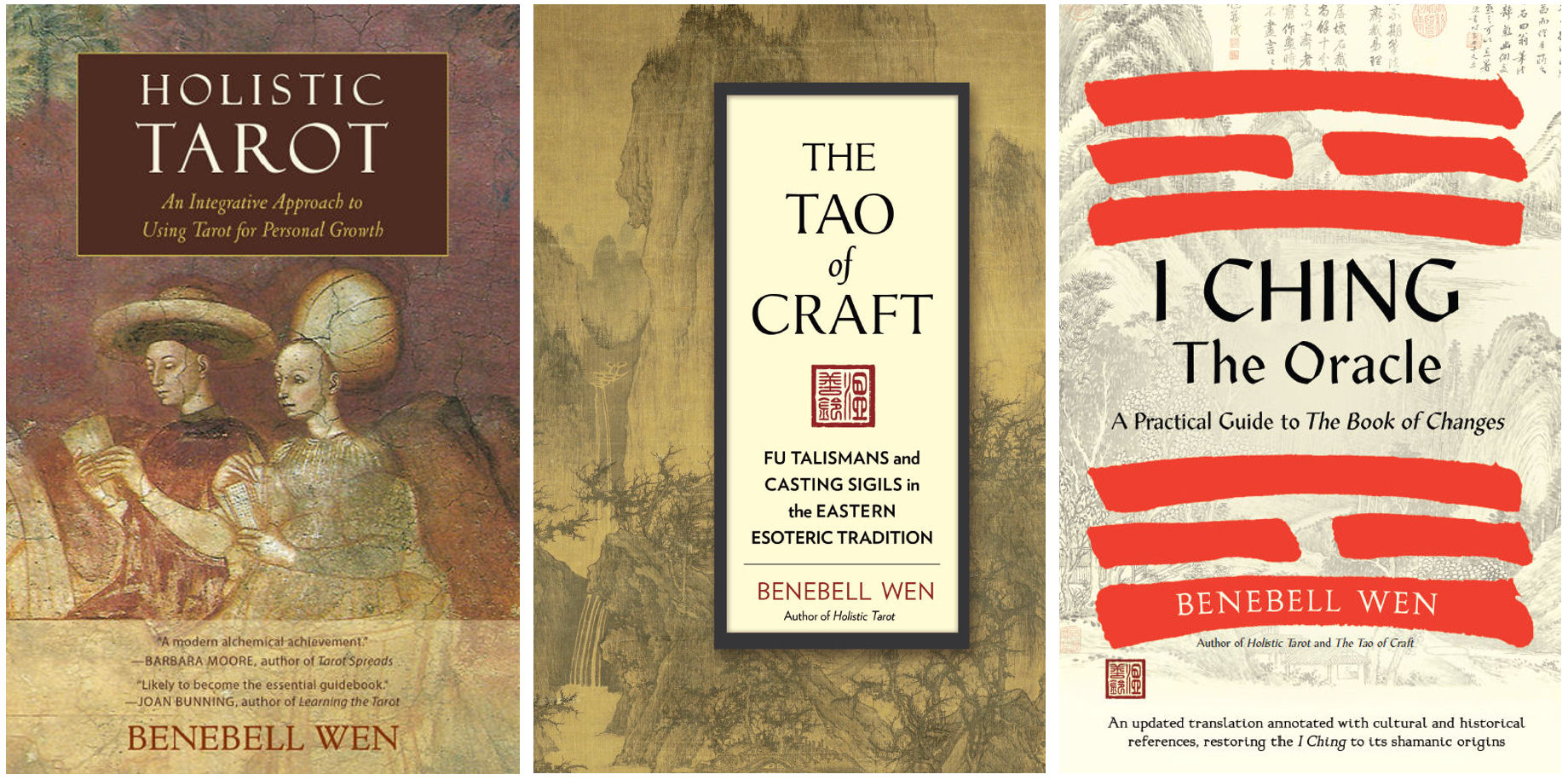
Holistic Tarot debuted in 2015, then The Tao of Craft came out in 2016. I didn’t publish another book until 7 years later, 2023.
There’s this unspoken pressure on writers to crank out books on a fairly regular, repeating basis. To be clear, no one demands it of us; it’s more of an unspoken self-imposed peer pressure. You look around and all your colleagues are writing a book a year.
There’s been a rise in anti-Chinese xenophobia here in the West, and the tarot community has been no exception.
Yikes, did the well-known public figure in the world of tarot just say, in that above comment, that they “know of no Chinese printing” company that doesn’t steal copyrighted work? And then imply that Chinese people like to “beat the foreigner” aka exploit white people?
Every one of these screenshots were authored by someone I know or know of, someone I am connected to via the tarot community. Many are by well-known public figures in our community– published and celebrated tarot authors and popular deck creators. However, I’ve redacted names and profile pictures because that’s not the focus here. This is not about calling anyone out. Let’s focus on the content of the messages being spread in the tarot community and what social impact it might be having.
If you don’t think the rise in anti-Asian hate and violence here in the US is connected to all of these little microaggressions against the Chinese, then you haven’t been paying attention.
Since the opening premise of the tarot deck I created, the Spirit Keeper’s Tarot, was to explore and experiment with the concept of animism, I thought I might chime in. To that end, I’d like to separate out the discussion on deck personification and the discussion on animism.
There was a TikTok video that kinda sorta went viral among tarot people. All my tarot friends were chattering about those “six ways” and so many feels got riled up. Heck, the fact I made my VR two weeks ago and am still talking about it right now with an addendum blog post shows I got a little riled up, too.
In my (probably misplaced) priority of trying to keep videos short and succinct, I didn’t flesh out the thoughts I had wanted to share. And then many tarot colleagues continued and extended the discussion, so now I have even more thoughts. =)
Random old photo to accompany the commentary. I’m holding the Tarot of the Holy Light by Christine Payne-Towler, which at some point long, long ago I received for free. Do I need to disclose that?
Psst… I have a “TL;DR Short Summary for the Not-Readers” that summarizes this otherwise very long blog post. So if you don’t have the time or you’re only a little bit interested and not that interested, then scroll all the way down to the end for the TL;DR Short Summary.
I’m reviving and sharing a blog post I drafted in 2019 that has sat in my WordPress saved file for the last 3+ years. It’s about FTC-issued disclosure guidelines (“Rules”) for social media influencers, and key takeaways to glean from the Rules if you’re creating content in the Mind, Body, Spirit spheres. I never got around to finishing and posting that 2019 draft, back when the FTC disclosure guidelines first gained traction, but I think now is a good time to reopen the discussion.
What’s of note to me is how the legal minds who are often the ones drafting these Rules seem to be people who have no personal experiences or insights into the communities they’re drafting the guidelines for. Even when they employ subject matter experts, those SMEs tend to be biased, or come from a very particularized segment of the community, and therefore do not fairly represent all interested parties.
There’s consumer protection, which nobody’s against. But then there’s untenable rules of compliance that aren’t clear enough for practical application by the people the rules are demanding compliance from.
By the way, none of this is my legal opinion, and do not rely on it as such. All of this is personal commentary in reaction to the FTC disclosure guidelines as someone who considers herself a deck reviewer but who could potentially be categorized as an “influencer.”
My interest in this particular consideration piqued earlier in 2023 when I noticed a sharp change in the gender demographics of who views my Yutube channel, which appears to have shifted just as the subject matter of my channel’s content shifted, from being tarot dominant to more I Ching.
Though I don’t have any screenshots to show, back in 2018 and well into 2019, the gender demographics for my Youtube channel was something closer to 20% Male and 80% Female, and that checks out for most of Tarot Tube and witchy content creators, especially among witchy content creators who present as female. I did notice that after 2019 when I started making more Taoist occultism content on the channel, the demographics shifted slightly to 30% Male and 70% Female.
(For clarification, when we say Male or Female, these are per the identifications opted in by the users.)
I didn’t follow the analytics too closely, so I can’t pinpoint exactly when the shift happened, but in early 2023, per the screenshot image above, I noticed suddenly that the demographics were closer to 50/50, which is in fact strange for the tarot and witchy communities and stranger yet for female-presenting content creators like me. You don’t typically see 50/50 demographics for viewership when it comes to tarot and witchy content. There’s typically an underrepresentation of men.
In my head I’ve been mulling over a candid video chat I’ve been wanting to make for some time now, but it’s only these last few weeks of stirrings in our tarot community that concretized my motivation to just go ahead and do it. =)
I’ve only chosen one comment to read as an example of a recurring common critique I get, and the three recurring common critiques I’m chatting about in this video are as follows:
I’m pretentious and elitist, and also an opportunist,
My work is imbued with negative, demonic entities and/or I am possessed by or consort with negative, demonic entitles (evil, dark energy, etc., take your pick of descriptive), and
I say insensitive things at all the wrong times (as interpreted from the writings I’ve put out there).
In the video I also reflect on authenticity, the perception of virtual authenticity, and how true, sincere human authenticity will come back to bite you in the ass online, and the only way to appear authentic is to fabricate and manufacture the illusion of authenticity.
The photos interspersed throughout this post are totally random, just for Pretty.
It would have made more sense for me to present this topic in video form on my YouTube channel, but I’ve been a bit under the weather with the flu, so my voice is scratchy, my nose is stuffed, and I don’t feel like putting on makeup. A blog post will have to suffice.
You’ll have to watch these videos first because what they have to say is what I’m referencing throughout this write-up. By the way I hope you’ll like and subscribe to them all as I have. ❤







 benebell wen