Maybe I’m Not a “Witch.” Maybe We’re Excluded for a Reason.
There was a fun witchy banner I scrolled upon with this happy, inspiring message of “Pagans and Witches Unite!” It then featured Stregheria, Feri, Cultus Sabbati, Luciferian, Haitian Vodou, Santeria (Lukumi), Palo Mayombe, Wicca, and then a catch-all “Indigenous Shamanic Paths.”
No special call-out to Asians?
And by “Asian” I really do mean continental, islander, north, south, east, west, there was NO representation there at all. For the largest most populated continent in the world, making up more than half the global population of magical traditions and practices, people just decided to tuck all of that under “Other”?
It seems like Asian magical traditions are always getting left out.
This commentary sums up my responsive thoughts to a certain heated, well, highly-engaged – we’ll call it – provocative discussion that was going on in my social network. The assertion presented was: Magick is not a replacement for therapy and definitely not a form of trauma therapy. By extension, anyone making such claims is unethical, misleading, and hurting vulnerable populations.
Just for the full context so you can catch me if I’m off, the quote was:
“Guys, Magick IS NOT a replacement for therapy and it’s DEFINITELY NOT a form of trauma therapy. Please do not listen to anyone who tells you differently. Such a claim is unethical, misleading; and even worse, hurtful to vulnerable people who seek healing. I am a licensed therapist with 20 years of mental health experience and an occultist. I hope this means something. . . . Jessica says magicians posing as ‘magick healers’ are no different than evangelical faith healers who prey on the vulnerable. She say the key is EMDR, not LBRP.”
I want to start by saying there is nothing there that I disagree with. In principle, the author of this original post is right. And also, this is the right messaging.
“Magick,” beyond Aleister Crowley’s definition of “the science and art of causing change to occur in conformity with will,” is use of ceremonial rituals, sigils, visualization meditations, meditations in general maybe, mantra work maybe and so by extension, affirmations (?), herbalism to an extent, and various other “woo-woo” practices like candle magic, spell jars, spellwork, trying to time certain forms of workings to seasons, lunar phases, or planetary movements, and/or using divination as a form of diagnostics tool.
So what do I really think? Can such modalities that we categorize under “magick” replace trauma therapy administered by a licensed, qualified healthcare provider?
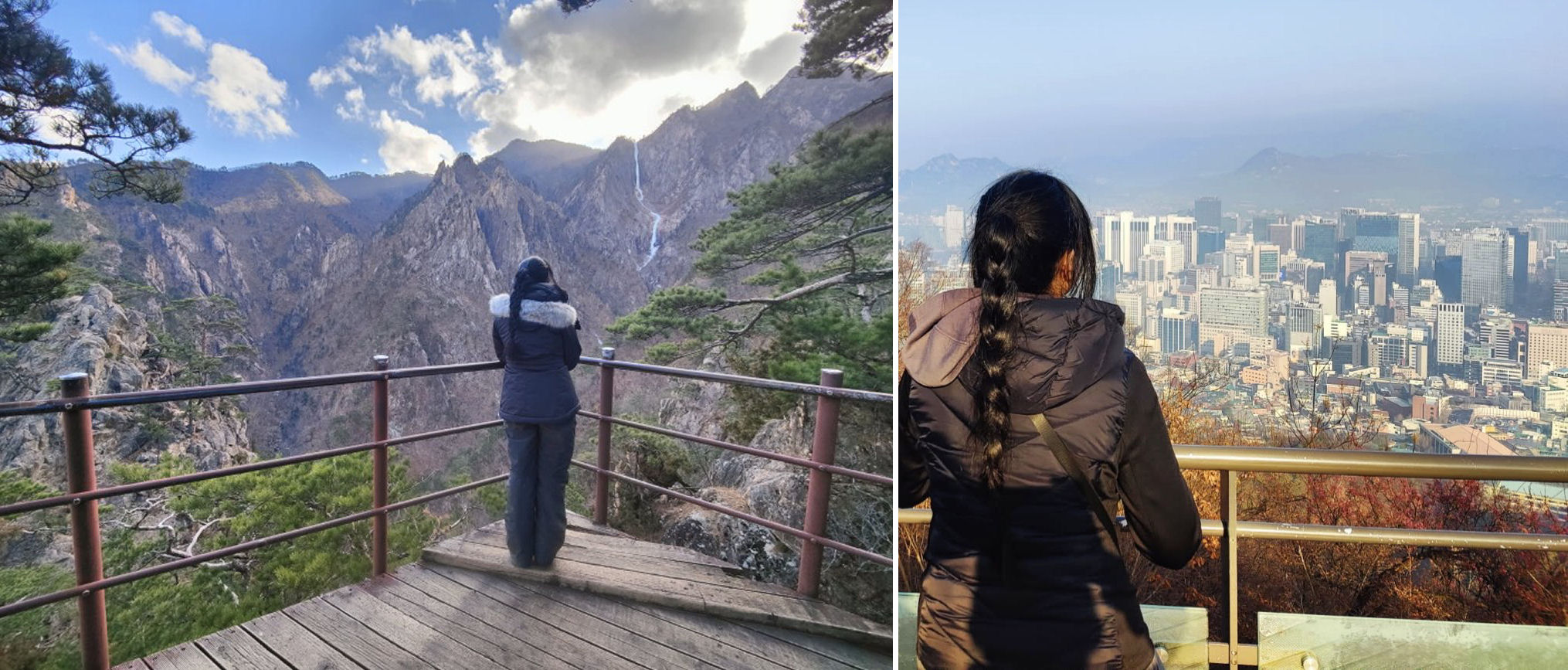
Random photos of my 2025 sights and experiences interspersed throughout this post…
Oopsie doopsie, this “2025 Year in Review” is coming so, so late. A bit emblematic of my 2025, though, which is anything online-related gets relegated to lowest priority. Eeps. It’s because this past year I’ve kept my work more local community oriented, and my focus more family oriented.
I find that too much gets lots in translation when it’s via social media. I notice how in person, we assume the best in people, but online, we assume the worst. In person, we delight in how similar we actually are; but social media would have you think we can never get along.
2025 has been a year that demanded discernment. Can you discern truth from falsity, what’s natural and what’s edited, what is authenticated and what is entirely AI generated. Economic fissures between the have’s and the have-not’s are widening, which in turn is stoking civil unrest, all while we ravage our environment.
Note: I wrote this after two generous glasses of port on an empty stomach…
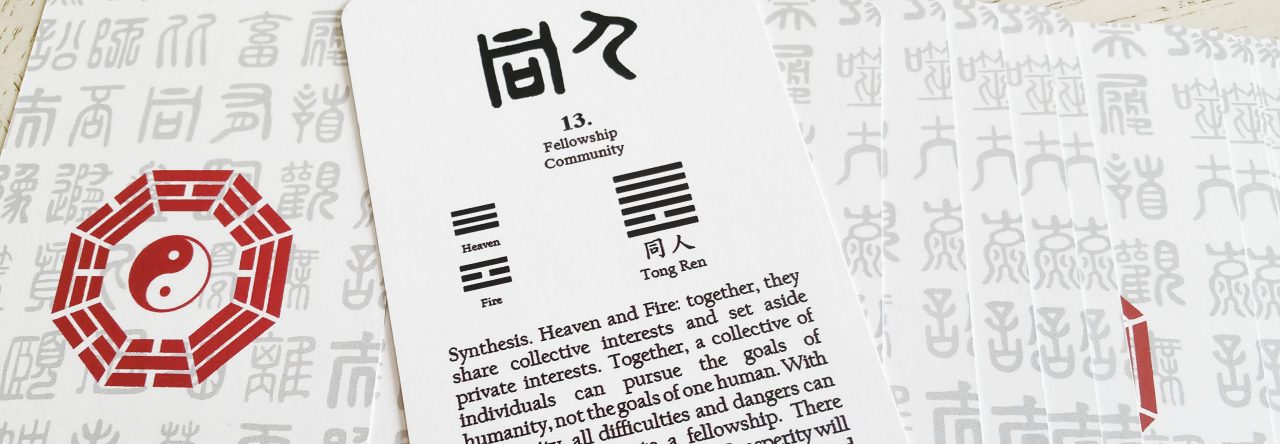
Every so often, someone calls my translation of the I Ching or my work-in-progress on the Tao Te Ching “New Age.” They’ll say it dismissively, as if they’ve discredited the authenticity of my work, and the legitimacy of my scholarship. Funnier yet, not one has been able to competently articulate how and why my work is more “New Age” than its counterparts. For some reason, my interpretation is automatically assumed to be wrong if it departs from what some old white guy from the 50s wrote about these Chinese texts, and we give the old white guy, taking a Christianized outsider perspective, miles and miles of grace.
When pressed, their explanation collapses onto itself in circular reasoning. “It just sounds New Agey.” Or “Well it’s because she’s an occultist so she can’t possibly be unbiased, neutral, objective, and scholarly.” They’ll say it doesn’t sound like “ancient Chinese wisdom.” And that expectation is problematic.
Recently I came across this video essay by a fellow community content creator on YouTube who had some candid critiques of authors, influencers, and content creators from our mutual community. She shared frustrations about seeing a growing disconnect between those who create content and those who consume content, i.e., the audience that supports an author or content creator.
She had a lot of very legit criticism of the present day online creator ecosystem. Bots and AI-generated responses, monetizing parasocial relationships in a way that feels exploitative, the end of peer to peer communications and the rise of transactional relationships, alienating many socioeconomic classes with paywalls, and having assistants manage community spaces rather than the big-name content creator themselves engaging in those community spaces — I hear you. All valid points speaking truth to power. Also, her concerns speak to something deeper– the loneliness and disconnection many of us feel online these days. Where has that sense of fellowship gone?
Though as someone who also writes, publishes, and maintains an online presence, I have some strong feelings about these points, particularly around community engagement and the unrealistic expectations that get imposed on authors and content creators.
I’d like to unpack some of those critiques, not just from that one YouTuber or from that particular video essay, but because what she said reflects a majority view currently held against content creators when they’re not being responsive in their comments section. I want to offer my perspective. But this isn’t a response to that video, no. These are just my reflections on the realities of engagement, from a content creator’s perspective, inspired by the points she raised in that video.
Two of my current go-to blends. “Anti-Itch Oil” consisting of tea tree oil, eucalyptus, and lavender really does (at least for hubby and me, and all the friends and family I give this to) alleviate minor itching and bug bites. It also clears my sinuses, and helps with congestion. The blend of frankincense, rosemary, and peppermint smells like petrichor! That after-rain scent! This one’s a great massage oil to soothe tense muscles, carpal tunnel, and I also use it as a hair and scalp treatment oil.
Essential oils get a really bad rep these days, and for good reason. Beyond the scams and pyramid schemes, its contemporary New Age associations with “this can cure cancer” claims and people replacing evidence-based healthcare with fragrance blends is why people are – and should be – skeptical.
Not only is there insufficient scientific and medical research to conclusively make claims, but often it’s misused, or people are uninformed about how to use plant extract essences. They definitely can cause skin irritation, allergic reactions, and in extreme cases of misuse, adversely interfere with your body’s regular functions (this is why those who are pregnant, trying to get pregnant, and young developing children need to heighten their discernment around use of essential oils). Some concentrated plant essences can also interact adversely with prescription medications.
Then of course there are the sweeping claims in the realm of magical thinking. This oil blend will bring you luck in love and romance, or this will exorcise demons, or this will help you to manifest wealth. This oil is for glamour magic. That oil is a cure-all.
The historical origins of the term “snake oil” is synchronistically telling here, actually. When Chinese laborers immigrated to the United States to work on the Transcontinental Railroad in the 1800s, they used a traditional Chinese medicine containing actual snake oil. Per TCM, fat extracted from non-venomous water snakes rendered into an oil, mixed with ginger and camphor extracts was a legitimate medicinal remedy for joint pain and muscle inflammation, which the railroad workers would use. Americans then capitalized on that idea by selling fake snake oil as a magical, mystical ancient Chinese remedy for all ailments. Hence the term “snake oil” came to mean a fraudulent health hype, when actually, the original source material wasn’t fraudulent at all.
Similarly, there are bona fide legitimate uses for essential oils, but capitalistic bad faith sellers of fake stuff give essential oils a bad name. Sadly.
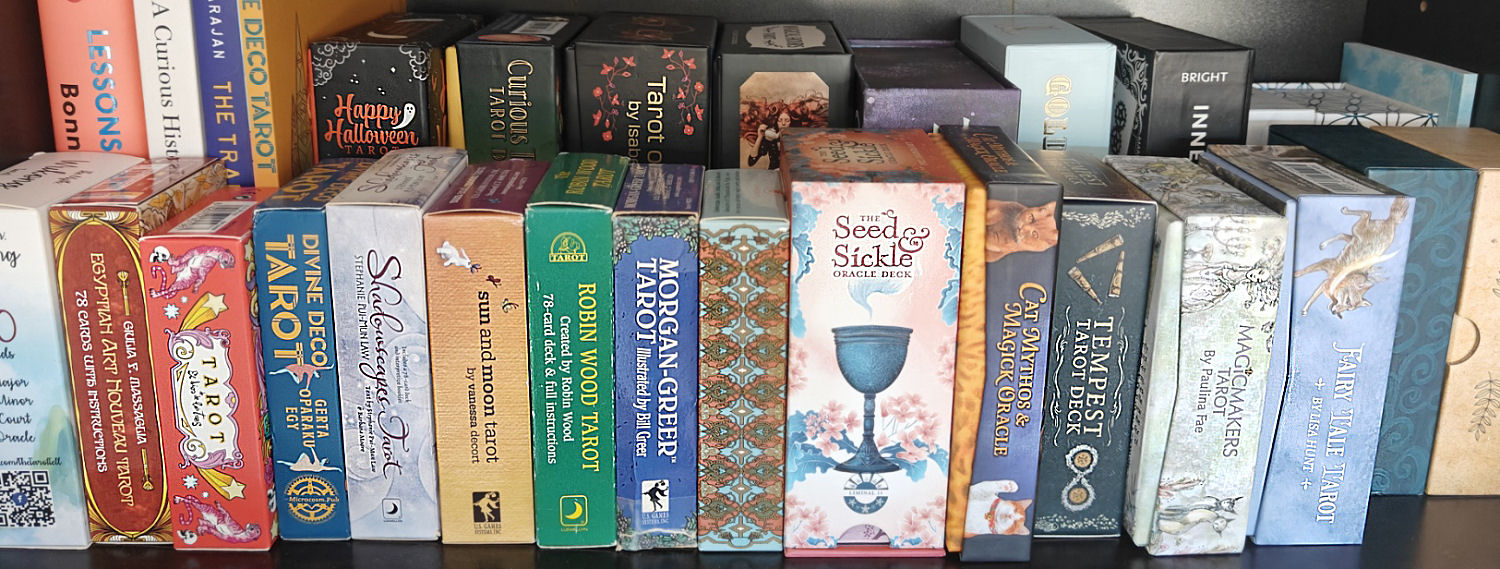
I’ll be sharing random snapshots of my witchy bookshelves just because.
I was listening to the podcast (a great one, by the way) Occultish Behavior: The Unholy Hour with Ivy Corvus and Justin Bennett, Episode 4: The Monetization of Magic where Ivy and Justin share their thoughts on paid endorsements, paywalls, charging for online courses, and so much more. They explore a spectrum of opinions, which I think so many of us can resonate with. These are observations I myself have been grappling with, so it was really fruitful to hear their perspectives.
As a collective we cycle back to this subject for conversation every few years. A year ago that #Occultea tag had lots of pagan and witchy content creators addressing social media witchcraft, grifters, aesthetics, consumerism, and gatekeeping. Consumerism in spirituality comes up frequently in the tarot community, which I’ve previously chimed in on here (Tarot Tube and Classism) two years ago, touching on many of the topics Ivy and Justin cover in this podcast episode, specific to tarot social media spaces, rather than the broader witchy/pagan space.
When we monetize the teaching of sacred knowledge, we complicate and maybe even risk committing sacrilege. But if we don’t meet humans where they are and provide monetary compensation, they’re not going to share their work.
For many holding sincere religious beliefs around how they’ve divinely received the sacred knowledge, trying to put a dollar and cents price tag on the value of that knowledge is intuitively icky. And yet if we don’t value that knowledge — and we demonstrate value by paying for it — then these sacred cultural traditions risk going extinct.
It seems like the majority agree that people should be adequately compensated for their work, but also we judge that at some point it’s just greedy, gross, and profane. We don’t want you to starve, but if you get too popular and start selling your stuff for too much, we’ll knock you off your high horse.
It’s funny how an oft-repeated tenet in the artist/creator community is “charge what you’re worth,” except when you do, you get vilified. If you charge a “grotesque” amount of money for your work, you’re perceived as having an inflated ego, and you’ll get accusingly asked, “What makes you think your work is worth so much.” Which also is a silly question to ask, because if the creator is doing business right, then the clear answer is the marketplace. The marketplace has accepted that their work is worth that much. It’s not ego. It’s capitalism. Okay maybe it’s both.
We all agree that some sort of balanced approach is best, but we disagree on what “balanced approach” means. Where do you draw the line and why do you draw the line there? Is charging $30 for an online course on planetary ritual magic okay? What about charging $300? $3,000? You say it depends on the content of that course, but how do we even apply an objective standard for review?
As an author and educational content creator of topics in mysticism, I struggle a lot with what a “balanced approach” means to me. I want to produce diligently researched, comprehensive, substantive educational videos on YouTube, but it’s a lot of work. It’s time-consuming, and at this point in my life, time is very precious. So if I’m going to invest my time and energy into making free educational videos to increase equitable accessibility to sacred knowledge, then I want to be compensated for that work, but how? Do I want money? Initially I think, no, I don’t need money for it. I just need something in exchange to feel like it’s fair, to feel like my investment sacrifice of time was worth it. But what?
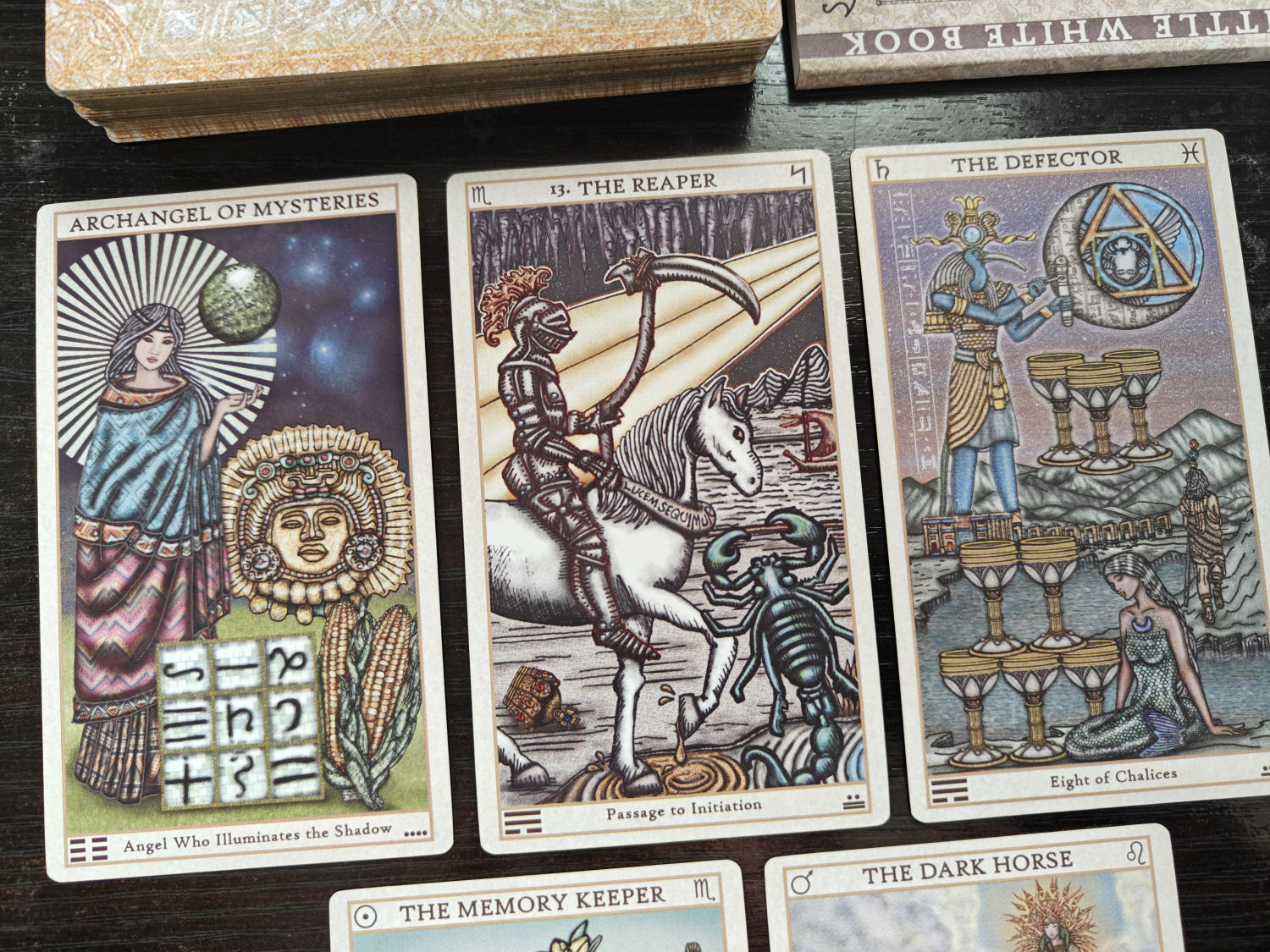
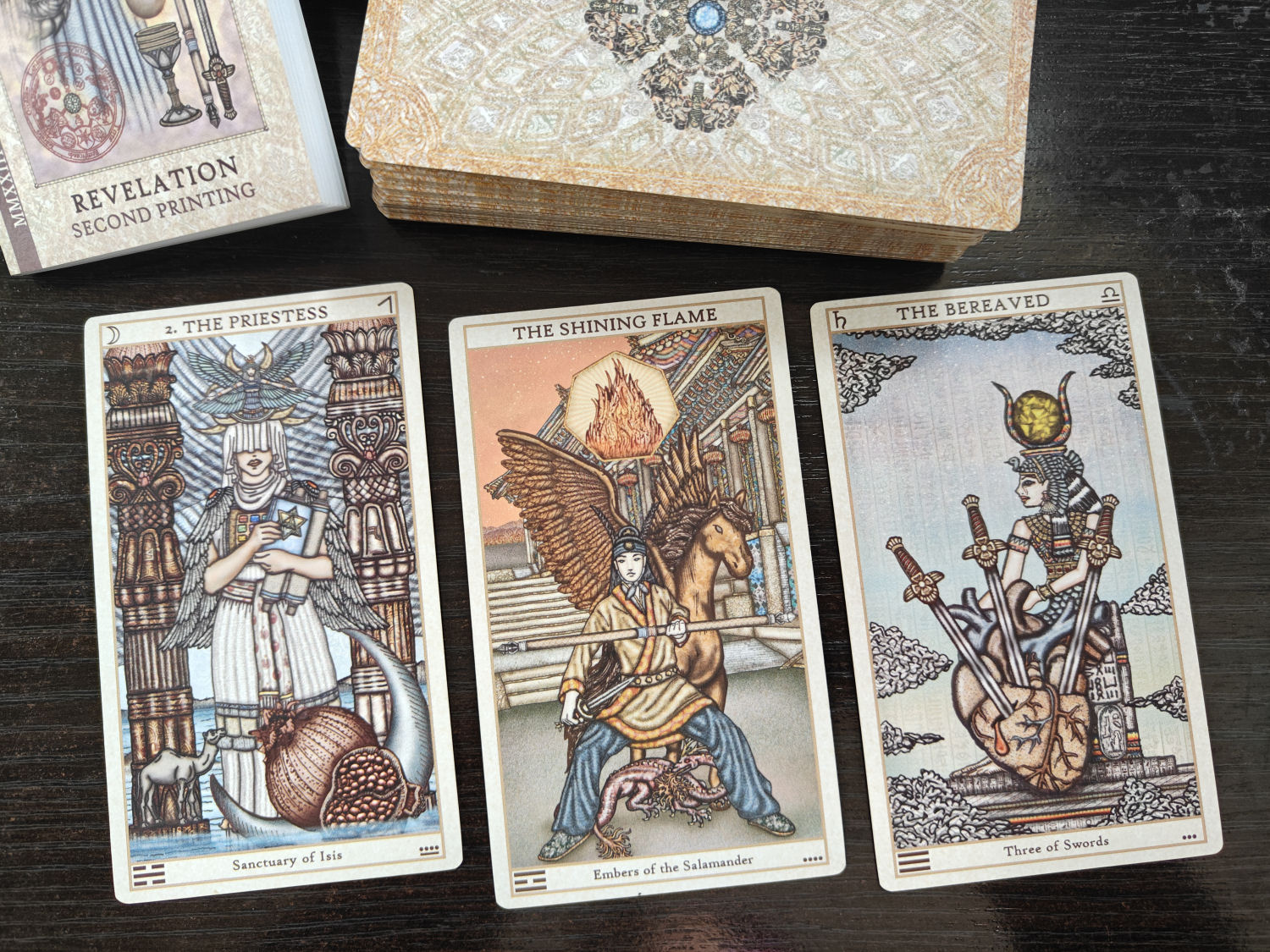
Random photos of my Spirit Keeper’s Tarot deck, Revelation Edition, because I didn’t know what else to use as images for this blogged reflection…
I think it was in 2022 that I first realized what it is I was witnessing: the tarot community as I’ve come to know it was dying, though it was also making way for the rise of something else.
Archangel of Mysteries, Key 13: The Reaper, and The Defector (Eight of Chalices) from the Spirit Keeper’s Tarot, Revelation Edition
The “Dying Internet” Theory
First, tarot trends don’t happen in a vacuum, immune to sociopolitical movements. In fact, we can often tie tarot trends to exactly what’s happening in the global mainstream society. Which is why we’ll start by laying the foundation and address the trending theory of a “dying internet.”
There’s this speculative idea that’s been whispered (or maybe more than whispered as of late) in tech circles here in Silicon Valley about how an organic, people-driven internet that echoes physical society is being replaced by manufactured template content and occupied by bots, more and more being generated by AI rather than written from scratch by a human, resulting in decaying authenticity and homogenization. As they put it, “the internet is dying.” It’s a slow, systemic collapse of feral, original human-authored (can’t even believe we now have to clarify) content being outrun by outsourced content mills, ad-driven clickbait drowning out the authentic individualized voices, monoculture, fake engagement, faked popularity, and more and more paywalls.
The theory isn’t so much saying the internet is dying dying, but rather, the internet as Gen Xers and Millennials have become familiar with is quietly fading away and morphing into something that will be unrecognizable to us. What was refreshingly democratizing about the world wide web is what’s dying.
A “Dying” Niche Tarot Community
I think I need to explain myself here. It’s not that I think the tarot, as a niche interest and esoteric study, is dying or will ever die. That will always reinvent itself and persist. It’s the form of the niche tarot community as those of my generation have known it that’s dying and soon to reincarnate into something we may find unrecognizable.
When the tarot first went online (at least as I recall and per my personal participation) back in the 90s, it was almost entirely conversational. We were discussing tarot, and often in a very nerdy, niche way. We were engaging in dialogue, debating, debunking, sharing, and not merely broadcasting canned information about it.
I feel like discourse used to be more in-depth, whereas now, online content about tarot is keyed to quick consumer consumption, because if you don’t, then your content doesn’t generate high engagement, whereas when you do play the SEO game, your content rises to the top. We’re rewarding homogenization.
And again, this isn’t something that shifted overnight. Any of us who’ve been here a bit have watched it happen right under our noses. Many have griped about it, especially back when the online tarot community was still more conversational. Nowadays there’s no more griping or controversial “drama,” no more raw TMI personal ramblings, because it’s all highly-edited strategically produced vanilla content keyed to generate ad revenue, rather than for sincere interpersonal discourse. The disintegration and morphing into the (to me) unrecognizable didn’t happen like a Tower moment; oh no, it’s been slow, gradual, in a normal wear-and-tear sort of way.
So here’s my conundrum. Recently I came across a highly visible, highly platformed video on Korean shamanism, by a white male academic. Don’t get me wrong– he did a fantastic job. It’s just that… a part of me does ask the question — why isn’t it an actual Korean shaman or mudang‘s video getting that level of visibility and exposure? Why is it when native practitioners talk about their traditions, their visibility and popularity is a small fraction of the view count that the white male academic gets?
Same goes for YouTube content on Taoism, inner alchemy, or esoteric Buddhism — the channels of white men garner the most visibility and occupy the top-ranking spaces. When it comes to educational content on Taoism and Buddhism, Western scholars overshadow the contributions of indigenous practitioners and Asian scholars. The imbalance has the impact of erasing lived experiences and native expertise, and all insights valued as authoritative are inevitably filtered through a white Western lens.
Worse yet, click into any of the lower-ranking videos on these subjects by native practitioners and skim through the comments section — you’ll find white men correcting the alleged inaccuracies of the native practitioners. Also, funny point — POCs can always spot the white dude in the comments section, irrespective of what profile photo or handle they use.
I call this a conundrum because I don’t have a clear solution — it’s a tension between inclusivity (welcoming all voices and perspectives on my lived tradition) and protecting marginalized voices (when the white male voice and perspective talks over the voice and perspective of the lived tradition). Notice how it’s always a white guy who says he knows the most authentic version of the tradition that is not even his to be authenticating, or how his interpretation of a sacred text that he’s appropriating is more accurate. He hijacks the culture and then positions himself as the expert.
At best, a POC is given secondary, lower-level credit for the purpose of validating the expertise of the white guy standing center stage. Not to mention, a POC voice is only platformed if they agree with the Eurocentric point of view. If a POC expert dare challenge established Western expertise — just watch what happens next.
This is here because blog posts need to be accompanied by images, as you very well know. I typed into ChatGPT the following prompt: “Create an image that is an artistic expression of the [__one-word summary of main occupation, e.g., author, attorney, artist, etc.__] [__name__] based on the published works they’re most known for, public persona and platform, and publicly accessible information about this individual.” This prompt might generate text only, in which case your next prompt will be “Create an image that is an artistic expression of [__name__] based on the foregoing analysis and assessment.” Left image is what ChatGPT produced when I used my legal name and profession of attorney; right image is what it produced for the author Benebell Wen.
Long before AI came on the scene, I had already been wondering if maybe psychic ability in humans wasn’t as woo as we thought, and really, it’s just a rare few people’s brains being able to process “big data” they were somehow downloading from a collective unconscious, spot patterns, and synthesize that data in a way that now appears to the average person as predictive or supernatural.
These algorithms that seem to know exactly what we want to see, who we are, our preferences, core identity, innermost wants and values mirror what people often say about psychics and mediums– “She [the psychic] knows me better than I know myself!”
I believe clairvoyance, clairsentience, and claircognizance are simply functions we have yet to fully understand in a clear, practical way. But really at the heart of it, it’s just cognitive science and pattern recognition, much like what powers AI.





 benebell wen