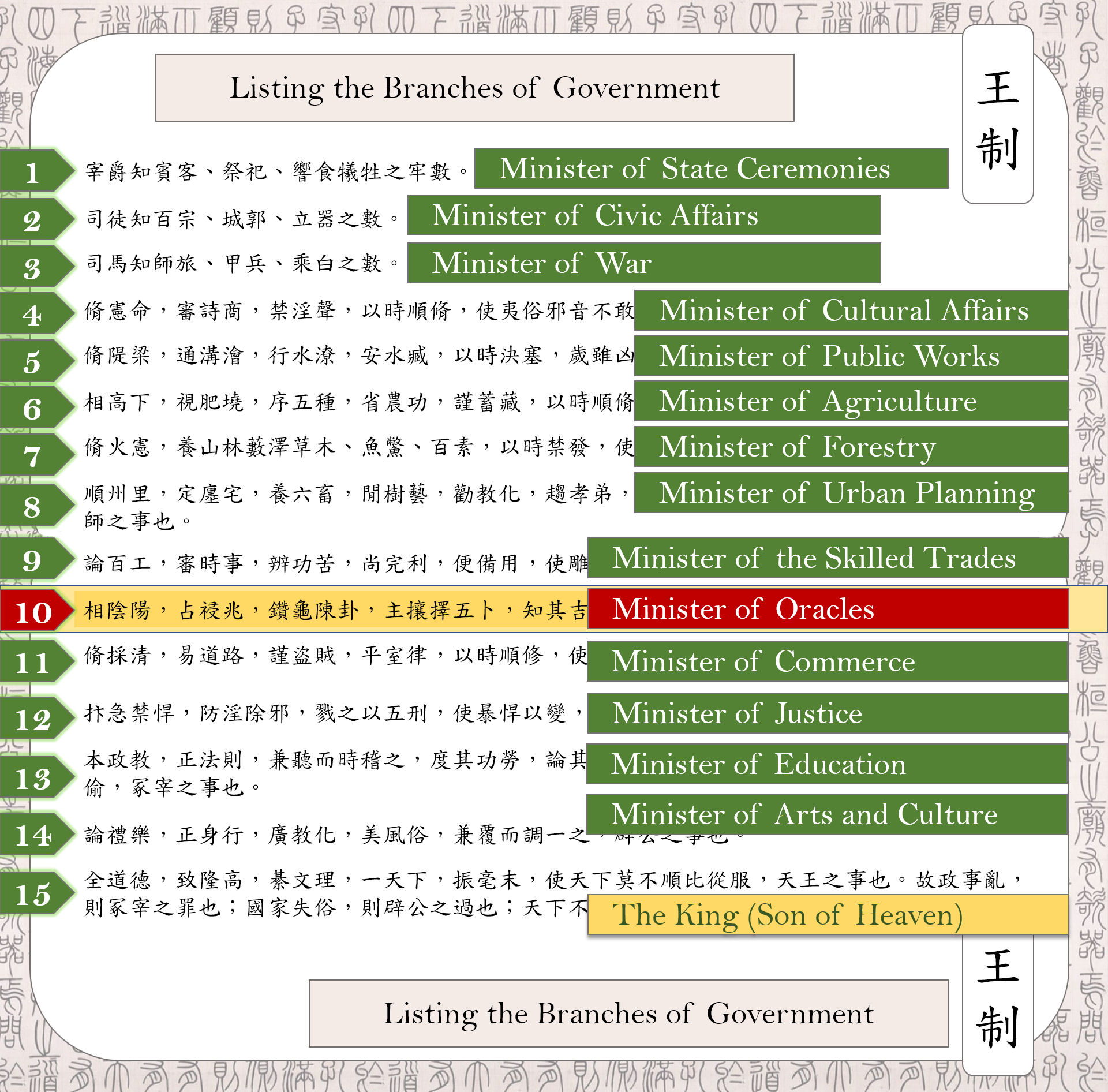
A single line statement from Xunzi (3rd c. BCE) becomes the framework for mastering Chinese folk magic. In this lecture, we unpack the “Minister of Oracles” (Minister of Magic?) in the royal bureaucracy of early China and reveal how it encodes a five-step curriculum.
From 王制, Scroll 9, Section 35, in Xunzi 荀子
There’s a passage in Xunzi that lists out fifteen branches or bureaus of government ending with the one who oversees them all, the Son of Heaven, or the Head of State. The tenth office listed is the Minister of Oracles, chief among the shamans 巫.
You could even make the argument that this translates to the Minister of Magic, as that title more fully encapsulates everything this particular government official is in charge of for the kingdom.
This is an introduction to Taoist inner alchemy, by way of cultivation work with the Zhou Tian, or Mandalas of Heaven, grounded in canonical source texts and living tradition. Key features of this curriculum are:
A 200+ page structured textbook and workbook (that serves as a companion and book of your study notes, personal reflections, and log of experiences)
Primary canonical texts translated into English (I don’t believe I’ve ever seen this obscure text translated into English before) with annotations
Practice instructions that go beyond the free, publicly available lectures and guided experience prompts
Structures the free, publicly available material into theoretical foundations and practical application
Emphasis on ethical grounding and safety
Participant Question & Answer feature (a password-protected FAQs page tailored to you)
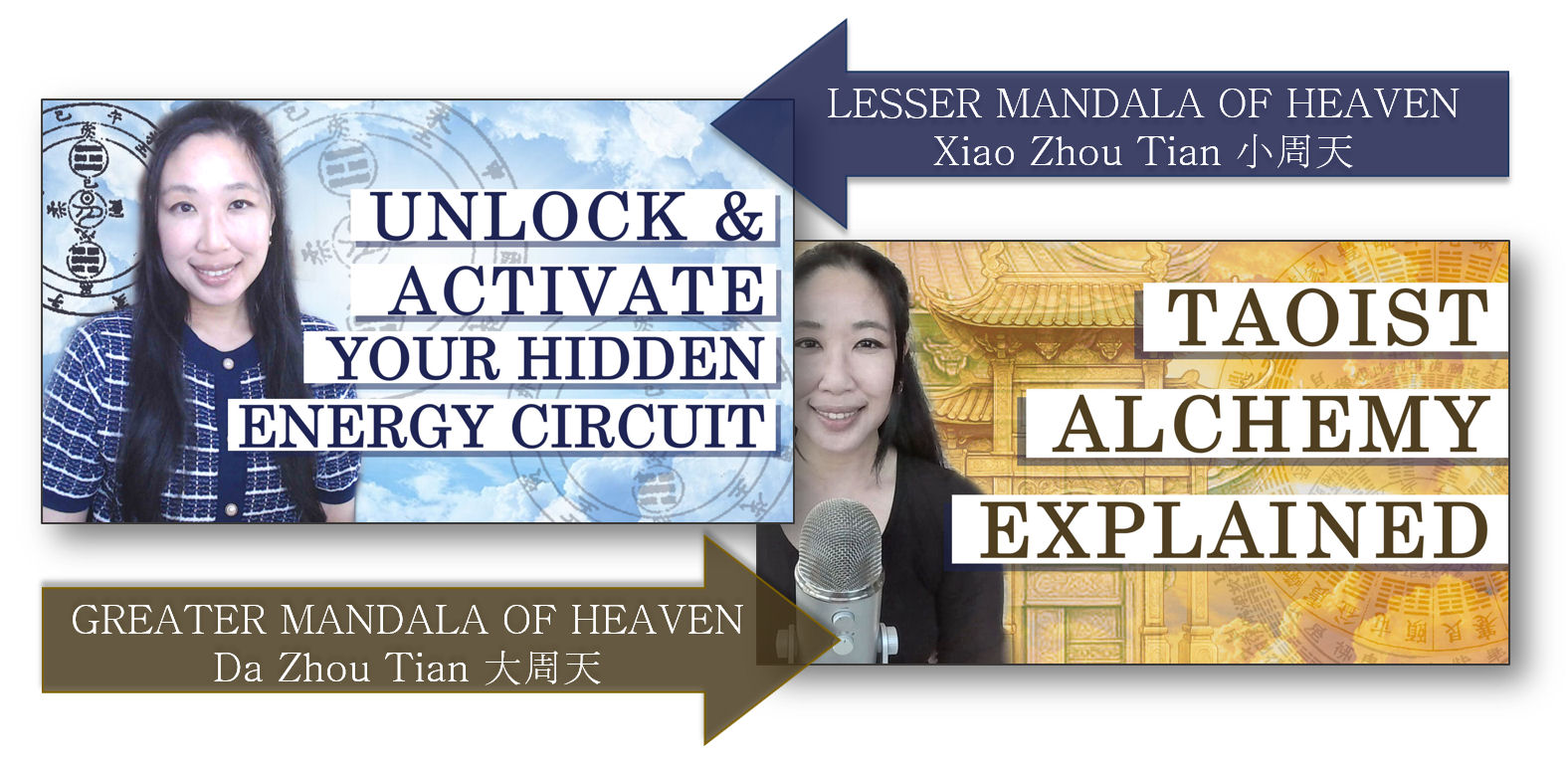
The two core lectures on the Lesser Mandala of Heaven 小周天 and Greater Mandala of Heaven 大周天 are already available free to the public, which you can access:
A Taoist Secret to Cultivating Personal Power: On the Lesser Mandala of Heaven, Xiao Zhou Tian 小周天
This deeper-dive cultivation practicum organizes what was introduced in those two lectures into a sequential system that becomes praxis-oriented.
The course book, which is a workbook, is a guide on how to integrate those core practices.
In other words, the two free lectures introduce the ideas. This course is where the cultivation actually happens. It is a structured container for the teachings.
The coursework expands the scope in depth and breadth, curating a curriculum to study, practice, and self-reflect on the Mandalas over a period of 100 days, guided by a 200-page course textbook, through which you will:
Notably increase your internal vitality, awakening and actualizing otherwise untapped core powers, &
Master the foundational principles and symbolic systems shared among many lineages of folk magic across Asia, essential in Taoist mysticism and esoteric Buddhism.
Deliverables
A 200+ page cultivation manual and workbook (digital PDF delivered to your email inbox; you can order a printed spiral-bound copy of the book via a third-party print-on-demand site at-cost). Your course text becomes your one-stop consolidated resource with all of the following and more:
Authoritative reference tables and diagrams
Organized sections with clear, beginner-accessible explanations of core Taoist principles, especially in the area of inner alchemy
Step-by-step guided practice instructions
Canonical sources and textual translations, so that you know where these practices come from and how they were historically understood
Reflection prompts and line space for you to log your insights and experiences right next to the reference materials– this helps to reinforce your learning, and also serves as a journal– you’ll be able to refer back what you wrote in here and assess your own progress
MP4 downloads of just the guided meditation. I’ll send you two versions: one that has Heart Sutra musical incantations in the background layered beyind my voiceover narration, and a version that’s the voiceover narration only.
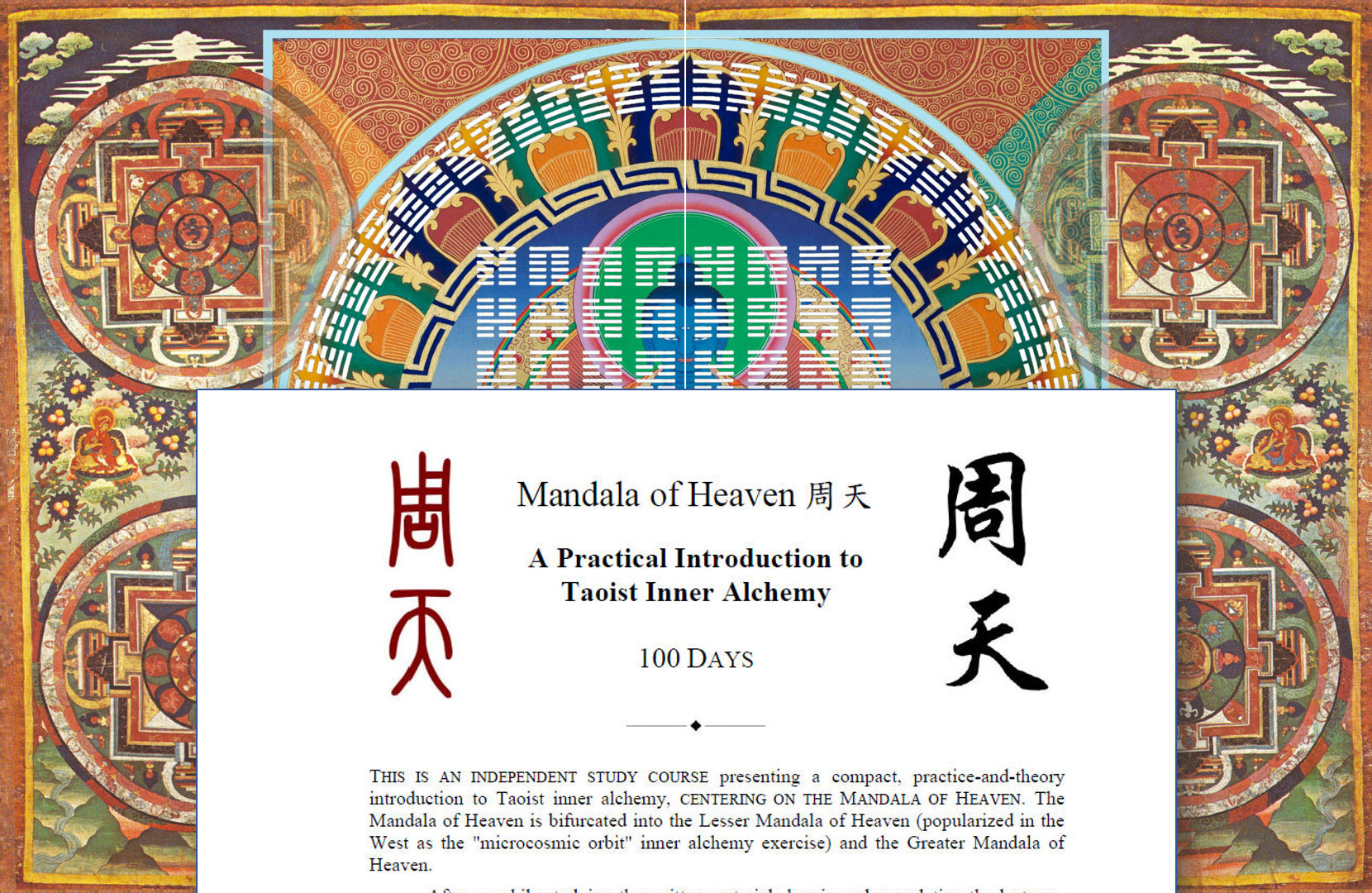
300-dpi resolution digital image of the cover design (17.25” x 11.25”), which can be be used for art prints, wall hangings, etc. In Taoist and various Eastern esoteric traditions, such a design would be called a form of Spirit Map (靈圖, líng tú) or magical painting (術畫, shù huà).
Cover design features four mandalas from the post-Geluk era (circa 17th c.) representing the canonical four Buddha families and generally symbolic of a four-fold cosmological system of protective guardians.
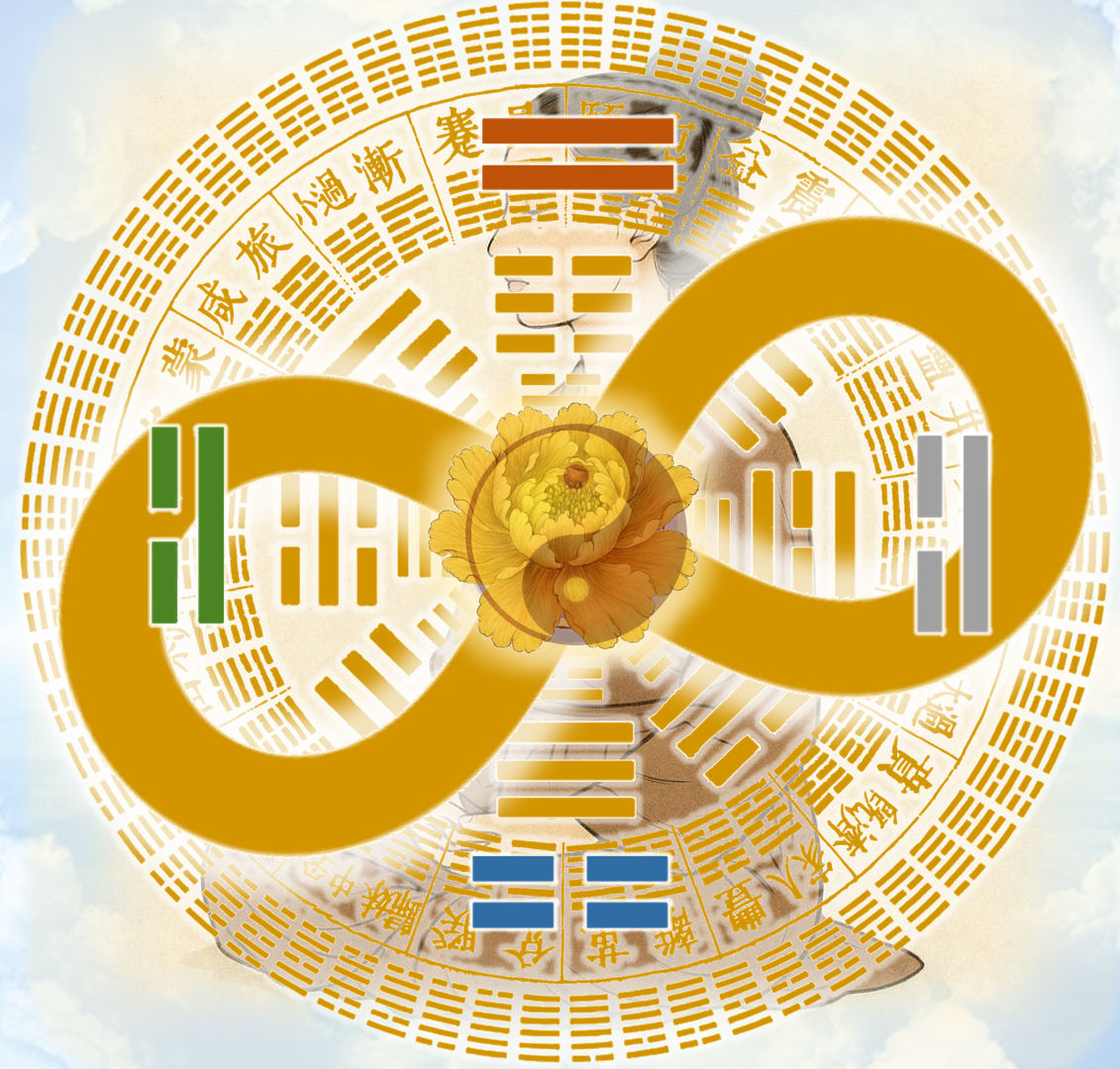
The central seal that spreads across both the front and back covers is the Blue Medicine Buddha. The 64 hexagrams appear both as an 8×8 square diagram and as a full circle.
Original translations and annotations of excerpted chapters from the Dao Men Yu Yao 道門語要 (Fundamentals of Taoist Alchemy), circa 1271 – 1325, specifically the two chapters on the Lesser Mandala “運小周天之法” and the Greater Mandala “行大周天之功” with explanatory annotations
Fundamentals is a collection of much older canonical essays compiled by Huang Shang 黃裳, a Taoist priest of the Zhongpai 中派 (Middle Pillar Lineage), a tradition of Taoist inner alchemy
dated back to the Yuan dynasty founded by the master Li Daochun 李道纯.
The essays date back to the Yuan dynasty, received texts of the Lineage, while the date of Huang Shang’s compilation is unclear, though speculated to be the Qing dynasty.
The Middle Pillar Lineage was known for its syncretizing of Taoism, Buddhism, and Confucianism.
The term “黃裳,” Huang Shang’s namesake, is a direct reference from Hexagram 2, Line 5 of the I Ching.
QUESTION & ANSWER WITH BELL | Course Participants Only FAQs Page. Email me your questions and I’ll compile the Q&As into a password-protected page for course participants only. This is your opportunity to ask me any questions you have related to these subjects.
Admittedly I’m not great at responding to emails, especially ones with questions that may involve a thoughtful, thorough reply. But the questions submitted through this course curriculum will be prioritized, and I’ll answer them via multimedia formats on a password-protected FAQs page.
You can ask anything related to this subject matter. Or ask how I personally practice, or apply certain principles. Feel free to ask about my perspective, or ask the questions on Taoist mysticism that you can’t seem to find anywhere else in English.
Through the framework of the Lesser and Greater Mandalas of Heaven, this course introduces the foundations of classical Taoist inner alchemy. It will consist of studying translations and annotations of canonical source texts on the Mandalas of Heaven, guided practice, and reflective work.
For a sampling of what’s in the course book, click on the above link to a PDF to read the first 49 pages, which outlines your learning objectives, gives you the table of contents, and introduces the premise of this Work.
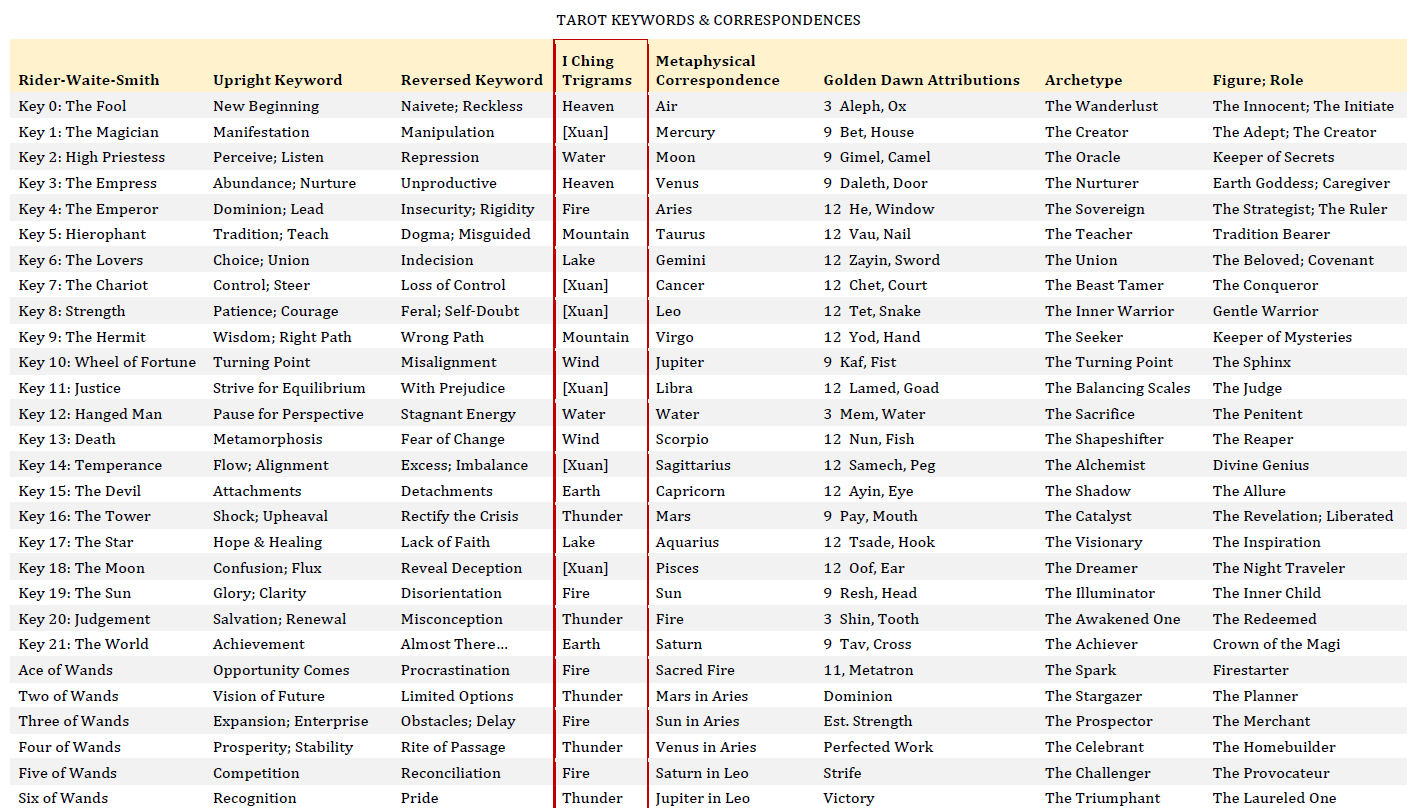
I’m an I Ching aficionado and also a tarot aficionado, wrote chonky books on both subjects, so naturally I’ve thought long and hard about how the two systems reconcile. This page is a download of a tarot and I Ching correspondence table for your easy go-to referencing.
This is Part II of what we started in Part I on the Lesser Mandala of Heaven. Part II covers the Greater Mandala of Heaven, and in doing so, provides an advanced introduction to Taoist alchemy.
In this introduction, I want to explore the inner logic that underlies one of the world’s most sophisticated (in my opinion) systems of spiritual cultivation. I intend for this intro to be a deep-dive into the heart of Taoist alchemy by delineating the Greater Mandala of Heaven.
The ultimate goal of Taoist alchemy is to transform the finite into the infinite, matter into spirit, and limitation into transcendence. We cover this ground by first understanding the distinction made between inner alchemy and outer alchemy.
Philosophically, this is a system and tradition that presents a compelling perspective on how Change happens.
Historical Textual References
In addition to the two texts mentioned in Part I, these are some of the oft-cited sources of insight on the Greater Mandala of Heaven 大周天. The titles are hyperlinked to the full texts over at ctext.org (the Chinese Text Project). While CTP as a site has its limitations, it’s one of the best free, accessible, and online databases for primary sources of pre-modern Chinese texts, so it’s the most user-friendly for folks like you and me.
This is Part I of a two-part video lecture that introduces a Taoist secret breathwork practice known as the Lesser Mandala of Heaven, or Xiao Zhou Tian 小周天.
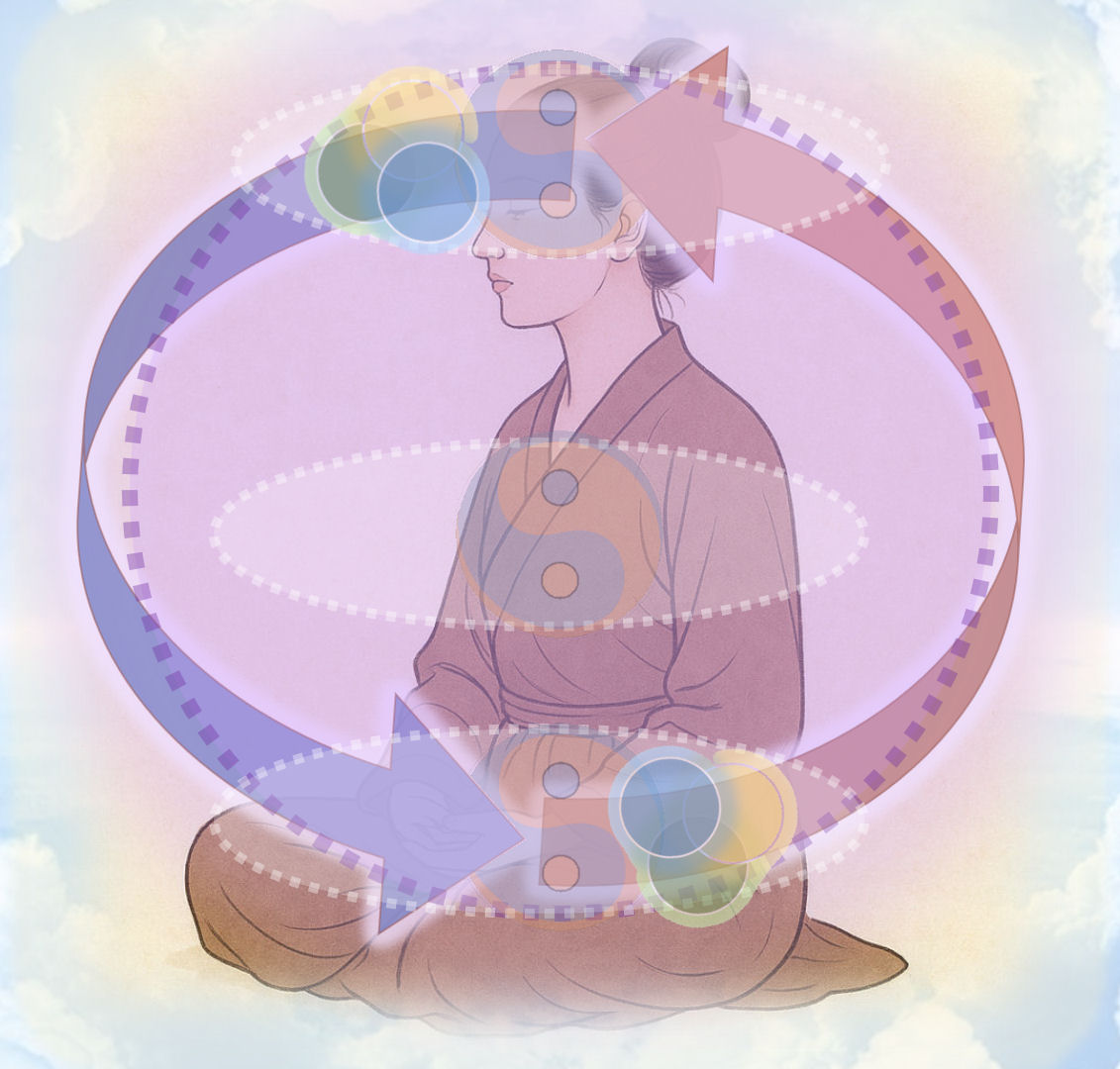
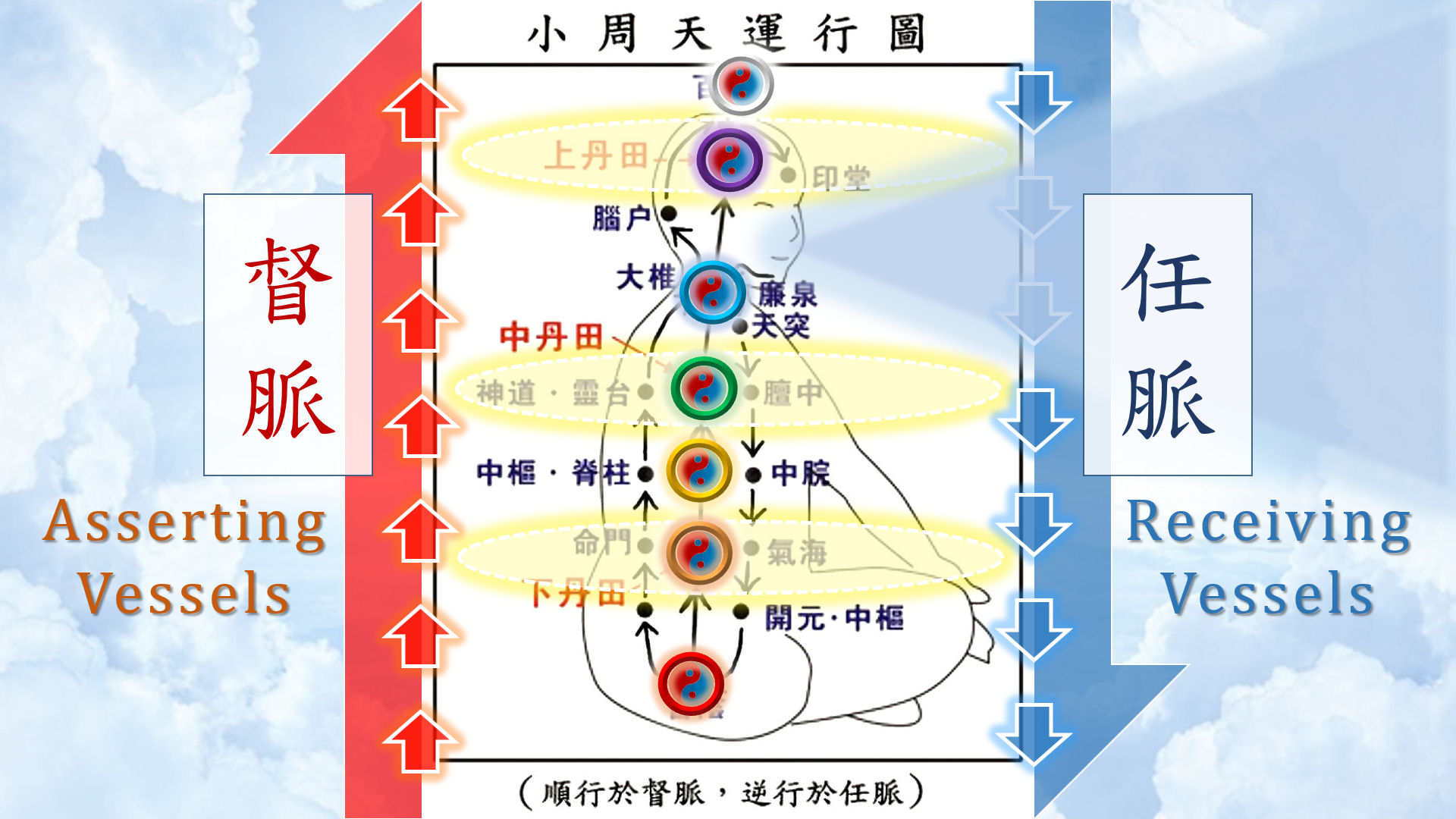
Rooted in classic Taoist inner alchemy (內丹, neidan), it teaches you to unlock a hidden energy circuit that runs through your body, up the spinal Du 督 meridian and down the frontal Ren 任 meridian, forming a continuous loop of vitality.
By circulating the triple treasures along this hidden energy path, you harmonize the body’s three dantian 丹田, or energy centers, with the three realms and cycles of the universe. Taoist masters believe this alignment refines your essence, restores internal balance, and elevates your personal power.
To round out the discussions, we’ll be covering:
Guarding the Center 守中 baseline Taoist practices and their textual/historical origins
The Guarding of the One 守一冥想 guided meditation
Principle of Union of Heaven and Humanity (Tian Ren He Yi, 天人合一)
Ethical foundations (de, 德) and the Three Virtues as the basis of cultivation
Lifestyle precepts
The Du 督 and Ren 任 meridians
Jing, Qi, Shen 精氣神: The Triple Treasure
About Your Dantian (Three Internal Fields)
The Internal Body Clock & Wu Xing
Personal ritual space mirroring Taoist cosmology and numerology
The Six Omens of spiritual awakening, confirming readiness for Greater Mandala of Heaven work
Study of the translations and annotations of the Fundamentals of Taoist Alchemy 道門語要 (1271 – 1325) source text
This orbit is set up to attune with the cyclical convection current of nature: heat rises and expands, as it rises, it then cools, contracts, becomes denser, and so the denser, cooler flow sinks down, contracting.
The video is timestamped, and you’ll find a step-by-step guided practice on how to direct breath up and down this internal orbit, transforming your body into a living mandala and tuning it to the rhythmic cycles of nature.
This practice is more typically transmitted from teacher to disciple, but here, let’s see if we can offer a more direct and more easily accessible method.
Whether your goal is improved health, increasing your energy reservoir so you can get more done in a day, or to unlock your mystical potential, this is a cultivation technique worth your while to learn.
Botanical Dreams Oracle by Lynn Araujo and Catrin Welz-Stein
I partook in this thought leadership workshop and learned about the five categories of questions to ask for more effective, strategic decision-making. Being me and having the interests I do, of course I immediately connected these learnings to tarot, I Ching, and in general divinatory readings.
Teachers in nearly every divinatory tradition or system talk at length about the importance of how you ask and frame questions for divination. The quality of answers you receive — be that in strategic leadership, personal development, or divination – is directly influenced by the clarity, precision, and intention behind the questions you’re asking.
Apothecary Spirits Oracle by Eric Maille, Michael Anthony, and Thomas Witholt
A well-framed question acts like a lens. It brings your focus to what truly matters, and in the case of readings, hones the focus narrowly on what it is you most want or need to know. The better your question, the more noise will get filtered out of the reading result, enhancing meaningful insight.
Thinking about how to frame questions through the principles of these five categories is really helpful, I think. Hence, this share.
In an executive leadership workshop I attended, I learned about identity capital and how people leaders need to help their teams cultivate identity capital. It’s a concept popularized in The Defining Decade by Meg Jay, which in short summary is the collection of professional and personal assets that define why you’re great. This is subdivided into four categories: (1) skills and credentials, (2) social networks, (3) life experiences, and (4) personal qualities.
Identity capital is what sets you apart in your marketplace or industry. It attracts more opportunities, builds your credibility, and empowers you to be more persuasive. Even when headhunters don’t consciously realize it, they’re looking for candidates with identity capital in abundance. Those who stand out in competitive environments are the ones who are rich with these assets.
I found the workshop useful, so I want to share what I learned. And of course I thought, how fun would it be to combine those professional development learnings with divination as a tool for self-reflection.
Below is a free downloadable Identity Capital Workbook.
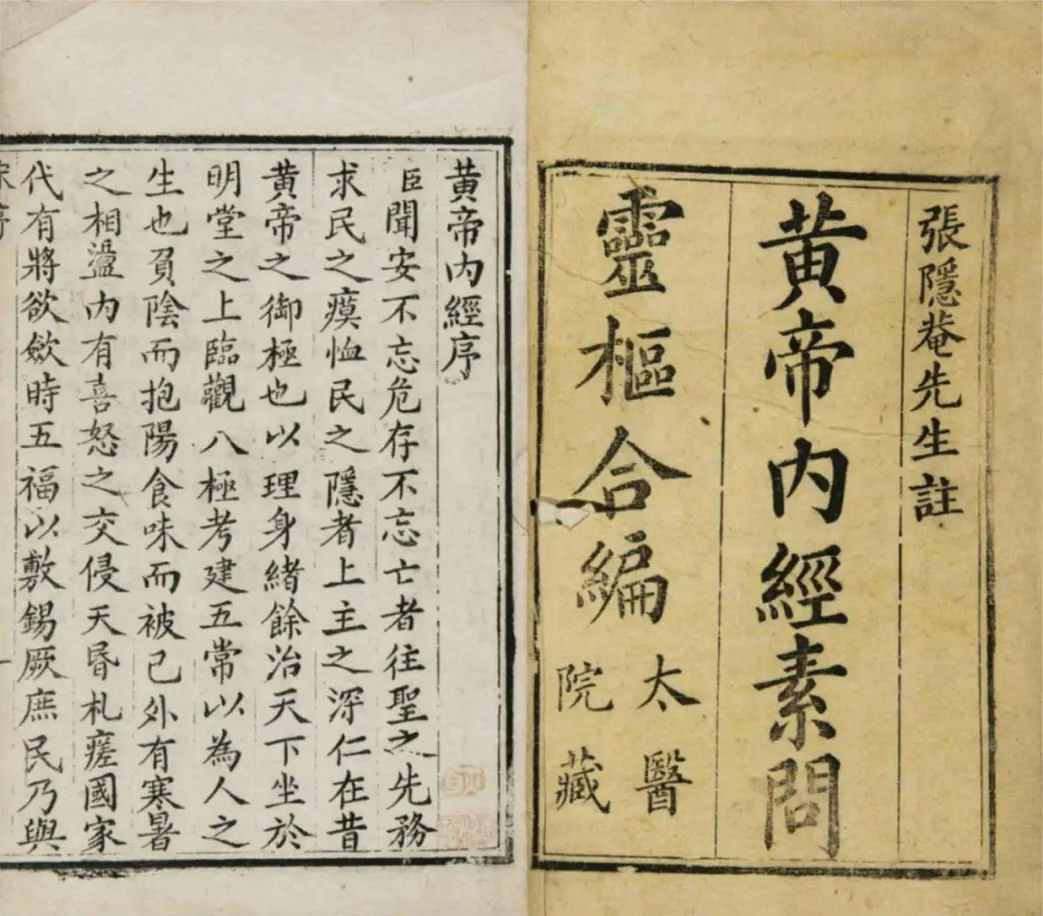
There’s this section in Chapter 9 of The Spiritual Axis (Ling Shu) from the classical medical treatise Inner Canons of the Yellow Emperor (Huangdi Neijing), which in canonical versions is often designated as Verse 27 that I love for many reasons.
Nine universally applicable precepts of healing can be extracted from Verse 27. The way they’re worded, you can interpret them through different lenses and they still hold true. The verse functions as axiomatic to acupuncture, and to both the ancient and the modern healthcare provider.
You can read it through the lens of how to ensure physical health, and also how to ensure mental, emotional health, and — as to the primary scope of work I operate in — to spiritual health.
If you’re looking at it as a road map for your own healing journey, it works. If you’re a healer of any stripe, these are nine clinical axioms for guiding patient care. You can look at these nine precepts as applied medical wisdom, or heuristics for clinical decision-making. They work as key tenets for helping a practitioner refine their diagnostic and therapeutic approaches.
And finally, in my view, these nine precepts can be instrumental to helping anyone set the foundation of their personal spiritual practice. It’s designed in such a way that you can account simultaneously for mundane physical health and hygiene tenets and for basic considerations in ritual or ceremonial magic.
Let’s time travel and step into the mystical lineage of the Neolithic Wu 巫 shamans that laid the foundation for Taoist mysticism. This free public video lecture explores the birth of Taoist magic and the enduring legacy of Wu shamanism. We’ll decode Taoist occultism as it is practiced today to reveal the hidden history of how shamanism shaped the mystical practices of East Asia, preserving and refining early shamanistic techniques into a structured magical system, giving rise to Taoist mysticism.
Taoism is the enduring legacy of the Wu 巫, and how their oft-forgotten roots and history have shaped the modern practices of spirit mediums, Asian modalities of witchcraft, and Taoist ritual magic today. We’ll bridge the gap between the ancient traditions we’ve inherited from the Yellow River cradle of civilization and modern mystical practices, presented in a way rarely explored in the English language.
This is Taoist witchcraft decoded, in reclamation of the Wu 巫’s shamanic practices of the Tao 道.
I had such a great experience recording the first chapter of my audiobook that I had to share, and memorialize in a blog post. My publisher North Atlantic Books arranged for me to record at Live Oak Studio in Berkeley, a truly fantastic place. This is for the third book, I Ching, The Oracle.
To be standing where music legends and NYT bestselling authors once stood! ::faints::
Now I kinda wish I had the backbone to ask if I could take some photos of the engineer’s setup, you know, that station in front of the glassed-in studio space with all the colorful levers and buttons. =) But it seemed like his space and I didn’t want to intrude. So, womp, womp, sad face, no impressive sound-engineer’s-giant-keyboard pics for my social media. (Do blogs even count as social media anymore?)
This was my first time in a recording studio,* and certainly my first time recording my voice narrating my own book. I left the experience with a lot of admiration for professional voice actors and audiobook narrators. Like the voice actor we chose for narrating the I Ching audiobook — he sounds like one of those National Geographic or History channel voiceover guys! It’s a skill, and maybe dare say even a talent.
*Technically, I’ve been in a recording studio before, with an entire symphony, as one violinist in a sea of violinists in the violin section of said symphony. But for sure this was my first time in a recording studio for totally-me reasons.
Just because you wrote the Thing doesn’t mean you can competently read the Thing aloud, especially since I would not call my writing style “conversational.” So when you read it aloud and your writing style departs from your personal “conversational” style of speaking, it comes across as awkward.
Fortunately, the sound engineer was fantastic. He coached me really well, telling me when I was speaking 10% too fast and needed to slow down, when my energy wasn’t matching my last paragraph, and flagging words that had just the most subtle stumble, or even when I was getting a bit too loud with my breathing (lol). I have confirmed that audiobook narration is not necessarily the best profession for you if you have asthma (I have asthma).
This audiobook recording experience left me with the unequivocal acknowledgement that I write very long run-on sentences. The sound engineer had to stop and teach me how to breathe. If you come to a really long sentence, even if it doesn’t have punctuation, put in breath marks as if it did have periods, otherwise you’ll run out of breath, as I did when I was reading my own damn book.
More fun tips I’ve learned: Apparently, eat a crisp apple before you start recording voice narration. I don’t know if that’s just folklore or if it’s scientifically legit, but a lot of voice actors swear by it, and believe it’s a thing. It’s supposed to help your voice be at its tip-top condition.
And don’t wear “loud” clothes while you’re recording. So for instance James was wearing a nylon jacket and sporty pants or something that goes swish swish every time he moved even a little, so he wasn’t allowed in the recording booth. Fortunately I’m a nerd who reads all the homework assignment materials ahead of time, so I knew to wear “soft, quiet” clothes.
To be a competent voice actor, you almost have to over enunciate words. So many of us lay people don’t realize that we mumble when we speak. There were several instances when the sound engineer stopped me and offered guidance on how to over-enunciate, because I was jumbling my words and it wasn’t as crisp as it could or should be.
For I Ching, The Oracle, I’ll be doing the voice narration for Chapter 1, the Introduction only. A pro audiobook narrator, Wyntner Woody, will be narrating the rest of it, speaking both the classical Chinese text of the Zhouyi and the English translation and annotations.
The Hubby (a native Beijingnese speaker) and I listened and re-listened– and re-listened– to the finalist list of audition reels. We debated, we re-listened, we looked up each one of their bios… which is to say we put a lot of heavy thought into who to choose. There were many different and competing factors for consideration, hence the debating and long deliberation time as we wracked our brains over who to go with.
For the audition, each voice actor recorded about a page or two from one of the introductory expository chapters and then recorded Hexagram 1, both the classical Chinese and the English. We (and particularly Hubby, because he’s the native standard Chinese speaker; the Mandarin I speak is not standard) ultimately went with Wyntner because of his more precise standard Chinese pronunciation.
Why didn’t I want to narrate the entirety of my own book? This is the analogy I give. Since I grew up listening to southern Taiwanese people (deep south) whose primary tongue is Minnan/Hokkien speaking Mandarin Chinese, my Mandarin pronunciation is not “standard Chinese.” If I had narrated my own I Ching book, it would be akin to listening to someone narrate Shakespeare with a heavy southern drawl. If you’re looking to voice Shakespeare, you’re looking for a particular way of pronunciation, right? Same here.
That and time constraints. I think the total was going to be something like 20 hours of straight narration, which means lord knows how many hours buffered around those core 20 to get those final 20 hours right.
Due to my full-time job, I would only be able to work weekends, and then you would have to coordinate with the studio’s schedule and available time slots. So ultimately it did not make sense for me to narrate my own book, and for the publisher to hire a pro.
Oh by the way, I learned that reading aloud 9,000 words equals about 1 hour of studio time. So the way they estimate how much studio time to book is based on word count. It’s not an exact accurate science, but ballpark more or less, 9,000 words is 1 hour of recorded audio.
Hubby, wearing “loud” clothes, and therefore banned from the recording booth.
Plus, James (the hubby) is more of an audiobook listener than I am, and he says that any time he sees that the book is narrated by the author, he skips it and won’t listen, because it has been his experience, as a consumer of audiobooks, that the author’s narration tends to be a bit too amateur to listen comfortably to for dozens of hours on end, and that you really do need a pro to do it. Voice acting is totally a skill. Not just anybody can or should be narrating audiobooks.
There are other interesting issues that come up with bilingual (even multilingual) narration. So, for example, Wyntner pronounces “I Ching” as you would in Mandarin Chinese, per pin yin, even when it’s in the context of an English sentence, whereas when the context is English, I just pronounce “I Ching” and even “yin and yang” the way a typical American would pronounce those words.
But then in other instances, mid-sentence while speaking English I’ll hop over and pronounce it as you would in Chinese. Wyntner is super consistent with his stylistic approach, whereas I, a lay speaker, am very inconsistent. Sometimes I pronounce “Tao Te Ching” the way you would in Chinese, per pin yin, and then other times, without explanation or rationale, I’ll pronounce it the way average Americans might pronounce it.
It’s a phenomenon you’ll observe — native Chinese speakers and non-Chinese expat/foreign speakers speaking Chinese will switch pronunciation midstream in English, and try to pronounce Chinese words as you would per pin yin, but Asian Americans do not. Asian Americans pronounce in the Chinese way when speaking Chinese, and then pronounce it the white people way when speaking English.
For example, when James pronounces his own Chinese surname in English, he’ll kind of give it a proper Chinese pronunciation to it. Whereas when I pronounce my own Chinese surname in English, I’ll just pronounce it the way white people might pronounce it, and don’t bother giving the proper pronunciation. But obv. will pronounce it the “right” way when I’m speaking Chinese. Or how you’ll hear Wyntner pronounce yang as “yahng,” with the soft-A like “ah,” which is correct, whereas I just go with the Americanized hard-A “yayng,” like “yay,” which is incorrect but has become normalized.
In any case, Hubby and I are both super glad we went with Wyntner, and we cannot wait for the final result to be out in the world!
James is currently proofing Wyntner’s narrations, listening to the entire audiobook, and he reports that my book is actually very, very interesting! =) Yay! James says that my I Ching book is so interesting to listen to that he even paused between sections to go look stuff up and read more on the history! I’ve earned myself a new fan, in the form of Hubby! =D [I mean, it’s not like he read a single page of Holistic Tarot or The Tao of Craft, so this is ah-mazing!]
As for the I Ching audiobook, it is going to be significantly different from the printed book, for many reasons. One, the audiobook omits all the exercises (basically the whole “grimoire” part of the book), the entire divination how-to section (so the audiobook has nothing in there that teaches you how to do the divination procedure, whereas the printed book dedicates a big whopping chapter to all the ways), and any passages that reference tables, charts, or images had to go, or be rewritten so that you’re not making references to phantom visuals.
The I Ching audiobook’s purpose, as I see it, is to hear the classical Chinese recitations of the hexagram verses side by side with the English translation and then my annotations. The chapters that cover the history, mythology, and cultural lore of the I Ching also makes sense as an audiobook. But the more practical hands-on elements, I feel, need to be either in printed book form, with the written instructions plus illustrative images, or as a video tutorial.
Also, the audiobook does not include any of the end notes. In a few select instances, Wyntner recommended that he include a few additional statements to integrate some of what I wrote in the end notes, as he felt the explanatory material in the end notes would help provide clarity to the text, and we agreed.
I rewrote a lot of the annotations and commentaries to the Zhouyi translations (the actual I Ching text) so it would read better as an audiobook. Also, I totally rewrote the Introduction that I narrated. About half of it stayed the same as the printed version of the Intro, but then about half of it is net new. Even two hours before heading to the recording studio I was still on my computer rewriting passages!
In any event, unlike the challenges, obstacles, and frustrations I encountered during the publisher-author collaboration phase of the print book for I Ching, I really, genuinely enjoyed my experience during the publisher-author collaboration phase for the audio book version.






 benebell wen