Just a note for those who might be interested: the “Learning the Opening of the Key” video and workbook course from 9 years ago is now freely available.
You’ll first want to click onto the below hyperlinked page to download the workbook PDF and all supplemental materials:
Botanical Dreams Oracle by Lynn Araujo and Catrin Welz-Stein
I partook in this thought leadership workshop and learned about the five categories of questions to ask for more effective, strategic decision-making. Being me and having the interests I do, of course I immediately connected these learnings to tarot, I Ching, and in general divinatory readings.
Teachers in nearly every divinatory tradition or system talk at length about the importance of how you ask and frame questions for divination. The quality of answers you receive — be that in strategic leadership, personal development, or divination – is directly influenced by the clarity, precision, and intention behind the questions you’re asking.
Apothecary Spirits Oracle by Eric Maille, Michael Anthony, and Thomas Witholt
A well-framed question acts like a lens. It brings your focus to what truly matters, and in the case of readings, hones the focus narrowly on what it is you most want or need to know. The better your question, the more noise will get filtered out of the reading result, enhancing meaningful insight.
Thinking about how to frame questions through the principles of these five categories is really helpful, I think. Hence, this share.
I’m making an effort to complete the Holistic Tarot companion course video series. Here’s the ninth installment, on tarot history, or more specifically, theories of origin.
While there’s 33 pages of citations for the content of this video, I hope it’s clear that we’re still talking about speculation– hence theoriesof origins. I started this focused level of research back in 2014, even before Holistic Tarot was published, for a work of historical fantasy. Yes, a novel. That novel I’ve been struggling with, which I hope I can dedicate 2022 to.
Journey to the West is a Chinese epic from the 1500s. It’s about Tripitaka, a Buddhist monk from China’s ancient capital (think: somewhere in the central north of the modern-day country you’re familiar with) who is tasked by Kuan Yin to journey to India to receive Buddhist scriptures.
Kuan Yin frees the Monkey King, a trickster figure with magical abilities, from his incarceration, who was punished by the Buddha and imprisoned after he stole peaches of immortality from Heaven. In exchange for helping the monk on his quest, the Monkey King will not only be freed, but will achieve enlightenment.
White Dragon Horse, a banished dragon spirit transformed into a horse, serves as Tripitaka’s steed. At the end of the journey, the horse becomes a bodhisattva and is restored to his original white dragon form.
Pigsy, a philandering and gluttonous warrior general banished from Heaven’s army after he offended Chang’er, the moon goddess, is also tasked to accompany Tripitaka, as is Sandy, another former warrior general in Heaven exiled to the mortal realm due to anger management issues. It’s a quest story about a virtuous, principled monk and a band of misfits who fight or outsmart demons and survive supernaturally perilous terrain.
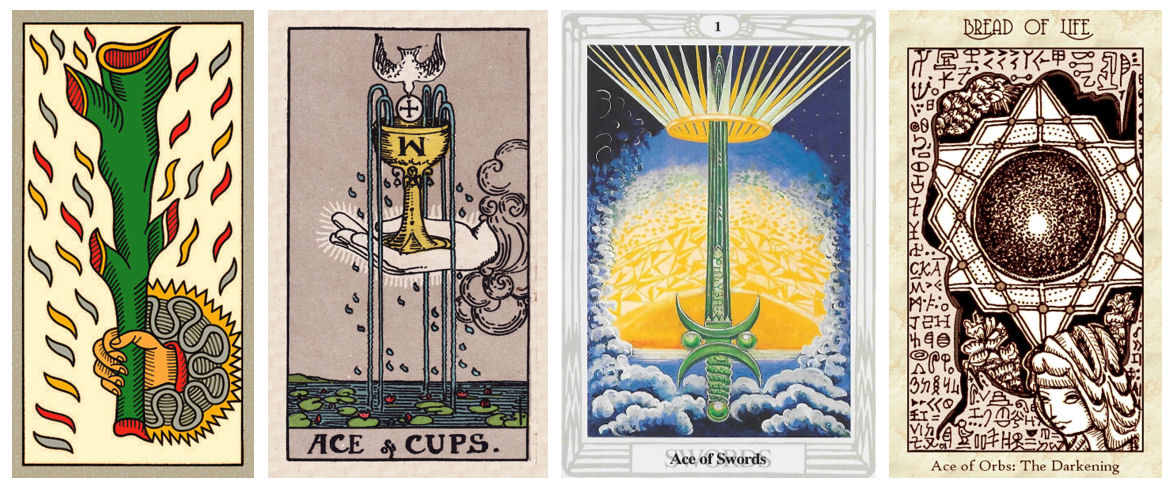
Tarot Card Meanings with Benebell is going to be an educational video series covering the 78 keys or cards of the tarot, showcasing the distinct attributions for four different deck systems: the TdM, the RWS, the Thoth, and my own deck, the SKT.
COURSE OBJECTIVES
Here are my objectives for the course:
(1) Facilitate familiarity of the TdM, RWS, Thoth, and SKT so you become proficient at reading any and all of the four systems,
(2) Offer a card by card primer designed to help memory retention of the key meanings in a more visually engaging way than studying them out of a book, and
A recurring sentiment you’ll hear, even among tarot readers, is that Crowley’s Thoth deck should be avoided, because Crowley. After e-mailing me paragraphs of rehashed Internet research on the salacious nuggets of the man’s biography to lay the foundation of their point, the inevitable question will come: “Should I avoid working with the Thoth because it’s got bad juju?”
I’m always amused when this question is presented for me to answer, as if I have any reasonable idea whether you in particular should work with or avoid working with the Thoth. It’s a matter of personal preference, and so it’s a question I can’t answer without knowing you through and through.
To strengthen your personal vitality and the reservoir of metaphysical powers you can command or control, through attunement to those inner and outer alchemical forces embedded into the archetypal tarot architecture.
Some of you may know of the online video companion course to Holistic Tarot already. I put out the first few video lectures for the series this past week. The videos supplement the study guides and handouts, which supplement the book, Holistic Tarot. To check out the course outline and description, click on the above hyperlinked banner. This blog post is just to offer some of the behind-the-scenes commentary.
Offering a Beginner’s Tarot Course
I have been pressed ad nauseum about offering a beginner’s tarot course. While I haven’t felt called to start production of materials with that specific intent in mind, as in an online multi-media course that teaches you how to read a deck of cards, I wrote Holistic Tarot with that specific intent (i.e., to instruct on tarot at the beginner level) in mind. Then when the book launched back in 2015, I created a portfolio of syllabi, study guides, and handouts to help people navigate the 800+ pages. That was my “beginner’s tarot course.”
Still I got pressed. Apparently that wasn’t what many of you folks had in mind when you think “beginner’s tarot course”?