The Journey of Love oracle deck by Alana Fairchild and illustrated by two artists, Rassouli and Richard Cohn, was published by Llewellyn (Blue Angel Publishing) in 2014. It’s printed in the same style common among modern oracle decks right now, with the larger dimensions, sticky high-gloss finishes, and vibrant contemporary art.
There are 70 cards in total, along with a sizable perfect-bound guidebook. Alana Fairchild has rapidly ascended to the top of the New Age Movement. She is based out of Australia and is the bestselling author/creator of guided meditation CDs, books on angels and crystals, etc., and exquisite oracle decks that tend to be inspired by the divine feminine. There’s the Kuan Yin Oracle deck, the Isis Oracle, Mother Mary Oracle, and Sacred Rebels, among others. I have the Kuan Yin deck (my review posted here), this one, and the Sacred Rebels (review forthcoming). I love the Sacred Rebels deck, like, a lot, but I might actually love this one, the Journey of Love oracle more.
Prior to getting a tea leaf reading from Tabitha Dial over at Tarot and Tea Leaf Readings, I didn’t know much about the practice. Okay, I still don’t know much about the practice, but my perspective has definitely shifted. Tea leaf reading, or tasseography, is a cross-cultural divinatory practice that I’d seen done before, heard about through my childhood, but never delved into. So I had no idea what to expect from Tabitha.
I asked her about the trajectory of my book writing and publishing endeavors, but also kept open to any related messages that might come through. For my reading, she sent over a five-page single-spaced write-up accompanied by four large, full-color photographs. Tabitha used loose leaf black tea and as the leaves were steeping in the water, a strawberry symbol formed at the bottom of the cup. You can see it quite clearly here:
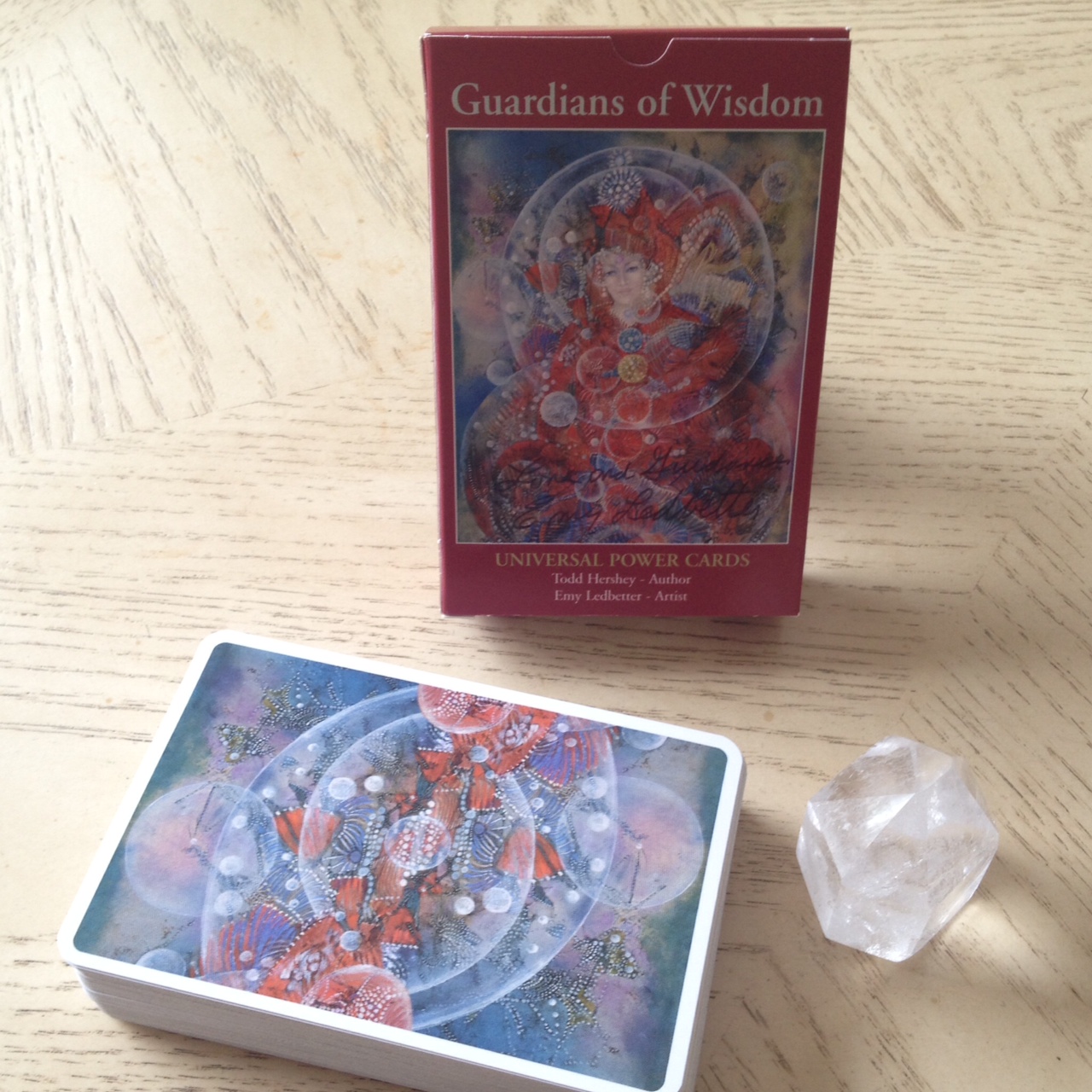
The Guardians of Wisdom Universal Power Cards is a 78-card tarot-inspired oracle and insights deck, or universal power cards, that was self-published back in 2000 by Todd Hershey and illustrated by Emy Ledbetter. I contend that this deck came out way ahead of its time, and had it been released today, 15 years later, rather than back in 2000, it would have become an instant bestseller and generated a great deal of buzz.
The vibes of this deck are the same vibes as today’s most popular oracle decks and resonate with why we reach for oracle decks, only the Guardians of Wisdom cards do it better. Like, way better.
It’s not light and sugarcoated. Many of the messages can be bitter pills to swallow about yourself. As either tarot or oracle decks go, this one is way up there in terms of how well it achieves equal competency between both upright and reversed readings with the deck. In fact, you’ll want to read with reversals when you use the Guardians of Wisdom power cards and you’re not going to want to overlook that very important component. In fact, it’s half the deck. Literally.
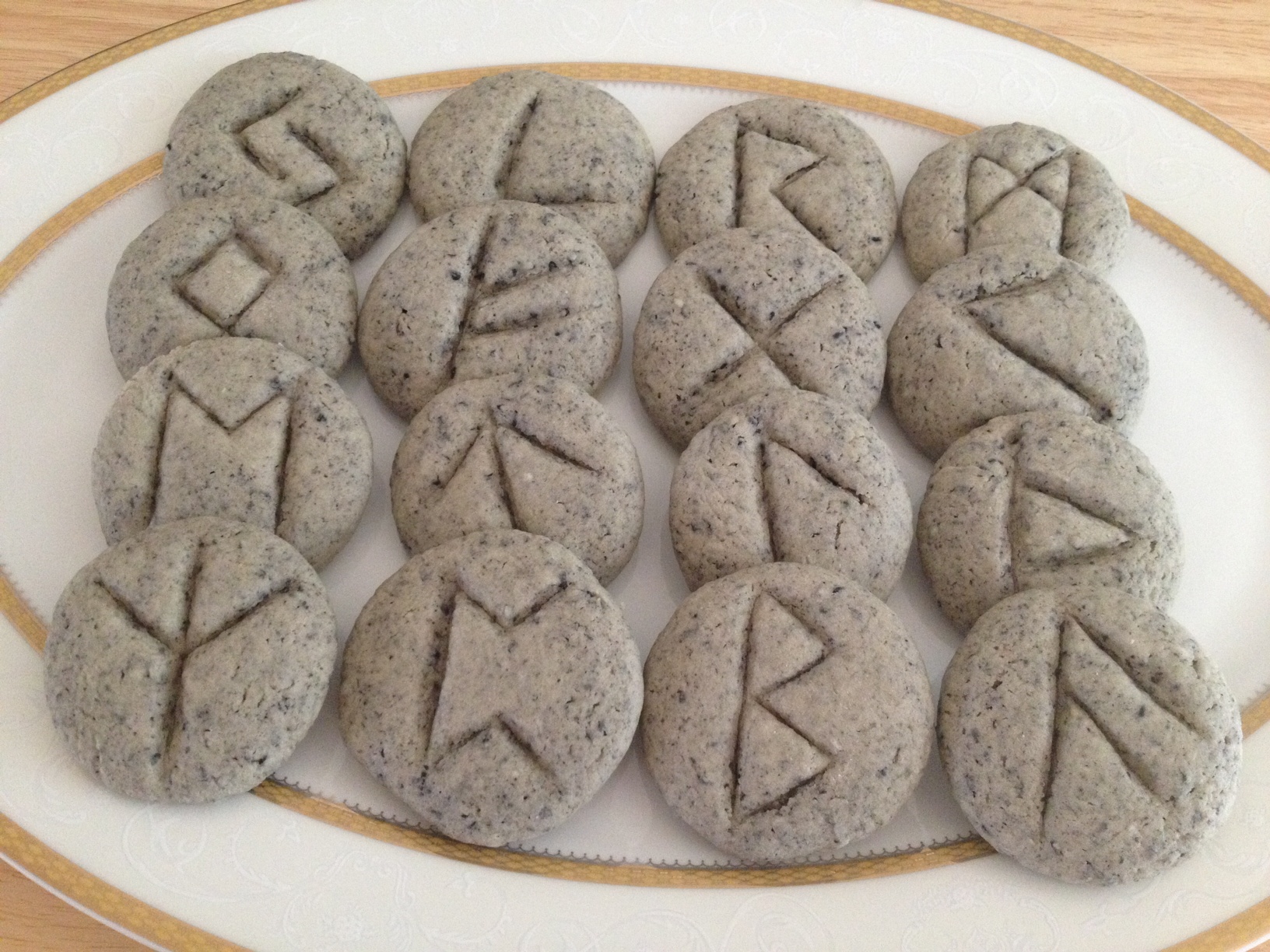
These black sesame shortbread rune cookies look like beautiful stone runes but are also absolutely delicious to eat. I am so excited to be sharing this recipe, which comes from a book I’ve been loving, Kyotofu: Uniquely Delicious Japanese Desserts by Nicole Bermensolo and Elizabeth Gunnison Dunn. It’s published by Running Press.
The recipe in Kyotofu is just for straightforward black sesame shortbread cookies, a fantastic recipe, and then I took it a step further and turned these cookies into runes. Now, I don’t know much about runes or rune divination, so bear with me here and I welcome any corrections in the comments section.
The Orbifold Tarotcomes from the inventive mind of Michael Bridge-Dickson and I have been granted the privilege of reviewing a pre-release version. The Orbifold Tarot is grounded on the cosmological principles of sacred geometry, a cross-cultural concept that the physical world and its metaphysical dimension can be expressed through mathematics, specifically, geometric design.
The god principle and intelligent design are not mutually exclusive from geometric design, and if we accept that “as above, so below,” then the mathematics of our universe is synchronistic with the mathematics of our personal lives. All that we as tarot practitioners have accepted as occult theory is thus rooted in mathematics, in sacred geometric forms. That is the premise from which we begin our journey with the Orbifold Tarot.
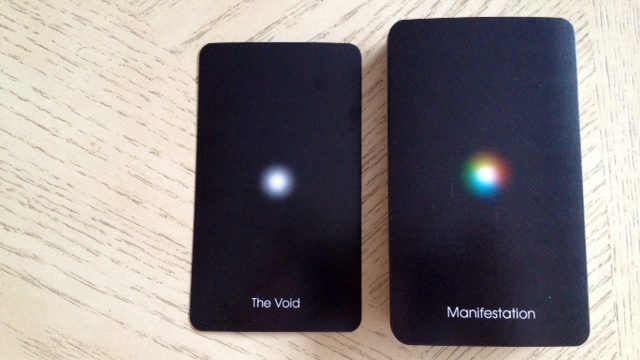
There are 80 cards in total, with the traditional tarot structure of 78 plus 2 cards, The Void and Manifestation. Initially I associated The Void with Key 0, The Fool and Manifestation with Key 1, The Magician, so I was confused by the distinction made between these two additional cards with Keys 0 and 1 of the Majors. However, Bridge-Dickson explained it cogently to me.
Bridge-Dickson himself debated whether to make the distinction. To him, Key 0, The Fool is the blank slate individual, a soul ready for the new adventure ahead, the journey through the three septenaries of the Major Arcana. The Void, in contrast, is the non-individual, the utter lack of manifestation whereas in The Fool, we still have the ego present. Key 0 represents beginnings, as traditionally associated with the card, whereas The Void is before the beginning.
Manifestation, too, is the non-individual, beyond being, though as manifestation, of course it encompasses being. Together, The Void and Manifestation represent the paradox of simultaneous being and non-being beyond the individual. Bridge-Dickson felt the principle had to be separated out from Keys 0 and 1, as The Fool and The Magician include personal Will, which renders both cards affirmatively being.
The Orbifold Tarot is color coded to represent the elemental correspondences that Bridge-Dickson sees as the deconstruction of each card’s essence. White is Spirit. Yellow-gold is Air. Red is Fire. Blue is Water. Green is Earth. Keep that in mind as we examine the card samples. Here in The Fool card, we see Air encompassed by Spirit in the form of the unit circle. The beginnings of the formation of self are thus Air, the mind or thought, beginning to occupy a specific space of Spirit.
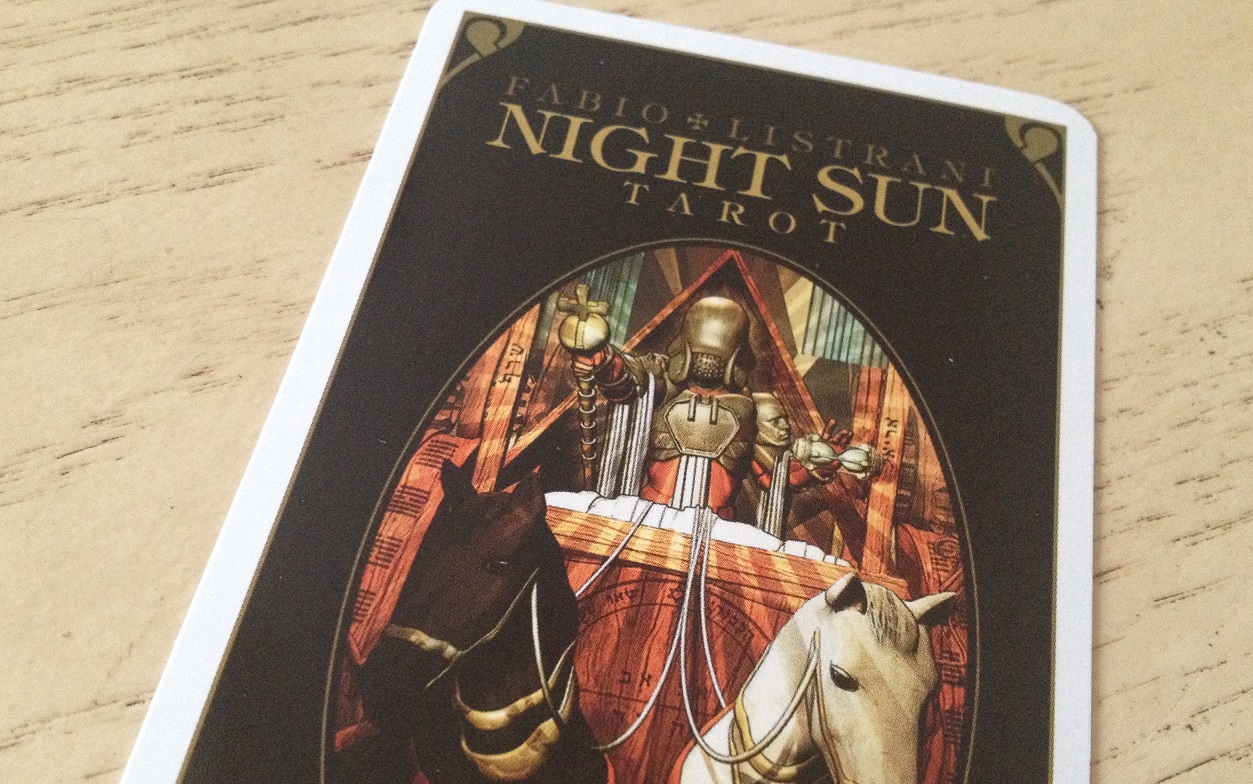
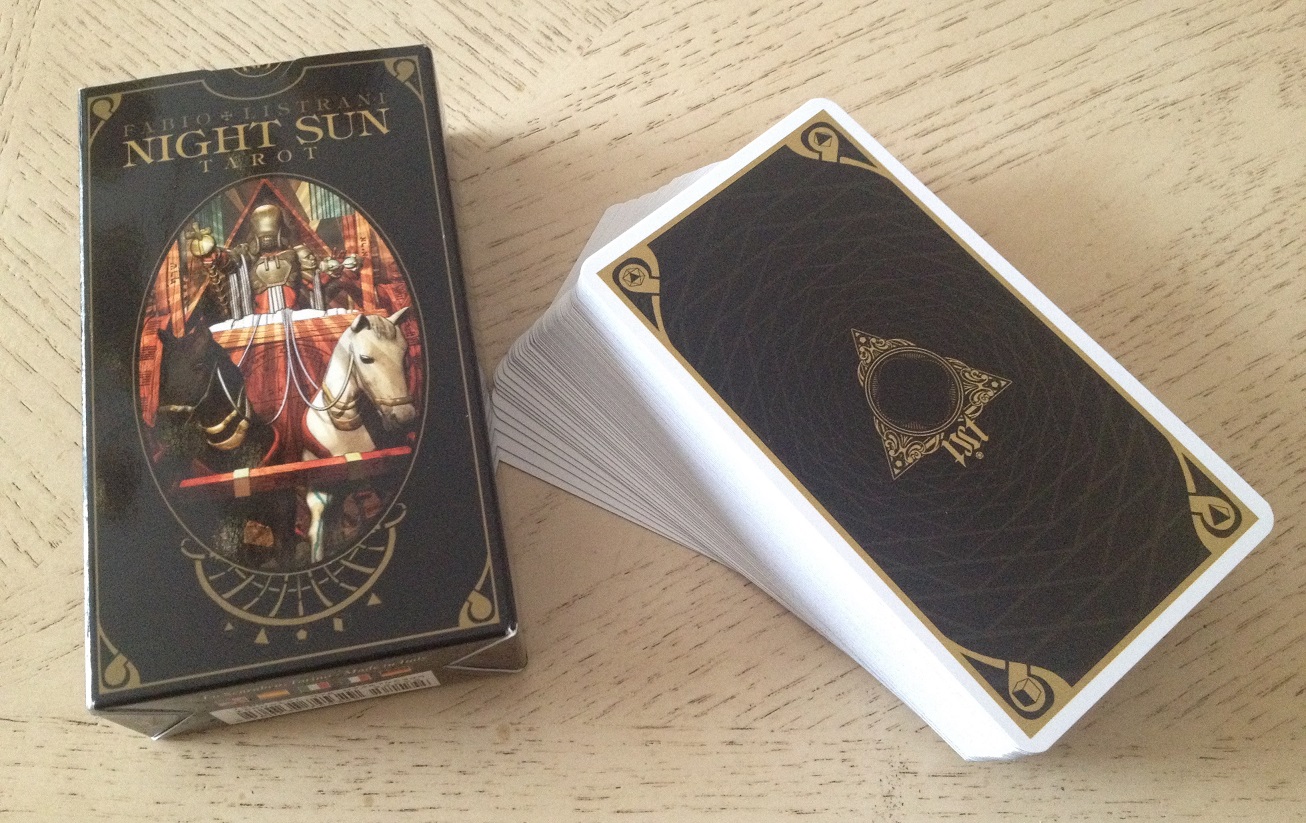
Fabio Listrani’s Night Sun Tarot is one of those decks I couldn’t wait to get my little hands on. I would consider this an esoteric tarot deck. On the Majors, you have the astrological, elemental, and Hebrew letter correspondences in the card corners. In the Minors, you have the elementals and decanates. I usually have to hand-write these onto my working decks, but here on the Night Sun, the work is done for you, and done beautifully.
There is a strong Modern Age comic book art style to the Night Sun Tarot, with digitally rendered illustrations. Fabio Listrani, the brainchild behind this exquisite deck, is an Italian artist and graphic designer whose work tends toward the science fiction/fantasy genres of art. He seamlessly blends Eastern and Western esoteric symbolism and cultural references, and updates esoteric tarot for the 21st century with this very original, insightful, and groundbreaking new deck.
Tarot of the Holy Light: A Continental Esoteric Tarot (Noreah/Brownfield Press, June 2015) is a book that started ten years ago, and so when I talk about the long-awaited arrival of this book, I’m not kidding. It is the first volume of companion text to the Tarot of the Holy Light tarot deck by Christine Payne-Towler and Michael Dowers, which I’ve reviewed on this site before.
Volume two, forthcoming, will be Foundations of the Esoteric Tradition. The two volumes together function as left and right hemispheres of the same mind. This book review will only be of volume one, Tarot of the Holy Light (“THL Companion Book”)
The THL Companion Book is self-published by Christine Payne-Towler and Michael Dowers under their publishing entity, Noreah/Brownfield Press. The book is soft-cover and perfect bound, and at 492-pages, is full of meat. I love the unique dimension, too, at 5″ x 7″, which makes it an incredibly compact text to throw into your handbag.
While there is no historical verification that tarot descended from mahjong, their striking similarity in structure and the cosmological or philosophical correspondences associated with the playing pieces is still worth noting. Both seem to be subdivided into Trump cards and Minors, and within the Minors, further subdivisions into suits, with each suit numbered into pip cards or tiles. Both were intended for games, but both are also used for divination.
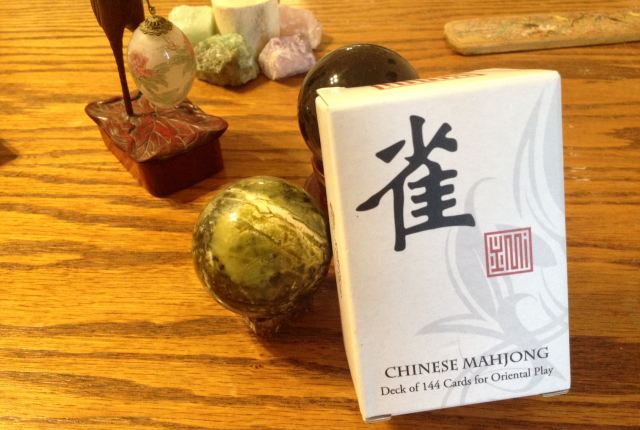
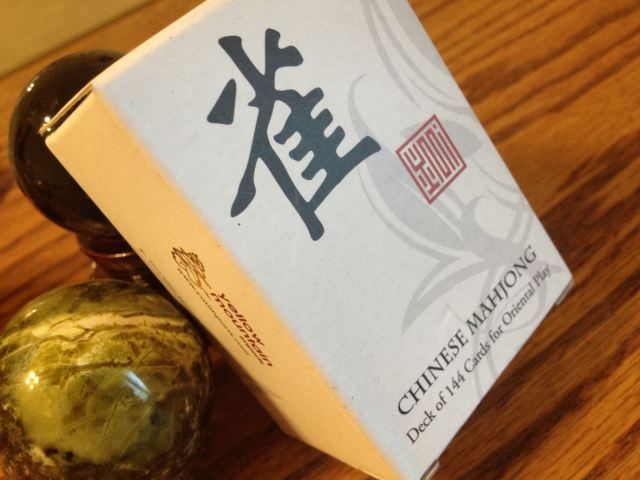
Recently I’ve been inspired to hunt down my own mahjong set, but there is a reason Chinese people get special tables for mahjong– the darn thing takes up a lot of space. There’s just a crap ton of tiles that make annoying clicking sounds when you shuffle, and the tiles remind me of Joy Luck Club or something, I don’t know. I knew I wouldn’t be using my set for games, and it’d be strictly for divination study. Intuitively, a whole set of mahjong tiles (the standard click-clack ones Chinese folk play with) didn’t feel right in my reading room, my personal sacred space. So. I opted for a more discrete alternative– mahjong in the form of cards. They have that now! It’s awesome. It’s a deck of 144 cards.
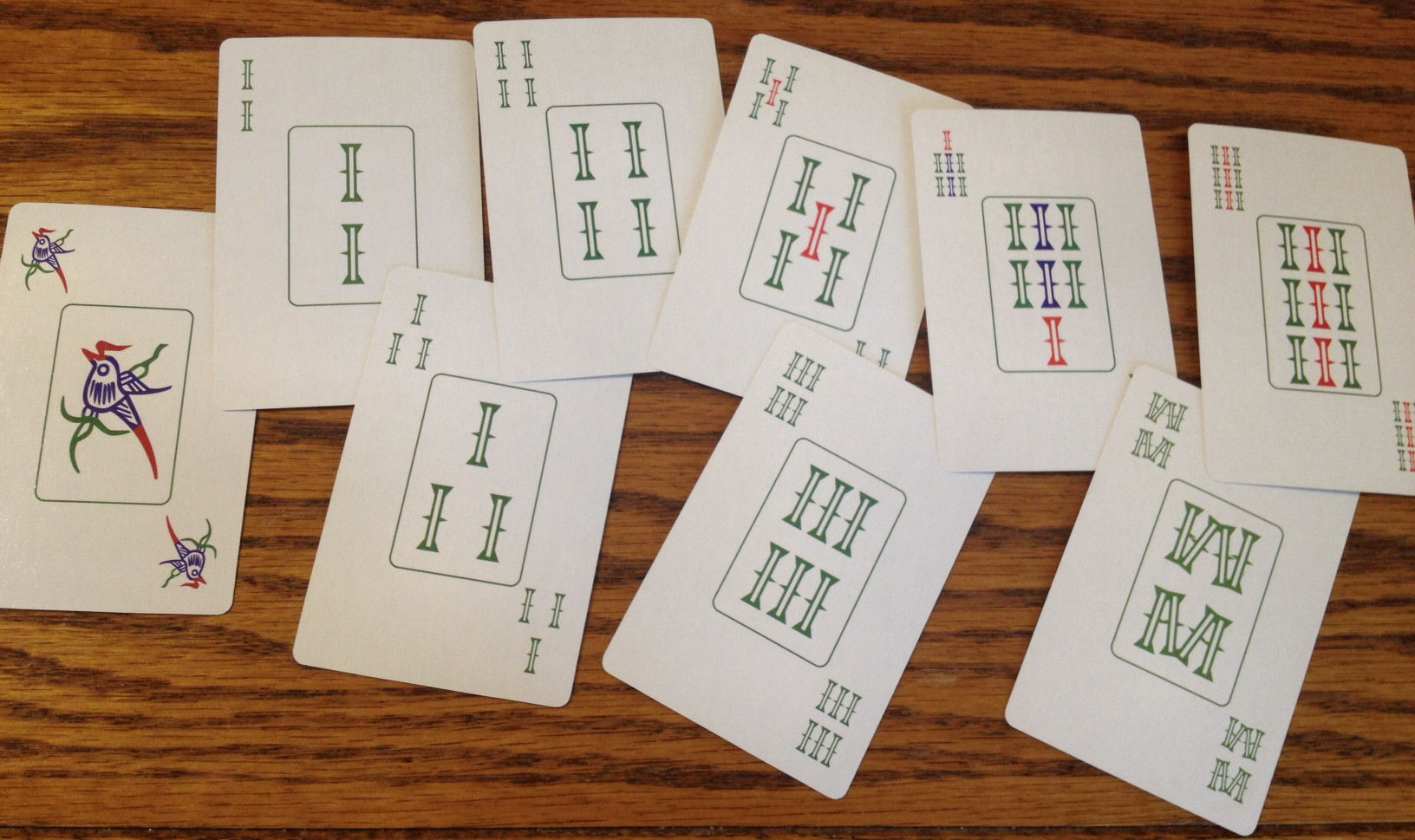
I’m using a cute little deck referred to simply as “Chinese Mahjong: Deck of 144 Cards for Oriental Play” published by Yellow Mountain Imports. You can get it off Amazon for all of five bucks. It’s great. The card quality is kind of meh. They didn’t produce this particular deck with esoteric or spiritual work in mind, that’s for sure. There’s a tacky high-gloss laminate and as you can see from the photos, it’s very, very basic in card imagery.
Mah Jong “Minors,” Suit of WheelsMah Jong “Minors,” Suit of BambooMah Jong “Minors,” Suit of Characters
Mahjong consists of 3 suits: Wheels, Bamboo, and Characters. The 3 suits are correspondent with Heaven, Earth, and Man, after the Chinese cosmological concept of the Trinity of Lucks.
Heaven Luck represents circumstances you’re born into, beyond your control, like the social class of your parents or innate talents and physical attributes, i.e. nature. Heaven Luck is believed to be pre-ordained.
Earth Luck is your geographical location, and how where you are affects what you do or who you become, i.e., nurture. Earth Luck is your environment and how your environment helps or hinders your success.
Man Luck is free will, what you do with yourself, the choices you make, your education, your actions, behavior, attitude, etc.
Additionally, Wheels often indicate life circumstances, events, conditions, or things that “happen” to you, things beyond your control that you’re just going to have to figure out how to deal with, the cards you’ll get dealt; Bamboo will talk about wealth, finances, money matters, security; Characters talk about career, education.
Super-traditionally here, marriage was seen as orchestrated by the fates, and so might get expressed in a reading through the Wheels, or if some important things were about to go down, with the Honors or Supreme Honors (more on that later). So it wasn’t like in tarot divination where you might have a whole suit (i.e., Cups) associated with love, relationships, and our emotional plane. The emotional plane wasn’t really seen as this whole separate matter that might require its own suit. So there wasn’t a suit for it. Interesting cultural differences here, me thinks.
I heard about the Haindl Tarot not too long ago through the grapevine of tarot readers I know. Yet this deck was first published back in 1990. Hermann Haindl (1927-2013) is a German artist known for his surreal art and incorporation of mythology.
Rachel Pollack has penned companion books for this deck that come highly, highly recommended by pretty much every tarot practitioner I know. I haven’t dived into them yet, but will. At this stage, I’m interested in connecting with the deck directly to see what I can glean, and then I’ll be consulting Pollack’s books on the Haindl.
The Haindl Tarot is a truly remarkable deck for any tarot enthusiast to work with.
For the Majors, each card corresponds with a letter in the Hebrew alphabet per Qabalistic tradition, from The Fool as Aleph, Key 1: The Magician as Beth, Key 2: The High Priestess as Gimel, and so on. Each card also corresponds with an Anglo-Saxon rune. At this point in my personal tarot practice, I don’t work much with Hebrew alphabet or rune correspondences in tarot, but the astrological correspondences on the bottom right corners of the cards excite me.
Preview of Select Majors. Click on photo to enlarge.
The paintings are surreal with subdued, subtle coloring. I’ve filtered these photographs to add greater contrast for clarity purposes, but in hindsight I wish I hadn’t. Now you can’t see the light, ethereal quality of the original coloring. In person, the art is not quite as bold as they seem to appear in these photos. The art seems to mirror the stream of consciousness of our minds, which results in an incredibly powerful and evocative tarot deck to work with.
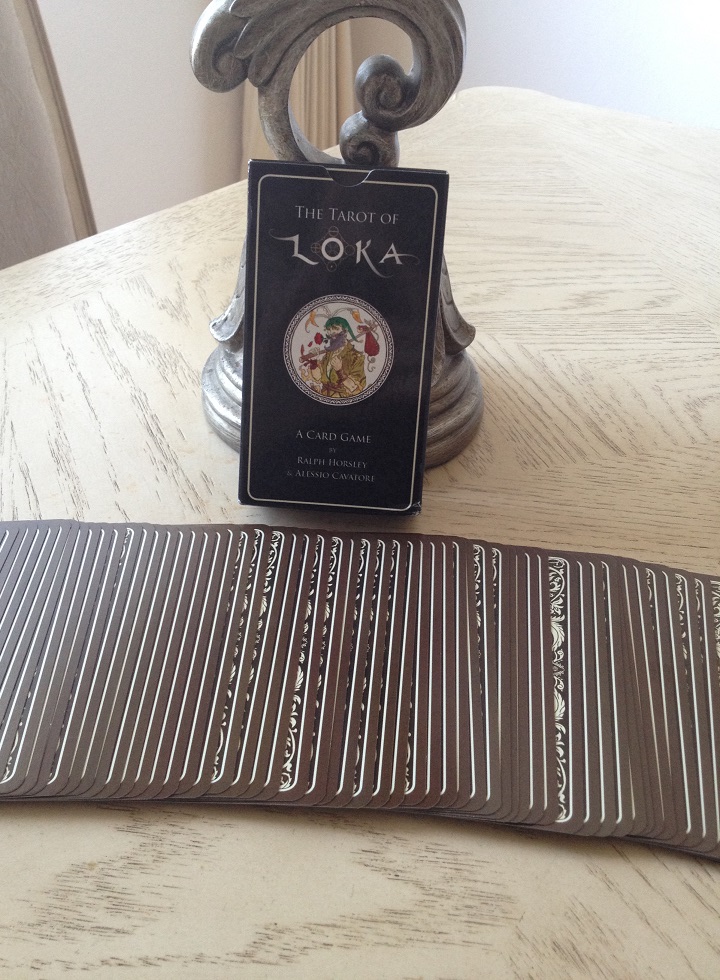
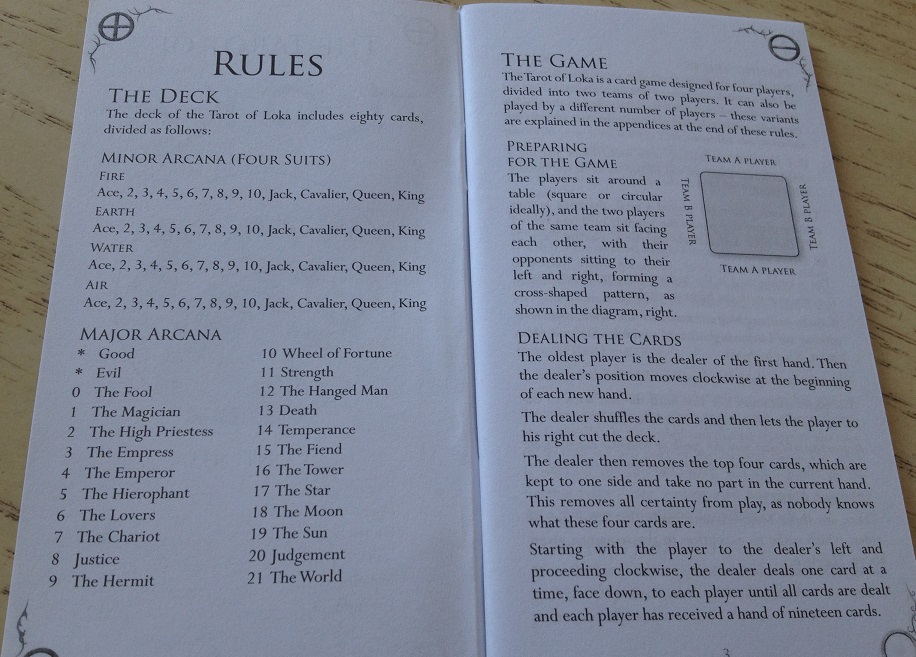
The Tarot of Loka is designed for game playing, not divination, and that intent is made clear in the companion LWB (little white booklet). However, I hope no one will mind too much if I focus my deck review on using the Tarot of Loka for divinatory purposes, since that is my area of interest.
Inspiration for the deck comes from the fantasy world of Loka, which you can see in another game, Loka: The World of Fantasy Chess. Warriors in four armies, the armies that correspond with the four suits, Fire, Earth, Water, and Air, are at battle, though two suit armies are in alliance versus the other two suit armies. In some ways, the tarot game for Loka as instructed in the LWB reflects that premise.
The original intent for the Tarot of Loka is a family-oriented card game, for four players. The LWB provides the rules for the game. I’ve found a number of reviews online for Tarot of Loka as a card game, so if that’s what you’re looking for, I’m afraid you have come to the wrong place and I apologize for the inconvenience. Some great reviews of the deck as a game can be found here and here, among others. My review, however, is going to look at the viability of the deck as a divination tool.
I won’t be using this deck for game playing for a silly superstition-sourced reason: I never use a deck, any card deck, for both game playing and divination. It’s one or the other. I can’t remember who “taught” me that, but that was one of the first and earliest “rules” I learned about cartomancy. Is it a silly “rule”? Yes, of course it is. However, call me a closed-minded fool, but I can’t pull myself out of that habit. So, because I do want to be able to use this deck for divinatory purposes, I won’t be playing games with it. So again, my review is focusing on the Tarot of Loka as a divinatory tool, which is not the deck’s intended purpose.
The Tarot of Loka is designed by Alessio Cavatore, an Italian game designer, and illustrated by Ralph Horsley, who does some really incredible medieval style art. The Tarot of Loka began as a Kickstarter campaign and was first published by River Horse Press, though later came to be distributed through Llewellyn.
The card dimensions are a typical Lo Scarabeo size, about 2.5″ x 4.6″, and as you can see in the above photo, symmetrical along the vertical side, which eliminates reading reversals or having to look at a card “upside down” when it comes up in a reading. They’re bordered dark brown, which looks great on these cards.
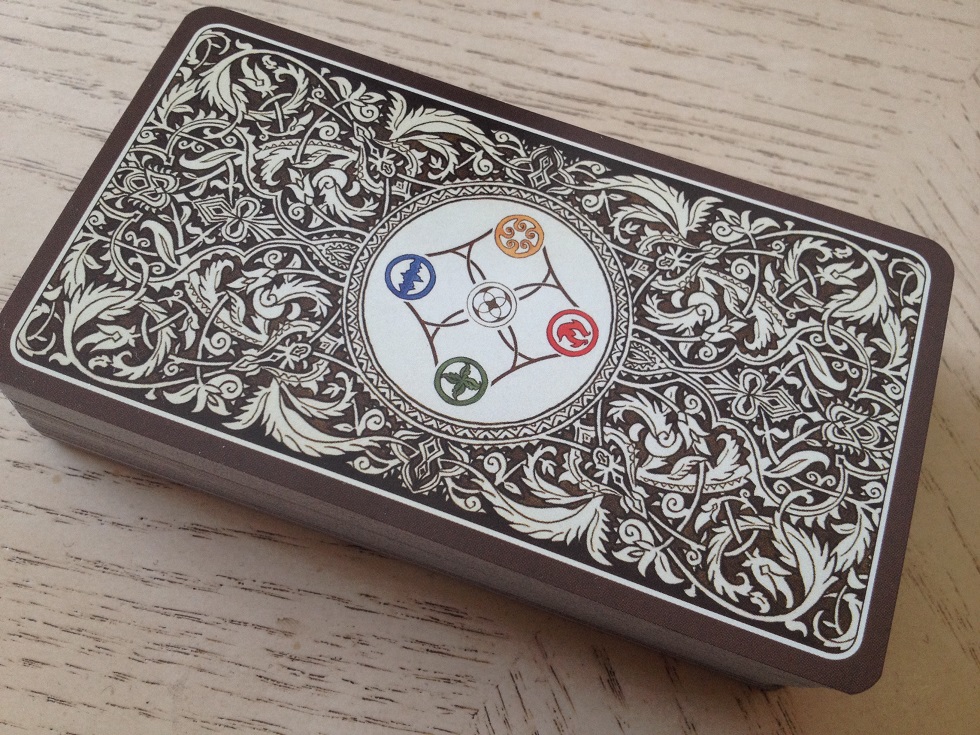
The card backs are not reversible, but it’s a very subtle difference, so not really significant. There are beautiful, ornate medieval-inspired designs with a center medallion that shows the symbols for the four suits of the Minor Arcana connected with the central symbol for the Major Arcana, or trumps. I love the card backs. These backs are exquisitely designed.













 benebell wen