The B.O.T.A. Tarot and Paul Foster Case

Let’s conclude Golden Dawn Tarot week with an offshoot-GD deck, the B.O.T.A. Tarot by Paul Foster Case, illustrated by Jessie Burns Parke. In this blog post, the fully colored Majors are from the 2009 Ishtar Publishing reprint of Paul Foster Case’s Learning Tarot Essentials: Tarot Cards for Beginners (1932), via the Internet Archive.

You can buy the black and white deck for coloring direct from the Builders of the Adytum here for just $8.50. It’s an incredible deal! I’ll share more photos of the physical deck later in this review, but it’s matte, unrounded corners though, and lovely quality.

The digital images of the Major Arcana for download can be purchased for $5.00, linked here and digital the Minor Arcana digital files for $5.00, linked here. B.O.T.A. also has a couple of other deck purchasing options at their online store, so be sure to check it out, and nothing over $20– great prices. (fyi this is not an advertisement or promo; no one paid me to say any of this.)

Continue reading “The B.O.T.A. Tarot and Paul Foster Case”

Golden Dawn Magical Tarot by the Ciceros

Earlier in the week I posted about the Golden Dawn Tarot by Robert Wang and Dr. Israel Regardie, and continuing on what has somehow turned into Golden Dawn Tarot week here on my blog, this will be a showcase of the Golden Dawn Magical Tarot (or New Golden Dawn Ritual Tarot) by Chic and Tabatha Cicero.

The guidebook is titled The New Golden Dawn Ritual Tarot: Keys to the Rituals, Symbolism, Magic & Divination (2010). I’m reviewing the 2014 reprinted edition. The guidebook also refers to the deck as the New Golden Dawn Ritual Tarot, but then the box reads Golden Dawn Magical Tarot. In the guidebook, the authors themselves refer to the deck as the Ritual Tarot, so that’s what I’ll be going with.

If you’re interested in contemporary Golden Dawn based ceremonial magic and the tarot, then you’ll want to get this book and deck set.

Continue reading “Golden Dawn Magical Tarot by the Ciceros”

The Golden Dawn Tarot by Robert Wang

Robert Wang, perhaps best known as the author of Qabalistic Tarot, is also an artist. He created The Golden Dawn Tarot back in 1978 and later the Jungian Tarot in the 90s. There’s a companion book to the deck, An Introduction to the Golden Dawn Tarot published through Weiser also in 1978. You can digitally “check out” or borrow the text at OpenLibrary.org for an hour, which is what I did and will comment on as a supplement to this deck overview.

From Robert Wang’s An Introduction to the Golden Dawn Tarot (Weiser Books, 1978)

“Rarely has a tarot deck created more pre-publication interest than this long-awaited Golden Dawn Tarot pack by Dr. Robert Wang, a devoted scholar and researcher of the Secret Order of the Golden Dawn,” wrote Stuart Kaplan about the deck.

With the guidance of Dr. Israel Regardie, poring over old notebooks of members from the Hermetic Order of the Golden Dawn, Wang created the Golden Dawn Tarot as an esoteric deck intended to reveal, with greater clarity, the Golden Dawn interpretive approach to the cards. This was to be a “missing link” between the Rider-Waite and the Crowley Thoth. Kaplan described Wang’s deck as “an important rare book in the field of tarot.”

Continue reading “The Golden Dawn Tarot by Robert Wang”

Secrets of the Jewelry Box Tarot by Timea

I was fortunate to get an early review copy of Tímea Méhész’s Secrets of the Jewelry Box Tarot. Méhész is a silversmith and jewelry designer who, from early childhood, has leaned an interest into mysticism and the esoteric arts.

This deck intrigued me because I haven’t seen anything like it. The concept is ambitious. Méhész is a metalsmith and jewelry designer. She creates upcycled jewelry. Secrets of the Jewelry Box is a photographic collection of her beautifully crafted pieces, each one inspired by a tarot card. What if you opened up your jewelry box and each trinket in there connected to a Key of the tarot?

Continue reading “Secrets of the Jewelry Box Tarot by Timea”

Ink Witch Tarot by Eric Maille

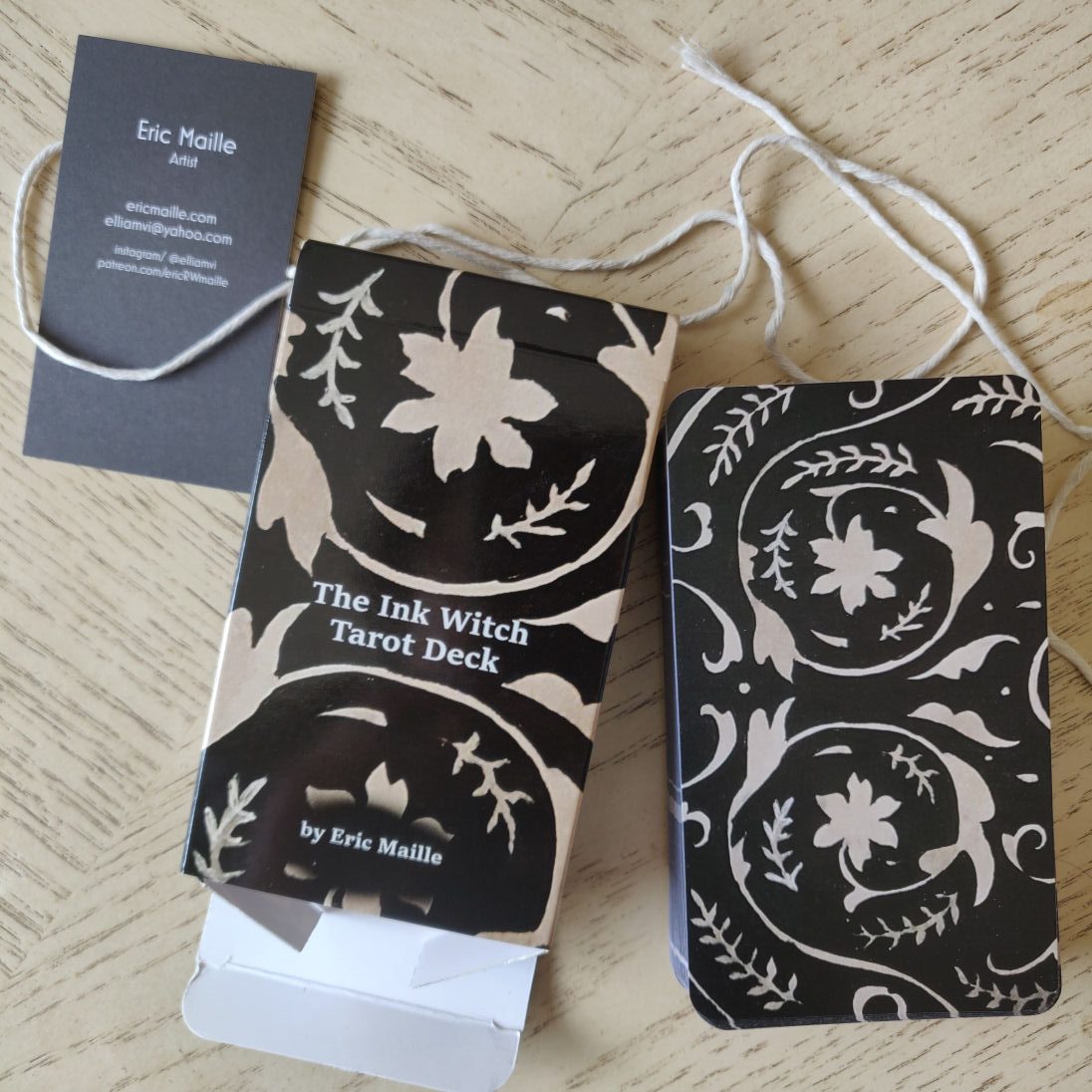
A while back I reviewed the book The Cards: The Evolution and Power of Tarot by Prof. Patrick Maille. Eric Maille is his son, an artist, and the creator of the Ink Witch Tarot. Maille is an Oklahoma-based artist and illustrator whose works explore “the irony that we as humans often feel poorly equipped to live out that experience, struggling against our environments, the people around us, and our own emotions” (per his artist statement). And you’re going to find that theme at the heart of these beautiful illustrations.

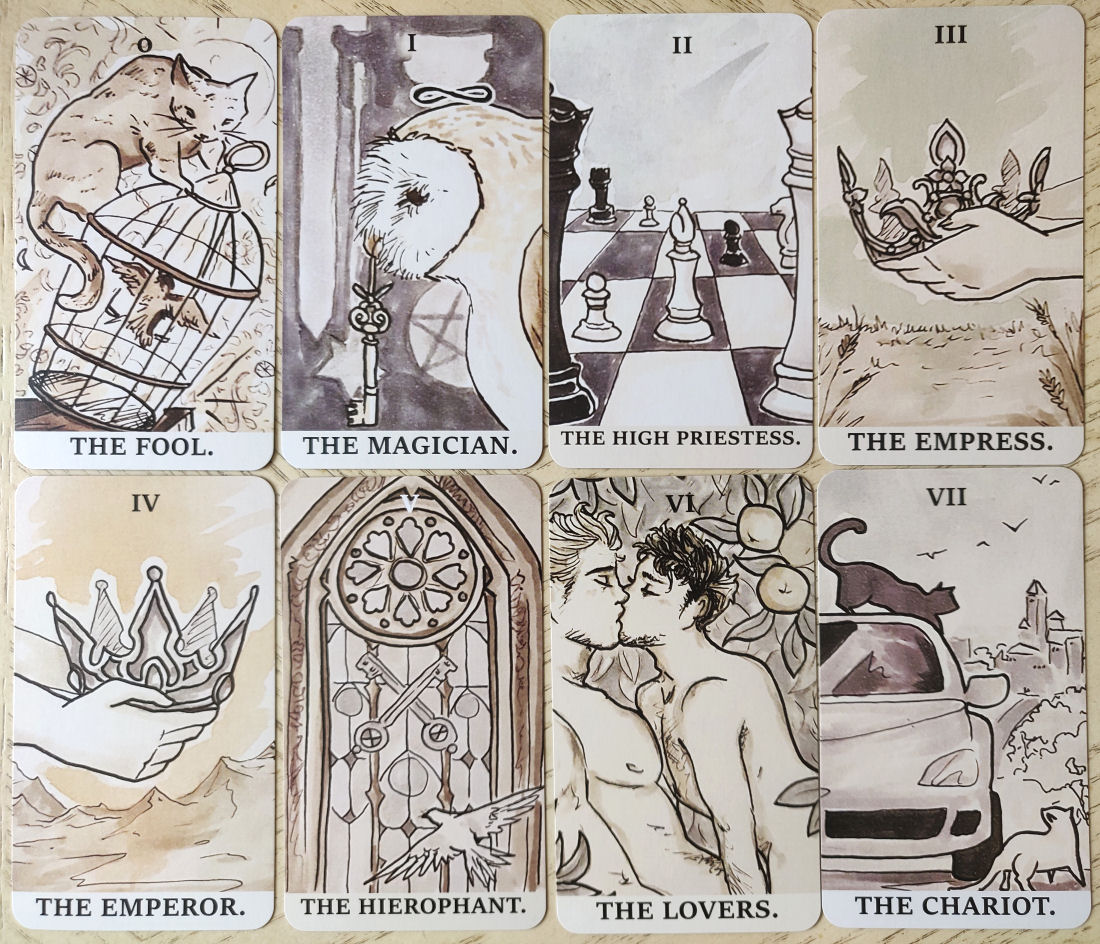
The art style here reminds me of haboku, a form of traditional Japanese ink brush painting that’s done in monochrome, expressing depth through sharp uses of contrast, an art style that tends to be impressionistic, soft, and flowing.

What is so compelling about the Ink Witch Tarot is the storytelling, and Maille’s artistic interpretations of each tarot card. In Key 0, I see The Fool as the bird, who appears to be in a precarious position, but the way that cage is about to fall off the tabletop, the door will swing open and that bird will be freed. If you view The High Priestess illustration as an in-process chess game, either the other side’s pawn is about to take the bishop or the bishop is about to take the other side’s king. Meanwhile both sides’ queens are side by side in the foreground, reminiscent of the traditional High Priestess’s twin pillars.

Continue reading “Ink Witch Tarot by Eric Maille”

Botanica Tarot by Kevin Jay Stanton (Beehive Books)

The Botanica Tarot, published by Beehive Books, is truly one of the most exquisite tarot decks I have had the pleasure of seeing. Beehive Books is a boutique press that specializes in beautifully designed books.

If the 78 cards of a tarot deck signify 78 universally experienced allegorical points on the circle of life, where more often the cards speak to human life, then these 78 cards speak to the circle of life in the plant kingdom.

Continue reading “Botanica Tarot by Kevin Jay Stanton (Beehive Books)”

Russian Tarot of St. Petersburg by Yury Shakov

I cannot believe it’s taken me until 2021 to share my thoughts on the Russian Tarot of St. Petersburg. This deck was first published back in 1992 and was among my first and earliest collection of tarot decks. I loved this deck so much. It’s one of those decks that summon up the perfect atmosphere when doing public tarot readings.

These are Russian Palekh miniature paintings done by Yury Shakov (July 15, 1937 – March 10, 1989). Palekh miniature painting is a form of folk lacquer art done with tempera paints and varnish. Shakov specialized in this particular medium and the artwork on the Russian Tarot of St. Petersburg was his final commissioned work before he died. However, I also read that he didn’t finish this deck, and that another artist picked up where Shakov left off to complete these paintings.

In the Majors, you’ll find historical and cultural references. The Hierophant, for instance, features Saint Duke Vladimir holding a scepter and a Russian Orthodox cross.

Continue reading “Russian Tarot of St. Petersburg by Yury Shakov”

Spacious Tarot by Carrie Mallon

I’ve been so enamored of the art and the premise of tarot reader Carrie Mallon and illustrator Annie Ruygt‘s The Spacious Tarot. In The Spacious Tarot, we explore the spirit of a place, and divine by invoking the genius loci.

Carrie Mallon has been on my radar for a while now. She’s been producing a lot of high-quality, accessible tarot content. Mallon has a YouTube channel where you will find lots of free 30 min. to an hour tarot workshops, such as “How to Work with Tarot Spreads” and “How to Read Tarot Tenderly,” or “The Four Styles of Reading Tarot” and “The Fool’s Journey,” just to name a few. She’s got a calming, down-to-earth, and resonant style of teaching that I think you’ll love.

In The Spacious Tarot, there are a few exquisite instances of cameos from the animal kingdom and depictions of wildlife, such as fish in the four court cards from the suit of Cups, bears in the Pentacles court, blackbirds in the Swords court, and red salamanders in the Wands court.

Continue reading “Spacious Tarot by Carrie Mallon”

The Muse Tarot by Chris-Anne Donnelly

The Muse Tarot by Chris-Anne Donnelly is a contemporary tarot deck reimagined into the four suits of Inspiration (Wands), Emotions (Cups), Voices (Swords), and Materials (Pentacles or Coins) rendered in vibrant digital art collage.

It is the fraternal twin of the Light Seer’s Tarot and I’m here for it.

Dynamic and full of energy, The Muse Tarot comes to us when such a vivid deck is most needed, helping us to navigate the challenging times our world currently finds itself in. Uplifting and bright, this is the deck that will help you to overcome creative blocks and jump-start your inner drive.

Let’s start with a simple reading. Choose a card: left, center, or right. Remember your selection. We’ll be revisiting these three cards at the end of this review and through the card you’ve drawn, get a little message from Spirit at your place and time, and also see how you connect with the Muse Tarot.

Continue reading “The Muse Tarot by Chris-Anne Donnelly”

Ibiza Tarot: The Oracle of Tanit Flip-Through

I was gifted this deck ages ago, but it sat dormant for years, and I only recently thought to take the cards out of their box and give them a whirl. The Ibiza Tarot: Oracle of Tanit is a 39-card oracle deck inspired by 22 keys from the Major Arcana, the tarot court cards, and the Phoenician folk magic found on Ibiza, plus cards corresponding with the ancient gods.

Tanit is the Phoenician patron goddess of Ibiza, Spain, and is associated with love, fertility, and rebirth (I’m getting this straight from the guidebook itself; see above). She’s often depicted with a bust reminiscent of Medusa. The pagan goddess Tanit is invoked as the power behind divinatory readings with this deck. The faded imprint of a woman’s face on the deck box and guidebook cover art seems to be that of the goddess.

This Mediterranean-inspired deck, with the island of Ibiza (which is described as “the playground of the Gods, Phoenicians, the Greeks, and the Romans”) as its namesake, blends numerology, astrology, and the Phoenician alphabet with the Major Arcana. The deck is intended to be a celebration of Ibicenca heritage and tradition.

Continue reading “Ibiza Tarot: The Oracle of Tanit Flip-Through”