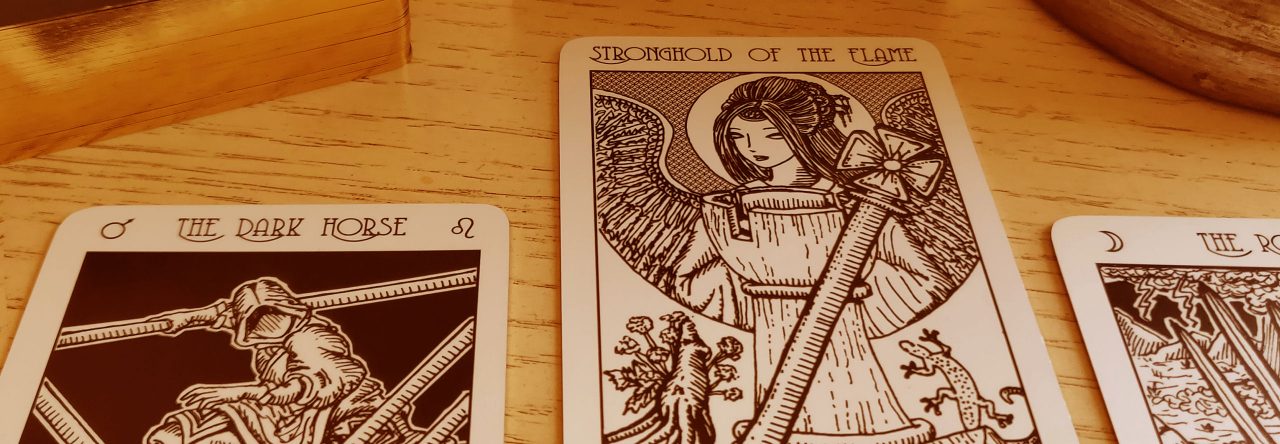
The Wandering Moon Tarot by Rachael Jean

I love black and white decks and I love pen and ink illustration. So it is no surprise that the Wandering Moon Tarot by Australian artist and tarot reader Rachael Jean is right up my alley. This deck was gifted to me by the artist, whose art style I absolutely love.

By the way, you can’t tell from these photos, but the card back design is holographic, and when it catches the sunlight at just the right angle, it glitters! Super magical!

Working with solid outlines and pointillism while commanding white (or negative) space with finesse, Jean’s compositions are clean, always with strong focal points, and expressive. There are a couple of bonus cards in this deck, and The Wanderer, pictured above, is one of them.

Here, a “solitary traveler of the cosmos sits upon a planet’s surface, looking up and gazing at a crescent moon. This figure is surrounded by universal energy and cosmic love.” This card reminds you to stay grounded and present, appreciating the moment. Also, look at the chunkiness of that companion guidebook! It’s co-written by the artist Rachael Jean and Marion Kirk.

As tools, there are two types of tarot deck illustrations I like to make sure I have in my collection: the first is when each card illustration feels like a complete and comprehensive universe, and perhaps might be considered “busy” with all the detailing, and the second would be a deck like Wandering Moon, where each card’s illustration feels like anatomical parts of a sentence, or thought, the way signs and symbols would appear to you in a crystal ball.

And because of that minimalist aesthetic, with each card more likened to a glimpse into a crystal ball, Wandering Moon Tarot is fantastic for large multi-card spreads from the Celtic Cross to in-depth 15-card readings. With all that white space, this is one of those decks you could really customize with your own pen and ink additions, if you wanted to.

Continue reading “The Wandering Moon Tarot by Rachael Jean”

Oracle of Dr. John Dee by John Matthews and Wil Kinghan

The Oracle of Dr. John Dee by the illustrious John Matthews and one of the tarot community’s favorite artists Wil Kinghan was first published in 2013. Anything with the name John or Caitlin Matthews on it is guaranteed to be well-researched and worth your while.

John Dee was an alchemist, astrologer, mathematician, geographer, philosopher, and historian. In other words, a polymath. Dee met Edward Kelly, who claimed to be a powerful medium. In a vision, Kelly told Dee that he saw Archangel Michael seated on a throne with a kneeling figure at the archangel’s feet, and that figure was none other than John Dee. Needless to say, Dee took a liking to this Kelly.

Dee and Kelly formed a partnership where, over the course of several months, the two downloaded an entire language system from Heaven, the language Adam used to converse with the Creator and the angels. Dee called this language Enochian.

Continue reading “Oracle of Dr. John Dee by John Matthews and Wil Kinghan”

The Field Tarot by Hannah Elizabeth Fofana

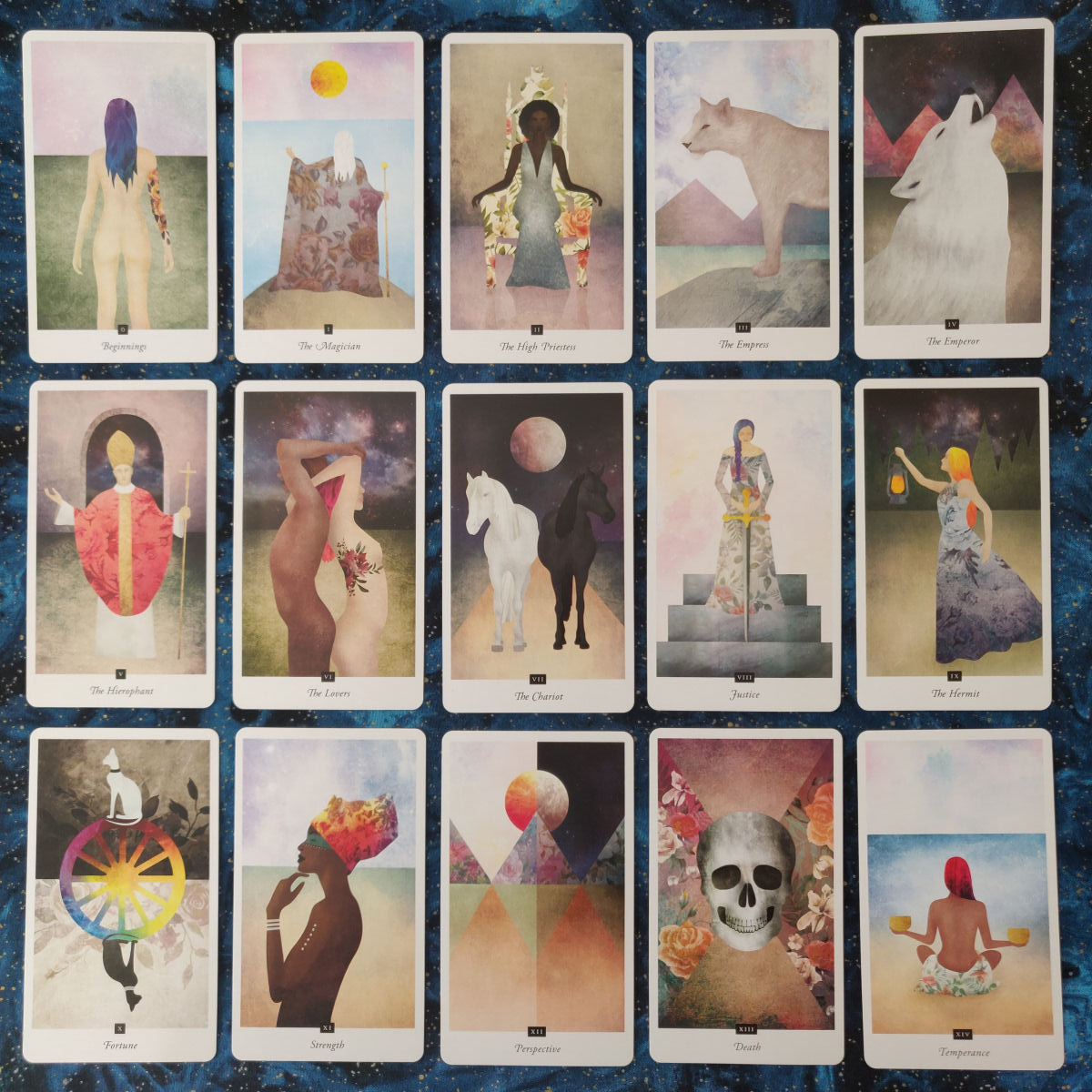
The Field Tarot created by graphic designer and artist Hannah Elizabeth Fofana definitely intrigues me. It feels a bit like a futuristic mystery thriller with an indie ethereal, quasi-vintage (the floral patterns evoke this) aesthetic.

The deck was created to guide readers through the sacred space (“the field”) where the tarot narrative takes place. Noted in the guidebook: “The prominent horizon line used throughout many of the cards puts you, the reader, within this space, allowing you to connect the traditional tarot journey to your own.”

With Justice in the place of Key 8 and Strength as Key 11, plus something about how the deck resonates intuitively, this feels deeply Thoth-inspired.

Continue reading “The Field Tarot by Hannah Elizabeth Fofana”

Shadowscapes Tarot by Stephanie Pui-Mun Law

The Shadowscapes Tarot is one of Llewellyn’s evergreen decks, meaning it remains a consistent bestseller since its first publication in 2010. And that’s no surprise. Oakland-based artist Stephanie Pui-Mun Law is indisputably one of the most talented illustrators to set her hand on to creating tarot art.

This is one of those decks you want to take a magnifying glass to. With the delicate threadbare lines and inlays of elaborate ornamentation, it would be almost disrespectful to not devote hours of meditative study to the details.

Three Septenaries of the Major Arcana. Click to enlarge.

How would I describe the deck art? If Asgard of Old Norse saga and Tianchao, the Celestial Empire of Chinese mythos merged into one kingdom inhabited by factions of magical creatures in which an epic fantasy was set, then you’d get the Shadowscapes Tarot.

Continue reading “Shadowscapes Tarot by Stephanie Pui-Mun Law”

Tarocchi dei Celti (Tarot of the Celts) – Majors Only Deck

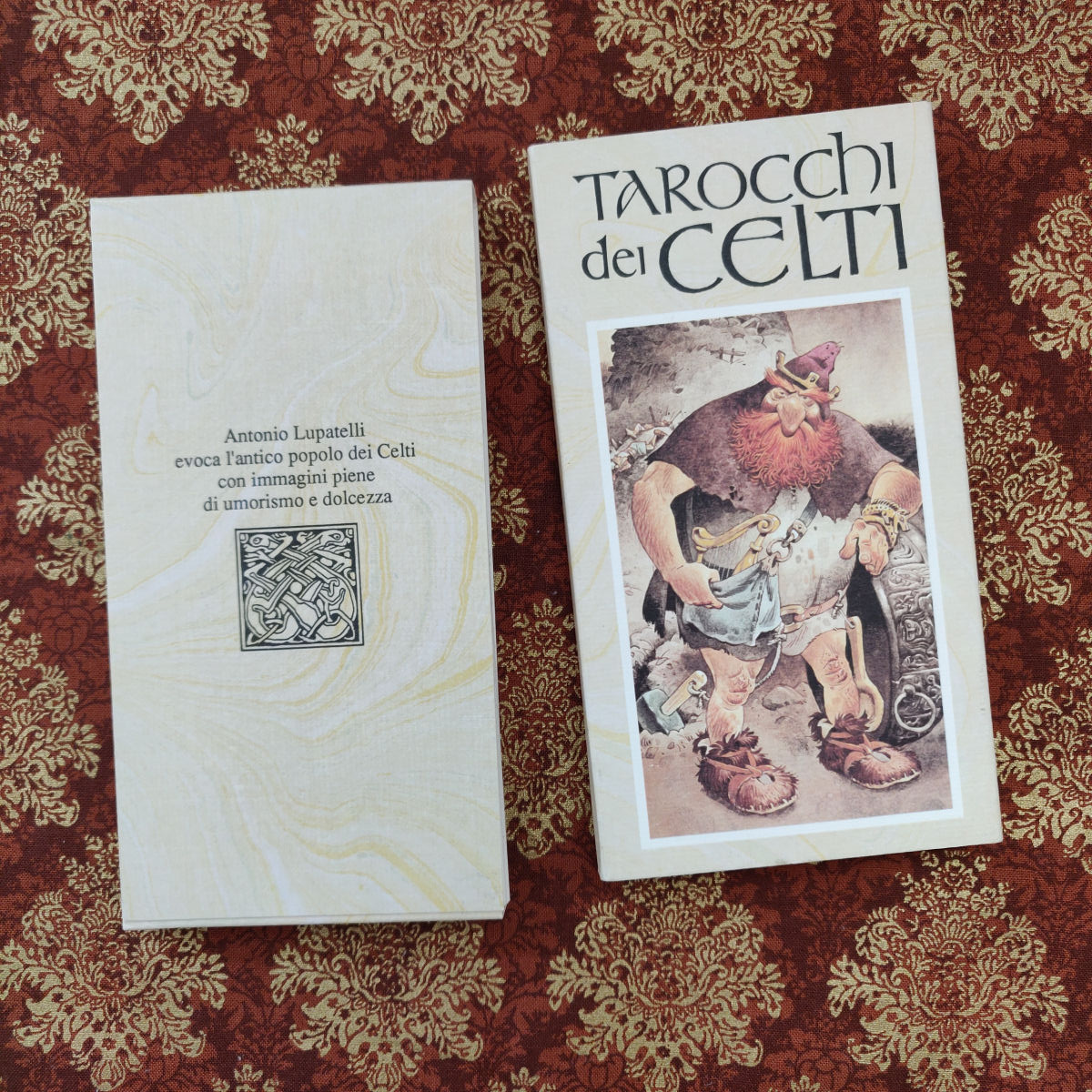
Tarocchi dei Celti, or Tarot of the Celts, is a Majors only deck published in Italian. The artwork is done by Italian illustrator Antonio Lupatelli (1930 – 2018), “evoking the ancient people of the Celts, with illustrations that are full of humor and sweetness” (thank you, Google Translate).

Laughs nervously. Okay, I’m wholly unqualified to be reviewing this deck. I have no idea what any of the key titles say, and when I tried typing the words into Google Translate, for instance with “Fintan mac Bochra,” the application tells me this phrase doesn’t exist in Italian, and in Arabic, allegedly it means “Venta is not good.” Not only is there the language barrier, there’s also the cultural barrier– I’m not all that familiar with Celtic mythology.

Ah, wait a minute– now if I type in a whole paragraph, the translation result is better. For Key 0 (il Matto), it’s Fintan mac Bóchra, and that’s a name. He was a Druid known as “The Wise.” I like that play of Fintan the Wise on the tarot Fool card. The salmon pictured on the card is a reference to Fintan being able to shape-shift into a salmon, and a reference to the Salmon of Knowledge in Irish lore.

As for the artwork, there’s certainly a whimsy to these illustrations. Of what I can read, note Morrigan for Key III (The Empress card). You may need to click on the above image file for a zoomed-in close-up view. Oh, and I’m guessing Key II (The High Priestess) is Brig or Brigid.

Due to a severe lacking in my knowledge of Celtic mythology, I’m not going to comment on any of the associations, so whether The Morrigan as the tarot Empress card makes any sense… I have neither the information nor knowledge to offer intelligent commentary. =)

Continue reading “Tarocchi dei Celti (Tarot of the Celts) – Majors Only Deck”

The Goddess Tarot by Kris Waldherr

Kris Waldherr’s Goddess Tarot was the deck I read with in college at sorority houses and Greek mixer events. It would be this deck, pulled out of my messenger bag. The room would hush, because people still get a little nervous around tarot cards, and I’d have the querent shuffle the cards while focusing on her question, and then when she was ready, to cut the cards in three, restore to a single pile, and hand back to me. Then I’d lay out the Celtic Cross.

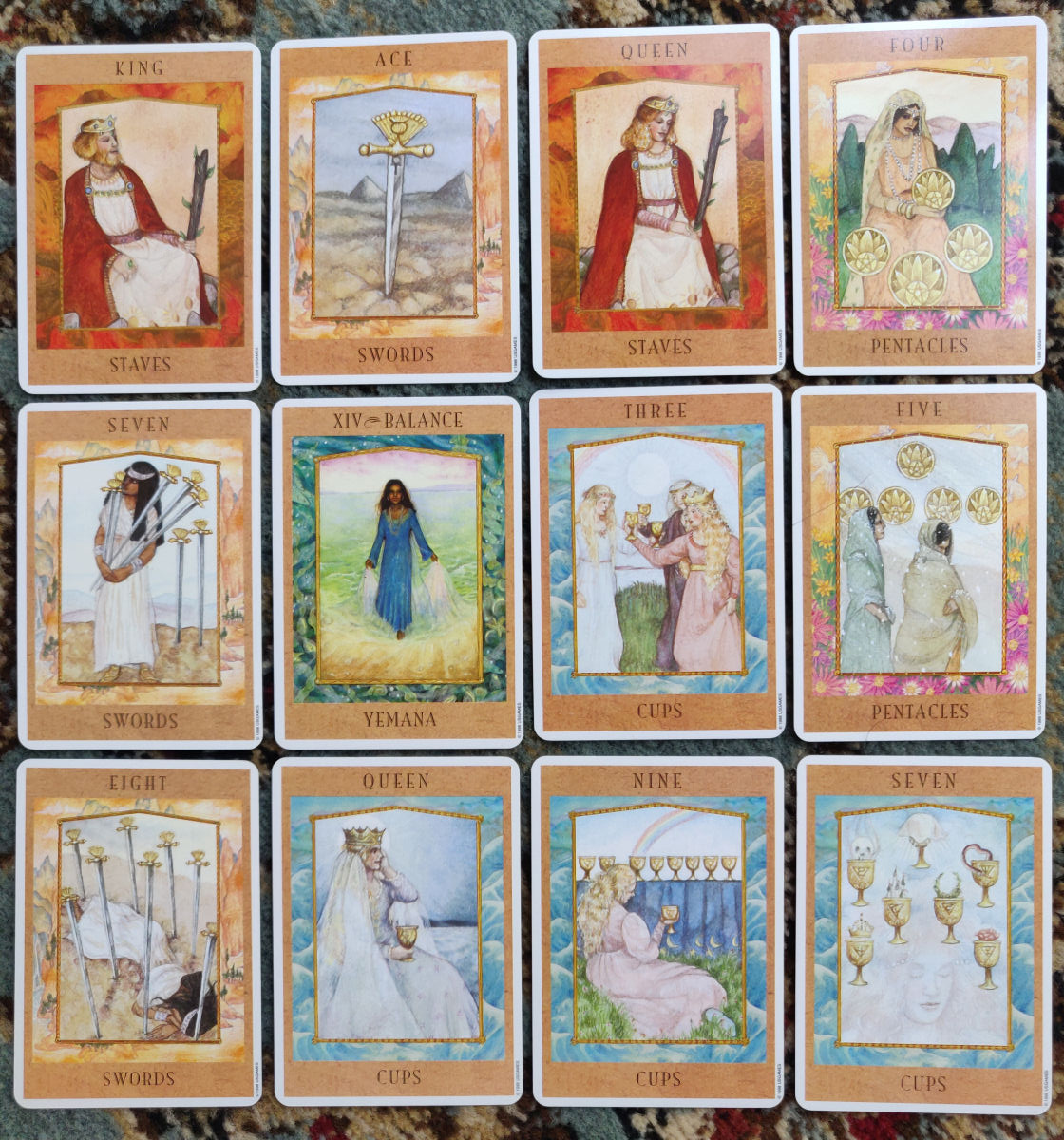
Back then I found that some people could get antsy around the RWS, so I couldn’t use the yellow box RWS without a risk of someone freaking out. Whereas no one ever freaked out when I read with the Goddess Tarot. The artwork is soft, with low contrast and low saturation, light values, and if I had to speculate on the medium used, I would guess watercolors and maybe some colored pencil.

The only male representation in this deck are in the Princes and Kings, and that was done intentionally by the artist. The Goddess Tarot is a “celebration of the Divine Feminine” (quoted from its LWB) with drawings of goddesses from around the world. Writes Waldherr, “My intention in creating the art and design for The Goddess Tarot was to create a tarot deck that would speak directly to women using our stories, while incorporating the archetypal power and symbols of the tarot.”

Continue reading “The Goddess Tarot by Kris Waldherr”

The Crystal Unicorn Tarot by Pamela Chen

The Crystal Unicorn Tarot by Pamela Chen and illustrated by Lisa Higuchi lets the unicorns and rainbows loving child in you become the Oracle. With the standard symbology of the Rider-Waite-Smith deck in place, this deck is interchangeable with the original Rider pack.

This deck was blowing up everyone’s feed a while back, and I can totally see why. They are absolutely adorable. Like the extra card, “Donut Worry.” That the Donut Worry card is a cheeky bonus the way the Happy Squirrel card is and this one features a little squirrel by the unicorn… Omg. ::dies::

Candy colors remind me of the pre-Kindergarten girl I used to be, getting up early on weekday mornings to watch cartoons. (My personal favorites, if anyone’s asking, were My Little Pony, Glo-Worms, Strawberry Shortcake, and Care Bears.) By the way, a world-renowned psychologist and professor did research on beneficial effects of kawaii on us, which I’ll get into toward the end of this review, reinforcing why a deck like Crystal Unicorn holds such power.

The cards feature two unicorns, one with pink hair and one with purple hair, and they’re the two protagonists that appear throughout the scenes. The Fool’s Journey becomes a story of love, or maybe friendship, or both.

Crystal Unicorn Tarot reminds me of my girlhood because in my grade school years, I loved sketching unicorns. One time my father sat down and observed me doodling unicorns (horse figures), but didn’t voice any comment. A short while later, there was a hardcover drawing reference book on horses waiting for me on my bedroom desk. Unfortunately I was eight years old and the drawing reference book was most likely intended for university-level art major students, so it went straight over my head and I absorbed nada.

Continue reading “The Crystal Unicorn Tarot by Pamela Chen”

Robert M. Place’s Tarot of the Sevenfold Mystery

The card back design of the Tarot of the Sevenfold Mystery features the Staff of Serapis, Serapis being a principle god in Egyptian mysticism. The staff features the head of a wolf, a lion, and a dog, representing the three Platonic souls and also, the past, the present, and the future heads of Cerberus. During the Renaissance, this imagery was associated with Prudence, who is featured on The World card.

That Staff of Serapis card back design was the first thing I saw of this deck, and I was immediately intrigued. Years ago a friend of mine gifted me with the Sevenfold Mystery deck, believing this was a deck I’d love, and he was right.

Creation of the Tarot of the Sevenfold Mystery by Place began “at the dawn of the 21st century” and was initially inspired by the Pre-Raphaelite paintings of Edward Burne-Jones. Burne-Jones himself was inspired in large part by Botticelli and Michelangelo’s depictions of human figures and expression of Neoplatonic themes.

The unnumbered Fool card is Stultitia, featuring a woman with ass ears symbolic of the Soul of Appetite. She is blindfolded, symbolizing ignorance, and the dog at her side represents instinct. And of course, The Magician card is Hermes, and the High Priestess is Sibyl. Note that Key 9 is unnamed, for The Unnamed Seeker, The Hermit. This is “a mystic who has a vision of the sevenfold mystery. . .  He has no name because he represents silence and meditation.”

Continue reading “Robert M. Place’s Tarot of the Sevenfold Mystery”

Rota Mundi Tarot: The Rosicrucian Arcanum by Daniel E. Loeb

The Rota Mundi Tarot by Daniel E. Loeb, published earlier this year by Red Feather, is a tribute to the original Fraternity of the Rose Cross, and at its core, a tool for studying theosophy (theos = god, sophia = wisdom). The Rosicrucians integrated Western occultism with the tarot, a deck of playing cards, and through this medium, found a way to reconcile alchemy, Kabbalah, and the Arcanum Sapientiam Deum, or the Secret Wisdom of God.

The Rosicrucians were Christian mystics that formed a secret society to protect themselves from being burned at the stake for heresy. They embraced a divine feminine with parallels to the Shekinah (indwelling glory), a feminine word referring to the Spirit of God or the Holy Spirit. Rosicrucians believe this divine feminine to be “the Breath and Power of God, and an exact mirror of His goodness.” There is an oracle that can be used to consult this divine feminine form of wisdom called the Rota Mundi, or Wheel of the World, which is this deck’s namesake.

Eliphas Levi made the connection that the Rota Mundi of the Rosicrucians was the Tarot, and that theory stuck to the point where now, ROTA is inextricably tied to TAROT in Western occultism.

Loeb’s Rota Mundi Tarot seeks to convey Rosicrucianism in a coherent oracle system to clarify that theoretical connection between ROTA (i.e., the Spirit of Wisdom) and TAROT as an oracle for consulting that divine feminine form of wisdom.

Continue reading “Rota Mundi Tarot: The Rosicrucian Arcanum by Daniel E. Loeb”

DruidCraft Tarot: Meeting of Wicca and Druidry

A while back Lisa, Dani, and Dustin of Three Fat Readers talked about the DruidCraft Tarot, and that inspired me to chat about the deck here in a blog post. This isn’t a deck review. It’s me sharing my personal experiences with the DruidCraft. Another reason I wanted to go out of my way to post this is as a bit of a passive-aggressive defiant response to a recent “most influential” or “best of” publication on contemporary tarot decks where the DruidCraft Tarot by Philip and Stephanie Carr-Gomm, illustrated by Will Worthington was noticeably missing from that “best of” list. Like… whut?!

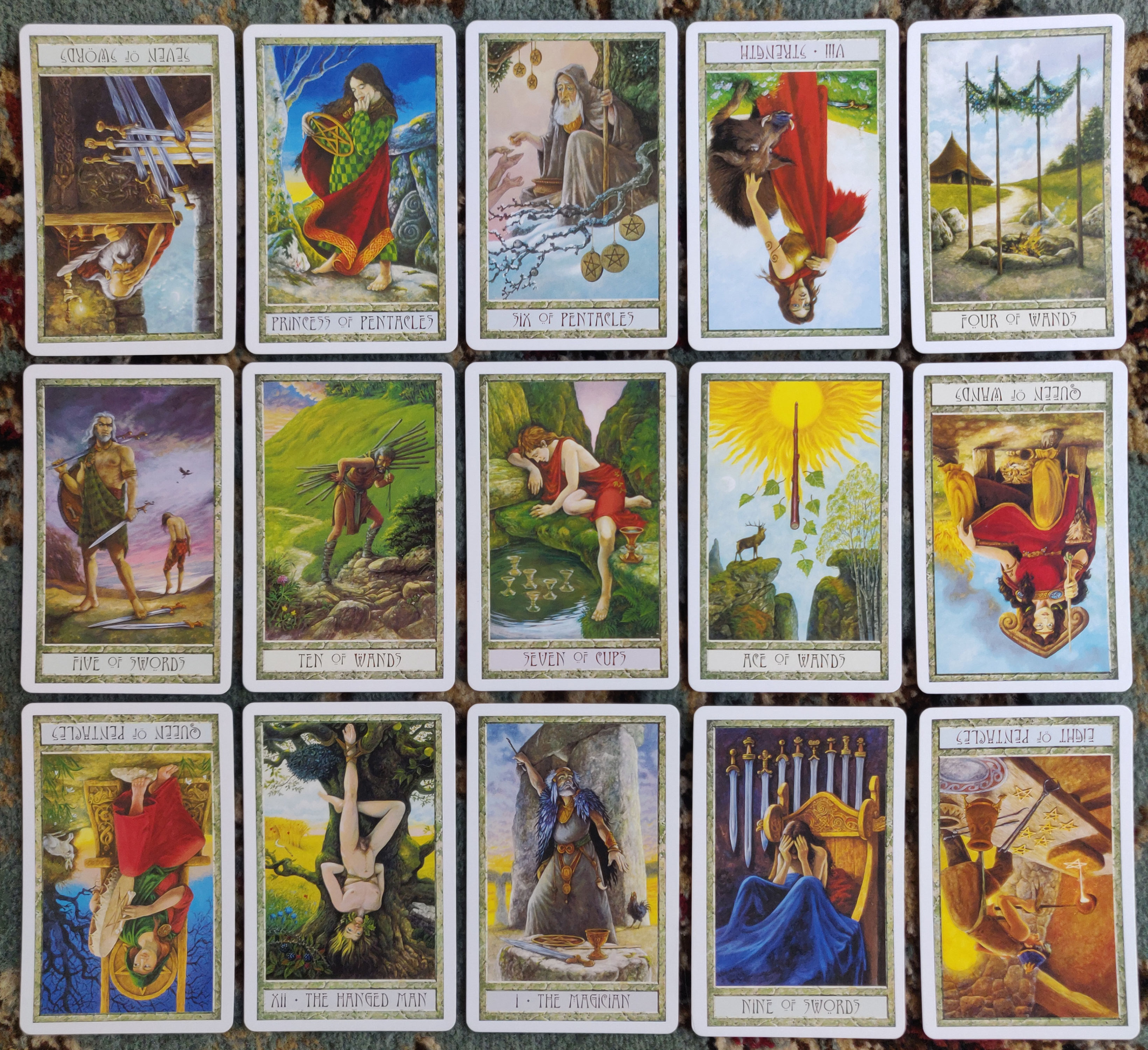
This was one of my go-to public reading decks from back in the day. When I was in my 20s, I did countless parties and social events with the DruidCraft. Some of the cards in these photos are going to be upside down because I wanted to show you my copy of the deck straight out of its tattered old box and I read reversals with the DruidCraft. What you’re seeing here is the exact order, upright and reversed, that the cards were in the very last time I used them… which was about a decade ago.

Click on photos for high-res, close-up viewing.

The premise of the deck is to be a synthesis of Wicca and Druidry, to express a path that the guidebook calls “The Old Ways.” The deck is also inspired by the Golden Dawn, which united “many of the disparate strands of the Western Magical Tradition . . . A quantum leap in the understanding and application of the Tarot occurred thanks to the stimulus of the Golden Dawn, and so we have drawn on this in The DruidCraft Tarot Deck for its intrinsic worth, and for its historical connection with the evolution of Druidry and Wicca” (cited from the guidebook).

Continue reading “DruidCraft Tarot: Meeting of Wicca and Druidry”