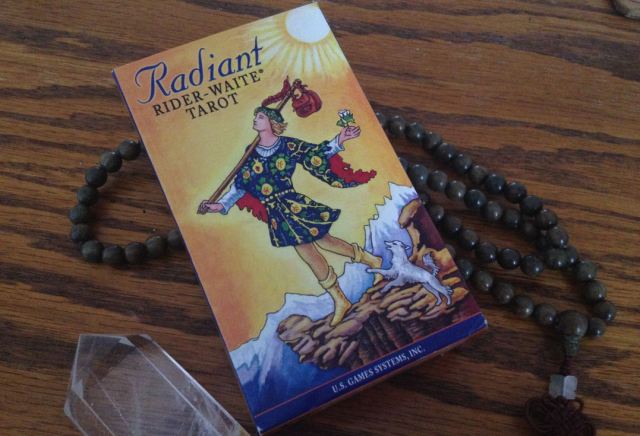
The Radiant Rider-Waite Tarot is aptly named. The colors are brighter and there is a wholly modern feel to this deck. The deck is laminated, glossy, and is printed on relatively sturdy cardstock. Holding the box, there’s a cheery vibration I get from it. The deck has a lot of great energy to offer a tarot practitioner.
I purchased the Radiant Rider-Waite because it comes highly recommended by some of the most acclaimed tarot professionals of this decade. I was looking for a professional tarot reading deck in the RWS tradition, one that would strictly be a Rider-Waite-Smith clone. I’ve started to get antsy about having too many random folk fondle with my original Rider Waite deck and my Golden Universal has been getting a lot of mileage, wear and tear as well. So I need a new professional reading deck I can use and let people play around with.
I was really, really hoping the Radiant Rider-Waite would be it.
Unfortunately, no.
Why not? It has nothing to do with the artwork, by the way. The artwork by itself is lovely. Compared to the original art by Pamela Colman Smith, this version, which are updated, vibrant recreations of Smith’s art by Virginjus Poshkus are superb. Poshkus thinned out the harsh black outlines from the Smith deck, added subtle shading, and recolored the deck so that now the images pop. There’s a bright, positive energy here, and I can see how it’s a great energy for young beginners in the RWS tradition to be working with. (And I do mean young beginners. I’m doubtful how well received this deck would be to mature beginners.)
See, there’s also a cartoony vibe going on that I’m not sure works for me in a reading deck. The cartoonish renderings are distracting to me. Yes, Smith’s art isn’t fantastic, but the original RWS serves its purpose. The two-dimensional imagery in the original RWS and austere lines help me tap into my intuition. The vibrant cartoons in the Radiant Rider-Waite? Not so much.
Poet Scot Slaby sent me a copy of his chapbook The Cards We’ve Drawn (Bright Hill Press, 2014) to read and I want to share it with all you tarot enthusiasts out there. I very much enjoyed it and read it through cover to cover several times. These are poems that can really tug on your heartstrings, even more so for the tarot enthusiast who can truly appreciate the depth of Slaby’s lines.
The first part of the book consists of 11 poems, each poem expressing one card and position in the Waite Celtic Cross spread. Of all signifiers, it’s the Knight of Cups. What is it with poets and the Knight of Cups? =) No, seriously. The Knight of Cups frequently appears in readings I do for poets.
If the first 11 poems of the book were to be configured into an actual CC spread, here’s what it would look like:
This is so cool. I stumbled across some fascinating home footage of a professional tarot reading done in Taipei, Taiwan. There are no subtitles, so for those who don’t understand Mandarin, I’m going to provide a recap. I found the reading session quite fascinating, mostly because it’s cool to see how other practitioners approach readings, especially from other cultures. (Well, for me, it’s the same culture in a way, since I’m Taiwanese, but you know what I mean.) The practitioner did this reading for 250 NT, which is about $8.00 USD. That is cheap! Holy cow!
He started by telling the seeker, who blogs as The Chindian Chronicles that she could ask four questions. Each tarot deck can answer four questions at a time, he tells her. (Interesting!) She chooses her Studies, her Family, her Health, and Love. He’s also using the RWS system, though not any reproduction of the RWS that I’m familiar with. Actually, from some of the screen shots, it looks like a version of the Universal Tarot (which closely follows RWS and is considered an RWS clone) by Roberto De Angelis. I love that there’s the dharma wheel on the backs.
I also think it’s cute how the girls are nervous about the reading, though I love that he reassures them and is really overall doing a great job at this. I’m going to do my best to translate the reading session, since I’m sure my practitioner friends are very interested.
I refer to the following tarot reading technique as The Eta Method. It’s not a spread exactly, but rather a process, a method for divinatory reading. “Eta” refers to revelation. It is believed that the decoded esoteric meaning of the Greek letter H (Eta) is that of revelation. Read more here. It fits with my understanding, my intentions, and the purpose of this reading procedure. Hence, The Eta Method.
In a nutshell, The Eta Method is this:
(1) selecting a signifier,
(2) performing a modern (and my personal) adaptation of the First Operation,
(3) reading and interpreting cards in certain positions in the First Operation,
(4) considering the degrees and thus numerology, and
(5) considering the elements.
The following explanation of the method may imply that it’s exhaustive, but I swear to you it is not. Granted, while it is not impossible to do it in 15 minutes, it will come across as rushed and I wouldn’t recommend it. However, it is absolutely doable within 30, so long as the practitioner limits the seeker’s questions and personal stories to the very end of the reading (because you know how that goes). The best practice for The Eta Method is for 1 hour sessions, but again, suitable for 20-30 minutes. It’s most definitely not like The Opening of the Key.
In Chapter 33, the final chapter of my forthcoming book Holistic Tarot (coming out January, 2015; you can pre-order now!), I talk about how I got started in tarot.
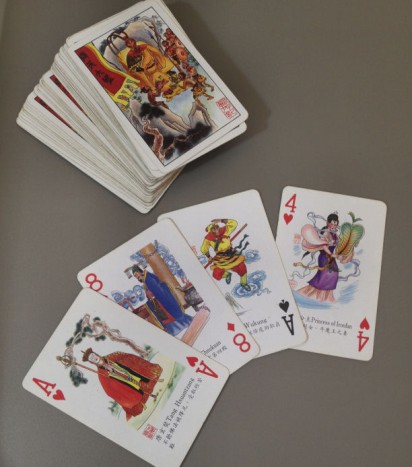
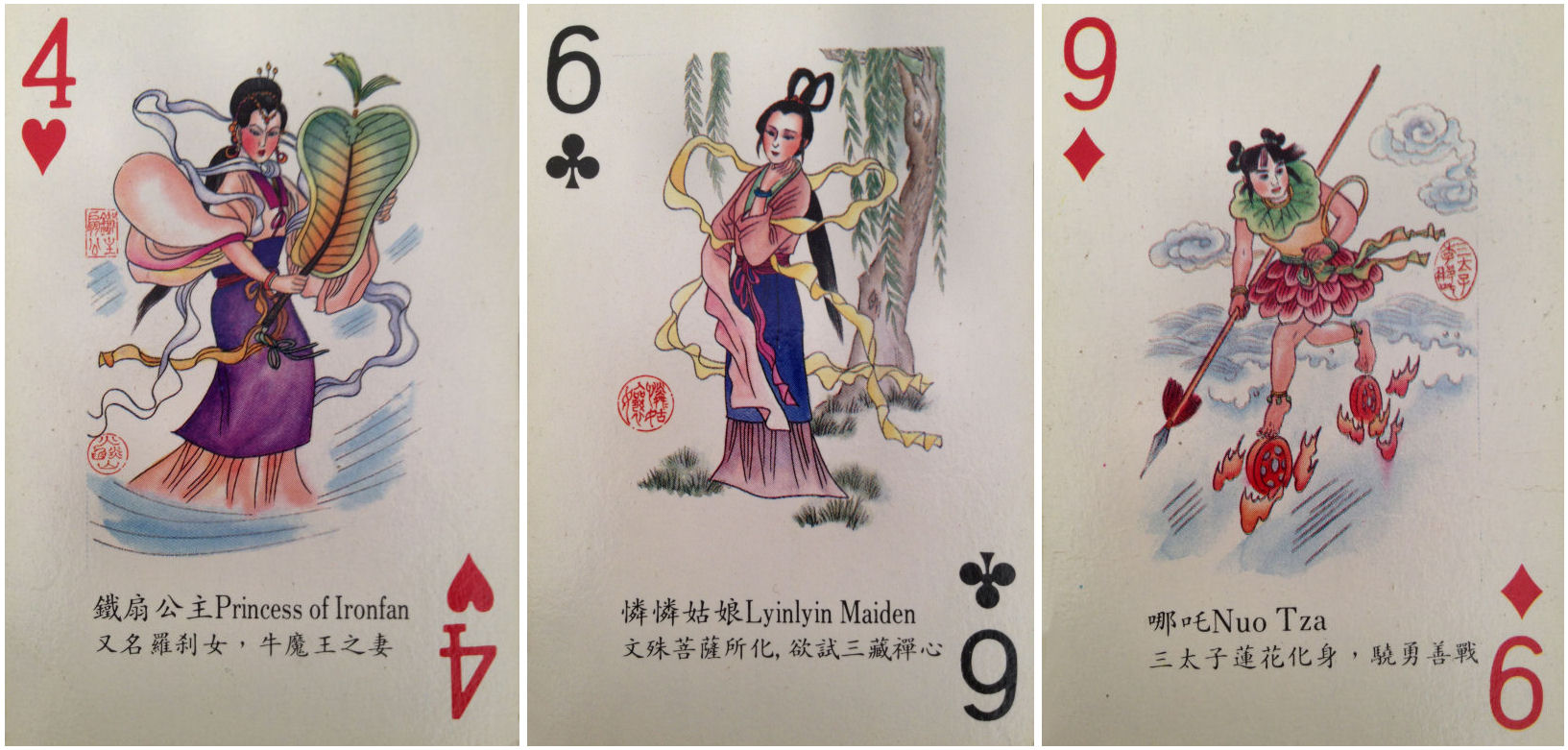
In elementary school I acquired a standard 54-card playing deck from Taiwan that depicted the characters of one of my favorite classical Chinese novels, Journey to the West (西遊記). While writing that chapter, I thought back fondly of those early memories, that large deck in my hands, shuffling carefully so that none of the cards would fall out (as the deck was large for my hands), fanning the cards out and selecting a couple to study, like maybe the characters on each card that had been drawn out into the spread held some meaning to my life. You could say it was my earliest foray in cartomancy.
As I wrote, I worked from my memory of that Journey to the West deck, figuring it was still back on the east coast in my childhood home, if not lost for good. Recently, the Hubby and I cleaned out all our old storage boxes and I stumbled across that Journey to the West deck I talked about in my tarot book. I couldn’t believe it! I had managed to save it all those years and not only save it, but for reasons now lost to me, I bothered to bring it with me when I moved out here to the west coast!
In my memory, the cards were huge and required careful maneuvering. However, now that I have the actual deck in hand, they’re quite small. Gasp. The cards shrunk! That or I grew up.
I recount this as calmly as possible. That is said more for my frame of mind than yours.
I had stumbled upon a fortune teller in Chinatown sitting at a makeshift tabletop. The chairs were miniature and when sitting, your knees would be up next to your ears. What had intrigued me to stop and listen in was her method of fortune telling: the tarot. You don’t see tarot divination that often among the Chinese, so of course I had to observe. A young woman about 20-ish years of age and her friend sat across from the fortuneteller. From what I overheard, the question was about love.
The fortune teller used what appeared to be a Marseille-based deck. I couldn’t figure out a discrete way to take photographs, so let’s assume my memory is good and go with the below reenactment, using the CBD Tarot de Marseille.
A deformed Celtic Cross due to space constraints. The Mary-el Tarot.
At the intermediate level, every tarot practitioner should have a repertoire of at least 7 spreads. Now note that as an advanced reader, you will have fully developed your personal practice approach and may have only one spread that you always use, no matter the inquiry or situation, or a repertoire of spreads that are very different from the ones mentioned here, or an altogether different intuitive approach to readings. All that is developed with time, however, so at the intermediate level, expose yourself to as much as possible and master a minimum of 7 spreads to empower yourself as the most adaptable and efficient reader you can be.
In my own practice I customize and design new spreads on a case by case basis. I also employ a variety of techniques to answer questions–operations from various Golden Dawn methodology (or my adaptation of it), card counting, etc. However, I do insist tarot students who have gained a proficient understanding of the card meanings and who know the basics of tarot interpretation to begin building their repertoire. There are 7 spreads you should know by heart at any given time:
A 3 card reading spread
A 4 card reading spread (or a 5 card reading spread)
It’s perplexing that I would take so long to acquire the Mary-el Tarot but it did, just over 2 years from its publication date (February, 2012) by Schiffer Publishing. Now that I have it, I’m even more perplexed at myself for the delay. I’ve been hearing about it here and there, reading reviews, seeing vlogs about it, and even articles in various tarot publications.
Get this deck. No wishy-washy preceding terms like “consider…” or “perhaps you might like…” or “I personally suggest…”– No. Get this deck. You should get this deck.
Unless, of course, you only like paintings of pastel rainbows and pretty little kittens and unicorns, absolutely cannot tolerate nudity for whatever reason, or you can only use the straightforward Rider-Waite tradition or you can only use the Marseille or you can only use the Thoth. If any of those are true about you, then yeah, forget it. Stick with what you know. Otherwise, Get. This. Deck.
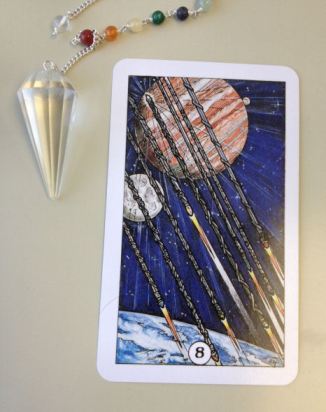
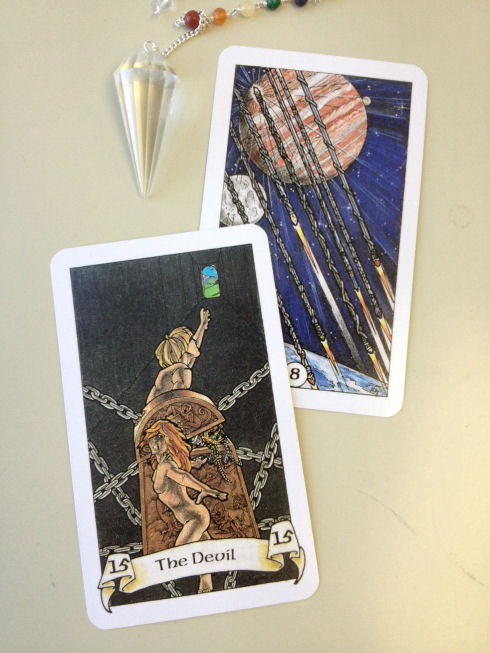
I did not want to post about this. The tragedy hit a bit close to home for me and both Hubby and I have been on top of the updates about the situation in as real-time as it can get. This afternoon I spent some time concentrating on the matter and had my trusty Robin Wood tarot deck on hand. I went through the deck to select a signifier and from the Robin Wood deck, the Eight of Wands leapt out at me as the signifier to read with for Malaysia Airlines Flight 370. Quietly, and what was going to be privately, I drew a single card for the matter. What happened next took me by surprise.
I drew Key 15: The Devil. If that isn’t compelling enough, look at the imagery on the card. I happened to select the Robin Wood tarot to read with, which is a deck with a unique take on The Devil card, different from the traditional systems.
And I’m just going to leave the posting at that. I wasn’t going to share, but wow, just wow. I may not be a mathematician, but I believe the probability of me drawing that card for this reading is about 1.2%.
from the CBD Tarot de Marseille by Yoav Ben-Dov (cbdtarot.com)
I grew up trained to fear the number 4. In any scenario where I had to be assigned a number, I would sit there praying that the number 4 would not appear in my assignment and dreading that it would. If my seat number in the exam room had a 4 in it, I’d take it as an omen of impending failure.
I’m not the only one. There’s a name for it: tetraphobia. If they’ve got a name for it, it means I’m not alone. The Taiwanese and South Korean navies avoid assigning the number 4 to their ships. In Hong Kong, Taiwan, Japan, and many other parts of East Asia, you’ll hardly ever see a 4th floor. It’s the 1st floor, 2nd, 3rd, and then 5th. For a race stereotyped to be good at math you’d think they’d know how to count. Hospitals don’t have a 4th floor for sure, and no room number in those hospitals will have a 4 in it.
To the Chinese, 4 means death. 4 means bad luck. 4 means misfortune. 4 means you’re going to suck at life. 4 means you are not a Chosen One. Chosen Ones never get number 4. They get, well, 1. Or 8. Chinese people love the number 8 the way tarot readers love the Ace of Cups or The World card. As for The World card, by most counts it is the 22nd card in the Majors and the theosophic reduction of 22, 2 + 2, is 4 and so take that tetraphobic Chinese people!
I guess back in the day in Chinese grammar schools, the concept of homonyms got glossed over. Everybody there missed the lesson on how a homonym is when two words sound the same but have different meanings. Different. So even though pronouncing the number 4 in most East Asian languages and dialects sounds the same way one might pronounce the word for death, the two words should still retain their different meanings.
Not so to the Chinese. Just because the number 4 sounds like the word for death, suddenly 4 means death. There’s some serious issues with logical reasoning there, which is hilarious to me, because in the Western tradition, 4 means logic, rationality. More on that later.
When I first started study of the tarot, especially when reading with a Marseille deck, numerological associations for the number 4 tripped me up. The numerological association for 4 seemed all too clear: you were doomed. 4 in batons? You’re doomed to fail at work. 4 of cups? You’re doomed to fail in love. You get the pattern. Growing up in the Chinese culture meant I hyperventilated just a little when the number 4 appeared in my life.
Tarot helped me overcome that fear of the number 4. Don’t laugh. I’m serious.
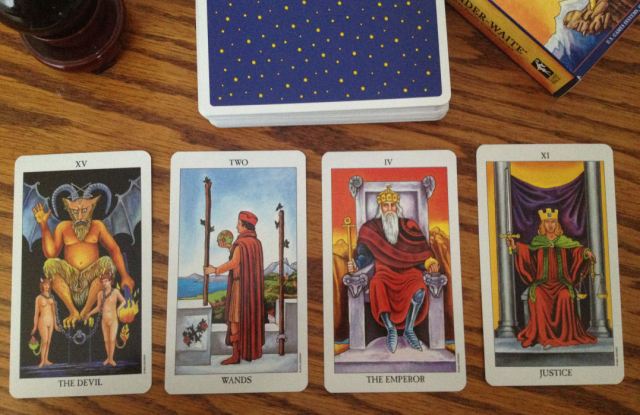
The Emperor might not be all sunshine and rainbows, but it is still a strong card with an empowering message. In western numerology, 4 symbolizes stability, like the four legs of a table or chair, the four corners of the universe, the four elements, the telegrammaton YHVH. 4 is the number of rationalism. Hey, I like rationalism– 44 means great power and physical vigor. 444 is said to be an omen of the Divine’s presence.
When four Fours appear in a tarot spread, there will be peace and order. The Four of Wands in the Rider Waite Smith deck is all about prosperity. The Four of Cups: introspection. Introspection is hardly death and doom. Four of Swords: repose, recuperation; not your preferred state of being but there is a positive message latent in the card–the loved ones awaiting your return depicted in the stained glass window, the secret weapon underneath you– whereas the number 4 according to the Chinese is straight up bad, no nuances.
Those of Life Path 4 are indispensable to a society. They’re our builders, our planners, our architects, the designers of all social constructs. People of Life Path 4 make things happen. Donald Trump, Oprah Winfrey, and Bill Gates are all 4s. Leonardo da Vinci, Mark Twain, J. P. Morgan, Paul McCartney? All 4s with 4s littered throughout their numerology charts.
Even more intriguing is how 4 is so not a big deal even in traditional Chinese metaphysics. Take the I Ching hexagrams. Hexagram 4 suggests naiveté, not death. Hexagram 14 is abundance, validation, all good stuff, like the Four of Wands. Hexagram 24 hints at progress. Hexagram 34 is a powerful, positive omen. So okay, Hexagram 44 is getting a bit darker. Entropy ain’t great news, but still. Hexagram 54 is back to positive again. I’m using the terms positive and negative very loosely here, by the way, as neither tarot nor the I Ching can be characterized with absolutes. And Hexagram 64 is like the Judgement card, give or take huge liberties with the interpretation.
The Four Pillars of Destiny (四柱命理學), which is said to date back to the Song Dynasty, is founded on the idea that there are four components to mapping out a person’s destiny chart. That destiny chart, based on month, day, year, and time (the four pillars) of birth, is supposed to be a playbook of your life. Four for life, people, not four for death!
Understanding quells fears. It is now my dedicated mission to alleviate tetraphobia among the Chinese. Or– okay– at the very least, the Chinese in my arm’s length social network…







 benebell wen