Godfrey Dowson’s Hermetic Tarot Revisited

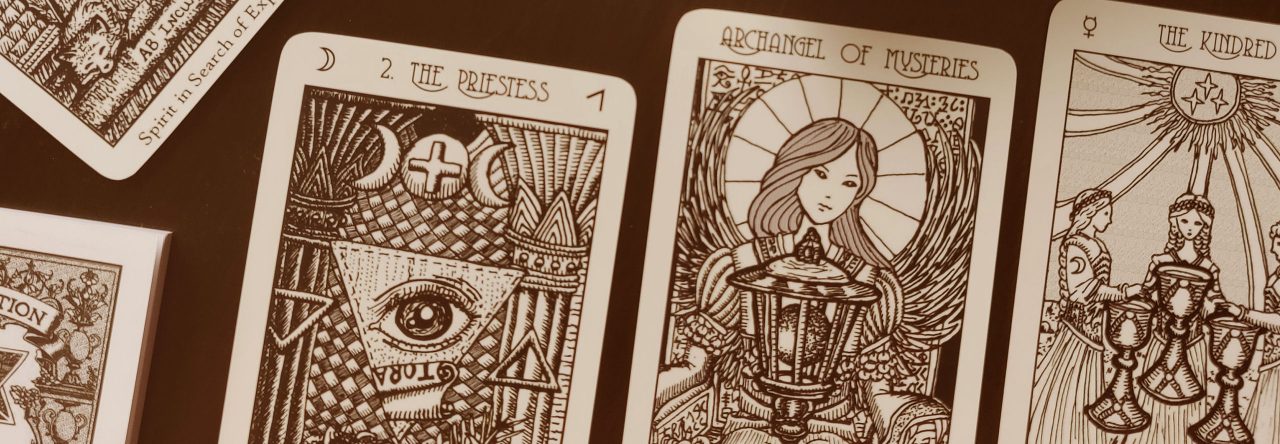
The Hermetic Tarot by Godfrey Dowson was one of my earliest deck reviews on this blog, back in 2013. And it wasn’t even really a deck review. I don’t know what that was other than a little bit too cringe for me to try to reread now. Anyway, let’s revisit the deck and add this posting to our cluster of Golden Dawn deck discussions.

The Hermetic Order of the Golden Dawn was active for only about fifteen years, and yet consider the scope and breadth of their influence in Western occultism, especially in the world of tarot. Even fun, flighty, not-at-all-occult mass produced pop tarot decks are unintentionally influenced by the Golden Dawn.

Crowley first published a description of the Order’s card designs in The Equinox in 1912, riling MacGregor Mathers to the point of litigation to try and stop Crowley’s publication. Then around World War II, Israel Regardie published the Golden Dawn card descriptions again, and provided oversight to both Robert Wang and the Ciceros in their subsequent GD decks. The LWB introduces Dowson’s deck as one more Golden Dawn based tarot deck in the line of succession since the Order dissipated.

Dowson’s pen and ink drawings for the Hermetic Tarot were done between 1975 and 1977, with the deck published by U.S. Games in 1980. Stuart Kaplan co-wrote the LWB that comes with the cards. Kaplan remarks about the Hermetic Tarot that it is a “compelling reconstructed version of the tarot that undoubtedly will take its place as one of the most important esoteric tarot decks published during the twentieth century.”

Continue reading “Godfrey Dowson’s Hermetic Tarot Revisited”

Tarot of Ceremonial Magick by Lon and Constance DuQuette

The Tarot of Ceremonial Magick by Lon Milo DuQuette and Constance DuQuette was first published by U.S. Games in 1997, then republished in 2010 by Thelesis Aura. The edition you see here is from the Third Printing, 2013. Interestingly, these cards were printed in the Republic of Korea. Since it’s rare to see that, I thought it was worth a mention.

While DuQuette is a Thelemite, and therefore you’re going to see strong influences from Aleister Crowley’s Thoth throughout this deck, not to mention a portrait of young Crowley on The Magus card, it’ll be instructive to consider this deck alongside the Golden Dawn based decks covered earlier this week: the Golden Dawn Tarot by Robert Wang and the New Golden Dawn Ritual Tarot by Chic and Tabatha Cicero.

Continue reading “Tarot of Ceremonial Magick by Lon and Constance DuQuette”

The B.O.T.A. Tarot and Paul Foster Case

Let’s conclude Golden Dawn Tarot week with an offshoot-GD deck, the B.O.T.A. Tarot by Paul Foster Case, illustrated by Jessie Burns Parke. In this blog post, the fully colored Majors are from the 2009 Ishtar Publishing reprint of Paul Foster Case’s Learning Tarot Essentials: Tarot Cards for Beginners (1932), via the Internet Archive.

You can buy the black and white deck for coloring direct from the Builders of the Adytum here for just $8.50. It’s an incredible deal! I’ll share more photos of the physical deck later in this review, but it’s matte, unrounded corners though, and lovely quality.

The digital images of the Major Arcana for download can be purchased for $5.00, linked here and digital the Minor Arcana digital files for $5.00, linked here. B.O.T.A. also has a couple of other deck purchasing options at their online store, so be sure to check it out, and nothing over $20– great prices. (fyi this is not an advertisement or promo; no one paid me to say any of this.)

Continue reading “The B.O.T.A. Tarot and Paul Foster Case”

Golden Dawn Magical Tarot by the Ciceros

Earlier in the week I posted about the Golden Dawn Tarot by Robert Wang and Dr. Israel Regardie, and continuing on what has somehow turned into Golden Dawn Tarot week here on my blog, this will be a showcase of the Golden Dawn Magical Tarot (or New Golden Dawn Ritual Tarot) by Chic and Tabatha Cicero.

The guidebook is titled The New Golden Dawn Ritual Tarot: Keys to the Rituals, Symbolism, Magic & Divination (2010). I’m reviewing the 2014 reprinted edition. The guidebook also refers to the deck as the New Golden Dawn Ritual Tarot, but then the box reads Golden Dawn Magical Tarot. In the guidebook, the authors themselves refer to the deck as the Ritual Tarot, so that’s what I’ll be going with.

If you’re interested in contemporary Golden Dawn based ceremonial magic and the tarot, then you’ll want to get this book and deck set.

Continue reading “Golden Dawn Magical Tarot by the Ciceros”

The Golden Dawn Tarot by Robert Wang

Robert Wang, perhaps best known as the author of Qabalistic Tarot, is also an artist. He created The Golden Dawn Tarot back in 1978 and later the Jungian Tarot in the 90s. There’s a companion book to the deck, An Introduction to the Golden Dawn Tarot published through Weiser also in 1978. You can digitally “check out” or borrow the text at OpenLibrary.org for an hour, which is what I did and will comment on as a supplement to this deck overview.

From Robert Wang’s An Introduction to the Golden Dawn Tarot (Weiser Books, 1978)

“Rarely has a tarot deck created more pre-publication interest than this long-awaited Golden Dawn Tarot pack by Dr. Robert Wang, a devoted scholar and researcher of the Secret Order of the Golden Dawn,” wrote Stuart Kaplan about the deck.

With the guidance of Dr. Israel Regardie, poring over old notebooks of members from the Hermetic Order of the Golden Dawn, Wang created the Golden Dawn Tarot as an esoteric deck intended to reveal, with greater clarity, the Golden Dawn interpretive approach to the cards. This was to be a “missing link” between the Rider-Waite and the Crowley Thoth. Kaplan described Wang’s deck as “an important rare book in the field of tarot.”

Continue reading “The Golden Dawn Tarot by Robert Wang”

Random Personal Update

Most of this blog on my website consists of deck reviews, some book reviews, and right now because SKT III is in production, SKT status updates. I haven’t checked in with you with a personal update in a while. So let’s chat. Hi! How’ve you been? Let me share with you what’s been going on in my corner. =)

That Novel I Kinda Started Talking About… and then Didn’t?

In March of 2020, I posted this: “Novel Writing Adventures.” And this: “What Writing and Publishing a Novel Means to Me + Asian American Kid Problems.”

Back in 2013 I started this ambitious novel (I say “ambitious” because the plot and premise is really convoluted and in terms of my own skill level, I was trying to accomplish way more than my technical proficiency or storytelling ability was capable of.) I got up to 37,000 words before I abandoned ship.

I revisited that same manuscript in 2015, discarded about a third of what I had written in 2013, continued on, and got to 59,000 words before, again, abandoning the undertaking because it got too overwhelming.

In 2018, I threw away all 59k words of the previous manuscript, started from 0, wrote furiously for 2 years straight, and by February/March of 2020, exactly when the pandemic hit the U.S., completed the manuscript at 118,000 words.

Continue reading “Random Personal Update”

Secrets of the Jewelry Box Tarot by Timea

I was fortunate to get an early review copy of Tímea Méhész’s Secrets of the Jewelry Box Tarot. Méhész is a silversmith and jewelry designer who, from early childhood, has leaned an interest into mysticism and the esoteric arts.

This deck intrigued me because I haven’t seen anything like it. The concept is ambitious. Méhész is a metalsmith and jewelry designer. She creates upcycled jewelry. Secrets of the Jewelry Box is a photographic collection of her beautifully crafted pieces, each one inspired by a tarot card. What if you opened up your jewelry box and each trinket in there connected to a Key of the tarot?

Continue reading “Secrets of the Jewelry Box Tarot by Timea”

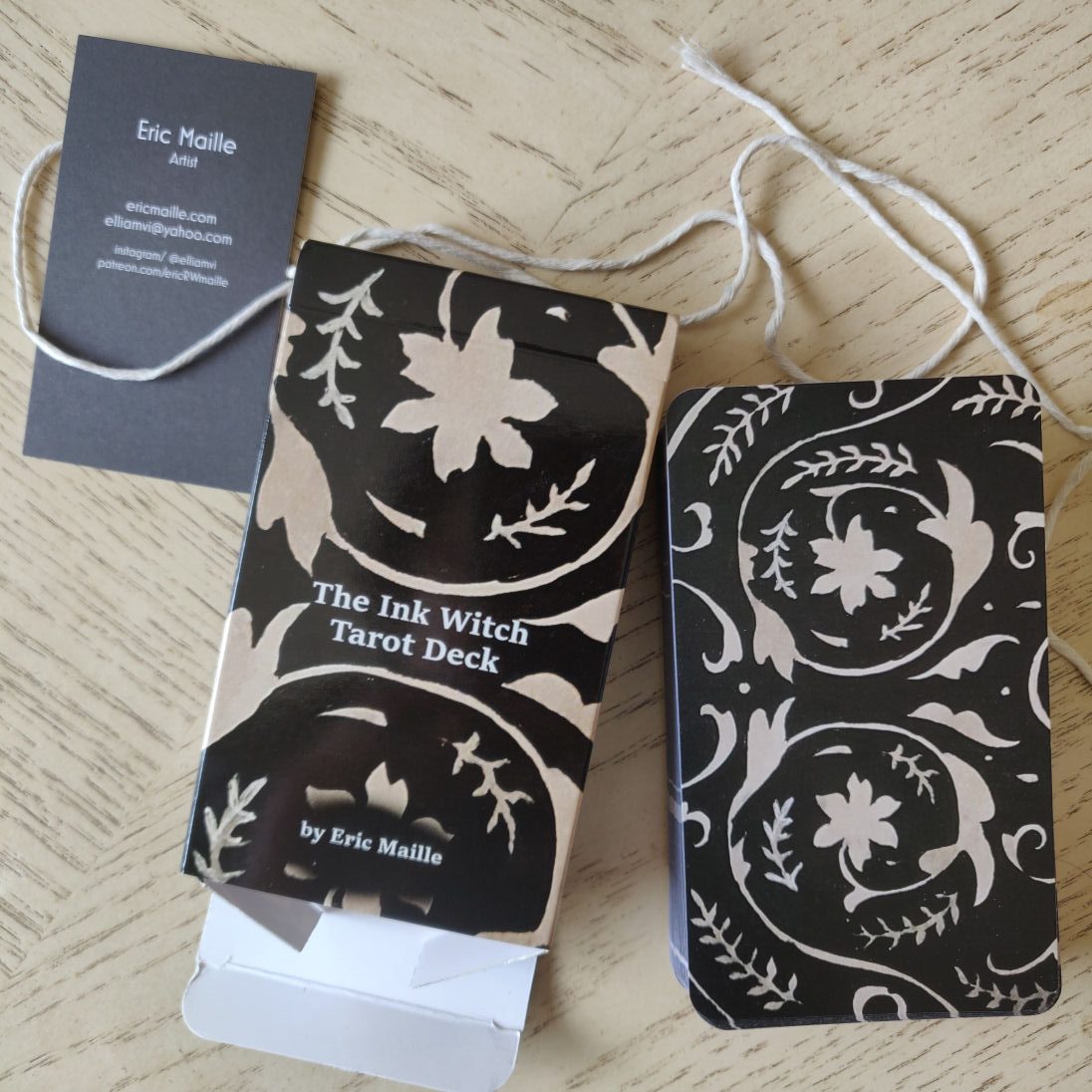
Ink Witch Tarot by Eric Maille

A while back I reviewed the book The Cards: The Evolution and Power of Tarot by Prof. Patrick Maille. Eric Maille is his son, an artist, and the creator of the Ink Witch Tarot. Maille is an Oklahoma-based artist and illustrator whose works explore “the irony that we as humans often feel poorly equipped to live out that experience, struggling against our environments, the people around us, and our own emotions” (per his artist statement). And you’re going to find that theme at the heart of these beautiful illustrations.

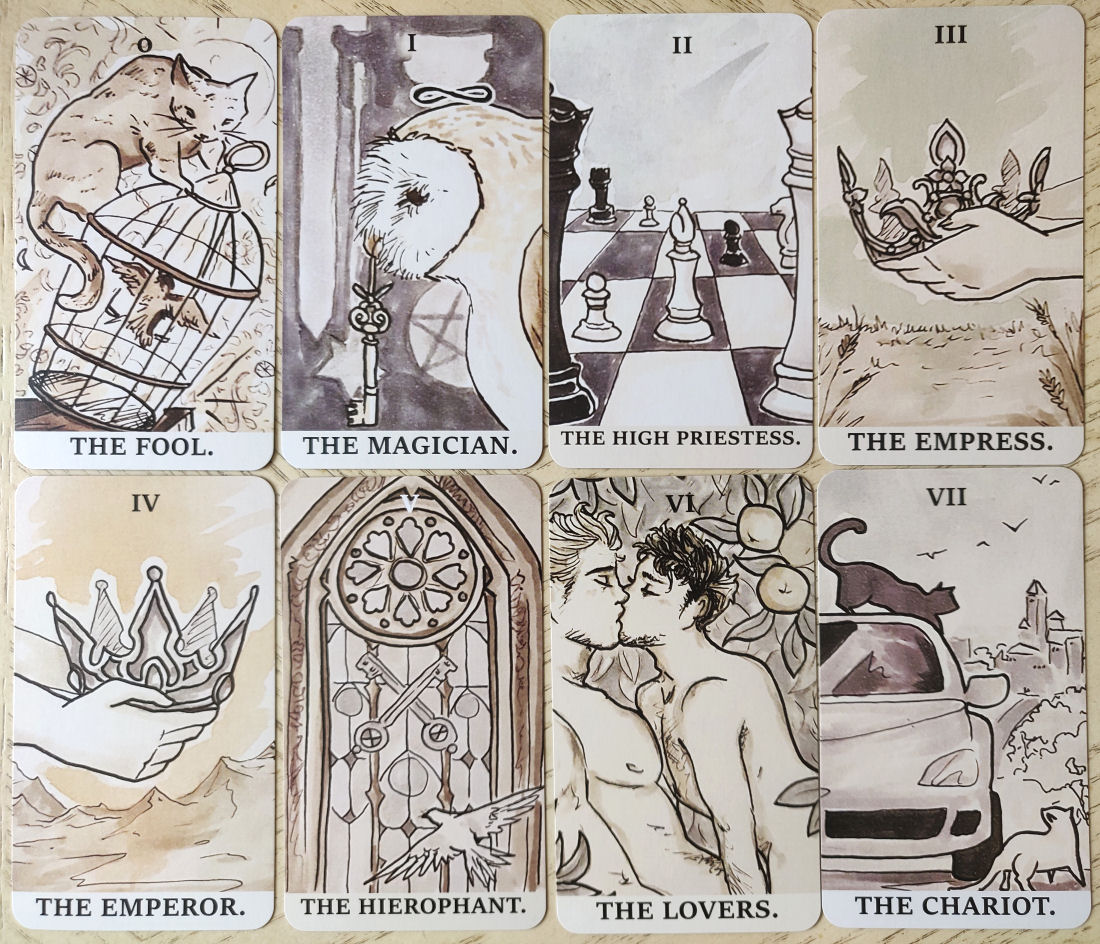
The art style here reminds me of haboku, a form of traditional Japanese ink brush painting that’s done in monochrome, expressing depth through sharp uses of contrast, an art style that tends to be impressionistic, soft, and flowing.

What is so compelling about the Ink Witch Tarot is the storytelling, and Maille’s artistic interpretations of each tarot card. In Key 0, I see The Fool as the bird, who appears to be in a precarious position, but the way that cage is about to fall off the tabletop, the door will swing open and that bird will be freed. If you view The High Priestess illustration as an in-process chess game, either the other side’s pawn is about to take the bishop or the bishop is about to take the other side’s king. Meanwhile both sides’ queens are side by side in the foreground, reminiscent of the traditional High Priestess’s twin pillars.

Continue reading “Ink Witch Tarot by Eric Maille”

Botanica Tarot by Kevin Jay Stanton (Beehive Books)

The Botanica Tarot, published by Beehive Books, is truly one of the most exquisite tarot decks I have had the pleasure of seeing. Beehive Books is a boutique press that specializes in beautifully designed books.

If the 78 cards of a tarot deck signify 78 universally experienced allegorical points on the circle of life, where more often the cards speak to human life, then these 78 cards speak to the circle of life in the plant kingdom.

Continue reading “Botanica Tarot by Kevin Jay Stanton (Beehive Books)”

Tarot Deck Care and the Impact of Humidity

Maybe this topic is talked about more often than I realize and I simply haven’t been made aware, I dunno. In any event, I wanted to condense (ha..ha..I’ve got jokes….) some insights on the impact of humidity on your tarot cards.

Ever notice how a wooden door seems to expand ever so slightly in the hot summer months? Musicians are all too aware of how temperamental wooden instruments can get depending on the weather and the humidity. Paper products like your tarot cards are made of cellulose fiber (derived from plant-based materials, like bark, wood, and leaves). They’re porous, causing them to be highly sensitive to humidity levels.

Cardstock absorbs moisture in the air.

Cardstock is hygroscopic, which means the cards, by their chemical (alchemical?) nature, will try to maintain an equilibrium with its environment, which means it’ll absorb water molecules in the air and also release its water molecules out into the air, to try and maintain that equilibrium. The temperature, humidity, and the climate of the region you live in have more of an impact on the durability of your tarot deck than you may realize.

Continue reading “Tarot Deck Care and the Impact of Humidity”