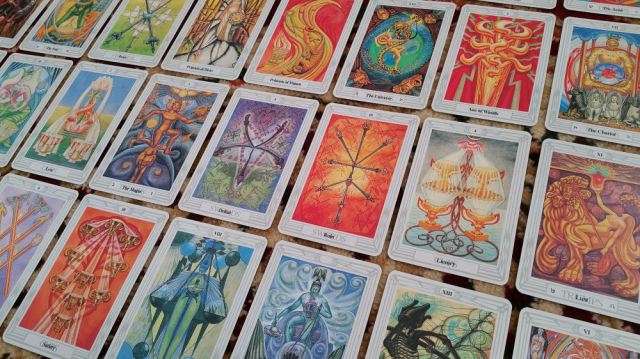
A recurring sentiment you’ll hear, even among tarot readers, is that Crowley’s Thoth deck should be avoided, because Crowley. After e-mailing me paragraphs of rehashed Internet research on the salacious nuggets of the man’s biography to lay the foundation of their point, the inevitable question will come: “Should I avoid working with the Thoth because it’s got bad juju?”
I’m always amused when this question is presented for me to answer, as if I have any reasonable idea whether you in particular should work with or avoid working with the Thoth. It’s a matter of personal preference, and so it’s a question I can’t answer without knowing you through and through.
When the future outcome as prognosticated by your tarot reading is negative, is there anything you can do to change it? One powerful, effective, and yet very easy to implement technique is taught by Rachel Pollack: create a tarot mandala.
This technique comes from Seventy-Eight Degrees of Wisdom, first published in 1980. A new and updated edition of this tarot classic was released earlier this year, in March, 2019.
Although working with a tarot mandala is by no means limited to changing the outcome of a negative tarot reading, I framed the title of the episode in that way since it’s one of the frequently asked questions I get: Is there anything you can do to change the negative forecast of a tarot reading? Yes, there’s plenty you can do! And casting a tarot mandala is one such method!
Today’s installment of Sightsee the Tarot will walk you through the choreography of a five-minute party reading and some incredible tips on choreographing party readings, straight from one of the most renowned tarot professionals in the country, Jenna Matlin. But even if you’re not interested in being a pro reader, mastering the five-minute party reading is a great skill to have.
Since footage for this video was filmed after 10 pm, I didn’t have any human bodies to be my extras. =) Hence, our little stuffed friend Q-Ball is the stand-in.
Post-edit, I realized I didn’t cover everything I wanted to cover (and certainly nowhere close to covering all the juicy bits in Matlin’s book!), so this companion blog post is my personal add-on to the video.
Have Tarot Will Party by Jenna Matlin is an easy-to-read, accessible orientation to the business of tarot reading. Reading this book is like having your own personal tarot business mentor, giving you solid guidance every step of your way.
Matlin shares how she got started as a professional tarot reader, working festivals, doing the brick and mortar, and her incredible journey all the way to the top of the field.
Today, most tarot businesses have gone online (and stay online), and even most tarot business coaching programs focus on e-commerce. There’s an entire segment of business and professional opportunities open to you in your locale, which you might be ignoring! Jenna Matlin teaches you how to tap in to those local markets, and how to truly make a name for yourself in your region.
If you’ve been meaning to add party readings to your professional work as a reader, but aren’t sure how to get started on that, then Have Tarot, Will Party is the book for you. How do you keep from making rookie mistakes? Matlin gives you all the insider tips and industry secrets that no one else will. How do you get booked for readings? How do you develop your local or regional platform so that you get booked consistently for party readings?
In today’s installment of Sightsee the Tarot, we’ll be exploring Mary K. Greer’s Tarot for Your Self: A Workbook for Personal Transformation and working through journaling prompts to self-reflect on our relationship with money and what we aspire for in terms of prosperity.
We’ll then work through my reinterpretation of Greer’s Prosperity Mandala for an integrated approach to tarot journaling, self-reflection, and intense divinatory work.
For six days after casting your Prosperity Mandala, you’ll revisit it daily and when you sit with the tarot mandala, you’ll receive additional insights, new ideas, come up with solutions to problems that have been hindering your progress, work through productive brainstorming about your personal financial situation, and positively shift yourself toward greater prosperity.
July 19 – 21, 2019 will be the Masters of the Tarot conference held at the Omega Institute in Rhineback, New York. The Masters of the Tarot conference is an annual tradition started by Mary K. Greer and Rachel Pollack. This 2019, the master teachers featured at the event will be Mary and Rachel, Michelle Tea, author of Modern Tarot and many other works of fiction and creative nonfiction, and the renowned psychic Terry Iacuzzo, author of Small Mediums at Large. Oh. And also, me.
If you’ve ever been interested in attending a tarot workshop held by me, this may be your last chance to meet me in person and pick my brain, at least for a very long time. I won’t be making any public appearances for the tarot in 2020 and some significant plans to shift gears have been in the works for some time now. So at least for me, the 2019 Masters of the Tarot conference is going to be very special and deeply personal. My workshop presentation topic will reflect as much. =)
Also, you’re going to be learning innovative and profound insights into the tarot from living legends: Mary K. Greer and Rachel Pollack.
Michelle Tea is a prolific author who has published numerous memoirs and novels. One of her books, How to Grow Up (Penguin/Plume), is currently in development with Amazon Studios. Tea is the curator of the Amethyst Editions imprint at Feminist Press. Her writing has appeared in Harper’s, Cosmopolitan, Marie Clare, xoJane, and BuzzFeed, among others.
The tuition for the event is $465, which covers workshops by all the master teachers, all panels, breakfast, lunch, and dinner at the Omega Dining Hall from Friday, July 19 to Sunday, July 21, and daily open classes in meditation, yoga, tai chi, and more.
The Faery Godmother Oracle Cards by Flavia Kate Peters, illustrated by Julie Dhemiah Meacham, transports you to a world of mirrors, each one leading to its own mystical realm. The art and the keywords in this deck are evocative, whimsical, and to me, perfect for inner child work.
The artist, who goes by Dhemiah, paints in a fairytale style. She’s called to the spirit and magical realms and her art reflects the visions she channels from what she refers to as the “other worlds.” Her works are primarily done in acrylics and watercolors.
Before we continue with the review, three cards are presented to you above. Choose one: left, center, or right. Then at the close of this review, we’ll see what your card pick was and read its corresponding entry from the guidebook.
Tarot, Astrology, and the Four Seasons. Reference diagram from Tarot of the Bohemians (Papus). Click to download high-res image file.
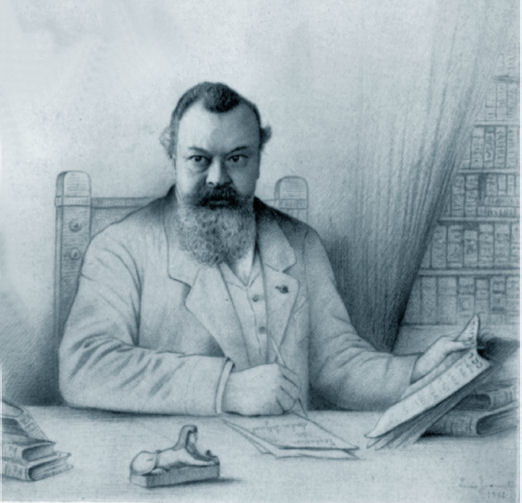
This is a two-part installment of Sightsee the Tarot as we take a tour of Tarot of the Bohemians by Papus, the pseudonym of Gérard Encausse, a French physician and occultist.
Part 1 is lecture only, summarizing the entirety of the text, Tarot of the Bohemians. Part 2 is a hands-on guided workshop of a reading method taught by Papus.
You don’t have to watch Part 1 (lecture only) to work through Part 2 (guided tarot reading method). The two parts can be standalone videos that you watch without the other.
So if you just want to try out the late 19th century reading spread instructed by Papus and don’t much care for an audio-visual summary of Tarot of the Bohemians, then skip Part 1 and go straight to Part 2.
If you’re just here for the audio-visual summary of Bohemians but aren’t in the mood to do a tarot reading right now, then just watch Part 1.
Over the years I’ve received numerous requests to do a day-in-my-life walk-through and I’ve finally gotten around to doing it, in blog form. =) This will be a typical weekday in my life. At some point in the near future I’ll post a sequel: a weekend in my life.
I wake up before sunrise, and so what you see above is what I typically see when I head downstairs to the kitchen to make myself a pot of coffee, especially through the winter months.
As I walk down the stairs and while the coffee brews, I’m mapping out my morning. What needs to get done in the next three to four hours? Where did I leave off on each of those projects I’m about to dive in to?
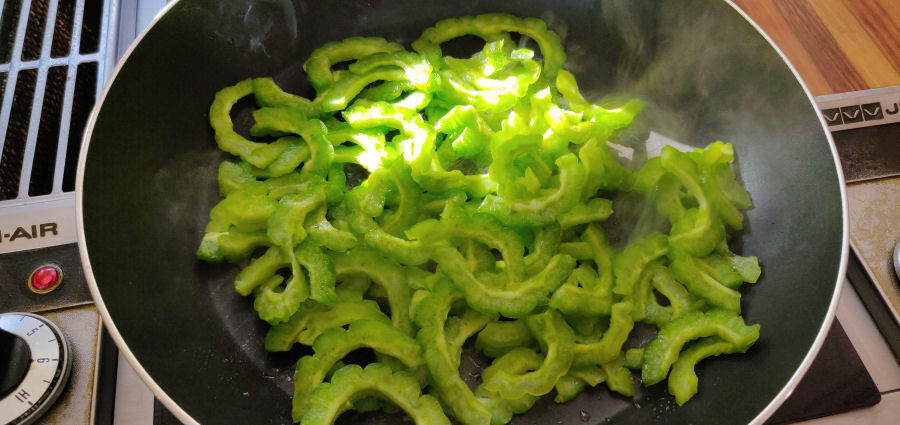
My breakfast this morning is sauteed bitter melon (just a little bit of animal fat, no seasoning) and fresh blueberries. I don’t eat this for yummy reasons. I eat this for medicine reasons. While I’m prepping, I’m checking work e-mails, drafting and scheduling blog posts, outlining talking points for videos, or if I’m in the middle of writing a book at that time, then my laptop is open on the kitchen table and I’m writing while I’m cooking.
To be clear, modern medicine wins over homeopathic, folksy, holistic anecdotal home remedies every time for me, and if I get diagnosed with something, I’m going to go with the prescription pills. But on the regular, in terms of preventative care, I’m a huge proponent for considering the medical and health benefits of food. I very much follow Traditional Chinese Medicine (TCM) for my diet and cooking. So almost everything I eat has a TCM purpose to it. Herbology isn’t just having shelves full of pretty glass jars filled with exotic herbs. It’s something I implement into daily cooking.
I’m not going to say something like breakfast is the most important meal or that it’s even necessary. I don’t think it’s necessary for most people, given their 21st century lifestyles. However, in agrarian cultures, you *had* to eat breakfast, because immediately after, you’d be working out on the fields until sundown! That’s my ancestry and DNA, and so I find that for me, even though I’m not working out on a literal field, what I do is a modern and mental equivalent. Breakfast powers the operations of my mind and keeps me going in an optimized and productive manner.
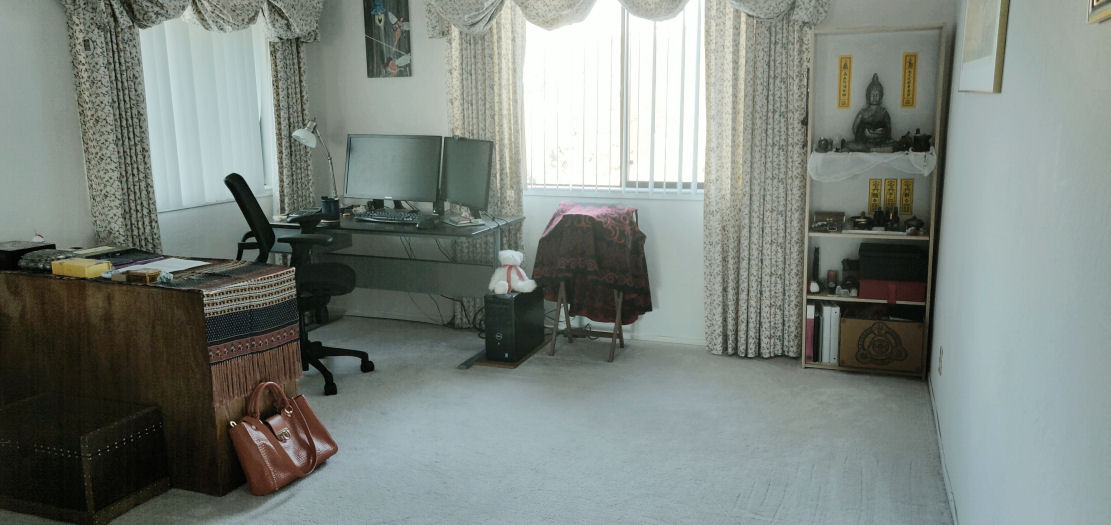
Most mornings, I get to watch the sunrise. My home office window looks out directly east (something intentional, which I looked for when house hunting), so I can sip my coffee, do stretches, a morning meditation, or a morning ritual facing eastward and actually get to catch a glimpse of the rising sun.
This is important to me. Watching the sunrise conveys a rather remarkable and paradoxical feeling where, simultaneously, you feel both incredibly honored and important and yet also, equally, incredibly small and insignificant. I think that’s quite the compelling thought at the start of every day of your life.
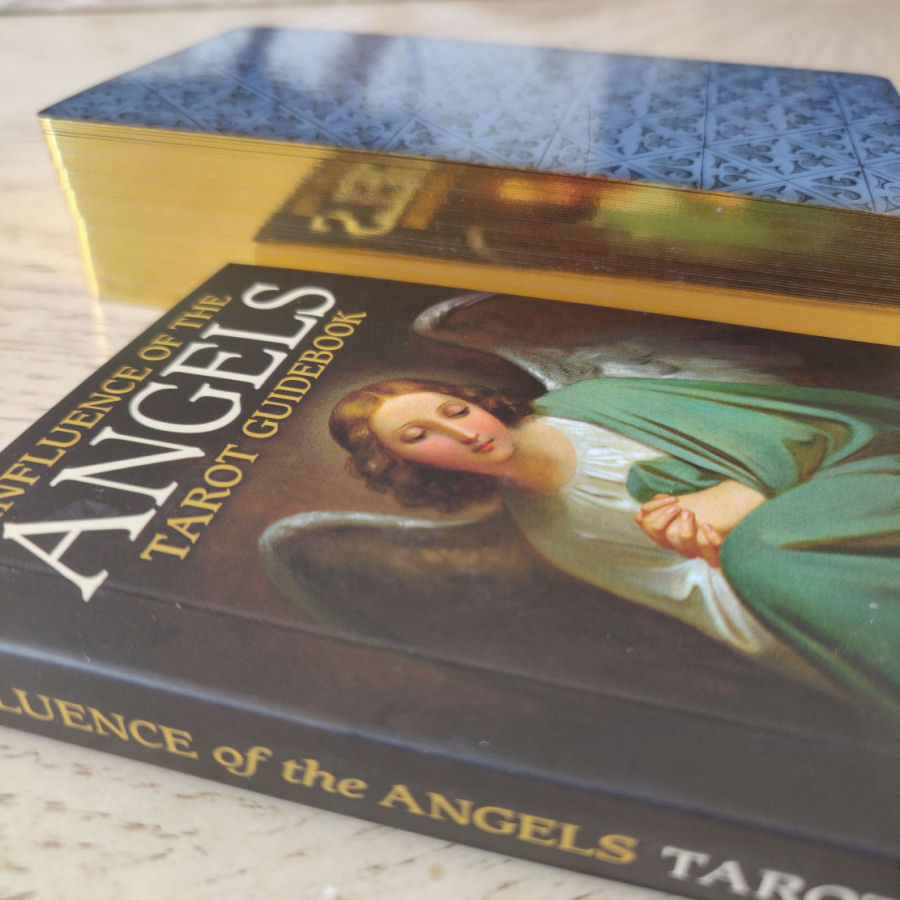
Influence of the Angels is one of the most exquisite angel tarot decks. Although the artwork is digital collage, it doesn’t feel like it at all. Classic paintings of antiquity are expertly modified into the tarot architecture and bring to life the Christian perspective of angels. The technical work here is flawless.
Angeles, notes Barbessi, are celestial messengers between God and humankind. In Influence of the Angels, the Major Arcana feature named angels while the Minor Arcana feature nameless ones.
I love that the deck comes with a meaty 184-page guidebook that delves in to the chosen symbolism on the cards, angelic messages, and presents this deck as a comprehensive beginner’s deck where you can begin working with the cards right out of the box. The back of the book provides two spreads tailored for the deck that anyone, beginner-level to seasoned reader can use.





 benebell wen