
A single line statement from Xunzi (3rd c. BCE) becomes the framework for mastering Chinese folk magic. In this lecture, we unpack the “Minister of Oracles” (Minister of Magic?) in the royal bureaucracy of early China and reveal how it encodes a five-step curriculum.
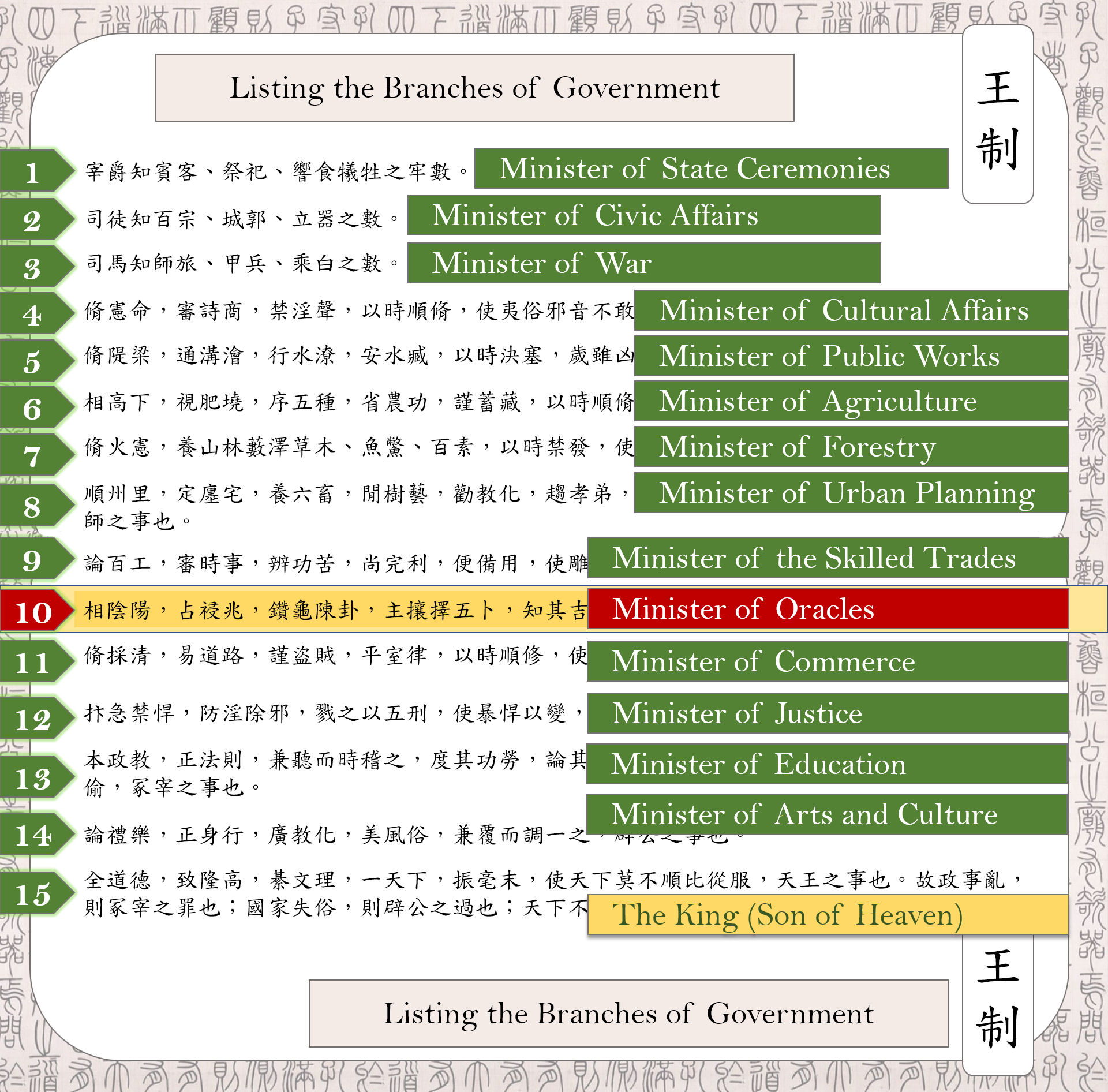
There’s a passage in Xunzi that lists out fifteen branches or bureaus of government ending with the one who oversees them all, the Son of Heaven, or the Head of State. The tenth office listed is the Minister of Oracles, chief among the shamans 巫.
You could even make the argument that this translates to the Minister of Magic, as that title more fully encapsulates everything this particular government official is in charge of for the kingdom.
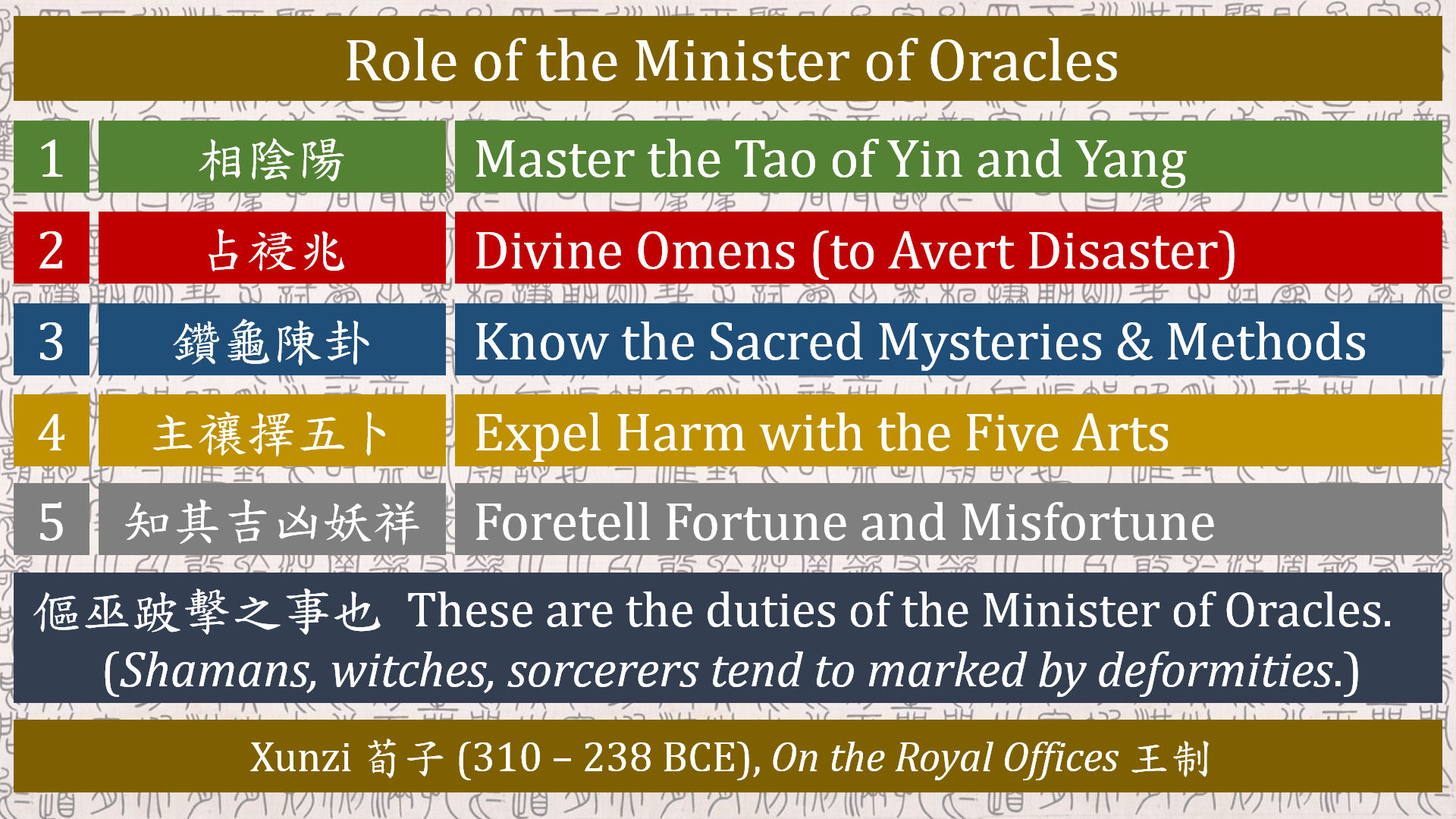
Click on these image files to download them or for a more enlarged view.
The Pre-Qin text we’re looking at is from Xunzi 荀子, Scroll 9 王制, Section 24:
相陰陽,占祲兆,鑽龜陳卦,主攘擇五卜,知其吉凶妖祥,傴巫跛擊之事也。
This Minister of Oracles is charged with five key responsibilities, and one of those five can be interpreted to imply the Five Mystical Arts 五卜. So by cross-reference, that’s 10, because the Minister of Oracles must also be skilled in the Five Mystical Arts 五卜.
Why this excerpted passage from 300 BC is so notable is how it presents a pretty good checklist of the core skills in Chinese folk magic, and is therefore a structural foundation and defining framework for how you might want to approach learning and mastering the Way or Tao of the Wu 巫.

#1: Master the Tao of Yin and Yang
相陰陽
The first of the Five Skills to master: to read and be able to interpret the formations of yin and yang. The key word here is being able to interpret the yin and yang you’re observing.
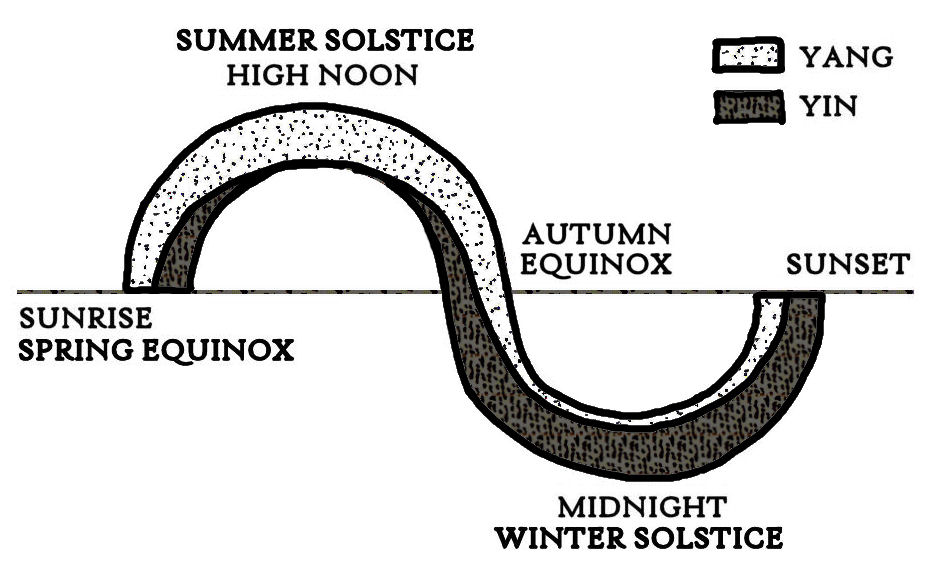
Chinese cosmology asserts that at the most fundamental level, our reality is nothing more than patterns of electrical signals of 0s and 1s, a binary. Everything you see, hear, sense, all seasonal phenomena and earthly formations can be classified under one of the Ba Gua Eight Trigrams, consisting of the binary yin and yang.
Yin-yang movement explains seasonal cycles, time, and also space– each of the geographic regions are governed by one of the eight trigrams, which expresses the specific combination of yin-yang movement in that region.
And so, while most lay people are focused on the superficial of what they’re seeing, hearing, and sensing, you, assuming you are to be a Minister of Oracles, are able to see the binary values of reality, what reality is, at its most fundamental level.
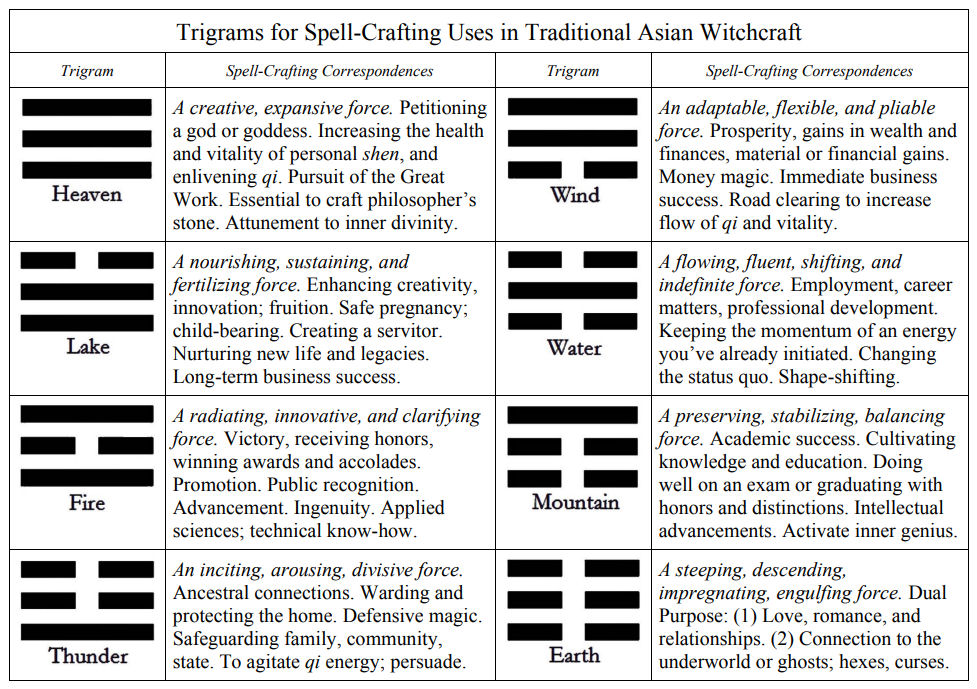
Correspondence tables of the Ba Gua eight trigrams, for instance, are all about how to interpret the formations of yin and yang. Hence, the practitioner’s use of reference tables and diagrams. For the notable ones found in I Ching, The Oracle, see here.
If I say, right now the season is spring, can you tell me what season is next? Because you understand the seasonal cycle, you can say, summer. Are you predicting the future? The premise of the I Ching is that all movements of change in this universe follows the cycle expressed by the 64 hexagrams (384 lines of yin and yang). Thus, by divining where in that I Ching cycle we are right now, we know exactly what will come next, because there are laws of flow that yin-yang movement follows.
How foundational is this first concept? Being able to divine and spot patterns at this binary level?
It’s how Onmyodo 陰陽道 developed, a Japanese form of divination, developed 800 years after the writings of Xunzi. It is both philosophy and practice, premised on the axiom of as above, so below, and so it reconciles yin-yang observations of the heavens, astrology, and of the earth, the formations and movements of nature in our environment.
Under the umbrella of this first line is also Yin Yang Shu 陰陽術, a term you’ve encountered if you’ve read either of my books The Tao of Craft or I Ching, The Oracle. It’s essentially a catch-all term meaning the occult arts. According to lore, Jiu Tian Xuan Nu, the Lady of the Nine Heavens teaches Yin Yang Shu, the Occult Arts, to the Yellow Emperor, and that’s the lineage of mystery tradition we inherit today.
#2: Divine Omens to Avert Disaster
占祲兆
Skill #1, interpreting yin and yang formations, is about knowledge and understanding of the world around you, and nature’s cycles, how the universe operates, spotting patterns.
Here, Skill #2 is about being able to then use that knowledge (plus divination) to mitigate harm. Always keep your antennae forward so you can anticipate danger before they arrive. You have to be the one who sounds the alarm.
This is also the concept of preventive medicine, or preventive care. You’re reading the signs and omens closely, so you can tell when things are taking a dip, and you can give enough advance warning to loved ones to help break their fall.
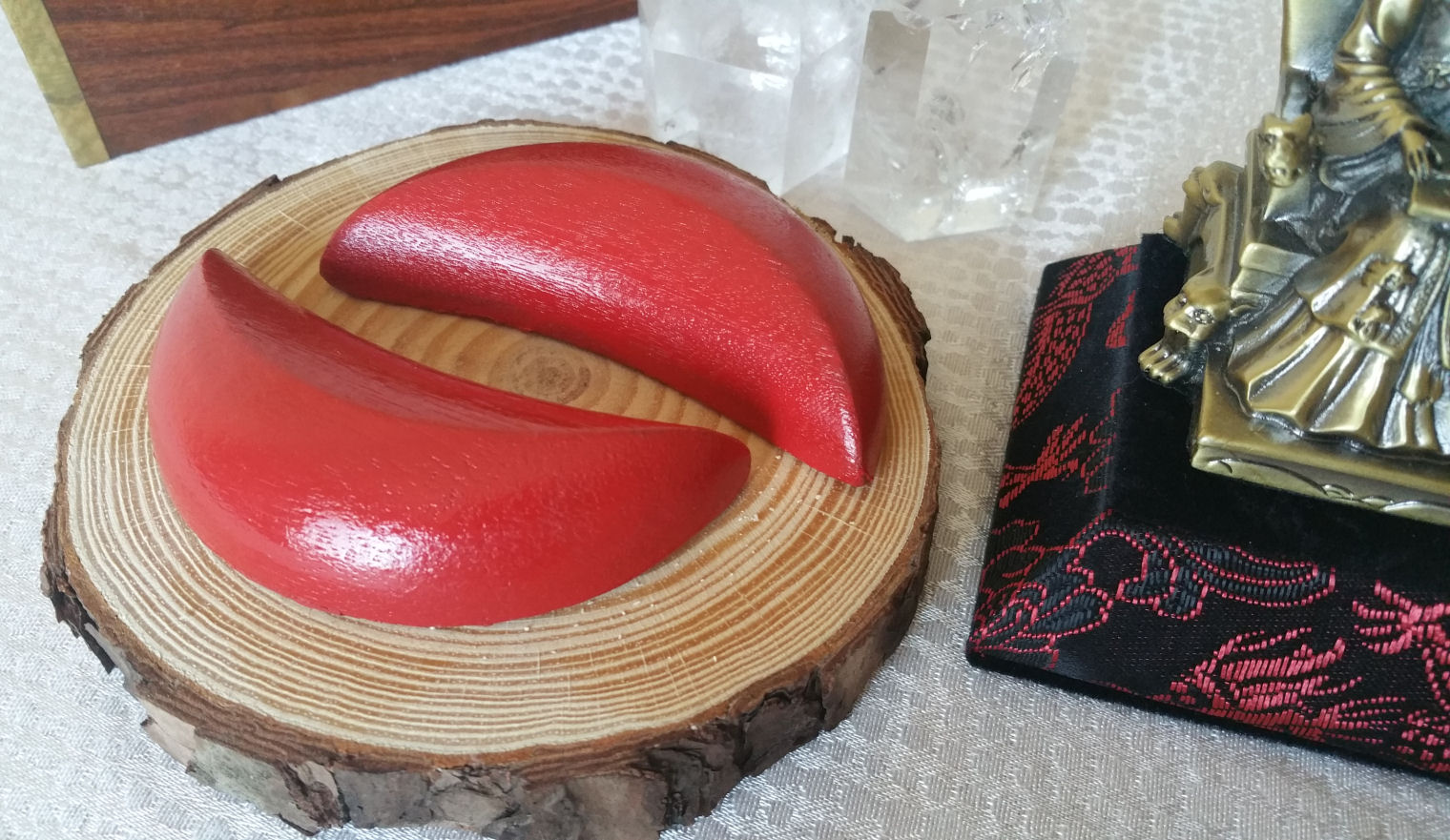
“兆” (zhao) is a reference to tortoise shell divination, and while there are many different approaches to that divination method, the most common and easiest to learn is with two shells, which when tossed, divine yin-yang lines. Over time, tortoise shell was replaced by moon blocks, similar to the ones you see above.
So many of the Asian folk magical traditions, beyond China, work with divination blocks. It has become an essential practitioner’s tool. For more information on moon block divination, see Tinkering Bell #5: Moon Block Divination and I Ching Divination with Moon Blocks.
#3: Know the Sacred Mysteries & Methods
鑽龜陳卦
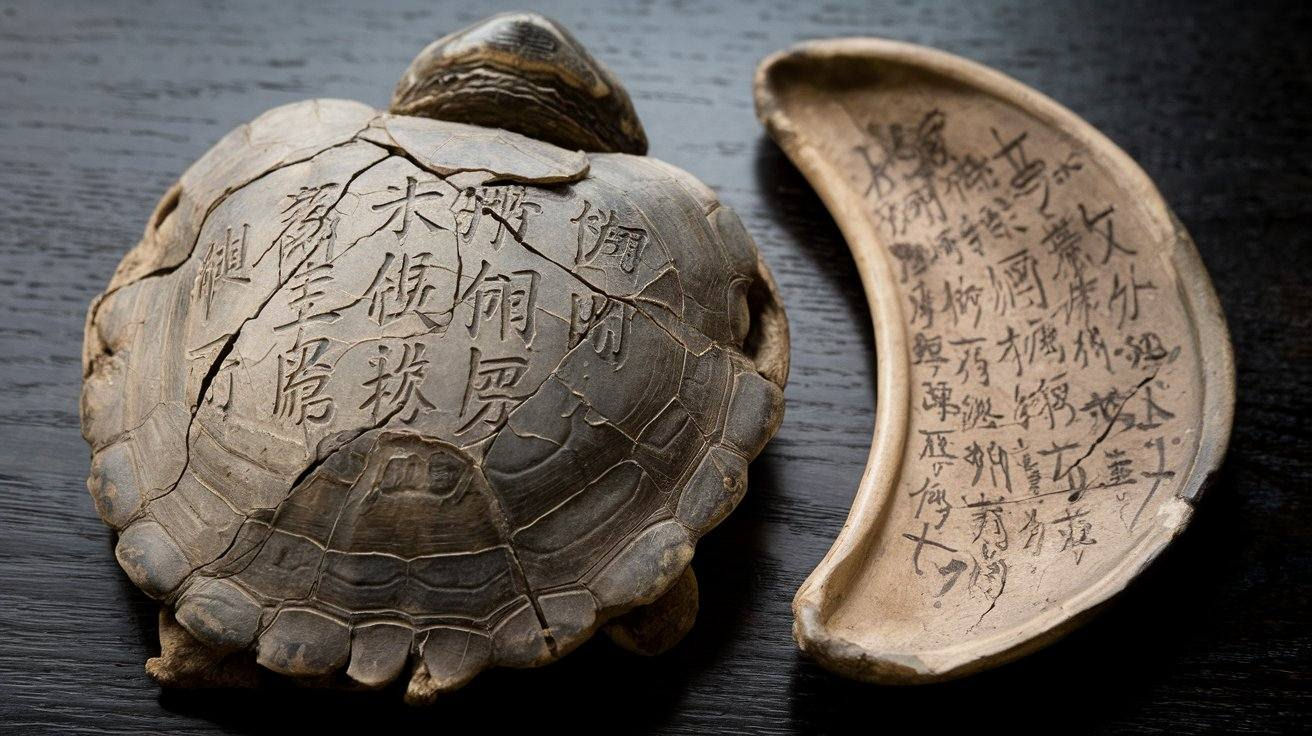
“鑽” (zuan) is the methodology used to heat and crack the tortoise shells and oracle bones for divination. It also means to penetrate, to drill down deep. Thus, it’s a figure of speech here for depth of knowledge.
“龜” (gui) is tortoise, and here, means the Sacred Tortoise sacrificed and used for divination (communion with the gods). The Sacred Tortoise is also a symbol of the Mysteries. In the four directions, the tortoise corresponds with the north, the direction of darkness, the abyss, the ancestral realm, and the mysterious.
“陳卦” (chen gua) means to cast the divinatory result (“gua” means hexagram or trigram). Here it refers to methodologies of the Mysteries.
This phrase translates directly to “drilling into the tortoise shell for divination to cast the hexagrams (or trigrams),” where “卦” (gua), while referring to trigrams and hexagrams, generally means the divinatory result cast.
Yet there’s a deeper meaning embedded here. “Drilling” is also “going deep,” penetrating through the surface into the interior. This is a metaphor, a figure of speech for intense study and therefore mastery of the Sacred Methods, the Mysteries, because the Tortoise is a symbol of the Mysteries. And so 鑽龜陳卦 also means to know the sacred methods. To Know the Divine Mysteries.
#4: Expel Harm with the Five Arts
主攘擇五卜
The first three skills relate to perception and interpretation:
- Observe yin and yang, and know how to interpret the yin-yang patterns you see,
- Forecast the consequences, and be able to anticipate danger before it comes, to keep the people safe,
- Know deeply and understand the Mysteries, which means knowing the sacred methods.
The fourth is what you do and the action you take in response to what you’ve observed and interpreted. The Minister of Oracles doesn’t just read fate and destiny, but has to know how to change it.
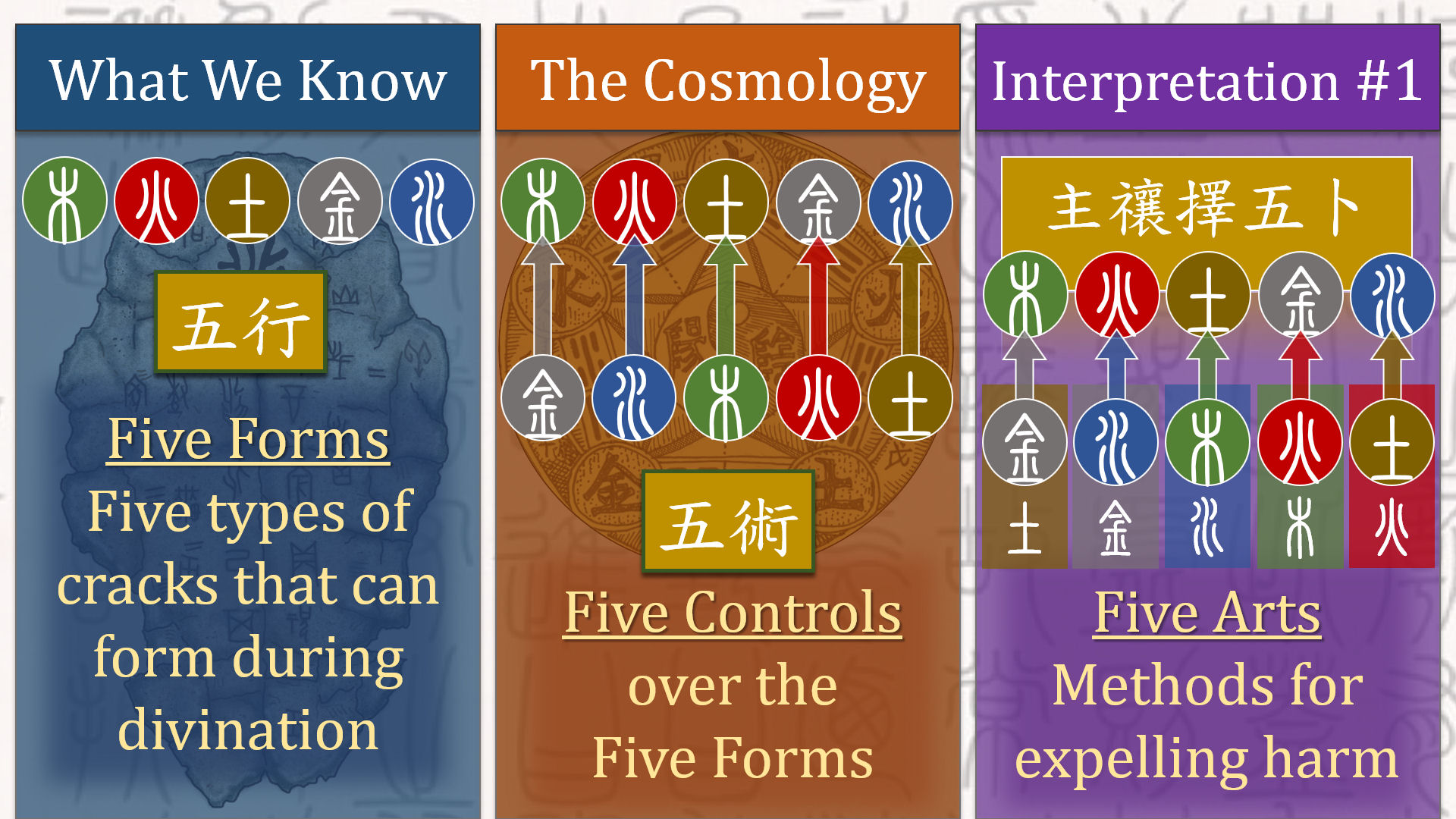
The “五卜” (wu bu) here means the five divinatory signs. In its historical context, it was referring to the five classifications of cracks that can form during oracle bone or tortoise shell divination, and the five classifications correspond to the Five Movements (Wu Xing), or five dynamic phases of Change.
These are still “formations of yin and yang” because for each of the five, there’s the binary of yin and yang, so there’s Yin Wood, Yang Wood, Yin Metal, Yang Metal, etc., for a total of ten.
Per the cosmological beliefs of the time, any phenomenon in this universe corresponds with one of these five classifications and another one of the five can defeat it, or mitigate the damage that could potentially be done by the calamity predicted by the Five Forms. And so these five became the five controls over the Five Forms.
And so our best interpretation of this fourth skill is that the Master of Oracles must be able to not only divine which of the Five Forms of disaster is prophesied, but also know the Five Arts for warding each of the Five Forms of disaster.
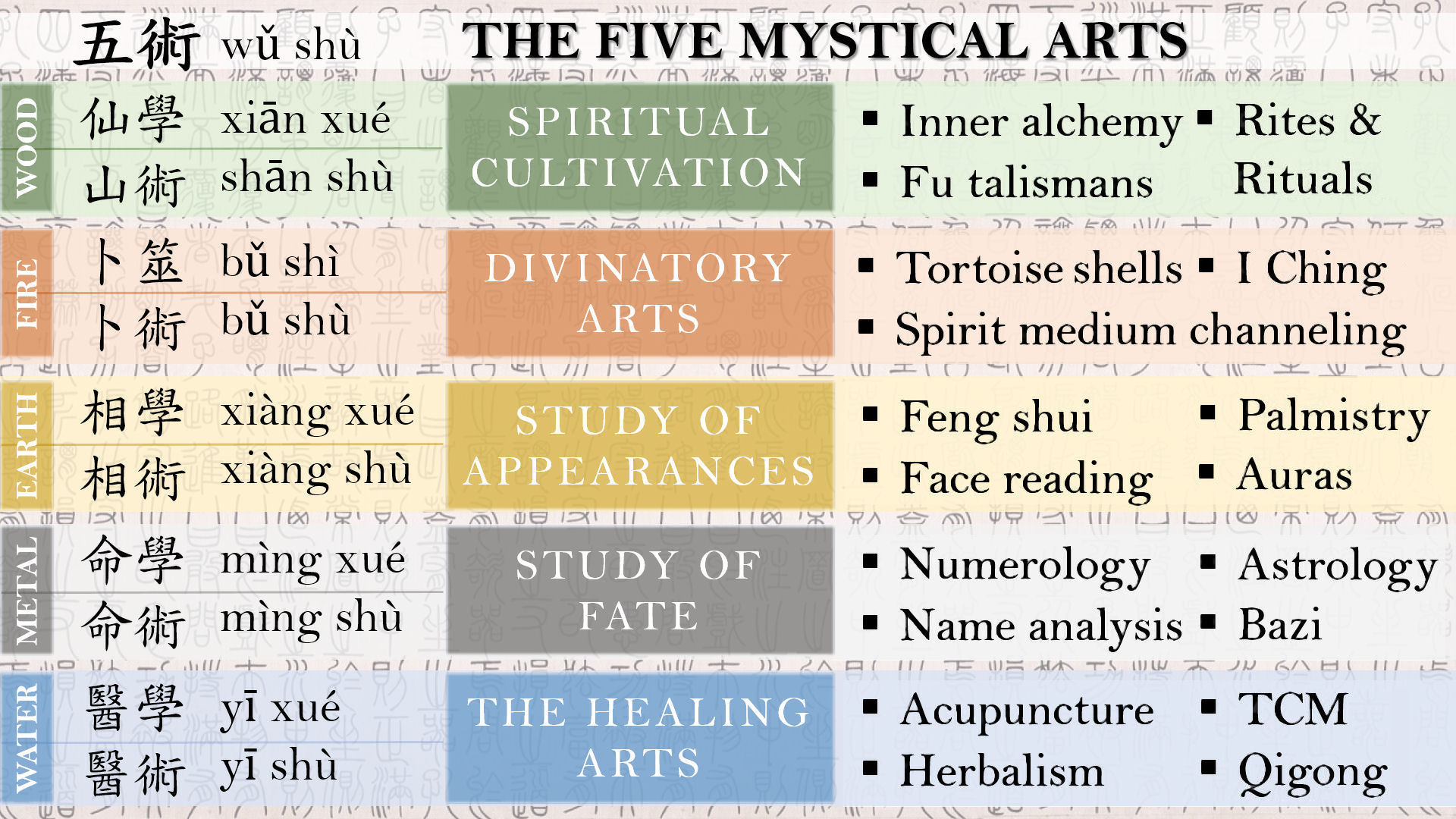
There’s another interpretation of this line, cross-referencing into a popular expression of the mystical arts: Wǔ Shù 五術. The Five Mystical Arts are: Spiritual Cultivation, be that so you possess command over occult powers or so you can transcend and be one with the Tao; Channeling Divinity, Study of Forms and Appearances; Study of Fate; and the Healing Arts. There are many subset practices under these five categories, such as talisman and sigil-crafting, mediumship and channeling, feng shui, palmistry, or face reading, astrology and Ba Zi Four Pillars analysis, or herbology and Traditional Chinese Medicine
The “五卜” (five divinations) also means to never exceed five tries in divination or in magical interventions. Per Chinese magical folk belief, five is the maximum number of times you can do a divinatory reading on a question before you piss off the gods.
Actually, you can permissibly do divinatory readings on the same question, or “try, try again” with a spell up to three times. If you’re super desperate and the situation is dire, the maximum is five. After that, you’re gonna get yourself in hot water with the spirits, goes the folk belief.
Interestingly, and not at all intentional or planned out, my first Asian magic book was The Tao of Craft, under the category “Spiritual Cultivation.” My second book was I Ching, The Oracle, which would be “Divinatory Arts.” Guess my next book will be on feng shui for “Study of Appearances”? And after that, BaZi Four Pillars of Destiny for “Study of Fate” and then for “The Healing Arts,” I dunno, TCM? Maybe a compilation of faith healing methods across the Asian folk traditions.
#5: Foretell Fortune and Misfortune
知其吉凶妖祥
The final skill is the skill of judgment. Discerning whether a Path will be auspicious or inauspicious. There are four characters in this line relating to divinatory outcomes:
- “吉” (ji): Favorable, harmony, alignment. Note: An outcome may be emotionally painful, but still be favorable from a divinatory perspective.
- “凶” (xiong): Unfavorable, misalignment, there are obstructions. Note: An outcome can seem great and desirable, but is still ominous and unfavorable, putting you in misalignment.
- “妖” (yao): An omen of blessing.
- “祥” (xiang): Indicates an anomaly, something’s off, tread with care.
To say that line means “foretell fortune and misfortune” was over-simplistic, but I was trying to fit the number of characters into limited spacing on the PowerPoint slides, so… =)
In review, Skill #1 was about being able to identify, observe, and interpret yin-yang formations and understand their movements. That’s the baseline prerequisite knowledge you’ll need to be able to do divinations, and the main purpose for doing divination is to help avert disaster. Also, to be able to avert disaster, you’ll need to know the sacred mysteries and mystical arts.
That gets us to #5, which is to say when you look at a decision being contemplated, you have the skills to assess whether that decision is auspicious or inauspicious. At the end of the day, the main duty of the Minister of Oracles is to be able to give counsel, presumably guidance that is coming straight from the gods and spirits.
“Hunchbacked Shamans and Limping Spirit-Mediums”
傴巫跛擊之事也
There is one final, significant point Xunzi makes about shamans and witches: Those who would fit the role of Minister of Oracles bear physical deformities, according to this Xunzi line. For the purposes of modern witchcraft, I read this as a metaphor that the witch in society is an anomaly, and is going to stick out like a sore thumb. Even when we integrate into lay society to hold government titles, to hold down respectable occupations, we won’t ever truly be respected.
Also, a modern interpretation of this idea of deformity would be those who are neurodivergent, who are socially non-conforming, or who have been through trauma.
According to prevailing thought at this time, during the Warring States, those who are born with prescient knowledge, able to harness unseen forces, are practitioners of mysticism and/or the occult, fall into two camps:
One, the upright, moral, humble types who are scholarly, learned, and who modestly pursue spiritual cultivation, and
Two, the deformed shamans. They tend to be arrogant, they still have the gift, just like the first type, but perhaps they’re morally gray characters.
Xunzi (and many of his contemporaries) acknowledges that shamans have an official role in the government system. He recognizes that they possess power, can divine, communicate with spirits, read omens, and access unseen forces.
But he’s also quite critical of shamans, witches, and sorcerers. These are not figures who are respected by proper society, but proper society tolerates them, because on some level they acknowledge that these shamans, witches, sorcerers, or Ministers of the Oracle are needed.
I think in Xunzi’s mind, the shamans, witches, and sorcerers are the ultimate embodiment of human nature when endowed with unchecked power, or put another way, these sorts of abilities, outlined in the Five Core Skills and Five Mystical Arts, magnify what’s innate, which Xunzi thinks is evil and self-serving (we’ll get to this in the next section), so external constraints, including social stigma, are needed to keep these types of people in check.
Human Nature: Mencius vs. Xunzi
人之性善 vs. 人之性惡
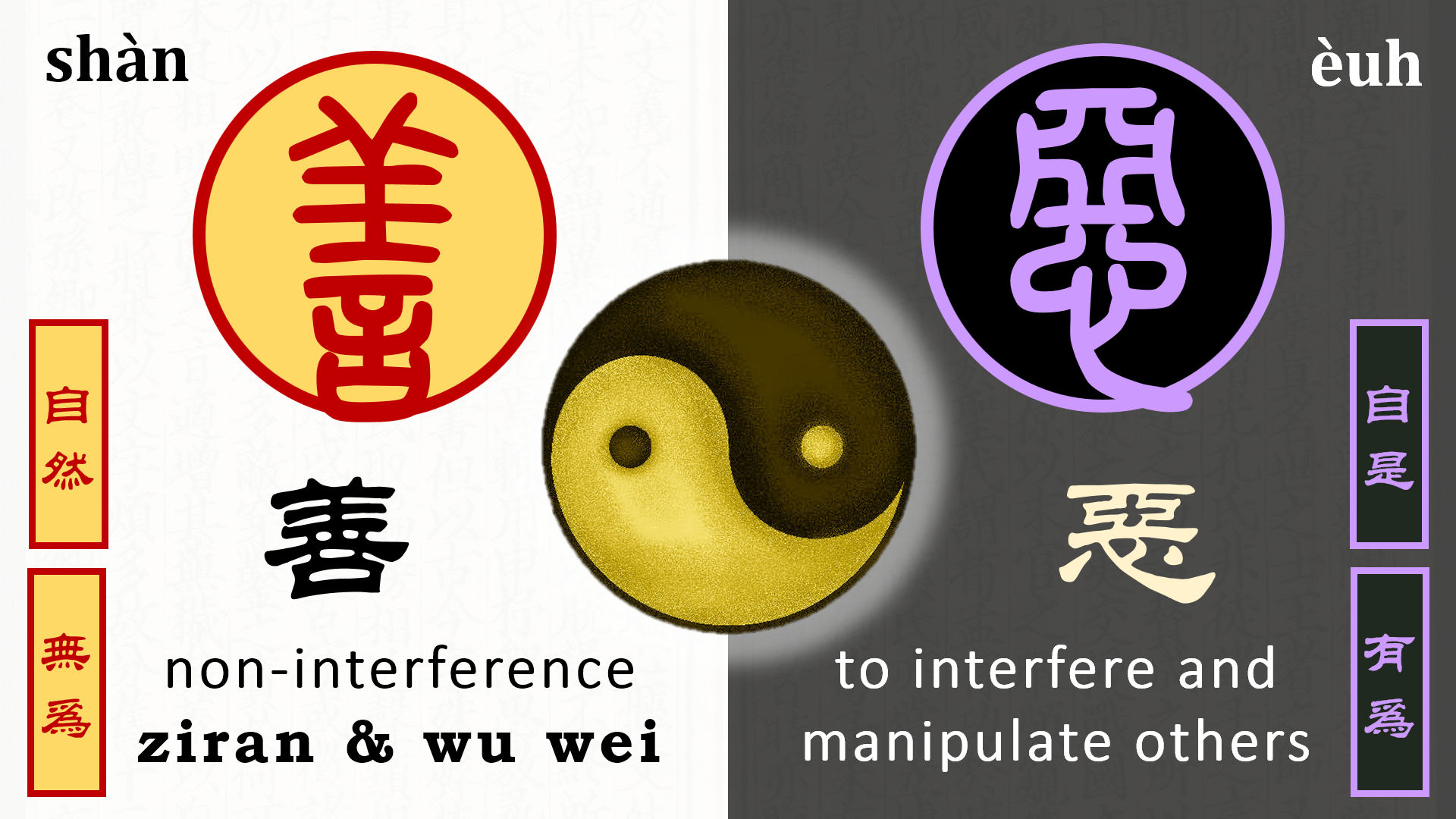
At the end of that video, I recap the famous philosophical debate between Mencius and Xunzi. Mencius had said “人之性善,” humanity is inherently benevolent and good. Xunzi writes in reaction to that, criticizing Mencius and then declaring, “人之性惡,” humanity is inherently self-serving and evil.
However, we’ve got to address what we mean when we say good vs. evil. The polarity is presented as: Shan 善, which to simplify, we translate as “good,” and Euh 惡, its opposite, evil. But when we say “good,” we mean non-interference, to abide by the doctrines of ziran and wu wei. And when we say the polarity of that, we mean to interfere, to manipulate, to force against another’s nature, to impose your Will over Divine Will or natural Will.
The philosopher Mencius espoused that people are inherently Shan 善. The reason we see humans wanting to cultivate virtue and instill morality is because we’re by nature good, that our true will is naturally aligned with divine will, so long as we, well, go with the flow. And it is in our nature to want to be compassionate, and generous, and to be of service to others, because it is in our nature to want to be harmonious. It’s true, the pain and suffering, and the toils of the mortal world corrupts us, and pollutes that inner purity. So education and cultivation of virtue are about keeping that pollution at bay, to undo the corruption, and to let us be our true selves, which is pure and kind, and toward divinity.
To put it mildly, Xunzi disagrees. He says people are inherently Euh 惡. Our nature is “evil” in the sense that we only care about ourselves, we’re self-serving, and if left to our own devices without consequence, we would be violent, cruel, lazy, greedy, and immoral. Any goodness that humans display is performative and with ulterior motives, because we’re profit-driven, competitive, greedy, oh, and also, cowards, because we don’t stand up for justice if it might hurt us (which is why we, says Xunzi and his school of thought, we need draconian legal systems).
So, Mencius sees our wrongdoing as just symptoms of getting tainted by the woes of mortal, material life, and if we spiritually cultivate to rise above sensations of suffering and materialism, we purify ourselves back to our true natures.
Whereas Xunzi sees our wrongdoing as us being us. Suffering and materialism comes from our nature and what we’re inflicting onto this world. Spiritual cultivation, education, and most importantly, a strong legal system and police state, is how we correct that human nature.
We’ve noted how Xunzi basically looked down on the Wu, or shamans, witches, and sorcerers. And interestingly enough, it aligns with his philosophical outlook. I think in Xunzi’s mind, the shamans, witches, and sorcerers are the ultimate embodiment of human nature when endowed with unchecked power, or put another way, these sorts of abilities, outlined in the Five Core Skills and Five Mystical Arts, magnify what’s innate, which Xunzi thinks is evil, so external constraints, including social stigma, are needed to keep these types of people in check.
That was a bit of a tangent into Chinese philosophy, but I think it’s relevant to this subject. You know how in Western magical circles, there’s the discourse of “white” vs. “black” magic, and the critique of that binary? There are similar discussions in Eastern magical circles, though slightly different, because we’re not coming from a Christianized view of that binary. Instead, perhaps we might apply the Mencius vs. Xunzi debate.
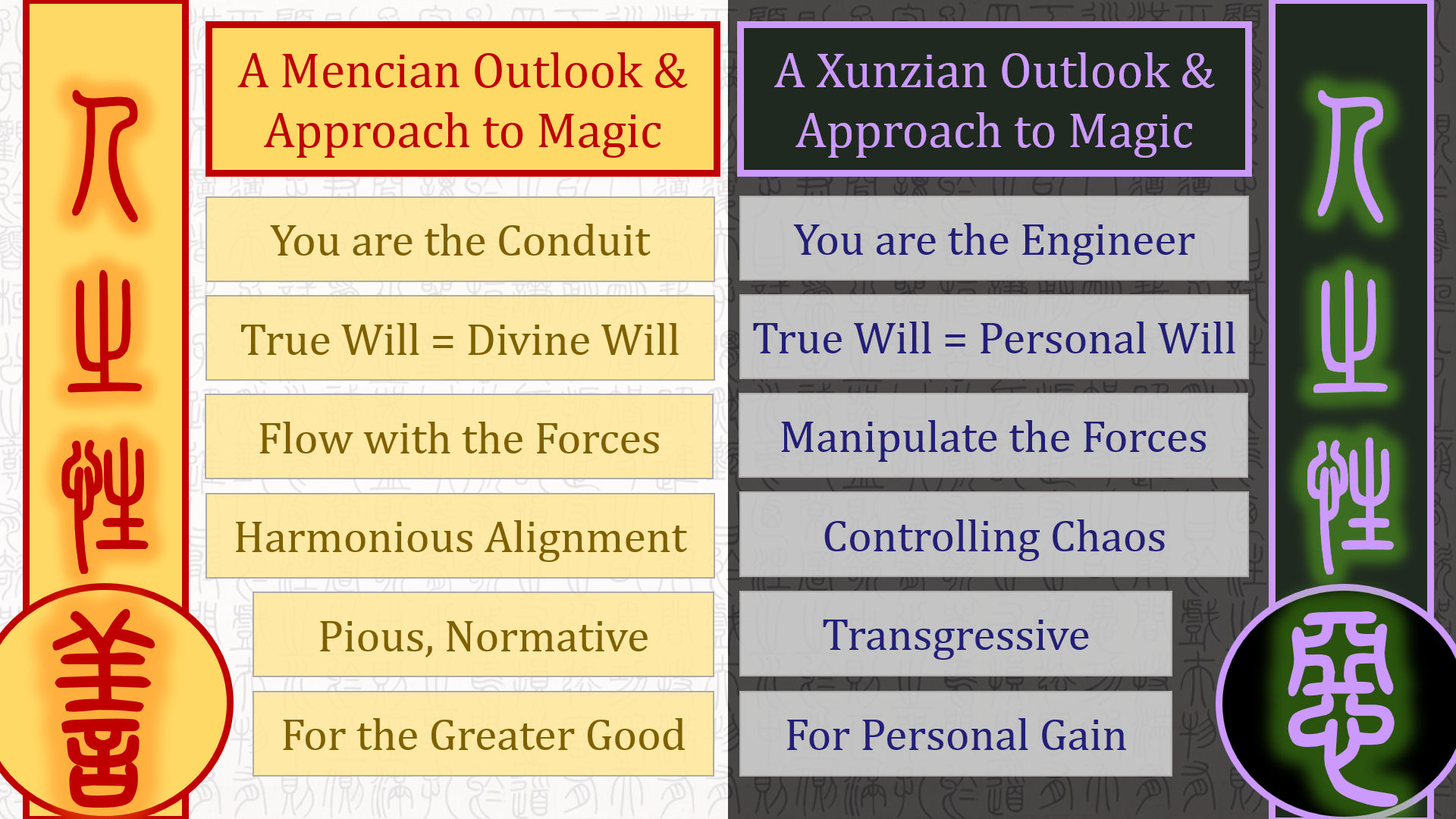
For me, the scope of what I mean by a magical practice that is “Shan 善” is non-interference so as not to risk disturbing the balance of nature, to not manipulate, and to not impose personal will onto others. When I pursue Buddhist/Taoist or spiritual cultivation, it’s about purifying all that we’ve accumulated from our suffering so that we can return to our true nature, which is benevolent, generous, and compassionate.
In terms of your own philosophy of and approach to the craft, are you in the Mencius camp or the Xunzi camp? =)
 benebell wen
I nominate Benebell as the Minister of Oracles! I believe she is (overly!) qualified for the job, and I enjoy benefitting from the knowledge she is sharing with us. Thank you Benebell.
LikeLiked by 2 people
Pingback: Om Mani Padme Hum in Asian Magical Traditions – benebell wen