

I partook in this thought leadership workshop and learned about the five categories of questions to ask for more effective, strategic decision-making. Being me and having the interests I do, of course I immediately connected these learnings to tarot, I Ching, and in general divinatory readings.
Teachers in nearly every divinatory tradition or system talk at length about the importance of how you ask and frame questions for divination. The quality of answers you receive — be that in strategic leadership, personal development, or divination – is directly influenced by the clarity, precision, and intention behind the questions you’re asking.

A well-framed question acts like a lens. It brings your focus to what truly matters, and in the case of readings, hones the focus narrowly on what it is you most want or need to know. The better your question, the more noise will get filtered out of the reading result, enhancing meaningful insight.
Thinking about how to frame questions through the principles of these five categories is really helpful, I think. Hence, this share.

The five categories are:
- Investigative: These questions uncover facts, evaluate evidence, and clarify the present situation so you can understand what is working, what is not, and why.
- Speculative: These questions spark creativity and innovation, helping you to explore alternative possibilities, untapped ideas, and unconventional approaches.
- Productive: These questions focus on action and progress, determining readiness, resources, and the practical steps you need to advance.
- Interpretive: These questions seek to derive meaning from the information you have at hand, aligning key insights with long-term goals.
- Subjective: These questions focus on personal perspective, emotional truths, and interpersonal harmony, to ensure that the human element is fully integrated into your decision-making process.

Here are examples of questions from each of these five categories:
(1) Investigative.
Investigative questions help you diagnose the current situation by uncovering facts, identifying causes, and evaluating what is or isn’t working. They ground your thinking in evidence and clarify the scope and urgency of the issue. This type of inquiry sets the foundation for informed decision-making.
- What happened?
- What is working? (and/or) What is not working?
- What are the causes of the problem?
- How feasible and desirable is each option?
- What evidence supports the proposed plan?
- What data is most relevant in making the most informed decision here?
- What data is missing that is otherwise relevant in making sure I make the most informed decision possible?
- What is the impact?
- How has this situation evolved over time?
- What repeating pattern or trend do I need to be most mindful of?
(2) Speculative.
Speculative questions invite creative thinking and open the door to innovation by exploring alternatives, challenging assumptions, and imagining new possibilities. This line of questioning is essential when you’re seeking to break out of routine patterns and generate fresh approaches.
- What other scenarios might exist?
- Could we do this differently?
- What else might we propose?
- What can we simplify, combine, modify, reverse, or eliminate?
- What potential solutions have we not considered?
- What is that “too bold” idea that might be worth trying out?
- How might a different industry (or a different personality/archetype) solve this problem?
- What would this look like if I were to start from scratch?
- What if I assume the opposite of what I currently believe?
(3) Productive.
Productive questions are focused on action—they help you assess readiness, identify concrete next steps, and ensure that resources and timing align. These questions bridge strategy with execution, making sure your plans are realistic and actionable.
- What is the next step?
- What do I need to achieve before taking it?
- Do I have the resources to move ahead?
- How do I access and acquire the resources needed?
- Do I know enough to proceed?
- Am I ready to decide?
- What milestones can I set to track my progress?
- What is blocking my momentum?
- What is the timeline that I need to be mindful of?
- In what way do I measure success?
- What does success look like for me in this situation?
(4) Interpretive.
Interpretive questions help make meaning out of new information and experiences, aligning insights with long-term goals and values. They encourage reflection on how current events or data influence your broader direction and strategic intent.
- What did I learn from this new information?
- What does it mean for my present and future actions?
- What should be my overarching goal?
- How does this fit with that goal?
- What am I trying to achieve?
- How do my values influence my choice?
- How does this situation align with my long-term goals and vision?
- What principles should be guiding me through this uncertainty?
- What is the story I am telling myself about this situation?
(5) Subjective.
Subjective questions bring the human element into decision-making by surfacing feelings, perspectives, and relational dynamics. They ensure that emotional intelligence, stakeholder alignment, and interpersonal trust are considered before moving forward.
- How do you really feel about this decision?
- Are there differences between what was said, what was heard, and what was meant?
- Have I consulted the right people?
- Are all stakeholders genuinely aligned?
- What unspoken concerns might be influencing the situation?
- Who stands to gain or lose?
- What personal biases might be at play?
- What is my intuition telling me about the situation at hand?
- How do I best manage conflict/the disagreement?
- How can I get the support and confidence I need to move forward?

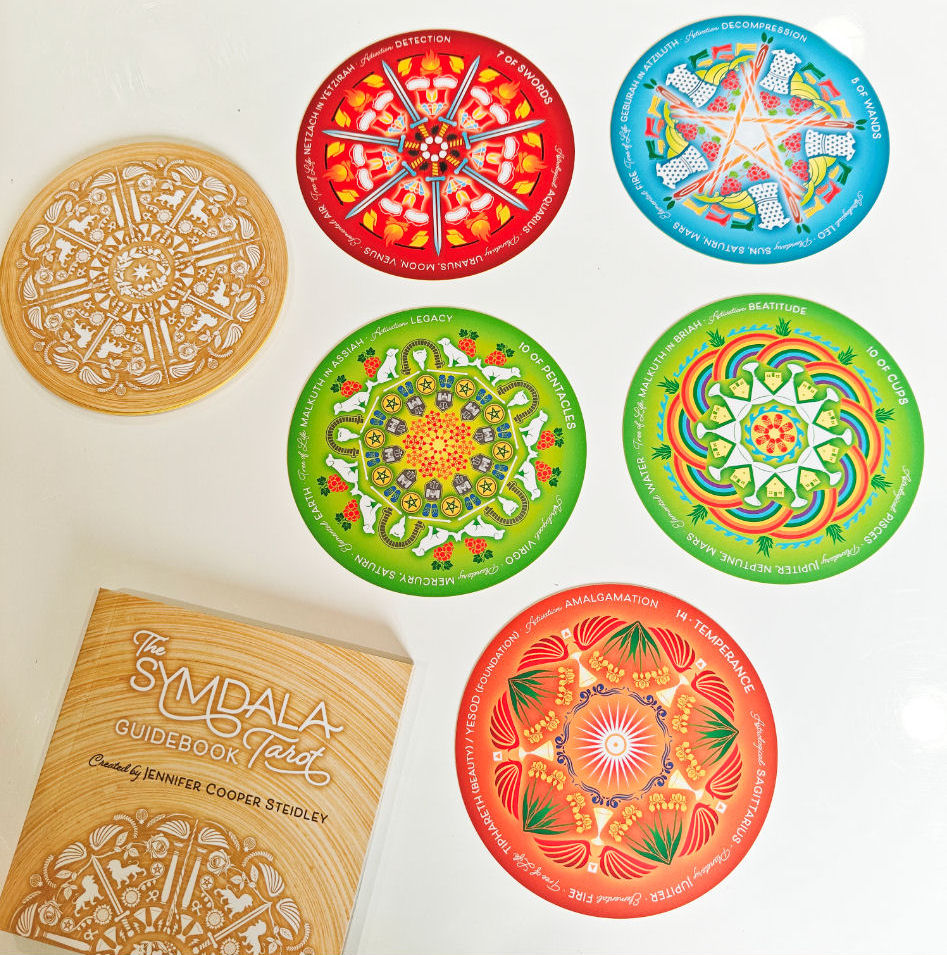
Designing Tarot or Oracle Spreads
There’s no limit to how the Five Categories of Questioning can inspire tarot spread design. So go nuts. Here’s one way I found to be most helpful for myself: a five-card reading spread, with each card position corresponding with one of the five categories of questions.
For example, the following five-card spread can be used to explore a decision I need to be making, a life transition, or to get some clarity around a creative endeavor:
- Card 1: Investigative: What is the root of the issue? (or) What is currently happening?
- Card 2: Speculative: What new ideas, unseen possibilities, or alternative paths should I be considering?
- Card 3: Productive: What should be my next step? (or) What action is ready to be taken right now?
- Card 4: Interpretive: What does this experience mean in the broader context of my life purpose?
- Card 5: Subjective: What emotions, inner beliefs, or relationships are influencing this situation, that I should be paying more attention to?
If you’re a coach working with people leaders in corporate, then instead of using a tarot deck, this would work just as effectively with archetype cards, any sort of more corporate-friendly not-so-overtly-mystical oracle deck with user-friendly keywords or affirmation phrases.

Framing More Precise Questions for the I Ching
First, well actually, this holds true for tarot pedagogy, too, but among I Ching practitioners, there’s a bit of a difference in opinion on just how important the framing of questions is. I personally tend to be of the opinion that it is not that important at all. And in fact, it’s more about grounding, centering the heart and mind, and being open and receptive to Divinity. The answer and guidance you most need will come.
But to be fair, there are also I Ching practitioners likely to disagree with me, and will assert — as you often find in tarot — that you need to be very precise, intentional, and mindful about the question you present, because “garbage in, garbage out,” in a manner of speaking.
To integrate this five categories of questions concept with I Ching reading, take a moment to reflect on what it is exactly you want to know, what insight you are seeking, then scan the above list of questions from all five categories and choose the one question that would make the best template for your inquiry, then tailor and tweak it a bit to be specific to your situation at hand.
Knowing which category that question you chose comes from, out of the five, will give you additional important insight on exactly which gap in knowledge you’re seeking to fill.

Journaling Prompts Based on the Five Categories
I love journaling. It really helps me to refine my thinking process. I can often talk myself off a ledge just by journaling through the problem. With this framework of five categories of strategic questioning, you can totally take your journaling to the next level.
- Investigative: What do I already know? What facts or data am I sitting with? – I then free-write my responses to these questions.
- Speculative: What creative options or pathways have I overlooked? – Personally, I find it useful to pull a few cards to prompt my creative thinking, then proceed with the free-write.
- Productive: Am I ready to take action? What’s holding me back?
- Interpretive: What is the bigger picture or soul lesson I sense behind this? – Using the I Ching here to divine a single hexagram, or line statement from one of the gua of the hexagram is useful here.
- Subjective: What am I feeling that I haven’t named out loud? – Again, divinatory readings to start the thinking process is useful for reflecting on such a question.

All content shared in this article are offered freely for any use, commercial or non-commercial, for any purpose whatsoever. No attribution or credit back to me is necessary. If you’re a life coach, mentor, professional reader, or anyone who finds value in integrating these insights into your work, please feel free to do so without hesitation.
 benebell wen
there are people with the true talent of foreseeing,they may use stones,bones,numbers even mud…but it’s them,not the object…so let us not be prey of aestetical preferences,or any attractive appearances,just concentrate on your inner nature and learn to listen without visual or auditive distractions..one may ask..how to do it? the word “how” connects immediately to a concept or method of doing something through a way,just keep in mind not to substitute the pointing finger as the Target …
LikeLike
I really like these specific categories of questions as a framework, and it’s smart to include at lesat one of each in a spread to make sure you have full coverage! And thanks for showing off the Apothecary Spirits! I hope they’re sharing lots of lovely healing energy along with their divinatory insights ❤
LikeLike
Very interesting and insightful, thank you
LikeLike
Great post. I think question formation is one of the most important part of a reading and will put it in use immediately. Thanks for the useful and important article!
LikeLike
Great information. Thank you for sharing.
LikeLike
Oi Benebel ; Conheci seu blog através de Theresa Reed e de seu blog. Essas perguntas são muito Vivo no Brasil e seu blog veio a expandir minha mente e meu mundo de estudo do Tarô. Muito obrigado
LikeLike