
Course Description
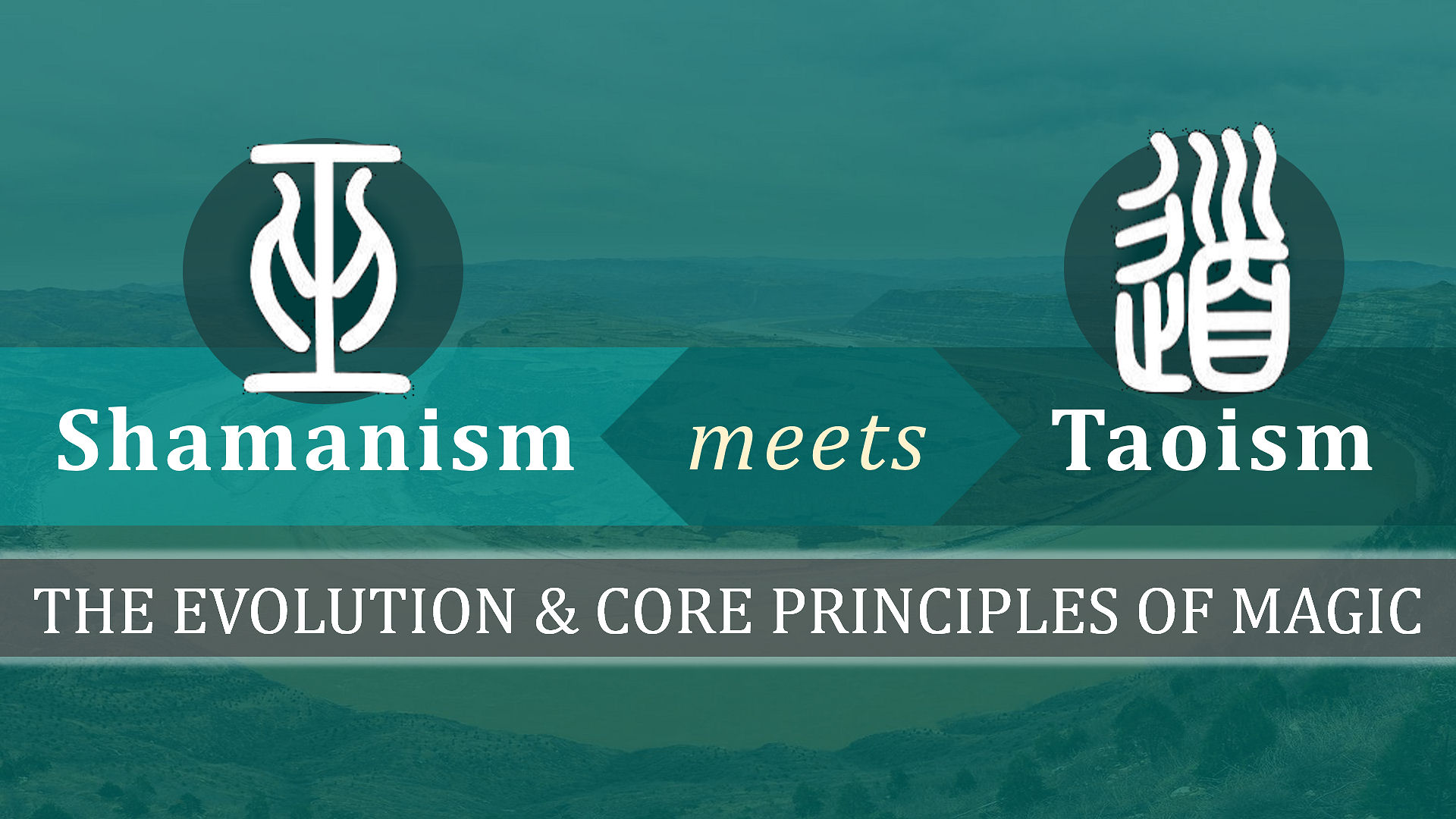
Let’s time travel and step into the mystical lineage of the Neolithic Wu 巫 shamans that laid the foundation for Taoist mysticism. This free public video lecture explores the birth of Taoist magic and the enduring legacy of Wu shamanism. We’ll decode Taoist occultism as it is practiced today to reveal the hidden history of how shamanism shaped the mystical practices of East Asia, preserving and refining early shamanistic techniques into a structured magical system, giving rise to Taoist mysticism.
Taoism is the enduring legacy of the Wu 巫, and how their oft-forgotten roots and history have shaped the modern practices of spirit mediums, Asian modalities of witchcraft, and Taoist ritual magic today. We’ll bridge the gap between the ancient traditions we’ve inherited from the Yellow River cradle of civilization and modern mystical practices, presented in a way rarely explored in the English language.
This is Taoist witchcraft decoded, in reclamation of the Wu 巫’s shamanic practices of the Tao 道.
Preliminary Conversations
Half of the content for this course is going to be text. Even after scripting out the video lecture, I had to cut many of the foundational sections and convert it into text, as you’ll find here under “Preliminary Conversations.”
About the Opening Scene
The opening scene to this video lecture was based on Pre-Qin classical texts I found describing the Wu in combination with archaeological artifacts traced to the Shang dynasty. It’s (obviously) an imaginative reconstruction, though that doesn’t take away from the depth of research that went into it. Early accounts such as Zuozhuan, Liji, and Guoyu help us to understand ritual gestures and wardrobe. Archaeological findings from Shang-era sites and burial artifacts provide visual and symbolic clues.
The Semantics: How Do We Translate “巫 (Wu)” Into English?
Semantics is the study of meaning in language, symbols, and logic. It’s about how words convey meaning, how meaning changes in different contexts, and how people interpret and use particular words.
As someone born and raised in the culture, this ideogram “巫” is immediately evocative of a full scope of meaning. By the way, within the culture and among native practitioners, what the word evokes will differ depending on which generation you were born into. For example, my late grandmother would probably distance herself as much as possible from identification with that term, even if practice by practice down a checklist, she ticks every single box. My mother has a more balanced perspective, acknowledging that it has negative connotations to the mainstream, and therefore self-identifying with that term will come with undeniable risks and social alienation, but also, she thinks it’s cool that the younger generation – my generation and the one after me – is trying to reclaim it.
Adding to the complexity of semantics is how are we to translate “巫 (wu)” into English?
“Shaman,” the way it is used as a loan word in English, is the popular translation today, in this decade, because of the common point of serving as an intermediary between spiritual and physical realms. It’s also the preferred translation among native practitioners when endeavoring to explain their traditions to the English-speaking world. Don’t we want to respect the preferences of native practitioners and how they self-identify?
To say to native practitioners, “No, you cannot use that word to self-identify and explain your practice to us” is not just a matter of gatekeeping, but it’s flagrantly disrespecting their agency and how they choose to represent themselves in cross-cultural dialogue.
When I translate “巫 (wu)” to “shaman,” I’m using the word “shaman” as a loan word, like how “robot” is originally Czech, meaning forced labor or serfdom, but now means something totally different in English. “Pajama” in its original language meant loose-fitting pants. Now in English it means sleepwear, top and bottom. “Ketchup” in Hokkien was a fermented fish sauce. Or “tycoon” which in Japanese meant a high-ranking shogun, but now means a wealthy industry leader. “Avatar” in Sanskrit meant the earthly incarnation of a deity, but as an English loanword means your online digital representation. “Shampoo” in Hindi meant a scalp massage. Today the word is used to indicate soap for washing hair.
That said, we need to acknowledge that when we translate “巫 (wu)” to “shaman,” the downside is the risk of conflation with its original Evenki meaning and the specific traditions of spiritual specialists who mediate between humans and spirits through trance states, healing, and divination within Siberian indigenous traditions. You risk imposing a much broader definition that homogenizes the label, thereby erasing its original cultural, religions, and historical context. You risk erasing nuance, or misrepresenting local beliefs.
So admittedly, it’s not a perfect translation, though the “巫 (wu)” unequivocally is by definition a “spiritual specialist who mediates between humans and spirits through: trance states, holistic healing methodologies, and divination.” That’s why the majority view among East Asian historians, archaeologists, scholars, and the lay practitioners themselves prefer “shaman” as the English translation for “巫 (wu).”
Here’s an oft-raised point: Why not just use the transliteration of “巫” and translate it as “Wu” or “Wu-ism”? So in English, instead of saying “shaman” or even “witch,” call it what it is in the original language — “wu,” and instead of calling it shamanism, call it Wu-ism (shudders). There’s just one problem with that.
In English-speaking societies, East Asians often experience a unique form of marginalization known as the perpetual foreigner stereotype—no matter how many generations their families have lived in the West, they are still perceived as outsiders. This linguistic othering extends to cultural and spiritual practices, where non-Western traditions are often framed as exotic, inscrutable, or fundamentally different from what is considered mainstream.
When we transliterate 巫 as “wu” instead of translating it into an English equivalent like “shaman,” we reinforce this dynamic, making it seem distant and unfamiliar rather than an integral part of the global human experience of spiritual mediation, of shamanistic traditions that fundamentally unites many of our indigenous practices.
(… not to mention the admittedly superficial point that “Wu-ism” sounds ridiculous.)
While “shaman” is a loan word itself, it has been widely adopted into English as a general term for individuals who serve as intermediaries between the physical and spiritual realms. Using “shaman” to translate 巫 places Chinese spiritual traditions within a broader, universally understood framework rather than isolating them as something perpetually foreign. This approach not only makes the practice more accessible to English speakers but also affirms that East Asian traditions are not locked behind linguistic barriers—they are part of a shared human heritage.
Tianism to Tengrism: Shamanism by Different Names
Chinese Tianism revolves around Tian (天), meaning “Heaven” — a cosmic, moral force governing the universe. This concept emerged from ancient Chinese beliefs, particularly during the Shang and Zhou dynasties. Initially, the Shang people worshiped Shangdi (上帝, “Highest Deity”), but the Zhou shifted focus to Tian as an impartial, universal force embodying moral order. This shift helped justify the Mandate of Heaven (天命), which legitimized rulership based on virtue
In Tianism, the Wu shamans were intermediaries between the human world and the divine, ancestral, and spirit worlds. Aspects of Tianism were later folded into Taoism and even Confucianism.
Mongolian Tengrism centers on Tengri, the eternal blue sky, representative of a sky god and the overarching sacred force of the universe, similar to the concept of Shangdi. It was prevalent among Turkic and Mongolic peoples, including the Xiongnu and Mongols. Genghis Khan famously declared his conquests were sanctioned by Tengri, a striking parallel to the Mandate of Heaven in Tianism.
Like Tianism and Taoism, Tengrism emphasizes harmony with nature, shamanic practices, and balance between Heaven (Tengri), Earth (Eje), and various spirits (ongon). Böö shamans, like Wu shamans, were intermediaries between the human world and the divine, ancestral, and spirit worlds. Both the Wu and the Böö performed healing rituals, guided souls, and communed with spirits, often through ritual dance, incantations, and trance-like states. Both traditions involve soul journeys and the concept of reincarnation.
Lineaged Taoists vs. the Wu
Although tracking common threads across historical texts and ritual practices documents how much of Wu shamanism did in fact get integrated into what later became standardized Taoist practices and principles, this is not to say they were BFFs. Far from it. In fact, they were often in social opposition.
During the Shang and early part of the Zhou, the Wu held political and social power. However, by the Han and through the Six Dynasties period (220 AD – 589 AD), especially with the establishment of the class system, the gentry practicing forms of mysticism clearly derived from Wu shamanism denounced Wu shamanism and rebranded what they did as Taoist ritual. The thing is, classism was the divide, not what they were actually practicing.
Likewise, Confucianist-influenced schools of thought wrote vehemently against Wu shamanism, describing it as superstitious and ignorant, but then in the same breath, would still practice forms of what basically amounted to spirit mediumship and fortune-telling. Not to mention, Taoism as practiced by secret societies rebelling against the imperial court would blend Wu shamanic practices with Taoist principles. E.g., the Yellow Turban Rebellion circa 184 AD.
Thus, while Taoist occultism de facto integrated Wu shamanistic principles and practices, it wasn’t always acknowledged or credited. In the end, the line between Taoist ritual and Wu shamanism has never been as clear-cut as the social and political rhetoric made it out to be. The Wu may have been pushed to the margins of society, but their influence endured as the vital force woven into the very fabric of Taoist mysticism.


Download Lecture Notes
Click the hyperlink below to download the lecture outline notes.
Download the PDF
Wu Shamanism Meets Taoism
White Academia vs. Native Practitioners: Who Gets to Speak? Academic Power and the Silencing of Native Practitioners
I’d like to take a moment to comment on some epistemic injustice I have had the unfortunate experience of witnessing. It is a recurring and troubling pattern in academia that white male scholars, often with limited linguistic fluency in Classical Chinese and little to no lived experience within the cultures they try to speak as authorities on position themselves as gatekeepers of knowledge in traditions that are not their own.
For the work I share on Wu shamanism and Taoism, I go to great lengths to find native practitioners and native Chinese academics to peer review my work, request their feedback, and improve my work based on their notes. I ground my work in extensive primary-source analysis, not to mention long conversations with native practitioners of the craft in Taiwan, Hong Kong, and Singapore. Also, the obvious: I myself am a native practitioner and a “cradle Taoist/Buddhist.”
Not only is what I share informed by my academic training, but also my positionality as a native practitioner and cultural inheritor of the tradition. When white male academics claim authority over practices I was born into and raised with—and then position my lived experience and scholarship as somehow less credible—they reveal not a commitment to scholarly objectivity, but a troubling assertion of cultural and intellectual dominance.
In 2025 we are still dealing with the marginalization of women of color in academic spaces, especially where we speak with authority about or own ancestral traditions, is a symptomatic issue that we all need to be more mindful of.
Related Videos for Reference
- Secret Book of Three Sovereigns & Seal of the Nine Immortal Realms
- Most Influential Grimoire in Taoist Practice: Baopuzi
- The Lo Shu Magic Square (雒書, Luò Shū)
- Wu Xing: Five Movements Toward Change 五行 · 오행
- Taoist Spirit Maps (靈圖, Língtú)
- The Eight Trigrams (八卦, Bā Guà)
- Lady of the Nine Heavens (Jiu Tian Xuan Nu) and the I Ching
- Taoism: A Decolonized Introduction
- Wu Shamanism: Just a Rumination
- What is the Way of Heaven (天之道, Tiān zhī Dào)?
- Your Inner Palace and the Akashic Records
- Descent into the Underworld 觀落陰 (Wu Shamanism)
- Ritual Magic and Shamanism in Pre-Qin China
Support My Work
I’m excited to share educational lectures like this one for free public access. These videos are a labor of love, driven by my passion for preserving and sharing my culture’s spiritual traditions in a way that is meaningful and accessible to modern seekers.
If you’ve found value in this offering and would like to support my work, I deeply appreciate any donations to help sustain the continuation of these free video lectures. Your contributions allow me to keep producing this content, research, and provide free resources on Taoist mysticism and esoteric Buddhism.
To donate:
Thank you for your generosity and support– it means the world to me!
With gratitude,
Bell
 benebell wen
Dear Ms Wen,
Thank you for this article (and all others too), very informative & I’ve learned a lot ever since I first came across your YT channel (and your website).
Just a very small point: ““Ketchup” in Hokkien was a fermented fish sauce. The Malay and Dutch borrowed the term to mean a tomato-based condiment.”
‘Ketchup’ in Cantonese is literally ‘tomato juice’ (茄汁). The Malay ‘Kicap/Kichap’ is generically used to describe the fermented (salty/sweet) soybean sauce (醬油).
Just my two-cents.
E. Shieh
LikeLike
Thank you for your additional insights!
LikeLike
Regarding the translation of wu, using wu in English would also have the disadvantage of conflating it with woo-woo.
LikeLike
I haven’t had time to watch your YouTube video yet (I was in an isolation room a few days so I have a valid excuse lol) but I did have time to read a bit. The way you organize information and present it is really good. Please continue to do what you are doing!
Kind regards,
Christopher
LikeLike
Thank you so much for your sharing, wisdom, scholarship and dedication!! My favorite acupuncture and TCM teacher of 24 years is Jeffrey Yuen (88th generation Taoist master – jade purity school).
Since I have always been shamanically inclined (also many decades now as acupuncturist and Medical Qi Gong practitioner) I asked my brother if he considered me “woo woo” (not understood, weird and sometimes crazy to them. ) He emphatically agreed “yes!”. So I informed him that Wu meant shaman and in Mandarin language often one doubles a word for emphasis and the reason they did not understand me is due to being in a shamanic and truth teller role!
Years ago – when still doing more carpentry work – I kept getting the measurement 81 inches – and when I asked spirit guides what this was about I was only told “you will learn soon.” A week later upon entering the Daoism exhibition at the Asian Art Museum (San Francisco), the first exhibit showed that Lao Tzu was born at the age of 81 as a sage!!
For what’s it’s worth!
LikeLike
I’ve waited in writing this comment, because I wanted to watch the video, read the full post and also the PDF before saying something.
I want to thank you for all your teachings, the clarity, the explanations you give and all the material you provide.
The topic is very well discussed and gave me many aspects I want to explore further. At the beginning I was waiting, but after reading this I started my three-ring binder about Shamanism and Daoism because I feel it’s something I can’t put off any longer.
This blog and all your books and videos are a treasure, not just for who follows you, but for the world, because you are collecting organically so many information, creating a place where everyone can find information, references and other aspects related to asian culture.
Once again, thanks for what you are doing
LikeLiked by 1 person
Thank you for writing about Wu shamanism, apparently it’s in bloodline from my maternal side
LikeLike
Pingback: Chinese Astrology circa 246 BC: Wuxian Five Star Divination – benebell wen
Pingback: Om Mani Padme Hum in Asian Magical Traditions – benebell wen