Anyone else notice the intensity of recent conversations swirling around so-called girl bosses and trad wives?
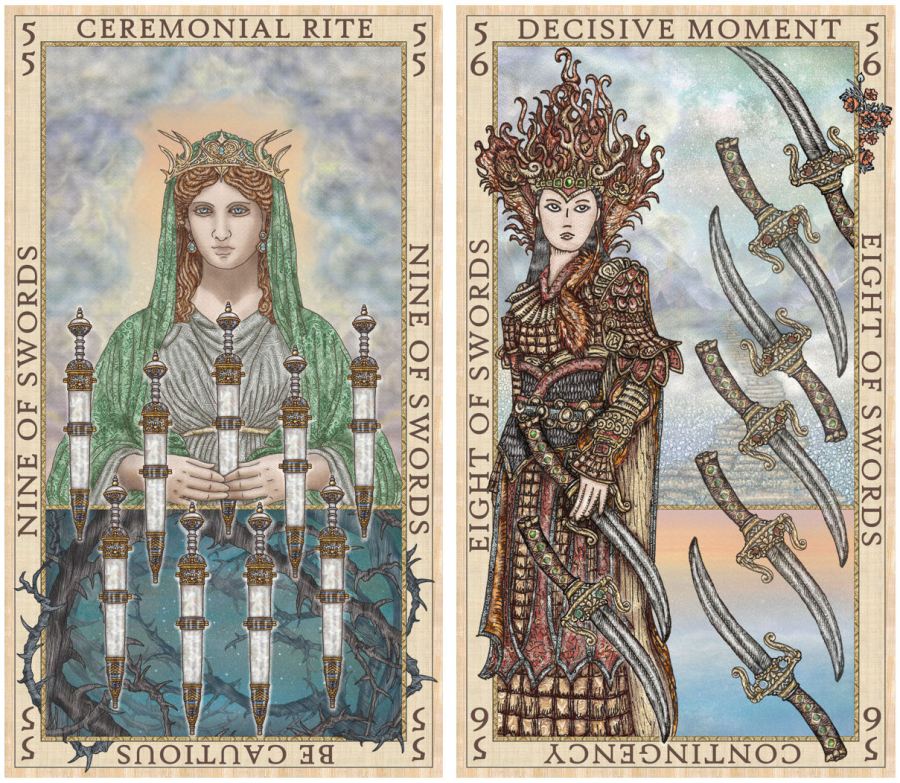
Funny enough, as I nosily listen in on video essays, podcasts, and commentaries, I’ve been sketching the Eight and Nine of Swords from my Etteilla deck.
Now you’re like, wait what does the Eight and Nine of Swords in the tarot have to do with girl bosses and trad wives?

I thought nothing. But the illustrations I seem to have subconsciously done at this time sure are amusing.
Chronologically I worked on Card 56, the Eight of Swords first, which appears to give off girl boss energy, then moved on to Card 55, the Nine of Swords, which one might identify with trad wife.
This blog post is another installment of my Etteilla Tarot art project status updates.
At the same time I thought it’d be fun to pepper in some rambling on this whole trad wives, girl bosses conversation du jour.
For my out-of-touch hermit friends 😉 who are like, “whut?” — The term “girl boss” can mean women in male-dominated professions, entrepreneurial women who are CEOs of their own business, and/or “single childless cat ladies” who aren’t prioritizing the domestic sphere. Oftentimes they have also adopted some more-traditionally-masculine qualities to be able to do what they do.
The term “trad wife,” short for traditional wife, signifies stay-at-home mothers who prioritize domestic labor (perhaps even glamorize it). They tend to fully embody more-traditionally-feminine qualities.
I’m convinced that people who wholly embody either one of these two archetypes only exist on the internet as influencers.
In the modern day, in real life, most average families have the common sense to assess their unique predicament, and the adults in the room sort out who needs to do what. Maybe sometimes their decisions seem to conform to “traditional gender roles” and maybe sometimes they don’t.
(Also yes, all of this is grossly heteronormative, apologies.)
Another point of issue is how the conversation is often pitched as trad wives versus girl bosses, as if the two are mutually exclusive and could never possibly get along with one another. As if the more common scenario isn’t that most women embody a bit of both, depending on the situation.
Which brings me to an unintentional amusing point about these two card illustrations.

You’d assume the left image of a warrior woman is the “girl boss” and to the above right is the “trad wife.”

Except the warrior is Fu Hao, a historical queen who was the wife of King Wu Ding of the Shang dynasty, who also happened to be one of the generals leading King Wu Ding’s army and was a high priestess (or shamaness).
Fu Hao bore children for the King and so in many respects, embodied a “trad wife,” except she also happened to be skilled in martial arts and as a priestess was granted the authority to divine on behalf of the empire, an authority more typically reserved for men. Evidenced by the grandeur of Fu Hao’s tomb, it was clear that her husband, King Wu Ding, loved and honored her.

In the Nine of Swords, that’s a Vestal priestess, and while she’s wearing the accouterments that give off the impression of “trad wife,” she’s most definitely a childless single woman (being that she is a Vestal priestess and all…). And who would be shocked if she also loved cats?
To me, the recent fervor of hate for “single lonely and childless cat ladies” and calling them sociopaths who shouldn’t have the right to vote isn’t the commentary the speakers think it is about women. It’s social commentary about the men who have failed them. Also, the take that only people with children should vote because one would only care about society’s future if you have kids is an unintentional reveal of the speaker’s own selfishness and prejudiced mindset. If anything, that’s scary. Because your kids, I assume, look like you, raised to absorb and emit your ideologies. So you can only care about society’s future if that society is created for people like you? Yikes.
But back to my Etteilla doodles.
The above side by side comparison, I believe, shows the world of difference that small details make. I liked the left version well enough when I completed it (…and posted it to Instagram prematurely…), but felt like something was missing. It wasn’t complete. Not that I’m convinced that the right version above is complete, but the seemingly minor addition of earrings and a couple of “breaking-the-fourth-wall” thorny branches adds so much value to the overall composition.
Oh, and for clarity, I did not intend the cards to be themed trad wife or girl boss at all. I knew exactly what I wanted to draw for the Nine of Swords, and exactly who I wanted to depict in the Eight. It is by fluke of timing that it coincides with these social media conversations.

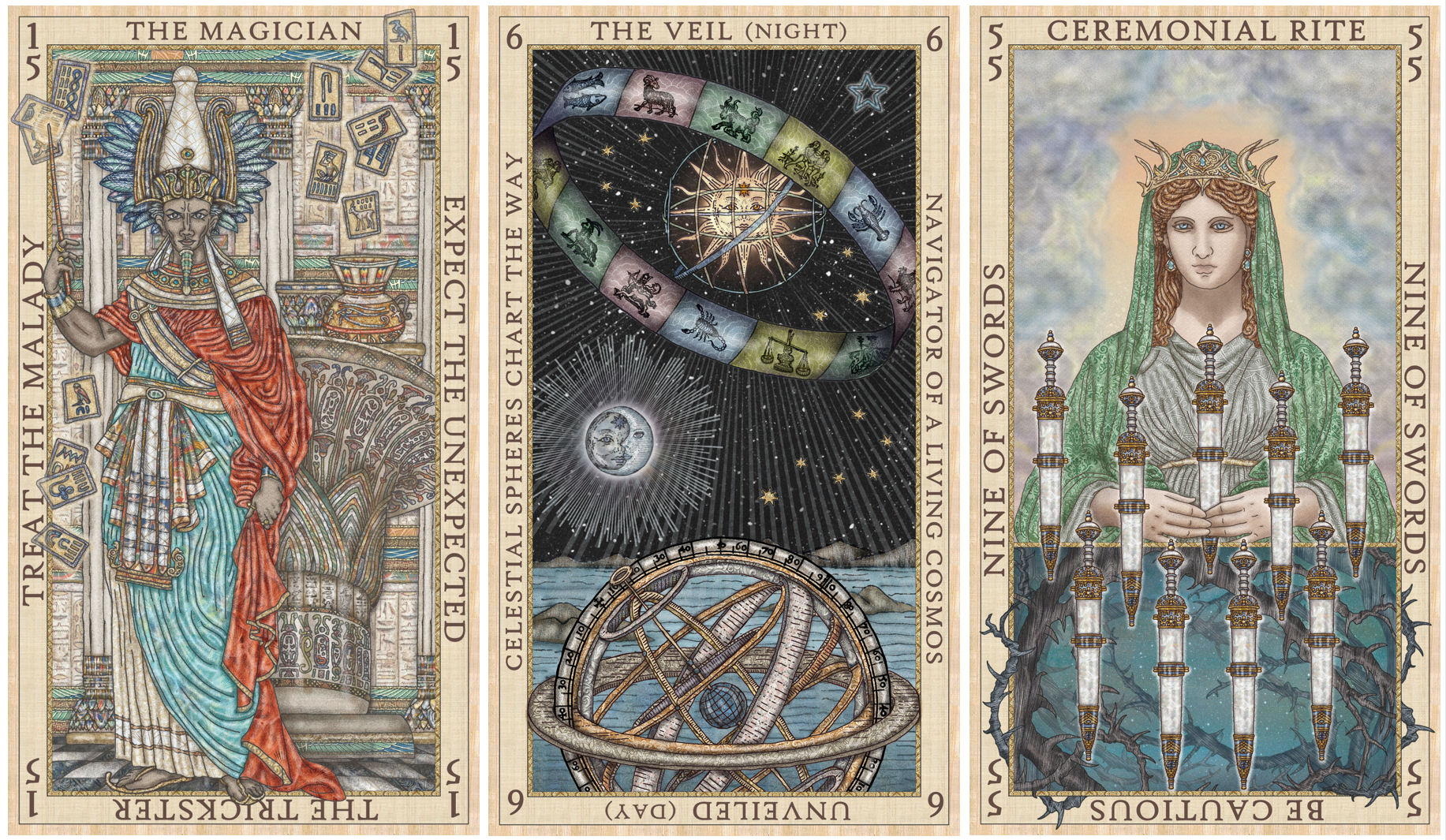
In the Etteilla, the Nine of Swords upright portends ceremony and religious rites or spiritual traditions. (Amusing, considering how most of these trad wives are deeply religious.)
It designates your conscience and could be alerting you to your divine calling. Reversed, the keywords are “Justified Distrust,” noting that discretion is the better part of valor (Shakespeare).
Assuming my illustration here codes trad wife upon first impression, the message of this card is telling us something significant about the trad wife persona: people are a lot more than what meets the eye.
Like has anyone been following the Ballerina Farm Mormon social media entrepreneurs controversy?
I believe that seemingly contradicting realities can be true at the same time. I think the aspects of the husband that many secular working women see as problematic are the same exact qualities that attracted her, the influencer, to him, a literal billionaire. I wouldn’t call those attributes objectively toxic. I would just say that his attributes are not for everyone to be accepting of.
The NY Times journalist who wrote the exposé on Ballerina Farm painted this picture of her, who sacrificed everything for him, and he who sacrificed very little, how controlling and domineering the journalist perceived him to be and how passive and nurturing the ballerina wife was.
Whereas the wife herself clearly stated that both of them had to make sacrifices for the marriage to work. Which is a pretty generically true statement for all marriages.
To me, none of that codes particularly trad. It is an often unintentional reality that many families deal with, trad, girlbossy, or otherwise, and that is in a team setting, women still do more and sacrifice more, and men think they are contributing equally, want to contribute equally, but just seem to fall a little short compared to the load of responsibilities their women counterparts are taking on.
In the viral Ballerina Farm situation, I don’t see her as a victim, and I don’t know that he’s repugnant. I think many women would probably find him insufferable. But these women are not married to him. And the woman who is married to him seems to like him for him.
Does she probably carry a bag of broken dreams? Yes probably. Don’t we all? I don’t know that anybody forced her to do anything. I just think sometimes many of us let circumstances carry us away in a particular direction, leaving us with that bag of broken dreams. It’s funny the way the internet declares how sorry we feel for her, when what we really mean is we feel sorry for ourselves, for the bag of broken dreams we are carrying. At least she’s got a billion dollars to wipe away her tears with.
Rather, none of the firestorm has been about her or him. It has been about us projecting ourselves onto this canvas, and reading our own deepest, darkest anxieties into their story.
What a fun keyword for that Etteilla III (Princess Tarot) Nine of Swords: Conscience.

In the Etteilla II, Cambyses, son of Cyrus the Great, circa 500 BC, King of the Achaemenid Empire and Pharoah of Egypt, is pictured in the lower third. I opted to go in a different direction. These engravings felt a bit like “just put some 18th century version of clipart there to fill up the space.” I wanted my pictures to be a bit more meaningful.
As for another oft cited trad wife influencer, I like Nara Smith, who is this stunning model dressed to the nines in high fashion, while cooking meals from scratch in her kitchen, filmed for TikTok with an ASMR tone voiceover. If you are looking at that as representative of what real women should do, then I think maybe you’re missing the point. It’s meant to be artistic expression. It’s meant to be staged.
Both Ballerina Farm and Nara Smith are forms of cosplay. Their world-building is meant for social media consumption, for virtual reality. Not meant as an authentic as-is role model for women to follow. I mean, it’s a bit like looking at paintings of myths and epics, and wondering why your life isn’t like that.

Another thing I’ve been wondering about– When we talk about trad wives, what we really mean seems to be religious wives. And even more specific than that– Christian wives.
So I really would prefer people to leave “trad” out of it entirely and just call it for what it is — Christian fundamentalism.
To take Christian fundamentalism and someone’s specific brand of religiosity and extrapolate that out to general “trad” is exclusionary. (And also so iconically Christian to think that their own way should be representative of all ways.)
Because fine, let’s talk about heteronormative traditional gender roles. In a healthy scenario, authority is evenly distributed among the partners. Heck, it’s applicable to non-traditional relationships as well — if power and authority are not evenly distributed, things go sideways, fast.
My mom is very much, on the surface insofar as you go down a checklist, what you’d consider a trad wife. But my dad is terrified of her. (Or I think to be more precise, he is terrified of her being unhappy. So he goes out of his way to keep her happy.) She lets him think he’s in charge, but I don’t think he or anyone believes she’s submissive. Power and authority are balanced.
Whereas plenty of my friends are women in high-powered careers who “girl boss” more fiercely than the online #girlboss influencers, and her partner, male or otherwise, does not need to be her professional or financial equal to “lead.” I wouldn’t even call it leading, because that’s just weird. What it is, is almost primitive, in the sense that she feels safe and protected in her partner’s presence. He’s the one who takes out the trash. He fixes the plumbing. He opens doors. He makes sure she’s walking on the inside of the street and he’s surveilling her surroundings to keep her out of danger. Is that “trad”?

Hopefully me see-sawing between topics isn’t getting too confusing. The above left card image is from Orsini’s 1838 book, oft dubbed Etteilla I because it came first in chronology, and above right is a printing of the 1850 Lismon letterpress edition, dubbed Etteilla II. I’m also showing the ancient history learning cards (Jeux de cartes instructives, Histoire ancienne, 1809, by Godard) that the lower third engravings were sourced from.
In Etteilla I, the Eight of Swords featured an engraving of Fohi (today, the convention is to go with the spelling Fuxi) and in Etteilla II, it got swapped with Confucius, because all Asians look alike. I do love how diverse and inclusive the 18th century Etteilla deck (probably unintentionally) is.
Speaking of traditional Confucian values, there’s no denying that it asserts men as the head of the household, and women should follow the men. But it’s also Confucian to say that a man’s masculinity is tied to how well he looks after the women. So if he is not treating her like a queen, then that says something about his lacking of virtuous masculinity. Even under extremist Confucian ideology, its principle demands of men to look after the well-being of women. In the same way a kingdom that is suffering is proof that the king is terrible and should be overthrown, under extremist Confucian ideology, if you’re truly following it, then when a woman is suffering, it’s proof that the man who had been tasked to take care of her is terrible and deserves punishment. (Fun fact: Confucius was raised by a single mom.)
By the way, fundamentalist interpretations of Confucianism (that focus on the first part, i.e., men dominate, but neglect the latter part, i.e., look after the well-being of women) led to some serious fractures in society, which ended up throwing China into an extremist form of Communism, an emotional response to the extremist form of Confucianism.
So can we all just agree to avoid extremism?

Because of the Fuxi and Confucius references in the historical Etteillas, I wanted to stay in that cultural lane. For my Eight of Swords illustration, I did a bit of recycling. You might have seen the above drawing before. It’s of Zhurong, a deity associated with the south (and thus among the four directional deities), goddess of fire, war, military strategy, martial arts, and connected to Mars. Some traditions express Zhurong as a god, while others, particularly in the southernmost regions of China and southeast Asia, express Zhurong as a goddess.
I scanned in that very, very old doodle and then digitally colored it in, designating her as the legendary Fu Hao embodying the goddess Zhurong. Describing Fu Hao as embodying the goddess Zhurong is to say that a mortal is being possessed by or endowed with divine powers, and therefore in a state of divine possession, is able to perform miraculous feats.
But back to traditional gender roles. Even if, for whatever reason, you’re hell-bent on fulfilling traditional gender roles rooted in millennia of primal necessity, the person staying home to look after the house and kids isn’t suddenly the submissive, and the person going out to work 9 to 5 isn’t suddenly the dominant.
A truly good, wholesome person doesn’t see their partner as inferior or superior; simply put, each is taking on different tasks so the project gets done. I’m a bit handier in the kitchen than James, so I cook. James is a bit handier with a chainsaw, so he does the yard work (we have an orchard of trees to prune). James does all the laundry because his dad did all the laundry, so he took after his dad. I read all the contracts, and basically anything that involves reading is going to be my domain, because I’m the Type A in the family who likes to read.
Neither James nor I were ever like, this is for a man to do, this is for a woman to do. It was more about assigning tasks efficiently to who would be more skilled at it. And I would bet this is the case for most families today.
To talk about it as “traditional gender roles” is using the wrong term to describe what you really mean: you want everybody to convert to fundamentalist Christian values.
That’s what this whole trad wife thing is actually about. It’s about centering Christianity. And those who are critiquing the trad wife movement are simply pushing back and saying no, we don’t all have to center Christianity.

Check out the keywords for the Eight and Nine of Swords. I’m delighting in the ways the Etteilla traditionally assigned card meanings is going to break the brains of the modern-day RWS reader. It really calls into question the philosophical concept of card meanings. And acknowledging that the majority agreed upon attributed meanings can and do evolve with time.
Kind of like gender roles.
On the Etteilla Eight of Swords cards themselves, you’ll see keywords like “backbiting,” which is to gossip in bad faith behind someone’s back, or to be judgmental. But in texts on card meanings such as the Orsini and Lemarchand, this card can prognosticate a critical, decisive moment, a pending crisis and therefore the immediate need for crisis management, and a warning sign that greater clarity and clearer line of sight into the situation is needed. I leaned more into what the texts said were the card’s meaning, and went with “Decisive Moment.”
As for the current issue surrounding gender roles and chronic childlessness happening in East Asia, blaming women and feminism is misplaced.
So what’s happening at the moment in places like China, South Korea, and Japan is that women are choosing their careers over having kids (they’re girl bossing), resulting in a birth rate crisis. Hilariously, it’s gotten so bad that China lifted its One Child Policy and is all but begging the population to have babies.
The driving factor, though, isn’t progressive women’s rights and feminism. The issue is how the cultural norms in these places do not leave women with many options. Cultural norms enable men to both pursue an accomplished career and have a family, but do not enable women to do the same. And to oversimplify the problem by saying the solution is for women to revert back to trad wives, staying home barefoot and pregnant, and giving up career accomplishment is not it. I’m not saying that as a feminist; I’m saying that as a realist. Realistically that’s just not gonna happen.
Over the last century, the feminist movement has empowered women to evolve, to reclaim personal sovereignty and self-determination. Meanwhile, masculinity wasn’t really given the tools or guidance to evolve in tandem. If we want to remedy the birth rate crisis, then focus on the men, not the women, because the men will be the key to positive change. And what I mean by that is collectively, their mindset and the culture of masculinity needs to evolve.

In the reverse, the keywords for the Eight of Swords are Incident, Event, and Happenstance, where the Orsini text further emphasizes that it’s an incident of controversy or dispute, where you will need to assert your rights and fight for what is your due.
Another offered keyword is Contingency, so that’s what I went with. There is a strong likelihood that an accident or misfortune will occur, and so if this card appears in reverse, the message is to put into play your contingency plan, to mitigate any fall-out from the Incident, Event, or Happenstance.
Think about how many trad wife mothers and grandmothers repeatedly told their daughters — told our generation of women — you must be financially independent. You must always have your backup contingency plan. What was their experience as a trad wife that compelled them to hammer this message into their daughters? Why are we now, in 2024, trying to erase the wisdom of two+ generations of our women?
To me, traditional values, which accommodates all types of marital relationships, just means you make a commitment to each other and stick it out to the very end, in sickness and in health, for poorer or for richer. It means mutual and reciprocal loyalty. And all parties to this spiritual contract must uphold their end of the obligations, respect, and honor. When one side breaches that contract, laws must give the other side a viable way out.
Women divorcing men isn’t modern. It’s as old as the Fertile Crescent, in Mesopotamia, 2300 BC being the earliest known document of divorce. Women were divorcing men in ancient Egypt, see via Papyrus Harris 500, dated to around 1075 BC. Han dynasty (200 BC – 200 AD) documents indicate that women had legal recourse for seeking a divorce.
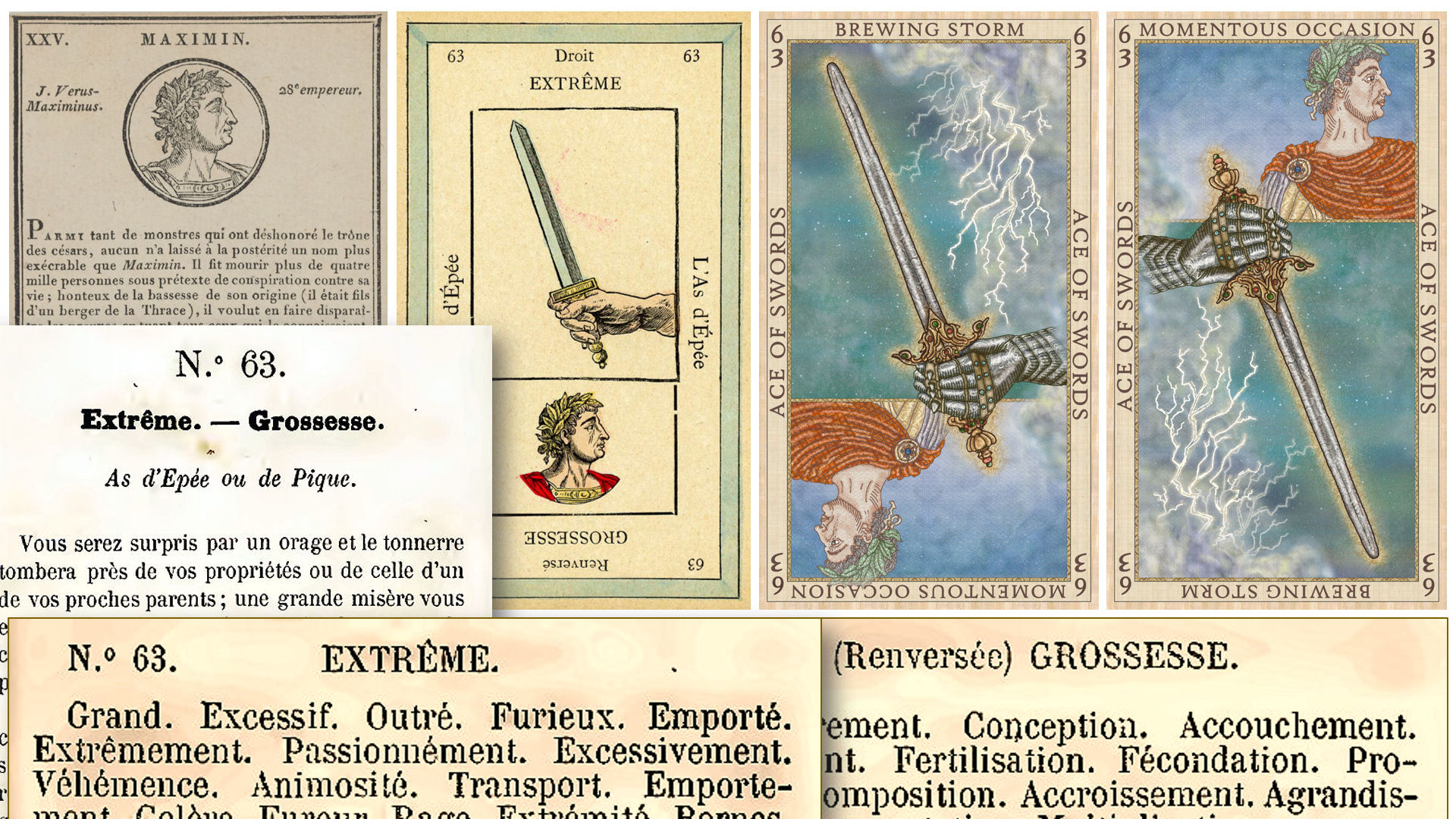
(I interrupt my own thought process with a show-and-tell of my Ace of Swords.)
Over the centuries, power and authority became imbalanced. So women’s suffrage had to become a thing. Traditional gender roles weren’t the problem. Extremism leading to that imbalance of power between the sexes was. Assigning one as superior and the other as inferior is the problem. And the thing is, no matter what century or what part of history or what part of which culture, I don’t think among the healthy mindsets, that was ever the belief. Rather, the belief was that you do your part and everybody’s role is equally important, because we are interdependent. If you do not respect and honor the other person’s role, you won’t have harmonious interdependency. And it is the lack of respect and honor that causes breakdowns in society, not changing roles. Roles necessarily change because circumstances of society and the collective change.
Maybe within the framework of traditionalism, what we’re saying is that divorce is not what we reach for just because things get hard. We do not have to be religious to approach marriage as sacred. It is an oath. And you don’t want to be an oathbreaker.
But in certain circumstances, you have no choice but to break the oath, or they broke the oath first, and now you need to walk because they breached a sacred vow. There are instances when oathbreaking is the necessary course of action.
And all of that is still “trad.” It’s just unfortunate that the only visible version of trad is Christian fundamentalism.

This is going back a few months, but here’s an update on how I ended up resolving the initial composition for the Six of Swords (where Fuxi is pictured in the lower third of Etteilla II). Instead of featuring both Fuxi and Hildegard von Bingen on the same card, I relocated Hildegard von Bingen to the Seven of Swords.

I might still need to go back and intensify the lines of those swords so there’s more color contrast. Also, the lower third of the Seven of Swords featured Constantine the Great, and I want to revisit this card to see if I can work in his mug shot among all those swords and not have it look overly busy.
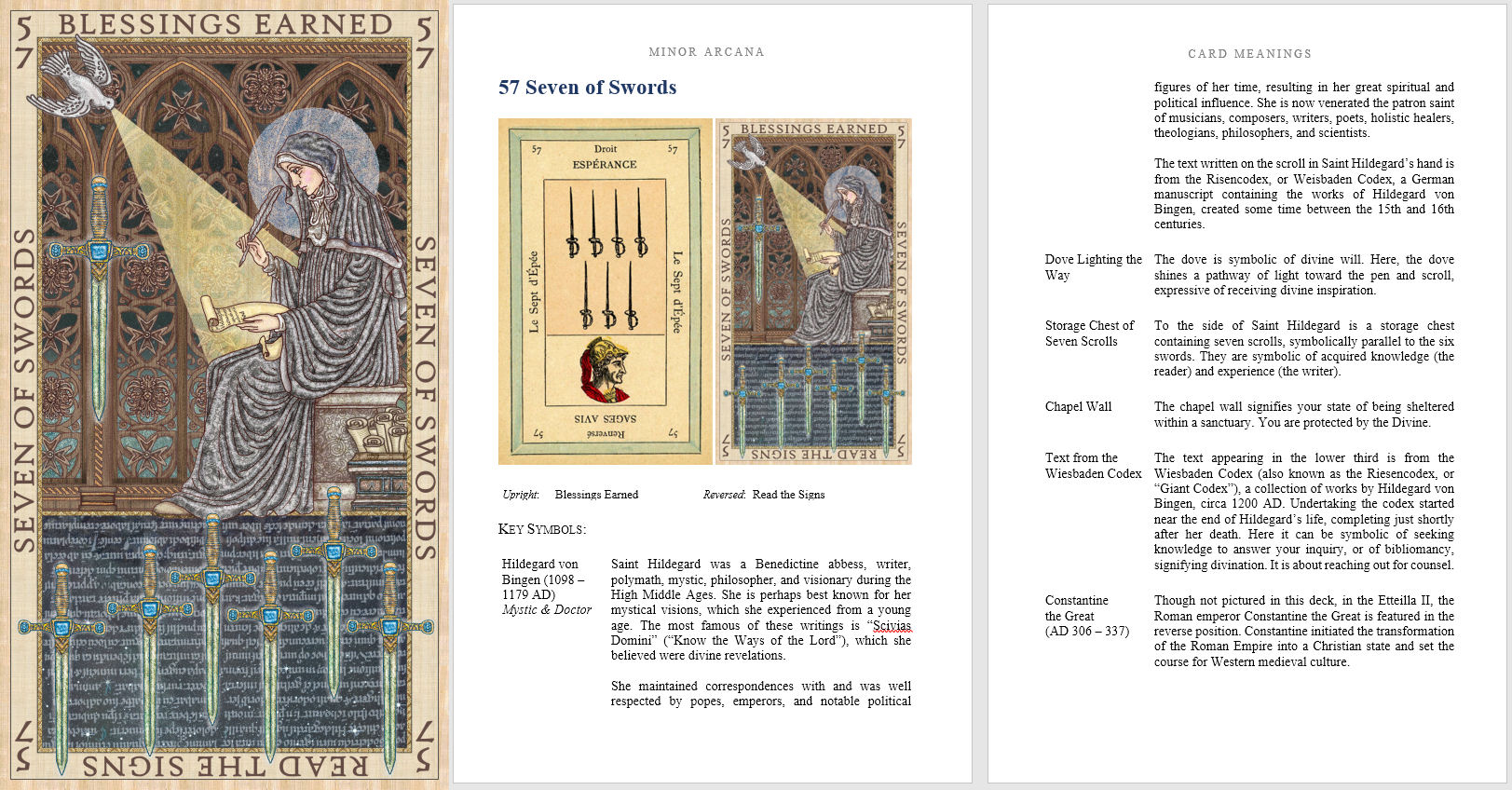
And if for any reason this might interest you, here’s a high-res download of my Hildegard illustration:

Please feel free to use the above for any non-commercial purposes, at will.
Apologies if this blog post was disjointed. Such is the state of my mind as of late.
 benebell wen
Thank you for your incredible thoughtfulness and depth of knowledge. I always learn so much from you.
LikeLiked by 1 person
Ballerina Farm has been everywhere! Loved reading your thoughts on the current ‘girl boss/trad wife’ moment happening and in conjunction, learning more on the 8 and 9 of swords 🙂
I wish the general internet public would quit taking everything online so LITERALLY and at face-value but life continues to imitate art (even if the standard isn’t actually reachable!)
LikeLiked by 2 people
H
Girl! Please don’t apologize for this brilliant and perfectly executed relevant piece. First I love your art and style in all your decks and books. How I learn so much from you. This article gave so much depth and insight into the ancestral world with how it too had growing pains. I enjoyed it all! Thank you.
LikeLiked by 1 person
I’m so glad you enjoyed it. Thank you!
LikeLike
“So can we all just agree to avoid extremism?” Is so Now… all this extremism, division and distraction tactics keeps us from working together as a society. Like can we just please work together and meet in the middle somewhere. Great discussion as usual 🌱
LikeLiked by 2 people
Oh, your trad wife 9 of swords is so beautiful! And I love how you resolved Fuxi and Hildegard von Bingen. Such a gorgeous deck! ✨ All your cards are so beautiful 💖
LikeLike
Thank you! Yeah having both on a single car got a little busy looking.
LikeLiked by 1 person
I so can’t wait to get a copy of the finished deck. Since translating one of Etteilla’s book his deck has really spoken to me.
LikeLiked by 1 person
That’s so cool that you translated one of his books! I kind of want to know more! If you ever need a book reviewer… 😉😜
LikeLiked by 2 people
I would love to provide you with a review copy – I’ll email you.
I’ve had one review already – see https://traditionaltarot.wordpress.com/2022/12/11/book-review-etteilla-hisler-theory-and-practical-instruction-on-the-book-of-thoth/
LikeLike
I’m old enough to remember when a term like “girl boss” would be an insult to women everywhere, even conservative women.
LikeLike
Oh I have a feeling conservative women still think girl boss is an insult today. 🙂
LikeLike
It was the feminists who were insulted, not the conservative women. Before feminism, conservative women were quite OK with being called “girls”.
LikeLike
This deck wwill be a watershed for Etteilla in English, I feel. As will the doorstop^H^H^H^H book that accompanies it.
Great work (and commentary)… keep on keepin’ on!
LikeLike
I stay off social media other than YouTube and had no idea those were still things. Girl boss has always sounded so off putting. Like women are just girls playing dress up pretending to be in charge. It is really ridiculous for people to just want to shove themselves or someone else in a box. Most humans have depth and variations and aren’t just one thing. They will be in for a world of hurt when the retire (girl boss) or kids are grown(trad wives). I had children young and my whole identity was mom. I was a single mom, I worked, I had to take on conventional male and female roles. Now my kids are grown and when my whole identity was wrapped in mom it’s a difficult adjustment so I took in 6 cats 😅. Idk why some fool wants to knock cat ladies we are pretty awesome. My mom died when I was 4. Her and my dad lived a rough life style and my dad decided to sober up to raise my brother and I. I had a great-aunt who had never had children and she stepped in to help my dad as did 2 aunts who were also without their children. Those three women were/are so important to me. My great-aunt took on a motherly role till she couldn’t due to dementia. She was the most wonderful loving human I have ever met. She was more of a mother to me than my birth mother. My other 2 aunts have also been motherly to me. My brothers gf has birthed 5 or 6 kids and has one. The idea that only people who birthed care about the countries future is asinine. Just because someone is as fertile as a cockroach does not mean they care more about their children or the countries future. I could spew my distaste for that comment another hour… it’s people like that that make me chose cats over most people. Anyway lost my train of thought I guess. Look forward to seeing more of the deck and hope to be able to purchase it.
LikeLike
hi Benebell,
I can’t keep up reading all your emails so I’m jumping here and there. Loved all your drawings for the Etteilla cards. I can’t wait for its completion. A new set for me to learn. I’m using your SKT everyday. One card easy read as time is so short for all the things I wish to accomplish. I gave SKT to my daughters. Ayumi brought it with her while she’s studying in Japan and we use it regularly for our daily query. It helps me understand and affirm my feelings and thoughts or hunches and still a lot of meaning to decipher in just one card. Thank you for all you do. Shelly
LikeLike