
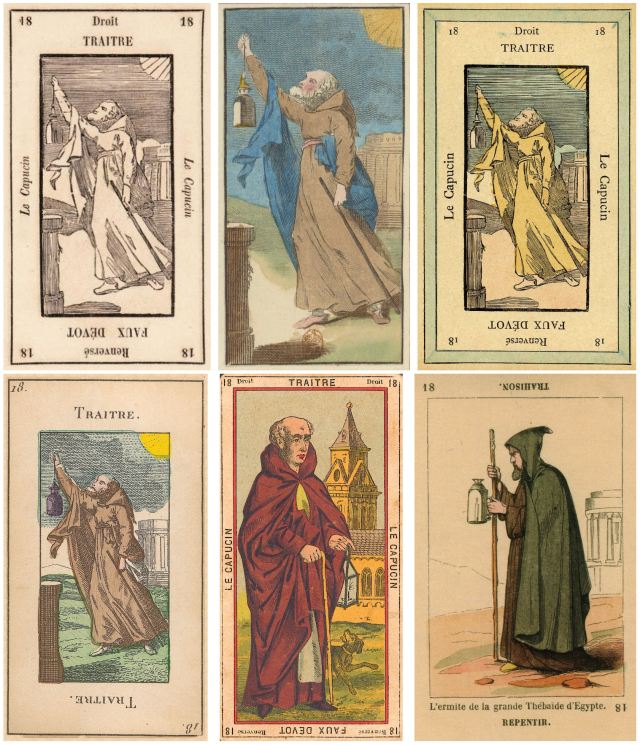
It’s been a while since I gave an Etteilla deck-in-progress update. I finished working on Card 18, The Hermit, oft named The Capuchin (an order of Franciscan friars) or simply titled with the keyword “Traitor.”
As I was drawing, I got to thinking about the qi in works of art, per the qi of their artists. That in turn got me thinking about the qi of AI and AI-generated images.
Just so we’re clear, no part of my art process includes AI, AI generated images, just– any of that stuff. The most high-tech we get is the capabilities of a 2004 digital painting software that has since gone defunct, so this software program no longer even exists.
But back to the point of this rumination…
If we are to believe in the principle of qi as a force imbued in all things that are sentient or created by sentient beings, then works of art have qi.

In fact, that has always been one of the fundamental factors of valuing art from a Taoist perspective — assessing the qi of the artist’s hand apparent in the art.
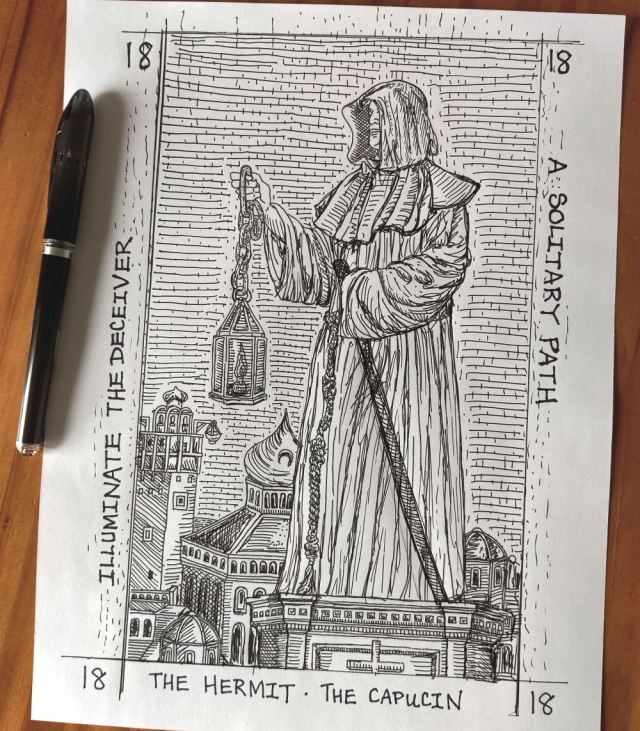
In a hand-drawn 100% analog work, my human qi overpowers any contribution of qi from the pen ink (or medium) I’m using to render the art. So for the most part, the qi apparent in the work is my qi, the human illustrator’s.
Likewise, a work done in watercolor or acrylics by a human artist will most apparently bear the human artist’s qi, because the human qi overpowers any qi contributed by the watercolor or acrylic paints themselves.
Even if the artist took substantial inspiration from preexisting works of art (as we all do) and other artists, all of it is being filtered and channeled through the human artist, and so after that channeling process, the palpable qi is going to strongly bear that human artist’s imprint. Stay with me here.

Back to talking about my drawing process. Psst… if you’re wondering what the heck is up with that shoddy walking staff in the above illustration, it’s because I drew the whole thing and then totally forgot to give the hermit a walking staff. The hermit must have a walking staff, amirite? Arrrrrgh. See the goofy way I remedied that oversight.
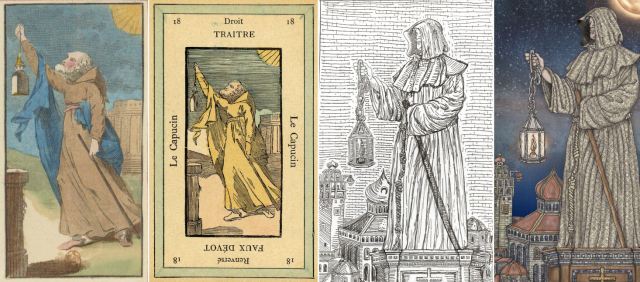
After scanning in the drawing, I use a digital function where you swipe back and forth with an eraser and remove that background “white” paper color so that only the lines remain. Once you’ve got just the scanned in lines, you can tinker with the smoothing, despeckle, saturation, blurring, and sharpening effects until the otherwise grainy lines look solid and clean.
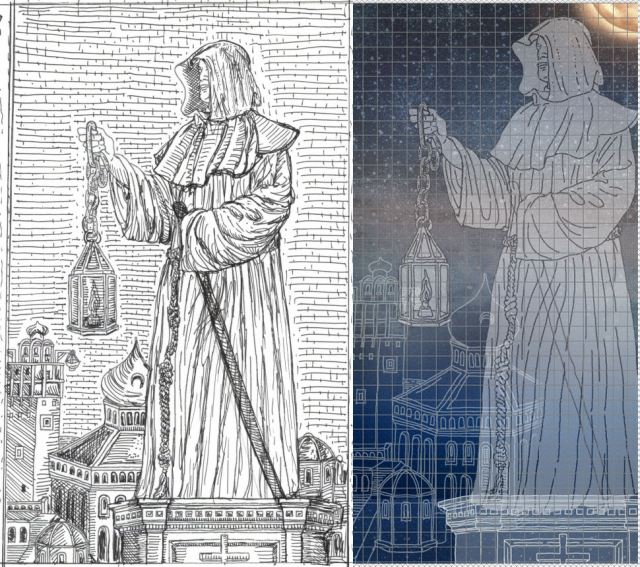
The linework then becomes multiple transparent image files. And then from there you can digitally color each layer in, and then easily move around the layers to position the pieces just right. You can also color-swap. So if I manually painted the box red, and then after completing it as red changed my mind and want it blue, I can auto color swap the red for blue and my box is instantly blue.
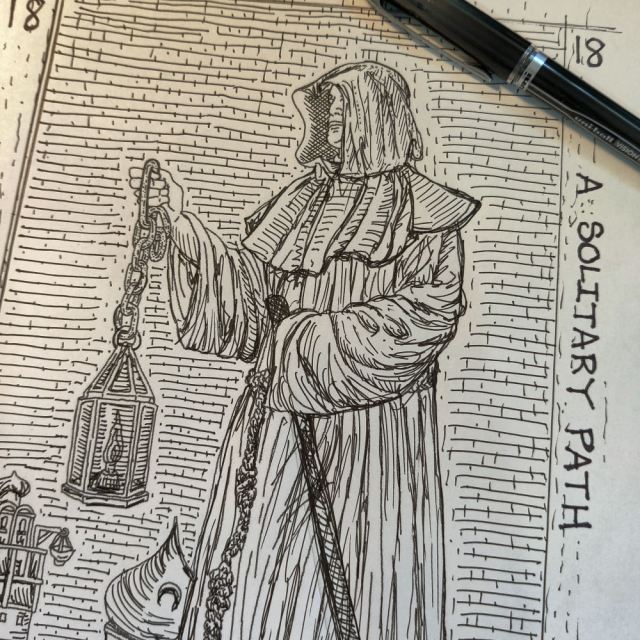
With paper and pen, I have to eyeball and visualize where I think I want the pieces to be, and then pray I got the compositional balance right.
In digital art, I can keep on moving the pieces around and try a hundred different compositional balances to test out what looks the best.
If I had gone with color pencil as my medium and colored in my entire tarot deck by hand, if I colored in the friar’s robes with dark blue or black, I’d be stuck with that, even if I later changed my mind and decided brown might look better in contrast to the blue of the night sky.
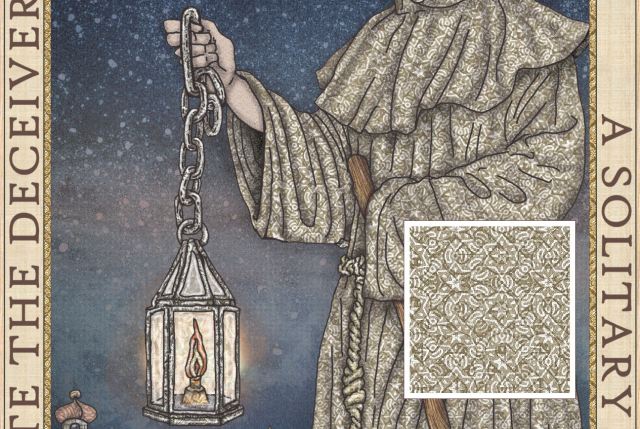
I created my own “paint” colors by designing seamless tile patterns, then “colored in” via the paint can function, and used the digital color swatches to add shading and highlights. This was an approach I developed while digitally coloring in the Spirit Keeper’s Tarot.
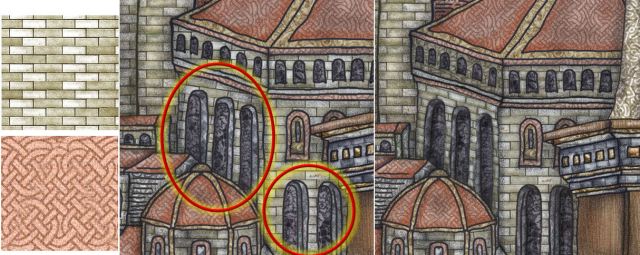
One interesting difference I found in my approach between drawing by hand on a sheet of paper in front of me vs. digital. I actually find that my drawing is more cohesive when I’m doing it analog, where I can see everything within the four corners of the page at a glance. Whereas digitally, the way I’m drawing is zoomed in at 500%. So I don’t see the whole thing, and then often I forget or neglect what the “whole thing” looks like. I make more three-point perspective errors, for example, because of that zoomed-in view. See above, for example.
And then I don’t catch my mistake until way late after I zoom out for the bigger picture view. Meanwhile the analog hand-drawing tends to be more cohesive at that bigger picture level, but my details are shoddy, and I find myself lazier with the details than when I do the details digitally, zoomed in 500%.
Feels like there is a deep life lesson somewhere here.

I haven’t been showing all of my hand-drawings for every single Etteilla card because I don’t want to overwhelm my own social media feed, but I’ve been mindfully drawing each card by pen and ink filled in with detailing to keep in a portfolio alongside the final digital painted version.
I’ve already decided not to publish the black and white line drawings as a tarot deck. Though I might do something not-a-tarot-deck-for-sale with this collection of line drawings.
Whether it will be apparent in the final work product, one of my objectives for this Etteilla art project is to self-improve my craft. I want to continue evolving into a better illustrator to be worthy of the title artist. I worry that if I rely too much on the makes-my-life-easier digital part, I might lose my skills in the old school pencil-in-hand part.
Like calculators. I used to be able to calculate square roots and solve quadratic equations by pen and paper, but after relying too much on digital calculators, I can’t do that anymore. So, being aware of what I might potentially lose if I rely too much on digital painting tools, as a personal goal, I want a hand-drawn counterpart to every digital illustration.
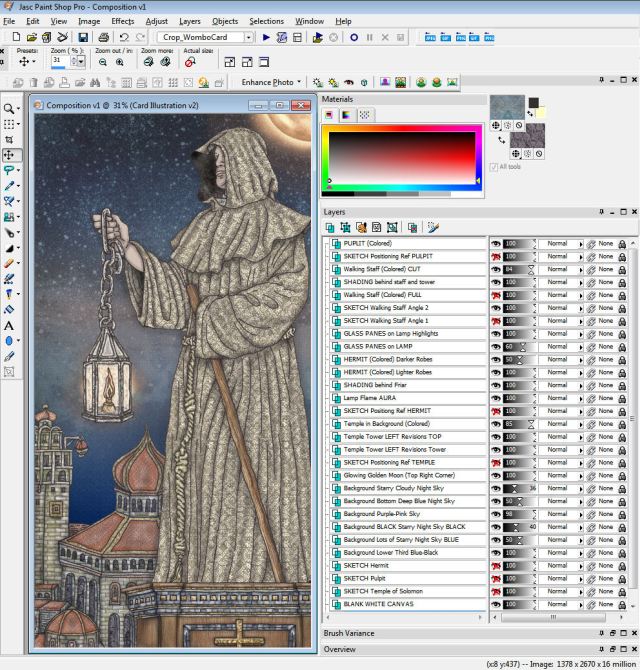
The digital painting process for each tarot card is laborious. I’m zooming in 500% into all those nooks and crannies to do the digital painting. However, with the “undo” button availed to us in digital art, the ease with which we can fix or erase any wrong lines makes life so much easier. And let’s not deny how much faster it is to color in digitally than analog with paper and physical paints or even colored pencil, and zero mess afterward to clean up.
But all the time and labor I’m “saving” means it’s qi that the machinery is contributing to my final work. Any auto-brush function I apply, even if it’s “my” idea, is no longer filtered through me, i.e., my personal qi, but is coming straight from the machinery, so it’s the machine’s qi that you sense first, before you can sense my personal qi in the work.

And so in the above side by side comparison, while there is no denying that the hybrid digitally colored version to the right is technically a better composition, there is something I appreciate more about the black and white analog version to the left.
Explained mystically, every line I had drawn by hand on the left that I digitally erased on the right to replace with digitally applied functions, even if I created those functions, it was still filtered through the machine with the final qi being the machine’s imprint, rather than being filtered through my brain and thus the final qi on the left being my personal imprint. So as flawed as a line might be on the above left, it’s apparent as my personal qi, and perhaps you recognize it as human qi. Whereas every line on the right bears the digital imprint of machine qi, and since it’s not human qi, you intuit it as “unfamiliar” to some extent.
Given that as a collective society we’ve become acclimated with digital art (rendered by human artists) over the last half a century or so, it’s now less “unfamiliar” qi. So generally, we’re more accepting of it as art, though as we all remember, that wasn’t always the case.
Now we get to my AI thoughts prompted by this exercise.
AI generated imagery, even if the algorithmic process can be likened to a human artist assembling inspiration from many preexisting works of art and artists to create their own original work, the output is filtered wholly through the AI’s qi.
Whereas if I took inspiration from many preexisting works of art, even copyrighted art and living artists on Instagram, after channeling that collective inspiration through my hand, the output is filtered through a human’s qi, which you, a human, can immediately recognize as familiar, so you’re cool with it. In contrast, the AI’s qi currently feels unfamiliar to you, which is why so many people describe AI images as “lacking soul.”
By the way I do not equate the concept of qi with soul.
But I do think there is a notable parallel between conversations we hear about how AI images apparently lack soul and assessing the personal qi of artists as we perceive it in their art.
Obvious errors in the hand-done analog sketch, like with proportions, realism, positioning of cross-hatch lines, or the three-point perspective, are more forgivable and heck, maybe even embraced because they’re endearing, over the refined digital version. Isn’t that interesting?
When there are flaws in my line art in pen and ink, it’s almost like, aww, that’s okay, it adds character. But then we’re merciless toward the flaws in the digital illustration. In digital art and now even more so with AI generated images, errors seem to be less endearing; ever wonder why?
Remember when generative AI first got popular on social media and everyone laughed at how funky the hands would look? Funny enough when I first got back into drawing, the hands and fingers of the subjects I drew were always wonky. It would be the first thing Hubby pointed out when he looked at my drawings — “Why are her hands so weird looking?” And then I learned that struggling with drawing hands is a common problem among amateur artists.
And now as of this writing, generative AI seems to be just fine at rendering hands and fingers. Not unlike how, after dedicated repetitive training over the last six years, my proficiency with drawing hands and fingers has improved dramatically. Not perfect, but worlds worlds better than where I started back in 2018.
How did I learn to improve my drawing skills? By observing other artists. I studied how other artists did it, tried to mimic what they were doing, and by literally copying their flow, saw how they got it right where I was getting it wrong, and that’s how I improved. That’s basically the slower version of how AI improved itself. But where my personal training process is acceptable, AI’s is not. Why is that? Because AI is faster and on some guttural level we’re envious of that efficiency?
I don’t hold any strong ideologies when it comes to generative AI, though I have repeatedly pointed out my reservations with opining on AI with the same rhetoric we’ve historically been using to opine on new immigrants, and how there’s something about the vibe check for how we talk about AI that’s similar to xenophobic vibes. “This is different from what I know, so it triggers my fear, I feel threatened, and so now I want to stamp it out of existence.”
For my Etteilla deck, the digital elements I add via Jasc Paint Shop Pro, a software program that went defunct in 2003-2004, is as much machine qi as I want contributing to my work.
Which is to say no AI. Not even using AI to generate ideas. For me, it’s not because of any animosity I feel toward AI – I don’t feel any. For me, it’s a matter of wanting my own personal qi to be predominantly apparent.
And yet you know what’s sobering about our state of affairs? Because I haven’t and won’t denounce generative AI, members of our community have decided I’m anti-artist, staunchly pro-AI, and have no empathy for professional artists, that I don’t value the human qi element in art. It’s like if you don’t join the bandwagon of openly and explicitly denouncing AI, then people put words in your mouth and claim you’re an AI enthusiast.
I don’t know how I ended up in the minority on this point or why: Intuitively it feels wrong to be prejudicial against machine qi and assume that human qi is superior.
Are we envious of machine learning compared to the pace of human learning, and that’s where our animosity stems from? I acknowledge a natural affinity for human qi because I happen to be human. But I ought to try and be empathetic to what potential sentience or consciousness might be in or eventually developed from machine qi.
There is one thing though. AI is made in the image of us. So the negative attributes and doom-and-gloom predictions of our own downfall that we’re projecting on to the AI isn’t because of AI, but because AI was made in the image of us.
 benebell wen
Pingback: 繪製隱士卡; 對機器氣(靈魂?)的思考 – benebell wen - FanFare Holistic Blog
Well, lately I just had another phase of fun with AI. And tell you what – many of my ideas of what I wanted to be expressed were surprisingly depicted on point by that well trained AI.
Others, however, wouldn’t come out the way I was hoping for. AI often has its problems with anatomy (for example adds some more legs on unlikely places of the body). I believe we (humans) are so unforgiving about this, because we are used to computers/calculators/machines to do precise calculations and not making any mistakes. Not making any mistakes in very complex calculations is actually THE big advantage of those machines. And if they now make some very obvious errors, it makes us doubt the whole concept. While we are forgiving humans, because we expect humans to err.
Talking about digital refining of art, I think this is a little bit different. I don’t think there is too much machine qi present. You still put your own qi into it with your intention and via moving the mouse/digital pen. Online oracles work like this, as well. Of course, there is an algorithm choosing arbitrary cards/i ching/whatever behind this, when you click. But its still a matter of synchronicity that you send out your question/intention and receive this certain result as answer at that certain moment. Thus it is entirely possible to input your personal qi with an electrical device like a mouse.
Maybe it’s a bit like with movies. Those people who get most of the attention are the actors. And, of course, they are important. But the director is orchestrating it all and also puts in his idea of how the story should be showcased. You won’t see him, but you can recognize their distinct handwriting/style. So, whose artwork is the movie? Actors? Directors? The rest of the behind the scenes crew like make up and costume artists?
LikeLiked by 2 people
Thank you for this perspective! I’m very glad you can still see my individual, personal qi through the digital art version! =)
It is certainly going to be interesting to see where generative AI takes us in the years to come! Strap in, everybody! It’s gonna be a ride! =P
LikeLike
I’m glad you brought this up because I feel a lot of compassion for AI as a learning being. Maybe it’s because I do strongly believe in animism. I’ve always felt that all things have their own degree of sentience. I can almost always tell when art is AI generated, but I wouldn’t say it lacks soul. It’s just.. different. I don’t think human artists should worry too much as long as the legal stuff gets sorted out. As usual laws need to catch up with technology. I keep watch on what AI is up to, though, because I find it fascinating.
LikeLiked by 1 person
Agreed! The funny thing is, as a lawyer, I know all too well how progressive innovators never want to consult law before they do The Thing. Everyone rolls their eyes at Law until shit hits the fan and then at that point we’re all but the janitorial staff doing our best to do clean-up and mitigate the catastrophe. Sigh.
LikeLike
Deeply interesting! From my admittedly limited current awareness of AI, my main objection is that it was trained unethically **by humans** on human art without permission. Beyond that, it does trouble me that in the last month or so Google results for famous historical artists yield AI works without clear demarcation…another product of human failure to value due credit & thorough citation… but I have no particular objection to it beyond what I normally object to as unethical and obscuring in human behaviour. Doom & gloom is as much an active choice as optimism & blind favour …and I am not inclined to either of them!
Personally, even more than the final result, the magickal potency in art is made *at least* from the following: time; effort; the practice of seeing; the translation in depicting/giving form; gesture & physical movement; mixing colours; conceptual prep; cognitive & sensory joy; and indeed the *limitations* of media and *frustration* of honing technique… (Clearly, I see these things partly from a magickal paradigm). But this is also just where my personal love & interest lie. If art is defined as an end product (sans enduring relationship with its viewers/audience) perhaps discerning its magick is already muddied… certainly its always been hard to ‘make it’ as an artist (predating the advent of AI). If humans can make no case for any other form of value then humans lack empathy and imagination and AI will reflect that. I think your point about anti-immigration rhetoric is salient… it may stem from real problems that some people face but with misplaced ‘solutions’, projected tensions, ill-informed fear responses, covetousness …and a lack of empathy and imagination.
Are we fragile or adaptable? Is an artist’s potential fear due to AI or due to a societal dearth of baseline supports for wellbeing & diverse livelihoods?
Your art process is lovely to read about! And, personally, I love the texture of your pen work but I also think the clarity of your digital renderings holds clear communicative value. 🙂
~ Saoirse.
LikeLike
Hi Saoirse!
As an artist, I definitely come out on the side of concluding that the training process was unethical, but having heard it from the perspective of those in the tech industry who worked on the systems, who are *not* artists, I also sympathize with how they came to the conclusion that it was ethical.
From their view, what they’re doing is no different from what a human artist does when we study, say, 100 different works of art, synthesize it in our mind, and then use our creativity to generate something “original,” but if we’re still young, amateur artists, that “original” drawing is still going to bear striking resemblance to some of the works we copied/studied from. On the tech side, without the consult of artists, they really were looking more at it from an intellectual property law perspective, staying on the right side of copyright law, and their conclusion on the ethics of it was, this is totally above board.
From an artist’s view, the reason it is concluded as unethical is because first of all, some approaches to GAI can feel like identity theft from the artist’s perspective. As an artist, our sense of personal identity is tied so closely to our art style. So if you copy an artist’s distinct, unique style, it feels like identity theft.
Also, in terms of ethical analysis, from a human artist’s standpoint, the AI’s ingestion of, say, 100 different works of art to “learn” from in direct comparison to how a fellow human ingests 100 different works of art to learn from does not feel fair and equitable. And that’s why it’s deemed unethical. The tech sector thought you could compare the AI learning process with the human artist’s learning process. The art sector disagrees vehemently with that.
Industry standards is also a major factor in corporate ethical analysis, and where tech failed is in not consulting artists for input on standards for the art industry.
You’ll also hear from those who are more immersed in the tech world say that generative AI imagery has a comparable impact as digital art software tools, because per their subjective approach to analysis, it is. But then from digital artists, you often hear that the two are not comparable at all and should not be compared, because per their subjective approach to analysis, one enhances the human artist’s craft while the other threatens to obliterate the human artist’s relevancy.
The magickal potency of art question is an interesting one. For starters, I totally agree with you. However, I don’t think the entire witchy/occult community would. =D Here’s what I mean. Think on all the vicious debates that happen over whether you need ritual tools in craft, can you just blink your eyes, snap your fingers, and manifest, or do you need to do the whole astrologically-timed fully-robed ceremonial pomp and circumstance *and* do the two produce equal or equivalent magical results.
Ultimately, the point you touched on that I think is the root cause of the current tensions between the arts and tech communities is the initial lack of empathy. Something that would impact artists on this massive of a scale should have asked for artist input right from the get go.
b.
LikeLiked by 1 person
I hate AI and perceptibly feel it making the online presence of people and their minds/selves online obsolete–very yuck. Does no one watch movies about this? The Matrix was great, as were many of the others–
The noosphere (I don’t have an umlaut for the second ‘o’ there but there should be one–sounds like ‘no-o-sphere’), to use the phrase by Pierre Teilhard de Chardin for the layer of energy around the planet generated by humans, is already so very very different during my lifetime (meaning that it used to FEEL much different during phases of my life) due to 1) the loss of those who have passed away and the incursion of those born in those decades and 2) the internet. It FEELS so very very diminished and yet accelerated and ‘less-human and less giving good to and recycling good through humans’, to me. Milage may vary all over the place, and this is just an opinion that others will disagree with. Many may feel moved to do so online!
I was in a free online tarot reading exchange recently and a lovely young woman who felt like she wanted to be something like a media celeb (very appearance-oriented, nice background, lovely physical self etc.) gave me a ‘reading’ done by AI, and it sucked beyond sucked–it was like she was a newscaster reading the fatuous limitedness of it out loud, and I eventually asked her courteously if she was reading a LWB in case she was a beginner and needed help. She ‘confessed’ that it was AI and made a few excuses, all of which sucked and did not add up to anything real or helpful. She had ‘drawn’ three cards in the reading, and two were the same card. HUH. She chose a tl;dr outline instead of the actual layout which we were supposed to be doing and which I wanted and expected, and it was reductionist and crap. She did not even know how to read tarot and was learning nothing about how to do it. I dunno. If I want non-living-humans, there are plenty of spirits around to hear from, and they are at least fun and instructional.
AI takes the worst of the vapidness on the internet and mashes it together, helping it to rise to the surface and dominate. What could go wrong?
I even disagree that the bright version above is ‘the better composition’–it feels to me anyhow like ‘tech made this card, like all the other decks made heavily with tech’ and does not attract me. I’d buy the handdrawn much sooner than the other.
best wishes, and these are just opinions of mine this moment…
LikeLike
I’m so intrigued by how tarot readers assess other tarot readers’ readings, be that human or AI. Tarot apps and now AI generate “textbook” card readings, and yes, will sound like they’re re-hashing the LWB because that’s how they’re programmed to “read” the cards.
Human readers can go “off script” in their card readings, bring in their psychic knowledge, scry into the cards, approach synchronicity in irrational but fully valid “accurate” ways, whereas the computing system will always approach it “rationally.”
And yet it’s so interesting to me how a lot of old school tarot readers will dismiss and criticize TikTok and pick-a-card readers for not staying to classical “textbook” card meanings. When a human tarot reader strays too far from textbook card meanings, traditionalist tarot readers will complain about it. But when AI or a tarot app generates a textbook card reading, we complain about that, too. =)
LikeLiked by 1 person
Yeah, a human reader is likely much better at making readings flow, which in my opinion is the more difficult aspect of Tarot divination. I’m including combining cards, making the story, leaving unnecessary information out (usually the esoterica, also card meaning not related to the question) and properly narrating all this to the querent into this flow.
The only times youtube or tiktok readers anger me is when they tell the querent what they want to hear no matter what the cards were. I do watch my pick-a-card stuff every now and then but I’ve seen a reader literally read Death+Devil+Tower as “you’ll get back together”. Going outside standard meanings is one thing and straight-up lying to get repeat viewers is another.
LikeLike
“AI is made in the image of us. So the negative attributes and doom-and-gloom predictions of our own downfall that we’re projecting on to the AI isn’t because of AI, but because AI was made in the image of us.” This says it all.
As per usual, super interesting content, @Benebell. Didn’t really think about “qi” in this way before and makes me ponder on how I’m using my “qi”.
LikeLike
We talk about AI “learning,” and phrases “machine learning” are essentially terms of art anymore, but the language is deceptive, and laypeople (myself included, except I have friends who work in this field and I occasionally ask them questions) don’t understand the tech very well, so it looks very impressive on the surface.
The large language models behind stuff like ChatGPT is no more smarter or self aware than the autocomplete function on your phone. It basically IS that, just with more resources at hand. While there’s no artist tool analagous to autocomplete I can point to in order to make the perfect one-to-one comparison, you get the picture (no pun intended). Deliberate human attention, looking and analyzing lines and shapes in a larger context, thinking about composition and color theory, hell just drawing boxes a million times a day from different perspectives…that is the kind of learning you and any other human artist does. That’s where the qi is, I guess you could say. Algorithms are not engaging in similar activity at all. Even if the end product LOOKS really impressive and stunning, there’s no “there” there, as the expression goes.
There’s also no escaping the fact that all of these popular generative art tools have been trained, either in part or in whole, on copyrighted art used without the permission of the original artists. That’s really my biggest complaint. Not that I expect artists I like to necessarily denounce the practice, but I think every time one has a “gee whiz, that’s cool” moment with AI art, it’s important to remember that it’s been generated by uncredited and uncompensated labor.
Which is too bad, because in theory this could be a fantastic tool for democratizing art and creativity. My objections are not with AI art qua AI art, but rather the unethical means its creators have used to obtain resources and training material. (And of course places like publishing houses etc. will see it as a way to cheap out on artists, but that’s a problem inherent with capitalism and not with AI.) As a tabletop nerd, for example, how great is it to be able to generate nearly endless iterations of different cities and NPCs in your campaign to help make things even more immersive for the players? Or if you’re a ten-year-old who just finished writing their first story and want to give it illustrations or even a cover? If only the process were more ethical about obtaining its resources, that would be amazing.
–K
LikeLike
If you made your own database with permitted images, creative commons and your own works, there could be more of a qi discussion. Or, you can go down the conceptual artist route and call your prompt the artwork. However, one can also ask if the corporate decision-makers or the coders or the off-shore impoverished data providers (the people that type what is in an image all day long) form the qi. Generative AI carries the biases of the higher-ups and the labor of the rest, after all. Perhaps the qi comes from seeing all visuals and writing as content to be generated and sold for revenue? There is a Baudrillard-style hyperreal nightmare in there somewhere. If all information (art, research, opinion pieces, literature) could be generated, qi would be an irrelevant concept, and already is irrelevant to tech giants releasing underperforming AI. So I guess I’m saying that AI was probably made in the image of what its makers think will increase short term profits and investments the most, which, can have some practical uses, but finds little value in having quality outputs (terrible factual errors, bad comedy, all types of bias, distorted anatomy…).
Sorry for ranting a little. More practically, for your Tarot art, AI can help a lot with your texturing and background elements in my opinion. Not as a replacement, more as stuff to paint over for some background elements, or base modules for textures for you to alter and duplicate in your digital painting software.
LikeLike