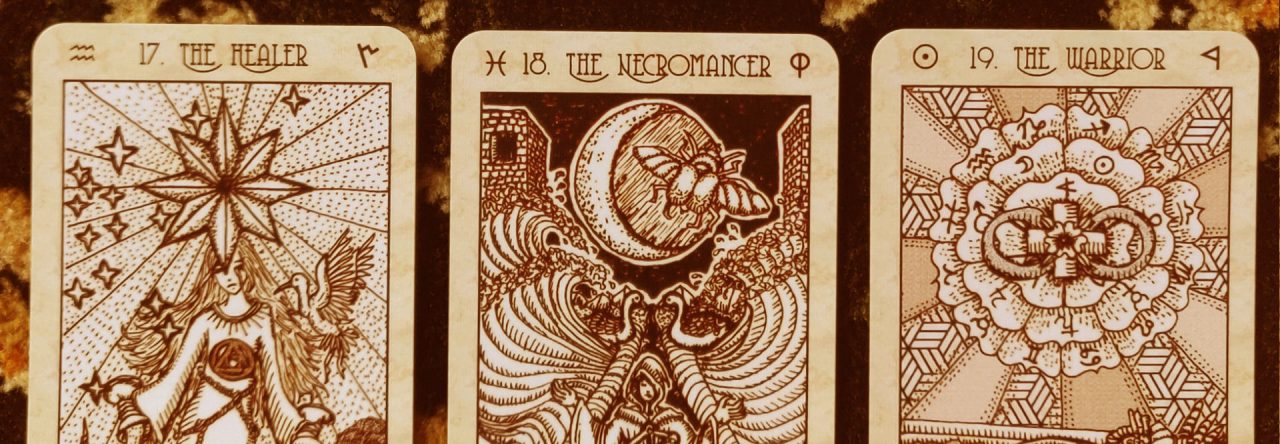
I started working on my reconstructed Etteilla Tarot in early 2022 and was making pretty decent progress. Then in all of 2023 I only completed the first drafts of 7 cards. That’s right. Seven. It took me an entire calendar year to complete seven cards.
Also, I stalled on the Judgement card because I just couldn’t get the composition quite right.

At first I was seeking inspiration from, like, Michelangelo and van den Broeck, with hundreds of teeny tiny people, angels, and demons in the background, lined up and down those mountain tops. But having nowhere near an iota of their talent, my drafts kept looking like a hot mess.

What got me through was just a whole lot of copying…
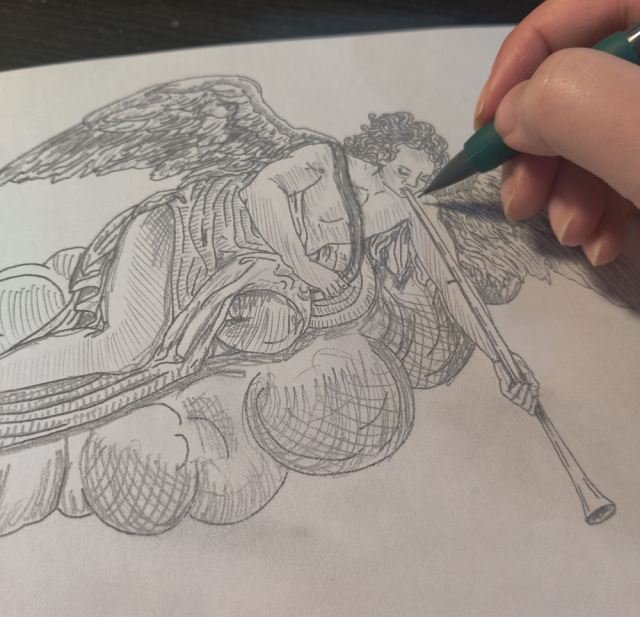
- My trumpeting angel is based on one of the angelic figures in the 16th c. van den Broeck illustration;
- The nude “Adam and Eve” figures are from the Judgement card in the Lo Scarabeo Tarot (I love that the deck is one of the first to bring together all three major tarot traditions, Marseille, RWS, and Thoth), which was first released in 2007; and
- The cloaked man rising from his tomb is from the 1843 Lorambert’s Jeu de la Princesse iteration of the Etteilla.
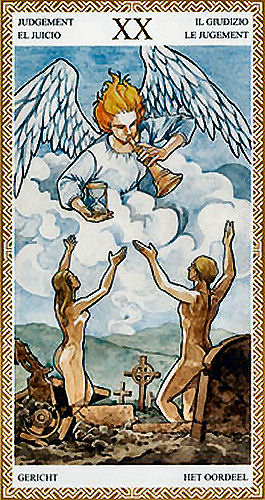
The modern deck inspiration from the Lo Scarabeo Tarot (LST)‘s Judgement card is borrowing from that deck’s premise to comment on this reconstructed Etteilla– Mark McElroy and Anna Lazzarini, the artist of the LST, synthesized the key symbols of the three most influential decks of tarot history, which I’m then showcasing as Adam and Eve (primordial figures) in the Last Judgement of what, in an alternate reality, could have been the most influential deck of tarot history, Etteilla’s system, but receded into obscurity in large part because of the rise in popularity of these three decks synthesized by the LST. There are other little nods in this choice. The LST was released in celebration of Lo Scarabeo’s 20th anniversary as an Italian publishing house. 20th? Judgement card? =)

The background is something I had already done for Card 8 and the skeleton pieces are from Card 17. Plus, the copying and recycling of preexisting visual elements is a very Etteilla-esque thing to do.

And then finally I realized I just had to follow the cues of past Etteilla Judgement cards. You need to pick maybe three key essential symbolic elements and that’s it. At tarot card size dimensions, if you try to draw thousands of itty bitty resurrected people figures, angels, and demons, nothing translates. It ends up looking blotchy.

The angel sounding the trumpet is kind of a must, right? So getting that part of the composition right was my first order of business.
Then to connect this card to The Devil and The High Priest, I wanted to depict the lovers again, now being resurrected from the dead. Also add in the old white-cloaked dude and skeleton parts, copying the Princess Tarot version of Judgement, and I’ve maxed out the limit on what can fit comfortably in one composition.
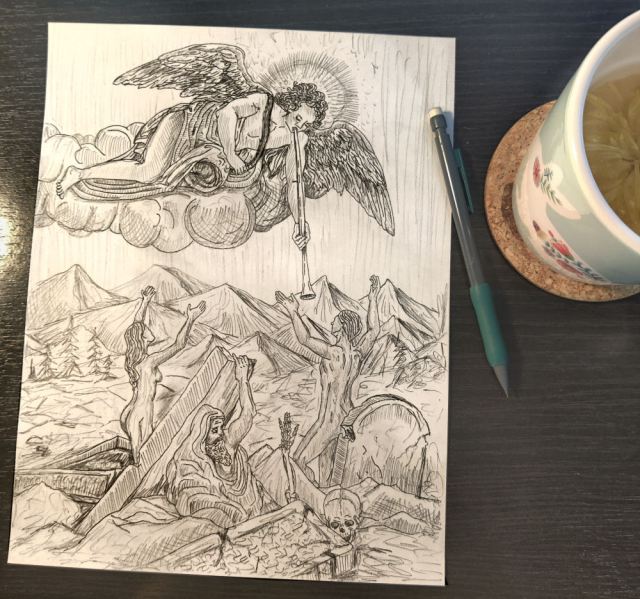
In terms of process, I’m continuing to approach the medium as a hybrid. Every card begins with a pen and ink line drawing. I find that it’s still faster and more efficient for me to get the thumbnail sketch down by hand analog than it is to attempt digital illustration, but for sure I use digital illustration techniques once I scan the sketch in. For instance, there are often line mistakes in the hand sketch that I’ll fix digitally.
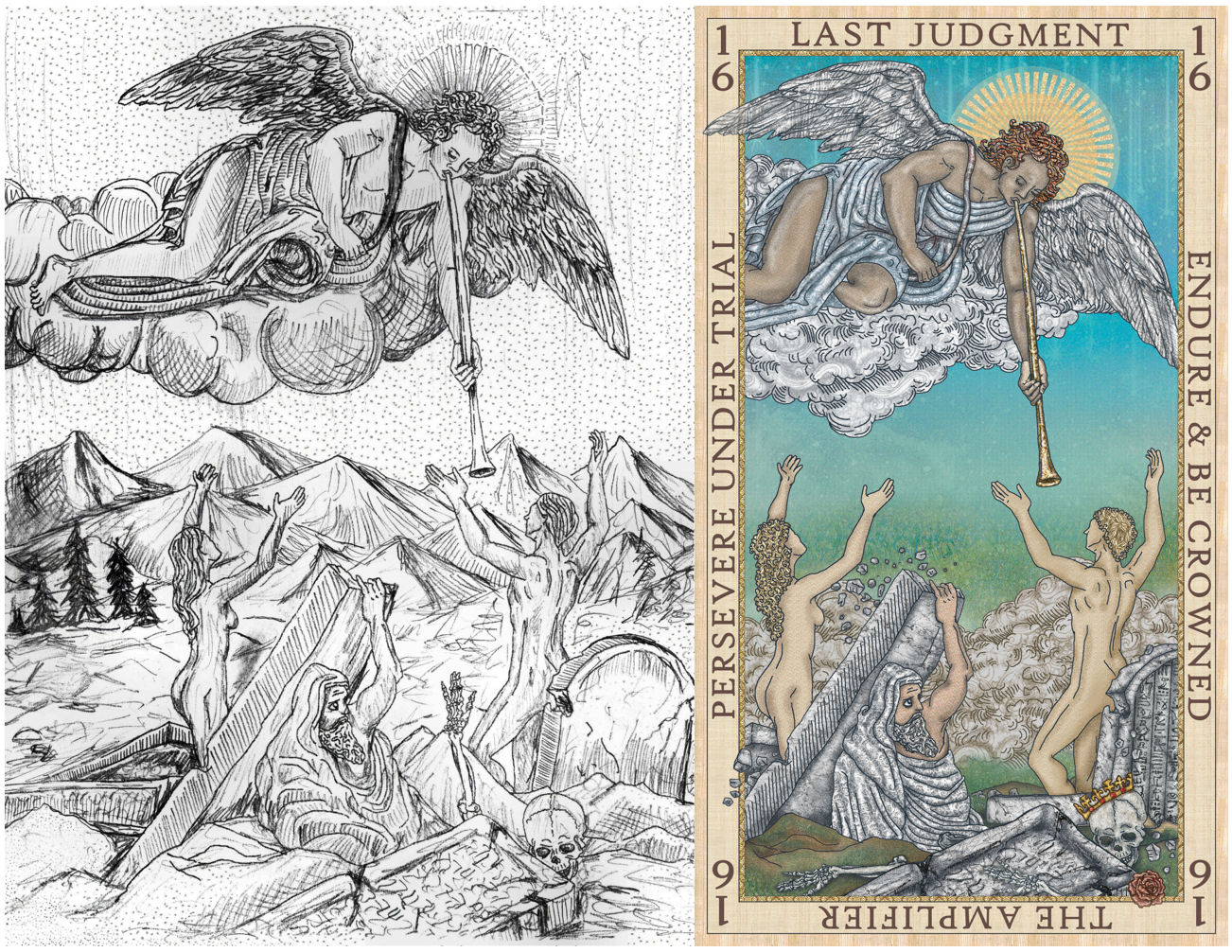
After I scan the sketch in at high resolution, I clean it up and also disassemble the foreground, middle ground, and background elements so each becomes its own digital layer.

Color is added via digital painting in Jasc Paint Shop Pro v. 9.0. The program is now called Corel PaintShop Pro after Corel acquired Jasc in 2004. That tells you how old my software is. I am using digital painting software from the early 2000s.
Also, you can see from these work-in-progress photos that I do quite a bit of tweaking to spruce up the line drawings. In my thumbnail I was going to have a mountainous landscape for the background, but I couldn’t make it work. The composition was getting too busy, so I opted for wispy bands of color instead.

Fun mystery: The crown is on the guy’s head in Cards 13 and 14, but then… in the Last Judgment card, that crown wasn’t on his head when he was laid to rest, and instead, you see it on a third figure– the skull. Gasp. What happened? =)
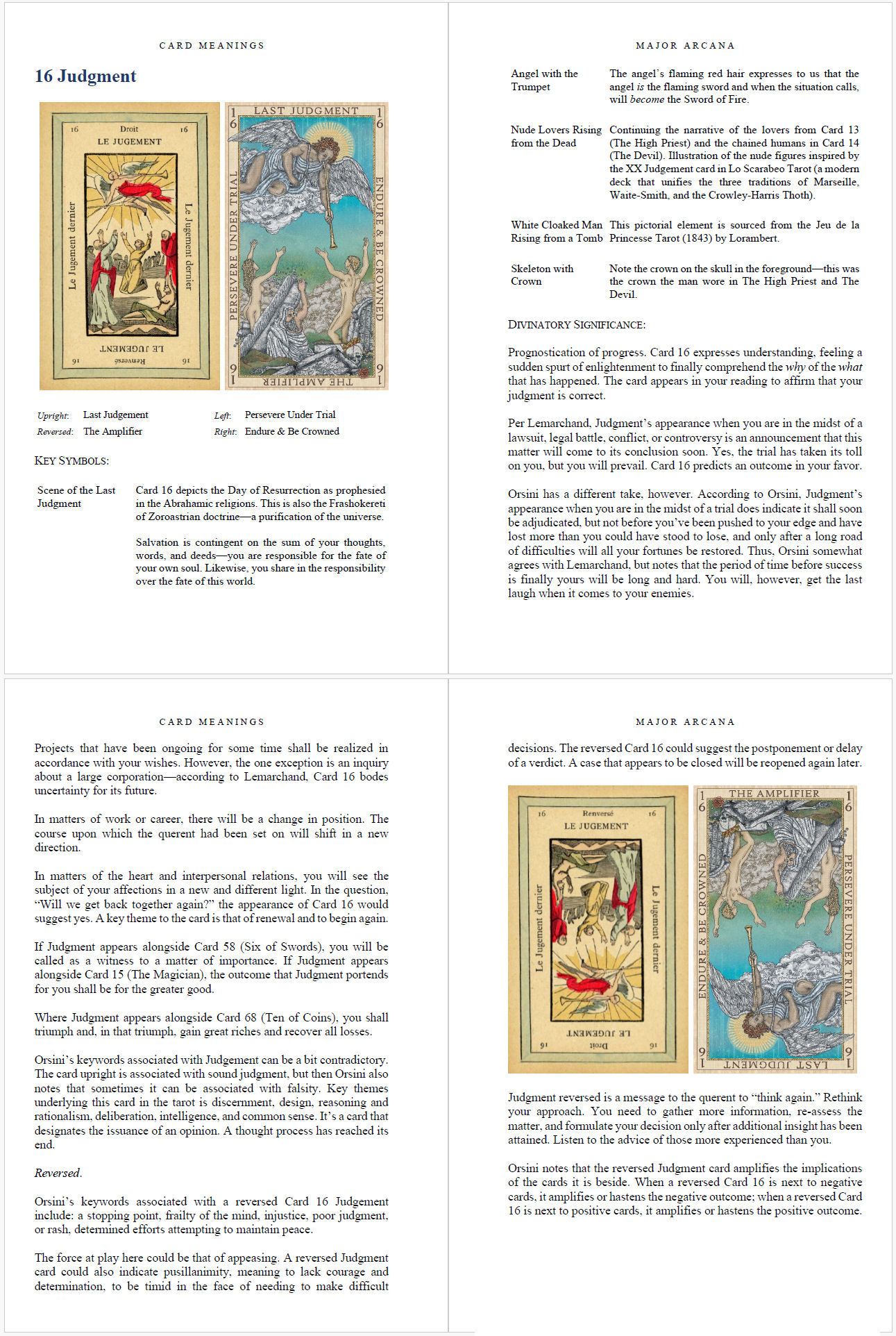
The Judgement card in the Etteilla is a sign of progress. Situations that have been ongoing and unresolved for awhile now finally come to their conclusion. The card, according to Orsini and Lemarchand, also signifies a major shift. That “sign of progress” is going to be subjective — a good omen to some, and a bad omen to others. Not everybody is gonna be on the winning side.
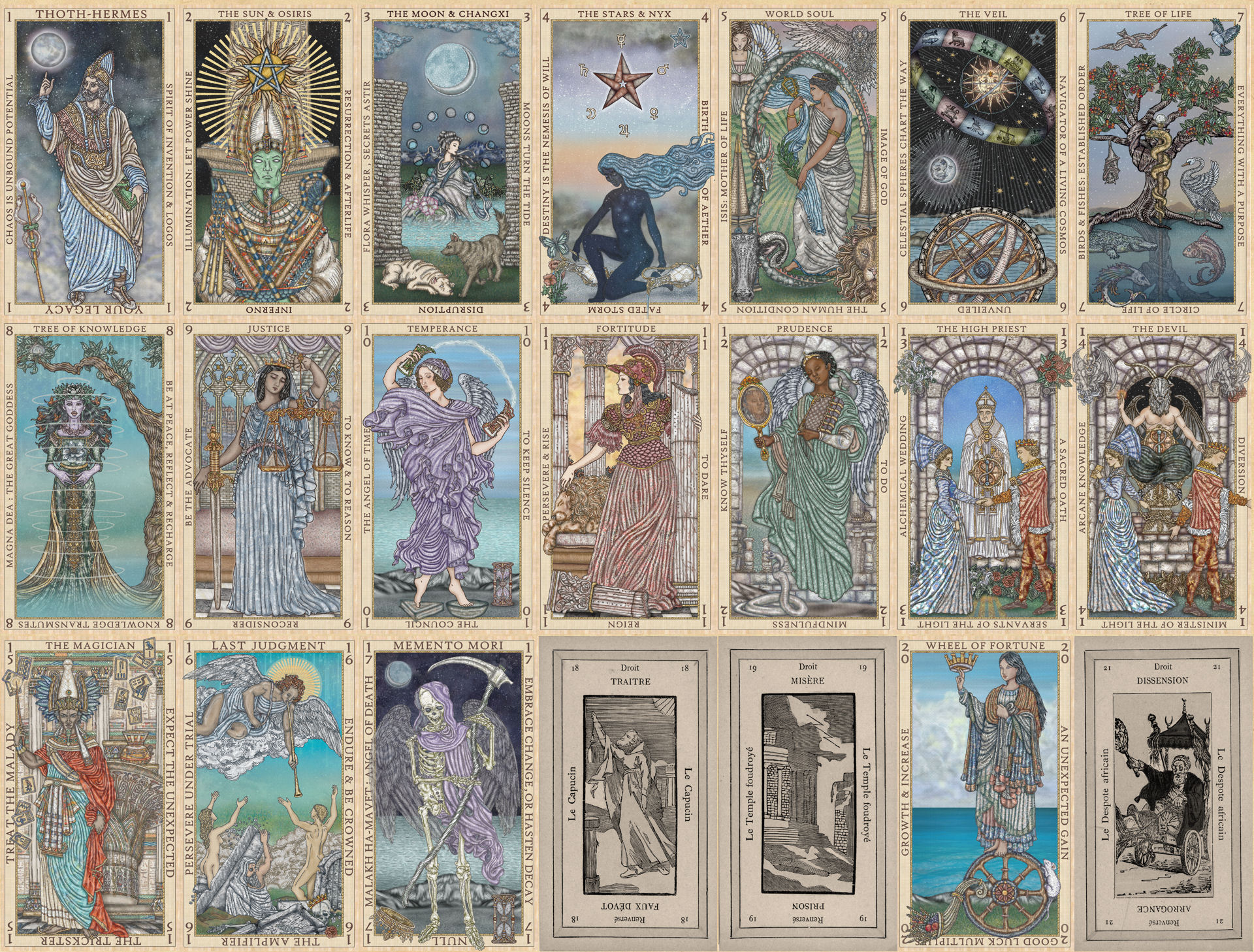
Above you’ll see which Majors I’ve completed the first drafts of as of this writing. I haven’t done Cards 18, 19, or 21 yet, so I’ve used the 1850 Lismon engravings as placeholders. These aren’t final drafts yet, because already I see tweaks that need to be made. For instance, since both Cards 1 and 8 are significator cards in the Etteilla system, the feminine image in Card 8 should be the same proportionate size as the masculine (Thoth-Hermes) image in Card 1, so that needs to be revised.

Of the Minors, I’ve completed the Coin pips, but barely made a dent in progress on the other three suits, and I have not started on any of the court cards yet. For my Etteilla courts, I want to establish strict thematic and symbolic consistency, so I figure I need to work on the courts altogether in one fell swoop. I’m holding off on the courts until I have a definitive, committed plan for them.
Overall I’m pleased with how my Etteilla art project is coming along, even if my progress has been abysmally slow. I believe it is further establishing my style and point of view as an illustrator. Friends and family assure me that “you can totally tell it’s drawn by whoever did the Spirit Keeper’s Tarot.” It’s a good sign of technical improvement when an artist is finally delivering consistent, defined style.
My first card to work on in 2024 is going to be The Hermit card, or as it’s oft titled in the Etteilla, The Capuchin (a reformed Franciscan denomination of friars circa the 16th century). I’m tickled by how the Etteilla Hermit card is going to break the brains of RWS-seasoned tarot readers.

The Etteilla Hermit card doesn’t just mean one who has achieved a first degree of esoteric knowledge, but one who has gone a step beyond to pervert or misinterpret that knowledge. In terms of tarot pairings, almost any time the Etteilla Hermit card appears next to another card, the Hermit will negate all positivity and good auspices from that other card. Keywords associated with Card No. 18, The Hermit include: hypocrisy, concealment, the seducer, the corrupter, cunning, treason. Reversed, its meaning includes religious hypocrite, false devotee, someone who is performative and insincere with their spirituality. Oh this is going to be fun!
 benebell wen
I just love your color choices – sigh – beautiful
LikeLiked by 1 person
Pingback: 第16卡,最後的審判 – benebell wen - FanFare Holistic Blog
Beautiful!❤️
LikeLiked by 1 person
Wish this was already finished so it was possible to order the deck. Love it!
LikeLiked by 1 person
WOW!…TRIPLE WOW. Benebell stop beating yourself up over ‘slow progress’. Slow cooked food is always tastier!
LikeLiked by 1 person
Wow, the deck you’re making is beautiful. It’s great to see your process, and this looks like a deck I’d be glad to add to my collection.
LikeLiked by 1 person
the hermit: egad!! 😅. The deck is looking beautiful
LikeLiked by 1 person
But WHY are you using such old software? There are great options, like Krita
https://krita.org/en/
LikeLike
Ngl, I’m curious too on this! I know artists who are still using Photoshop CS2, despite it being over a decade old, just cause it’s a familar workstation that works without demanding much of your computer. Maybe it’s a similar thing here? Art software can be needlessly complicated for sure, so I get not wanting to learn an updated or different program.
Personally, I think Clip Studio or Paint Tool Sai would be a better alternative, but Krita is great too!
LikeLike
Graphics software didn’t add that many new functions over the years. Maybe some AI based stuff and filters. But the fundamental basics stay the same.
I’m also using software that is more than 10 years old. And it works like a charm, really.
It’s different with 3D art and animation. There is quite a lot of development going on.
LikeLike
I’ve tinkered with Krita before, but just find that I’m so used to navigating Jasc Paint Shop Pro that it’s harder for me to switch programs than to simply figure out how to do what I want to do directly in Jasc Paint Shop Pro, which so far, I’ve managed. =)
Plus, I’m really not doing anything fancy or sophisticated digitally that would require a more advanced software program. All I’m doing is choosing colors to color in my line drawings and using basic digital drawing tools to edit my sketch. =)
LikeLike
There’s actually Humble Bundle for Corel Painter & PaintShop Pro going on right now, too. I’m more familiar with photoshop, but it looks nice?
LikeLike
Quite simply, Beautiful. Thank you for sharing your journey through this amazing project.
LikeLiked by 1 person
Looking amazing so far! Definitely been looking forward to seeing how this goes, I’ve wanted another Etteilla inspired/based deck for a while!
LikeLiked by 1 person
The Hermit card has always been “my card” since I am a Virgo so I was really surprised to read this information. Is it too early to pre-order? lol I love your work so much!
LikeLiked by 1 person
haha at the rate I’m going, years too early to pre-order. =D
I’m not doing any pre-orders until the complete deck and guidebook are done. I wouldn’t want that kind of pressure from people who’ve given me money demanding that I work faster. =P
oh, and funny enough, per Etteilla, this card doesn’t correspond with Virgo. His Card 6 (The Veil) does. =D
LikeLike
I am reading I-Ching and crossreferening against human design (10 Treading) “Dragons Tail” seems like 10 wands rx (sat) and 2 pents (jup) to me; maybe I am mistakin.
LikeLike
What do you think about the Ipeo card from Sola Busca? That card might be very helpful for The Capucin.
LikeLike
I must confess I’ve been working with the tradicional Etteila deck just because i can’t wait for this deck to come out. Your dedication… The detail for each card is just beyond words. I can’t wait to see the final project 🙂
LikeLike
Whoo hoo! Slow and steady wins the race! This is going to be a materpiece🥰
LikeLike