
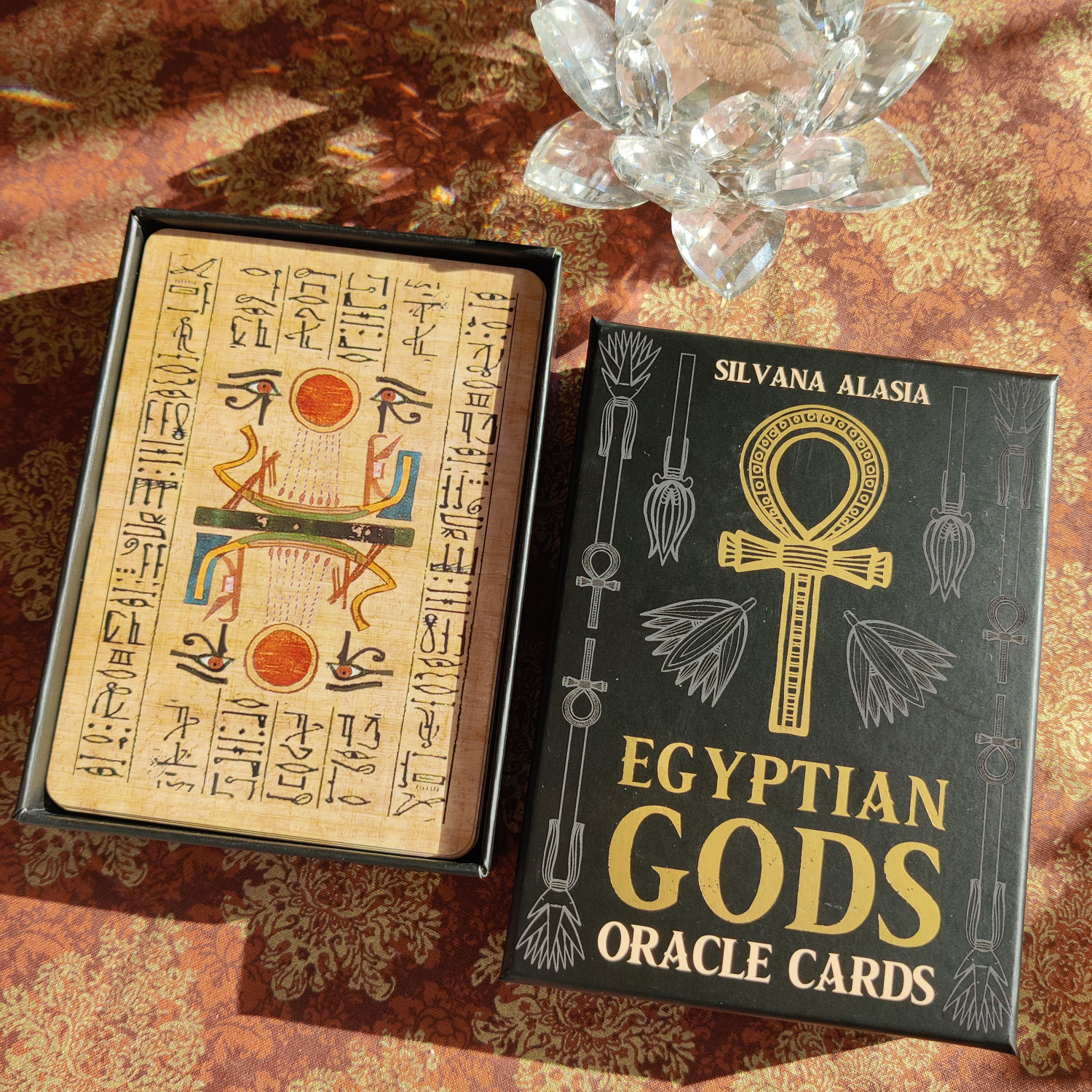
Oracle of the Egyptian Gods by Silvana Alasia features portraits of Egyptian deities painted in tempera on papyrus in the ancient Egyptian drying method.
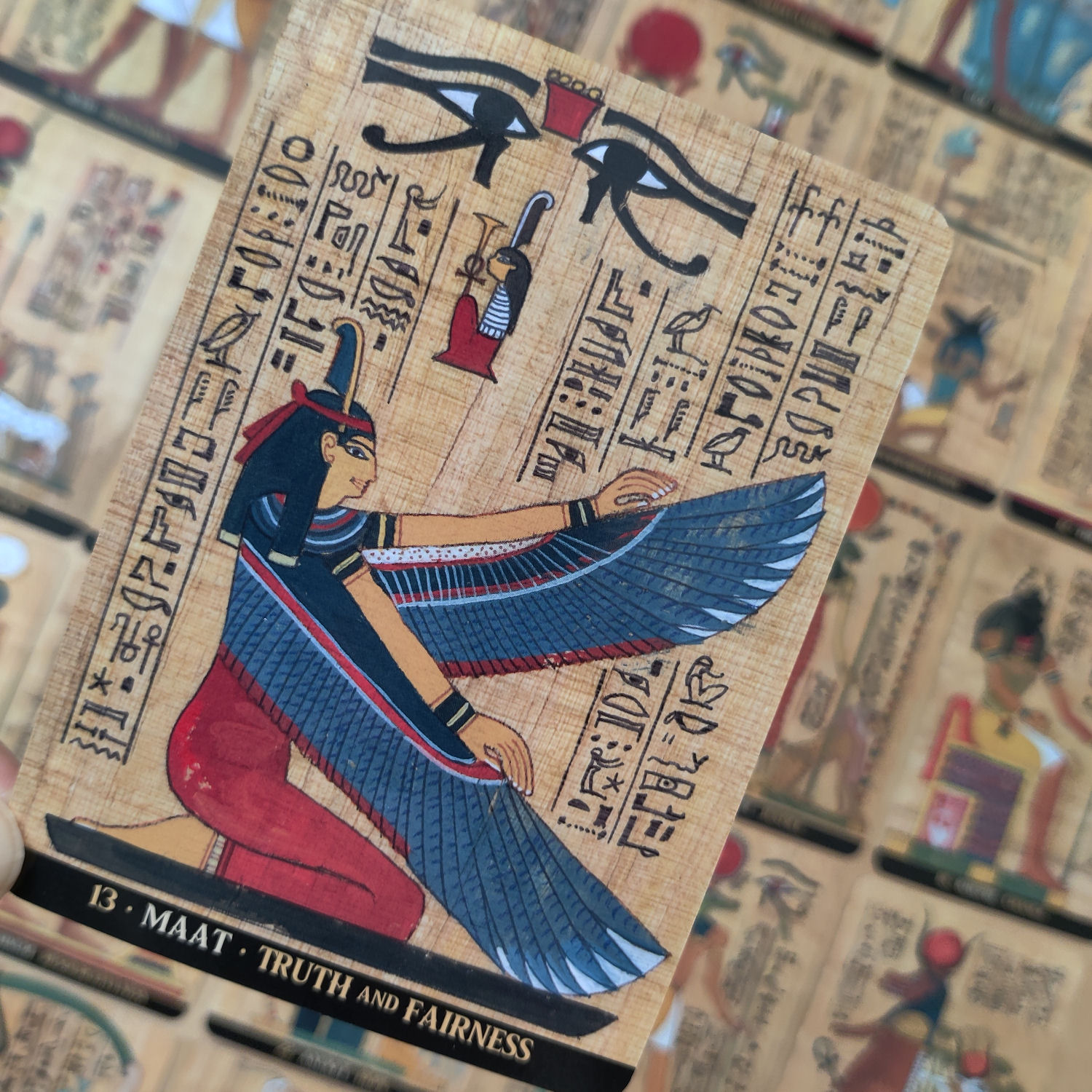
It was the art style really captivated me, and then as I explored the deck further, it turns out to be of the most well-done Kemetic-themed decks I’ve seen in a while.
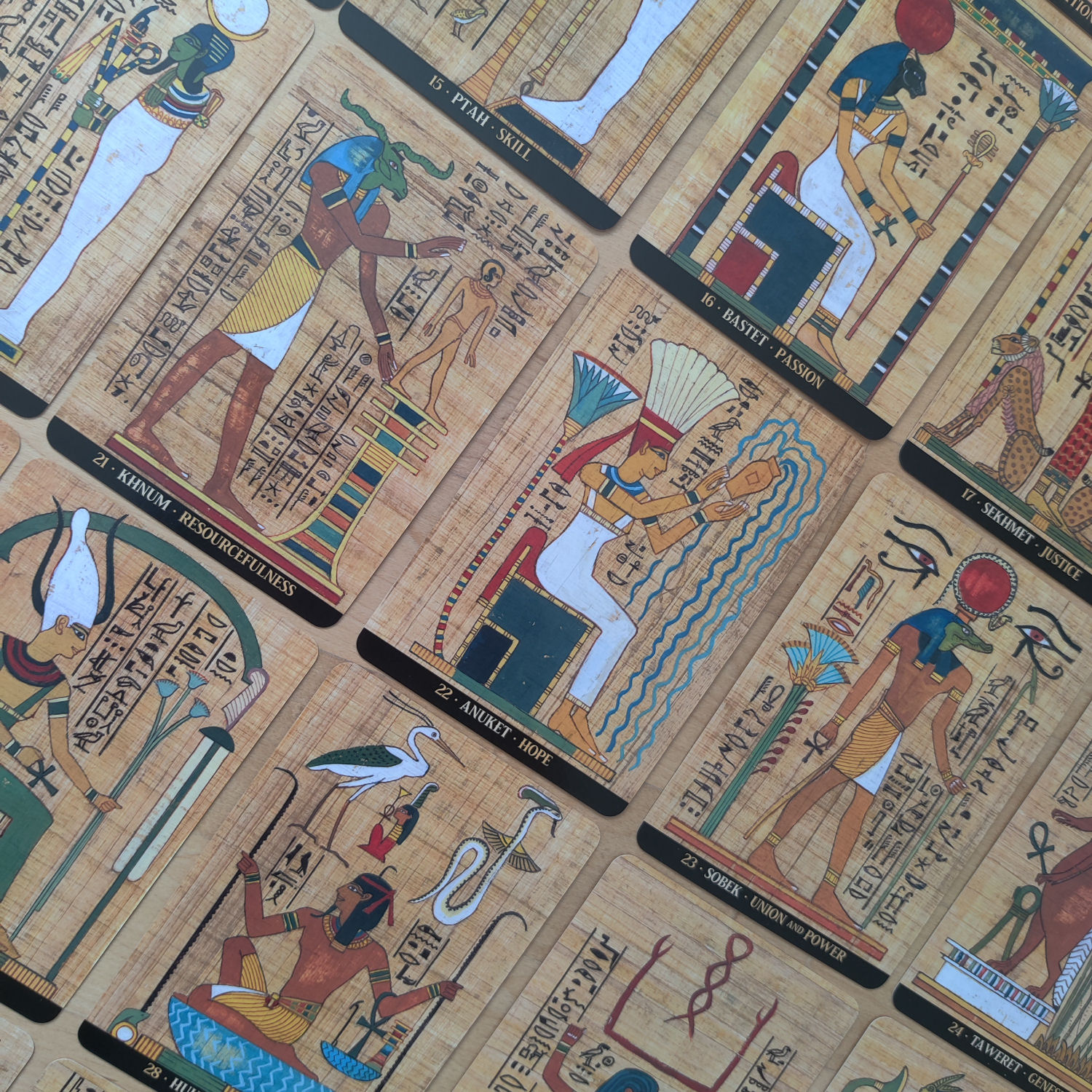
This is a deck of 36 cards, each bringing messages of wisdom, warnings of danger, advice, and protection. Each card features a god or goddess from the Egyptian pantheon.
The meaning of the word “god” in hieroglyphics (Neter) represents the instrument through which a force that is not directly visible manifests to us, revealing its nature through the occurrences of its effects.

Per the Egyptian Genesis, in the beginning there was chaos. Then from the depths of the primordial waters came Nun and Nunet. Upon their union a phoenix alighted and thus Ra, the Sun was born, the Father of All Gods, and from Ra came Amon-Ra, god of Creation. The ordering of the cards are inspired by the Creation story. After Amon-Ra came the Ogdoad.
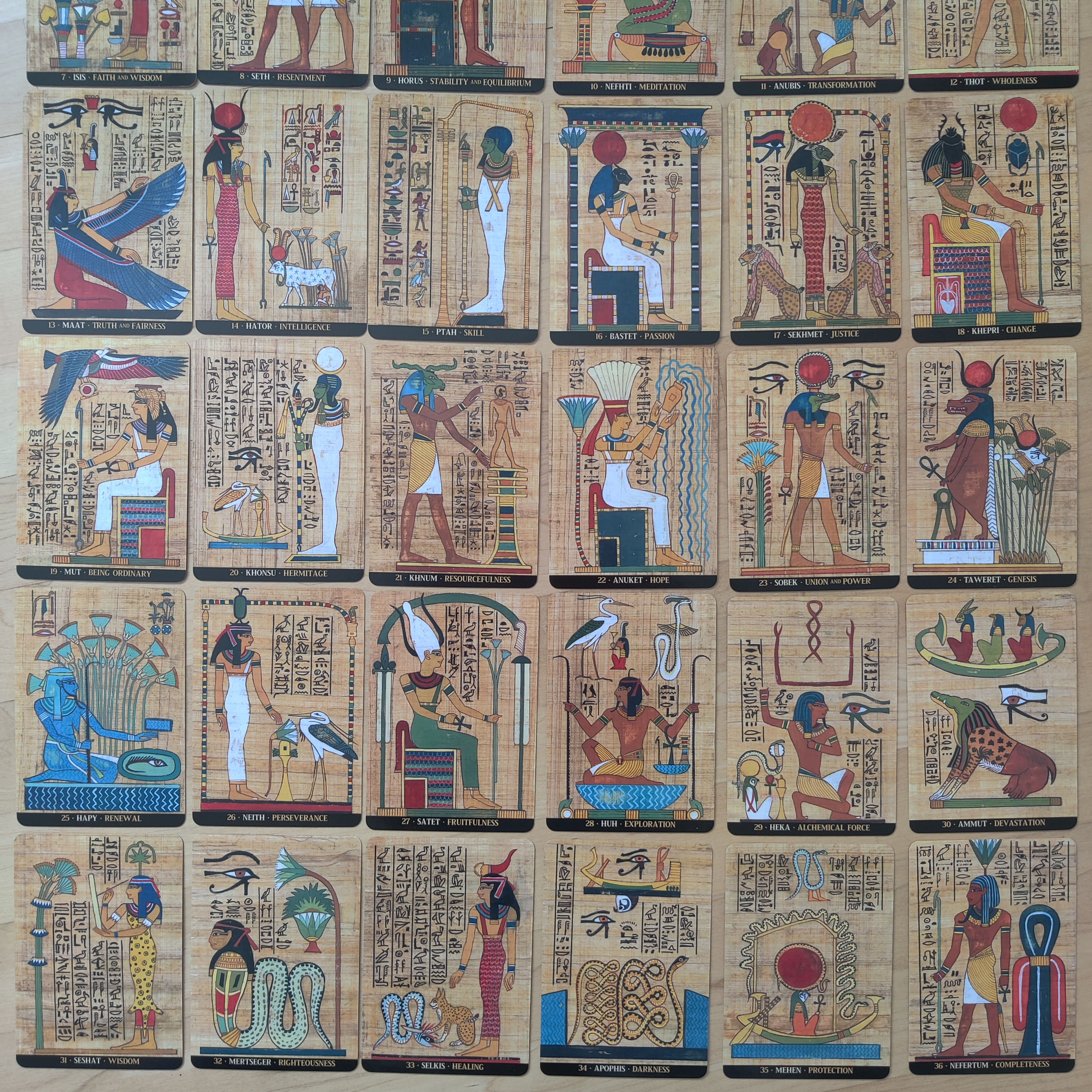
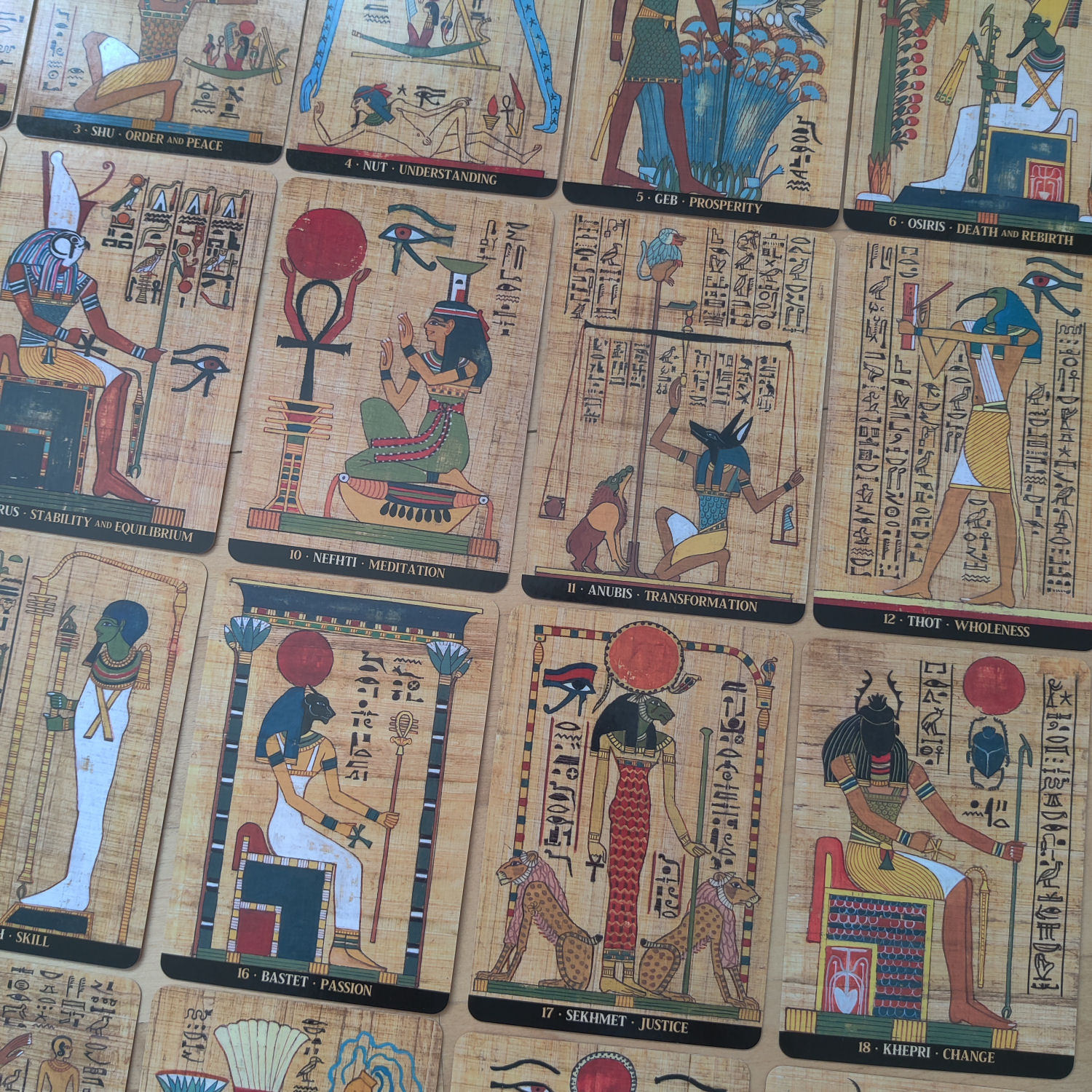
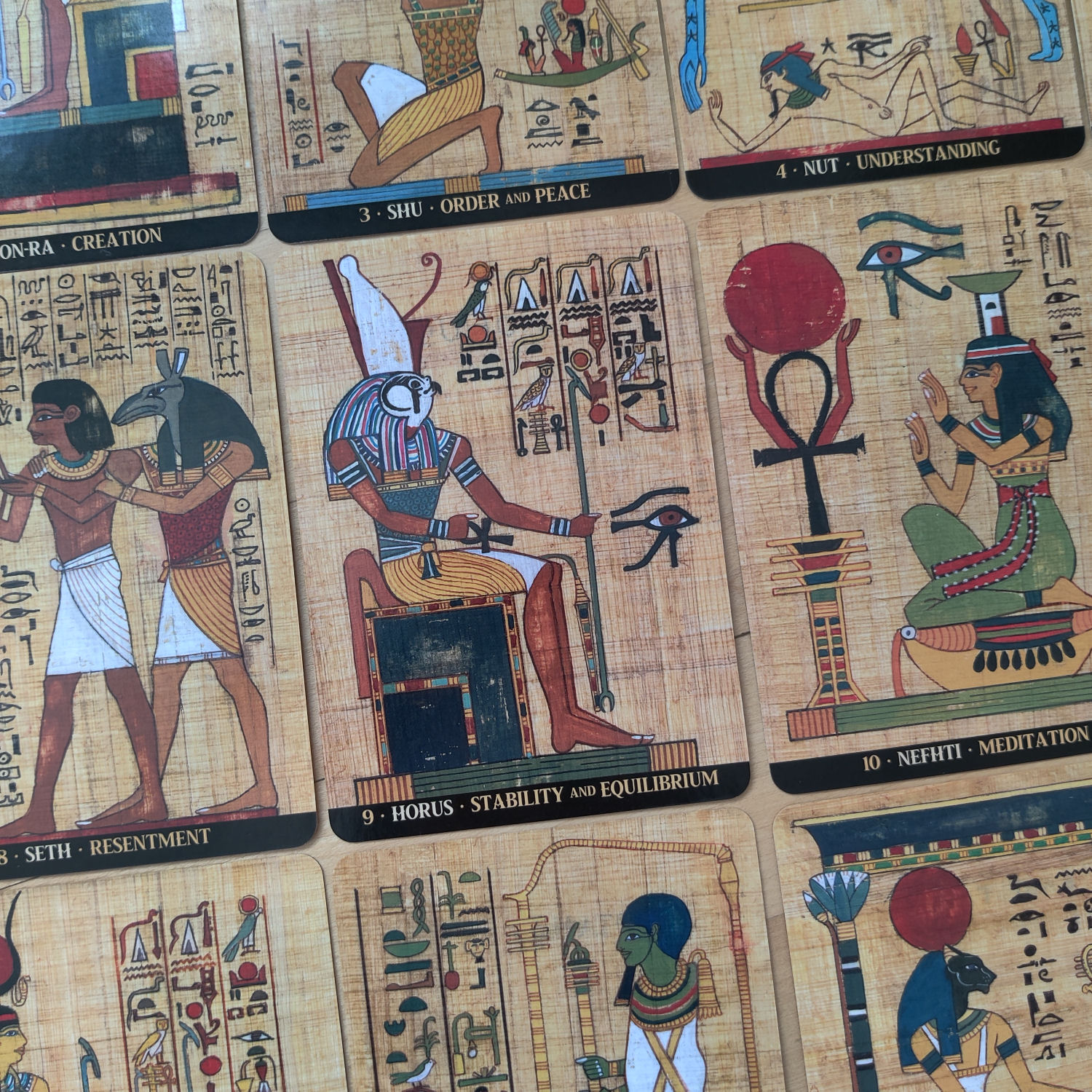
The layout of the cards is perfectly well done for operability as an oracle deck. The beautiful painting occupies most of the space, and at the bottom, you have a card number, to easily look up the reference in the guidebook, the deity name, and then a prophetic keyword.
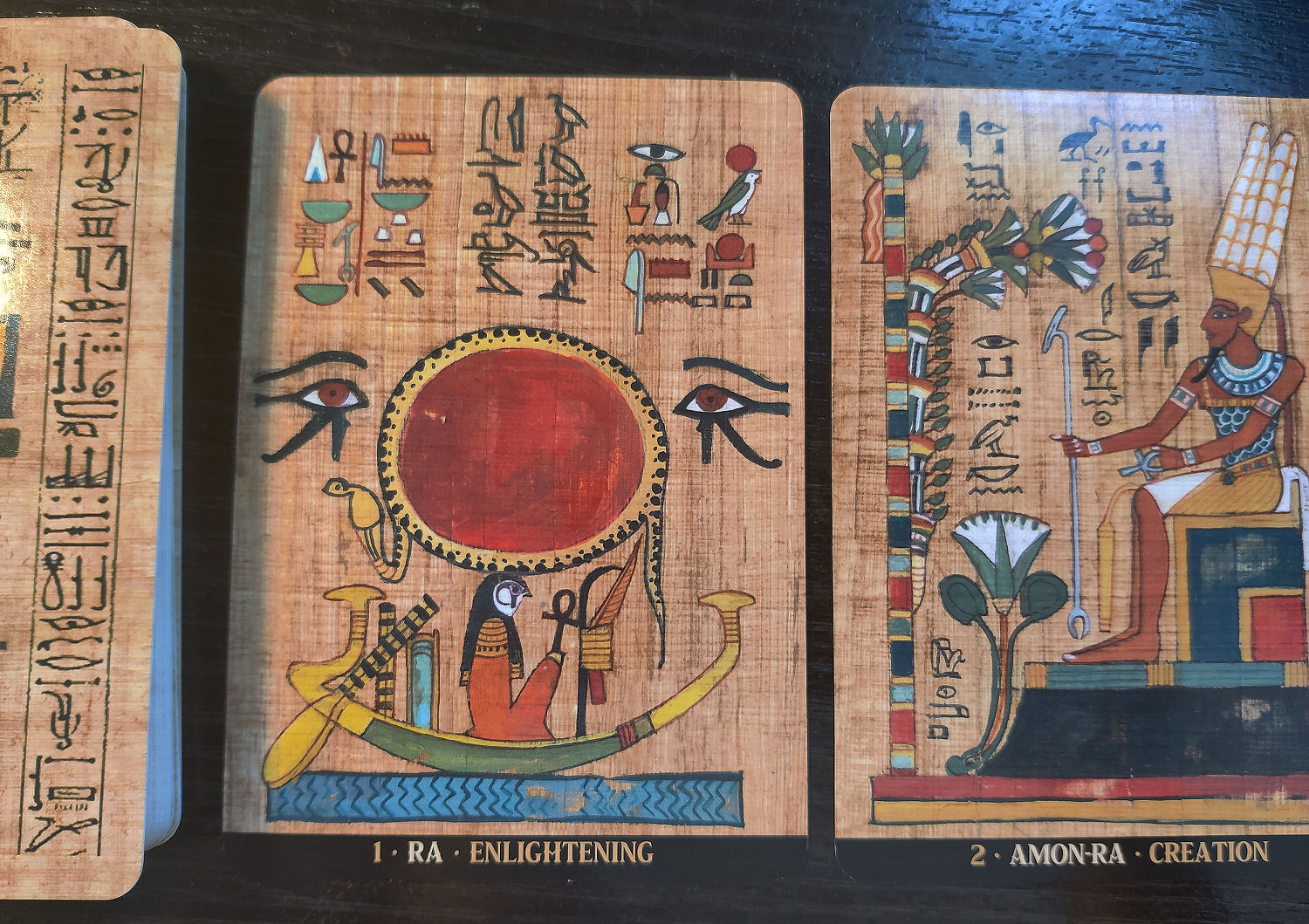
Card 1, Ra, bears the keyword Enlightening. Ra is the sun god, “He who rises up, climbing high in the sky,” and corresponds with knowledge as attained and witnessed by the third eye.

Card 7, Isis, the Mother Goddess, bears the keywords “Faith and Wisdom.” Her name means “throne” and the headdress she wears is in the shape of a throne. She is the goddess of Great Magic, and when you align with faith (in the spiritual universe) and wisdom (of the material universe), she will reveal to you secret knowledge.
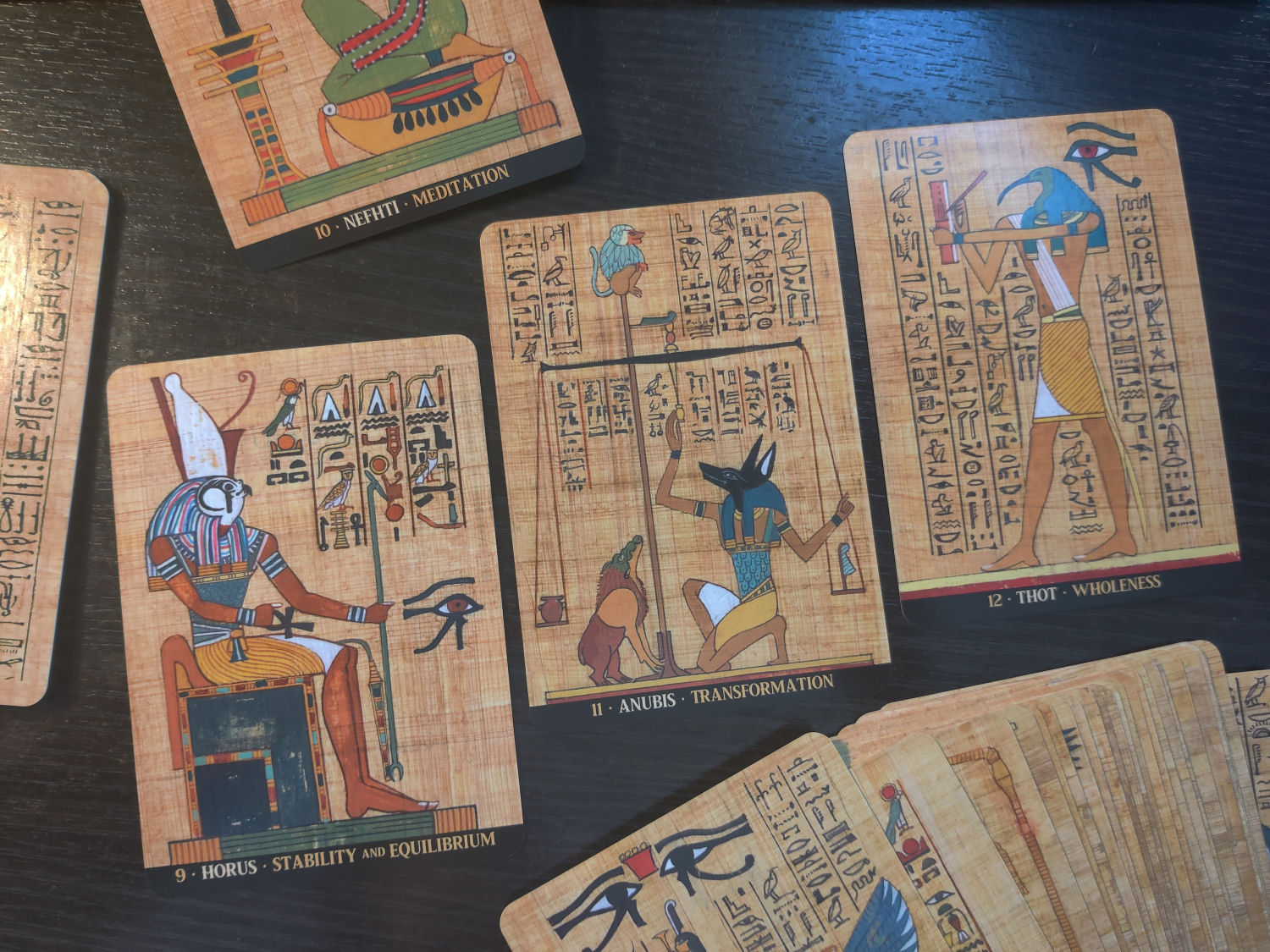
Card 9 is Horus, for Stability and Equilibrium. Card 11 is Anubis, for Transformation, And Card 12 is Thot, for Wholeness. Thoth is the Lord of Time, protector of scribes and the inventor of writing, god of magic, clairvoyance, and the laws.
During a battle with the god Seth, Horus lost his left eye, which Thot then healed. Thus that eye became the talismanic Eye of Horus. This is the card of order and harmony, bringing sound advice and to help you advance to higher ground.

Heka, the god of magic, and also of healing medicine, brings vitality, magnetic strength, and guides the successful development of your accomplishments. His namesake means “the first work.”

Mertseger, whose name means “She who loves silence,” is a punisher goddess who poisons evildoers and oathbreakers. She represents authority, intelligence, and helps you to guard against those who bear ill-intentions against you. Selkis (card image slightly cut off above, but which appears below) is the goddess of magic and occult powers, often depicted as a woman with a scorpion on her head. She reigns over all poisonous creatures, representing both the poison and its antidote.
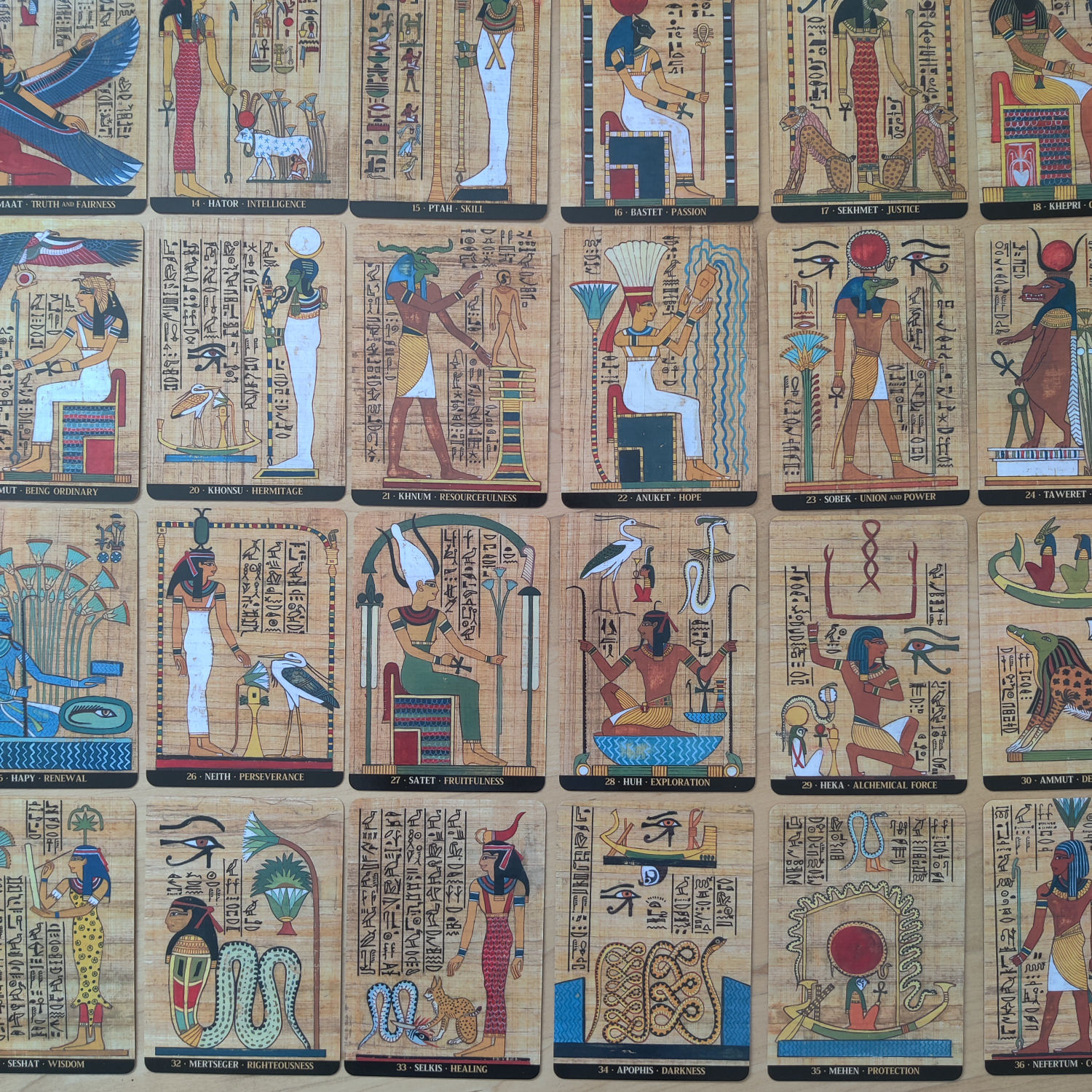
My one critique would be not providing translations of the hieroglyphics featured on each of the cards and whether the paintings were inspired by any historical sources in particular. Feels a bit like a missed opportunity.

While this might not be a deck I’d try to do practical readings with (though you most certainly can, and the guidebook will help with that), I would consider it a must-have among deck collectors. It’s beautifully done and I love Alasia’s selection of the 36 deities to portray in these cards.


FTC Disclosure: In accordance with Title 16 of the U.S. Code of Federal Regulations Part 255, “Guides Concerning Use of Endorsements and Testimonials in Advertising,” I received this deck from the publisher for prospective review. Everything I’ve said here is sincere and accurately reflects my opinion.
 benebell wen
Pingback: 西爾瓦娜·阿拉西亞 (Silvana Alasia) 的《埃及諸神的甲骨文》——貝內貝爾·溫 (Benebell Wen) - FanFare Holistic Blog
Nice deck, seems like animism had its origins during that time; unlike Disney animation, asking for guidance from a higher power is astounding. Thin film tarot deck is the only way to tap into energy patterns that originate from the universe, as I see it. Holistic: mind body spirit!
LikeLike
I’m intrigued by these 36 card Tarot decks and was wondering on what basis they are designed? For example are they structured to reflect the 36 decanates employed in Egyptian astrology for predictive purposes or some other assignment such as the Sabian Symbols? Does the author describe the origin of their correspondences? The early 15th century to 17th century decks certainly possessed a divinatory structure such as the 10 stations of humanity, the 7 noble virtues etc. The “Enchanted Shakespeare’s Oracle” (36 beautifully executed in Renaissance style portraits on card) by Elena Beato is a good example.
https://www.facebook.com/enchantedshakespeare/
The Ascendant Signs are also traditionally divided into 10 degree units known as Decanates, where each unit corresponds to an additional type of planetary influence often termed the “sub-rulers” as listed below:
These planetary sub-rulers modify the influence of the Ascendant as well as the houses and signs on the cuspal influence. The decanate on the ascendant will be of some importance in describing the personality as viewed by others and as the individuals’ unique “window on the world”. This ostensibly is the sign that was on the horizon at the time of birth, moving through each sign approx. every 2 hours, so if the correct time of birth is not known a lot can be missed out in the chart interpretation. Along with the position of the Moon, the decanatal ascendant and the Suns’ location this gives an astrologer the potential of creating as many as 5,184 differing personality types – and that’s not including the planetary positions/aspects which are also referred to in any chart analysis. Traditionally a series of symbolic/mythological & planetary attributes were assigned to each decanate and these are given below.
ARIES DECANATES:
1ST DEC: MARS/Mars.
Active, honest & outspoken, yet headstrong & impulsive. Enjoys being on the move – note influence of Mars in chart by sign & aspects.
“A ram leaping in front of a safe castle situated in a desert landscape. Pride, impetuosity, lack of reflection, jealousy, inconstancy in love, excessive appetites & desires. “
2ND DEC: SUN/Sun.
Assertive force modified & less self-centred whilst being ambitious and persevering by nature.
“ Andromeda chained to a rock, at the mercy of a sea monster, a winged horse flies to her rescue. Symbolises will and courage in adversity. “
3RD DEC: JUPITER/Venus.
Desire to travel & see the world very strong, interested in outdoor activities, sports, gambling/taking risks.
Religious & philosophical tendencies. Most restless of decanate.
“ A dangerous, amorphous yet agile sea mammal symbolises the unpredictability of chance, insecurity, imprudence, egotism and a taste for pleasure. “
LikeLike
Is there supposed to be a book? My order came without, although it says book and oracle cards
LikeLike
my cards did not contain a book to reference my readings. How might i go about acquiring said book?
LikeLike
✨✨
LikeLike
do you have a down load for the book?
LikeLike
https://tarotzoom.lanzoub.com/tp/iiHTJ2svv57a?webtp=UGFTMwBoVDcAYAplCm4AN1oxV2tXdAo6AjZabVY8Wm8HNQBnC24AZAQuA2xQPQYpWjEOOAdpAS0FNgE2BXdbaFBgUzcAIVQyAGYKawpnAGJaN1dgVzsKbQI9WmlWa1o5Bz8AMgsyAGEEagM3UDUGPlowDj0HaQEyBWEBPwVtW2hQZlM2AG1UfABm
LikeLike
https://developer-oss.lanrar.com/file/?VzECPAAxAjMGDwE5ADUAbFVqAjpUPVRgATZVflZPWx1VDAAHCwIEGVNEV08KfgdBABUDQgIOBioKfVU3V21RdlcxAjwAMQIzBg8BPgAwADxVPQI0VDpUYAEyVWFWOltiVWUAcQswBCNTOFc4Cm4HNABoAzACZQY8CitVI1d7UW1XZQJlAG8CYwZ/AWcAYAAuVT8CMFQkVGMBPlUyVmxbb1VkADILNARhUzFXNAo6Bz8AbgNlAjsGNgo1VWdXOVFgVzECMABlAmYGYwFkAGIANFVtAjJUbVR4AXZVN1ZsW3xVIAAkCzMEIlNsV2UKYwcyAGgDPgJpBjMKPFVqVy1RJFc+AjgAOAIwBm0BZgBjADRVOAIxVDNUbwE/VWVWOVt0VXsAcQswBDxTclc8Cm8HMQBvAzECawY8CjpVZFc8UWVXcQIgAC0CIQZtAWYAYwA1VTwCPlQyVGIBM1VnVjlbfFUgAD4LJgRtUzxXOApwBzcAaQM3AnMGMAo8VX1XOVFgV2QCewB7AjIGPwEgADoAXlVsAmxUNlRmAShVdVZ+WyNVJQAyCwkEJVNkVzwKbg==
LikeLike