
By “questionable” I mean authors whose morality, political beliefs, sociopolitical affiliations, or credibility have been put under compelling scrutiny.
Perhaps more so than any other subject area of interest, when you navigate religious, spiritual, and occult spaces, you have to conscientiously assess and process where you stand on this point. While the issue of where you stand on condoning the reading or the publishing of works by questionable authors is ever present, it floated to the top of my thoughts recently with this announcement by the publishing house Inner Traditions:
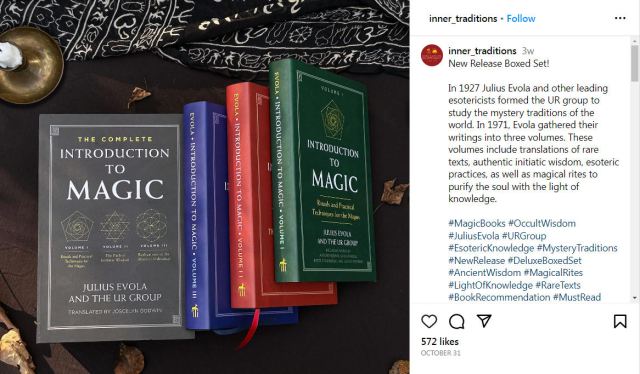
To explore this case study, I recommend clicking on the above IG posting and reading the comments, because I’m not going to re-post the nutty alt-right supporters who resorted to name-calling, homophobia, misogyny, and mocking people’s pronouns. There are also a few very long and thorough comments, too long to fit in a single screenshot, so I won’t be re-posting those either, though they’re worth a read.

Challenge of the announcement with all of the above aforementioned was predictable. What kind of took me by surprise was the strength and volume of voices who were saying, “This is totally fine. Hey liberals, stop being such babies.”

I have so many meandering and tangent thoughts.
You’ll often hear Evola described as a fascist, among similar descriptives. Instead of telling you what I think or what to think, I’ll present to you the man’s ideas in his own words so you can think and decide for yourself.
Putting it mildly, Baron Julius Evola (1898 – 1974) is a controversial figure. He published several essays, such as “Scientific Racism’s Mistake” and “Race and Culture,” proposing his own approach to scientific racism, espousing that the concept of race is more than skin-deep– race itself is spiritual. Race isn’t just anthropological or genetic, noted Evola, there is also psychical race of your soul and spiritual race (race of your spirit), and it is your spiritual race that builds the race of your body. [Quoting Evola: “Can an Aryan have a Jewish soul or inner race and vice versa? Yes, it is possible.” in “Science, Race, and Scientism,” Vita Italiana (1942)] On spirituality, Evola contended that transcendence is experienced differently by different ethnic groups, which is why he proposes the concept of “races of the spirit.” [The Elements of Racial Education (1941) by Julius Evola, trans. Thompkins and Cariou, cited in “Julius Evola’s Concept of Race: A Racism of Three Degrees” (2009) by Michael Bell, The Occidental Quarterly, Vol. 9, No. 2] It’s clear and unambiguous from his own writings that he has a ranked hierarchy of “superior” and “degenerate” races, and that Tradition with a capital T does presume that there is one original superior race (I’ll give you one guess which race he thinks that is). [Synthesis of the Doctrine of Race (1941) by Julius Evola] Here’s a hint: “Aryan corresponds more or less with ‘heroic'” and corresponds with “solar spirituality.” [Revolt Against the Modern World (1934) by Julius Evola, trans. Guido Stucco]
To illustrate his point, there is the Spartan, who possesses a Nordic soul, that can be contrasted with the Carthaginian, who possesses a Levantine soul. The Nordic soul considers it heroic to fight in hand-to-hand combat, and considers attack from a distance with projectiles to be cowardly; whereas the Levantine soul opts for expedient victory, and will employ elephant and grand sieges to utterly devastate the enemy. [The Elements of Racial Education (1941) by Julius Evola, trans. Thompkins and Cariou, cited in “Julius Evola’s Concept of Race: A Racism of Three Degrees” (2009) by Michael Bell, The Occidental Quarterly, Vol. 9, No. 2]
While Evola criticized “extreme racists” who espoused “ethnic purity” because a human cannot be treated like “a purebred cat, horse, or dog,” he argued that spiritual cultivation and mysticism could be used to purify the race of one’s spirit/soul. In other words, while he didn’t care for “ethnic purity,” his core proposition is that one should strive for “ethnic purification,” which is where he integrates his sociopolitical ideologies with his occult practices. Evola praised the profound value and wisdom of “operative Hebraic Kabbalah” but then says this: “As far as we are concerned, we believe that anti-Semitism has every reason to exist.” [Three Aspects of the Jewish Problem (1936) by Julius Evola, where Evola discusses “the Jewish spirit” and “the Semitic spirit”].
Evola also appropriated Buddhist thought to justify the superiority – or at least the positive meaning – of “Aryan,” noting that “arya” meant “awakened” and “noble” in Buddhist canon, ergo the Aryan race is the awakened, noble race, that “Aryanity” is a “positive universal idea.” He attributes positive traits to the “Nordic soul,” such as “Talk little, do much, and be more than you appear to be,” whereas the “Mediterranean soul” is “a vain, noisy show-off who does things just to be noticed.” [Men Among the Ruins (1953) by Julius Evola, trans. by Guido Stucco, ed. by Michael Moynihan]
He equates the “solar spirit” with the “Aryan spirit,” which is an “antithesis” to “the Semitic spirit.” And so when he gives instructions on “solar rituals,” it is not a stretch of logic to deduce that such rituals are intended to purify the soul so that it is more aligned with the “Aryan spirit.” Which is to say that Evola’s political writings give much-needed context for the content of Inner Traditions’ Introduction to Magic: Evola and the UR Group series. Oh, and bonus points: Evola all but justifies the caste system in India through the spiritual concepts of Dharma and Bhakti. He does speak fondly of the Egyptians, though, calling them a civilization that “must be considered of Western origin.” [Three Aspects of the Jewish Problem (1936) by Julius Evola, where Evola discusses “the Jewish spirit” and “the Semitic spirit”]
Spiritually and politically, Evola considered himself a traditionalist, and saw the progressive movement in art and society of his time as indicative of Kali Yuga, an apocalyptic Age of Darkness, though he himself was a Dadaist artist (make it make sense…). He is often cited for his writings on Asian philosophy, religion, and mysticism. The baron was on the brink of suicide when a Buddhist text he read inspired his spiritual awakening. Thus his early writings on spirituality focused on Chinese esotericism. He sought to bridge Hinduism, Buddhism, and Taoism with Western alchemy and Hermetic philosophy. He would later go on to appropriate the occult technology of Asia to support the spiritual supremacy of his own race. [Social and Political Thought of Julius Evola (2011) by Paul Furlong]
Oh, and by golly if there was ever to be a claim made of the cultural appropriation of Sanātana Dharma (Hindu) and Buddhist thought, it would be whatever abomination was happening in Evola’s hot takes.
Evola then founded the UR Group, an initiatory secret society dedicated to occult Hermeticism and ritual magic. After noting the vile, immoral times that humanity found itself in, evident of the Kali Yuga, Evola saw the UR Group’s high magical “divine” works and “secret science” as “the Way,” the path of light that will purify humanity. (And with that, one cannot help but draw the connection to Evola’s stance on racial spiritual purification…) Evola describes his concept of “the Way” as aligned with Eastern philosophy’s concept of “the Tao.” [Julius Evola’s Introduction to Magic: Rituals and Practical Techniques for the Magus, trans. by Guido Stucco]
The man rejected Evolution, calling it a fallacy, and instead believed in a sophisticated ancient civilization called Hyperborea, which maybe some call Atlantis or “the Western land” from which the “pure Aryan stock” was birthed — his concept of a “pure Aryan stock” did not come from apes; it came from Hyperborea/Atlantis. He believed that Incan Peru and Shinto Japan are examples of Aryan ancestors. [Revolt Against the Modern World (1934) by Julius Evola, which Evola himself considered his magnum opus]
Now, as for whether Evola was a Fascist, he lodged a lot of criticism against the Fascist movement and the key figures of Fascism at the time weren’t exactly fans of his work either. More precisely, Evola in effect said, if Fascism follows my values, then I’m cool with Fascism. Where Fascism does not follow my traditionalist and nationalist values, I’m not okay with Fascism. He criticized the Right of his time not because he was Leftist, but because he believed himself to be the “true” Right, i.e., even more “right” than the Right. [A Traditionalist Confronts Fascism: Selected Essays by Julius Evola, trans. E. Christian Kopff (2015)]
Whatever the relationship might have been between Evola and Mussolini, the latter has been documented as praising the former’s writings, specifically as it pertains to race and the superiority of the “Race of Rome.” Heck, Mussolini was so impressed by Evola’s ideas on race that it inspired the dictator’s political philosophy and was adopted as the official policy of Mussolini’s Fascist party in 1942. [Men Among the Ruins (1953) by Julius Evola, trans. by Guido Stucco, ed. by Michael Moynihan]
After the tidal wave of backlash, Inner Traditions noted that the translator, Prof. Joscelyn Godwin, would share a defense on why it is important to continue publishing Evola’s writings. I had wanted to wait for that defense and read it first before writing this, in case I might want to respond to it, but it looks like there will be some delays:
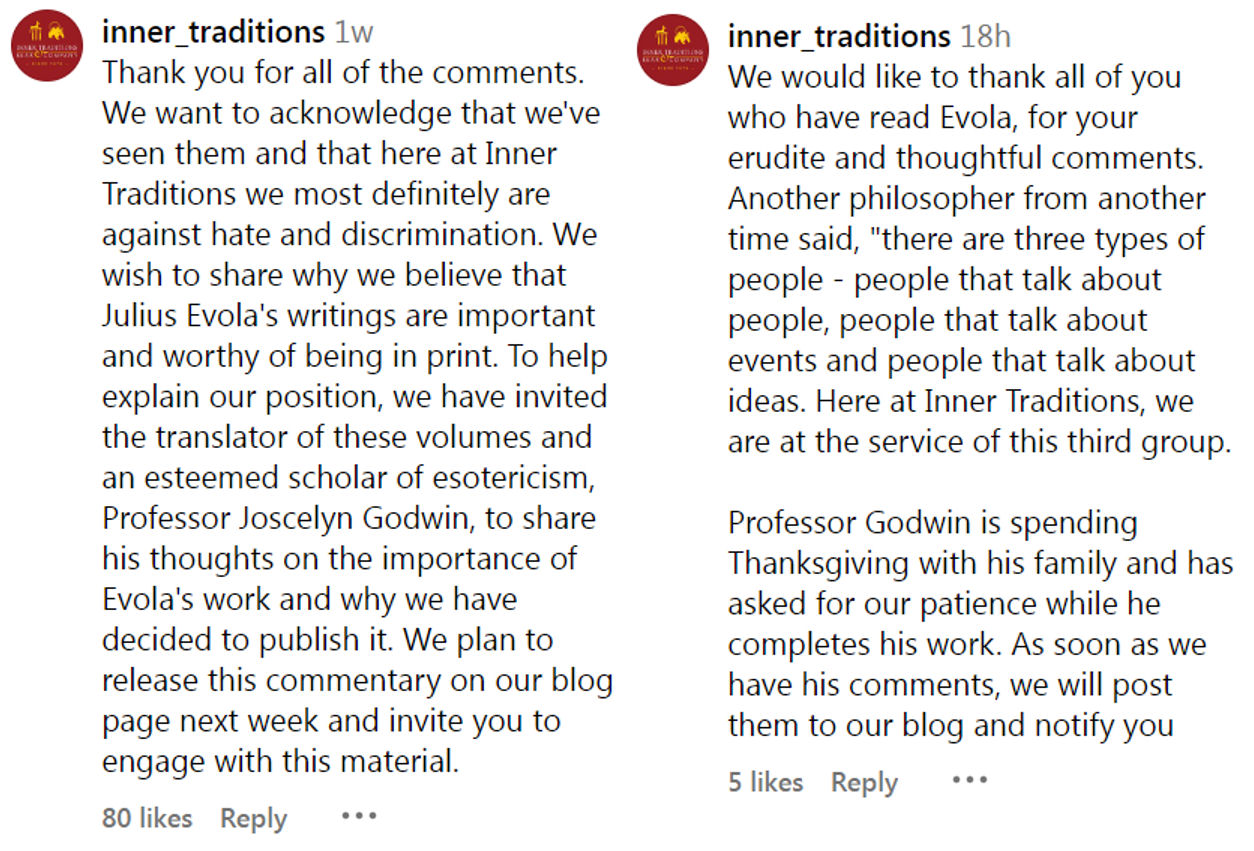
So I guess we’ll all have to wait and see.
The Digital Ambler posted a compelling critique of Evola’s take on Hermeticism back in 2022, though with Inner Traditions’ announcement, the article resurfaced and made its viral rounds again. You’ll even find it linked and referenced multiple times in the comments section of that announcement. It’s a great article, so I highly encourage you to read it if you haven’t already, even if I winced a bit at the contention that “the only thing fascists deserve is immolation and drowning” despite the quick follow-up, “this is not a call to violence” and tagging Evola’s work as “trash” and “idiocy.” (It’s just me being prudish; I’m not a fan of that sort of language.)
In terms of Modernist occult history, I’m not sure we can deny the significance of Evola’s UR Group and its tenets of Italian esotericism. Agree with it, disagree with it, see it as restorative of Hermetic tradition from an alchemical perspective or see it as a perversion of Hermeticism, however you opine, Evola made a mark, especially as a right-wing thought leader.
Also Evola: “We cannot ask ourselves whether ‘woman’ is superior or inferior to ‘man’ any more than we can ask ourselves whether water is superior or inferior to fire.” Except he goes on to say, “There can be no doubt that a woman who is perfectly woman is superior to a man who is imperfectly man.” Eeps. I was almost with you for half a second there, sir, and then you took that turn… [Eros and the Mysteries of Love (1957) by Julius Evola]
Plus, some of what he had to say may resonate with today’s far-left. “American civilization represents an exact contradiction of the ancient European tradition,” Evola said, noting that we’ve put the “quest for profit” over “transcendence, inner light, and true spirituality. … America has built a society where man becomes a mere instrument of production and material productivity within a conformist social conglomerate.” [Revolt Against the Modern World: Politics, Religion, and Social Order in the Kali Yuga (1934) by Julius Evola] And just to be clear, Evola was no fan of Marxism or socialism because they, in his view, “are direct creatures of the Jewish spirit.” He also wrote that “the main fathers and apostles of international social-democracy are Jewish. . . . Liberalism, combining with democracy, becomes judaised.” [Three Aspects of the Jewish Problem (1936) by Julius Evola]
Speaking of censorship and suppression of information, in my search for Evola’s own words — his writings and not just what other people are saying he said — the uncomfortable-but-not-yet-horrifying stuff was easy to find. The really horrible anti-Semitic manifestos that Evola wrote took further layers of searching and paywalls to get through. I don’t know how I feel about that. On one hand, obviously I get it. But on the other, if someone who had never heard of Julius Evola before and that Introduction to Magic collector’s edition boxed set piqued their interest, wouldn’t all this stuff I’ve shared be the first thing someone might want to know?
Prior to this, my awareness of Evola’s work was little more than “I have heard of him, and I’ve heard vaguely that he’s controversial.” I had heard that he was this and he was that, but maybe boys crying wolf meant I just didn’t know for sure how seriously to take the charges. If you run a cursory 30-second search “just to see” but you’re “not that interested,” you find conclusory statements and charges, but not a lot of direct evidentiary substance. And I get why– his actual writings, if you read them, make you want to sanitize everything after, scrub your eyeballs, and you’re like, great, now my database searches from WWII Era historical archives will surely have me put on government watch lists.
I’m torn between the thought “this should be more accessible to the public so people really, really know” and “no one needs to be reading this, why are we printing a luxury boxed set collector’s edition.” But book banning and censorship will always be the political canary in the coal mine telling us we’re going in the wrong direction. Whether it’s capitalism or communism that’s justifying the resulting censorship, the moment the collective declares “This should not be published because its ideas are bad,” we need to sit up and pay close attention to what happens next. Instead of criticizing a publisher for publishing ideas we disagree with, let’s publish criticism that eviscerates the substance of those ideas. There’s also a difference between choosing not to support a publisher’s decision that we find onerous and compelling public condemnation of a publisher’s decision that we find onerous. The former is contribution of personal power; the latter can become abuse of power.
There’s another well-known mind, body, spirit publisher who publishes collector’s edition books on the Third Reich, Waffen-SS, and Schutzstaffel. These books do not include any critical commentary and have been accused of romanticizing these organizations, presenting their war efforts in a positive, admirable light. Let’s ask this question: who do you think is the only readership buying those books? So then, who and what is such a publisher being complacent to? This publisher also happens to publish tarot decks and occult books. Where is the viral outrage? Why the unfair treatment between two publishers in the same industry doing the same thing? Why are we being selective?
Aleister Crowley is another controversial figure oft raised when we have these conversations on whether to dismiss all ideas, possibly good ones included, because a subset of those ideas are questionable (or come from someone who behaved in ways that were questionable). Between Crowley and Evola is just a sliding scale of your tolerance level. I won’t even get into the number of historically significant occult writers I have on my bookshelf who are, at best, heavily prejudicial against women.
There’s also the question of, do we have to publish disclaimers then? In the case of Evola, for example, does the publisher have to print an introductory chapter that goes through all of Evola’s political beliefs? I don’t know what my own personal answer to that question is. Because surely before I read an author’s writings I would like to know if said author believes a whole class of people should go die? But then is it the publisher’s affirmative duty to let me know that in the book description and opening chapter?
Maybe it’s on the reader to vet who we choose to read. With the internet at our fingertips, the argument is you can look anything up yourself, right? Except I’ve personally witnessed just how much disinformation there is about even little ole’ me that goes unchallenged, that’s borderline defamatory if not outright textbook defamatory, how much disinformation is out there about author friends I personally know, but what are you gonna do? Authors have a life to live. They can’t go around the internets playing whack-a-mole. And I guess for me, because that is my experience, I’m highly skeptical of anything I read on social media about so-and-so author or public figure unless words from that figure’s own mouth are quoted and the source of that quote cited, with full context provided.
So I’m not going to put any stock in someone saying to me, “So-and-so is problematic. Stop supporting them.” You need to give me (1) quotes verbatim that so-and-so actually said, (2) the source of that quote, and (3) the full and complete context for where those words came from. Without all three present, I refrain from judgment. Check for primary sources. Be critical of hearsay.
I’m no longer talking about Evola though. I’m now talking about how the communities on social media treat specific living authors and influencers. All too often when someone comes forth and says “this author is problematic, we need to stop supporting so-and-so author,” if you investigate it further, that someone turns out to have a personal axe to grind against the author. It wasn’t sincerely in good faith about problematic ideas; it was gossipy-level rivalry. It’ll turn out that there’s a whole story behind the scenes that the public never hears about, and all they get is that so-and-so author is problematic because they support this-or-that bad idea. And really? Do they actually support that bad idea or is that, too, a misrepresentation? Is there more to the story? How often have we rushed to pass a judgment of guilty only to find out three months later that they were innocent? And by then it’s too late. The damage has been done. Which is why I’m slow to condemn.
But what say you? What are your thoughts on the publication of authors who are deemed to hold questionable ideas or who have been accused of behaving questionably? And if we say yes, we need to scrutinize the political ideologies of all authors before we print or reprint their works, then we better roll up our sleeves now and get to work, because there are a lot of dead authors we need to drag back out into the limelight to review and living authors to interrogate. Or do we only single out the ones that popular influencers tell us about?
Let’s say I were to extract some random quote from Evola (one that is totally innocuous) that I happen to like and I re-quote it (I wouldn’t, but for this thought experiment let’s say I did) — does that make me problematic and questionable, too?
Is it enough to condemn the idea on the basis of the idea? Or do we need to condemn the author of that idea, too? To ensure that I remain “spiritually pure” and, in your eyes “virtuous,” need I reject Evola in the entirety and also publicly condemn him? (Is that not in itself a very Evolan idea?!)
 benebell wen
Pingback: 我們應該閱讀有問題的作者的作品嗎? 關於朱利葉斯·埃沃拉。 – 溫貝尼貝爾 - FanFare Holistic Blog
Personally, I find censorship of controversial or ideas that some people disagree with to be more disturbing and dangerous than publishing works that contain such ideas. We are all adults here. We can make up our own minds. I’ve made up my own mind regarding Aleister Crowley and choose not to expose myself to his writing and ideas as much as is possible for me in the Tarot world.
LikeLike
I’m with you. I actually have read quite a bit of Crowley, and used the Thoth tarot for many years (I don’t have to like everything about the man to appreciate some of his ideas), but I agree that we shouldn’t be “cancelling” authors and publishers for disagreeable ideas. It used to always be the Bible thumpers, and the people who wanted their votes, who wanted to ban books, and now just as often it’s the white knights on the “Left” who want to stamp out “incorrect views,” which to my mind makes it start seeming an awful lot like a religion itself. If we’re not careful, we’re going to end up with our own Red Guard movement. (I am not a member of the “far-right,” by the way, for anyone inclined to jump to that conclusion. I consider myself a liberal, but the old-fashioned kind. 😉
LikeLiked by 1 person
I’m still torn and haven’t quite made up my mind.
Elevating and celebrating certain ideas that run a high risk of inciting violence can embolden bad actors. We *are* all adults here, and that’s what’s so scary, because we can’t and don’t all “make up our own minds.” Collectively we are far too easily swayed by charisma and falsehoods.
Suppressing, censoring, even banning ideas, though, also run a risk of giving them even more power and martyrdom.
Ultimately it boils down to education and the importance of education. In an educational environment, there needs to be free, uncensored, and unfettered access. To all knowledge and information, all ideas no matter how abhorrent, all of it should be available in print. But in a mass market environment… I just don’t know. =/
LikeLiked by 1 person
I worry about the same things, especially about the bad ideas members of our own government are infecting the general populace with. But honestly, I suspect that the increasing number of people driven to the “Far Right” and many of their most worrisome ideas might actually be, at least in part, a REACTION to just this kind of thing, to people on the Left daily preaching about all the things we need to be protected from, and every day it’s something new. They don’t want to see the country taken over by what they see as a bunch of liberal thought police. 😉
And yes, a better educational system would definitely benefit us all. However, that should mean teaching facts, and practical and critical skills, not socially engineering our children to blindly believe whatever agenda today’s online justice warriors are pushing.
LikeLike
I am Juna Berry Madrone and didn’t know that I had to log in to be identified with the above comment.
LikeLiked by 1 person
Hi – I read a lot, and have a lot of competition for my reading eyes, and if a few esteemed, critical, logical reviewers have taken the time and pulled out false arguments, fallacies, liesetc. within a a text, I would simply believe them and not read the text.
If it were a text that discusses something that I feel that I have enough experience and expertise with, I might make the time to read the text myself.
I was a librarian in my working life, and I’m not in favor of banning any kind of books. When I was working, though, I would never buy books in the library that insisted that the Holocaust was a hoax, or denial of anything where there is plenty of evidence showing otherwise. Books with sketchy? Well, the first thing I’d ask is: “what *value* would this book have in the larger picture of the topic?” Of course, to include all voices in a conversation is important, but one must draw the line at wingnuts, and the cray-cray.
LikeLiked by 2 people
Hi Benebell, I hope you and yours are all well. Ohh- and happy Thanksgiving (if you celebrate it).
I read the hullabaloo about this author and his Nazi connection. Personally I wouldn’t buy anything written by a Nazi because clearly I have bias! But that doesn’t mean his work is invalid or incorrect. Censorship is a very scary demon too. We should all have free choice to purchase what we want without judgment. But maybe thats being an idealist?
LikeLiked by 1 person
Totally agree! One thing I’ve been generally disappointed in as of late, though, is that critical reviewers don’t seem to be taking the time to (1) provide the actual quotes, (2) cite the source, and (3) fairly and objectively present the full context. So we end up with influencers telling us exactly what to think but not always “showing the work” so we can arrive at that conclusion for ourselves.
LikeLiked by 2 people
Been ill and sleep deprived so possible this just went over my head. People aren’t just “good or bad”. Just because someone says or does something most find offensive doesn’t mean they didn’t contribute anything useful. Didn’t the electricity or light bulb dude steal the idea from someone else? I find taking credit for others work repulsive but im not about to shut my lights and tv off though maybe I should and go to bed…
LikeLiked by 1 person
Truthfully, I think focusing the argument on concerns about censorship is a misstep during a time of global fascist uprisings and spread of fascist thought, where fascist beliefs actually aren’t under threat of censoring but being spread increasingly. The republishing of Evola’s works is more aligned with that increased tolerance and spread of fascist beliefs than the opposing limiting of marginalized people’s works/beliefs. When we consider the paradox of tolerance, there absolutely should be a cut off concerning what should or shouldn’t be tolerated concerning an Author’s personal beliefs – and Evola absolutely fits the parameters of that limit. When Evola’s violent fascist personal beliefs influence his spiritual beliefs, and thus his spiritual writings being republished, exactly what value are we saying they have where the continued denigration and dehumanization of marginalized people is acceptable for the spiritual growth of the few? Especially when there are better, less violent sources for such beliefs?
Personally, I’m more interested in the spiritualists, such as the Buddhists and Taoists, he so openly appropriated from before deeming them less worthy than himself. People like Evola have had their time in the sun and, beyond that, I’m pretty sure his writings are available online for free due to their age/importance to others. Works like his own typically are archived for the public – and I’d prefer they remain simply archived, for free, in comparison to advertised for profit during such dangerous times. He doesn’t need a platform, nor does his work deserve celebration: I think many just believe so due to whose (privileged) voices we value, even when they are simply just the loudest in the room.
I think it’s high time we give more space to the people Evola denigrated and stole from, people whose work is far less likely to be archived, translated, and preserved in any manner, at this point in time. People like Evola are already emboldened and increasingly committing acts of violence against targets Evola himself would justify harm against. Let’s not slide the barometer of tolerance another inch to include such people as Evola. Violent beliefs like Evola’s don’t need to be normalized any more than they already are.
LikeLiked by 1 person
Yes, hundred percent agree. There is a real resurgence of fascism in conspiritual spaces and so, it really matters when reputable, trusted publishers reissue old works that feature anti semitic and other racist, fascist ideas as though they are part of occult practice.
LikeLiked by 1 person
All true. What I’m trying to digest at the moment is the volume of support in favor of celebrating Evola’s works, which totally validates what you just said about the spread and increase of these beliefs.
It’s also worth pondering on why a publishing house would think a handsomely produced boxed set of Evola’s works would sell well – after all, that’s why they produced it. I’m going to assume they’re correct in that forecast and that such a set *would* sell well. That would be the focus of my critique, personally – what is going on with the collective that would make this marketable now and what can those of us who are aware and awakened do about it? Rather than simply post rallying tweets trying to get everybody to stop supporting Inner Traditions.
LikeLiked by 2 people
Honestly, it’s a pretty tough pill to swallow, so I get where your coming from! Probably a bit pessimistic my end, but I’m shocked this hasn’t happened sooner. I’ve noticed that backlash pendulum swing from progress happening in spiritual spaces even back in 2020, although it was much smaller/hidden then. At this point in time, I’ve noticed more and more decks centered on BIPOC, specifically decks for Black people, struggling to find funding in ways that wasn’t as much of a problem just 2 years ago.
A lot of this makes more sense in the context of fascist spiritual spaces, which I don’t think most folk are familiar with. There’s such a hunger in those spaces for spiritual knowledge outside of paths such as Heathenry/Asatru and Paganism centered on Roman or Greek deities now. I don’t exactly understand the reasoning, but both of those spiritual paths have increasingly been seen as “degenerate” by modern day fascists, whereas that wasn’t the case in the past. It’s opportunistic and flat out ugly, but I think Inner Traditions saw a niche needing to be filled and decided to fill it. Sure, all spiritual societies revolving around Evola’s work has failed in the past but, just like Evola’s fascist tendencies, I don’t think the publishing house really cares about that. Just that they know there’s customers willing to pay, no matter who that material harms. But I also know that conservatives, even ones who have no interest in Evola’s work, will speak out in support of it just to normalize such material.
So, at this point, I’m wondering if there really is that much interest in Evola’s work OR if this is another round of fascists rallying around a product they don’t actually plan to monetarily support. Truth be told, I’ve seen other companies try to bank on fascists and it doesn’t seem to work out in the long run unless they decide to court fascists entirely. As loud as they are, there just isn’t enough of them to truly make this financially viable without catering to them absolutely.
I think that’s what worries me most: this may just be the first phase of Inner Traditions testing the waters for even worse things in the future.
LikeLiked by 1 person
A controversial author doesn’t scare me, because their ideas are not likely to change my core values. I rather like the shock value of such books. Though I’m shaken to my core, strangely enough, I can understand where they come from while still disagreeing with them. I especially like it when I feel/sense something isn’t right but I can’t put my finger on what and why. It marinates for a couple of days until I’m clearly able to define what is bothering me and that deepens my perspective. They help me better define where I stand on certain issues. It’s like when you’re among like-minded people you don’t really see yourself. But when you’re among polar opposites you see yourself because of the difference. We don’t see the stars in the light (daytime) we see them in the dark.
So, I’m not against publishing such a book, but I’d be lying if I said I wasn’t a bit fearful of the effect such a book has when it falls on fertile grounds. Or when it falls into the hands of someone who sees it as truth rather than a perspective or hypothesis they can explore and ultimately accept or reject. I think that is why many people ultimately protest against publishing such books.
LikeLiked by 1 person
Yes, same—I, too, am fearful of the effect Evola’s ideas have when it falls on fertile grounds, or how it might manipulate impressionable minds. The concern with censorship, though, is expressed in this Chinese proverb, which I now have forgotten how to quote verbatim—something about how if you try to dam the Yellow River, it will eventually cause a flood. The meaning is the more you actively attempt to suppress something, you’re just delaying the inevitable and the day it rains it’ll pour. Better to let it flow freely and naturally, but to gently guide its direction.
LikeLiked by 1 person
I make it a point to read authors I disagree with and especially those who I think are horrible and evil. Especially if they’re evil. I need to know the truth about what a person has actually said, not what the internet says the person has said. I would not condone censorship for any reason. I don’t think a publisher is required to fact check a book, though they may want to add an introduction placing a book in its historical context. Knowledge is power. I urge everyone to dig deep into a topic or a personality, not just taking the common knowledge approach. We have a legacy media that is not interested in the truth, but we also have the freedom to hunt down different sources. Critical thinking is so important, especially now.
LikeLiked by 2 people
Censorship – no, thanks. Context – yes, please.
I take a rationalist approach to esoteric study, and I believe it is vitally important that we know the authors we are reading. We need to know the personal, spiritual, social, and historical context in which they wrote. We must never take anyone’s words at face value without first vetting the source.
This is especially important in spiritual and esoteric studies because these subjects are so closely related to, even dependent on, matters of belief and faith, and intangible, intuitive experience and understanding. We don’t have a lot of forensic evidence or testable methodology to work with to verify what someone is telling us. Because of this, these fields of study are extremely prone to charlatanism, manipulation, and demagoguery.
It should be an immediate red flag if an esoteric author is not open and transparent about what their beliefs are and where they’re coming from in their practices. I mean, throughout history, esotericism and spirituality are full of authors who blindly made stuff up or lifted whole belief systems from other cultures, relabeled them, and sold them as new revelations to Queen Elizabeth or Emperor Rudolph II of Bohemia or all the Real Renaissance Housewives of Venice. Let’s be blunt about it.
I think we can also look at recent history and current events and know that there’s not just a lot scammy content out there, but a lot of malicious content, too. The world today is awash in blood libels, all draped with secretive, mystical trappings, but many people would never recognize them as seeking to spread messages of hate and bigotry unless they got a backstage glimpse at who is writing, publishing, and sharing said content.
So I say Evola should not be banned, but should be presented in the context of who Evola was, what and who the UR Group were, and what their beliefs and ideology were. Such context is vital, and this boxed set from Inner Traditions seems to lack it.
I looked up the boxed set listing on the publisher’s website. It does not mention Evola’s historical context at all, let alone his association with the Italian fascists. It includes the word “controversial” but does not mention what the controversies are. No mention of “race,” “purity,” or any of the stuff Evola himself openly discussed during his life. I find this extremely problematic, especially considering the time and place where the books were written. Evola is a historical source. His writings should come with historical context. Failure to provide that context risks misrepresenting what he is telling us in the books.
And I do have to wonder why, given Evola’s historical context and our current social and political context, both of which are involved in rising waves of fascism, why Inner Traditions decided not to address the fascist context of Evola. It makes me suspect they are just trying to cash in on the trend towards secretive, mystical trappings draped over theories about race and purity, without taking the responsibility to acknowledge it.
On that basis, I would not buy this set.
LikeLiked by 3 people
Re: “And I do have to wonder why, given Evola’s historical context and our current social and political context, both of which are involved in rising waves of fascism, why Inner Traditions decided not to address the fascist context of Evola.”
I think that strikes at the crux of why so many in the community have been raising their objections. It’s a decision that warrants an explanation. I am most certainly not critiquing people for raising objections. If anything what surprised me were the number of people who remarked, “this is totally fine, what’s the big deal.”
My only critique would be let’s not try to rally for the cancellation of a publishing house for one questionable book choice; let’s urge the publishing house to engage the public in this discourse.
LikeLiked by 2 people
I would not cancel the publisher. I just would not buy this particular product.
LikeLiked by 1 person
There’s currently quite a bit of discussion happening on social media from people endeavoring to expose the publisher’s history of printing problematic authors, and thus calling for the community to stop financially supporting the publisher.
LikeLike
Oh, I see. I’m actually in support of boycotts as a political action, but as a citizen of the USA, I’m also a strong supporter of the First Amendment. I think that, if a publisher has an editorial slant in favor of problematic authors of one kind or another, the public should be made fully aware of that so they can make an informed decision about how they deal with them. And I think people are exercising their own First Amendment rights if they call for such a publisher to be boycotted. But I would not support an organized boycott or cancelling of the publisher.
LikeLiked by 1 person
I loooooove Evola and Crowley. Love their work and ideas. I find your views to be problematic, but the media is owned by the left, so my views aren’t the “correct ones.
LikeLike
And who the hell appointed you to be the judge of what is “questionable”? Leftists like you destroy everything you touch, and now even the occult world is becoming a weak unintellectual safe space for dimwitted libs.
LikeLike
I don’t think books should be censored. You could go down a whole rabbit whole on this topic – Caravaggio was a murderer, should his art be destroyed? People who lived in the past will no doubt hold disagreeable opinions. Our historical heroes and heroines probably held views we won’t like, we just don’t always know them, if they didn’t write a book with their opinions. People who live now may hold opinions we don’t agree with. In a pluralistic society we must accept differences of opinions. If we want to live in a totalitarian state I hear North Korea is nice.
Whilst in this example you highlight there is a real reason using terms such as Nazi and fascist to describe the author, those terms themselves have been thrown around so much in modern times that they generally become meaningless. Anyone who holds an opinion someone doesn’t like is ‘right-wing’ or a fascist. But they aren’t. They are generally just normal people holding normal views.
From what i hear, publishing is gripped by ideology generally and modern authors are being cancelled or having publishing staff at major houses try and refuse to work on their books, even when the author and their views are perfectly acceptable – but just happen to be views the publishing staff don’t agree with. I don’t think we should let ideology dictate what is published. The people trying to censor books are probably worse than the people writing books that are disagreed with.
At an extreme example, I would not want to read Mein Kampf – but do I think it should be available to be read by students of history or someone researching what causes the rise of evil?, yes. It must always be better to know what people are thinking than to push it in to the shadows where it can grow in the dark where you can’t see it.
LikeLiked by 2 people
Publishing works isn’t the problem here. It’s the statement of making a 4/volume collector set out of the work. There is an implied endorsement that the works are due elevation and are worth the investment.
From Sam Block’s post, it seems that these are not works that are worthy of elevation.
Are there works whose light has dimmed due to time and lack of attention that should be elevated? I’d venture, yes.
Suppose a company such as Inner Traditions keeps work in print. That’s a good thing. It allows for access and reduces the mystique of a hard-to-find text may imply.
But if it has money to invest in producing ‘library-worthy’ editions, then the hope is that it would do it for works it deems worthy.
And the question is, what other older works has it published recently that it has given the same treatment to? And what does that say about its focus and priorities?
And why now? What motivated them to republish them at this time?
LikeLiked by 1 person
It’s a business, though, and decisions aren’t made by a public vote. We’ll all have different ideas what works deserve to be republished or get special treatment, and you and I don’t get to make that decision for them. We only get to vote with our wallets – or at least that’s the way it should be. As for what people are posting on social media… if I was the company, honestly, I would not engage with the haters, because everyone knows by now that if you start to take them seriously, it will only puff them up and spur them on and the complaints will grow. Whereas, if the company just ignores them, most of them will soon find something else to be pissed off about.
LikeLike
I’m not saying they should be done by public vote, but as a business decision if they think Nazi magic is a best seller, then I worry about their ethics. And that will tarnish their non-Nazi authors.
LikeLike
I get what you’re saying, but it’s a potentially slippery slope. What subject matter will this very small but very vocal minority object to next and use as a basis to question the company’s ethics? And if companies keep capitulating to these kinds of demands, how long before we end up with only works that have been given the ethical stamp of approval by these moral police? It’s frightening, once you realize just how little most of the younger generations know about history and different cultures, and their complete inability to contextualize past works in their historical time-frame.
LikeLike
Yes. This.
LikeLike
Yeah these are really good questions that I’m anticipating the response piece that the translator will be putting out will answer. That’s the expectation at least. =)
LikeLike
Controversy sells. It’s an well worn marketing tactic. I expect that more copies of these volumes will sell now because of the spectacle and the outrage. Banned books ultimately accrue more power and authority by virtue of being perceived as too problematic to be read. The professor of a history course I took some years ago made a statement that has stayed with me: “Read history forwards.” It’s never going to work to discuss the problematic events and figures of the past while applying the social conventions and mores of our current day. Of course that’s not to say that we can’t have critical discussions about these topics. We absolutely should! But so often these conversations devolve into attempts to make ourselves feel right and others wrong. We’re not simply wrestling with the past. We’re trying to make the world be something other than what it is. Problematic books and people I believe — I hope — will always exist. After all, many of us are deemed problematic by our social and political opponents. What makes a book troublesome depends greatly on systemic strata of power that undermine opposition. It would be wonderful if we are able to evolve to a point where books and ideas stand or fall on their own merit. Or better yet, if we learn to extrapolate useful tools and techniques, contextualize the unruly, and demonstrate within our lives and social systems where the theories and positions of the past fell short of true possibility. If Julius Evola’s perspectives have no value in today’s world, then let them collect dust.
LikeLike
Controversy sells. It’s an well worn marketing tactic. I expect that more copies of these volumes will sell now because of the spectacle and the outrage. Banned books ultimately accrue more power and authority by virtue of being perceived as too problematic to be read. The professor of a history course I took some years ago made a statement that has stayed with me: “Read history forwards.” It’s never going to work to discuss the problematic events and figures of the past while applying the social conventions and mores of our current day. Of course that’s not to say that we can’t have critical discussions about these topics. We absolutely should! But so often these conversations devolve into attempts to make ourselves feel right and others wrong. We’re not simply wrestling with the past. We’re trying to make the world be something other than what it is. Problematic books and people I believe — I hope — will always exist. After all, many of us are deemed problematic by our social and political opponents. What makes a book troublesome depends greatly on systemic strata of power that undermine opposition. It would be wonderful if we are able to evolve to a point where books and ideas stand or fall on their own merit. Or better yet, if we learn to extrapolate useful tools and techniques, contextualize the unruly, and demonstrate within our lives and social systems where the theories and positions of the past fell short of true possibility. If Julius Evola’s perspectives have no value in today’s world, then let them collect dust.
LikeLike
Interesting topic. Well, I must say that I didn’t hear about Evola before I read your post. However, I do believe that it is ok to publish questionable texts of questionable authors, as long as it is commented with a short remark that this text/author is questionable and why. It is only a few years ago that Hitler’s “Mein Kampf” was finally allowed to be published in Germany, again. But only with those said remarks. I personally think that is the right way to go, because taboo makes people only more curious and true Nazis had their secret, illegal copy of that book anyway. But serious historians were not able to do critical research on that topic.
However, Hitler is well known and why his ideas are questionable. But in the case of lesser known Nazis – such as that Evola – it is important that a reader has at least the information that one might consider to collect some background information about the author of that text.
Well, but it’s actually more dangerous that some other famous authors/thinkers/philosophers get away with less critique although they also agreed to some ideas that might be considered questionable. Jung for example did not fully distance himself from Nazi ideas. And he also went that far with his idea about the collective unconscience that certain opinions/views/spiritual ideas might be imprinted to the genetics. Sounds pretty much like Evola’s idea of a spiritual component to race, if you’d asked me…
LikeLiked by 1 person
So here in the UK, the government just announced they would deprive disabled people of their medication in order to get them back into work, the rhetoric around asylum seekers as invading vermin is rife and the covid19 inquiry revealed our prime minister said he was ‘happy’ to ‘let people die.’ The idea Evola espoused – that some people are fundamentally inferior – is alive and well in my country.
I don’t need to consume old fascist occultism in the name of free speech. I wish we were doing literally anything else in our tarot community than wasting our time on Evola. Have we got no social justice magic to be getting on with?
LikeLike
A colleague of mine who was enthusiastic about “Shakespeare” told me he had turned his attention away from the Bard (Shakespeare) and instead begun to study Evola’s philosophy and ideas. Your article is as always well-researched and fairly comprehensive and that far right enthusiasts and of course the “Nazis” of Germany had an interest in Evola’s philosophical and metaphysical ideas is pertinent and important. I assume that is the reason a vacuum was created because people were afraid that bigots would be armed with the relevant scientific evidence to support their ideology! For this reason also western democracies have ignored the ‘elephant in the room’ in the hope it would go away. But it hasn’t. But to place these ideas into context we have to examine other historical incidents which have been disposed of in the dustbins of history! For example England’s most famous monarch Henry VIIIth was responsible for the slaughter of 100,000 Irish people and replacing them with an English and Norman populations in an invasion that lasted 5 years and is now considered a genocide of the Celtic race. Scotland’s James 1Vth had over 4,000 women condemned as ‘witches’ who were burnt or simply executed because of the anxiety over magic and witchcraft (That more than were executed in Europe during the Spanish Inquisition). On top of that the Greek/Russian mystic philosopher G.I. Gurdjieff was personally an acquaintance of Joseph Stalin but I have read many of his books since his ideas have stood the test of time about the human condition.
Whenever the subject of burning books is brought up I am reminded of all the books that were lost, stolen and destroyed in history which I suspect amounts to a considerable amount. Dr John Dee for example had in his possession one of the most comprehensive collection of occult and esoteric books but when he returned from Europe he discovered someone had ransacked his house at Mortlake and removed them all! Among them were a 24 volume of his “Merurius Coeslestis” as well as some 500 other rare and valuable books.
However when the state or government or for that matter an educational institution decides which books remain available despite their controversial content that is another matter. I am reminded of a book by Rad Bradbury entitled “Fahrenheit 451” which presents an American society where books have been personified and outlawed and “firemen” burn any that are found. The novel follows in the viewpoint of Guy Montag, a fireman who soon becomes disillusioned with his role of censoring literature and destroying knowledge, eventually quitting his job and committing himself to the preservation of literary and cultural writings.
I am not fully acquainted with Evola’s work but would I like to read his 4 volumes? YES, I would. I have also read the poetry of Ezra Pound, a ‘friend’ of Mussolini from what I understand but again I would refrain from exorcising him out of literary history. I was confronted with the same dilemma when I was writing my article “The Polar Myth & The Cosmic Aeons in Human Evolution” when I came to examine the philosophy and beliefs of Madame Blavatsky within the Theosophical movement: Well, I came to the understanding that those beliefs were inherently ‘racist’ and possibly bigoted born largely out of a lack of contact with the Black population or sense of ‘white superiority’ despite the fact that they also lacked any scientific, anthropological or archaeological evidence to support them. Of course Theosophists continue to propagate her beliefs with more prophesies and predications about the future of humankind feeding off the anxiety that has arisen over population explosion, immigration and cross-fertilisation of the human species.
best wishes, leonidas
LikeLike
Benebell, I’m disappointed in this post and confused about what the conflict is. I’m not sure how you can say these books are being censored or banned when a major publishing company is republishing them. There is no organized or political movement to remove them or take them away from people and suggesting that this is some form of censorship or book banning when books are being pulled from libraries for having LGBTQ characters or themes feels very “both sides”.That glaring issue aside, a publisher is definitely responsible for the content they are willing to publish and put their names on and the least they could do is own it. A foreword explaining Evola’s work and putting them into the context of the author’s beliefs is the least they could do if they want to move forward with this and could provide that information to people who might be interested but deserve to know the real person behind the book.
Disney went through a similar issue with depictions of race and racial stereotypes with their very early work like Song of the South. They could absolutely have buried it and I don’t think anyone would have lost anything meaningful, but if I recall correctly they rereleased it with a statement on the DVD and streaming. The statement owns it and says that the depictions were wrong then and wrong now and hope to move past it by shining a light on how disgusting these were to the people they supposedly represented. This is something I think is very helpful in media to showcase and mock how obviously hurtful and stupid the stereotypical and insulting depictions are. I’m less sure that this is a viable solution to occult works which are supposed to be spiritual and something that if it contains outright hatred deserve to not be taken seriously. At the very least it could be a start and make it more a reflection of the reader and who they are and what they believe if they read these notes and their context and still choose to take the content to heart.
LikeLike
I don’t believe I ever said they were being censored or banned. I said this post will cover many different meandering issues and topics. You might be conflating two of those issues I was exploring.
As I have said several times already, I absolutely agree that a foreword or clarification note providing context can help greatly. But for balanced consideration, I also asked questions about whether publishing houses have that sort of affirmative duty. I didn’t answer that question. I simply presented the question.
Also, you’re disappointed in this post because… why? I opted for “show, not tell.” Instead of saying something like “he is a racist” and leaving it simply at that, I went and quoted Evola’s own words on race so that you can reach, beyond any shadow of a doubt, that conclusion.
Thank you for sharing your insights. They’re very helpful and contribute a lot to this discussion.
LikeLike
Thank you for the linkback! I’m glad you enjoyed the post, and for what it’s worth, I’m glad it’s making the rounds again.
Something you mentioned in your post was that Evola “left a mark”, and it’s something I see others (Inner Traditions included) do from time to time, saying that Evola was “important” or “influential” on modern Western esotericism or that he was “impactful” on those who came after him. What I have to ask, though: how? Like, what did he actually leave a mark on, whom did he actually impact and steer the development of, who really considers him important—besides fascists? In practical terms, what significance does Evola have outside of his virulent, violent, hateful ideology? As a case in point, you said above that, prior to all this, you yourself weren’t even aware of Evola outside of him being vaguely controversial; I have a number of friends who likewise share similar experiences with (lack of) exposure to Evola’s works but who only really came to learn about him because of his ideology (just as you have). So, really, how important is he as an esotericist who happens to flirt with ideology, or is he really just an ideologue who happens to flirt with esotericism? And if so, then does he really need to be republished as an esotericist once again in a luxe casebound version with the implication that his other works are also worth reading?
Moreover, is that sort of “impact” or “controversy” alone really that sufficient for publishing (and therefore publicizing) someone like this? Like, the 1980s Satanic Panic certainly “left a mark” on Western esotericism, too, but does that mean we should republish Chick Tracts and similar hateful books to appreciate the hateful and damaging ideas that that mass conspiracy theory spread? I would say “no”: just like with racist bathroom graffiti, just because someone “leaves a mark” doesn’t mean it should be left up by others, much less photographed and publicized outside the bathroom.
In response to the close of your post: recently I made post on my blog that I originally ended with what I thought was a relevant quote, one I’ve always liked by the comedian Louis CK about not taking things for granted. I wasn’t aware of his “controversial history”, but then a friend pointed out on social media “hey, this post is good, but surely there’s a better way to close it out than with a misanthropic kids-these-days screed by a sex pest?”. I did my part, learned about Louis CK’s history (that I was heretofore unware of), and rewrote the end of my blog post doing away with the quote entirely with an apology for having included something like that in there to begin with. It’s no loss for me to not quote someone whose actions and history actively makes others uncomfortable, after all, regardless of what the quote might be, especially given how many other quotes there are out there I could have picked relevant to my post. It’s likewise no loss for someone to not republish a violent hyperfascist ideologue when there are so many other (actual) esotericists to publish—so what does it say when they go out of their way to not only continue to publish them, but to defend their choice, especially when resorting to other defenders of right-wing ideology published in far-right venues to describe why Evola is alright? Does that make them “problematic and questionable”? Simply: yes, it does.
LikeLiked by 1 person
Thank you for stopping by and sharing your insights and thoughts! I’m a huge fan of your work! Thank you so much for all that you do!
As for whether or not Evola “left a mark,” I hoped my regurgitation of that phrase comes across as objective, as in “this is what people say” not “this is what I believe.” If that wasn’t clear, my apologies for the confusion. I don’t have any opinions on Evola’s noteworthiness.
From a purely economic and capitalist standpoint, I can understand why a publisher might think it profitable to publish Evola’s works (given the sheer volume of writings on him found in JSTOR, SSRN, Academia.edu, and his social media hashtags).
From moral and noteworthiness standpoints, I’m still waiting to hear from Inner Traditions’ promised response piece. =)
LikeLike
Bingo! “From a purely economic and capitalist standpoint, I can understand why a publisher might think it profitable to publish Evola’s works (given the sheer volume of writings on him found in JSTOR, SSRN, Academia.edu, and his social media hashtags).” Everything comes down to money, they are a publisher after all.
Perhaps Inner Traditions is hoping to appeal to university libraries? Being that he is a figure that is studied and written about by historians, having the work remain accessible is important for historians to read the primary sources. The translator, Joycelyn Godwin has a long bibliography under her belt. https://en.wikipedia.org/wiki/Joscelyn_Godwin
LikeLike
Thank you for such a thoughtful approach to a very difficult subject, as well as facilitating a helpful and insightful discussion. I love your site and have bought all your books and am working through one of your courses.
Evola’s influence is much broader than one might think. I am a fan of metal music and have written about it in the past. He is a patron saint of a number of extreme metal musicians. His philosophy and writings are reaching a very right wing and fascist musical community who is creating really ugly music. I am not opposed to making his works available, but putting them in a deluxe edition is very much a statement of pandering to certain groups who look at him as a hero of the the racial struggle. I am proud to be one of Evola’s Jewish problems.
LikeLiked by 1 person
Thank you, Rabbi. Your comment means a lot to me, and thanks for adding insight to the reach of Evola’s influence. How crazy he’s infected music, too? That’s such an odd additional scope – that such a philosopher is admired in the heavy metal music community? Ugh.
Agreed re: what message is it sending that it’s being printed with collector’s edition production value. I added an edit to my blog post just now – there’s another publisher in the mind, body, spirit spaces that does something very similar, if not arguably far worse (certainly that argument can be made), and goes unchallenged by our community. I wonder why and how we select who to publicly condemn.
LikeLiked by 1 person
I so appreciate your reply and thoughts. I am pretty knew to Tarot, and your teachings are so helpful to me.
The amount of hate literature that is still being published saddens me, but does not surprise me. I am troubled, though, by companies like Inner Traditions hiding behind their alleged virtue to publish this. It they are really concerned about helping people heal from trauma and grow spiritually, they would not publish this. They are bringing more spiritual poison into the world while congratulating themselves on their morality and compassion.
LikeLiked by 1 person
The intersection between spirituality and the future of humanity is Evolas thesis, I think. The probability that I choose Devil rx is a rarity and the likelihood that consciousness will become a focus for future generations is the question for concern. I believe that in the end spirituality is the only thing that will exist. Underneath race and ethnicity we all strive to live in harmony and coequal. Power has been a corrupted influence and only a few enlightened individuals have made peace with that outcome.
LikeLike
Oops this isn’t very intellectual you. Trying to silence beliefs that don’t align with yours.
LikeLike
I just read your edit to the original blog article, and it raises yet more good and important questions.
I didn’t realize that there are significant writings of Evola that are not promoted like his more famous works, and that they are way worse than the writings currently being called “problematic.” It sounds like these other, hard to find writings are not problematic, but pretty clearly and unproblematically bigoted and fascist. In other words, there’s not a lot of controversy or gray area about what he’s trying to say in those works.
In my opinion, the fact that more openly bigoted writings by Evola are not included with his other works makes the publication of the more famous works even more problematic. Are these books being published so people can learn about and from Evola? Well, how are we supposed to learn about him or learn from him, when such an influential part of his thinking is hidden from us?
You raised the legitimate question of whether it’s okay to think some of an author’s ideas are okay while rejecting others. Can we accept some of a person’s ideas without accepting the whole person and everything they stood for?
Personally, I say that most of the time, yes, we can, but only if we have enough information about the person to make an informed decision.
Nobody is perfect, and every author is questionable to someone. If we insist that our mentors, teachers, gurus, whatever, must be paragons of perfection, free of any flaw or fault, we’re not going to learn much from anyone.
That doesn’t mean that everything should be okay, but it does mean that we have to learn the facts and apply critical thinking before we decide whether someone is unfairly maligned, or they’re problematical but we can work around it, or they’re so bad and harmful to the world that nobody needs to hear from them again, or they’re so harmful to ourselves personally that we are justified in cutting them out of our circle.
How can we make such judgments? By studying the person in question – all their works and all their context. If we can’t do that – if the context or works are lost, for instance – then we must find other points for our critical thinking, such as how their works have been used historically. If we can’t do even that, then are we able to understand the author at all?
So some people say Evola is that bad. Other people say Evola is not that bad, or not bad at all. Each of us should make our own determination by reading and applying critical thinking to Evola.
But if we can’t read Evola in context, are we reading the true Evola or some editor’s version of him? If we can only read some of Evola’s works but not the works that are effectively suppressed, are we reading Evola at all?
And if some of his works – perhaps the strongest, most radical, most provocative of his works – cannot be found while others are promoted, isn’t that, itself, a form of censorship? Can’t that be understood as an attempt to control the narrative around him, to make him seem like something he wasn’t – to whitewash him, as it were?
Why would anyone want to do that? The man is dead. He’s already been cancelled by the universe. There’s no reason not to present the full and complete picture of him now – unless someone is trying to present an edited picture of him. Who might do that, and for what purpose?
All authors are questionable to someone, but if a publisher is going to promote an author as questionable as Evola, then it should be an all-or-nothing proposition.
The deluxe boxed set should be The Complete Works. It should include any existing bigoted screeds right alongside the big tomes of magic and, not brief disclaimers, but extensive addenda by accredited scholars, examining the context in which the author wrote. It should be a course and lecture series in a box.
If a publisher doesn’t do that, then what are they doing?
Frankly, if I’m presented with a questionable author, and I am given no way to answer those questions so I can understand the author, I’m not going to read the author. Why? Because I won’t have enough information to make an informed judgment, so I will be forced to make assumptions. I’m old enough to have learned that, when forced to operate on assumption, it saves a lot of time, effort, and money, to jump to the negative assumption and just say no-thanks and move on.
For instance, even not knowing Evola before now, I can look at the mere surface of his writings and draw the assumption that he’s of the school of esoteric thought that asserts that spiritual states are evident in physical states and that there are superior and inferior beings in the world based on higher or lower spiritual lineages. This assumption is probably accurate, though incomplete.
It so happens that my spiritual path and viewpoint are the polar opposite of that viewpoint. There is nothing in that school of thought that is relevant to my practice or life path. So why would I drop [checks publisher’s website again] $125.00US on a boxed set of what I see as just another voice from the Thule Society peanut gallery?
Maybe I would buy it to add to my history library, if it was the actual complete works and included enough contextual information that I could learn something about that school of thought and Evola’s group, and their socio-political influence, which is arguably relevant to my life today.
But since I’m not going get that info, I’m not going to waste my time on it. And I won’t mind explaining my decision, as I did above.
If that annoys someone who thinks that me being dismissive of Evola and critical of Inner Traditions amounts to cancelling or censoring, well, they’re as entitled to their opinion as I am to mine.
LikeLiked by 3 people
The problem is not with Evola per se, but with the whitewashing he receives, which in turn allows modern-day fascists to keep on propping up his ideas to justify their own.
I wrote about it here: https://marcovisconti.substack.com/p/sure-keep-on-publishing-evola
LikeLike
Pingback: Should We Read the Works of Questionable Authors? On Julius Evola. – Open Opportunity Network
Pingback: Monetizing Mysticism (Here We Go Again?) – benebell wen
Granted, I am two years behind in my reply, but this issue is still germain.
I have several books by objectionable authors. My dad insisted that I read Mein Kampf because, as he said, it’s important to know what people are up to. As a bookseller for many years, I have sold my share of objectionable books to people seeking them out for a variety of reasons. HOW and WHY we read is important.
I am going to pick out the word “credible” to focus on. There is an author who is often accused of racism (I think credibly, going by both words and associations) who had, for a time, done groundbreaking work in my area of spirituality. His early works were indeed solid starts, and some could say foundational in the study. However, in his later works, published by and for a racist organization, his outlook is tailored to that organisation’s outlook and goals.
Does this bring his earlier work into question? I think yes, though I also am not in favour of leaving knowledge on the table. So, I read critically, and weed as I go when I refer to that early work. In light of his later work, some…..stuff leaps out.
Will I ever buy another of his books new? No. Will I cut myself off from the useful stuff? Also no.
-Chrissa
LikeLike