

The Masonic Tarot came out in October 2022, created and illustrated by Chilean artist and academic Patricio Diaz Silva, and it is in the top 10% of the most well-done tarot decks in recent years. The illustrations for the Major Arcana are exquisite, as are the court cards.

Do note, however, that this deck has elected to go with non-narrative illustrations for the pips, which works for the Masonic Tarot given its ceremonial leaning purposes.
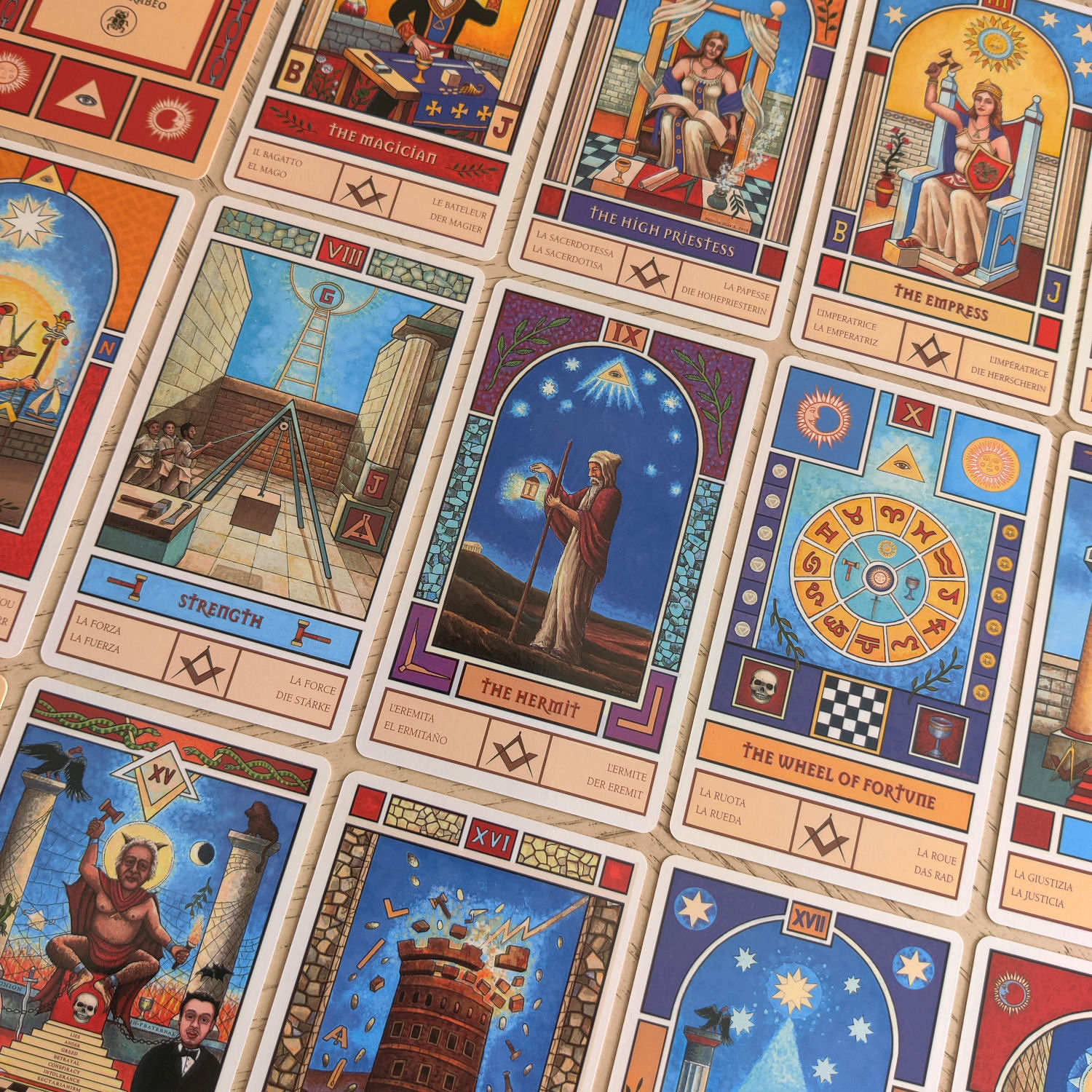
The deck is designed as a “gateway into the secret mysteries of the soul” integrating the sacred symbolism of Freemasonry. The premise melds together the arcana of the tarot with models from Masonic rites, with heavy emphasis on alchemy.

The Major Arcana in the Masonic Tarot are distinctly categorized as either female cards or male cards, day vs. night cards, positive vs. negative, active vs. passive, and so the core metaphysical premise here is that of a defined binary.

The Fool, for instance, despite being the card without a number “outside the system” who signifies the avant-garde that breaks the mold (notes the guidebook), is nonetheless defined as female, night, and of the element Water (rather than the more popularized Golden Dawn association with Air).

The Magician is male, day, associated with the element Fire, symbolized by gold. The High Priestess is female, night, associated with the element Water, symbolized by the chalice. And so on and so forth.

I loved going through each card one by one with the little white book, which packed in a lot of information into the tiny booklet. Take, for instance, The Hanged Man. “The Hanged Man is a prisoner of external circumstances and the will of others. He is subjugated, exposed to humiliation, and depreciated. . . . This card represents dependence, submission, and lack of freedom. It is inaction, castration, the temporary cancellation of all its capabilities. . . . The only positive aspect attributed to this arcana is the idea that the submission of the Hanged Man could be a voluntary act, an act of giving, sacrifice, sustained confidence in faith and love.”
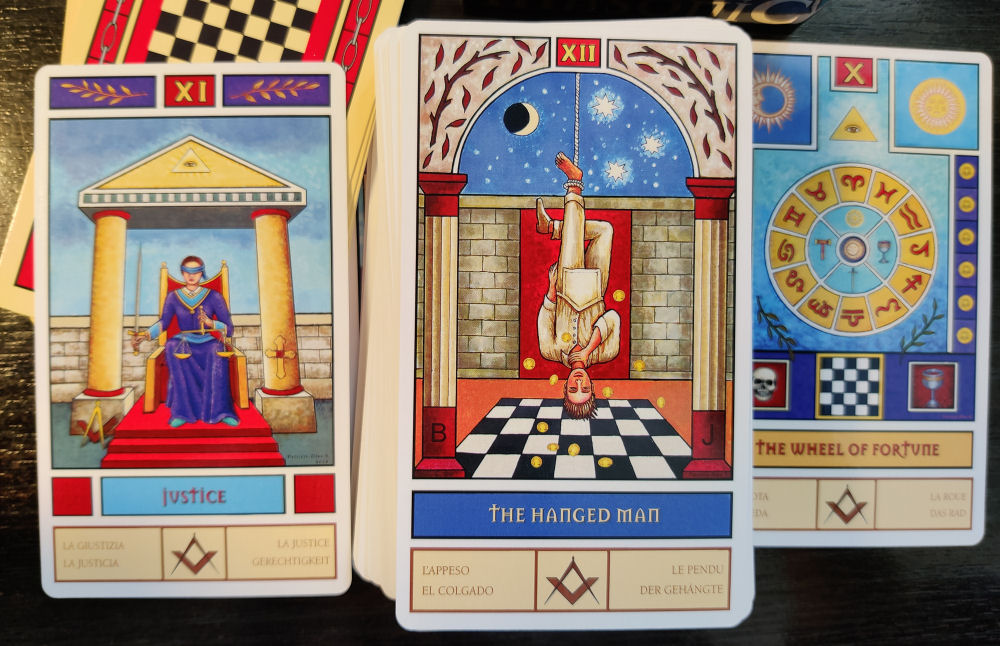
The setting of this illustrated Hanged Man card corresponds to a Masonic temple, where the figure is wearing the white dress and apron of an Apprentice, legs intertwined in a position taken by candidates during initiation before the altar of the Lodge. In terms of that core binary, The Hanged Man is female, night, and associated with the element Air, here symbolized by the Sword of Damocles.

Taking magnifying glass to illustrations, especially in the Majors, is such a delight. The stairs leading up to The Devil, the seat of the Worshipful Master, reads: Sectarianism, Intolerance, Conspiracy, Betrayal, Greed, Anger, and Lies– these are the Seven Deadly Sins of a Lodge. The two chained characters in the foreground represent the columns of Apprentices and Fellows. The figure to the left shows his venomous tongue; the figure to the right is the bureaucrat.
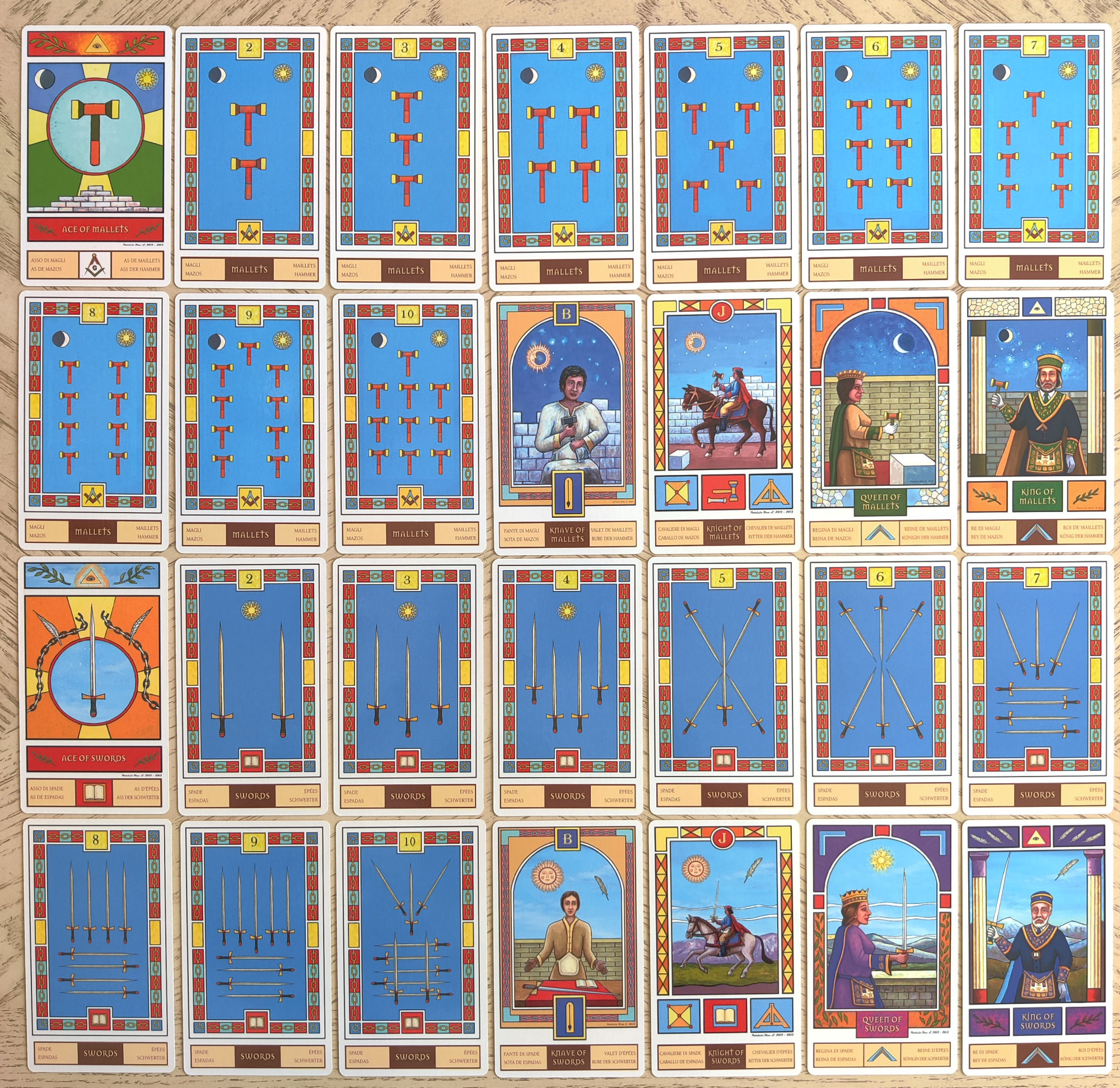
The Minor Arcana in this deck are subdivided into two bodies, one called the Hierarchies of Nobility and the other the Masonic Numbers, whereby each are grouped by the four alchemical elements.

The element of Earth is represented by the mallet, a tool used by Masons to represent work on stone, the hard layer of the earth.
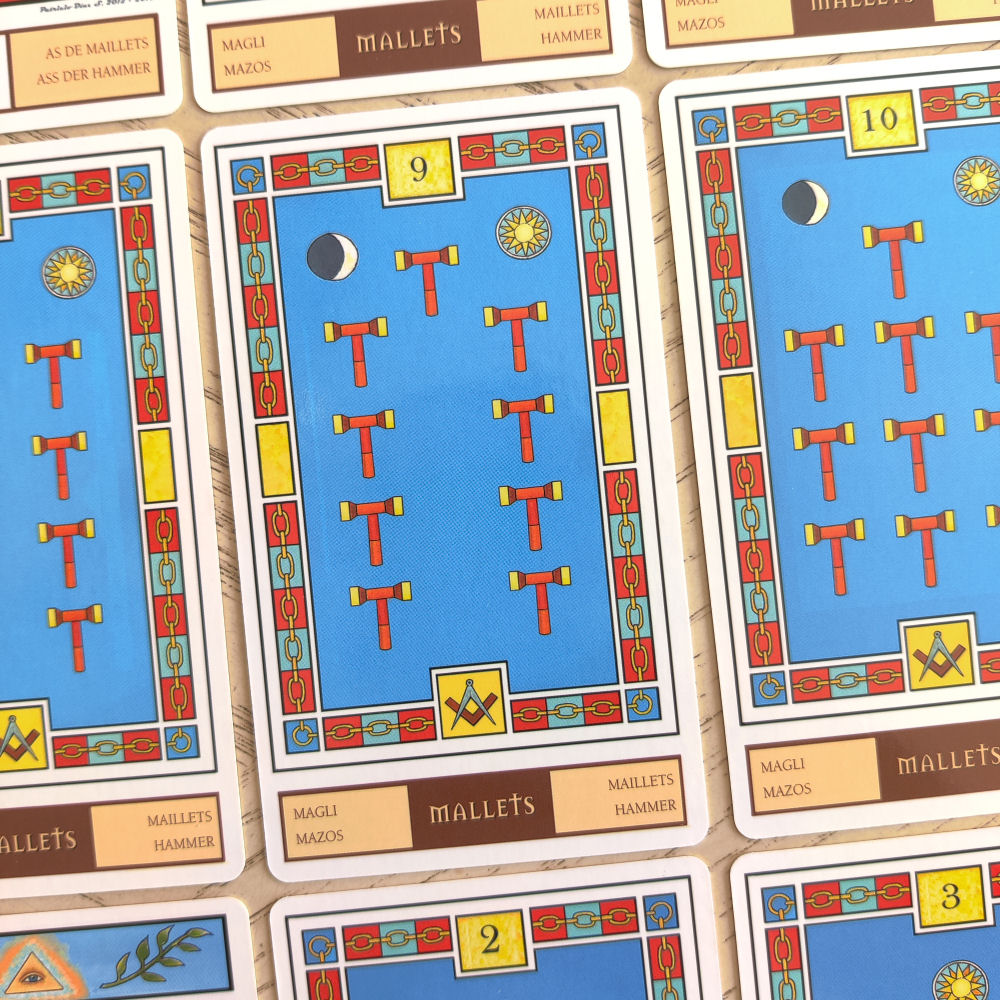
The suit of Mallets is the densest of the four elements, with its nature being concrete and material. It’s stability, introversion, and quiet, expressive of those who tend to be more methodical. The defining statement of the Mallets is, “I use.” The Nine of Mallets (corresponding with the Nine of Pentacles), for instance, represents the silence and perseverance that results in the Perfected Work.

The element of Water is represented by the chalice, which contains the transubstantiation of wine into blood, symbolic of the emotional realm.

Water is the second densest of the elements after Earth, with a sensitive, changing nature. It expands the body with any stimulus, and it is the mirror that reflects light and color. Water invades. Water brings instability. It’s sentimentality, and therefore brings with it moodiness and a temperamental nature. The journey this suit represents is that of, “I feel.”

The element of Fire is represented by gold, whereby metal reaches its beauty by purification through fire.
This is the stage of transformation and consumption– it’s fast, unforgiving, it’s about reaching one’s peak. This is fearlessness and independence, and the ambition for leadership. The defining statement of the suit is, “I am.”

Cards like Two of Gold announces an alliance between two people pursuing a common goal, and predicts economic success; Three of Gold is the inner fire that projects passion and courage, able to guide and inspire others.

Air is represented by the sword, symbolic of thoughts and ideas. Of the four elements, Air is the only one that is invisible and soundless. It moves and invades without being noticed. There is a coldness and emotional detachment here. The defining statement for the suit is, “I think.”
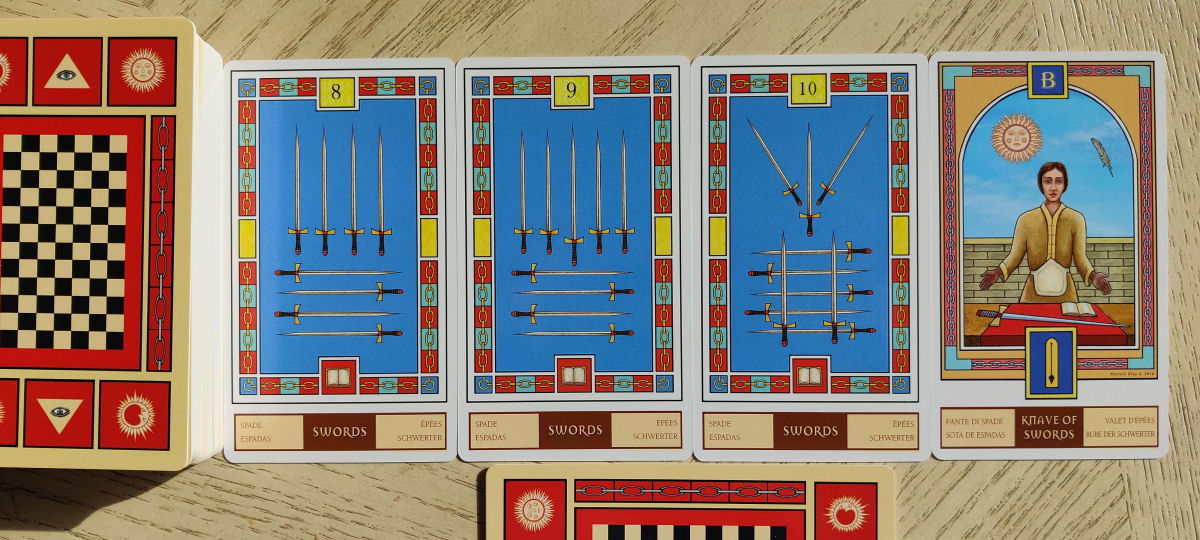
Cards like the Nine of Swords represents the top masters inspired by the knowledge of the occult, and faith in the transcendental. This is a card that conveys protection and defense. Whereas the Eight of Swords represents balance and order. The Ten of Swords in this deck doesn’t quite have the meaning typically associated with its RWS counterpart– here, it’s symbolic of law and justice, and represents the multiplication of forces to defend a common cause.

The court titles are the Knave (he), Knight (he), Queen (she), and King (he), and in this deck are definitively ascribed personality traits.
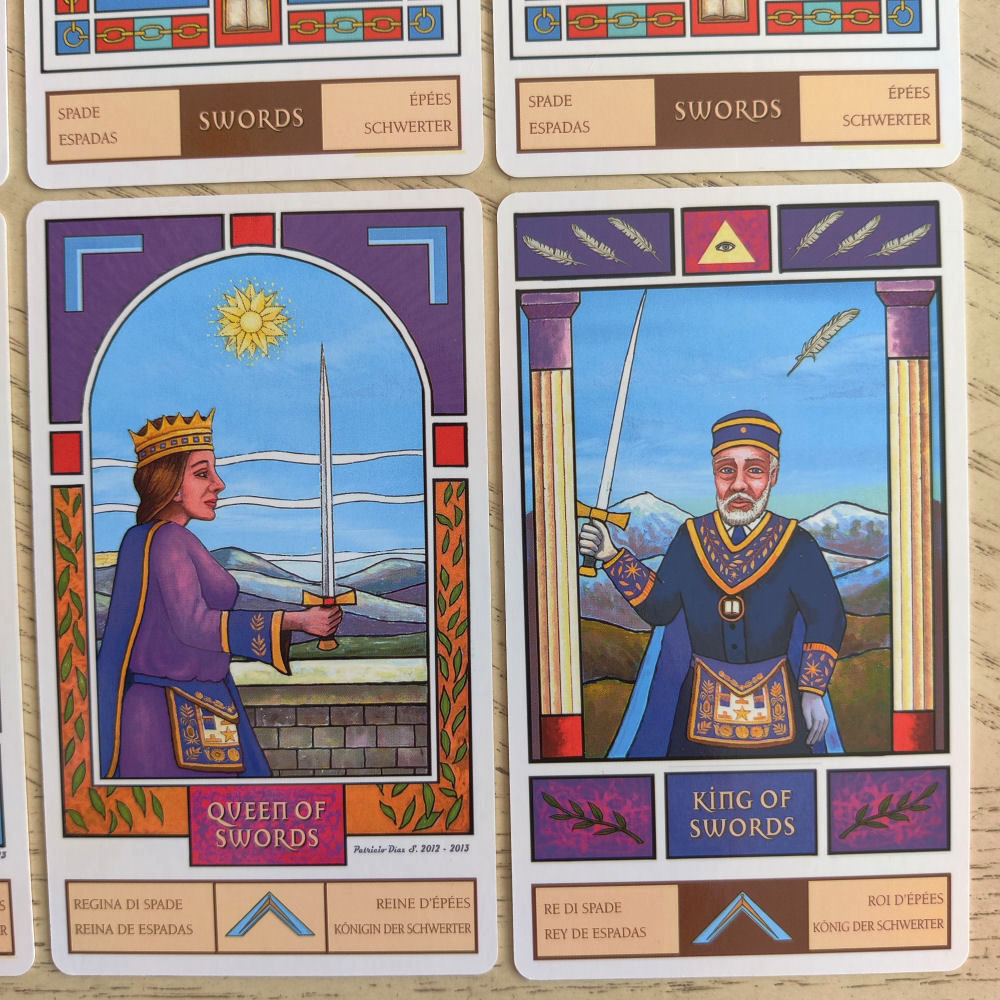
So, for instance, the Queen of Swords inspires moral conduct and fair balance between rights and duties, promoting conservation of manners, discipline, and order. The King of Swords is intelligence and eloquence, a gatekeeper of law and tradition, whose sword represents clarity of thought, and separation of good and evil.

In the Masonic initiation ceremony, the initiate is blindfolded and led into the temple, guided through various trials of symbolic purification associated with these four alchemical elements.
As the initiate presents their oath, they are given a symbolic representation of the light of consciousness, thereinafter leaving behind the ignorance of the secular world and accepting the initiate’s new role as an apprentice.
The first stage of that ceremony begins with earth, where the blindfolded candidate is placed in a dark room, dimly lit by a candle. Through confinement in this dark chamber, the candidate attunes to the nature of Earth — the attributes of isolation and silence leading to self-realization.

After that is the Three Journeys of Mystery, journeying through Water, Air, and Fire. The first of the Three is in effect a baptism, ritual purification by water. The second of the Mysteries is purification by Air through the ceremonial clash of swords. The third is purification by Fire, where the initiate runs their hand over the tongues of the flame. Then finally, the candidate drinks from the “cup of bitterness,” a ritual of purging.
As the rite comes to its close, the initiate holds the Holy Book in one hand and a compass in another, pronouncing the oath. “What do you most want right now?” the Masons ask the initiate. The initiate then responds, “To see the light.” That is when the blindfold is removed and the candidate is illuminated by the glow of the ceremonial fire.

The mallet, the chisel, the level, and the apron become the Apprentice’s tools for learning the art of building the Great Work.
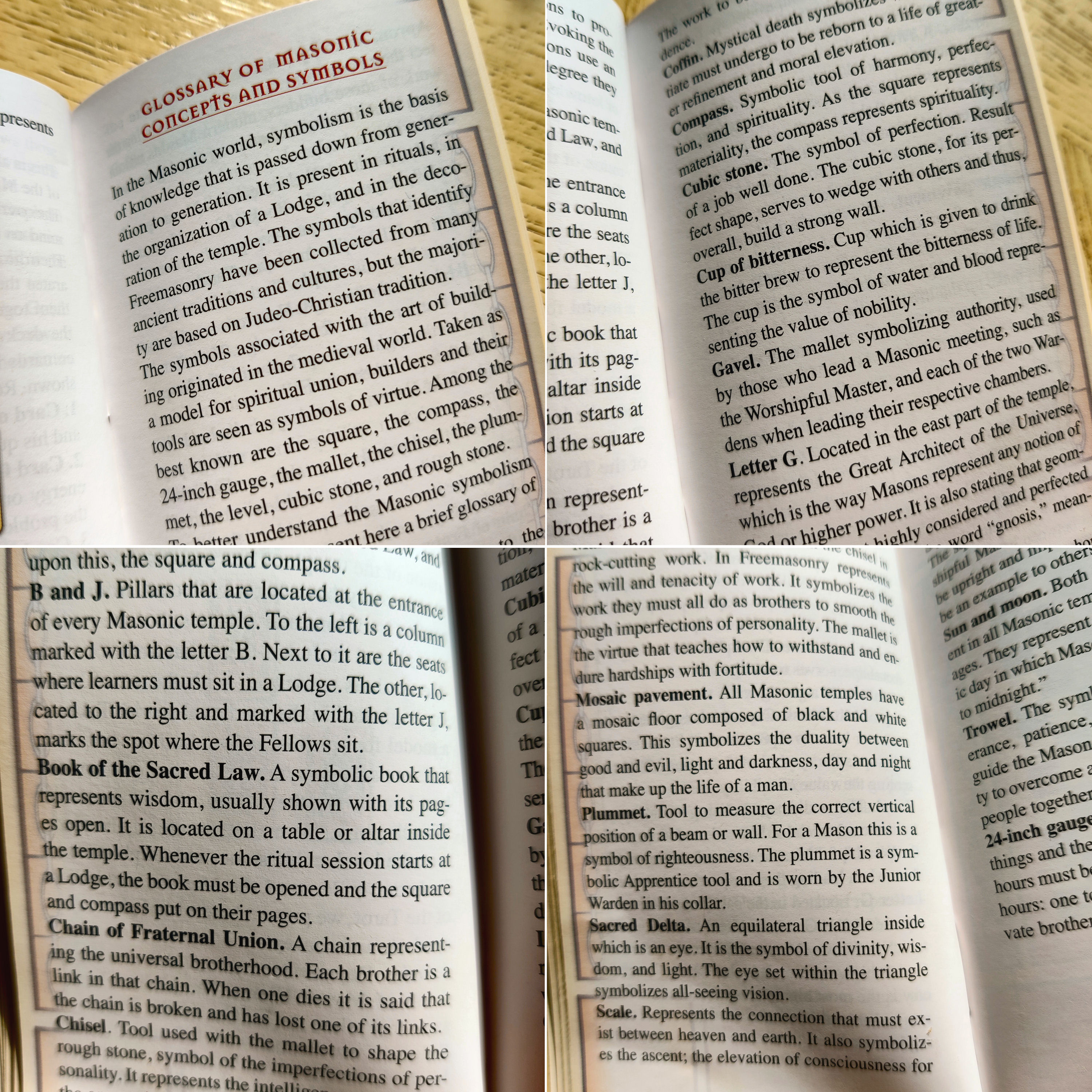
In Freemasonry, symbolism is the basis of knowledge. It is how that knowledge is passed from generation to generation of Masons. The symbolism in tarot follows a similar principle. To help integrate the two systems into one when you work with this deck, the guidebook includes a very helpful Glossary , which I absolutely love and think we should try and normalize as an essential part of every tarot guidebook. =)
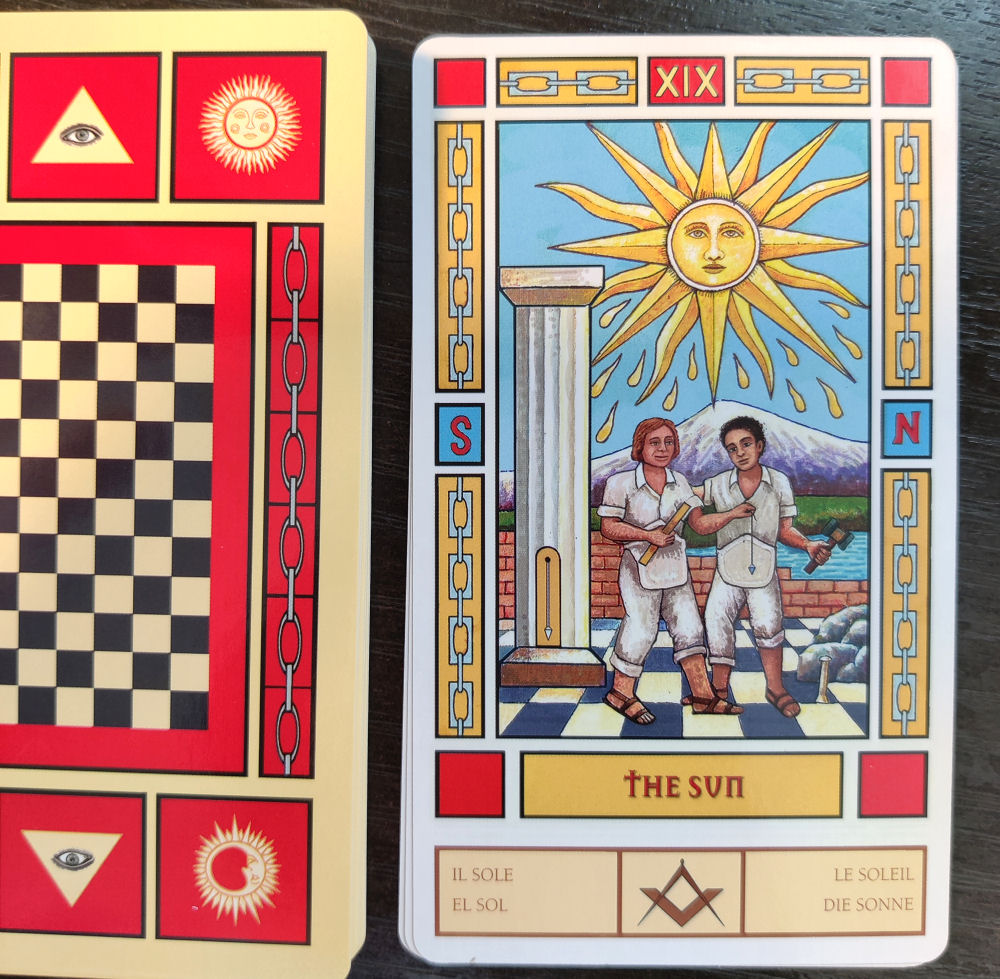
The layout design reminds me of Lon Milo DuQuette’s Tarot of Ceremonial Magick. If you like the genre of esoteric tarot decks, such as the AlcheMystic Woodcut Tarot, Dame Fortune’s Wheel Tarot, Earth Magick Tarot: Hermetic Prophecies, Kabbalistic Tarot, Tarot of Magical Correspondences, or Secrets of the Rose Tarot, then you’re really going to take to Patricio Diaz Silva’s Masonic Tarot.
The production quality is top notch, printed in Torino, Italy, with really luxe, heavy-duty cardstock, though there is a high-gloss finish I’m not fully a fan of. Overall, beautifully done with an impressive attention to detail. I’m definitely now a big fan of Patricio Diaz Silva’s artwork.


FTC Disclosure: In accordance with Title 16 of the U.S. Code of Federal Regulations Part 255, “Guides Concerning Use of Endorsements and Testimonials in Advertising,” I received this deck from the publisher for prospective review. Everything I’ve said here is sincere and accurately reflects my opinion.
 benebell wen
I’ve come across Mr de Silva on Facebook some time ago-I’m impressed by this deck and am updating my site with an emphasis on tarot symbolism & Shakespeare of course.
You might like my recent paper:
https://www.academia.edu/109719991/Tarot_of_the_Skull_The_Megalithic_Secrets_and_Origins_of_the_22_Tarot_Keys
LikeLike
Oops this isn’t very intellectual you. Trying to silence beliefs that don’t align with yours.
LikeLike