Should We Read the Works of Questionable Authors? On Julius Evola.

By “questionable” I mean authors whose morality, political beliefs, sociopolitical affiliations, or credibility have been put under compelling scrutiny.

Perhaps more so than any other subject area of interest, when you navigate religious, spiritual, and occult spaces, you have to conscientiously assess and process where you stand on this point. While the issue of where you stand on condoning the reading or the publishing of works by questionable authors is ever present, it floated to the top of my thoughts recently with this announcement by the publishing house Inner Traditions:
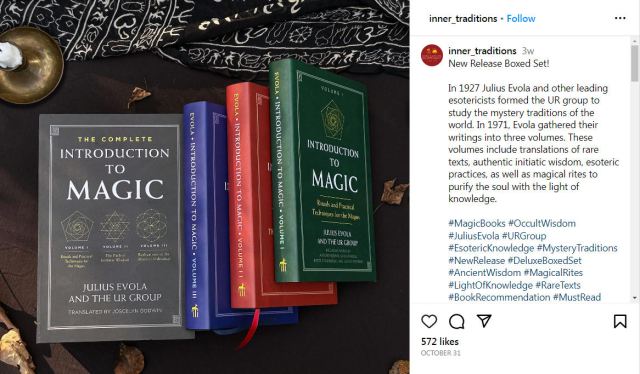
Instagram: @inner_traditions

To explore this case study, I recommend clicking on the above IG posting and reading the comments, because I’m not going to re-post the nutty alt-right supporters who resorted to name-calling, homophobia, misogyny, and mocking people’s pronouns. There are also a few very long and thorough comments, too long to fit in a single screenshot, so I won’t be re-posting those either, though they’re worth a read.

Challenge of the announcement with all of the above aforementioned was predictable. What kind of took me by surprise was the strength and volume of voices who were saying, “This is totally fine. Hey liberals, stop being such babies.”

I have so many meandering and tangent thoughts.

Continue reading “Should We Read the Works of Questionable Authors? On Julius Evola.”

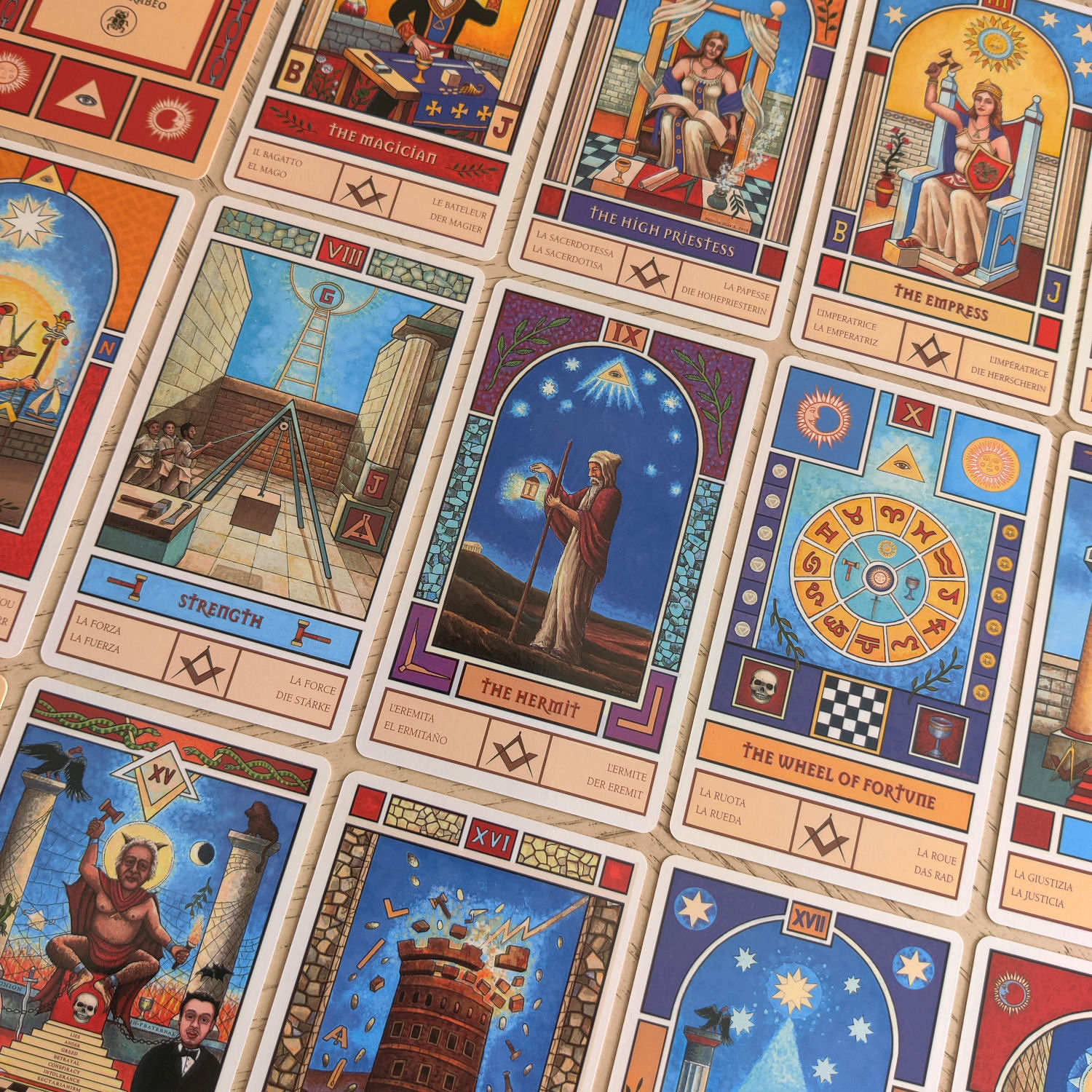
Masonic Tarot by Patricio Diaz Silva

The Masonic Tarot came out in October 2022, created and illustrated by Chilean artist and academic Patricio Diaz Silva, and it is in the top 10% of the most well-done tarot decks in recent years. The illustrations for the Major Arcana are exquisite, as are the court cards.

Do note, however, that this deck has elected to go with non-narrative illustrations for the pips, which works for the Masonic Tarot given its ceremonial leaning purposes.

The deck is designed as a “gateway into the secret mysteries of the soul” integrating the sacred symbolism of Freemasonry. The premise melds together the arcana of the tarot with models from Masonic rites, with heavy emphasis on alchemy.

Continue reading “Masonic Tarot by Patricio Diaz Silva”

Why is the word “feminist” triggering? Disappointing realizations.

So I posted this video yesterday:

When I made this video, I genuinely did not think there’d be anything controversial about it. I will even continue the assumption now and say that if you actually watch it in the entirety, you, too, would not reach the conclusion that it’s trying to be anti-male. Nor will you find it laced with any ulterior motive of gender politics.

Heck, now in retrospect, I probably could have titled the video “Tao Te Ching & the Divine Feminine.” Right? It’s just that I have a complicated relationship with the concept of “divine feminine” hence I went with “feminist metaphysics.”

Within hours of its posting, I received the following comments:

This blog post starts with my reaction to the above responses, but then I’ll go off on a tangent to share some unfiltered ramblings with respect to Eurocentric Taoism and cultural appropriation.

Continue reading “Why is the word “feminist” triggering? Disappointing realizations.”

Dragon Gods, Land Spirits; the Hakka

I’m compounding several different topics into one video and probably should have done separate videos for each topic, but for me, they’re all related to each other, and so I guess from that personal perspective, it makes sense for me to be presenting them in one bundle.

Upfront, let’s clarify: I’m not teaching, I’m sharing. I wanted to learn more, went out and attempted to learn more, and this video and companion blog post is just me passing on to you what I’ve learned.

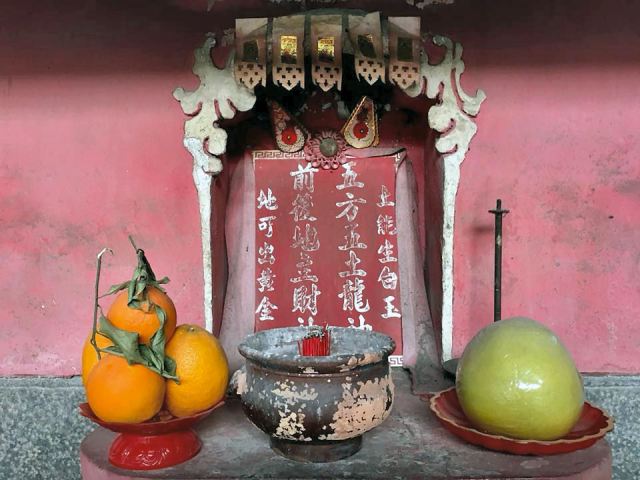
Dragon Gods of the Earth 土地龍神

Image Source: 香港古蹟行腳

Dragon god(s) (土地龍神, tǔ dì lóong shén ) are personifications of the land, where mountains and rivers meet, and thus from a feng shui perspective, reveal dragon veins (龍脈, lóong mài).

Rituals (such as 化胎, Huàtāi; in Hakka, it’s pronounced Fā Tói) can be performed to harness the qi or powerful essence from these dragon veins to bless a home and bless lands that the Hakka now occupy to ensure good harvests, prosperity, safety, protection, and good health.

What’s distinct about Hakka dragon spirits veneration is its association with the earth rather than water. Traditionally in Chinese lore, dragon spirits/gods 龍神 and the Dragon King 龍王 are associated with the temperaments of the seas.

Continue reading “Dragon Gods, Land Spirits; the Hakka”

Your Inner Palace 元辰宮 and the Akashic Records

This blog post is an addendum and continuation after what I discuss in the video linked above.

The Akashic Records is very much a Western conception, right? The Theosophists of the 19th century formulated a mash-up of Eastern and Western esoteric traditions and from that mash-up came its most popular legacy– the Akashic Records.

Most of us get that the “Akashic” part was inspired by the akasha, a fifth element or essence found in various Asian traditions, associated with the sky, space, aether, and in Buddhism, even a state of mind. But what about the “Records” part?

But first, I’d like to start with the discussion on akasha and godhead.

Continue reading “Your Inner Palace 元辰宮 and the Akashic Records”

The Esoteric Buddhism of Japan Oracle Cards (Yuzui Kotaki and Miki Okuda)

The Esoteric Buddhism of Japan Oracle Cards is so beautiful, so awe-inspiring that I treat it as I would a sutra — all the Buddhist etiquette applied to sacred texts I apply to how I handle this deck.

Acharya Yuzui Kotaki is a Shingon Buddhist teacher and a vice-chief priest of the Maginosan Ren-join Temple in Kanagawa, Japan. Miki Okuda is a painter, both in traditional and digital media who specializes in Buddhist religious art. The deck was first released in 2021, and I don’t know how it flew so under the radar in the tarot community.

Continue reading “The Esoteric Buddhism of Japan Oracle Cards (Yuzui Kotaki and Miki Okuda)”

Home is Here: Practicing Antiracism with the Engaged Eightfold Path by Rev. Liên Shutt

Rev. Liên Shutt is a Sōtō Zen Buddhist priest, educator, and licensed social worker who was born into the Pure Land traditions in Vietnam, then did their meditation training in North American Zen and Insight (Vipassana) Buddhism.

A co-founder of Buddhists of Color and Access to Zen, Rev. Shutt facilitates the Engaged Four Noble Truths program, a restorative framework for meeting any given critical need, especially when applied to oppressive forces and systems. In 2020, that program was called upon to help meet critical needs emerging as a result of the pandemic, and after the murder of George Floyd, to help facilitate ways Buddhist practice can address racial justice.

“This book is for all who have been hurt and harmed by the system of white supremacy and other systemic wrongs,” writes Shutt, “and for those seeking restoration and healing.”

Continue reading “Home is Here: Practicing Antiracism with the Engaged Eightfold Path by Rev. Liên Shutt”