

I don’t have a dog in this fight, no skin in the game as they say. There is more benefit to me opting out of this conversation and staying quiet. In fact, speaking up would be ill-advised; I only stand to lose.
First, a quick statement about my personal background, as that will be context for my perspective. I am a self-taught illustrator and in the late 90s was highly skeptical of using digital art in tarot. Everything people who are against AI are saying right now about AI in tarot art was exactly my perspective of digital illustrator tools in tarot 30 years ago (because I did not understand digital art).
At the time I was alarmed to see how many digital artists could create something with the computer that looked almost too perfect, and do it so quickly, but then if you take away their tech and put a pencil in their hand, they could barely do freehand sketches.
However, my judgmental opinion was on the basis of a very superficial understanding of digital art. As I learned more about the process and was exposed to more digital artists as individuals, getting to know the intricacies of their creative process, the more my opinion evolved. I met more and more digital artists who could do phenomenal freehand sketching, and who had simply chosen digital software as their medium, not unlike deciding on acrylics, or pastels, or watercolor, or clay.
Now for the commentary on current affairs…
Indie Deck Review (IDR) is an online platform that has been posting reviews of indie tarot and oracle decks since 2018. They’re not a large platform, and very boutique– their operation is without a doubt a labor of love.
A few days ago IDR announced that, after its team of editors and reviewers (and to my recollection, is one comprised of a diverse team of experienced tarot readers that don’t even always agree with one another when it comes to opinions on decks or deck creators) met and conferred on what their approach, as a deck review platform, would be when it comes to AI Decks*.
* A note on the term “AI Decks”: This is a lot like saying “digital art decks” in the sense that it’s over-broad. “Digital art” can mean minimal investment of originality and creativity from the human artist and it can also mean the highest echelon of originality and creativity from the human artist that takes a laborious amount of time and labor to complete. Likewise with “AI Deck” as a term– the scope is just too broad. In the case of both digital art and AI, the extent of original, creative input matters. You can’t over-simplify with “all digital art…” or “all AI generated imagery…”
As a group of editors and deck reviewers, IDR collectively decided:
- They won’t discriminate when it comes to which decks to review; they want to stick to a firm non-discriminatory policy.
- When a deck is made from AI generated images, there will and must be full disclosure of that fact.
- Any time they post images of AI Decks on social media, that image will be watermarked to clearly identify that work as being made with AI.
- All that being said, again, they won’t discriminate when it comes to deciding which deck to review, which extends to not discriminating on the basis of AI or not AI.
You would have thought such a stance was about as neutral vanilla as it could get. Instead, the uproar and backlash against IDR was intense.
People demanded, what’s next, are you going to review and support counterfeit decks? Instead of recognizing that opinions differ and debating controversial points on their merits, people simply accused IDR of being wrong. There were accusations that IDR had no respect for artists when the very mission behind starting IDR was to support artists.
To that last point, I don’t resonate with extremist views. If you deviate from my perspective even a percentage point, then it is clear you [insert moral judgment]. Not being absolutely against AI and supporting the livelihood of artists are not mutually exclusive. Not agreeing with you 100% to the letter doesn’t make someone ignorant.
There were comments such as “Educate yourself”* directed at IDR. “If you think coming up with a prompt is art, you aren’t as enlightened as you think you are.”*
* Correction: The person I quoted above noted that I took the words out of context. It was not “directed at IDR” but rather, was directed at a supporter of IDR under the comments section of an IDR post. In the comments section of IDR’s announcement, an IDR supporter noted, “This is unfortunate. The bullies will win again. So many people don’t see AI as a tool that can be used in many different ways. . . . Why a spiritual community has so much gatekeeping is beyond me.” The person I quoted then replied to that supporter, “Educate yourself. AI is a ‘tool’ built on the backs of artists who aren’t paid for their stolen art.” Then later in that same paragraph, notes, “If you think coming up with a prompt is art, you aren’t as enlightened as you think you are.” So that’s the context that I’d like to clarify.
See. I would agree that merely coming up with a prompt is not art. The idealist in me would hope that no one actually thinks that. And so two points here.
Is “coming up with a prompt to feed into an AI image generator is art” actually IDR’s position? I don’t think so? Nothing I’ve seen would lead to that conclusion. So to start, is that even a fair characterization of IDR’s opinion prior to attacking IDR for allegedly holding that position?
Second point, even if someone were to hold the position “coming up with a prompt is bona fide art,” my response would be discussion and debate, not an ad hominem attack.
Within 24 hours, IDR announced that they were going on an indefinite break. Not too long after, the current editor-in-chief at IDR’s personal account went private, as the backlash had spilled over into her personal social media account as well.

Then, instead of showing any compassion for what the humans behind IDR might be going through emotionally and in terms of mental health as a result of that backlash, the comments in response were all but “serves them right!” and “guess they couldn’t take the heat for being on the wrong side of this issue.” [See addendum on “Snarkiness”]
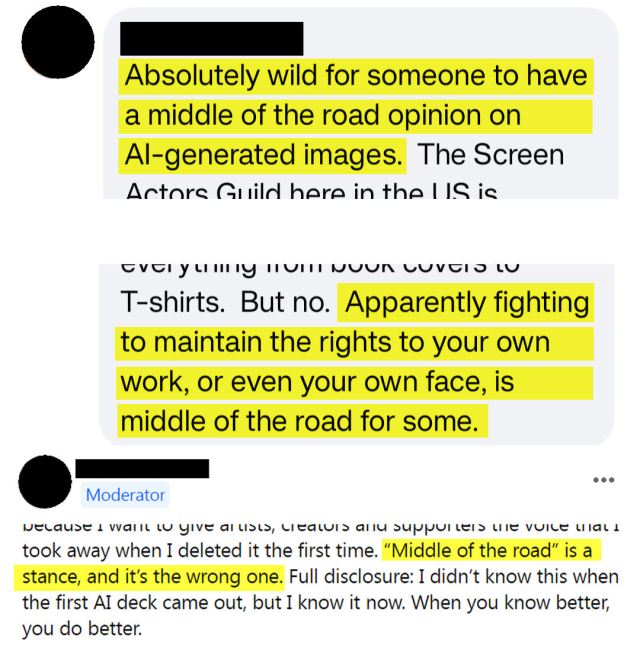
In reaction to IDR’s decision to adopt a “middle path philosophy” per their announcement, a recurring remark I saw was “you cannot be middle path with this issue!”
The thing is, the other side’s perspective is mischaracterized when it is juxtaposed with their own side. “Either you agree we should ban AI or you hate artists.” But that’s not the crux of the debate. That’s a mischaracterization of one side.
And just a thought on comparing AI Decks to counterfeit decks. Using AI generated images in a tarot deck is legal, but it has serious ethical questions that need to be answered. Counterfeiting a copyrighted tarot deck is illegal, full stop, and it’s not a matter of which side of the aisle; it is an assessment of legality and violating someone’s property rights. To compare the two is a false equivalency.
Some AI generated images can bleed into the scope of violating someone’s rights and therefore be illegal, but not all.
The collective energy I felt from the social media enclaves discussing this issue was that of “IDR’s position is very, very wrong and we need to make an example out of them so that anyone else watching knows how very wrong it is to take such a position contrary to our own.” That collective behavior is declaring to all watching, There is a correct way to think, and that’s our way. If you do not agree with us, then we will shun you for it.
IDR, unfortunately, started deleting comments and in effect censoring who could say what under their posts. And while that is their right, especially in the interest of preserving mental health, it’s just unfortunate because of perception — no denying it’s a bad look.
So why did I title this blog post “In Defense of Indie Deck Review”? Because I am defending the stance they took. Do not mischaracterize what they said, and do not interpret their words in bad faith.
It’s clear that they agree there are serious concerns when it comes to using AI generated images in tarot. That’s why they put those guardrails and disclosure policies in place.
But if and when any of their individual reviewers decide, in their own personal capacity, that they want to review a deck made from AI, as a platform, IDR wasn’t going to ban that individual from doing so. That individual reviewer would just have to follow the strict policies re: AI disclosure.
Those guardrails and policies were strict: Unambiguous disclosure that the images are AI generated. Easily recognizable watermarks when showcasing AI decks. All decks made from AI would have their own segregated, separate review section and would not be mixed in with the rest of IDR’s reviews.
So how their stance was construed as controversial is still beyond me.
I, even as someone who is unlikely to use or enjoy an AI Deck, do not understand the narrow-minded animosity toward AI Decks. You don’t have to like it. (I don’t.) You also don’t have to hate it with such vitriol that it corrupts your speech and behavior. Inciting frenetic paranoia, stoking fear, sending Internet mobs after specific individuals just because they used AI and you don’t like AI? — the “you are with us or you are against us” mentality, being so confidently sure that you are right, and the other is wrong.
All AI Decks are bad and should be shunned? You can’t think of any scenarios for which using AI to generate a tarot deck might be welcomed?
The value of a tarot deck and what makes it operable as a divinatory tool is only in part its illustration work; it’s also equal parts concept interpretation and tarot knowledge. What if someone with an incredible wealth of tarot and metaphysical expertise who does not have the financial means to collaborate with a human artist uses an AI tool to generate images to their exact specifications to communicate their expertise? If you are one who values that expert’s perspective, you wouldn’t be intrigued by what they’ve created?
Here’s another very real scenario. Let’s say a quadriplegic can use technology and facial movements to input text into an AI image generator to create illustrations that bring the visions in their minds to life, and they want to create a tarot deck with those visions. You wouldn’t be the least bit interested in learning more about that tarot deck? We’re just going to say all AI Decks are evil and any positive consideration for an AI Deck is bad? You’re going to get so hung up on the AI part that you would deprive those with disabilities such an opportunity, and deprive us, the public, of the privilege of getting to see such an incredible creation?
As an artist, I can’t say I have positive opinions on using AI generated images as the basis for an original work of art, let alone the entire image itself being AI generated. And if you do, my opinion is that it needs to be clearly disclosed. For ages I’ve been of the opinion that if you use digital tools in any way whatsoever (photo-bashing, digital collage, digital manipulation…) in how your art or your tarot deck is created, then that needs to be disclosed, the way traditional artists will talk about their process and which medium the composition is rendered in. This is done in watercolors, pen and ink, oil pastels, they’ll say. Encourage digital artists to do the same.
But that doesn’t happen. It hasn’t been a common practice since digital art came on the scene in the tarot world, and no one really seemed to think anything of it. Why is photo-bashing and undisclosed photo manipulation okay but AI machine learned generated imagery from aggregated data is not okay? Because the former takes human effort and the latter does not? But what about the human effort it takes to do the same with paintbrush in hand, via traditional media, head to head in competition with the person using photo-bashing and image manipulation? Even digital collage with public domain images – sure, it’s legal, but is it ethical – is it spiritual – to do so without crediting the original works? Good question, huh?
When you are a lawyer and also a spirit medium, sometimes your stance on things can get dicey. I’ve looked at collage decks incorporating portrait photos of real life people long dead, where the photo is definitely now in the public domain. So when I see it used in a tarot or oracle deck uncredited, the lawyer in me is like, yeah this is fine. But sometimes the spirit medium in me wonders, even though this is legal, is it spiritually ethical? What if the spirit of this person doesn’t want their portrait used in this way?
Right now, if you aggregate and de-identify copyrighted Public Data (your artwork that was publicly posted on platforms like Instagram, DeviantArt, or your portfolio on a web hosting service that have end user license agreements you the artist signed off on allowing your artwork to be aggregated and deidentified), it’s legal to feed that into AI machine learning. The open question is is it ethical, is it spiritual.
By the way, in general, to make the argument “AI uses stolen copyrighted works” is a mischaracterization of what is actually happening.
For the last two years, I’ve been researching and taking all the legal education workshops I can on FTC regulations, data privacy laws, the DMCA, CFAA, automated bot web scraping, what the popular platforms’ terms of use or end user license agreements say, Public Data vs. Private Data, and synthesizing my experiences and personal interests as an IP attorney, as an artist, and as a tarot deck creator to evaluate this issue.
My conclusion? A very sneaky loophole was used to make all this legal and it doesn’t pass the smell test but it’s also not “stolen copyrighted art.” It’s aggregated and de-identified Public Data. We, the artists, didn’t read the fine print when we consented to making our works of art Public Data. It also dismays me that there is no oversight and little in the way artists can do to protect their own copyrighted works from getting manually uploaded and fed into behind-a-paywall AI image generators (thereby evading anti-scraping laws).
You know how a human artist can study ten different illustrations of a ballerina and then in their mind “Frankenstein” (verb) the ten different illustrations together to create their own original illustration of a ballerina? And the ten different illustrations are no longer unequivocally identifiable in the new original illustration, even if the general style and vibe is still there?
The AI/techie lingo for that is generative AI sourcing aggregated and de-identified data to then create original content. (“Original” used in a legal/technical way, not an artistry/creative way.)
Machine learning is what most people in the tarot community think AI like Midjourney is. But machine learning is only pattern spotting utilizing statistical techniques to identify patterns that predict outcomes.
Programs like Midjourney at this point are Generative AI. It’s actually innovating. It’s learning on its own, and no longer just pattern spotting.
Again, no absolutes. If the AI’s algorithm isn’t narrowly tailored to exclude aggregation of Private Data, then its creators have a big problem on their hands. If an artist’s copyrighted work of art was erroneously posted as Public Data by a third party without that artist’s consent and authorization, then that’s also going to present a legal issue. Not to mention Generative AI comes with it serious security breach issues that the techies still don’t have solutions for. So in the instance of an AI image generator using Private Data or an unauthorized copyrighted work, now you can better make the case for “AI using stolen copyrighted works.”
But now you see why an understanding of that means it’s imprecise to say “all“?
When we talk about AI such as ChatGPT generating inaccurate information, which it does, we shouldn’t downplay the extent that humans generate dangerous amounts of misinformation. And maybe that’s where ChatGPT is getting its inaccuracies. The Creation is made in the image of its Creator.
IDR was doing a community service for tarot deck enthusiasts and indie deck creators. I’m saddened by the way I saw our community treat them.
The public discourse on AI Decks is an important and current one right now, but that discourse needs to be carried forth with accurate information and fair characterization. We need to be logical. We need to debate fairly and with integrity. Listen to opposing perspectives with an open heart. Converse in forums where people present do not agree with you so you can test out and strengthen your own arguments. Don’t just speak in the comfort of echo chambers.
The sense of injustice artists are feeling from both the issue of counterfeiting and the issue of AI generated images is the same, yes, but the two issues themselves as they stand are totally different and conceptually, we want to keep that clear. If “AI art is stolen art” is your only argument, then that’s not a valid leg to stand on, I’m sorry. (AI art could maybe possibly be stolen art in certain instances, whereas a counterfeit deck by its very definition is always stolen art.)
I hope my commentary doesn’t get mischaracterized. I am not defending use of AI to create tarot decks. I am supporting the position IDR took on policies around reviewing AI Decks — they will uphold an anti-discrimination policy, but if and when one of their reviewers writes a review on an AI Deck, it would need to comport to strict guidelines of disclosure. How that was a controversial position to take is still beyond my comprehension.
Oh, and just to be clear, this post is not about defending friends. I am not friends with the people at IDR. Their people have said uncharitable, scathing things about me as a person, but also their people have said very charitable and kind things about my work. So there is no issue of loyalty here. I observed something that did not sit right with me and decided to write up this commentary.
Addendum: Digital Art vs. AI?
I did want to revisit what some people perceived as me saying digital art and AI generated images are the same. I didn’t say that. But there are observable similarities in terms of impact; not equal, but comparable. I’ll give you seven ways they’re comparable:
- Both the advent of digital art and AI “leveled the playing field” when it came to issues of raw talent and drawing skills among illustrators.
- Both expedited the amount of time it takes to complete a composition. Both increased efficiency.
- To complete a given digital illustration with traditional media would triple if not quadruple the number of hours it’d take.
- Likewise, to complete a given AI generated illustration with manual digital art would triple if not quadruple the number of hours it’d take.
- Digital artists did take jobs away from traditional media artists when it came to commercial opportunities (cf. fine arts opportunities), just like how digital artists are now saying, rightfully so, that AI is going to take commercial opportunities away from them.
- Before digital art, commercial illustrations such as book covers and tarot decks were done in traditional media. Digital art illustrators displaced traditional media illustrators because they could finish the work faster and cheaper. Now almost all book cover art and the majority of tarot decks you see are done via digital art.
- Presently the same thing is happening to digital art illustrations. AI illustrations are threatening to displace digital art illustrators. The forecast is that soon almost all book cover art will be done via AI generated imagery.
- Both digital art and AI introduce an element of automation (just to vastly different degrees) to what had previously required the artist’s manual labor.
- Both digital art and AI increase accessibility to popular art.
- The older approach can’t compete head to head with the newer approach.
- Digital art augments the traditional artist’s technical skill level compared to what that traditional artist would be able to do by hand.
- AI image generators augment the digital artist’s technical skill level compared to what the digital artist would be able to do by hand.
- With the caveat that you first master how to use the tech.
- When digital illustration first came on the scene and rose quickly in commercial popularity, there was backlash from the majority of traditional artists. Now that AI illustration has come on to the scene and is rising way too quickly in commercial popularity, there is backlash from the majority of digital artists.
But yes, the key and most crucial difference between AI generated images and digital illustration is originality and creativity. Whereas traditional and digital art both still require originality and creativity, AI image generators do not, at least not from the human operating the tech.
Does acknowledging this bullet point listing imply I am for AI or against AI? No. It’s about being intellectually honest. You can disagree with someone’s conclusion, but what I’ve been seeing on social media from our community is name-calling people whose conclusion you disagree with.
In spite of my personal stance that’s wary of AI bleeding into the art world, I feel put in the position of having to come to the defense of generative AI. Because the greater offense here is fear-mongering and spreading misinformation to fear monger.
When we resort to fear-mongering, we’ve lost the higher ground. Seeing the merits of the opposing side does not mean you agree with their view. But the inability to see the merits of the opposing side or even hold space for it to be expressed means that deep down, we’re not actually certain that we’re in the right.
As I read the publicly made comments about AI from people who are generally good people, I cannot help but notice the striking resemblance to the historical rhetoric spread before anti-immigration laws get passed, before institutionalized racism, rhetoric that intensifies cold wars, rhetoric that runs rampant just before world wars.
It’s funny, recently the tarot community has been discussing deck personification and whether you personify inanimate objects such as a deck of tarot cards. I wonder if the greater vice is to dehumanize.
It Was IDR’s “Snarkiness”…
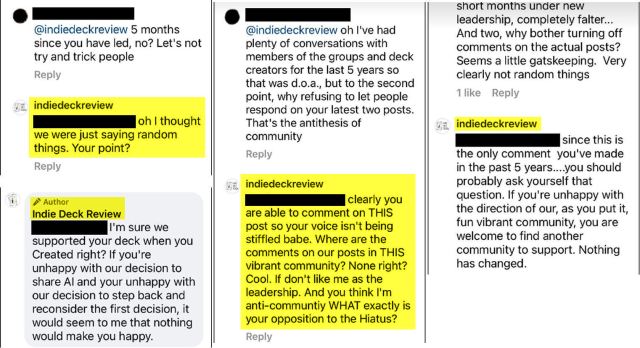
Let’s also talk about the community perspective. What I have heard from a number of different parties who had interacted with IDR, questioning their decision to showcase AI decks, was that they weren’t “bullying” IDR, but just asking questions and requesting that IDR reconsiders.
Immediately after IDR’s first announcement about their AI Deck policies going forward, comments expressed disappointment in IDR’s stance, but were more inquiring than outright negativity. Any backlash or stronger word choice only came after.
The inquiring and civil dissent converted to amplified backlash only after the community perceived alleged snarkiness from IDR, where instead of addressing community concerns around the AI Deck issue, the community felt like IDR wasn’t listening, and instead was responding back with stubborn attitude.
Continually those who had first engaged with IDR are adamant that there was no bullying going on.
Here’s the thing. The human representing IDR in these announcements and comments is one person, the current editor-in-chief. And she is holding the minority view on a controversial issue. Whereas all the questions and expressions of disappointment were coming in from multiple persons, all at once, bombarding a single person, and amplified because they collectively were the overwhelmingly dominant majority view.
And so while perception-wise, fighting back against what must have felt like an attack from all sides doesn’t look good, you get it, right? Many people are coming at you with the same interrogation, from many directions simultaneously, and you are just one person at the keyboard responding to them all. At some point, you’re going to snap and lash back with snark. It’s not the smart move, but it’s an understandable reaction.
I put the word “snarky” in quotes because I was struck by how often, repeated, and how many different people used that specific word. “Snarky.” I was seeing that descriptive used all over discussion threads, in private conversations with people sharing their perspectives with me, and independently, each on their own, the one specific adjective used was “snarky.” “It was her snarkiness,” multiple different people kept saying.
Objectively, does a textual reading of IDR’s responses to community concerns come across as snarky?
“Oh I thought we were just saying random things. Your point?” or “Your voice isn’t being stifled, babe. If you don’t like me as the leadership and you think I’m anti-community, WHAT exactly is your opposition to the hiatus?”
[And just to confirm, these screenshots are taken from public pages and postings.]
If you’ve ever experienced the feeling of being ambushed and outnumbered by the crowd and you feel backed into a corner, then maybe you might understand how the instinctual reaction from someone might be to snap back, to fight back.
That said, when you are representing a publication, and as the leader of that publication you’ve just made an announcement that will impact your supporters, then you will need to graciously field their questions and address their dissatisfaction. Like it or not, it’s in the job description of being a leader.
No denying it, there are two sides to this story. If you do something I didn’t like and I simply asked, “Hey, what was that all about?” and then you chew off my head with what feels like a disproportionate biting remark, I’m gonna change my tune, too, and come back swinging.
So there were, let’s say, a dozen polite questioning of the new direction IDR announced. Let’s assume IDR’s leadership then responded to each with a “snarky” (as it was perceived) remark. Each of the dozen only asked 1 question. IDR had to put out 12 responses in succession, alone, against each person’s 1. The dozen each come back swinging. They each think they’re only taking one light justifiable jab, but compounded that’s twelve punches received by one person.
Was there bullying? I’d like to believe there was no intent for bullying. But if we look at the impact, within 24 hours the impact drove IDR to shut down until further notice. Not just the IDR deck review platform, but also the leadership’s personal social media account. So you tell me what happened. -_-
 benebell wen
Sighs….. herd mentality on social media networks.
Ftr, I’ve one AI deck out of 100’s.
“Never underestimate the power of stupid people in large groups,” George Carlin.
LikeLiked by 3 people
Same… I have one deck that used AI to place the collage, collage made of pictures that the creator spent hours looking up, a very spiritual person, with several other decks (made traditionally) under her belt, and with such a respect for artists and deep knowledge of tarot. and she disclosed it upfront that she used AI to help her.
This deck, I love it, and to me, it was not generated to make a quick buck (this was a very limited edition of 400 and she could have sold thousands). It has spirit and you can feel the implication in its creation.
I had another AI deck, that did not disclosed it was made with AI, with strange incoherences between the cards, and no logic through the suits. This one, I sold it again when I heard it was AI, I couldn’t work with it anyway, even before knowing this. This one, for me, was what I could call an “AI deck”. No spirit, no heart, no comprehension of tarot.
But still people like it.
So to each their own, as long as it is not illegal as Benebell said.
So I really don’t see why IDR was attacked this way. They were pretty clear and transparent, which is refreshing nowadays.
I totally understand why people fear for their job/art/etc… but this is no reason to shoot the messenger.
I can’t stand herd mentality on social networks at the moment. Cancel culture is not my cup of tea.
And I love your quote Julie 😉
LikeLike
As someone who has also been commenting on this topic for many months, I have to conclude that for the most part I agree with you. I do however have to admit I find it kind of irritating that an AI decks can and are being produced in a fraction of the time and effort that I personally dedicate to my projects, but that is my problem and doesn’t in of itself make it wrong, certainly not legally anyway… but while your example of the quadriplegic using the technology is an interesting and valid point of consideration it surely is an exception to the rule. Forgive my human frailty but I cannot help but have some animosity towards a process that can match and indeed exceed whatever abilities (subjective I know) I have developed over an entire career, but equally I find the technology fascinating and I dabble with it myself. But I do feel that there is a secondary consequence when it’s evaluated in terms of tarot. If as I imagine will happen, that significantly more decks will be produced using AI that there is the danger that the value of decks will be undermined (not the economic price tag) but the appreciative value of time and human effort compared to what everyone is beginning to understand is a an increasingly easy process based on writing prompts. Based on my own experimentation with the AI, I’m not convinced that better results are a direct correlation to the entry of sophisticated tarot related prompts reflecting deep knowledge of tarot by whoever may be entering those prompts, indeed it’s become a full circle where AI chatgpt can be used to create the prompts that are then used to create the imagery. Another issue that is worth addressing , that I feel is problematic, is the ability to request from AI that the results for the entered prompts are generated “in the style of” x,y, z artist. You are far more qualified than me to determine the legality of that, but my layman’s point of view is that it’s utterly immoral, especially if the style in question is that of a living artist. Even more damaging is a recent instance where a deck by a well known independent tarot publisher’s deck was scanned and uploaded into AI to be the basis upon which a similar styled deck was produced. The artist justified this act by describing his AI deck as having been “inspired by” the deck he uploaded. In conclusion Pandora’s box may be permanently open and indeed is a wonderful opportunity for future directions, but there are many prices to be paid along the way. Full disclosure, I use it for fun and for trying out initial ideas, for reference etc etc, but then do my own thing with that reference and in my own style. In conclusion I really don’t understand exactly what went on with the IDR scenario. But I am concerned that the inevitable increase in the use of AI “may” and the freedom to use it will result in tarot deck production becoming too easy, too mundane, that the etherial essence of tarot will lose some of its magic.??????
Anyway as always thank you Benebell for a well thought out assessment.
LikeLike
I always value your perspective, Ciro, and I am holding you to those drinks when we meet up in Florida! 😂😂
I guess for me, I think a lot about diversity, equity, and inclusion. So even if it is to accommodate a minority of the greater population, I do think a lot about what measures can be put in place to ensure equity. So that is where I differ from you on the quadriplegic example. 💖
AI decks can be produced in a fraction of the time of manually rendered digital art from scratch. Digital art can be produced in a fraction of the time of traditional media. So AI generated imagery takes almost no artistic creativity or originality whatsoever, whereas at least with digital art, it requires a lot of creativity and originality. And also as I came to learn first hand, digital art is not as easy as past ignorant me presumed! I am very much a digital artist now. And the more I learned, actually learned about the craft, the more I appreciated talented digital artists.
As for rendering illustrations intentionally in the style of a living artist, it really depends on how it is done in terms of assessing legality. If I were defending the artist whose style got copied, I might try to take a more creative legal offense position and look into causes of action around publicity rights and identity theft. But on the grounds of copyright alone, it would be a tough one to win. Again, really depends on the specific facts.
LikeLiked by 1 person
Regarding the Quadriplegic, I’m not suggesting a dismissal of such cases, I just image that exceptions can be made, but that such statistically minimal example shouldn’t determine a far wider scenario ?
On the other point of using other artists work as prompts, OK determining how much of an influence was used and influential will probably keep attorneys entertained for years to come, but to understand where I see the immorality, read this . https://www.technologyreview.com/2022/09/16/1059598/this-artist-is-dominating-ai-generated-art-and-hes-not-happy-about-it/
I think we are going to keep the bar man pretty busy at Staarcon
LikeLiked by 1 person
Except a wider scenario is exactly what makes those products available to the disabled, otherwise they would not have them at all. You have to have the larger group accept a product that may seem silly other wise they won’t make it BECAUSE the disabled group is so small. As Seen on Tv is the best example of this. it may seem silly that someone with two arms needs a stick that lets you do things with one, but if the two armed man buys it then they will be able to afford to keep making it so the one armed man can buy it too.
As for prompts…. yes THIS IS DONE ALL the time outside of AI. I don’t understand why people are shocked.
LikeLiked by 1 person
It’s possible there are far more disabled artists out there than we know of, the way disabled people are excluded from creative arts via lack of physocal accessibility, healthcare, financial resources etc means we don’t really know how statistically minimal the cases are. I know you aren’t dismissing these cases, just acknowledging that society’s vision of a working artist is a narrow one.
I’m a disabled artist and while I don’t use AI, I use tech to save time and physical energy.
LikeLike
Also to add to the above, on saving time as a disabled artist, what I noticed about being disabled was that time becomes much more precious than when I had my health. It’s common in the able bodied world to prize striving over s project the hard way as proof of it’s merit. It’s the suffering artist mythos.
Losing a lot of my functional ability meant I had to plan ways to make the art I wanted to (in my case,, lino and intaglio printing) in s narrow window of time on days where my health was good. I had to become very efficient and tolerant of unexpected outcomes/imperfections in my art.
I totally get why seeing someone fart out an AI deck in days is frustrating, but more time spent on a piece doesn’t always make it a more skilled or valuable object.
LikeLiked by 1 person
“…that the etherial essence of tarot will lose some of its magic.??????”
For me personally, AI decks do exactly this. They feel cold. IDK how else to put it. I have one and knew that going in. As a consumer I want to know when it’s used and when it’s not so I can make an informed choice.
LikeLike
Re: The value of decks being undermined
Is this not being done already? The glut of decks being slapped haphazardly together by artists who don’t understand it, or by merchandising companies looking to cash in on an IP/trend, and brought to market via either crowdfunding or mass market publishing is already nuts, not to mention bootleg decks, which clearly have a consumer market whether we like it or not… you could argue tarot/oracle as a tool in the zeitgeist has been thoroughly devalued, especially over the pandemic.
Besides, AI image deck projects will still need to fight for their market share, fund a kickstarter, find a publishing agent, etc…. As you and Benebell know, bringing a project like a deck to life requires way more than a folder of jpeg images.
LikeLike
Yes you could argue that the whole genre has been devalued in recent years. By the sheer quantity of decks produced and the subjective quality of them, the assumed effort put into them, etc etc etc. and that’s just the legal ones. Tarot/oracles has clearly been increasingly perceived as a financial as well as a creative opportunity. With questionable results. It’s tempting to viewe that as reflection of contemporary mindsets. And a move away from purer traditional approaches to tarot production. But I feel that is a somewhat over romantic perception of the past. Those Marseilles decks so revered and valued and recolored, redrawn, reproduced and cloned centuries later, were not all lovingly produced by dedicated artisans laboring over every nuanced and deliberate detail. They were labored over in sweat shop conditions and produced in relative quantities. Colors used were often dictated by whatever pigments were in their inventory, rather than selected for their symbolic significance. Even the physical proportions and size of the cards, rather than be based of sacred geometry, were based on the optimum number of cards that could be obtained from standard paper sizes (defined by Bologna stone unit). My point is that Tarot being influenced to whatever degree by commerce isn’t some recent evil, and used to question the motivation behind the production of contemporary decks and dismiss the concerns of many artists who are now facing a new competitor AI, in addition to the others you listed. I roll my eyes at some of the decks that have been produced over recent years, cheesy decks. Poorly illustrated, and weird themes that have to be forced to work for all 78 cards. and no doubt many people roll their eyes at mine. But despite all the technological, legal, corporate, details being discussed here, to explain and support AI, all of which are relevant, many of which are going over my head. But One perspective remains clear. Yes there is indeed more involved to bring a deck to life than a folder of jpegs. And that is the time involved in producing those jpegs. That will vary from artist to artist, in my case my latest project represents about 3000 hours of work. I would like that effort to be compensated with sufficient sales, but the truth is more than likely it wont, even if I sell every copy, it will never realistically compensate. I also know I could produce a deck using AI in approximately a couple of hours because I actually started to do just that, pretty much completed each card of the majors, but decided I just didn’t want to continue. But my point is the difference in time and effort and the consequences of that will increase the already flooded market with significantly more decks. I can’t see how that won’t significantly reduce the number of human designed decks because it will not be economically viable to compete with AI. Some will consider that a reality that is what it is. And a exciting brave new world, Others will see that with grave concern and seriously be asking what lies ahead for them. and I think they are entitled to a little more empathy. I AM NOT Including myself. For many reasons unrelated to Tarot, principally health, I will not be producing any more decks anyway. But others will be, or would have been, but are now wondering how and if they can compete with a typed prompt. And ponder over how this new technology is undermining what may have been many years of dedication to honing their craft. Dismissive comments I’ve been reading on various forums such as…… artists need to adapt, embrace the technology, move on, change is nothing new etc etc….. yeah OK, but for some those cliches are easier to type than to actually implement. A bit like an AI prompt..
Ciro Marchetti.
LikeLike
This is why I am not on social media. Sick of the loudest people trying to tell everyone how to think and feel. Who decides what is right or wrong, good or bad? I have seen more hate from so called “spiritual” “love and light” people than I have seen in politics. I haven’t been looking at decks and was even unaware of this group but it is really a shame they were attacked like that. We should all be able to share our opinions and agree or disagree with out so much hostility.
LikeLiked by 3 people
I’ve commented here and on my own site and social media about AI, and I take a strongly anti AI stance precisely because of the unethical business mentality of AI developers. It kind of doesn’t matter if there could be ethical ways to use AI when all of the people in charge of AI development, promotion, and sales are dedicated to being unethical for profit. They basically make it impossible to be ethical with their tools. There is no honest way to pick someone’s pocket, and if you are working with pickpockets, using the contents of other people’s pockets, your work will be tainted by their crookedness. That’s my opinion.
Also, as a point of fact, I will quibble with one thing you wrote above: AI might be designed to de-identify and aggregate artwork scraped off the internet, but it has been proven multiple times that anyone with a little practice at picking prompt words can essentially re-identify the copied art and get an AI app to spit out an image so closely copying the style of a specific artist that it could be used as a counterfeit. And on rare occasions, AI apps have accidentally copied – literally copied – original works that are in their databases in response to random prompts. Statistically, what’s in the database can come out again intact. So anyone can end up stealing from another artist, or any other person, either intentionally or accidentally. Anyone who wants to use AI needs to be aware of that.
All that said, I agree that IDR’s stance was the best possible approach to AI decks for the kind of content IDR presents. Their policy is honest, transparent, non-biased, and ethical. The backlash against them strikes me as just another internet witch-hunt, which is pretty ironic in context, though sadly not surprising.
Of course, if we’re lucky this whole AI deck melodrama may blow over sooner or later, since a Washington, DC, court ruled last month, on 8/21, that AI works cannot be copyrighted because copyright only applies to human authors, and entering prompts is not sufficient involvement in the creative process to qualify as an author for legal purposes. This means that all AI decks are legally public domain and can be taken and used by anyone for any purpose of their own. And that means there can be no profitability or earnings potential in publishing AI decks. They are all, legally, giveaways. I have a feeling, if that ruling holds – and I don’t see why it shouldn’t – we’ll see fewer AI decks being generated in a few years.
LikeLiked by 1 person
Here’s the problem with your arguments. Which I know you don’t like to hear. “AI might be designed to de-identify and aggregate artwork scraped off the internet,” . no Image Scrapers we are calling AI do this. this is NOT what AI is or does on a larger scale. The court made a ruling on a very small part of the AI world. You are sweeping everything into one bucket without a full understanding of what the difference is. I dont’ believe you are correct, collage isn’t public domain.
In that, there is much in Ai which is NOT just scrapping images. Which in the art sense has been in use for years.
LikeLike
I’m not at all unhappy to hear your opinion. We are all equally entitled to our viewpoints.
I did assert as a fact that AI operates by scraping content off the internet, but I did not name the specific types of generative AI apps that do that. I assumed that would be clear from the context of the overall topic here, as set by Benebel’s essay. But that’s on me. I should have been more clear in my own statement.
As to the technical facts about how generative AI apps work, I will rely on the statements by the developers of generative AI such as Simple Diffusion and ChatGPT as to how they build their datasets, and on court rulings issued to date. I will also rely on the reports of affected parties and wait for the outcomes of the lawsuits, both pending and in progress, brought against various AI developers by artists and authors for copyright infringement, specifically alleging unauthorized use of copyrighted art and writing resulting from content scraping.
I’m willing to stipulate to a “not all AI” disclaimer, but I stand by my original statement in the context of the present discussion.
LikeLike
You need to rely on more than statements. as I said below:
“Image scrapers are a problem. But that’s the same tech that corrects your spelling or suggests what to say next when you type out an email. So even there we have to be very clear. ”
Just saying AI when you mean very specifically ” AI developers by artists and authors for copyright infringement, specifically alleging unauthorized use of copyrighted art and writing resulting from content scraping. ” hurts us. It confuses the issue and allows for loop holes because we are not using correct terminaology.
As a software dev in the thick of this, part of my job is parrying this kind of language. The example is used below is the actors strike, They don’t want to be replaced by AI . Okay fine… but that’s not what they are being replace with, they are being replaced by CG. They can put no AI in there contract but I can guarantee you that some PM is gonna say well we can’t use AI but all we are using is CG. I deal with with EVERY day.
I’m not against reglating content scraping but words very much matter in this quagmire. And assumptions will put us on the losing end as creators and artists.
LikeLike
I’m not going to continue to argue this. I am only going to respond to two points in your last comment.
First: If you dispute that groups of artists and other groups of authors have brought lawsuits against AI developers for copyright infringement, alleging unauthorized use of their copyrighted works to train AI apps, then I can only suggest you google some news reports about this very thing. It has happened. It is a fact. I don’t understand what you mean by suggesting that me mentioning it “hurts us.” Whether a fact is unpleasant or undesired for any given person doesn’t change the reality of the thing’s existence.
Whether any of these lawsuits will have any merit is up to the courts to decide. Until rulings are made, we are all entitled to agree or disagree with the complaining parties. I agree with them, you do not. Fine. We’re both within our rights.
Second: I don’t think I have to rely on more than my own statements in this conversation, nor do I think I have to prove myself or account for myself to you or anyone else. I expressed my opinion, which I have the right to do, and I referred to events which have been in the news recently. I don’t see how anything in my comments is more controversial than anything anyone else in this thread has posted. So, yes, I will stand by my statements, and no, I will not jump through whatever hoops you wish to set up for me. “Parrying” this kind of language might be part of your job, but answering to you is not part of mine.
I’ve said what I said, and I do not retract or change any of it. You may have as many last words on this as you wish.
LikeLike
Very well said. Thank you for stating and standing in integrity and the truth of what we face today: personal biases and othering on subjects that are not a “black and white” matter, there’s many colors and shades in between… there’s is room for different perspectives and even innovation… let’s just make sure we are being ethical and maybe we can use technology for good change
LikeLike
Without disclosing how I feel about AI (because its not necessary or relevant to the point I want to make here), I find it interesting to hear there are people who are so vehemently against an opaque process that they feel removes or diminishes human input in Tarot… that they’re willing to attack (and gloat over!) a human team practicing transparency.
Do we or do we not respect the human element in Tarot?
LikeLiked by 1 person
I was wondering the same about the transparency but you said it much better than I would have. That was kind of where I was going with there are things I’d like to know. Ironic stance indeed.
LikeLike
Thank you for being the voice of Benebell. Groupthink is very much alive and well, even in spiritual/tarot spaces.
LikeLike
The voice of reason*
LikeLike
Same difference! 😉
LikeLike
Fear. I think it is fear that AI will take over. But it is bullshit to attack IDR about their policies. Don’t like it? Move the fuck on.
LikeLike
While the people training AI may have used legal loopholes I do not have to give my approval of the ethics of it; and it is not clear that all training was ‘legal’. So I will continue to disapprove of using AI created results commercially until we have an opt-in database (+ public domain) as the basis of AI art.
That said, IDR’s policy was entirely reasonable and I am sad they got backlash for it. I would have hoped that in-depth reviews of AI decks would show the downsides of those decks.
On the question of ‘is it art’ my opinion is skewed by my own deck, which consists of 100% images in the public domain. I started the process in February of this year, got the first prototype in July, and am still working on the guidebook and sample spreads and will do a second prototype; I expect the release to be somewhere around December. Maybe. Some cards took twenty minutes to create, some took a couple of weeks, and that’s not counting the guidebook-writing and making sure the image I chose, in the framing I chose, matches my vision for the deck as a whole. There’s nothing to stop AI creators from putting in every bit as much (or as little) thought into their decks as people who use public domain art or collage: selection, framing, and interpretation are part of the process. I have seen original art decks that seem to have been phoned in, so there clearly is a spectrum already. On that point, at least, I cannot condemn AI deck creators without learning more about their individual decks.
LikeLike
I wholeheartedly agree, Bennie.
While I do truly disdain AI Decks, it’s not for me (or anyone else) to say what another person can or cannot/should or should not appreciate. It seems that IDR hit the right notes in attempting to cordon off and clearly identify the AI decks from all others, yet still include them for review. But I guess that wasn’t enough for the self-appointed “Tarot Police” (eewwww … just writing that gives me the creeps).
That said, I do actually own ONE AI deck in my collections of several hundred – and I have it specifically because the cold, lifeless, soullessness of AI art suits that particular subject matter. But otherwise I just find AI art ridiculous at best and repulsive at worst. And annoying.
LikeLike
I very much agree with all you’ve said. And it brings up something I’ve been giving a lot of thought. I ran across some of my collage work from about 30 years ago. I’ve been trying to decide if I should make an Oracle deck of it (through Make Playing Cards or such). I really like the images, but I have no idea where I got the pictures, other than in old magazines, so I can’t attribute them to the original artists. So far, my only determination is that maybe I could get them published for my own use only. Any thoughts?
LikeLike
I see a lot of people commenting on how lifeless and “cold” AI generated decks are, and to me that’s just another way of saying they suck, to put it plainly. And I agree, that the vast majority of them are just plain bad. However, to be fair, I have to also say that the vast majority of “human generated” decks also just plain bad, in my opinion. So for me, whether they are bad in a human way, whatever exactly that means, or in a cold, sterile AI way, the bottom line is that most of them are bad. Which is another way of saying that I’m also open to either being good, whether created by a human or an AI or some combination of both.
The first thing I look at when evaluating a tarot deck is whether I believe the artist actually reads tarot and has a deep understanding of the history and symbology of tarot, and how that understanding manifests in the art. Unfortunately, I see little evidence of that understanding in 9 out of 10 decks created by real life, breathing human beings; and I’m not sure I’ve seen any evidence for it yet in an AI designed deck. However, I’m certainly open to the possibility of ANY deck being good, regardless of whether the artist is human or machine.
LikeLike
I saw IDR’s initial post on their policy re: AI deck reviews and felt like that was well within their rights as content creators offering reviews. My personal stance is that I don’t support AI decks but I don’t think IDR said anything to merit that kind of pile on. IDR readers can skip AI deck reviews or find other review sites or start their own review sites.
At some point, we have to stop raging at people who create tarot content we dislike, especially when that content is free to access and on platforms where the people have to moderate the responses in the comments themselves. If we don’t, the online tarot world will shrink as it becomes too risky to bother offering anything of note.
LikeLike
Oh I wanted to say a bit about self learning (midjourney, chatgpt 4.0) on it’s own. They are and they are not. they are still predictive, and that means they are still trying to come up with the next thing or word. It’s not quite learning yet. It can’t reflect. I can’t reproduce. But it will be interesting if it gets there. But it’s still fiction as far as what actual AI is.
LikeLiked by 1 person
Ooh! Interesting! I was just in a mtg earlier this week here in silicon valley on generative AI that *would* be able to actually learn and reflect. In fact, I bring it up because of use of the word “reflect.” That was the same exact word the techies used!! 😀 Synchronicity! Or maybe it’s tech lingo? Anyway yeah I just remember them going on and on about AI being able to or not being able to reflect, and that now maybe this new blah blah *can* reflect.
Only thing I know for sure is it’s moving at lightning pace. In part because there’s so much money driving the innovation right now. But development is just going way too fast imho. It’s not letting any of the other professions — not just attorneys, but philosophers, politicians, creatives, all of the rest of us– catch up.
LikeLike
lol I used “techy” lingo cause I’m a techy in the thick of it. It is moving fast thanks to everyone and their brother throwing money at them. If they want us to slow down then maybe put money towards other things? It’s still maybe and for every 10 high level (PM and up) person that represents tech there is maybe one that actually gets the technology. Maybe it can, one day, but not yet. The only thing we know for sure is that the solutions certain software is coming up has moved passed input by us. Which is promisng. However many of them are dead wrong which we can’t fix because we didn’t stick them in there. Once it starts going wrong (not evil not on purpose) but basically giving wrong answers it’s pretty difficult to teach it to be right becasue the multitude of data is such we don’t know what data has combined for this outcome. That’s the current troubleshooting angle.
But back to reflect. A lot of very non techincal suits (PMs and up) are using reflect as marketing speak to replace analyse. Of course computers analyse things but it not reflection. Right now that’s a lot of a AI, the same tools we had for years and years with a bunch or portabello type marketing speak slapped on.
That’s not to say the future isn’t exciting but the fear is pretty unfounded. We are no where near Black Mirror or Terminator scenarios. But our pattern locked brains and our anthorpormorphizing (that me I’m describing me) is huge (which you said above).
In the same vein everyone feels the scare becuase this is the media darling at the moment. Like vaccines this work didn’t just show up now. We’ve been working on it for years and years. It feels like its moving fast beause no one was paying attention to our work at all.
Do I think AI is cheating. Nope. No more than fanficion, artist studies, or projectors. Do we need to be up front about it’s use, Oh Yes totally. (which was all IDR was trying to do).
Let’s say we “outlaw” everyone from writing essays in AI. That fine. Those same people are going to just then pay others to write them. That’s pretty time honored. I did it in college for two dollars per page. Kept me in coffee and teriyaki bowls.
Instead, we should ask ourselves why. Are we looking for content or style. A lit professor is usually looking for some who agrees on their stance on whatever book you are reading. Do we really care where it comes from? Epecially if passes the plagerize tool? Rather than creative writing where your style, voice, and subject matter, AI shouldn’t be used until it can create, and become it’s own person.
And then it woudn’t be used right? becasue it would be willing to work on it’s own. That’s AI.
We do not have that now, and it’s not in the near future.
I just want people to be clear because lumping it all under an AI flagpole will hurt us. The actors demanding they cannot be replaced with AI… um okay. But that’s not what they mean and still leave plenty of loop holes becausse what’s really being done is replaced by computer graphics, NOT AI. When you conflate the two you leave room for abuse to continue.
Image scrapers are a problem. But that’s the same tech that corrects your spelling or suggests what to say next when you type out an email. So even there we have to be very clear.
LikeLiked by 2 people
What you have so brilliantly and eloquently elucidated is how I feel about cancel culture and its strong ties with mob rule.
There are so few things in this world that are entirely black and white ; even those that are must be open to calm conversation because that is the only way that people will ever learn or be able to educate themselves by asking questions and listening. In term the person who wishes to educate someone on a subject, must do so with kindness and patience, because that is the only way that people can learn an entirely new way of thought.
I myself do not personally enjoy AI decks because as an artist, my concern is that artists of all varieties be it words or paint, etc. are slowly being replaced by something a little less soulful and a lot more cost-effective. That being said AI in tarot decks is a fairly new phenomenon. I am certain like most new ways of creation, things will evolve with time and my opinion may shift somewhat. I can already say that while I did not want to purchase it I have seen one or two AI decks where I felt more work and thought was put in and that’s what I really cared about when purchasing a tarot deck.
Thank you for defending Indie Tarot review, they certainly did not deserve any of the backlash. I am very sorry that it has caused them to take a break. Perhaps people will look at this and see the repercussions of thoughtless bullying.
LikeLike
Pingback: Deck Review: The Colorays Tarot – Tarot Cake