


There’s been a rise in anti-Chinese xenophobia here in the West, and the tarot community has been no exception.

Yikes, did the well-known public figure in the world of tarot just say, in that above comment, that they “know of no Chinese printing” company that doesn’t steal copyrighted work? And then imply that Chinese people like to “beat the foreigner” aka exploit white people?
Every one of these screenshots were authored by someone I know or know of, someone I am connected to via the tarot community. Many are by well-known public figures in our community– published and celebrated tarot authors and popular deck creators. However, I’ve redacted names and profile pictures because that’s not the focus here. This is not about calling anyone out. Let’s focus on the content of the messages being spread in the tarot community and what social impact it might be having.
If you don’t think the rise in anti-Asian hate and violence here in the US is connected to all of these little microaggressions against the Chinese, then you haven’t been paying attention.


Most of the world’s OEM original equipment manufacturing is done in China. Most if not all of the tarot and oracle decks you’ve purchased in recent years were made in China.
If most of the world’s manufacturing overall is done in China, then that means most of the world’s legitimate manufacturing is done in China… and therefore it would stand to reason that probability wise, most of the world’s knock-off manufacturing is also done in China.
It’s not a Chinese thing. It’s a numbers thing.
Most of the tarot and oracle decks touted as having the highest quality production values all around were and are also produced in China.
But we never really talk about that, do we. We only amplify the negative.
So we have to ask ourselves what is it that motivates us to call out China by name specifically when we make statements such as “cheap Chinese knock-offs” and declare in a hostile tone “China this” or “China that“?

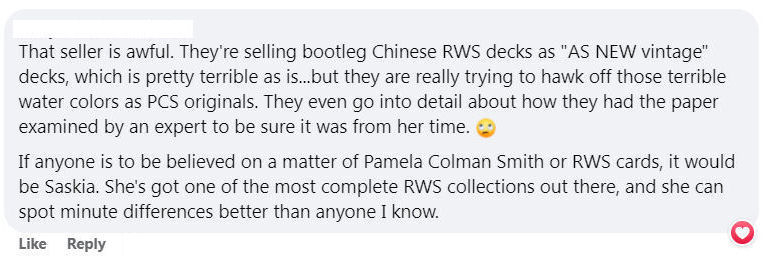
The remarks I’ve been seeing coming out of the mouths of good people in our community have been startling. “I refuse to buy cheap Chinese knock-offs!”
Okay, how about we refuse to buy knock-offs period? Personally? I refuse to buy knock-offs period. I refuse to buy fast fashion products period.
You have to be honest with yourself– why did you add the extra “Chinese”?
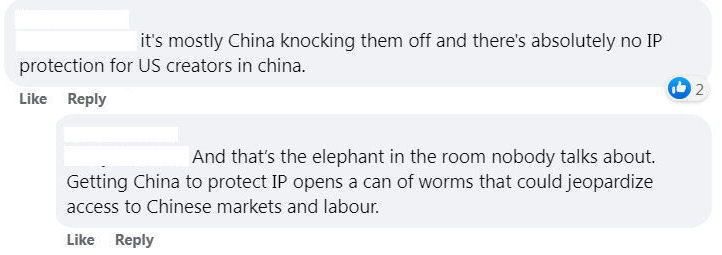
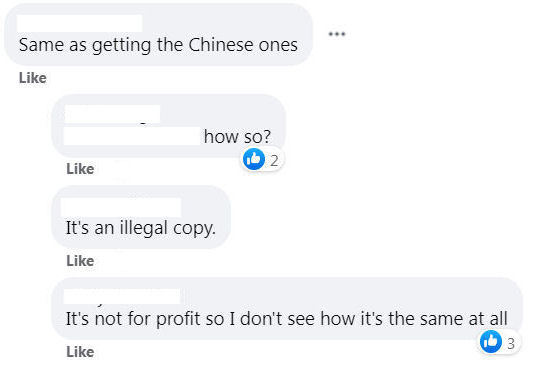
“Because most of the knock-offs are coming out of China,” you say.
Yeah, like I said, most of the manufacturing in totality, including most of the world’s legitimate manufacturing, is coming out of China. So that’s not the real reason why you said “China.”
The real reason you said China is deep-seated anti-Chinese sentiments. There are certain cultures and races that you know are not okay to call out because you’ll look bad if you do, but you feel safe letting anti-Chinese colors fly. There’s no social backlash for anti-Chinese microaggression.

During the Cold War Era, the geopolitical tensions between the West and Russia meant that Western media was in many ways encouraged to vilify Russia, be that via news reporting or in who we cast as villains in film. That led to the Red Scare, where innocent people were persecuted. The US went on a hunt for scapegoats within their own borders because of the increasing geopolitical tensions abroad.

Now the geopolitical tensions are focused mainly between the West and China. So we’re seeing the same pattern repeat itself.
Unless you live near a Chinatown and are friends with people who reside in a Chinatown, you might not have any idea of the increasing anti-Chinese hate and violence that’s been happening.
Every little anti-Chinese comment made online, that you contribute to solidifies a collective dehumanization of Asians (and I say Asians now because on the streets, you can’t really tell one apart from the other, so anyone who looks Asian becomes a target), which takes away any guilt for discriminating against them or for violence against them.
Ask any Asian you know who lives in New York City or the San Francisco Bay Area — how many of them will let their elderly parents ride public transportation or walk the streets alone, even in broad daylight, unaccompanied? Why is that?
The last time we took my Chinese father-in-law to Costco, he accidentally ran into someone. I was about fifty feet away watching the whole thing unfold. He doesn’t speak English and he’s mostly Deaf and refuses to wear hearing aids. But he did a few nods with his head at the dude– his way of saying, “Pardon me, I’m sorry.”
The dude, who’s about my age, flipped out disproportionately and shoved my father-in-law, an elderly man, hard, then hurled a string of curses his way. That’s when I leapt forward and shouted, “Hey! What the hell?” The dude grumbled, “F—- Chinese” and was on his way.
And that incident isn’t even considered a big deal. It’s considered par for the course these days. A lot of Asian Americans reading this are saying to themselves, “Oh that’s nothing, recently I…” and have a way worse story to tell.
[Also, I keep thinking how lucky that dude was that James wasn’t present. Boy that would have become a disproportionate Incident.]
Sites like Wish and Temu are problematic. I am not defending Wish’s or Temu’s selling of tarot deck knock-offs. I am speaking up against use of rhetoric that risks inciting anti-Chinese sentiments.
Yes, your contribution of a negative characterization of the Chinese on social media leads to incidences like what my father-in-law experienced, and worse. It’s all connected.
You can speak out against Temu as a bad corporate actor without resorting to anti-Chinese rhetoric. You can talk about the rampant problem we have with counterfeit decks on the marketplace, how even our local brick and mortar metaphysical shop is stocking counterfeits instead of original works, how Walmart and Amazon are selling counterfeits that rank higher in the search results than the real thing.
On the positive side, I do see a lot of tarot community leaders successfully calling out knock-off sites without resorting to anti-Chinese rhetoric. So you can do it! =)
How? Be specific.
- Specifically name the bad actor. It doesn’t matter that the specifically named bad actor might be Chinese or isn’t. You’re pointing to someone you can confirm is selling specifically named counterfeit decks. Instead of saying “those Chinese companies,” name the merchant — “XYZ company.”
- Instead of saying “Chinese mafia,” there are a few options. (1) Cite your source. Link to a valid, trusted government-published source for your claim. (2) Be specific. Identify the criminal organization you are alleging is behind counterfeit decks. (3) If you’re not trying to be a journalist and just sharing personal opinion, then keep it very general–“organized crime.”
- Before hitting “post,” review what you’ve written to see if what you’ve written could be interpreted as implying “all” Chinese or if it’s unambiguously, unequivocally clear that you are talking about one very specific case where the bad actor just happens to be Chinese.
- Before hitting “post,” consider a balancing of interests. What is the actual value-add of your comment being posted to the world wide web for a very wide and diverse audience to see? Would your words inadvertently cause harm? How might your words impact the Asian community, especially in light of a current increase in anti-Asian hate crimes?
Is Temu’s privacy and terms of use policies onerous? After I read through them, I sure think so.
But I also read through the privacy and terms of use policies of many US-based tech companies and they read the same. Have you ever sat down to read through the privacy policy and terms of use for any of the US-based game apps, let alone the social media apps where we’ve been willy-nilly sharing personal information?
There is a systemic issue with regards to your privacy and the monitoring of your digital footprint that is most certainly worthy of your concern, but China is just a scapegoat. Being hostile toward China won’t solve the problem. In fact, it’s worsening the cracks in whatever is currently keeping the peace.
The question I often get is the comparison to calling out, say, Canada in reference to one incident of something negative that happened. The question goes, why don’t people bat an eye when you call out (for example) Canada in reference to something negative, but Chinese Americans (and by the way, I am not Chinese) get hypersensitive when you call out something negative about China.
It’s because of the current geopolitical tensions between China and the US, which has increased the intensity of prejudice and discrimination that Chinese Americans have had to face. What you think is your innocent perfectly valid comment against China is contributing to the anti-Chinese sentiments that Chinese Americans have to deal with on the day to day.
For a host of reasons we both can intuitively acknowledge, when you call out Canada for something negative, it doesn’t result in a sharp uptick of bigotry and animosity toward Canadians. Whereas right now, the totality of anti-Chinese rhetoric we’re being bombarded with is absolutely causing a sharp uptick in bigotry and animosity toward not just the Chinese in China, but the Chinese living abroad in Western countries.
It’s the butterfly effect. Every single seemingly innocuous “cheap Chinese knock-offs” or “cannot trust those Chinese companies” remarks you’re making adds up and compounds into a collective unconscious green light to hate on Chinese Americans.
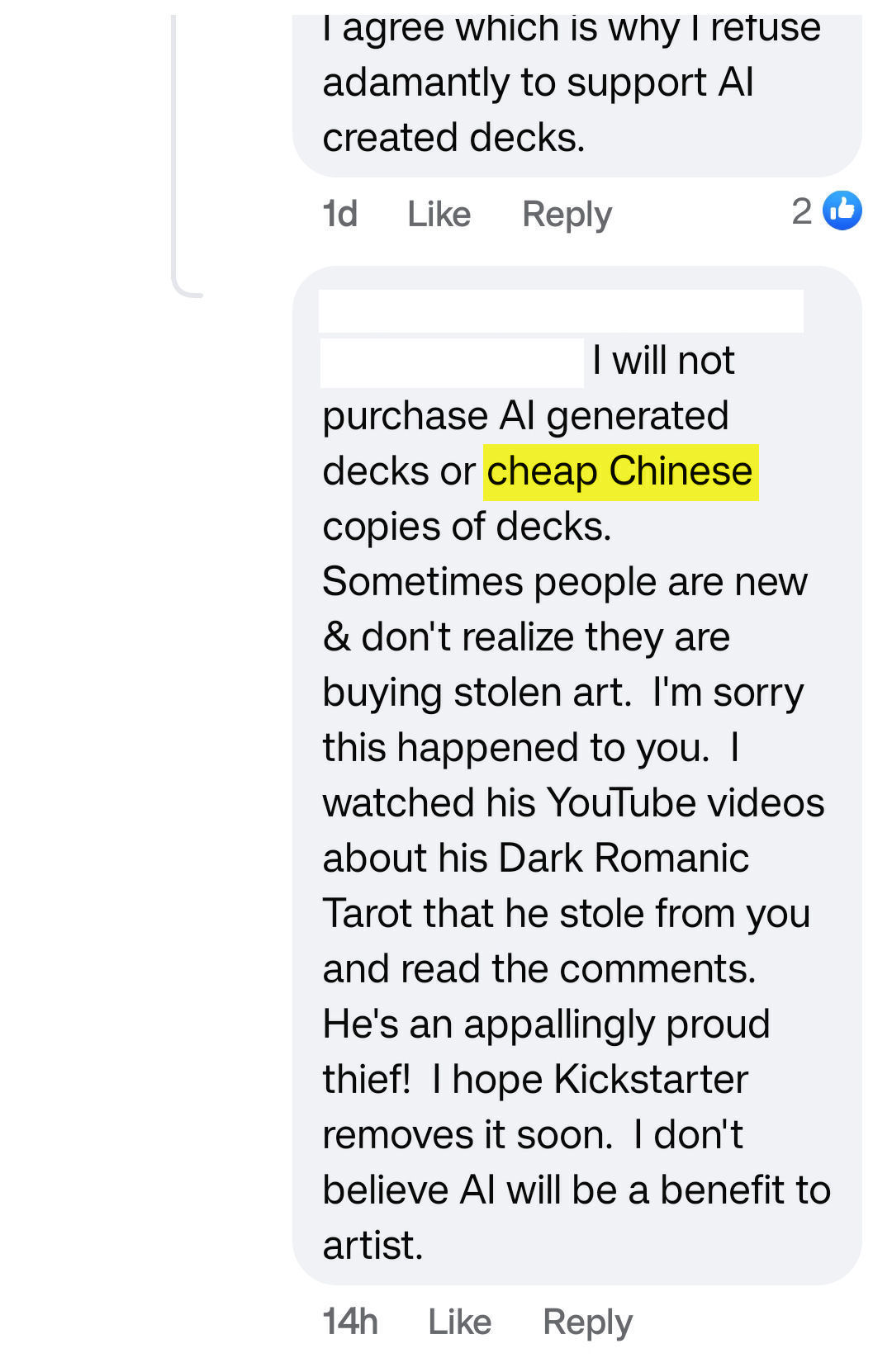
And speaking of AI generated images and text, China passed a nation-wide law that went into effect earlier this year, requiring the following:
- Users of AI models must obtain written consent from the owners of any works that are being fed through the AI deep learning model.
- Any media generated via AI must be clearly labeled as such, and done so in a way that will not confuse or mislead the public.
- Providers of AI models have the affirmative duty to maintain records of all incidences of infringement, plagiarism, use of proprietary images without consent, and violations of law, and have the affirmative duty to report these incidences to the authority.
- Providers of AI models have the affirmative duty to regularly and routinely review their algorithms, and also allow the government to audit and inspect their algorithms.
Wouldn’t it be nice if the US or UK passed similar laws? Wouldn’t this address all the concerns that the tarot community has raised around AI image generators and tarot deck creation?
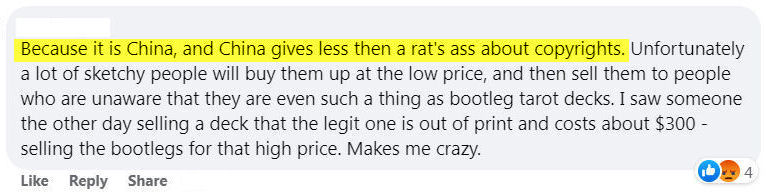
Interesting perspective, that above comment. Because if you ask me, it sure sounds like China cares more about their artists, writers, and creatives than the US does.
But is anyone in the tarot community, particularly those concerned about the negative impact of AI generated tarot decks, holding up China’s laws as a positive role model?
This comment I recently left in a tarot group sums up my message:

You know where these screenshots came from? Out of curiosity, I typed in “Chinese” and “China” as keyword searches in Facebook, kept the search results to Friends and the Groups I was in only, and what I’ve shared here, anonymized, are the top search results that came up.
I didn’t even search hard or long. “Wow. Tell me what you really think,” I thought to myself. What a hit of reality, to face what my own community thinks of people like me.
I hope we can continue the very important conversation around counterfeit decks, but do so without ourselves contributing to the increasing anti-Chinese sentiments gaining momentum in the West, which absolutely will lead to increased fear of a whole race of people, and more hate.

ADDENDUM
Thought I’d share some comments this post received (you can find them in the Community tab of my YouTube channel).


It’s super interesting to me how frequently red herring fallacies are used.
Of course there is so much to critique when it comes to the CCP. I’m Taiwanese, side with the green party, want independence for the island, and sympathize deeply with Hong Kong. You don’t think I have even more robust critiques of the CCP than the average white American?
But that topic is not directly related to the issue at hand, and you would only bring up something like the CCP or the Uyghurs (and if that truly is a topic you want to discuss, let’s expand that out to cover the treatment of Muslims in China) to mislead and distract from addressing the actual topic at hand.

A key skill that is needed to be a good tarot reader is to be far-sighted, to be able to foresee nonlinear cause and effect, to understand the complex system that is our universe, how one small flap of a butterfly wing today can lead to a typhoon tomorrow.
Throughout history, it always begins with popular public sentiment that assigns negative attributes to one group of people, and you don’t think it means you’re a bad person, because you have this one friend or even two from that group of people and they’re great, they’re not like the others.
The continuous paving of negative sentiments, seemingly harmless, is setting the powder keg. And then all it takes is one geopolitical spark to that powder keg to turn that ongoing pattern of assigning negative attributes– harmless, they were, you keep saying– to justify violence against that people.
When all is said and done, and you reflect back on your own acts, every little harmless sentiment you might have contributed to public discourse, do you want your own conscience to be clean?
 benebell wen
First off this was so upsetting. I am one of those that haven’t noticed so much due to the fact I’m off social media except YouTube and I try not to read comments and because I live in Kansas. I also don’t want the news. It’s all so overwhelming and I feel bad for it because I personally don’t know what to do. I will say that I did notice how people were talking in regard to covid and how that was blamed on China. Is that where a lot of this hate is coming from? I mean I’m sure people will find any reason really but it did seem like I at least heard about China in a negative way more during covid. To avoid knockoff I buy directly from the seller and I avoid fast fashion by supporting people I know don’t participate in it. I buy work out clothing from popflex because I know Cassie Ho doesn’t create fast fashion. I find good sellers on Etsy. I take my time and do my research. I wish others did the same. And I don’t understand why people are so damn determined to blame a country or a people for everything! Makes me think of what the Islamic people have been through due to a very few. It’s very sad all of it. If you have suggestions how someone like me a white woman born in the United States can help I’m all ears.
LikeLiked by 3 people
This kind of toxicity is exactly why I left all social media’s except YT years ago, Facebook was the worst of the bunch. People need to use that power for good not hate, yet that’s all I was seeing. Sickening.
LikeLiked by 5 people
I find that, in general, it’s becoming way too easy for people to resort to blaming scapegoats for whatever is bad or problematic in the world. The amount of casual, knee-jerk prejudice getting bandied about these days is seriously disturbing.
Yet, at the same time that many people are quick to scapegoat someone for a thing, they seem unwilling to call out the real people or groups or systems responsible for it. China is not responsible for undesirable knock-offs of tarot decks being on the market. That blame belongs to the US printing industry for off-shoring all its production rather than pay union wages to US workers.
Blame also belongs to the consumers for demanding cheaper products. I think we can be sure that nobody would be making knock-off copies of this or that tarot deck if they weren’t guaranteed to sell. And as long as people do buy cheaper versions of a thing, then the knock-offs will be made, no matter were or by whom.
So if people are bothered by sites like Ebay being full of knock-offs and counterfeits, they don’t have to look as far as China for why that’s happening. Maybe they should buy decks from the publishers at full list price, or else cultivate relationships with reputable dealers if they want to be sure of getting the original item. Caveat emptor, right? I dunno, that’s how I handle things like this.
Also, RWS is public domain now. Anyone can copy Colman Smith’s art, alter it, do whatever they like with it. There’s really no point in blaming “the Chinese” for cheap copies of RWS being on the market, as if they’re doing it on purpose to sabotage tarot.
LikeLiked by 5 people
Pingback: 當塔羅界煽動反華排外情緒 – benebell wen – FanFare Holistic
All of this of this makes me incredibly angry, sad and frustrated. It absolutely CAN be addressed without any other references as you state. I buy and sell used books, including decks here and there. I wrote on my seller page mine are authentic; I do not buy or sell “QR code” counterfeit decks as I prefer to call them. That is all anyone really needs to say IMHO. Fake is fake. I don’t care where or who makes it beyond that. Supply and consumer demand plus unrealistic expectations and me me me attitudes are bigger issues, as already stated.
LikeLiked by 2 people
Not bigger issues.. mis-spoke, just as big or bigger issues that need to be addressed that overarch everything else and lead to more of this problem, is more like it.
LikeLiked by 2 people
I’ve written often and extensively about counterfeits, but the anti-Asian xenophobia and racism is still unfortunately dominant on Facebook in general. Since I’m constantly searching for decks directly from artists and second hand, I’ve run across counterfeit manufacturers in Indonesia, Philippines, Russia, France, Germany, and many others. It’s not simply a China thing, but it’s a struggle to convince anyone that anti-China or anti-Asian sentiment in general is racism and uncalled for. People don’t listen, as they see themselves colorblind or free of racism, even if it’s Asian voices raising our hands.
LikeLiked by 1 person
I’m very glad to hear of the work You have been doing and your contributions to combat counterfeits. Thank you! ❤️🙏
LikeLiked by 2 people
I think that communities that suffer from counterfeit issues (like tarot decks) should get into a habit of supplying documentation of how to identify counterfeits in the market. It can be part of the deck’s description: this is the box, this is the art layout, etc. The details that make the deck more expensive that counterfeiters can’t affordably duplicate.
If there is a market pattern of doing this it will train buyers to be on the lookout for counterfeits. Those who don’t include the description will stand out more as counterfeit.
I’d like to see this happening more in tarot deck community. Perhaps if you did something like this you could inspire a trend.
I tried suggesting it to another tarot artist, but they just got angry at the idea of having to take any action against counterfeiters. But, people trying to make money off anything they can get their hands on has been occuring since the beginning of time. All creators will have to take some action to prevent unauthorized duplicates. I think this marketing technique would do well for tarot creators and encourage hype around the well thought out details of their deck creation.
LikeLiked by 1 person
Every deck I sell comes with a certificate of authenticity that is numbered and hand signed by me. 😊
Sadly that is not enough to stop bad actors. I’ve seen indie decks that come with certificates of authenticity that still get counterfeited.
Something that concerns me is the number of people who buy tarot decks in the US and the UK who simply don’t care if it is a knockoff. If we cannot educate and curb the demand, it is going to be very difficult to curb the supply.
LikeLiked by 3 people
I definitely disagree with this post on so many points though I can see and appreciate the intention to have a discussion surrounding it. I just see that both defensive positions can be true and therefore there is nuance where there are complaints. I see this issue in the real estate market right now… many investors of a certain background buying properties to sit empty or be rented to the average person who can’t afford to buy the house. We can suspend generalizations until there is information that a certain company from a certain company owns hundreds of properties around the country. This argument is proposing there is a victim when business practices are occurring that are not really beneficial to the average person on both sides of the deal. So while I might be in the minority on saying nuance is required here for both positions being true (as unsavory as it sounds out loud to those who take offense), it’s too easy to agree one way or the other. Emphasizing a country or people (see Whites being held accountable and emphasized/generalized in 60s for discriminatory acts) for shady stuff did not elicit such a response as you outline here. So we suspend vilifying and put a blanket “ALL should be held to the same standard… why does it just ostracize a certain group of people”… wasn’t that the same argument people had against saying “ALL lives matter”. To further illustrate a point not in favor. Btw, not sure if this adds anything to qualify my POV but I am a mixture of Mexican, Colombian, French Canadian, Korean, distant Jewish and Egyptian. I think it would be nice to live in a world where we don’t describe a group of people to be responsible for something in particular but we’d be living blindly and also removing the darker parts of what makes up those different groups of people. I live in a heavy metropolitan area and as nice as it is to see a Croatian neighborhood, and a Mexican neighborhood, and a Chinese Neighborhood where group beliefs, rituals, cuisine, and even family businesses and industries are particularly dominated by a certain group, it would be more detrimental to not acknowledge the reality of what people are noticing but business owners, investors, and our government is not concerned with.
LikeLiked by 1 person
And just so I am not made immune to this type of behavior myself (because I am) I will illustrate my point even further here. I moved to another state to try something new and to live somewhere more beautiful than where I came from at a price my partner and I could afford. We could no longer afford where we live in a metropolitan area due to transplants and other political/government/corporate systems in place robbing us of a comfortable living. Upon moving to that new state I was hesitant to advertise where I was from because I new many natives despised transplants (especially of my kind). I thought I could keep distance from this hate but my job placed me in a very public position providing therapy to said natives. Multiple times I was met with people who mentioned my home state and the challenges they faced by people from my state. They would explicitly say they can no longer afford to live where they live and especially since being layed off. I felt “but surely this does not apply to me… I am here to be a part of the community, help others, and spend money at your businesses… also, there’s a shortage of medical and health professionals so I am of use”. This is how I reasoned I was not part of the problem. Soon, my partner and I decided to return home and slum it even if we couldn’t afford it for various family reasons. We sold our home (for a profit… the exact profit one of my clients mentioned in a hypothetical example) and we left to our hometown. Was I offended to lumped in a group of people that I didn’t feel I was a part of? Yes. I rationalized that they were speaking of investors and corporate greedy market capitalizers… not me, just little old me living life. BUT I was too also part of the pain they experienced even if they couldn’t separate me from the “other”. Where I came from represented something to them and it was psychological, it was emotional, and it still left a huge gap between me and them. So I say this because the people who say these things that touch you in that deep and vulnerable defensive place also feel something deep and vulnerable. They are seeing the person who sells the empty home and owns 10 more sitting empty, they see the people who live in the most affluent areas and attend the most expensive schools. They see the people who are top of the class and get the most opportunities. They also see where and WHO there money goes to whether their government or that of the other state/country sees or cares. People are not blind. They are angry and beneath that anger is a voice that is not being heard. Sorry I had to add this separate because I couldn’t edit. I just wanted to show that I was part of the issue the people were complaining about even though I thought I wasn’t.
LikeLiked by 1 person
Thank you for speaking up about this. Are there critiques to be made about China’s labour regulations? Of course. So why don’t the rest of the world boycott them? People love to cry about Chinese greed but forget that China is “the world’s factory” for a reason. People EVERYWHERE pay for it. Your American creators, your French artists, your Swiss merchants. Why not blame them for fuelling the supply and demand? Every country in the world buys Chinese manufacturing but sure let’s blame the Chinese instead of the companies who would rather outsource labour than pay living wages and tax in their own countries.
And as you said a lot of top quality products are also made in China. Hell, Apple uses Chinese manufacturing because it’s cost effective and convenient. That’s capitalism for you.
LikeLiked by 2 people
Yes! I am an Asian myself and this is really disturbing. Mmany if the original decks I bought (imported, ahem) from US are printed in China! Turns out the publishers like to have a cheap printing cost even though it’s on China, huh? And since I study economics so I know that China is just the “biggest” manufacturing hubs by numbers, so I’m not surprised when those original deck are printed in China.
LikeLiked by 2 people
There’s a side that often gets neglected when people talk about “Chinese knockoffs”, and I think that’s a shame.
I mean, you’ve been there, but anyone else, just imagine you try to find a company to work with. What are you looking for? What are you looking for when you try to navigate a different culture? Are you looking for price only, are you taking risks like theft of artwork into consideration? Are there reputable certifications companies can have to show they are legit?
The more I go for certain points but not others, the more I open myself up for risks. No matter where I am and no matter where the company I work with is. Globalization increases the risks because too many businesses still address other cultures with the assumption that all people share certain values – but do they? And even if they do, the same value can be dependent on context.
The way I see it, those that did their due diligence before choosing the printing company they work with have a way smaller risk to have their artwork stolen. I don’t want to blame them – I merely want to point out that I think the best anyone could do to combat these issues from the creator point of view would be to increase the resources and availability of resources on how to find good printing companies.
What I see instead and exclusively is a judgment towards the culture in which the knockoffs got created, judgment for people who buy knockoffs (often without even offering a guide on how to spot them!) and lastly, judgment for publishers who dare to even print in that culture.
LikeLiked by 3 people
I’m not even on social media that much anymore but when I am, I see almost nothing but warnings and info and how to spot fake decks these days. Many also on the creators own sites as well. Not always no, but more often than not. It is out there, people still need to look to see it, though. IDK what the answer is by far; so many good points here by everyone that only fuels more thought. That was just my thought on that part being a social media recluse!
LikeLiked by 1 person
Thank you for talking about this Benebell (although in an ideal world you really shouldn’t have to).This is a significant reminder that words hold a lot of power and can cause and incite profound harm. We need to be careful with how we talk about things and make sure we’re not inflicting further damage.
The way that person spoke and behaved towards you and your father in-law is deeply shocking and completely unacceptable. I hope you’re both ok, I understand how traumatising something like that could potentially be. I’m English and half Persian, my dad was racially harassed by a neighbour. We have ‘freedom of expression’ laws in the UK rather than freedom of speech because hate speech is illegal. Luckily this person was sent to prison for their racist comments.
I can imagine this was a difficult post for you to write. Again, I hope you’re ok and I hope this post will cause many people to reflect on how they talk about things.
LikeLiked by 2 people
I stay in Asia pacific, and I feel there is a cause and effect which is happening. Through out the Asia pacific, China is becoming increasingly aggressive and so are Chinese people. Micro aggressions against other races such as Indians, Filipinos, Bangladeshis is on the rise in many Chinese dominated places such as Hong Kong, the little city state, etc. so obviously, a ripple of this effect is also happening. As we see a more bipolar world where the Chinese get increasingly aggressive, we will also see/witness a retaliation of sorts. People are not pushovers, if a starts hating on B, then B will also do the same on A. Unfortunately ultimately everyone suffers.
LikeLike
Ethnocentricism, racism, and colorism are without a doubt social problems that East Asians have inflicted across Asia. How I’ve seen Han Chinese treat and speak about Indians, Filipinos, and Blangladeshis go well beyond microagression and is straightforward blatant bigotry. Younger more progressive generations of Chinese *are* trying to dismantle that, and unjust systems in place do not make that effort easy.
Hong Kong’s situation is a lot to unpack. They were colonized by the British for so long that they themselves have now inherited the colonizer mindset.
Even within the Mainland, there is a lot of tension between ethnic groups, with the Han Chinese dominating and enforcing assimilation, which is to enforce erasure of any aspect of a minority culture that is deemed “inconsistent” with the Han Chinese.
How China will resolve these social problems remains to be seen.
LikeLiked by 1 person
Great post Benebell. Easy scapegoating is exactly it… seeing so few people taking issue with Amazon or platforms they want to keep using, decks they want to keep buying for cheap etc. but finding something – ANYthing – that is ‘other’ enough (to them) to avoid thinking critically about personal responsibility and impact. To rail against the issue of counterfeits by naming a *demographic group* rather than the machinations of the industries in which one partakes demonstrates a *wilful* blindness to the positive value adds that are within one’s immediate reach and control. Tearing down what is for oneself a convenient concept (for others an oppressive reality) rather than addressing systemic issues… Are we respecting IP as a community? Are we looking into the manufacture of our clothes, our phones, our commondities (including decks)? Do we have an awareness of whether the companies we support pay living wages or have safeguarding policies in place? Do we boycott or reduce our usage of services/companies that don’t? Do we report counterfeits when we see them? …And do we re-evaluate what we think of this ‘community’ when we see these things are’t being done?
LikeLiked by 3 people
FYI – The above post says ‘anonymous’ because I forgot to log in. I am it’s author.
LikeLiked by 3 people
Thank you for this. I have spent the majority of my adult life in books, as a seller, writer, and other areas. There was a huge shift in publishing in the early 1990’s, when we saw a lot of U.S. publishers shift to offshore presses. Chronicle Books would not be where it is without Chinese printing presses. Their Griffin and Sabine, heavily illustrated, was one of the first I noticed being printed there.
There is a lot involved in the whys of manufacturing. Labor costs is of course paramount, and a whole other discussion. How it affects *us* is that Chronicle, for example, is able to produce a wider variety of illustrated books. Not only is it still affordable for we, the consumers, but the quality is fantastic.
The issue of racism, and particularly anti-Asian racism is a long-going problem, and the U.S. has a horrible track record in addressing it. Everything from anti-Japanese internment camps to films like Gung Ho (put forward as pro-worker, but really anti-Japanese), not to mention John Hughes’ deplorable names for characters all serve to reinforce stereotypes and aggression.
The very least we in the tarot community (and as decent human beings) can do is be aware of our own part in all of this. Times are changing, but need to change faster, and we need to be the ones to make them change for the better.
LikeLiked by 1 person
Well, that is a feeling that I am not alien to, as a Mexican I am used to hearing about everything, that Mexicans are all from the cartel, lazy, thieves, corrupt blah blah blah..It is this generalization that an entire country is bad that creates what you call micro-aggressions and xenophobia.
Also in this so-called “community” I have found rejection when selling me a tarot because I live in Mexico.So This not only happens to you because of your race, it happens to the majority who live in third world countries, (a term that bothers me a lot and is still used as something derogatory).If there is much to talk about these issues here in our beloved “Tarot community”
LikeLiked by 2 people
A couple of years ago this topic came up. Prior to which I also referenced the source of pirated, counterfeit, illegally produced, copyright infringed (choose the adjective you wish) decks as being principally from China. I did not do so for xenophobic intent, I did so because it was a statistical fact and as a warning of what might be an increased chance it happening should an artist (and publisher) choose to print their decks in those countries. Just as I did in earlier years when I referenced the Ukraine and Russia of also being a source. This isn’t just a discussion, it’s personal. Every one of my decks has been pirated and in the vast majority of instances it has been done in China. Nevertheless when it was brought to my attention that referencing China can be misconstrued, offensive, and hurtful (especially to Benebell, who I admire immensely, I chose to refrain from referencing “China”, in my periodic subsequent posts regarding this topic. Furthermore to offset that and provide context, I have been very public in stating that despite the “increased risk” of producing decks in China, I still choose to do so. and no, its not because the unit cost is cheaper, that is probably the rational for major manufacturing, but the difference is actually not that significant when factored into the overall costs of production by an individual person for a custom item such as a tarot deck. I did so because I consider the Chinese company I work with to be very good, the quality of their work, material options, turnaround times etc is (IMO) superior to what I have received domestically. Furthermore there are socio economic factors to consider in international trade both legal and illegal, tarot included. Piracy and cheap counterfeit decks are produced (wherever that may be) because there is a market and demand for them. So yes, I have disdain for the bulk sellers who are based in China, but even more for the complicit sales platform in the West, and ultimately for those who buy such decks, not out of confused innocence, but because of the price tag and who then proclaim that its ok to do so, because they can read perfectly well with such decks. So in summary, when a deck designer such as myself is notified that over forty thousand pirated copies of my decks were confiscated from a container entering Brazil, and that was just one they managed to catch among the many they don’t, and that those came from China, yes I’m annoyed by that, and I want to get the word out, and while I have no absolute proof, I do believe that there organized crime involved. the sheer volume of decks produced, the transportation of them is just too much to be pinned on a few cowboy printers, so the term Mafia is not beyond my imagination. But then such organizations are not the monolpoy of one country either. Do you think that the people waiting for that container which had over 200,000 decks were just a couple of local spiritual shops waiting for their package from Amazon ??? So how can I and other artists, publishers, small retailers, reference and discuss this scourge in an attempt to make people more aware and hope that bringing attention to the issue might help and yet do so in a straight informative manner but doesn’t mentioning China? I am not being flippant or insensitive. I’m genuinely asking, because for me this isn’t just an unattached social media discussion point, this is a significant financial challenge to me and to many who are legitimately effected. The financial loss to an artist or author cannot be accurately quantified but it is nevertheless a significant factor. How can one have a fuller comprehensive discussion on this topic, one that acknowledges and references all the factors involved (and surely the geographical source of production is such a factor), and not be accused of inciting anti Chinese rhetoric which is absolutely not my intent? With that said, yes I have mentioned China several time in this monologue, but limited to this discussion, I do not do so in my public posts.
LikeLike
oops didn’t mean to post anonymously. my name is Ciro Marchetti
LikeLiked by 1 person
previous post was from me Ciro Marchetti, didnt mean to be anonymous
LikeLike
Hi Ciro!
This is going to be a long one. =)
As you know already, I greatly admire your art, and just as importantly, your contributions to the tarot community. You’ve always and you continue to be an incredible advocate. I love that you speak your mind and that you speak your truth.
Also, I am deeply grateful that after we talked about how specifically calling out China can be misconstrued, you actively shifted your language so it was more considerate and compassionate. That is the exactly the type of positive role model I was talking about.
To your question, I guess my question in response is, within the context of tarot creators speaking to tarot consumers on social media about counterfeit decks, does it matter where the shipping container is coming from (when almost all decks are being manufactured in and shipping from China anyway) in terms of how effectively an artist or creator can tackle the counterfeiting problem or communicate about the problem for the purposes of educating people against buying counterfeit decks? Or is mention of China more of a way to pin the problem on a scapegoat for that psychological hit of satisfaction?
Time and place factors come to mind. If I were a government official looking to set up import blocks or inspections to reduce import of counterfeit products, then yes, I agree that targeting China, so long as it is done so without negative impact or inconveniences to innocent, legitimate Chinese importers, is critical. But on social media, in a Facebook post from a deck creator to a group of deck buyers, I just wonder if it really matters, or if that type of culture-specific rhetoric causes more harm than any good it will do. Cost-benefit analysis.
As for “Chinese mafia,” to start, it’s awkward wording. If we are specifically addressing China-or Chinatown- based organized crime, the more common terminology used is the triads. It’d be the Chinese triads. So to me, the fact that the wrong terminology is used tells me that whoever is making that statement isn’t really well researched on Chinese organized crime. So that causes me to wonder whether they have any evidentiary factual basis for what they’re talking about. Someone with bona fide knowledge of the facts of such a situation would know to call them the triads. In which case, are we getting the information from a credible source? Do we really want to participate in spreading misinformation?
Comprehensive discussions on the topic of counterfeit decks without resorting to anti-Chinese rhetoric is absolutely possible. I would say it begins with first making sure there isn’t actually any anti-Chinese sentiments that might be subconsciously influencing our thought process, and to start by addressing any residual anti-Chinese sentiment that we might have absorbed.
There is a difference between saying “Be diligent in vetting a legitimate manufacturer in China who will value and protect your IP and here’s how” versus “Don’t ever do business in China because they don’t value your IP.” The first is actually helpful to prospective deck creators; the latter is fear-mongering and prejudicial.
There are a ton of scams and frauds among tarot readers. How do tarot readers feel when they hear comments like, “Tarot readers are all frauds. Don’t ever buy a tarot reading.” vs. “Here is how you can avoid getting scammed.”
Instead of juxtaposing the words “Chinese knock-offs,” talk about knock-offs in one sentence, and then in another sentence, talk about any patterns you might have observed with regard to China-based websites with a history of selling counterfeit products. If we know that our audience already skews anti-Chinese, perhaps remind them “not all” and balance the discussion with a reminder of the legitimate or the high-end China-based businesses.
Where there is already a tendency toward bias, being more considerate with tone is helpful. This isn’t about tone policing. It’s about knowing that some subjects, right now, are sensitive. And therefore out of consideration, let’s be sensitive.
As for an import of 200,000 counterfeit decks in one shipping container, that’s a very large quantity in one single shipment, even for a major publishing house to be imported in terms of legitimate decks. (Before writing that, I opened up the last 3 years of US import-export logs for the 3 major tarot deck publishing houses we’re familiar with to get some hard numbers for comparison.)
If that is true, and even if organized crime is behind it (why, of all possible industries, they chose tarot is certainly a peculiar, amusing choice), gangsters aren’t selling the decks direct to consumers. They’re selling it to a US-based distributor who has decided it’s okay to sell counterfeit decks. So the problem is still the US-based distributor, not China. And also I’m just really genuinely confused by how a US-based distributor can buy counterfeit decks from gangsters and not sniff out that something’s up? Other than willful ignorance? In such a scenario, that it’s coming from China has almost no bearing on the actual problem at hand. At those numbers – 200,000 – you’re looking at a *major* US-based culprit, irrespective of where the counterfeit decks were manufactured.
If there isn’t actual inherent bias against the Chinese, then it’s fairly easy to talk about this issue without getting anti-Chinese. And it’s okay that we’ve accumulated inherent bias because it happens. The next step is to unpack it. Over the years I’ve discovered within myself many biases I’ve picked up that now need to be addressed.
In the instance of 40,000 counterfeit decks being confiscated, if you are given hard evidence that those 40,000 counterfeit decks entered Brazil from a shipping container exported from China, sure, mention that and cite the source of your information. You’re stating facts, and it is case-specific.
As for artists, publishers, and retailers who want to discuss this scourge to bring awareness to the issue, many are effectively doing so without engaging in anti-Chinese rhetoric. So we’re seeing that it’s possible. “This XYZ listing on Temu is selling a knock-off of my deck because neither I nor my publisher authorized this listing. Report this to Temu and if you’re trying to buy my deck, do not buy from Temu because all listings of my deck on Temu are counterfeit.” And then the next course of action is for the community to work actively to make sure Temu, or any distributor for that matter, has a process in place for consumers to report possible counterfeit product listings so that the distributor can take the listing down or at least launch an investigation.
It’s the deck creators who repeatedly post anti-Chinese rhetoric who, after getting called out, refuse to acknowledge any wrongdoing, and in fact turn the tables to characterize themselves as the victim and place the blame on those who are calling them out that are truly causing the most harm to our community.
LikeLiked by 2 people
Yes, that’s a long one, and while I accept many of your points, I still feel that the geographical location where the vast majority of pirated items originate from is a factor to be considered and valid piece of information. As emotional as this topic must be for you, and who could blame you, there is undeniably an increased risk factor working with printers there.
You sounded skeptical of the figure I mentioned regarding the container, The content was of decks and other merchandise, clothing, electronics. I can’t categorically vouch for the accuracy of the numbers, other than to say, South America is a big place and divination in various forms is far more accepted ….. so there’s a big demand, Talking of big, so were the guys who approached my Brazilian contact, offering let’s say some incentives to not make a fuss about what he might find in the container. Which provides the rational behind you asking why, if there are criminal behind it, why would they choose Tarot decks of all,things. Why not, Rolex, Gucci, adidas, video games, medication, As you said, pretty much everything is manufactured in China anyway. So,tarot decks are like everything else, an opportunity, and by now a proven one.
As for those suggesting more due diligence from the artists who should make the effort to report any pirated items they come across. Seriously? Do people think that is a “wow that never occurred to me” idea. Even with Amazon, I have to jump through hoops to prove the legitimacy of my claim. and even then that can be contested by the seller. So What real chance would I or any other artist have reporting to say AliExpress, Wish or Temu? Plus, how many hours are there in a day, I have a tarot deck to finish.
I was impressed by the language you provided for the Chinese policy regarding the use of and declaration of AI. Yes ( would love the US and Europe to formulate a similar official position. But even better i would love that those positive sounding moral and legal, statements issued by whatever government are actually adhered to and enforced.
I believe you are scheduled to be a presenter at Staarcon, in a few months, I’ll meet you there and buy you a drink or three, I’d love to share some private tarot stats, that I think will surprise even you. In conclusion, I consider the Chinese connection apart from being a good movie plot, is also a valid point of discussion in tue context of piracy The question is wether it’s worth the price of it contributing to anti Asian rhetoric. Clearly it’s not, hence my change in approach to communication, once that was pointed out.
LikeLike
My experience with China immediately taking down counterfeit posts has been positive. If and when I see a counterfeit issue happening with my decks and I reach out to my China contact, that counterfeit site is taken down within 24 to 48 hours.
Whereas my experience with US-based websites is exactly as you noted– it’s next to impossible to get anybody at Amazon, Ebay, or Etsy to pay attention to you, same with YouTube and Instagram. And as for Temu and Wish, you’re contacting the US-based departments, not the actual China-based departments that monitor counterfeit posts. So if you ask me, the source of the problem is State-side.
Questioning how effective China’s IP laws are enforced is interesting. Is this based on substantiated evidence or is this based on speculation? Because, based on substantiated evidence and personal experience with IP litigation, it’s very hard to enforce US IP laws here in the US. Sure, we have pretty good laws for IP protection, but given the cost of a good IP attorney, being able to legally enforce your IP rights is next to impossible unless you’re wealthy.
Why do we focus our blame on China for manufacturing the counterfeit products instead of focusing our blame on the US government for not doing more to keep counterfeit products out and investing more resources in monitoring the domestic sale of counterfeit products? It’s our own government and corporations that don’t care enough about individual artists and creators.
And yes, looking forward to having loads of fun at StaarCon! ❤
LikeLiked by 1 person
What I find absolutely hilarious is adding “Chinese” in front of counterfeit decks is like adding “Scammers” after Tarot reading. I’d have thought that Tarot readers/creators can understand and probably tried very hard to educate others that NOT ALL TAROT RELATED PROFESSIONALS ARE SCAMMERS. There certainly are those who are, but I believe most are not. So as Benebell pointed out why put “Chinese” in front of everything you loath?
I rarely use social media and don’t belong to any Tarot community as yet but this kind of expressions is really putting me off joining any.
Being a Hong Kong born but British raised Chinese person, spending half of my life in a “Western” environment (Lived and worked all over U.K. and a Citizen there) and the other half in a “Chinese” environment (lumping Hong Kong, Taiwan, China together as I lived and work in all 3 places for some years each), and then speaking to so many different races of people (don’t forget we all belong to ONE race – the human race), I find that most people who have not been exposed to other cultures other than reading and listening to the news/social media, WILL at some point fall into this trap of blaming the most convenient and high profile scapegoat – China . Unfortunately, there’s not enough news outlets that tell them the other sides of the story so let me share one that is totally relevant here:
On TaoBao, one of the biggest e-commerce platforms in China, I found a bookshop selling Benebell’s Holistic Tarot book. I did my research and realize the size is not the same as the original so I believe it was a counterfeit and reported it. I didn’t check back for some weeks BUT, when I did check (I bookmarked the item to see if my action had any effect), the book was not only gone, the shop was also shut down. So, this proves that within China, it is not just a case of Wild Wild East, where nobody cares and everything is ran by the Chinese Mafia but shops and products are being monitored and if someone report them, they get removed.
Now, let’s see what happened in the West. I have bought great authentic decks from Amazon but for the past couple of years, I see also shops selling what everyone concluded as counterfeits are still thriving and people buy them despite those reviews. I did not see these shops being shut down. Who is to blame in this case? Are Western giants like Amazon doing anything, evidently not. Are buyers doing their due diligence, also not. But, let’s not blame our own, let’s blame the Chinese printer, the Chinese publisher, the Chinese tradesmen (who by the way didn’t import them into the West).
If there’s a demand, there will be a supply. This is a truth discovered from thousands of years ago. So what should the Tarot creators do if they DO NOT want people buying counterfeit decks? I propose proactively educate people about the quality of their decks, the time one spent on it (like Benebell did so well), how this helps artist make better art and spreading good energies around. Appeal to consumers’ logic and feeling.
I didn’t originally want to buy Benebell’s deck at all as I already own quite a few, but by visiting her site, understanding the hard work she puts in and the amazing art I see, etc., I was persuaded not only must I not get a counterfeit (I never did because I can see them going for a lot cheaper and common sense tells me that they are not the real ones), I MUST buy such the real deck, directly from the original source. This is what successful Tarot creators could do. Rise above these instead of spreading negative vibes by focusing on blaming the country which created majority of the parts in your phone or any gadgets you use and many of the most amazing Tarot decks.
Bad quality products didn’t originate from any particular country, they originate from the demands of stingy, greedy people who doesn’t want to pay more and deem that a substitute is “good enough”. Thus, producers look for the cheapest alternative to meet these demands and everyone knows it is cheaper getting things manufactured in China. This happens everywhere like I have bought multiple things in the U.K. where they stop working or break down quickly and guess what, they are made in the U.K.
I hope the Tarot community or in fact any community on any social media could start to consider we are all in it together, for better for worse. Yes, there will always be bad actors in trades, scammers, counterfeiters, fraudsters. However, our job is to beware of them and find ways to minimize risks, promote the real/good products, strengthening your own brand name, help Tarot enthusiasts understand the true value they are paying for so that even if they used to buy counterfeits, they change their mind and become your loyal customers.
Most importantly I’d like to see Asians, whether they are Chinese or of any other ethnicities no longer have to suffer from discrimination and violence initiate perpetrators who let fear and bigotry run their lives.
LikeLiked by 1 person
Oops, anyone who read what I wrote please excuse all the typos and grammatical errors, it’s been a long week and very late in the Far East. LOL
LikeLiked by 1 person
Lol story of my life. 😂 Really loved your comment by the way.
LikeLiked by 1 person
Thanks, I usually shy away from leaving long messages on anywhere but this topic deserves some attention, not just because I identify myself as Chinese (not Hong Kong-er because I really don’t think there should be a difference, regardless of one’s political stance, I’m pretty sure my DNA test will show that I am 100% “Chinese” if I do one!).
What also caught my eye is that some great names “liked” those posts you called out. It’s far to easy to just agree with one’s peers . I’d like to see more non-Chinese populations call these blind-spots and unconscious biases out more often.
Otherwise, some will just put this down as “Oh it’s just a few Chinese people being hyper sensitive about this or that, speaking up to show that their feelings are hurt”.
There is so much more to unpack, it’s hard to know where to begin so we could just start small and hopefully through this kind of discussions, we help to spread awareness and kindness.
LikeLike
As a stereotypical middle aged white European I’ve lived a sheltered life to what goes on for others. I did make a commitment a long time ago to learn more about issues the people of the land in my country face on a daily basis. Obviously this is from non lived experience so a shadow of the actual that people live with, I see the focus of this article and would like to think Im open to understanding more about this. It annoys me the slagging off, as you so clearly point out the whole world relies heavily on China for so much and yet its the underbelly ( which is in any country) that gets highlighted. What about all the people around the world happily buying the knockoffs so that they can on sell and turn an extra dollar. What about the people who work in appalling conditions to bring us the cheap cr$p we have become so used to as excess consumers? Given my grandaughter is half Chinese I feel a step closer to that which you have highlighted and very motivated to learn and understand more.
Ps. Just started studying your book after giving up about 5 years ago as a compete newbie. Gosh you have put some work in over the years. Your content is impressive and free offerings to support your book, amazing. Already got heaps of new layers to add to my practice
LikeLiked by 3 people
Complex nuances of something seemingly simple, seemingly superficial, and ultimately hurtful… In this time of viral information, words seem to take on a sometimes unforeseen or unintended life of their own. Your post started a conversation between my husband and me that lead to some interesting insights. Thank you for taking the time to write this.
LikeLike
The responders seem low intelligence. You write and think above their comprehension.
That line about “…loving the Chinese, never been to China tho…” is better than Mitt Romney’s “binders full of women” comment from back in the day.
Keep on, Benebellwen. Grateful.
LikeLike
Talking about yourself as a responder with low intelligence seems very harsh. Some self-discovery and development will help to increase your self-esteem and a positive self-image. Wishing you much peace and self-acceptance.
Then of course if you are speaking about everyone but you… then maybe a mirror might help. Just an honest opinion as open and carefree as yours.
LikeLike
I haven’t read anything that struck me as being “low intelligence” here. Insulting someone’s intelligence when we dislike what they’ve said is a cheap shot. ❤
LikeLiked by 1 person
I had a good chuckle because l didn’t realize this was a Mensa-level IQ test in disguise as a blog 🤣😉❤️
LikeLiked by 1 person
Until we accept we are all spiritual beings to have a human experience in this life time. We reincarnated in various culturual background through many life times, although we deny that we are equally all spiritual beings. Fundamentally, it is karmic lessons to learn and grow, it is no difference it happens within the same cultural from geographyical point of view. Of course, this universe is paradoxically in harmony, I can’t change others’ spiritual path or life jouney, I all have is to align my own thoughts, actions to be kind and be in peace. Namaste.
LikeLike
North Korean, KGB, or Chinese intercept possibly before the Tawian election to disrupt spiritual outcomes??
LikeLike