I Ching Dead Moon Oracle Deck: Gothic Asian?

Name of Deck : I Ching Dead Moon Oracle Deck
ISBN : 978-0738732602
Publisher : Lo Scarabeo
Publication Date : March 5, 2012
Card Size : 2.5” x 4.5”
Authors/Illustrators : Luis Royo
Total No. of Cards : 64

I love the I Ching Dead Moon oracle deck by Luis Royo… As a collector’s item, that is.

Royo’s artwork in Dead Moon is what I’ll describe as East Asian post-punk gothic rock that borrows imagery from Japanese samurai culture and imperial China, altogether with lots of blood, wild black hair, and intricate tattoos. And the consistent depiction of inclement weather in the backdrop.

In other words, awesome.

Sure, there’s some hypersexualization and exotification of Asian women in there, but let’s just agree that post-colonial social politics will be beyond the scope of this deck review.

Without question Royo’s Dead Moon deck is one of the best on the market when it comes to art. It is an oracle deck, however, and not tarot in the traditional sense. As it is based on the I Ching, the oracle deck has 64 rather than 78 cards, each corresponding with one of the hexagrams from the I Ching. However, the Dead Moon I Ching deck is haphazard with the illustrations. They don’t necessarily correspond with the hexagram it’s supposed to represent. Other I Ching oracle decks, such as the I Ching Tarot by Kwan Lau, depict images that the illustrator believes represents the meaning of the hexagram. If that was Royo’s intention, then it may have failed, at least for me.

deadmoonhx2

For example, Hexagram 2, Kun, or Earth, represents stability, support, strength, fertility, nourishment, etc. It’s a hexagram that reminds us to be calm and receptive to the natural world around us. In other I Ching oracle decks I’ve come across, Hexagram 2 is usually represented by a tree or a Mother Earth type figure. In the Dead Moon deck, we’ve got a half-naked forlorn looking woman who is kneeling, looking down. There may or may not be a waterfall in the background. It’s an incredible work of art, no question, but perhaps not the most comprehensive image to symbolize Hexagram 2. Not to mention there are no words on any of the cards to suggest what the hexagram you’re looking at is, other than the number. So either you know it or you don’t. No hints, anywhere.

As a result I found it difficult to use. When the I Ching is used on its own for divination, you consult the book after yarrow stalks or tossing coins or what have you. When the tarot is used on its own for divination, you interpret the meaning through the imagery and symbolism on the cards. A divination fusion of I Ching and tarot, one would think, would mean the ability to interpret the meaning of the hexagram via the imagery and symbolism on the oracle card. For Dead Moon, not so much.

deadmoon4

For instance, Hexagram 9, Shiao Chu, is about restraint and propriety. I just don’t get that from the card’s imagery. In fact, the woman on that card looks sexually inviting. Hexagram 11, Tai, is about reaping the fruits of your labor; success. Stunning artwork in Hexagram 11, but it makes no sense as applied to the meaning of Hexagram 11. Hexagram 22, Bin, is about grace and beauty. The image of the woman depicted therein kind of works for me but also kind of doesn’t. If I didn’t know the meaning of Hexagram 22 prior to encountering that card, I would not have guessed “grace and beauty.” Maybe melancholy.

The deck did not work for me when I applied traditional I Ching divination techniques and it did not work when I applied it to my go-to tarot and cartomancy spreads. I know I said that that post-colonial social politics is beyond the scope of this review, but the scantily clad, sexually objectified Asian women were offensive to me. Aren’t we beyond that kind of antifeminist and racist behavior yet?

deadmoon3

What’s more, to use Dead Moon as an oracle deck, the practitioner would need to be quite advanced and highly knowledgeable already of the 64 hexagrams. With no keywords, no card titles, illustrations that for the most part have little to do with the hexagrams, none of the symbolism of the original I Ching, and a barebones booklet that offers a shallow interpretation of Tao, if you don’t know the I Ching going into the Dead Moon, you won’t learn much about it after using the deck. Truth be told, I found the artsy-gothic-lots-of-sexy-Asian-women-and-hot-warriors deck of cards unappealing as a representation of the Tao, which I deeply regard.

deadmoon2

Dead Moon is not a tarot deck in the traditional sense and will be a leap for tarot readers to use. So from a marketing standpoint, who exactly is Royo targeting?

Collectors.

The I Ching Dead Moon is going to be a favorite in any tarot/oracle deck collection. The art is beautiful and the dark ambiance of the deck is altogether thrilling. However, for me, that is where the Dead Moon’s purpose ends. It does not work for divination under either of the two esoteric paradigms it claims to be inspired by, tarot or I Ching. It is pretty to look at and that is about it.
Eden Gray’s Mastering the Tarot

edengray

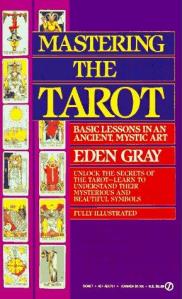
Mastering the Tarot: Basic Lessons in an Ancient Mystic Art

Author: Eden Gray

New York: Signet, 1971

ISBN: 0-451-16781-3

221 pages

My first books on cartomancy came from the public library, which segued into my introduction to tarot, but after acquiring the Rider Waite to begin my serious study, the book I picked up was Eden Gray’s Mastering the Tarot. Mastering, Gray’s fourth publication, is now considered one of the seminal modern works on the tarot. Concise, comprehensive, and timeless, Mastering has remained one of my go-to references from my personal tarot library. In spite of my many new book acquisitions over the last fifteen years, I find myself returning repeatedly to Gray’s book.

Mastering is subdivided into lessons. Lesson 1, Preliminary Steps, will help familiarize the reader with the cards. Basic structure is explained, as are logistical matters, such as caring for the cards. Lesson 2 sets forth general observations and patterns in the Minor Arcana. An overview of suit associations is provided. Then the subsequent Lessons 3, 4, and 5 provide interpretations for the pip cards, or Aces through Tens, in the Minor Arcana. A one page profile is devoted to each card, with a description of the card’s symbolism, a standard interpretation of the card upright, and a standard interpretation of the card in reverse. Gray’s interpretations seem heavily influenced by the Golden Dawn school of thought. The card lessons are organized in sets, by number (e.g., all four Aces side by side, all four Twos, all four Threes, etc.), deviating from the majority of tarot reference books, which group the cards by suits (e.g., the suit of Wands, Ace through King, then the suit of Cups, suit of Swords, suit of Pentacles). Gray’s organization worked for me because like Gray, I integrate numerology into my approach and thus chapters sectioned off by numbers helped to reinforce into my memory the numerological attributions of the cards. Lesson 6 reviews the court cards, Pages through Kings, and then Lessons 7 through 10 provides the interpretations for the Major Arcana, grouped in thirds. Gray seems to maintain a substantially literal interpretation of court cards, though she does gloss through a few figurative interpretations. Overall, card interpretations take up about 56% of the book, so in terms of reference manuals keyed to the Rider-Waite-Smith system, Mastering is the book to have.

However, for the beginner tarot practitioner with no prior experience, Mastering may leave a lot to be desired. As mentioned, the book comprises mostly of card interpretation. The basic learning steps from new tarot deck to reading spreads is rather sparse in Mastering. Lesson 11 does offer a chapter on how to read cards, shuffling, selecting significators, and synthesizing card meanings, but all of that is consolidated into a single chapter. For the intermediate practitioner or even the quick learner, that won’t be a problem; but it does make Mastering an ill fit for the true beginner.

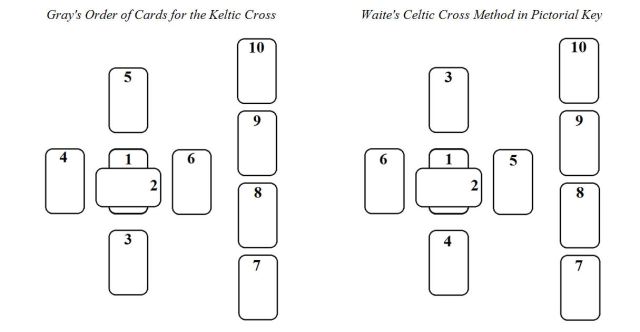
The main tarot spread that the book teaches is the Keltic Cross Method, which Gray devotes an entire chapter to. Although Gray’s card interpretations are rooted in the Golden Dawn system, her order of the cards in the Keltic Cross spread differs from the Celtic Cross Method suggested by A. E. Waite, an adept from the Golden Dawn. The diagram on the following page of Waite’s Celtic Cross Method is from his book Pictorial Key to the Tarot (1911). It is provided here to compare with Gray’s Keltic Cross. I have adopted Gray’s ordering of the cards.

grayvswaite

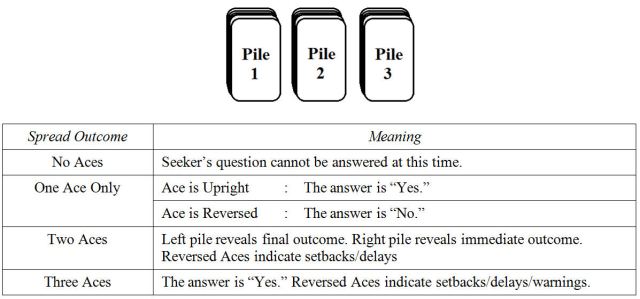
Waite’s order of cards in the Celtic Cross spread seems to be inspired by the Catholic sign of the cross while Gray’s Keltic Cross approach makes more chronological sense, i.e., lay down the foundation and past first. Gray also provides sample readings with the Keltic Cross, which help the reader understand the spread’s practical application. A few more spreads are explained in a subsequent lesson, though they seem to be added as an afterthought. One spread from Lesson 14 struck my fancy, though: the Three Aces spread. For yes or no inquiries, after shuffling, turn the cards over one by one facing up and stop when either an Ace is turned or the 13th card, whichever comes first. Once an Ace or the 13th card is drawn, move on to start a second pile to the right of the first pile. Again, stop at either an Ace or, if no Ace is drawn before the 13th card, then up to the 13th card. Continue until three piles are formed. If no Aces are drawn, the question cannot be answered. One upright Ace indicates a “Yes.” One reversed Ace indicates a “No.” If there are two Aces, the one to the left reveals the final outcome; the one to the right reveals the immediate outcome. Three Aces mean “Yes,” though reversed Aces suggest setbacks or delays. Gray’s Three Aces spread is one of my favorites for quick questions.

3acesspread

Most tarot practitioners integrate an esoteric or philosophical paradigm with their approach to tarot and for Eden Gray, her approach is influenced heavily by astrology. The ending lessons in Mastering associate tarot and astrology, applying astrological concepts to tarot divination theory and additional spreads. The astrology enthusiast will find Lessons 15, 16, and 17 highly informative.

The final lesson of the book, Lesson 18, covers tarot ethics, “The Use and Misuse of the Tarot.” Her chapter on ethics, however, can be summarized into one rule: don’t read the tarot in a way that fills other people’s heads with negative ideas about themselves or their futures. She dedicates an entire chapter to convey that singular message, though indeed it is an important one.

My only negative criticism of the book is not even a fair critique. The opening pages present tarot as an ancient mystical art passed down to us from the Egyptians and gypsies, which most of us now understand to be an unverifiable myth. The tarot was conceived as a card game, one played predominantly by the wealthy, and though cartomancy generally endured throughout history, using the tarot for divination only became popularized in the 1900s, most notably by the Hermetic Order of the Golden Dawn. However at the time of the book’s publication, the 1970s, portraying tarot as an ancient mystical art was the trend. It is not clear that Ms. Gray would have had access to any kind of information or research that ran counter to that presupposition. Thus, the “historical” introductory overview of tarot in Mastering that frames it as having “ancient mystical origins” is more of a reflection of the times than it is of Gray’s work.

Mastering the Tarot has had a considerable influence over the formative years of my tarot education. As important as the works of Papus, Paul Foster Case, and A. E. Waite’s card interpretations are to tarot studies today, Eden Gray will undoubtedly join their ranks in 50 years time, if she hasn’t already.