In Chapter 33, the final chapter of my forthcoming book Holistic Tarot (coming out January, 2015; you can pre-order now!), I talk about how I got started in tarot.
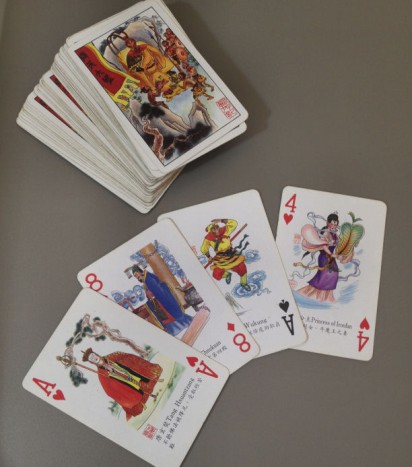
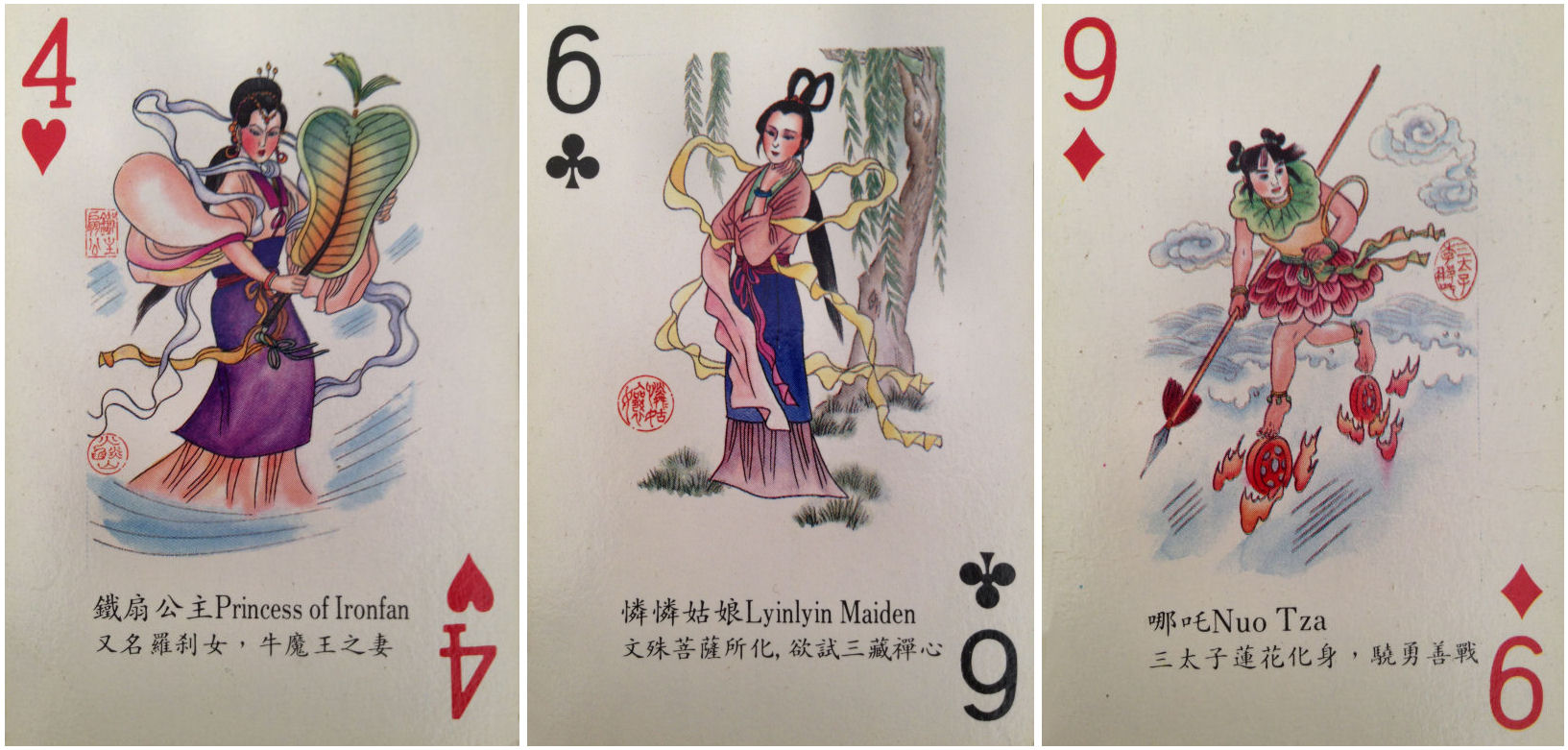
In elementary school I acquired a standard 54-card playing deck from Taiwan that depicted the characters of one of my favorite classical Chinese novels, Journey to the West (西遊記). While writing that chapter, I thought back fondly of those early memories, that large deck in my hands, shuffling carefully so that none of the cards would fall out (as the deck was large for my hands), fanning the cards out and selecting a couple to study, like maybe the characters on each card that had been drawn out into the spread held some meaning to my life. You could say it was my earliest foray in cartomancy.
As I wrote, I worked from my memory of that Journey to the West deck, figuring it was still back on the east coast in my childhood home, if not lost for good. Recently, the Hubby and I cleaned out all our old storage boxes and I stumbled across that Journey to the West deck I talked about in my tarot book. I couldn’t believe it! I had managed to save it all those years and not only save it, but for reasons now lost to me, I bothered to bring it with me when I moved out here to the west coast!
In my memory, the cards were huge and required careful maneuvering. However, now that I have the actual deck in hand, they’re quite small. Gasp. The cards shrunk! That or I grew up.
I recount this as calmly as possible. That is said more for my frame of mind than yours.
I had stumbled upon a fortune teller in Chinatown sitting at a makeshift tabletop. The chairs were miniature and when sitting, your knees would be up next to your ears. What had intrigued me to stop and listen in was her method of fortune telling: the tarot. You don’t see tarot divination that often among the Chinese, so of course I had to observe. A young woman about 20-ish years of age and her friend sat across from the fortuneteller. From what I overheard, the question was about love.
The fortune teller used what appeared to be a Marseille-based deck. I couldn’t figure out a discrete way to take photographs, so let’s assume my memory is good and go with the below reenactment, using the CBD Tarot de Marseille.
Let’s say you’re going to be planted somewhere for an extended period of time to do quick tarot readings. You could be at a corporate event or party– you and your tarot deck being the entertainment for the night; or you’re at a café doing readings for complete strangers for tips and practice; or you’re at a fundraiser doing readings for donations to your favorite non-profit. Whatever the case may be, you don’t have the time to do a full-length Celtic Cross for every jane and joe who walks by but a 1-card or a 3-card spread on the table isn’t going to look quite as impressive. Also, the range of questions you’re going to get in a very short time frame will run the whole gamut, so you still need something versatile.
Well I’ve got a technique you could try out.
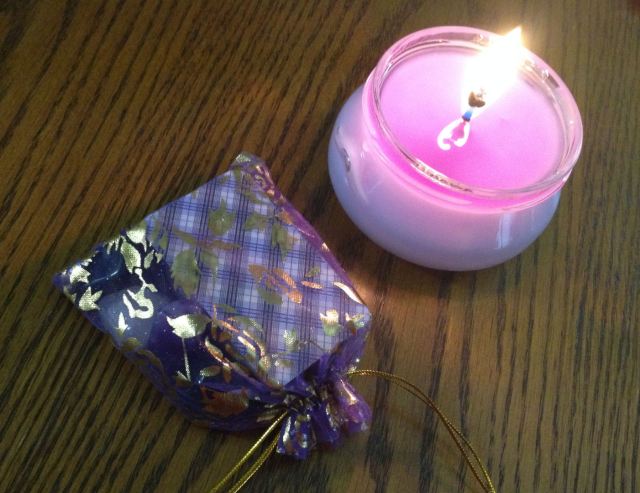
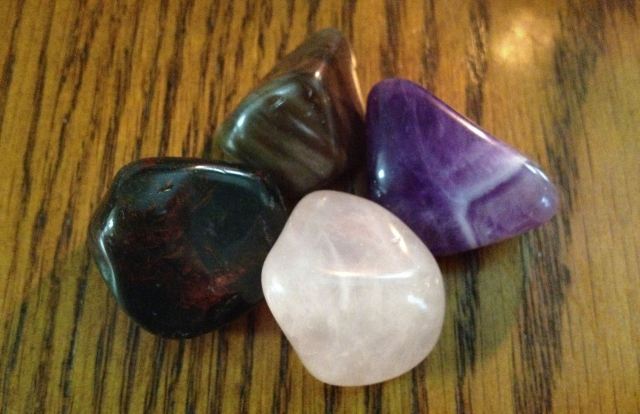
To demonstrate I’ll be using my miniature Rider Waite, which I carry with me in my purse at all times, but I’m guessing you’ll be using a normal size deck for your reading event. In the baggy with my mini tarot deck are four gemstones.
At the top-north point above is a piece of polished and tumbled petrified wood; bottom-south is rose quartz; east is amethyst; and west is green moss agate: Wands-Fire; Cups-Water; Swords-Air; Pentacles-Earth, respectively. These four stones will anchor every reading. I’ll set them out right to left corresponding with IHVH and utilizing a technique derived from the First Operation of the Opening of the Key method.
I’ve been observing dozens of professional tarot readers conduct their readings. The observations prompted me to think about the practice of describing the tarot cards to the querent (or seeker).
For example, if a seeker asks whether she will find love in the coming year and you the tarot reader draw Key III: The Empress, which of the below better reflects your response?
[ A ] . “I drew The Empress, the card of fruition. Venus rules over this card. The Empress is a sign of love, fertility, and family. See the laurel wreath on her crown? That symbolizes your victory. The Empress is also of the Earth. Seems like not only will you find love, it could be one that finally grounds you and brings a sense of stability in your life. The number 3 here suggests to me that all good things will be amplified this year. 3 is the number of creativity. The stars on her crown symbolize hope, and there are 12 of them, which suggests creativity and artistic expression. The 12 stars also symbolize the 12 constellations of the zodiac. There might be something karmically fated about the love you will meet this year.”
or…
[ B ] . “Yes, it seems you will be having quite a fruitful year in love. You may even meet someone you end up marrying. It’s going to be a plentiful year of romance for you, and, by the way, a year filled with creativity.”
Method A takes longer because you are identifying and describing the card first before interpreting it for the seeker. It also got me wondering: how many seekers really care about the cards? Are they requesting a reading to learn the names of the tarot cards? Does knowing that you pulled a Seven of Swords or Nine of Pentacles really mean anything to them? Or do they just want the answers to their questions?
If, however, you subscribe to the notion that the signs and symbols of the cards are the language of the unconscious and as a tarot reader, you are just an interpreter, then by providing the signs and symbols to the seeker, that person might be able to get more from the meaning than you were able to see. So why wouldn’t you provide the signs and symbols on the chance they might see something you didn’t? Any bilingual person understands this concept on an intimate level.
As for Method B, it is more direct. It answers the seeker’s question right away, which I have to assume is what most seekers want from you–a straight answer. I wonder if they really care about the elemental dignities of The Empress, the planetary influence, or what the empress depicted on the card is wearing.
A deformed Celtic Cross due to space constraints. The Mary-el Tarot.
At the intermediate level, every tarot practitioner should have a repertoire of at least 7 spreads. Now note that as an advanced reader, you will have fully developed your personal practice approach and may have only one spread that you always use, no matter the inquiry or situation, or a repertoire of spreads that are very different from the ones mentioned here, or an altogether different intuitive approach to readings. All that is developed with time, however, so at the intermediate level, expose yourself to as much as possible and master a minimum of 7 spreads to empower yourself as the most adaptable and efficient reader you can be.
In my own practice I customize and design new spreads on a case by case basis. I also employ a variety of techniques to answer questions–operations from various Golden Dawn methodology (or my adaptation of it), card counting, etc. However, I do insist tarot students who have gained a proficient understanding of the card meanings and who know the basics of tarot interpretation to begin building their repertoire. There are 7 spreads you should know by heart at any given time:
A 3 card reading spread
A 4 card reading spread (or a 5 card reading spread)
It’s perplexing that I would take so long to acquire the Mary-el Tarot but it did, just over 2 years from its publication date (February, 2012) by Schiffer Publishing. Now that I have it, I’m even more perplexed at myself for the delay. I’ve been hearing about it here and there, reading reviews, seeing vlogs about it, and even articles in various tarot publications.
Get this deck. No wishy-washy preceding terms like “consider…” or “perhaps you might like…” or “I personally suggest…”– No. Get this deck. You should get this deck.
Unless, of course, you only like paintings of pastel rainbows and pretty little kittens and unicorns, absolutely cannot tolerate nudity for whatever reason, or you can only use the straightforward Rider-Waite tradition or you can only use the Marseille or you can only use the Thoth. If any of those are true about you, then yeah, forget it. Stick with what you know. Otherwise, Get. This. Deck.
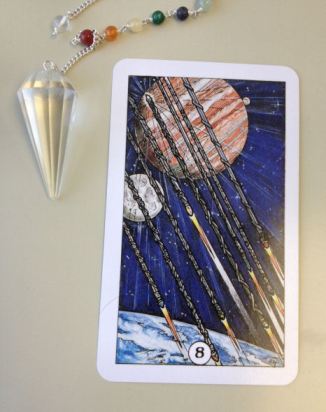
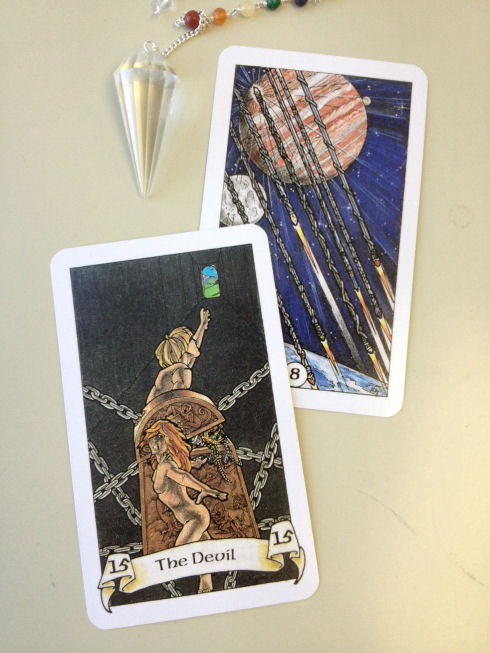
I did not want to post about this. The tragedy hit a bit close to home for me and both Hubby and I have been on top of the updates about the situation in as real-time as it can get. This afternoon I spent some time concentrating on the matter and had my trusty Robin Wood tarot deck on hand. I went through the deck to select a signifier and from the Robin Wood deck, the Eight of Wands leapt out at me as the signifier to read with for Malaysia Airlines Flight 370. Quietly, and what was going to be privately, I drew a single card for the matter. What happened next took me by surprise.
I drew Key 15: The Devil. If that isn’t compelling enough, look at the imagery on the card. I happened to select the Robin Wood tarot to read with, which is a deck with a unique take on The Devil card, different from the traditional systems.
And I’m just going to leave the posting at that. I wasn’t going to share, but wow, just wow. I may not be a mathematician, but I believe the probability of me drawing that card for this reading is about 1.2%.
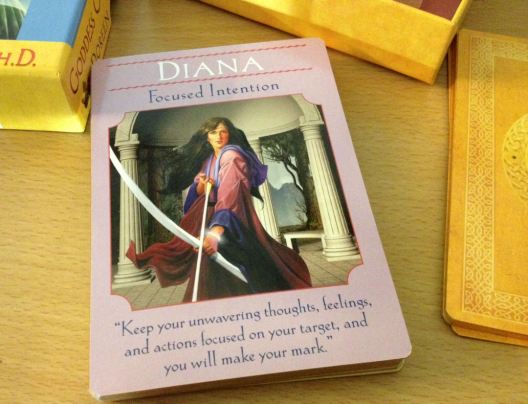
Here’s the thing. I’m such a snot. I didn’t want to like this deck. Oh no. I wanted to sneer at it. I wanted to toss my chin and hand up in the air and say, “What fluff!” But…
…I like it. I do. I really like this oracle deck. Deep down, I’m just a big fluffy bunny rabbit tarot practitioner. Because I really like Doreen Virtue’s Goddess Guidance oracle cards.
Lumping every professional tarot reader into a single category is not helpful. If you’re seeking out the services of a professional tarot reader, think about what kind of professional you’re looking for. Based on my experiences and observations, here are the different types I’ve seen:
TRADITIONAL READERS
When you think of the traditional practice of tarot reading, you’ll think of the Psychic, the Intuitive, the Empathic, or even the Holistic Reader (the Holistic may be straddling the line between Traditional and Modern–more on that later).
Each one brings a specific style and approach to the practice.
Psychic Tarot Reader. I don’t know what “psychic” means so I’m going to go fast and loose with the term. Some are self-proclaimed psychics and some have been called psychic so often by their clients that they end up reluctantly accepting the term in their title. The Psychic Tarot Reader is someone who, independent of the tarot cards, possesses the ability to see the forking paths we take, past, present, and future. They are able to, with remarkable accuracy, gauge people’s paths into the future and so, in that specific sense, seem to have the ability to see the future. In the alternative, they might be one who has a knack for communicating with other-worldly (so-called supernatural) spirits. Physiologically from birth, these readers have a particular gift, though that gift can be trained and improved (or suppressed). Now, put a deck of tarot cards in their hands and something magical, well, psychic, happens. My only concern with Psychic Tarot Readers is they make up about 1% of tarot readers, if even that, and so from the standpoint of a lay person, differentiating between a legitimate Psychic Tarot Reader and a charlatan is not easy.
Intuitive Tarot Reader. The Intuitive Tarot Reader is also someone who possesses a remarkable gift, though it is a bit different from being psychic. The Intuitive Tarot Reader has this uncanny ability to pinpoint the truth. From somewhere hardly rational, they can help you separate fact from fiction in absolutely the most rational sense. Intuitive Readers are like Swords: they cut away at all the irrelevant underbrush and help clear the path for you toward understanding.
Empathic Tarot Reader. If the Intuitive is someone who can make a beeline for the truth in any situation, the Empathic Tarot Reader is someone who feels exactly what you feel, who can sense energies in an environment and extract accurate emotional data from those energies. Since emotions are our truths, what the Empathic and the Intuitive do aren’t terribly different. They get to the same destination through different means. Empathic Readers are like the Cups (or Chalices). Empathics are incredible spiritual counselors. (That, however, should be distinguished from licensed counselors.) Empathics feel what you feel and because of that, understand you in a way no one else seems to understand you. That mutual sense of understanding can be cathartic and validating and just what was needed to help you move onward.
Holistic Tarot Reader. The Holistic Tarot Reader incorporates other practices with tarot to provide, well, a holistic experience. They’ll bring in numerology and astrology and runes and after the tarot reading, maybe draw an oracle card, or consult the I Ching. They have a sense of what incense can stimulate what, what gemstones and crystals amplify what energies, and generally draw from an expansive body of learned knowledge to integrate with the reading. In terms of how they read cards, they consider the context of the tarot signs and symbols, the esoteric knowledge that such imagery reference, and apply metaphors and archetypes to help you understand the fuller context of your situation. Intuitive and Empathic Readers may also be Holistic with their practice, but not all Holistic Tarot Readers are Intuitive or Empathic.
NOTE: Very few professional tarot readers fit neatly into just one of those categories. Each one will be a combination of the above, though they may be predominantly Intuitive or predominantly Empathic. Psychic Readers tend to be both. However, not all Intuitive and Empathic Readers are Psychic. Hope that makes sense. Also, very few tarot readers are one trick ponies, and so most of them are going to be Holistic to some degree.
MODERN READERS
Though we live in modern times, most tarot readers today still follow a traditional practice, as set forth above. Yet a few new types have cropped up in the last decade or so.
Holistic Tarot Reader. See above under Traditional. While Holistic Tarot Readers have probably been around since the early ages of tarot reading, a more defined approach with holism in mind did not come about until recently, so I include them in both listings, Traditional and Modern. The modern Holistic Reader may incorporate reiki, for example, or feng shui, or they’ll talk to you about chakras during your tarot reading. Your sessions with them might get heavily influenced by transpersonal psychology.
The Tarot Counselor. This professional is a licensed counselor, social worker, or therapist. The law says this person can get paid for counseling services because said person has received the proper institutionalized education necessary. In addition, the Tarot Counselor is a skilled tarot reader and integrates tarot into his or her counseling work. I don’t know if maybe it’s just the group I hang around or what, but from my vantage point, this type of tarot reader is growing steadily in numbers. The psychoanalytical aspect of tarot reading is becoming more popularly recognized today and looking less and less occult. If you’re looking for a counselor or therapist, consider one who uses tarot.
The Tarot Life Coach. It’s my understanding that life coaches do not need to be licensed or certified, but certainly correct me if I am wrong. Anyone can start a business service as a Life Coach with no required education, training, licensing, or certification (kind of like tarot readers). In a nutshell, Life Coaches help you identify your goals and then help you formulate a strategic plan to accomplish those goals. Then, they’re supposed to be there for you every step of the way to motivate you. Again, the incredible power and utility of tarot is recognized by modern professionals and many Life Coaches work with it to help their clients.
The Tarot Interpreter. The Tarot Interpreter sees tarot as a book, a prophetic text or simply, a tool that reflects that which is in the unconscious into the conscious plane so that such information can become of use. Book or tool, someone with specialized knowledge and a wealth of experience with the cards can read tarot in an optimally precise way. Like one of those TI-85 calculators– any dope can pick one up and use it, but without that specialized knowledge and training, good luck doing anything interesting with one! The Tarot Interpreter works as a translator. You approach the tarot directly, in effect, and then the Tarot Interpreter translates the language (the signs and symbols) of tarot to one you might better understand.
* * *
Tarot professionals will develop their own style of reading and that style is typically a hybrid of some of the above types. I’d say I’m a Holistic Tarot Reader and Tarot Interpreter mix. While it would be nice to see tarot professionals offering key information about their reading styles so that you can discern what type of reader they are, that might not happen. My recommendation is to review the above to figure out what type of tarot reader you’re looking for, and then find one with a reading approach that reflects that type.
from the CBD Tarot de Marseille by Yoav Ben-Dov (cbdtarot.com)
I grew up trained to fear the number 4. In any scenario where I had to be assigned a number, I would sit there praying that the number 4 would not appear in my assignment and dreading that it would. If my seat number in the exam room had a 4 in it, I’d take it as an omen of impending failure.
I’m not the only one. There’s a name for it: tetraphobia. If they’ve got a name for it, it means I’m not alone. The Taiwanese and South Korean navies avoid assigning the number 4 to their ships. In Hong Kong, Taiwan, Japan, and many other parts of East Asia, you’ll hardly ever see a 4th floor. It’s the 1st floor, 2nd, 3rd, and then 5th. For a race stereotyped to be good at math you’d think they’d know how to count. Hospitals don’t have a 4th floor for sure, and no room number in those hospitals will have a 4 in it.
To the Chinese, 4 means death. 4 means bad luck. 4 means misfortune. 4 means you’re going to suck at life. 4 means you are not a Chosen One. Chosen Ones never get number 4. They get, well, 1. Or 8. Chinese people love the number 8 the way tarot readers love the Ace of Cups or The World card. As for The World card, by most counts it is the 22nd card in the Majors and the theosophic reduction of 22, 2 + 2, is 4 and so take that tetraphobic Chinese people!
I guess back in the day in Chinese grammar schools, the concept of homonyms got glossed over. Everybody there missed the lesson on how a homonym is when two words sound the same but have different meanings. Different. So even though pronouncing the number 4 in most East Asian languages and dialects sounds the same way one might pronounce the word for death, the two words should still retain their different meanings.
Not so to the Chinese. Just because the number 4 sounds like the word for death, suddenly 4 means death. There’s some serious issues with logical reasoning there, which is hilarious to me, because in the Western tradition, 4 means logic, rationality. More on that later.
When I first started study of the tarot, especially when reading with a Marseille deck, numerological associations for the number 4 tripped me up. The numerological association for 4 seemed all too clear: you were doomed. 4 in batons? You’re doomed to fail at work. 4 of cups? You’re doomed to fail in love. You get the pattern. Growing up in the Chinese culture meant I hyperventilated just a little when the number 4 appeared in my life.
Tarot helped me overcome that fear of the number 4. Don’t laugh. I’m serious.
The Emperor might not be all sunshine and rainbows, but it is still a strong card with an empowering message. In western numerology, 4 symbolizes stability, like the four legs of a table or chair, the four corners of the universe, the four elements, the telegrammaton YHVH. 4 is the number of rationalism. Hey, I like rationalism– 44 means great power and physical vigor. 444 is said to be an omen of the Divine’s presence.
When four Fours appear in a tarot spread, there will be peace and order. The Four of Wands in the Rider Waite Smith deck is all about prosperity. The Four of Cups: introspection. Introspection is hardly death and doom. Four of Swords: repose, recuperation; not your preferred state of being but there is a positive message latent in the card–the loved ones awaiting your return depicted in the stained glass window, the secret weapon underneath you– whereas the number 4 according to the Chinese is straight up bad, no nuances.
Those of Life Path 4 are indispensable to a society. They’re our builders, our planners, our architects, the designers of all social constructs. People of Life Path 4 make things happen. Donald Trump, Oprah Winfrey, and Bill Gates are all 4s. Leonardo da Vinci, Mark Twain, J. P. Morgan, Paul McCartney? All 4s with 4s littered throughout their numerology charts.
Even more intriguing is how 4 is so not a big deal even in traditional Chinese metaphysics. Take the I Ching hexagrams. Hexagram 4 suggests naiveté, not death. Hexagram 14 is abundance, validation, all good stuff, like the Four of Wands. Hexagram 24 hints at progress. Hexagram 34 is a powerful, positive omen. So okay, Hexagram 44 is getting a bit darker. Entropy ain’t great news, but still. Hexagram 54 is back to positive again. I’m using the terms positive and negative very loosely here, by the way, as neither tarot nor the I Ching can be characterized with absolutes. And Hexagram 64 is like the Judgement card, give or take huge liberties with the interpretation.
The Four Pillars of Destiny (四柱命理學), which is said to date back to the Song Dynasty, is founded on the idea that there are four components to mapping out a person’s destiny chart. That destiny chart, based on month, day, year, and time (the four pillars) of birth, is supposed to be a playbook of your life. Four for life, people, not four for death!
Understanding quells fears. It is now my dedicated mission to alleviate tetraphobia among the Chinese. Or– okay– at the very least, the Chinese in my arm’s length social network…








 benebell wen