

The Hermetic Tarot by Godfrey Dowson was one of my earliest deck reviews on this blog, back in 2013. And it wasn’t even really a deck review. I don’t know what that was other than a little bit too cringe for me to try to reread now. Anyway, let’s revisit the deck and add this posting to our cluster of Golden Dawn deck discussions.

The Hermetic Order of the Golden Dawn was active for only about fifteen years, and yet consider the scope and breadth of their influence in Western occultism, especially in the world of tarot. Even fun, flighty, not-at-all-occult mass produced pop tarot decks are unintentionally influenced by the Golden Dawn.
Crowley first published a description of the Order’s card designs in The Equinox in 1912, riling MacGregor Mathers to the point of litigation to try and stop Crowley’s publication. Then around World War II, Israel Regardie published the Golden Dawn card descriptions again, and provided oversight to both Robert Wang and the Ciceros in their subsequent GD decks. The LWB introduces Dowson’s deck as one more Golden Dawn based tarot deck in the line of succession since the Order dissipated.

Dowson’s pen and ink drawings for the Hermetic Tarot were done between 1975 and 1977, with the deck published by U.S. Games in 1980. Stuart Kaplan co-wrote the LWB that comes with the cards. Kaplan remarks about the Hermetic Tarot that it is a “compelling reconstructed version of the tarot that undoubtedly will take its place as one of the most important esoteric tarot decks published during the twentieth century.”
Continue reading “Godfrey Dowson’s Hermetic Tarot Revisited”


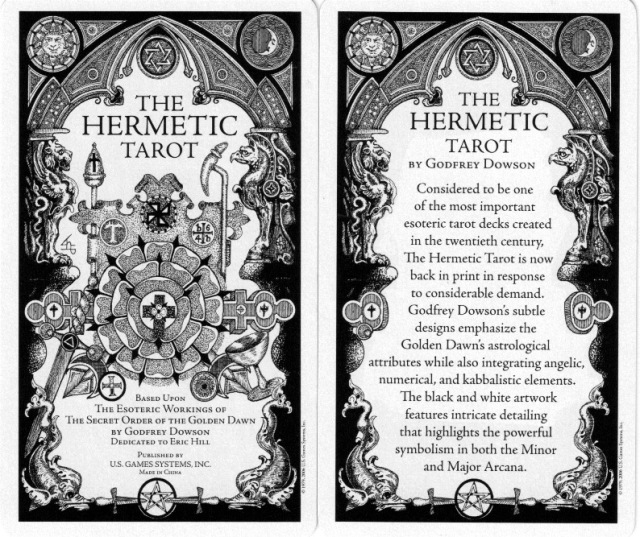
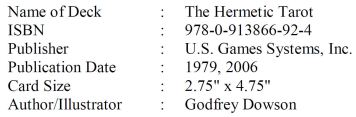
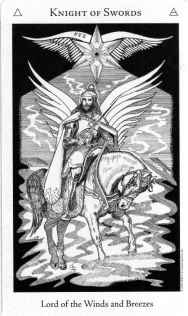 Godfrey Dowson draws heavily from elemental dignities and affinities, Western astrology as interpreted by the Golden Dawn, and the Qabalah. Corresponding alchemical symbols for the four elements and astrological symbols are embedded into each card to denote the attributions. In the Major Arcana, the Key’s corresponding Hebrew letter appears on the top left corner. In the court cards, the alchemical symbol corresponding with the classical element that the card itself represents appears on the top left and the symbol for the element corresponding with the suit appears on the top right. The Knight of Swords, for example, represents Fire (for the Knight) on Air (for the suit of Swords). For practitioners who adopt interpretive methods reliant on elemental dignities and affinities, that is a godsend. The backs of the cards are illustrated with the Hermetic Rose and hexagrams. As they are non-reversible, it may not be an ideal deck for reading with reversals. That being said, the little white booklet that accompanies the Hermetic Tarot provides the meanings of the cards in the “ill-dignified” position, as reversals are called in the booklet, which suggests that the deck is nevertheless intended for reading with reversals.
 benebell wen