

I am the guest blogger this week over at Best American Poetry and am feeling a bit like a fraud since I’m not a poet, at least not since the angry-histrionic adolescent years of poems about boys who won’t give me the time of day, printed in font size 14 in comic sans or some other curly girly font and center-aligned down the page. Hm, actually in college there was a brief period of doing slam poetry on themes of an Asian Diaspora ravaged by post-colonial ambivalence and cultural imperialism but that period is really best left forgotten too. I am, however, an avid consumer of poetry and have bookshelves at home filled with poetry collections and chapbooks, half of poets you’ve all heard of and half of poets you’ve probably never heard of.
I’m trying to think of when I first learned about the Best American Poetry series, and it turns out I can’t seem to remember a time when I was aware of literature and not aware of BAP. I read it in high school, college, and even recall sending a letter to David Lehman directly one time about a decade ago telling him I felt the BAP series didn’t include a fair representation of Asian American poets. The current series has been much better, I think, about diverse representation.
This week BAP is letting a tarot reader (me) run loose on their blog (http://blog.bestamericanpoetry.com/) and here’s what’s going to happen:
Continue reading “A Tarot Reader Guest Blogs at Best American Poetry”
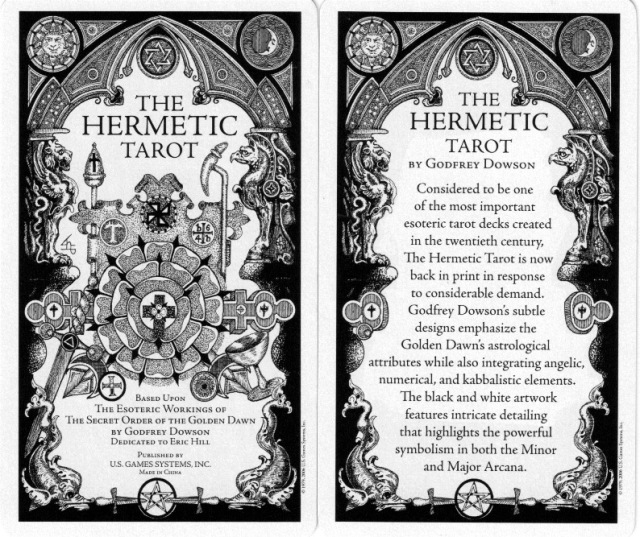
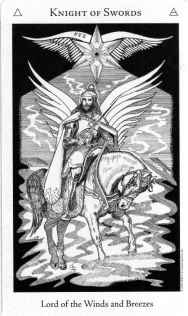 Godfrey Dowson draws heavily from elemental dignities and affinities, Western astrology as interpreted by the Golden Dawn, and the Qabalah. Corresponding alchemical symbols for the four elements and astrological symbols are embedded into each card to denote the attributions. In the Major Arcana, the Key’s corresponding Hebrew letter appears on the top left corner. In the court cards, the alchemical symbol corresponding with the classical element that the card itself represents appears on the top left and the symbol for the element corresponding with the suit appears on the top right. The Knight of Swords, for example, represents Fire (for the Knight) on Air (for the suit of Swords). For practitioners who adopt interpretive methods reliant on elemental dignities and affinities, that is a godsend. The backs of the cards are illustrated with the Hermetic Rose and hexagrams. As they are non-reversible, it may not be an ideal deck for reading with reversals. That being said, the little white booklet that accompanies the Hermetic Tarot provides the meanings of the cards in the “ill-dignified” position, as reversals are called in the booklet, which suggests that the deck is nevertheless intended for reading with reversals.
 benebell wen