ABOUT THE BOOK | READ EXCERPTS | MEDIA & MORE
TABLES & REFERENCES | COMPANION COURSE
AMENDMENTS TO TEXT | SUPPLEMENTAL WORKSHEETS

Please believe me when I say I dedicated my best efforts to making I Ching, The Oracle as polished and comprehensive as possible pre-publication, but such efforts still resulted in errors and omissions. This page will be a list of amendments to the text. I won’t go into negligible typographical mistakes, but will cover the substantive edits that I feel are important for you to hand-write into your copy of the book (or at least read and absorb into your overall understanding). Thank you for your patience.
Did you catch an error in the book that I did not list below? Please help me be as comprehensive as possible, and contact me with your notice so I can add it below and together we can help others rectify their copies of the book. Thank you!

Table of Contents
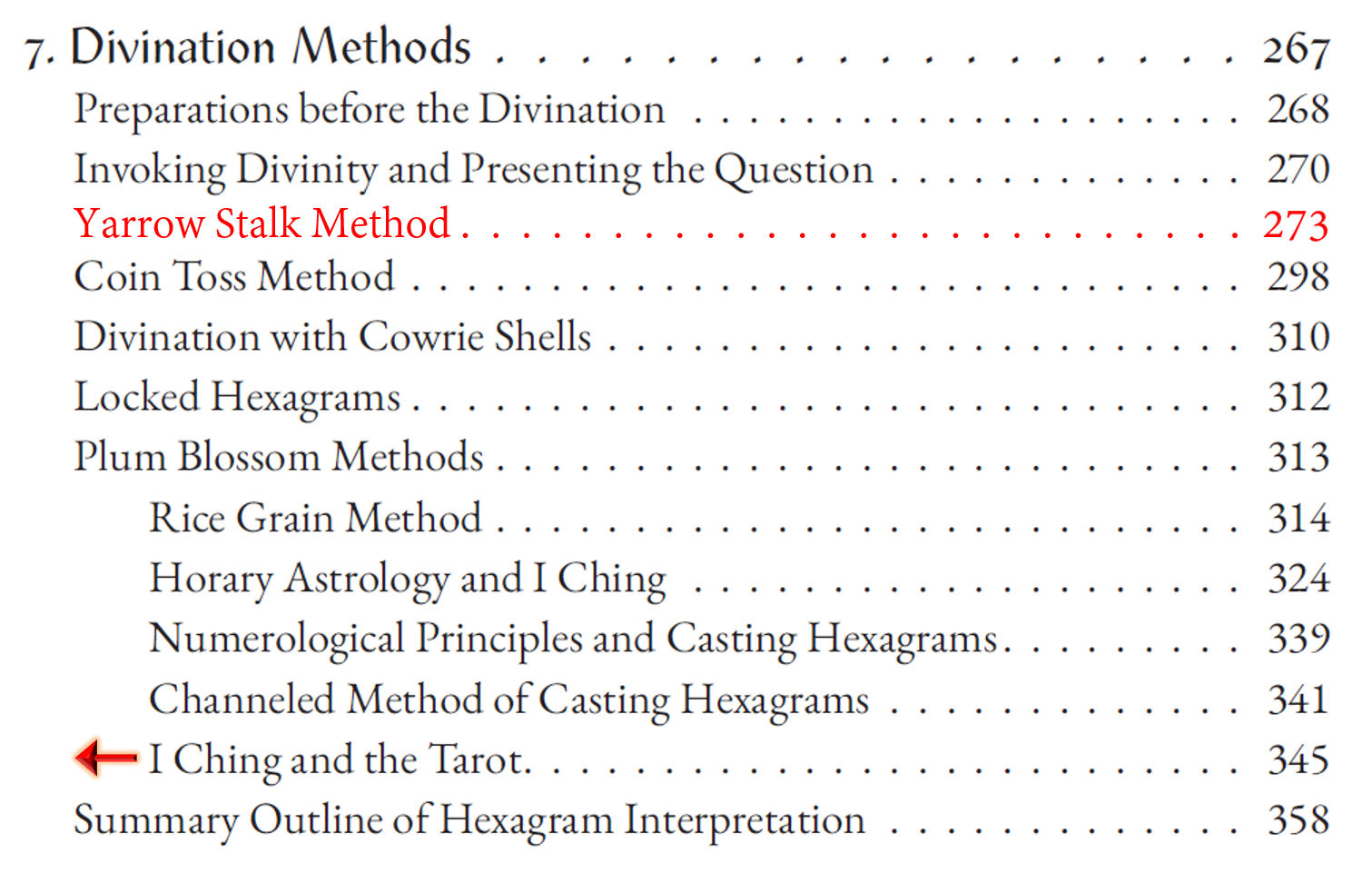
The Yarrow Stalk Method is missing from the Table of Contents. See above redline. I recommend making a note on this page of the TOC that the Yarrow Stalk Method begins on page 273.
Also, under the Chapter 7. Divination Methods heading, the sub-heading “I Ching and the Tarot” should be the second indented level, not the third. Needless to say, using the tarot and I Ching together is not a “Plum Blossom Method.” =)
List of Tables
page xvii
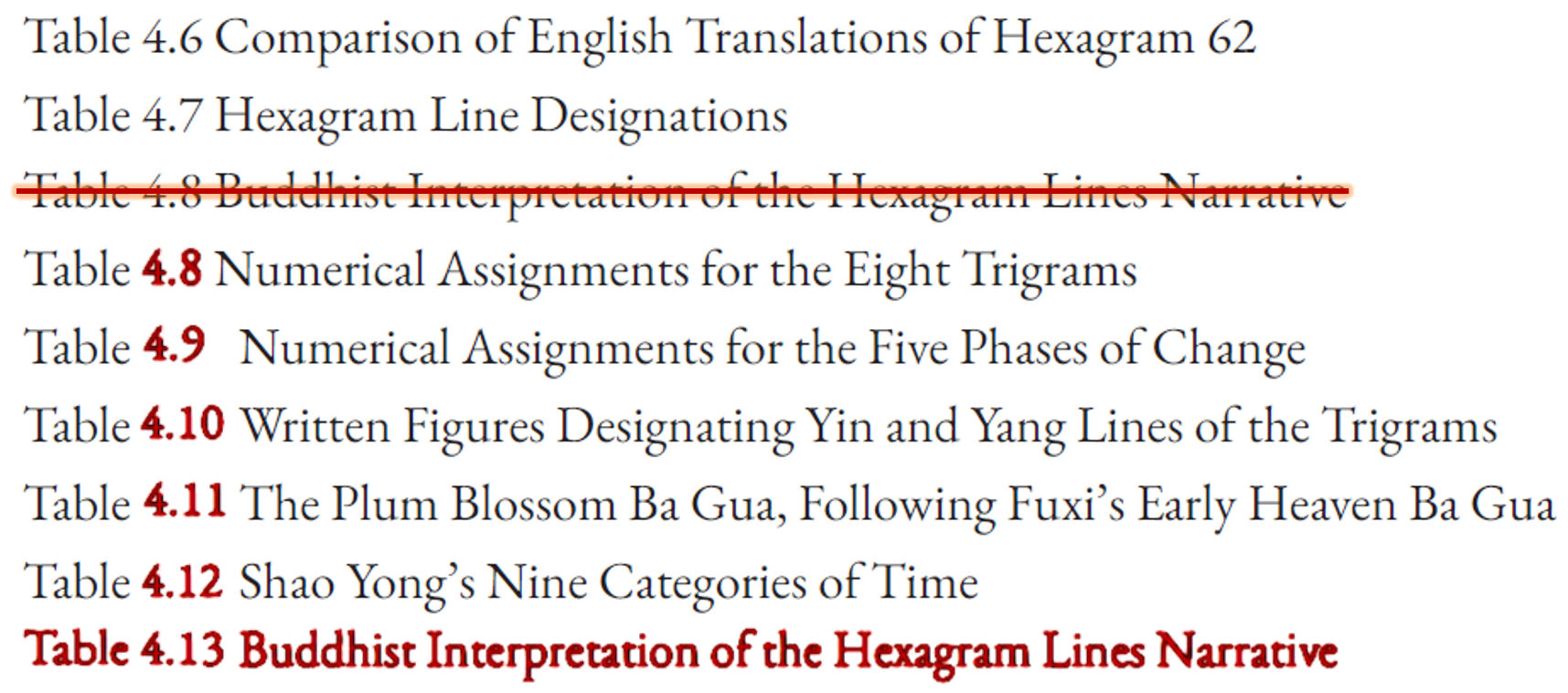
There was a slight mix-up with the Table reference numbers in the List of Tables as they correspond to the actual Table references in Chapter 4. See above corrections to the List of Tables section in the front pages.
page xix
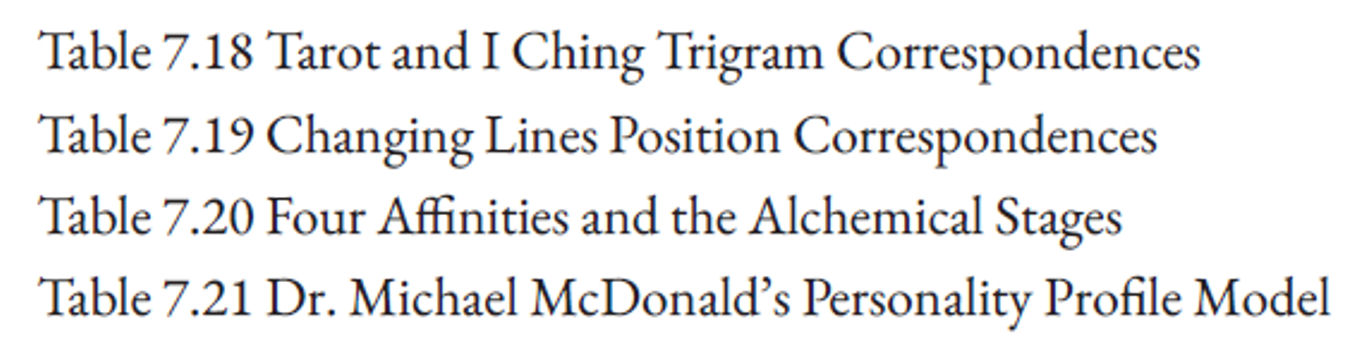
page 360
The reference to Table 7.20 Four Affinities and the Alchemical Stages is found on p. 360:

Chapter 3
Opening Lines
page 31
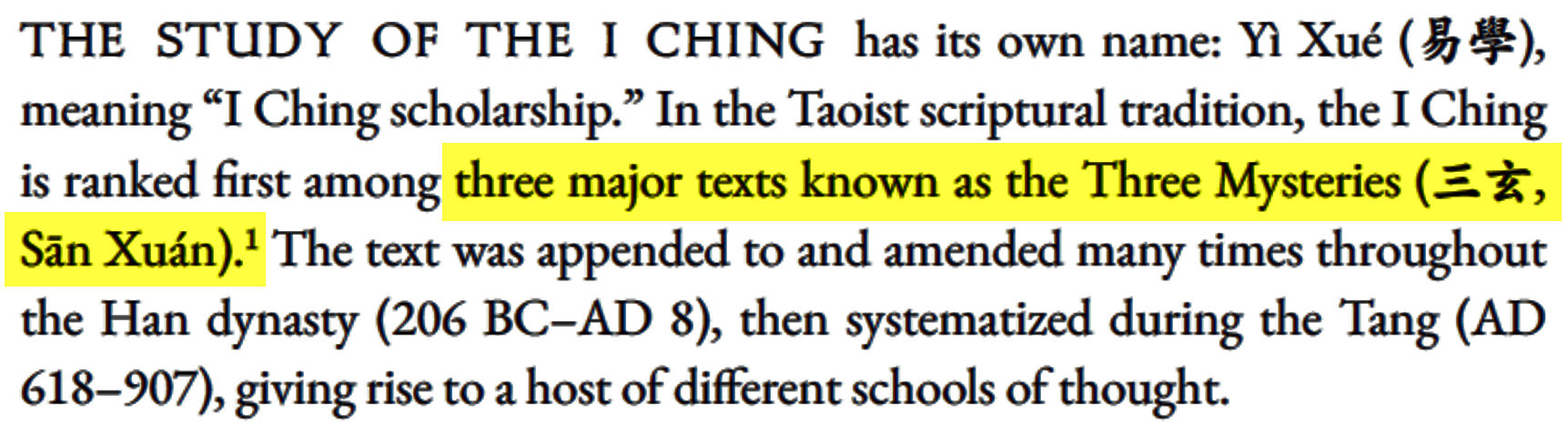
A listing of the texts that comprise of the Three Mysteries was inadvertently omitted from the end note– my own oversight, apologies. They are as follows:
- The Zhouyi (or I Ching) 周易 [易經]
- Laozi’s Tao de Jing 老子 [道德經], and
- The Zhuangzi 庄子.
The Xuánxué 玄學 or School of Mysteries (School of Metaphysics) that emerged between 200 and 400 AD sought to bridge the gap between natural science and religion through a system of thought they referred to as metaphysics (the Mysteries). According to the School of Mysteries, there are three texts one must study to understand the Mysteries. These three texts came to be known as the Three Mysteries. See Book of Sui (隋書), circa 581 – 618 AD.
There is a companion video discussion of the Three Mysteries of Taoist Scriptural Tradition, linked here.
Chapter 4
Interpreting the Hexagrams
page 99
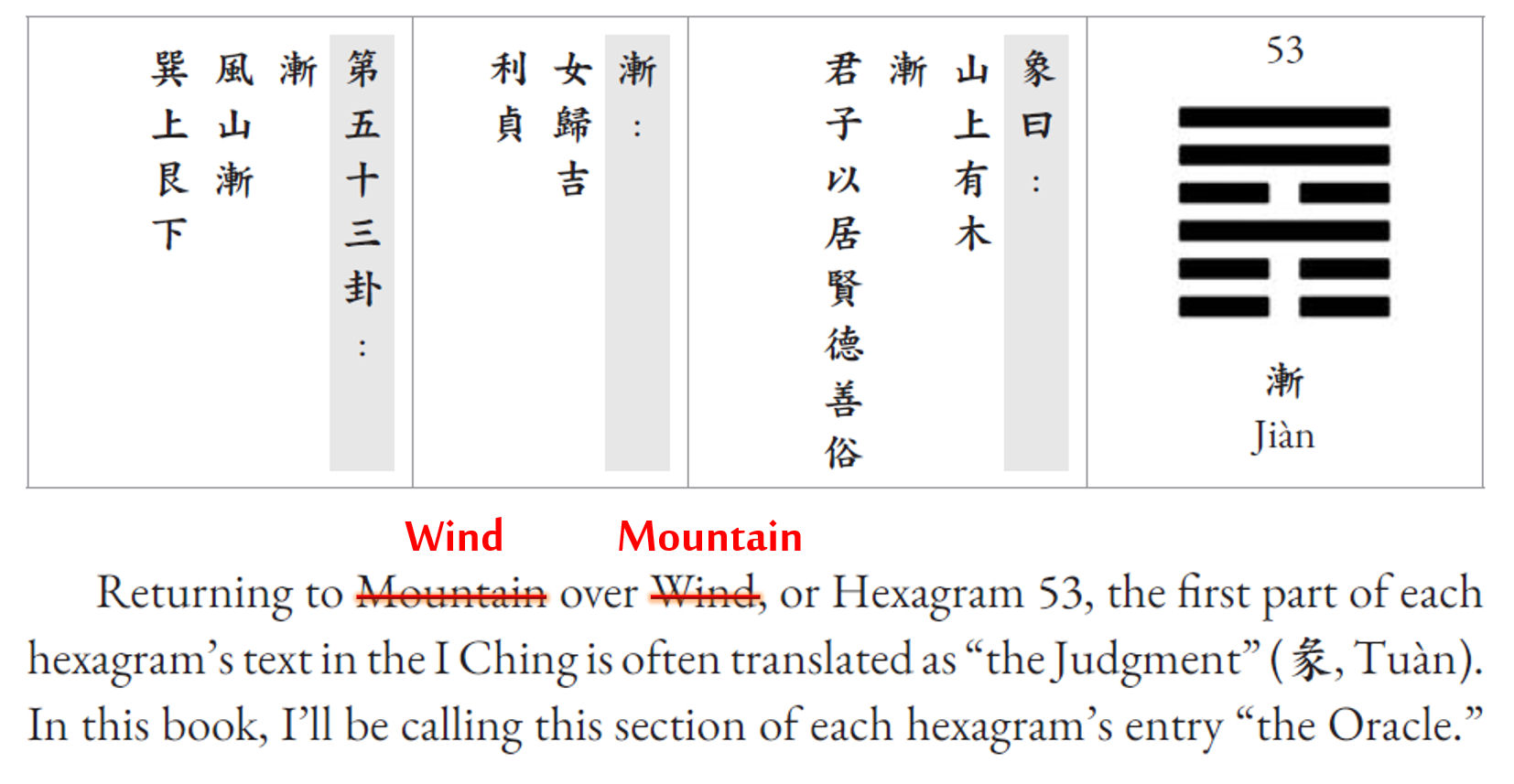
On p. 99, the trigram reference to Hexagram 53 are flipped. Instead of Mountain over Wind, it should read “Wind over Mountain.”
Practicum 4.2
page 138
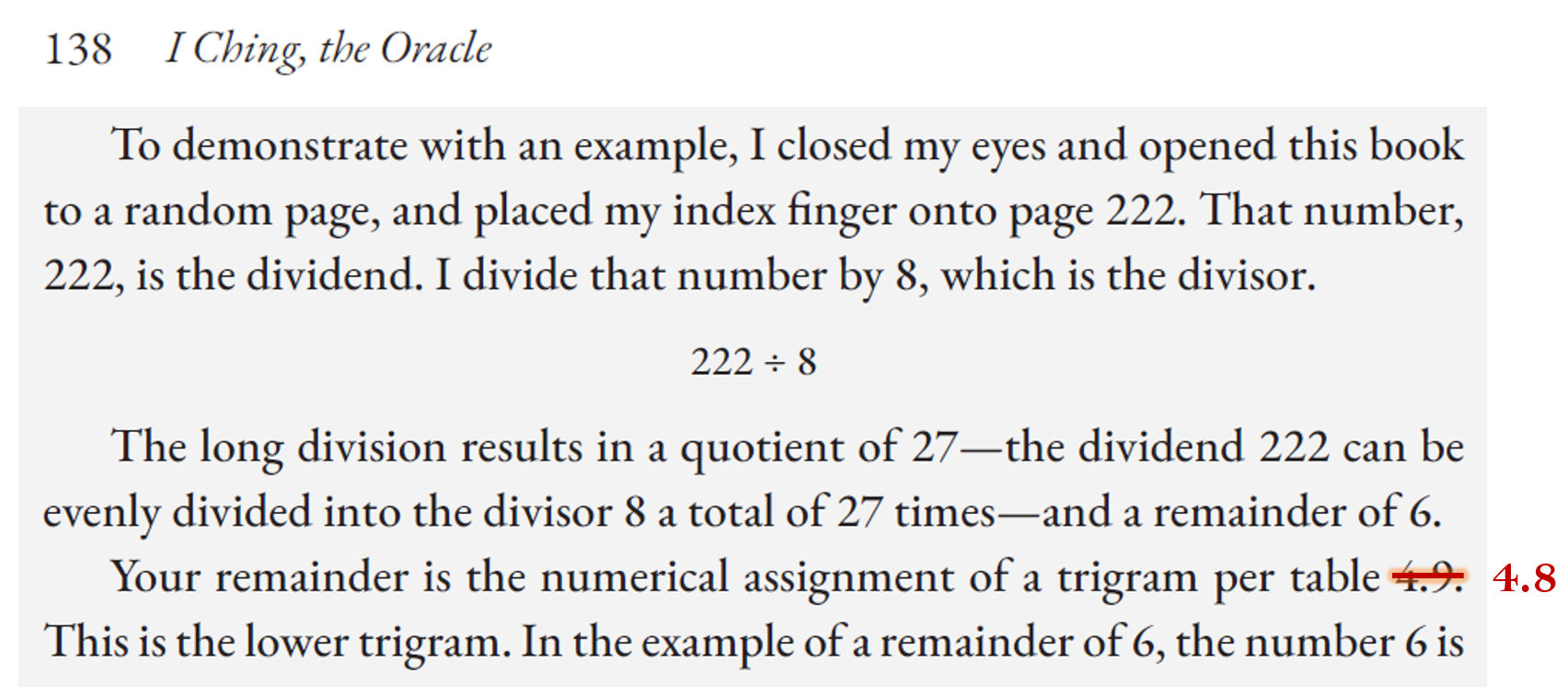
There’s a misprint in Practicum 4.2 from Chapter 4, appearing on page 138 of the text. The reference to table 4.9 should be to table 4.8 appearing on page 132 (“Numerical Assignments for the Eight Trigrams”). Thus, note also that the table reference numbers in the List of Tables from the front pages are wrong here.
Chapter 6
Practicum 6.2
page 244
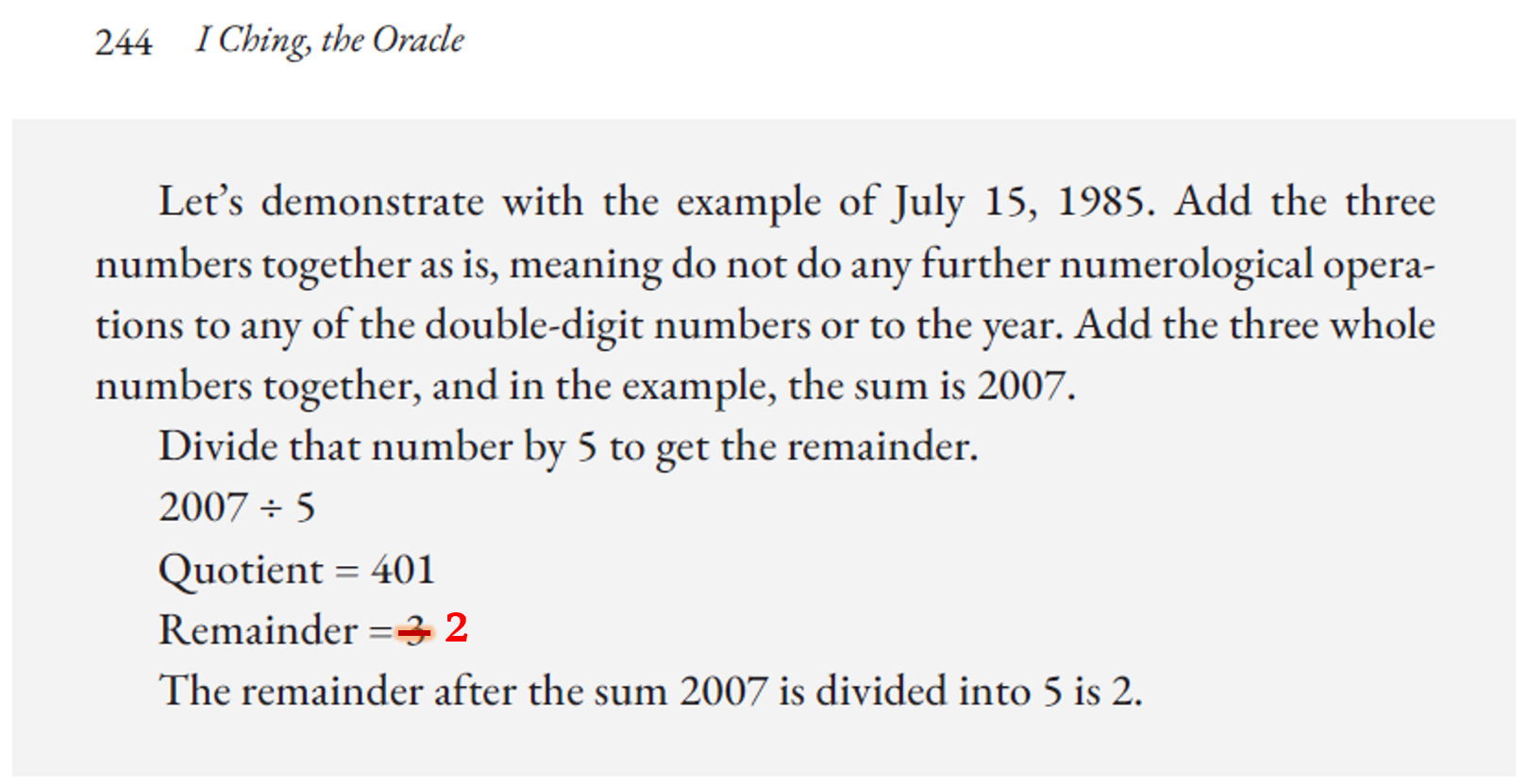
The Remainder is incorrectly given as 3. It’s 2. Fortunately, it’s corrected in the subsequent line. But to clarify any confusion, the “3” is a typo.
Chapter 8
Suggested Book Mod: Numbering the Pages
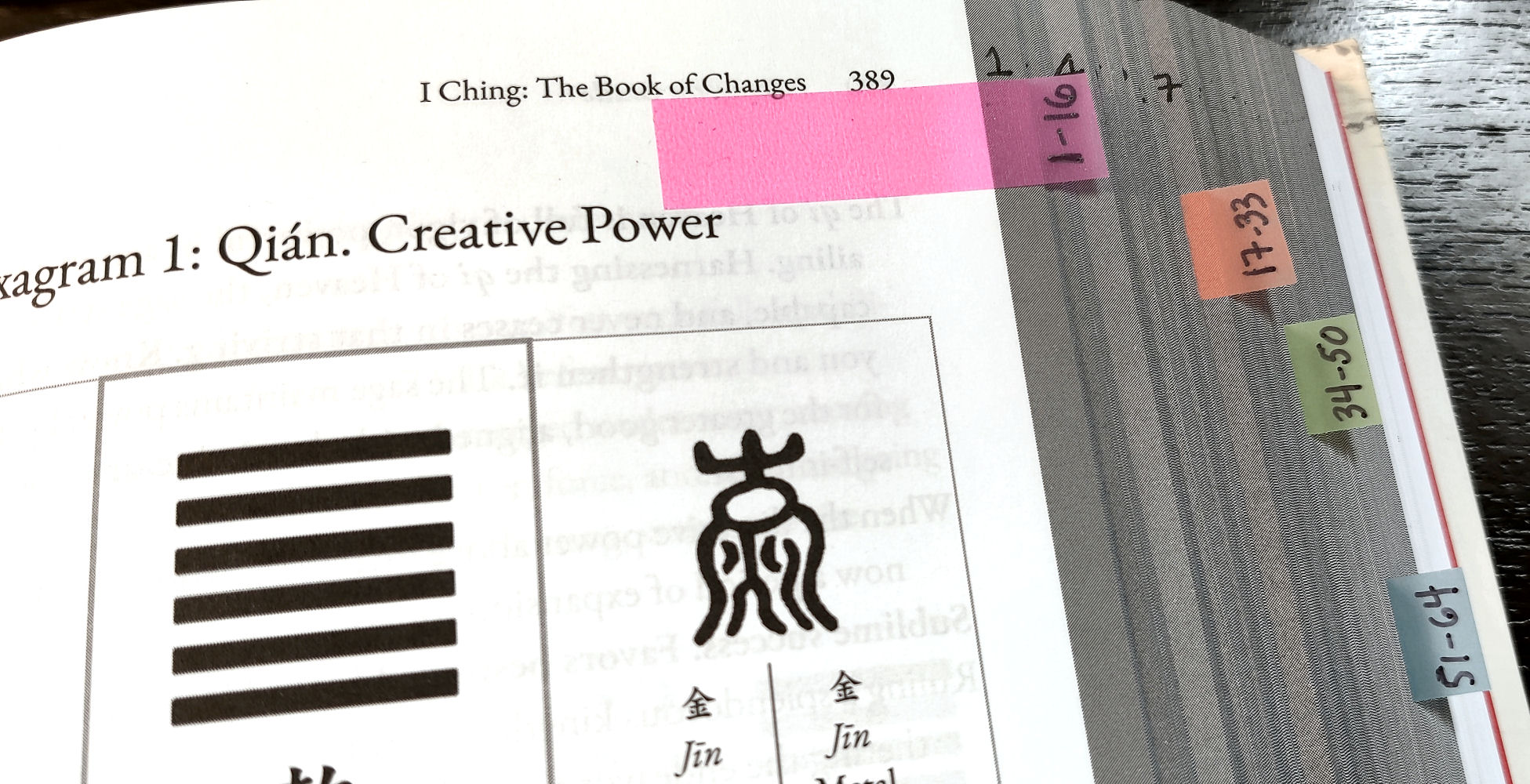
For easier referencing, I subdivided the hexagram translation pages with tabs. Personally I went with 1-16, 17-33, 34-50, and then 51-64, but go with subdivisions that make sense to you.
It’s more standard to subdivide into two sections: hexagrams 1 – 30 making up the First Sequence and hexagrams 31 – 63 making up the Second Sequence, but for easier referencing, I wanted more than two tabs.
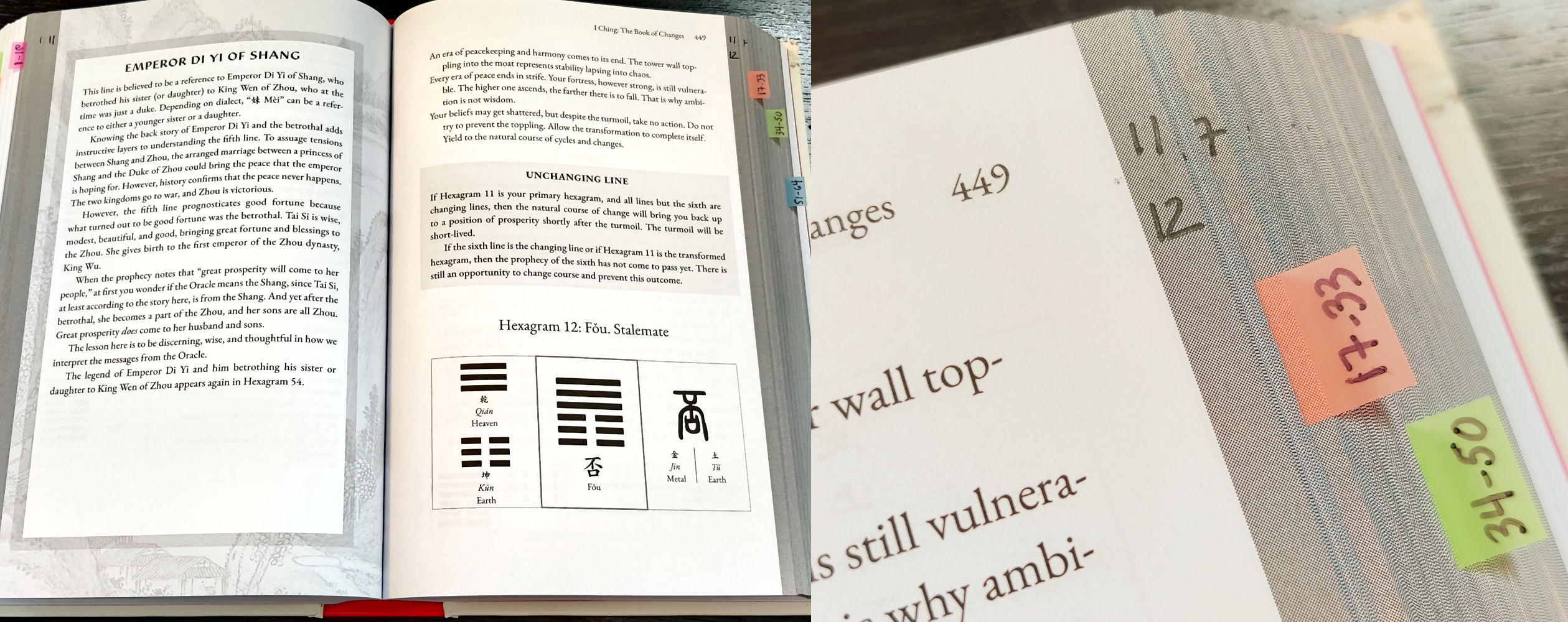
I also added hexagram numbers to the translation section, numbering 1 through 64 corresponding with the hexagram entry pages. When a page consists of the tail end of the previous hexagram and the beginning of the subsequent, I’ll write in both hexagram numbers. See what I did to page 449 above as an example. The top half of p. 449 is still hexagram 11, but the beginning of the hexagram 12 entry appears on the bottom, so I numbered this page 11/12.
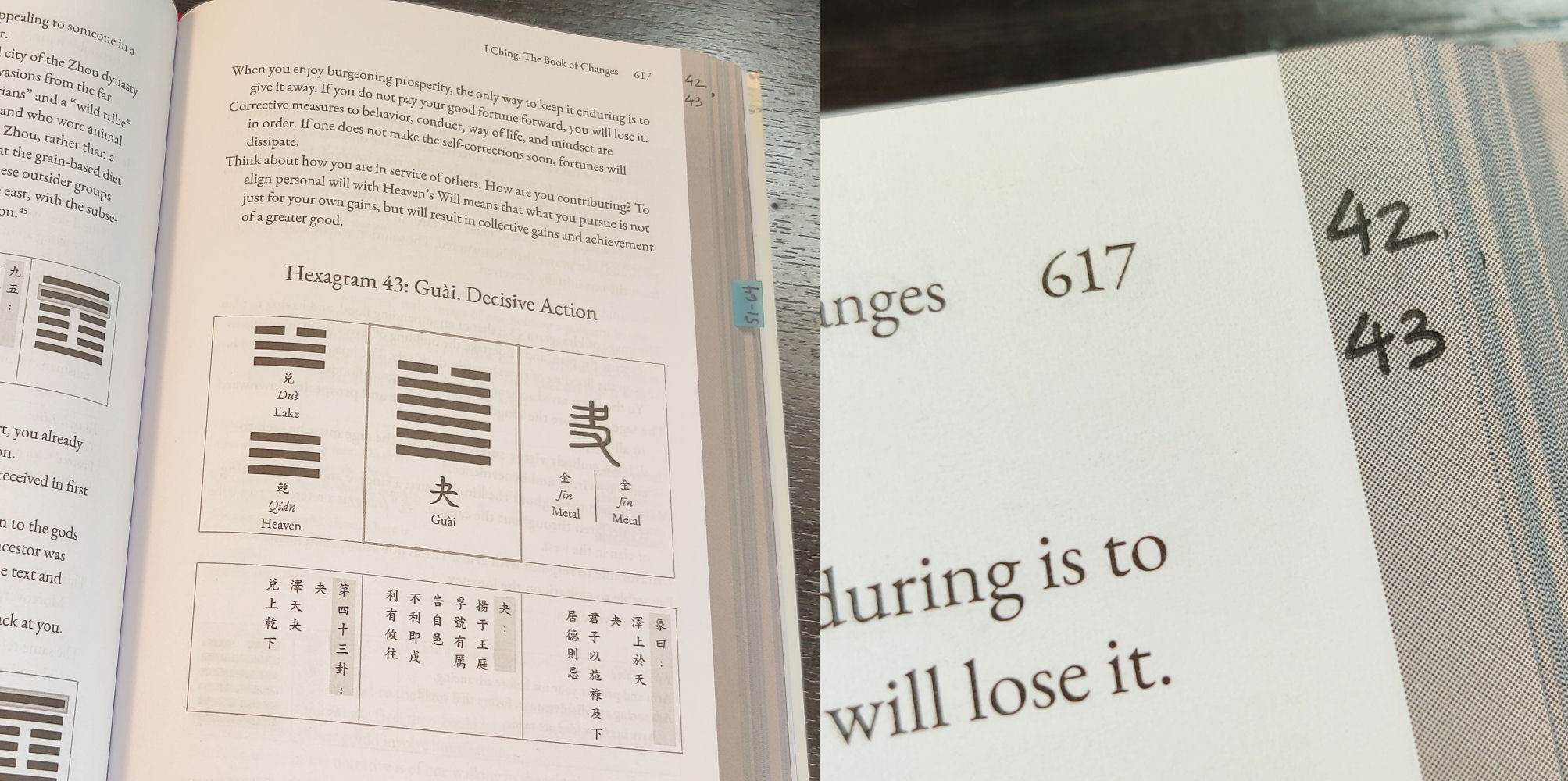
Above is another example. Page 617 consists of both the tail end of hexagram 42 and the beginning of the hexagram 43 entry, so I number the page margin with 42 and 43 as shown.
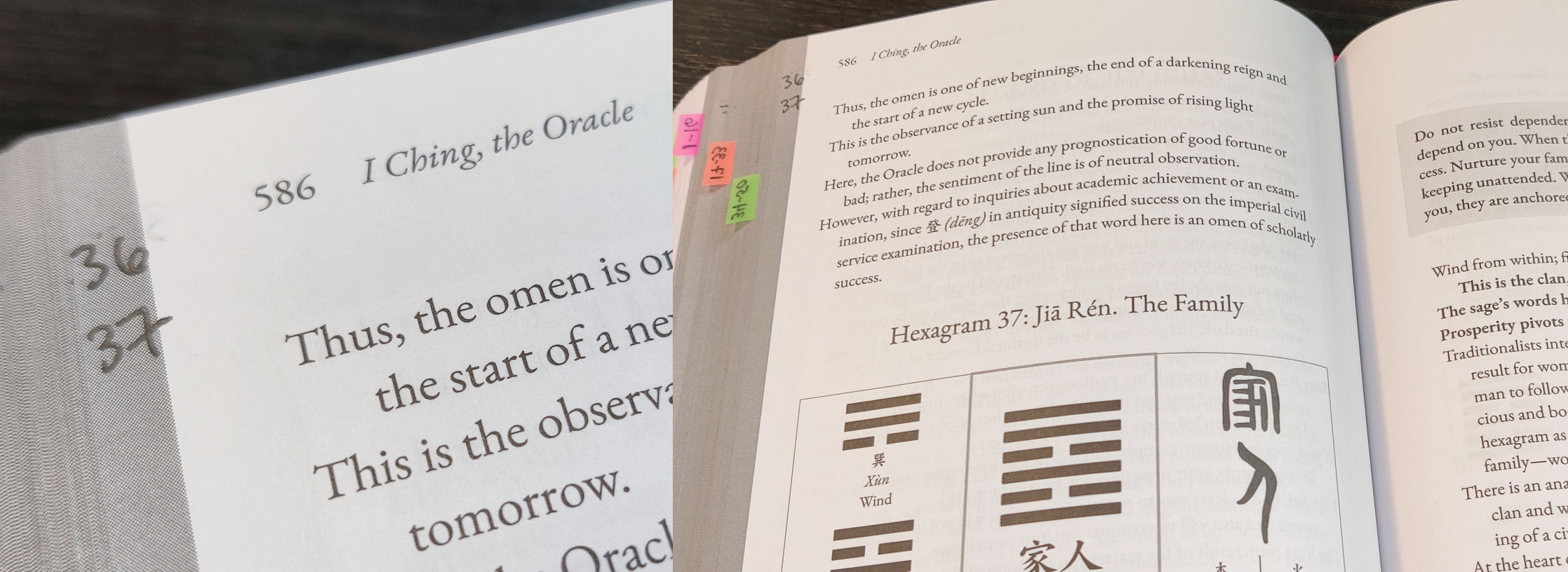
I align the hexagram reference number with the page number. This makes it so much easier to turn to the right page without having to look it up in the table of contents or index.
Hexagram 3
page 402
Oops, this one is my error.
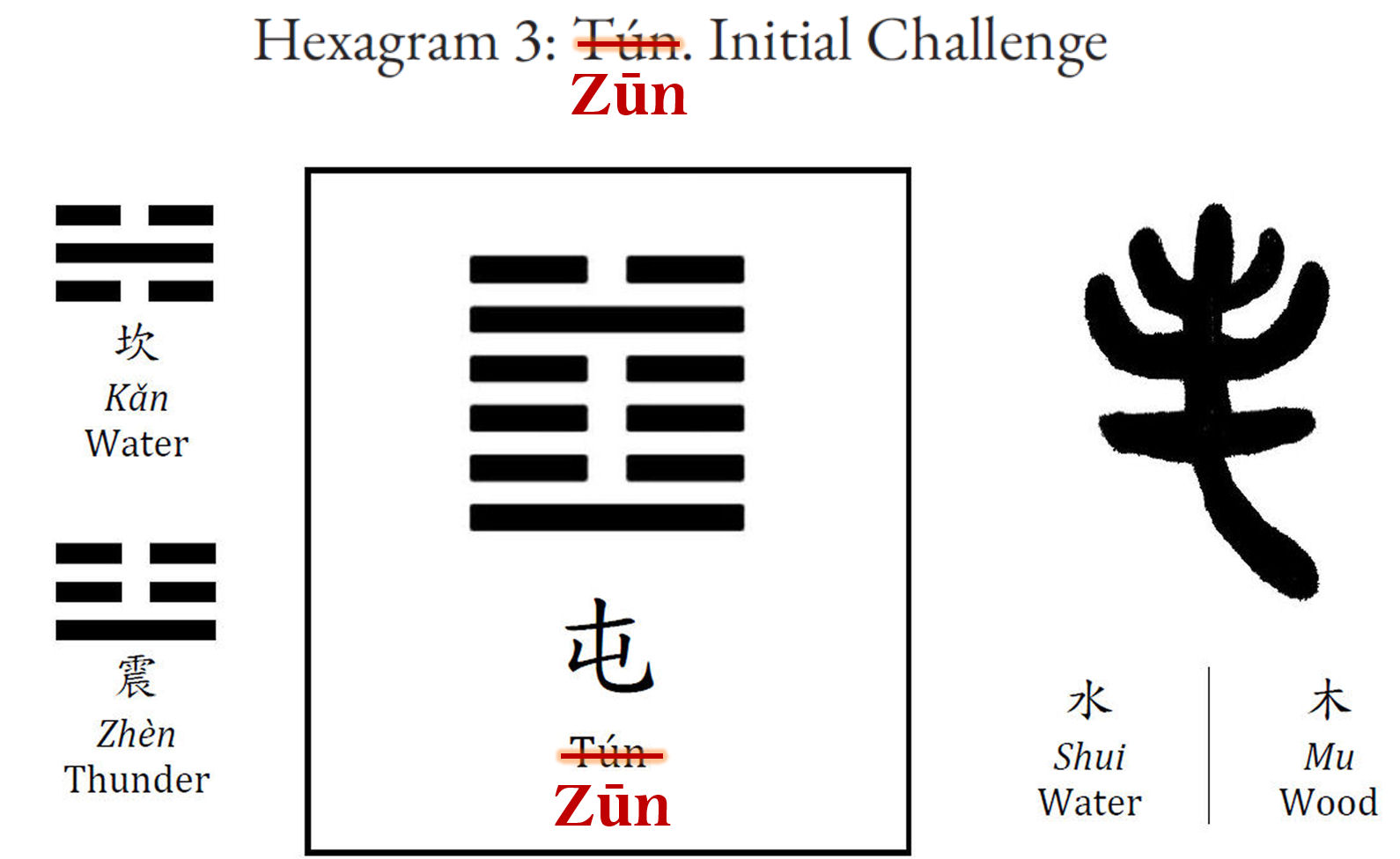
“Tún” is the Modern pronunciation of the word “屯,” but in Classical Chinese it’s pronounced “Zūn.”
page 433
Hexagram 9: Xiǎo Chù. Cultivate Gently
should be
Hexagram 9: Xiǎo Xù. Cultivate Gently
page 449
Hexagram 12: Fǒu. Stalemate
should be
Hexagram 12: Pĭ. Stalemate
page 523
Hexagram 26: Dà Chù. Cultivate the Supreme
should be
Hexagram 26: Dà Xù. Cultivate the Supreme
Hexagram 35
page 572
This is not so much an erratum to correct as it is a point for clarification:
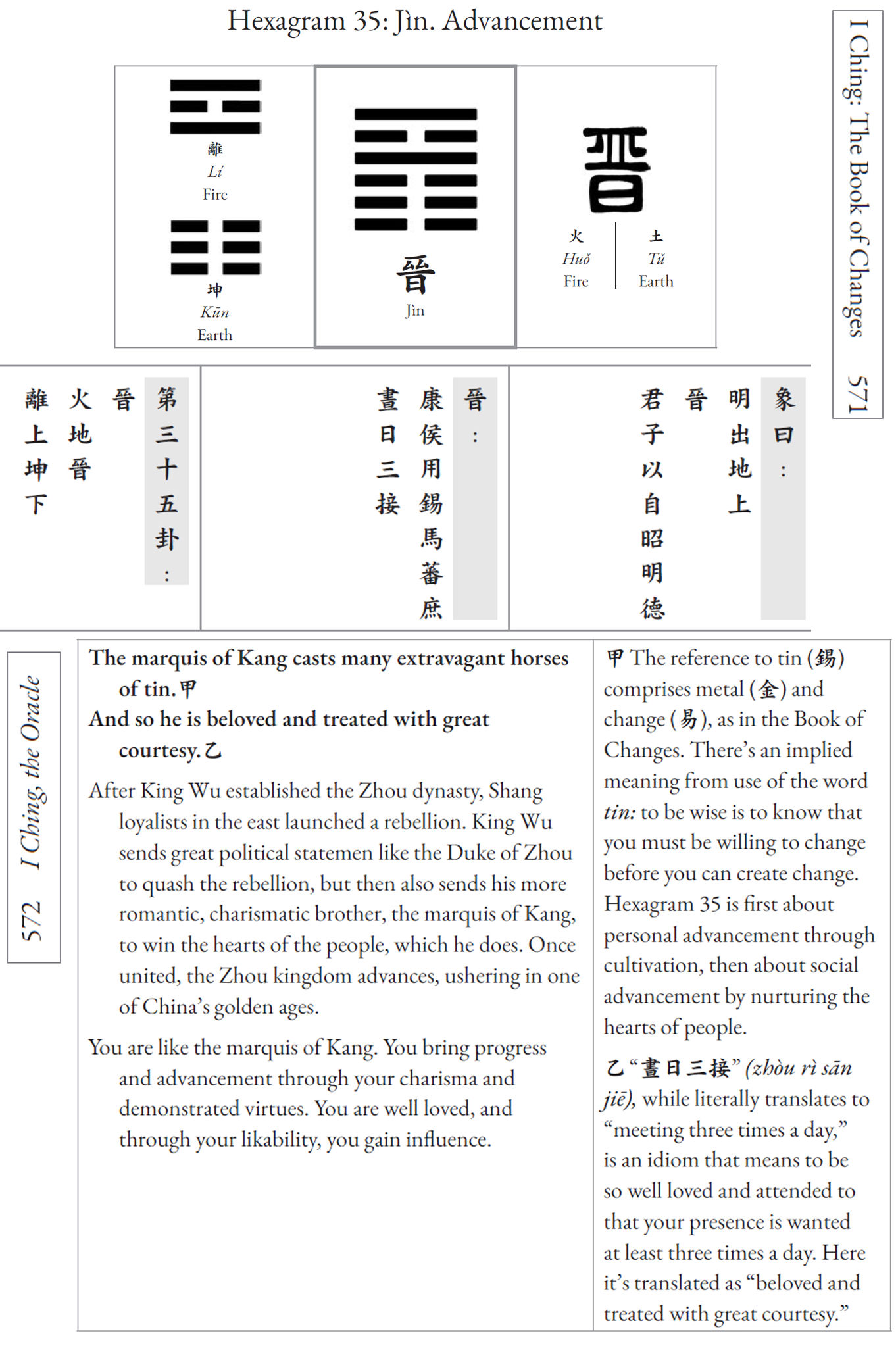
The boxed layout might cause some confusion. The layout might be clearer if presented as follows:
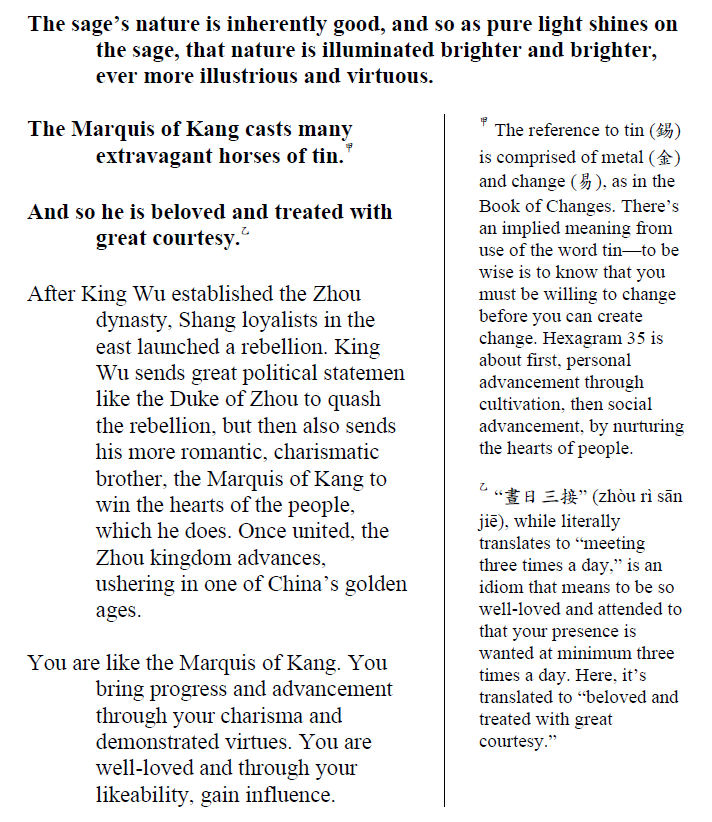
The text in bold is the English translation of the Image and Judgment line text. Following the text in bold are my explanatory annotations. To the right of the vertical line are notes.
The note in the above right column following the “甲” helps to explain the translation, “The Marquis of Kang casts many extravagant horses of tin.”
The note in the right column following the “乙” helps to explain the translation, “And so he is beloved and treated with great courtesy.”
Hexagram 36
page 580
There’s a misprint with the classical Chinese in Line 1. Here’s how it looks in the book, redlined to show the error:
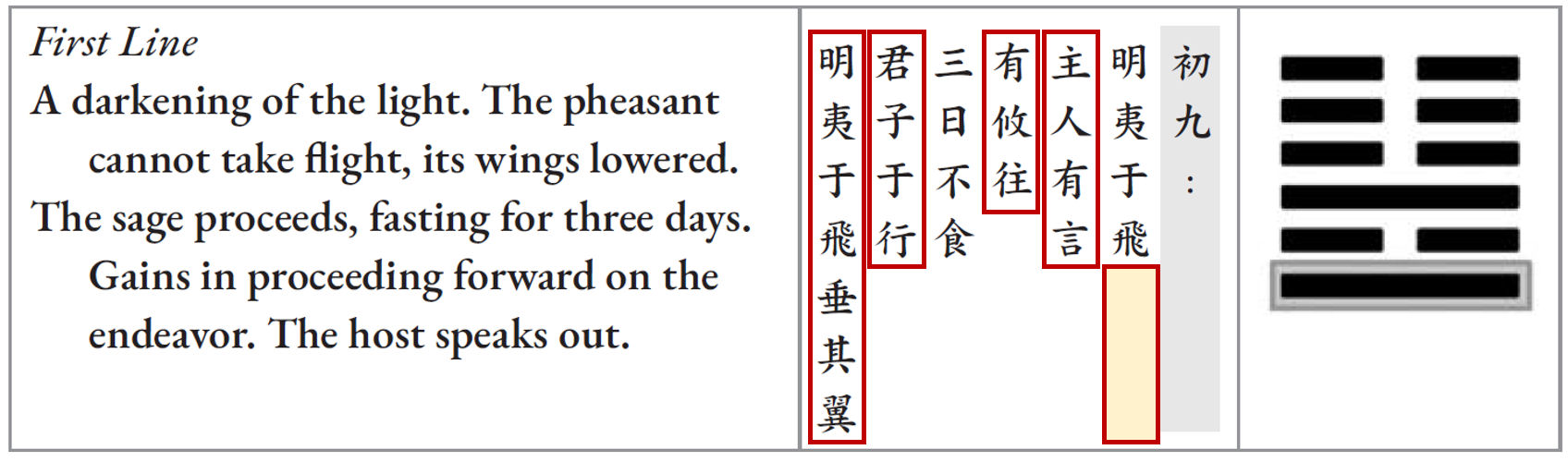
This seems to be a publisher’s error. I checked the manuscript I submitted and it’s correct in my version. Here’s the correct text in Chinese for Line 1:
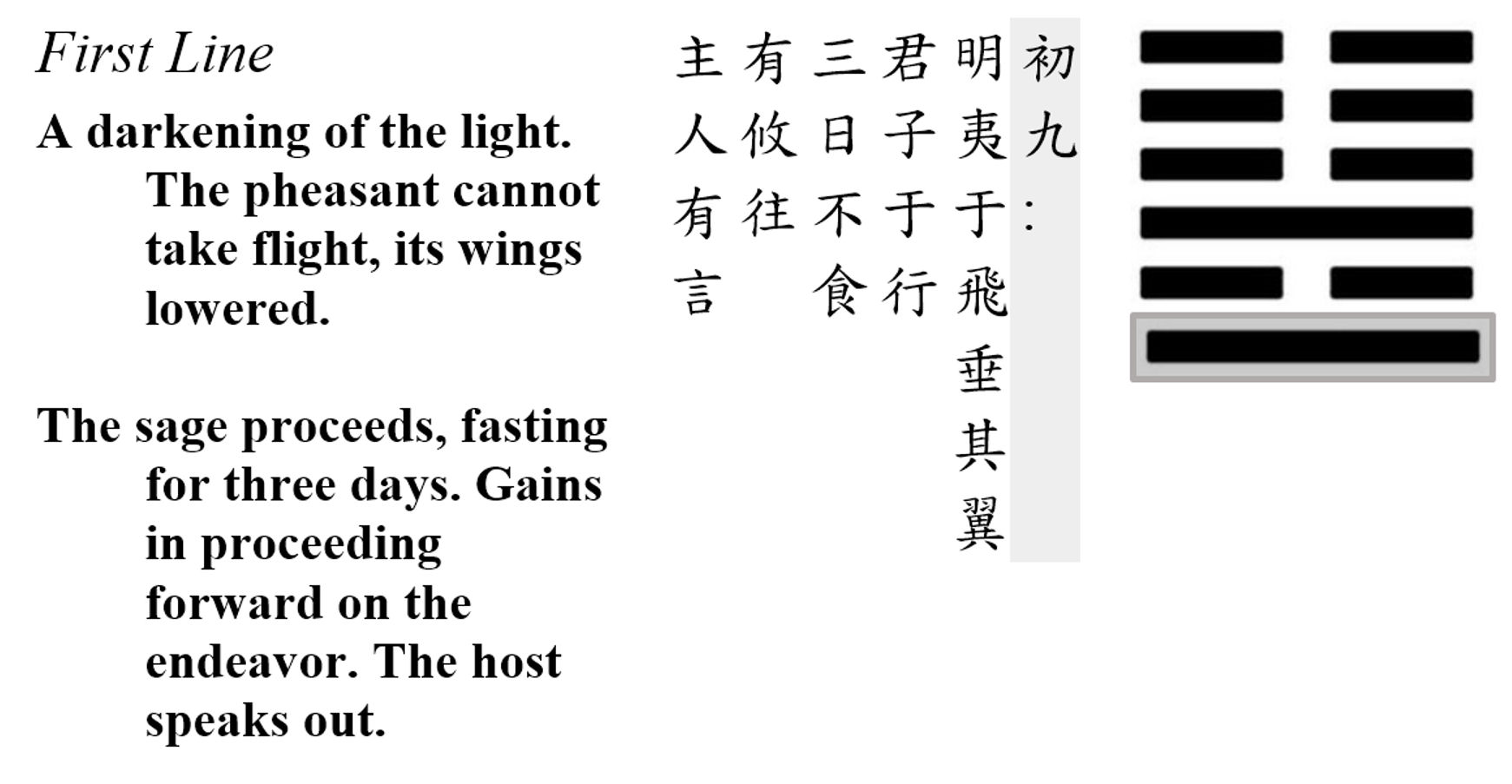
Hexagram 40, Second Line typo
page 604
The line:
With “獲 (huò)” (fox) in one line and “得” (earn, receive) in the next suggests that…
should be:
With “狐 (hú)” (fox) in one line and “得” (earn, receive) in the next suggests that…
Hexagram 42, wrong oracle bone script
page 612
Somehow the publisher inserted the wrong image file for Hexagram 42’s oracle bone script for Yi (Burgeoning), which should be as follows:
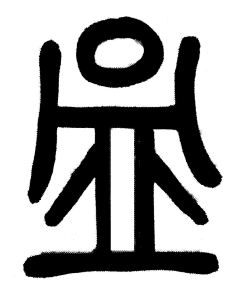
Instead, the oracle bone script for Hexagram 43, Guai (Decisive Action), found on page 617, appears twice.
Hexagram 42, Fifth Line typo
page 616
There’s a typo in the Chinese text:
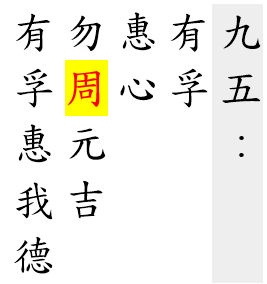
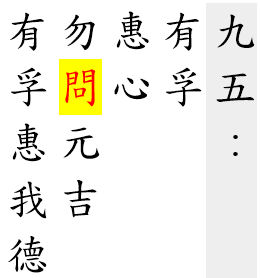
Typo. “周” should be “問.” Thus, the corrected Fifth Line should read:
Hexagram 51 typo
page 661
There’s a typo in the Image line text. The printed “七” should be “匕” (dagger).
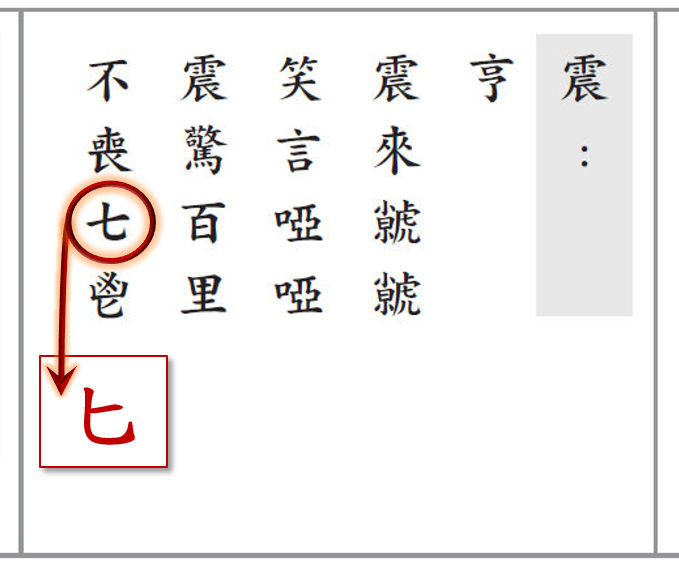
Hexagram 61 typos
page 726
In the Second Line, 九二, the text “鶴鳴在陰” should be “鳴鶴在陰” (whereby the correct phrase “鳴鶴” got erroneously switched around to “鶴鳴”).
page 727
In the Third Line, 六三, there’s a misprint; the text “成鼓或罷” should be “或鼓或罷.” The first character should be “或” not “成.”
Hexagram 63, Missing Sixth Line
page 744 – 745
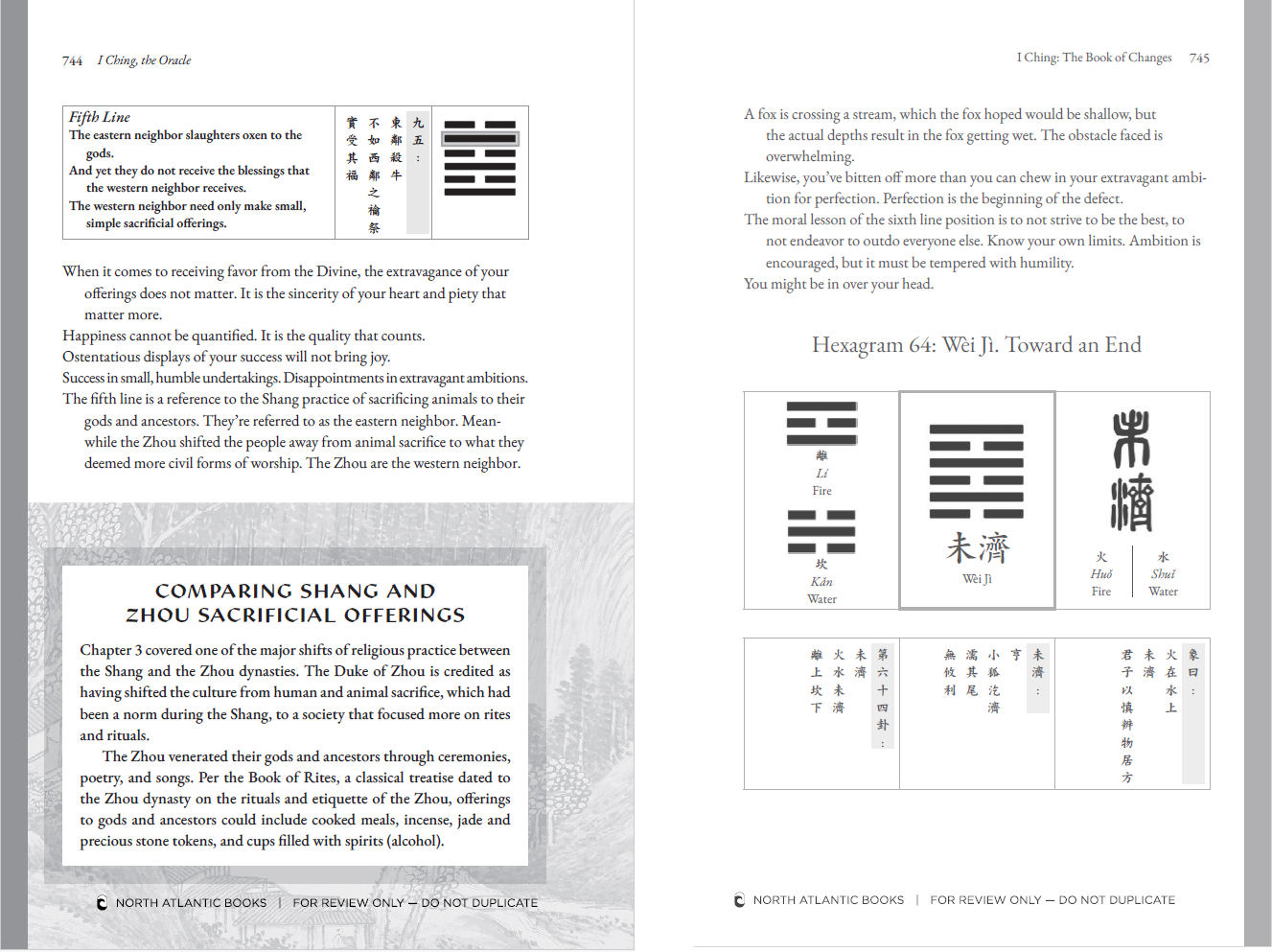
Somehow the line text and my translation for the Sixth Line (Top Sixth) of Hexagram 63 is missing. (It was present in the original manuscript I submitted; I checked.) See above for what the printed page spread looks like. See below for what it should have looked like:
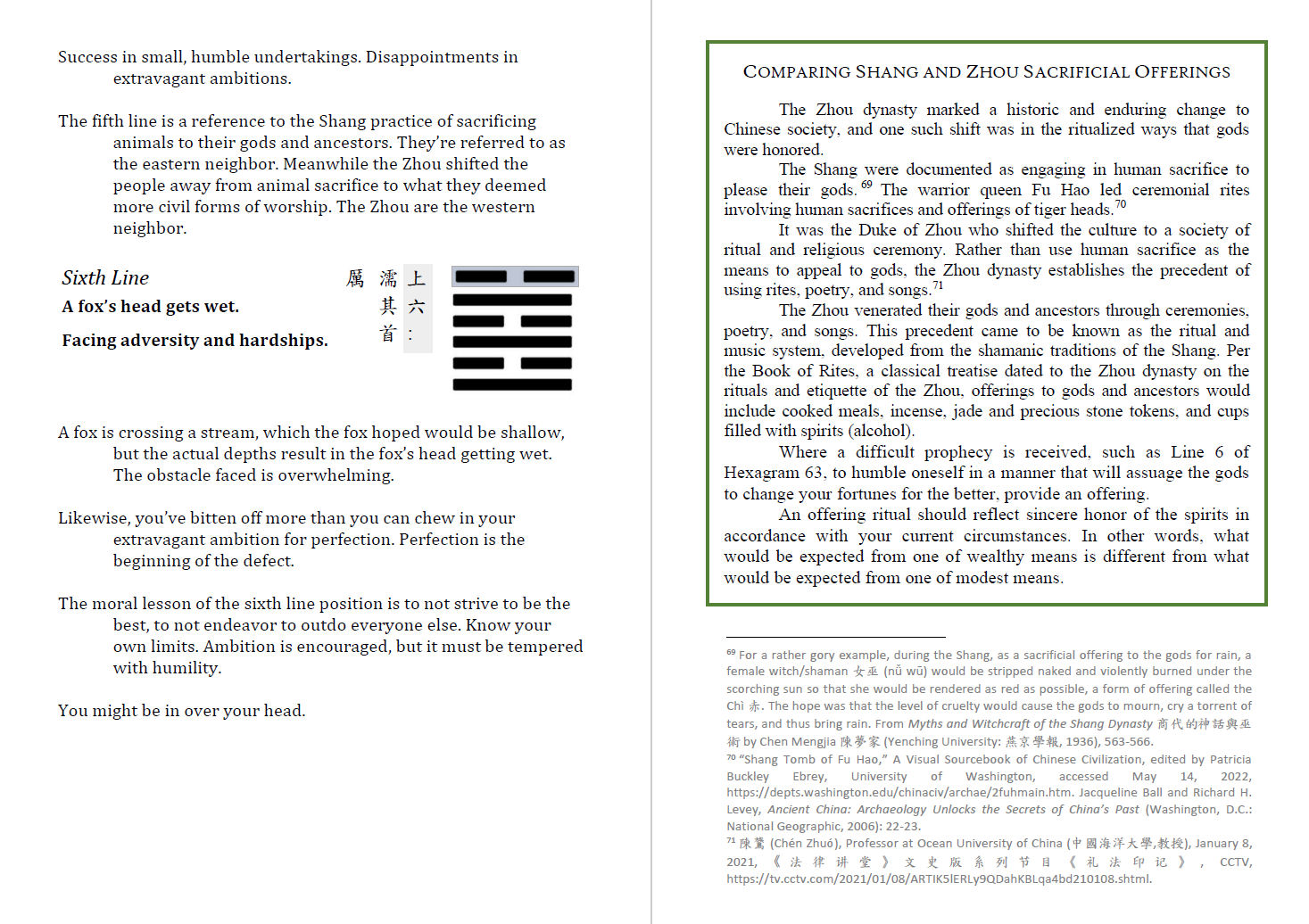
Line text to write into your copy of the book to amend the error:
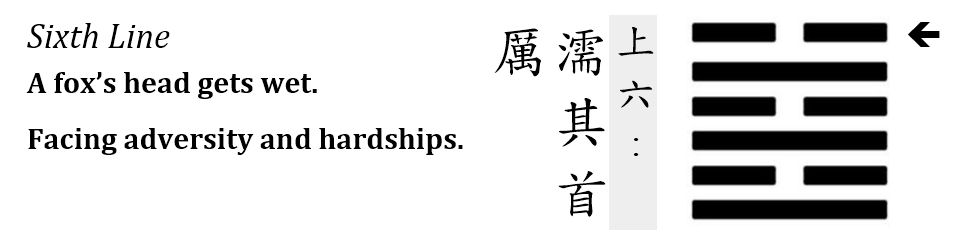
The above should go right before the commentary for the sixth line, “A fox is crossing a stream, which the fox hoped would be shallow, but the actual depths…” (page 745).
Chapter 10
Practicum 10.2
page 791
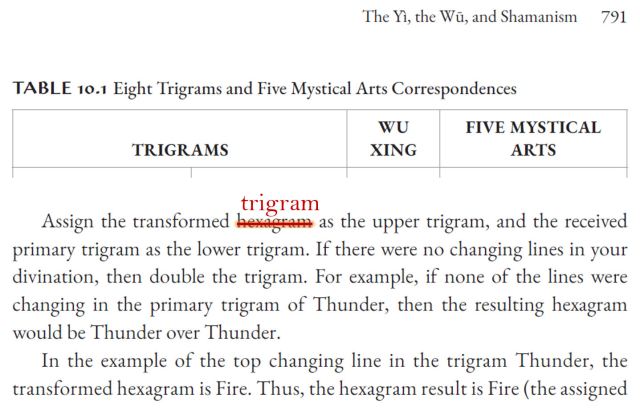
This typo is my own. It was wrong in my original manuscript. The above section on page 791 should read “the transformed trigram,” not hexagram, which will be evident from the instructions for Practicum 10.2, which this passage is part of. (Note: In Mandarin Chinese, “gua” refers to both trigrams and hexagrams, so sometimes when I do the translation in my head, I fumble.)
However, the formatting in this section makes it appear as if it is no longer part of Practicum 10.2, which is confusing. To avoid confusion, work through the practicums with the free downloadable PRACTICUM WORKSHEETS.
ABOUT THE BOOK | READ EXCERPTS | MEDIA & MORE
TABLES & REFERENCES | COMPANION COURSE
AMENDMENTS TO TEXT | SUPPLEMENTAL WORKSHEETS
 benebell wen