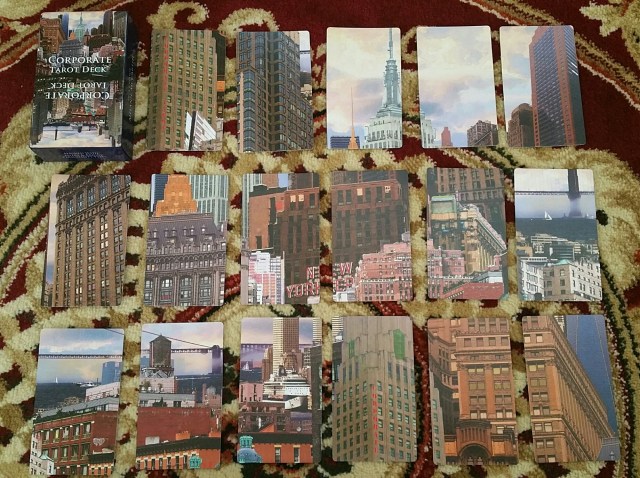
The Corporate Tarot by Melanie McCarthy is an incredible tool for employee training that re-polishes the tarot structure so that it might lend itself to the corporate world. Team building, corporate and operational strategic planning, and team brainstorming are big things these days among the midsize to large corporations. Perhaps I may be in an exceptional bubble in the Silicon Valley, but around here, every CEO and ED is looking for an “innovative, creative” way to get their employees to work together more cohesively. What better way to achieve that than through McCarthy’s Corporate Tarot?
Photographs with a corporate aesthetic illustrate this deck. I love the “stock photo” vibe here, honoring the frequent use of stock photos in corporate documents and marketing materials. Of course, I also love the diversity, which is subtle, seamless, and well done. Each card is assigned a keyword, one that represents a factor for corporate success (or hindrance to corporate success, e.g., “Conflict” or “Negativity,” etc.).
Another beautiful feature of the deck are the card backs. Each one is different and I believe they can fit together like puzzle pieces to create a unified urban landscape. The metaphor there is also clever.
Tried to find a photo of me with tarot cards. This was what I came up with.
Writer and tarotist James Bulls posted a provocative piece on the 10 questions every tarot reader must answer. Check out the post here. I thought I’d answer them for myself, so here we go.
A deck that taps into earth consciousness like no other deck, the Gaian Tarot is the much talked about, beloved, and exceptional deck borne from the genius of artist and writer Joanna Powell Colbert.
The Gaian Tarot was initially self-published by Colbert in 2010, and then it’s popularity convinced Llewellyn to publish it in 2011, and then somehow mysteriously, it went out of print. Copies of the deck were going for outrageous prices all over the interwebs as folks clamored to get themselves a copy of this beloved deck. Now, be happy all my friends, because the Gaian Tarot is back in a new published version by Schiffer Publishing and I’ve got to say, Schiffer has done a remarkable job with Colbert’s work.
Here’s an interesting point about this deck. At least four professional writers I am connected with use the Gaian Tarot for creative writing. One writes women’s fiction, one writes metaphysical books, one writes literary fiction (with a collection of short stories that has won prestigious book awards), and one is a bestselling author. Only one of them– that I know of– subscribes to a pagan-based spiritual path, and the only reason I mention that is to showcase the diversity and versatility of this deck. I don’t know if it was ever intentionally meant to become a “writer’s tarot deck,” but that it certainly has!
Be sure to read about Colbert’s creative process for the deck here. From what I could gather, Colbert works with mixed media. The inspiration for each Gaian Tarot card image begins with photographs– with one single photograph as the main focal point. Then a photographic collage is used for the background. Layered, the deck image is created. Then Colbert transitions into working by hand. The photographic collage becomes a line drawing and colored pencil sketch, and the final colored pencil sketch is cleaned up digitally.
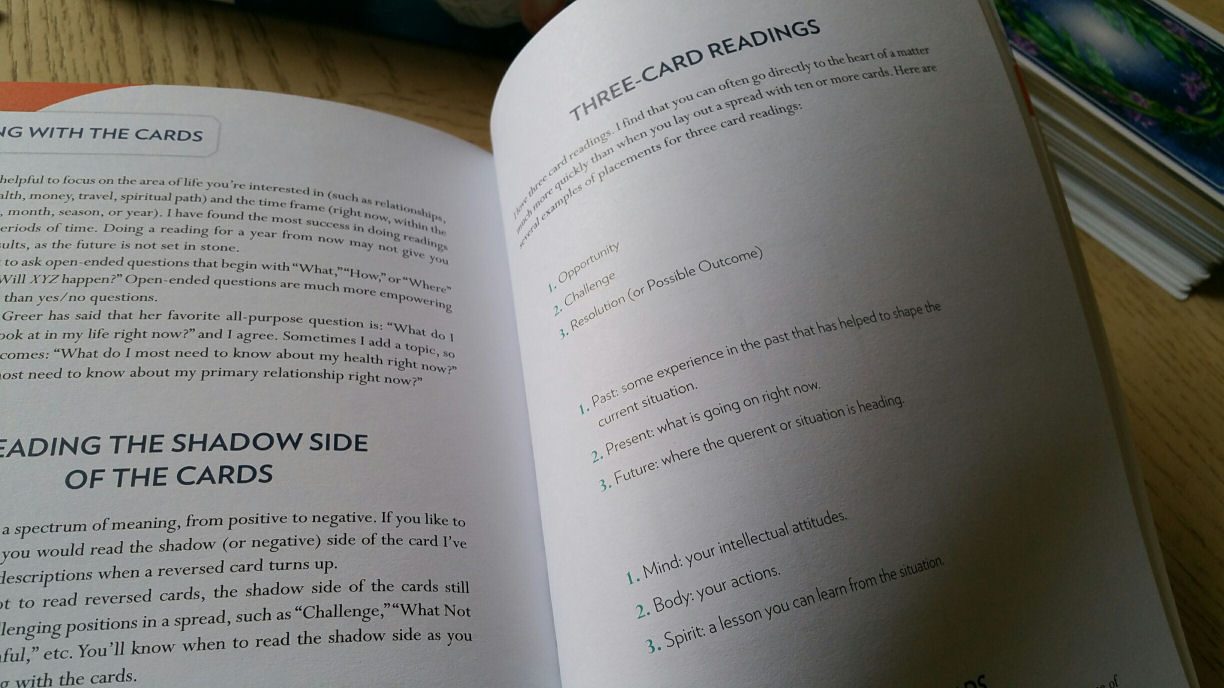
Let’s try a reading for you. Left to right above, the cards represent Mind, Body, and Spirit respectively. However, you’re to choose only one of those three cards. Which would you like to divine upon today? About your Mind, your Body, or your Spirit? Left, center, or right-most card? Remember your selection.
Here I’m lifting the idea of the “Mind, Body, Spirit” spread from the accompanying guidebook comes with instructions for three-card readings.
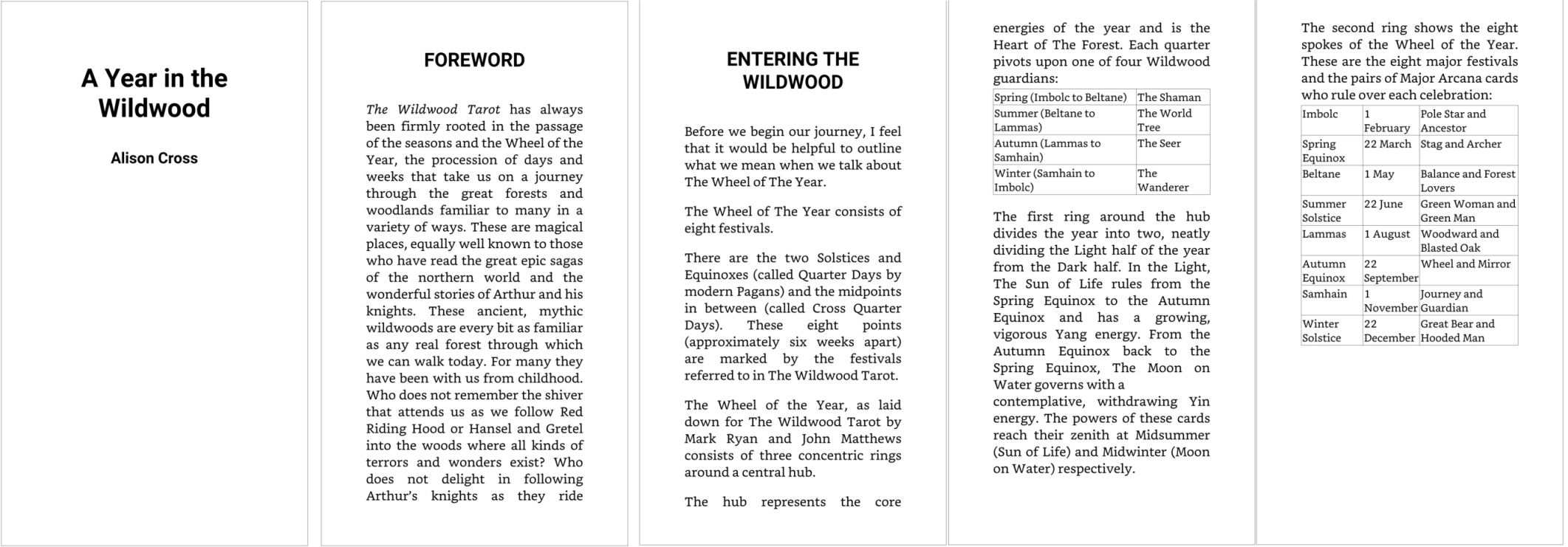
This is my review of the book A Year in the Wildwood by Alison Cross, and this won’t be a review of the Wildwood Tarot deck, though of course I’ll make reference to the deck while I comment on the book. Cross has published a thoughtful, explorative, and detailed guide to the Wildwood Tarot deck, a favorite and popular deck among tarotists today, especially those with a pagan persuasion. The e-book came out on Amazon Kindle earlier this year, 2016, and I am lucky enough to receive a copy for review.
Throughout this post, please feel free to click on the screenshot images of the e-book for an enlarged view.
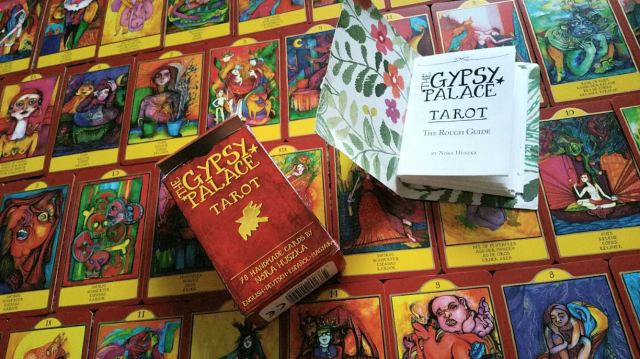
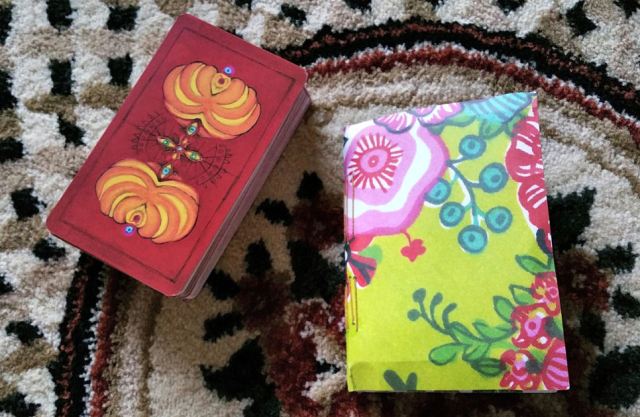
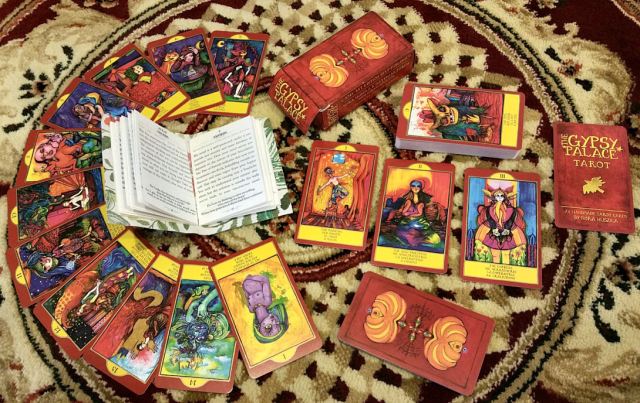
The Gypsy Palace Tarot by Nora Huszka is a potent deck for intuitive readings that articulates the “death and the maiden” motif. Gypsy Palace showcases a postmodern macabre aesthetic that blends tribal-aboriginal inspirations with Fauvist flavors. In other words, I love it.
I don’t know and can’t and didn’t verify, but I have the very strong hunch that Huszka is witchy. That hunch is so strong in me that I’m willing to speculate openly about it. =) Here’s why. There is such power invested into this deck and anyone sensitive will feel it. It’s really undeniable. So I have a strong hunch Huszka knows a thing or two about craft. (But again, it’s purely my speculation. I have no idea whether she does or not and didn’t bother to confirm it.) xoxo
Your deck, when you order it from Huszka, will come with a beautiful drawstring bag that matches the fabric of the accompanying guidebook. (However, that drawstring bag is not shown here.) If you’re going to get the Gypsy Palace Tarot, then I recommend ordering the set with the guidebook. You won’t regret it. I’ll show you why later on in this review.
This is a self-published deck that you can buy from the deck creatrix herself, via Etsy. You’ll want this deck in your collection if you’re a collector and you’ll want to work with this deck if you consider yourself an intuitive reader. There is also this “fortune-teller-traveller” boho consciousness infused into the Gypsy Palace Tarot deck that is going to resonate strongly with those who identify as a fortune-teller.
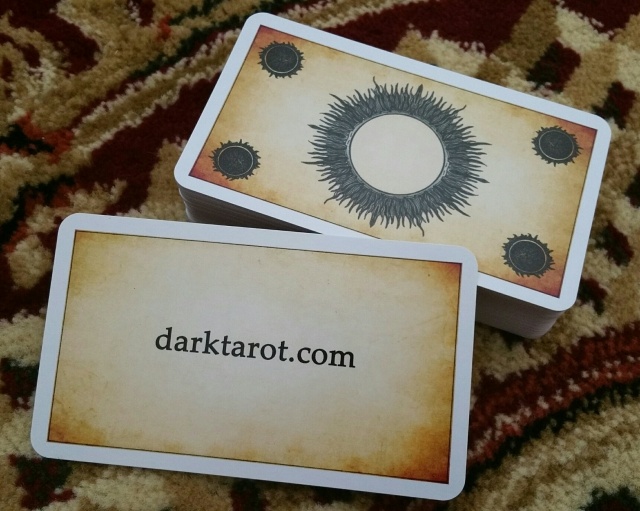
The Dark Tarot is a Tarot de Marseille based deck designed by M. over at darktarot.com. I say “M.” because I don’t know whether this person wants to be identified, so there we go. I’ve been working with this deck for a few months now and just love it.
M. reached out and gifted me with this deck and not for any promotional purposes either. This deck isn’t for sale. In fact, digital files to the cards are available for free download at darktarot.com and you can use those files to print out your own copy of the deck. Free! Yet M. gifted me with a hard copy of the deck just because. And I am so glad to have become acquainted with this TdM deck!
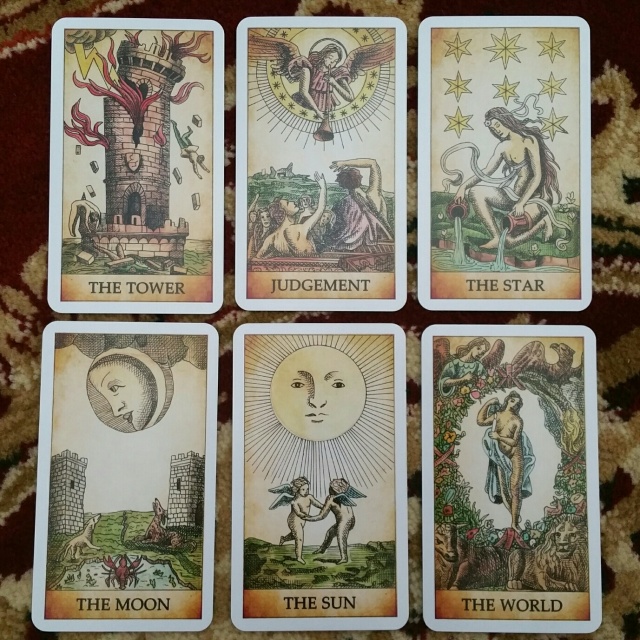
Above, just look at the beautiful imagery in the Majors.
I don’t know a lot about the deck so I’m not able to give a lot of information, but I can tell you it reads beautifully. It’s a piecemeal of several public domain TdM-based decks. I’ve been working with the deck in client readings, for my Learning the Opening of the Key master class over at Tarot Summer School, and for those who follow me on Instagram, posting tons of lovely photos of the deck over there. Also, stay tuned to the end of this post for details on a giveaway. M. and I are giving away a free copy of this deck.
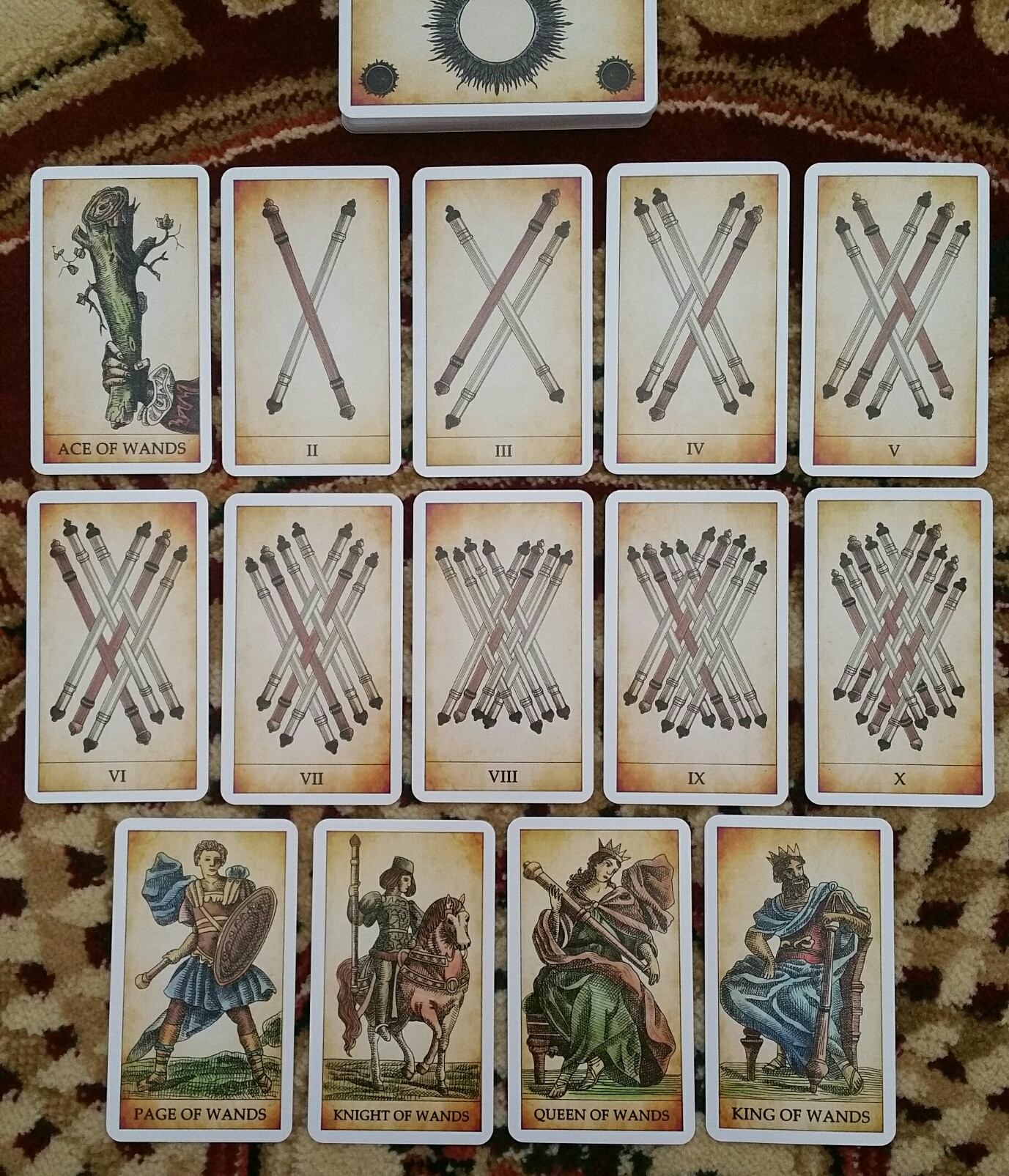
These cards look absolutely beautiful in a spread, and if you’ve been wanting to learn to read the Tarot de Marseille, the Dark Tarot is an ideal deck to learn on. In some of the Marseille decks, the suit of Wands and the suit of Swords can look alike and get confusing for novices. Not here.
There are white borders here but it’s easy to trim this deck if you so choose to. I love the faux antiqued look here and this will easily be a beloved deck by any Marseille (TdM) reader.
Originally offered at the Tarot Readers Academy in 2016 for the Tarot Summer School
Course Description:
This is a FREE ONLINE video-led course taught through concise installments that endeavor to de-mystify the Opening of the Key (OOTK) divinatory technique as detailed by Paul Foster Case, MacGregor Mathers, and Aleister Crowley, augmented with commentary from contemporary masters like Chic & Tabatha Cicero and Paul Hughes-Barlow.
Much like how the Celtic Cross spread has become a golden standard, we will learn how to integrate the OOTK into personal practice. Along with deconstructing the five operations of the OOTK, we will learn about elemental dignities, Kabbalistic basics, traditional card counting, Western astrology basics, and what all of these studies combined with tarot divination can teach us about the cornerstone principle in Western occultism–“as above, so below.”
The Hezicos Tarot by Mary Griffin is a self-published Rider-Waite-Smith based deck that blends a multicultural point of view with fairytale fantasy. It is a versatile, readable, and easily accessible tarot deck for novices, beautiful imagery that is fit for professional readers, and artwork that will tempt any tarot deck collector.
My favorite artistic style for tarot decks is unembellished hand-rendered line art, and that’s exactly what we have here. The Hezicos Tarot is done in watercolor and ink. There is a contemporary style to Griffin’s art. The imagery here leans feminine, storybook, with a fable and fantasy tone that works really well with a modern tarot deck.
Photograph that is unrelated to the topic at hand but posting here for the visual effect notwithstanding because your eyeballs need there to be a photo here and I couldn’t source one that would be related.
First off, naturally I will be speaking in generalizations.
People my age are sandwiched somewhere in between the Old Guard and the Millennial Readers.
Although my mother is not a tarot reader, she’s a metaphysical reader/practitioner of sorts and I’m super sure that had tarot been accessible to her as a young one, she would have totally become a tarot reader. Instead, she reads other stuff. Like your face. No, I kid, but oh no, I don’t. She really does.
I can see her attitude reflected in many of the Old Guard tarot readers. “I’m not normal. Tarot is not normal. Damn straight this is fringe. Deal with it.”
There’s an unabashed embrace of marginalized culture. There’s no embarrassment with dressing woo-woo as you walk among normal society. You can almost see traces of a hedge witch mentality.
Although she has never come outright to say so, I get the distinct sense that she doesn’t want everyone and the mainstream to become diviners, mediums, shamans, and practitioners of craft. There is a tacit yet clear exclusionary attitude. Or at least that’s always been the impression I got. She doesn’t want (let alone buy in to the ideas of) Mediumship 101, “everybody’s psychic,” or “pay me $300 and I will certify you as a bona fide tarot master.” (Hi. Certified tarot master here.)
Meanwhile millennial readers apply general business and marketing tactics to tarot–e.g., general PR and marketing principles to tarot business, coaching anyone and everyone to become diviners, mediums, shamans, and practitioners of craft, if you so choose. There are efforts to establish tarot into mainstream culture.
There is a pop psychology approach to tarot (which I have been pegged and critiqued as adopting, so apparently I’m in this camp) that strives to normalize divination practices or astrology, and to talk about spell-crafting as the law of attraction and “yay for positive thinking.”
However, at the heart of the millennial approach is the notion of accessibility, a socialist attitude toward the metaphysics. We can all have equal access to the Divine, to metaphysical energy work. (I confess, that is the attitude I adopt. That line sums up my opinion.) Metaphysics is for everyone. This is not paranormal, it’s normal. You don’t need anybody else to help you connect to the Divine. You only need you.
Okay, so as circumstances would have it, I’m now only a couple paragraphs in and I’ve already changed my mind.
Maybe I haven’t changed my mind exactly, but it is for sure vacillating. Is it really a generational thing? Or is it just a two-different-schools-of-thought thing? Is my personal anecdotal evidence and direct observations even reliable?
I’m in effect just looking around me, only to the point I am able to physically see, and making gross generalizations about what else is out there based on only what I see. Is what I happen to see an accurate microcosmic sampling of the macro? I don’t know. I really don’t.
However, there is for sure a determined voice among the occultists and metaphysicians who say that “occult” means concealed, and we are not to remove the veil for all. Only those who choose the path should or even can go beyond that veil to see for themselves what is there, and then come back with divinatory or revelatory information as needed, like an appointed messenger.
Is that way of thinking a bit reminiscent of limiting literacy to the elite so that the proletariat must rely on figures of authority (like a priest or priestess) for Divine insights? That was the way of institutionalized Western religion for ages. Is it hypocritical when metaphysicians repudiate that kind of authoritarian approach to religion, pursue occultism because they’re anti-authoritarian and want the answers for themselves, but then once they’ve found those answers, act in the same exclusionary manner?
I’ve observed that the Old Guard, Mom inclusive, have this sense that what they do “isn’t for everyone.” She would probably opine that not anyone can just pick up a grimoire, follow something in there, and yield results. Only certain people can do that. As I said, there’s a staunch exclusionary attitude. I’m also sure if I introduced her to the 21st century spiritual coaching power of manifestation business model, she’d find it absurd.
Actually, she wouldn’t. She’s pretty open-minded. She’d be surprised at first, but then come around. “Okay, all right, I get it. I wouldn’t have thought of that but I get it.” For instance, it might take her some time to grasp the idea that, say, I’m holding an online webinar course on Learning the Opening of the Key for Tarot Summer School and teaching occult theories to a whole bunch of people I’ve never even met, all at once. Perhaps in her view, spirituality, divination, and woo-based teaching is done one pupil at a time, a single teacher to pupil relationship that is honed over several years, not in 60 minutes.
Whereas maybe I do have a more “free love” attitude here. We’re entering a social era where notions once reserved in the New Age or even occult category run as an undercurrent through mainstream society. Corporate offices pay for yoga classes and meditation retreats for their employees. Businesses far from the woo will consider feng shui tips and tricks. Law firms invite in tarot and palm readers for their company Christmas party. Silicon Valley high-tech companies will hire a witch to cast a circle of protection around their computers, protecting them from hackers. All true stories here. I doubt any of this would have happened even 20 years ago. Things are changing.
As woo practitioners such as tarot readers converge more with the corporate and mainstream worlds, they adopt corporate and mainstream commercial strategies to advance their tarot business. Corporate and mainstream businesses converge more with woo practitioners and adopt woo into their environments because hey, “anything to help us earn more money. If that’s a spell or feng shui, then let’s do it.”
So admittedly, there was no point or core thesis to this post. I just thought I’d ramble on some thoughts of late.
It begins around 25:11 when one of my favorite YouTube personalities Kelly-Ann Maddox talks about #TarotsoWhite and the “overwhelming lack of racial diversity in tarot and oracle decks.” Maddox covers it all. She acknowledges white privilege, too much whiteness in the human depictions on tarot decks, disappointment in the fetishization of people of color in the rare times they are actually portrayed (she gives the example of the Nubian queen), and wonders what it is like for us people of color to spend untold amounts of money on tarot and oracle decks only to flip through them to see that you’re not being represented.
Well. The reality is we’re used to it. Or at least I am. It wasn’t until around 2000 that my community was represented in the media beyond sage-y old kung-fu masters with broken English and fortune cookie wisdom, me-love-you-long-time, dragon ladies, geishas, or know-it-all nerds. I mean I guess I’m okay with the know-it-all nerd. I can sort of identify there.
The reality is I’m used to not seeing ordinary Asian faces in the media and tarot is no different. If I don’t see myself depicted on film, then what makes me think I should get to see myself depicted in the tarot courts? Instead, I get “pleasantly surprised” when I see non-stereotypical images of Asians, well, anywhere, and then doubly pleasantly surprised when it’s on a tarot card.
My first inclination is to say, as a person of color, the whiteness of tarot card imagery doesn’t bother me. But I can’t leave it at that. I have to ask myself why it doesn’t bother me. The reason why it doesn’t bother me is what I said before—by now I’m used to it. People of color are used to being invisible. And, well, that’s deeply problematic. So even if it doesn’t bother me, it should bother me just as it should bother every person of color. If it doesn’t bother you, then it will never change. And if it doesn’t change, then the racial paradigm will always leave us marginalized.
As for #TarotsoWhite, I really don’t know what to say on this topic. On one hand, I don’t want to think about race during a tarot reading. Anything in the imagery on a tarot deck that “stands out too much” (and I don’t mean in a semiotic way) can be distracting to me. Here’s the thing: I want to think about race. I want to talk about social justice. But maybe not during a tarot reading.
And I do find that sometimes racial diversity depicted on a deck can be distracting because—sad, sad fact—it’s not something we’re used to seeing. Racial diversity is really different for us. Seeing a token Asian dude or a Black woman doing something that is not stereotypical or fetishized is different, and it’s so different for our senses that it can actually become a distraction. It becomes your focal point because differences are always our focal points. Instead of turning my mental wheels on the symbolism of the pomegranates and what that omen holds for our seeker, I’m thinking, “Oh look! The High Priestess is an Asian chick! How neat!”
One comment you hear echoed among readers about #TarotsoWhite is that the whiteness in tarot is why they have a preference for abstract tarot and oracle decks where any human figures depicted are racially ambiguous. The subtext here is: “I want to be racially inclusive but I don’t want to think about race during a tarot reading and people of color depicted in tarot imagery is still kind of distracting so this is my best response.”
I get that. I dig it. I agree.
The catch is, if no one buys tarot and oracle decks featuring ordinary people of color (and by extension, tarot readers get used to seeing–and liking–decks that feature ordinary people of color), then deck creators and publishers won’t be inclined to feature ordinary people of color, and so we will never get to that point where the Asianness of an Asian High Priestess or the Blackness of a Black Emperor won’t distract us.
The only way for race to not be a distraction is for the topic of race to become boring. When the topic of race is boring, an Asian High Priestess and a Black Emperor will be no big deal for our subconscious to handle. Unfortunately, the topic of race is very interesting right now, especially given the racially charged climate we live in.
So if I, a person of color, don’t even want to think about race during a tarot reading, do other tarot readers want to think about race when they dish out the Celtic Cross? And if we don’t want to think about race in tarot but race featured in tarot makes us think about race in tarot, then do people really want to buy tarot decks that feature different races?
Well. We have to.
Social progress in the tarot world will only happen if it’s profitable for deck publishers to get on board with social progress. Otherwise, they’re going to throw out a few token people-of-color decks so as not to appear racist, and then stick primarily to the all-white Arcana cast. Frankly, it’s not profitable right now for deck publishers to feature people of color because even people of color don’t want to see people of color. Everybody wants to see white people.
Each one of us bears the responsibility of changing that dynamic. Tarot practitioners have to make a conscious, concerted effort to show deck publishers, by the power of our spending, that tarot decks with zero racial diversity are not profitable. It sort of has to be a forced change at first, you know, fake it ’til you make it, and eventually, racial diversity in tarot will finally feel natural to us.
But it’s a tall order because the race thing is so deeply engrained into us that most of us don’t even acknowledge it.
It’s like how my name “Benebell” can bother someone because [true story here–and this is the part that she figured was okay to say in public…] Benewell was the name of her [presumably White] Civil War ancestor and so my name Benebell becomes a nuisance and a point of distraction to her. The racialized reality is [here’s the part people would think is not okay to say in public…] Benebell distracts her because Benewell was an old white dude and Benebell is a young(ish) Asian girl.
The race issue, albeit subconscious, was the distraction, not the name issue. If I had been an old white dude, my name wouldn’t have bothered her as much. But it bothered her because of the race discrepancy. She just couldn’t get over an Asian girl “hijacking” her White ancestor’s name.
That subtle yet insidious anecdote extrapolated out to the tarot community at large explains why we find racial diversity in tarot distracting (though would die before we admit it). It’s because our brains have been wired for a very long time to envision a white High Priestess and a white Emperor, and a white Queen of Cups, and white kids in the Six of Cups, and white people fighting in the Five of Wands. When these people are not white, we can’t help but stop to think, “oh… hey.” And at its worst (like the Benebell vs. Benewell account) it’s a nuisance and at best, a point of distraction.
It’s just something we have to get over as tarot readers. Not only do we have to get over it, but we have to push homogeny out of profitability and convince publishers and deck creators that it’s just economic good sense to feature boring racial diversity. No Nubian queens or geishas, just plain, boring people of color, but, you know, decked out like the Queen of Swords or the hermaphrodite in The World.
Addendum.
The tarot and oracle decks that fetishize or exoticize race are popular because we can observe racial difference in a way that emphasizes difference. Somehow that’s okay for our subconscious to handle. It’s when different races, i.e., people of color, appear normal and run-of-the-mill that blows our [subconscious, and sometimes not so subconscious] minds. When people of color are depicted as the “other,” that’s okay, and we can work with that. That’s not distracting because the depictions play in to our preconceived stereotypes. Deck creators and publishers have to do better than that. Racial diversity and inclusion has to go beyond Afro-centric Timbuktu pharaohs of ancient Egypt Imperial China Japanese samurai culture art.








 benebell wen