30 Day Tarot Challenge Meme (Questions 21-25)

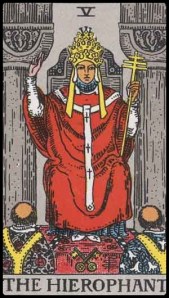
MajorArcana_Key_5_The_HierophantDay 5 of the challenge. 5 more questions.

See previous postings:

Questions 1-5 (Day 1)

Questions 6-10 (Day 2).

Questions 11-15 (Day 3).

Questions 16-20 (Day 4).

21. How do you feel when you do readings?

I try to feel the energies surrounding the client. It’s important to be open and empathic during a reading so that I can best serve the seeker.

22. Do you charge money or ask for other types of compensation for your readings/services?

Right now I don’t charge money. I ask for donations, token gifts to my loved ones on my behalf (hehe), or I agree to exchanges. I’ve been known to work for food. Boy do I love them cupcakes, especially the ones with buttercream. One client made me macaroons! ::heart:: I looove French macaroons.

23. What question do you most often ask the deck (or, ask on behalf of another)?

For myself I ask questions such as “how do I” or “what do I need to know about” that pertain to specific creative projects or ventures. That’s it. When I am reading for others, I can offer you statistics. About 51% of the questions clients ask are love related. 15% to 20% are work related. Now see the below bar graph for the frequency of question topics that clients ask me to read for.
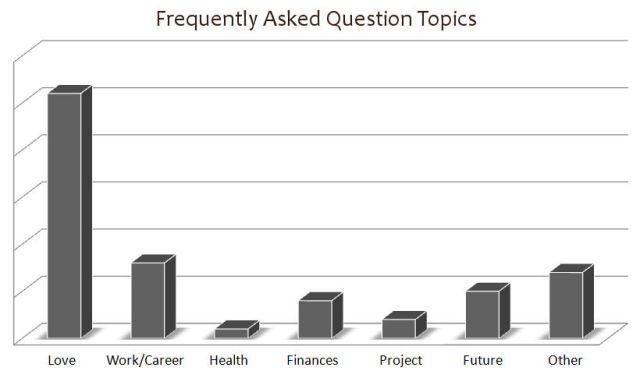
bargraph

24. How accurate do you believe your readings are (or, do they accurately convey messages from spirits/deity)?

Quite unremarkably, it depends. When I’m “in the zone,” I would like to say I am really accurate and can connect deeply to what’s going on in the client’s life. When I’m not in the zone, bleh. I go a-fishing. Or really, I just stop the reading and say, “hey, look, we’ve got to continue this some other time.”

25. What was the most dramatic/meaningful reading you ever did? (Not necessarily the most accurate.)

My answer will sound like a cop-out but it isn’t intended to be. Every reading I have ever done has been meaningful. The free one-card readings I do through FTN are meaningful in the moment. Otherwise, I wouldn’t bother doing them. Every full reading session I have done has been memorable. I can remember specific cards drawn for people who were complete strangers in readings done years ago. Some readings were dramatic because it touched the client to such a degree that tears were shed on sight. Others were meaningful because of how eerily accurate they were.  All readings for myself are meaningful because I don’t even bother consulting the tarot unless it’s something important.

If I had to choose one, I would say the reading I did for an established writer. The writer was struggling with a sophomore novel after the debut book received immense critical acclaim. There was a great deal of pressure to deliver the same success that the first book enjoyed. Writer’s block was setting in hard. The reading I did helped that writer move past the writer’s block and, in the end, published a second book that has been much talked about and praised in literary circles. That was cool.

Subsequent Updates:

Questions 26-30 (Day 6).
30 Day Tarot Challenge Meme (Questions 16-20)

It is now Day 4 of the meme, yet I’m two thirds of my way through the challenge since I’ve decided to tackle the 30 questions in 6 days rather than the full 30 days.

See previous postings:

Questions 1-5 (Day 1)

Questions 6-10 (Day 2).

Questions 11-15 (Day 3).

Now, on to the questions:

16. Do you ever use the Major Arcana without the Minor Arcana or vice versa?

Yes. I might use only the Major Arcana if I am interested in understanding the archetypes at play in a particular matter. If I have a question that is focused in one particular area, such as a work/career question, I may shuffle only the Wands and draw a single Wands card for insight, or if I have a love/relationships question, I will draw a single card from the Cups, etc.

3majorsradiantriderwaite

17. Do you do readings using reversals? Why or why not?

Yes. Every detail and nuance matters. When a card appears in reverse, it indicates a different shade of the meaning associated with that particular card from the color it would otherwise take on upright. How a card in reverse interacts with the other cards in a spread landscape is also relevant, very relevant in fact. I can’t imagine myself not reading with reversals, though I do know many amazing professionals who don’t observe them.

18. Do you feel a “connection” to your cards?

Yes. What’s interesting is I have that old ass deck of Marseille I was talking about in Day 1 and a 20-ish year old Rider-Waite. For some time I thought I liked those particular tarot systems because they were more accurate for me than the others, but one day I picked up a brand new deck of the Tarot de Marseille and a brand new Rider-Waite and they just didn’t do it for me. I realized it isn’t the tarot systems that I was connected to; it was those two particular tarot decks that I have handled for so many years. I’ve “connected” to those cards deeply and it had little to do with the tarot systems they represented, but it was that particular deck that worked well in my hands.

19. Do you feel/think the cards “think” or have their own consciousness? What do you believe makes the cards “tick”?

No. The cards are just objects. We make them “tick.” We’re using our inner qi to will the cards into a cohesive pattern that will make sense to us and help us make sense of our lives.

20. Do you read for yourself and/or for others? Why or why not?

Yes, I do read for myself, though less frequently these days. These days I primarily read for others.

Subsequent Updates:

Questions 21-25 (Day 5).

Questions 26-30 (Day 6).

30 Day Tarot Challenge Meme (Questions 11-15)

It is Day 3 of the meme, which should correspond with Days 11 through 15, since each question is supposed to take up a full day of contemplation. Instead, I’m truncating it down to 5 questions per day to finish off the challenge.

See previous postings:

Questions 1-5 (Day 1)

Questions 6-10 (Day 2)

11. What spread do you use most often/prefer and why?

I used to have a strong preference for the Celtic Cross, but really the only reason for that was habit. I knew the spread like the back of my hand and it was comfortable. My practice has evolved and now there is no single spread that I use most often. I listen carefully to the client’s needs and usually custom-tailor a spread for that client.

12. Have you ever created your own spread? If so, how effective is it? (Feel free to show the spread.)

Yes. All the time. If it would serve the client, then I will incorporate the client’s religious beliefs, faiths, traditions, culture, or just his or her specific inquiry needs into the spread that I devise. My spreads are generally based on some sort of cross or sigil. I have found that these tailor-made spreads are astonishingly effective when applied in the most precise way to both the client and the question.

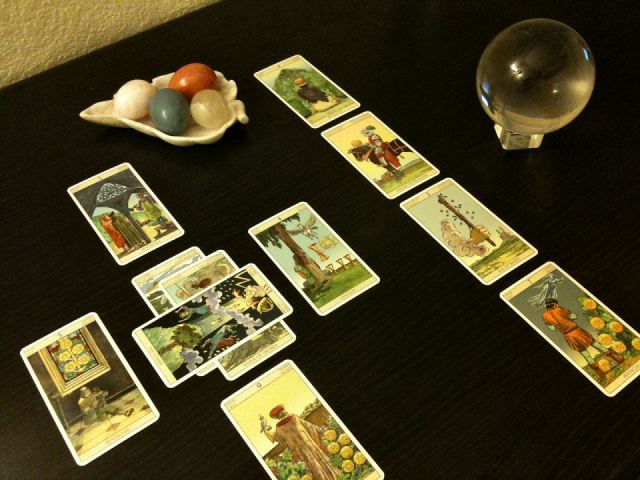
Here is one example of a spread I recently devised, called The Insight Cross:

Insight_Cross_Spread

13. Is there a card that continuously stumps you when it is drawn? Why do you believe this to be so?

Key 18, The Moon often stumps me. When it is the only card drawn, I get the meaning. However, when I need to understand it in the context of other cards, or even in the context of a client’s specific question, it is often difficult for me to explain The Moon as it pertains to our everyday life. Intellectually most of us can understand The Moon, but extrapolating its application is a little more elusive for me.

14. For what purposes do you usually use the Tarot?

These days, only to read for others. I do not read tarot for myself. Instead, I will patron another professional tarot practitioner for a reading. It supports their tarot business and I feel it’s more objective than me reading for myself.

15. How much emphasis do you put on the textbook meanings for cards, and how much stress do you place on the “feeling” you get from cards through their artwork/symbolism, etc. Do you do both, or one or the other?

My analysis begins with the classical meanings for the cards. However, I cannot stress enough how important it is to look at the overall landscape of a spread and see how the cards relate to one another. From there, exercise intuition to truly understand the holistic meaning of the card as it directly pertains to the client’s inquiry. How that can be done artfully and accurately is learned only through practice, practice, and more practice. You need to gain a great deal of experience before you understand the depths of intuitive reading.

Subsequent Updates:

Questions 16-20 (Day 4).

Questions 21-25 (Day 5).

Questions 26-30 (Day 6).

30 Day Tarot Challenge Meme (Questions 6-10)

I’m having fun with an internet meme that’s been circulating among tarot bloggers, and that is the 30 Day Tarot Challenge, though I’m blazing through it in 6 days, 5 questions each day. Perhaps that is defeating the original purpose of the meme, which is to ponder thoughtfully on each inquiry. I’ve adjusted that purpose a bit.

This is Day #2.

See previous postings on the meme:

Questions 1-10 (Day 1)

celticcross

6. What was the first spread you learned?

The Celtic Cross. For many years, it was the only spread I used. That was the old school way of teaching beginners. Thankfully, tarot tutelage has changed these last few decades and students are now beginning with a more manageable number of cards.

7. What is your favorite card (both in terms of deck’s artwork and divinatory meaning)?

Ace of Cups. Upright, that is.robinwood_aceofcups

8. Which card do you dread pulling the most?

I’ve reached a point where I don’t dread any of the cards, but that comes with acquiring wrinkles and lines on your face, in other words age. After a while, life simply stops unnerving you. Tragedy and comedy will come as they come. You learn to roll with the punches, as they say. However, when reading for people who are not familiar with tarot, I dread pulling the Death card, because I have to be really artful about explaining the card to them and calming them down.

9. What card do you pull the most often? Why do you think that is the case?

Two of Pentacles or Ten of Wands, with seemingly equal frequency. It is the way of our modern world, I suppose. Everyone’s busy. Everyone is overburdened and juggling a bunch of responsibilities at once.

10. What card best represents your personality (or, is most often pulled to represent you in a spread)?

Queen of Swords.

Subsequent Updates:

Questions 11-15 (Day 3).

Questions 16-20 (Day 4).

Questions 21-25 (Day 5).

Questions 26-30 (Day 6).

A Tarot Meme: 30 Questions (Questions 1-5)

I first came across this meme by way of Calamity’s Child on her blog post here, “30-day Tarot Challenge.” The meme seems to have originated with 78 Keys (link here), but just google “30 Day Tarot Challenge” and you’ll pull up many tarot bloggers who’ve taken on the challenge. Fascinating reads, so I suggest you read all of them. I’m a little late to the game, but the questions intrigue me and I would like to explore my answers via this blog, 5 questions at a time.

Instead of 30 days, I’ll wing them in 6 days. So here’s #1-5.

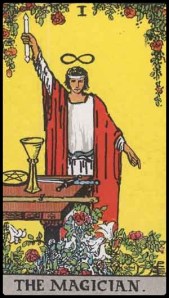
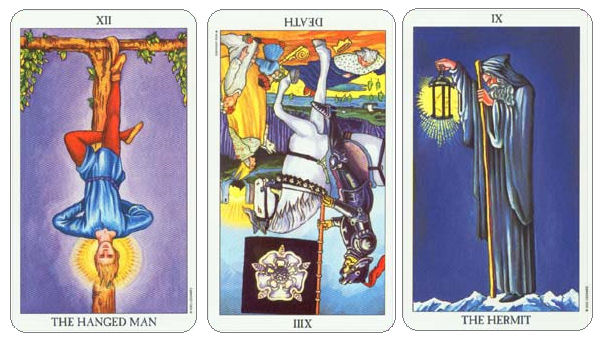
MajorArcana_Key_1_The_Magician1. What introduced you/got you involved in Tarot?
A deck was given to me from a friend as a gift, which is what first sparked my interest. I floundered with it for a bit, until I met a seasoned tarot reader who taught me the basics. From there my interest developed into a serious study of the art.

2. What was your first deck and why/how did you get it?

Technically my very first deck was a used Marseille deck obtained at a garage sale when I was a kid, but I didn’t know what it was. I thought it was a deck of playing cards (well, which it is, but you know what I mean) with random extra cards. I just didnt think much of it, probably because I was 9. In junior high a friend gave me the Tarot Nova. That’s when I began to learn about tarot and nurtured my interest. Later on I realized that the old deck of “extra cards” I had stashed in my family basement was the Tarot de Marseille.

3. Do you have more than one deck that you use and if so do you have a favorite? If not, why do you like the deck you have chosen?

When reading for others, I use the Rider-Waite, the Robin Wood, or the Goddess Tarot, selecting the deck based on the seeker’s particular inquiry. I may also from time to time use either the Marseille or the Thoth, usually upon request. When reading for myself, I gravitate toward the Marseille. Also, who am I kidding, I’m an avid deck collector and love to play around with the deck du jour, so at any given time I am probably fascinated with a different deck based on what I recently got my hands on.

4. How long have you been reading the Tarot?

About 15 years.

5. When and where did you give your first reading?

My first reading for someone else wasn’t until very late in my practice, and it was kind of an accident. I was meeting a sorority sister and her new boyfriend at her place, and then we were all headed out somewhere. When I arrived, she wasn’t ready yet, so she asked me to sit in the living room with her boyfriend. The two of us sat there awkwardly waiting for her. To break the silence, I asked him if he’d like a tarot reading, since I happened to have a deck in my knapsack. He said sure. The reading turned out to be eerily accurate, to the point where he thought my sorority sister and I were a fraud, and that she had previously told me all his deep family secrets (which she hadn’t!) and I was using the info to prank him into believing I was psychic (which I’m not!). Actually, in retrospect, it was pretty funny and the accuracy of that first reading definitely gave me pause.

Subsequent Updates:

Questions 6-10 (Day 2).

Questions 11-15 (Day 3).

Questions 16-20 (Day 4).

Questions 21-25 (Day 5).

Questions 26-30 (Day 6).

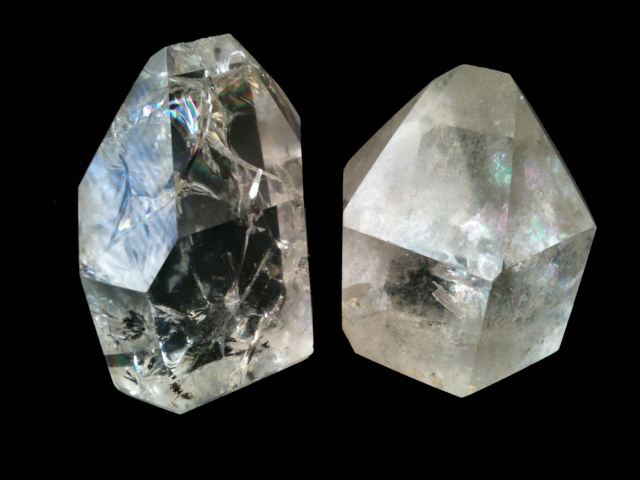
Yin and Yang Crystals

yinandyangcrystals

The crystal pictured to the left above is considered a yang crystal. The one to the right is a yin.

Yang crystals are glass-clear and transparent. There may be fire-like refractions of rainbows inside. Yang crystals are power crystals. They’re an amazing supplement to our work when we are seeking creative, active energies, power, strength, ambition, control, and aggressive healing. The elements of fire and air tend to be dominant. In other words, they correspond with the Wands and Swords of the Minor Arcana.

Yin crystals are milky white and translucent. The rainbows they refract are subtle, muted, and soft. Yin crystals are receptive. They channel love, enhance communication, spirituality, and intuition. They help us make sense of emotions. In yin crystals, the elements of water and earth tend to be dominant. They correspond with the Cups and Pentacles of the Minor Arcana.

As applied to tarot, when reading for questions about work, career, professional or personal development, creative projects, or ambitions, I like to keep a yang crystal nearby.

When reading about love, relationships, making sense of emotions or internal flux, I like to keep a yin crystal nearby.

For questions about finances, wealth, or property, it will depend on the question. Yang crystals are helpful around questions about wealth creation and asset acquisition. Yin crystals are helpful around questions about wealth management or the nurturing of what one currently has already.

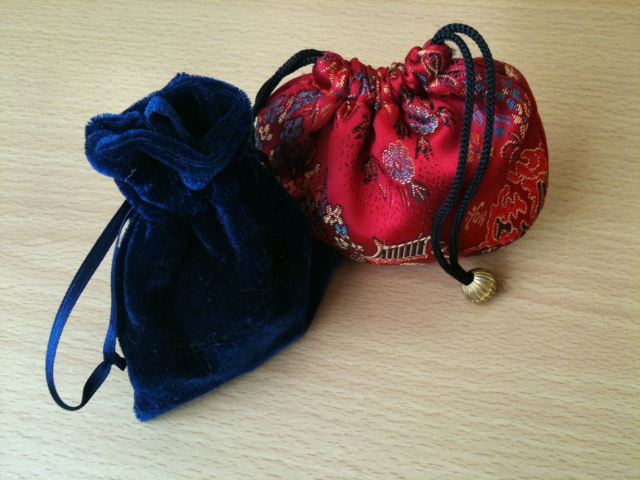
IMG_1249

Not that it’s necessary, but I keep the yang crystal in the red pouch and the yin in the blue. Just totally random info I wanted to share.

Anyway, I recommend to practitioners to have in their arsenal both yin and yang crystals. Don’t take my word for the differences between the two: just handle both and you’ll see for yourself. (Psst… a set of a yin and a yang crystal also make for a great gift to your favorite metaphysics buddy!)

Charging Fees for Tarot Readings

Whether it is appropriate to charge fees for tarot readings and other similar spiritual or divination services is a divisive and controversial topic, even though I don’t think it should be. The conclusion seems rather simple and unequivocal to me: yes of course one may charge fees for tarot reading just as one may charge for any sort of professional service, though when it comes to tarot, due to its more spiritual nature, we must be even more cognizant of ethics.

Yet indulge me for a moment while I reflect.

When I was a child, I met several Buddhists with an inexplicable empathic or intuitive connection to the universe and none of them charged fees when they interpreted their visions for seekers. At most they would accept donations. They would be conscientious of how they used the money from these donations: only for necessities; only for further helping others.

Their approach has always stuck with me, perhaps because of how impressionable my young mind was back then. Couple that with growing up in a Puritan society and that is probably why I feel intense bouts of guilt when I charge people for tarot readings.

IMG_1220

And so I don’t. Instead, I insist that I’m okay with giving the readings free, but will accept donations of any amount. I say this with the hope that the donation amount will be proportionate to their satisfaction with my work. If I provided zero insight and could not have been more wrong about their situation, then truly I am okay with nonpayment. If, however, they left feeling inspired, enriched, and empowered, then I hope they’ll show their gratitude by giving money that will reaffirm to me that I’m doing something right and continue on with my tarot reading adventures. Do not let my offer of free readings “for donations” fool you: I am very, very human, and very, very capitalistic. It is impossible for me to not measure the value of my tarot readings to others by the dollar amount I find in the coffers.

So when I get nothing, I feel like that’s my value. Imagine how that must feel after diligent focus on a tarot reading. Performing a one-card reading, thinking about it thoroughly, and writing up an assessment for the seeker takes 20 to 30 minutes, and that’s just for one card. I am very meticulous about how to apply that one card to the seeker’s question. Most of my readings are through written e-mails now, so then I need to write up something coherent. That, too, takes time. Ten plus cards can take up to an hour plus or minus. Many times, especially after repeat exploitation from seekers, I literally want to stop offering tarot readings altogether. I don’t think I even expect that much.

When you dine out at a restaurant, you expect to pay for the food and services. So when you request a tarot reader and the reader offers them “free, but accepting donations,” at least consider donating the cost of one restaurant meal. Isn’t that reasonable and the very least one can offer for another person’s time? In fact, when you request any kind of professional service at all, you expect to pay. So why would anyone go out of their way to seek a tarot reading and not expect to pay? Why would anyone take the initiative to contact me for a tarot reading and then not even consider how much time it must have taken me to do a reading and how much money they would want from a stranger if they put in that kind of time, commitment, and diligence for someone they didn’t even know? The more I advance down that line of thought, the angrier I get at the selfishness and lack of consideration of others. Is my time free? What makes them think I do not need to be compensated for in any way whatsoever for the work I do? Especially when I devote so much of myself to my work?

And that is when I start to think that the professional readers who charge $100 for their readings got it right. What is something I often say to seekers? Do not ever let others determine your self worth. You define your own worth. And yet here I am, a hypocrite, letting others determine the worth of my tarot readings rather than defining it myself.

Yet before I can change my mind and start charging for my services, that guilty conscience kicks in. I don’t know where it comes from, but I wish I could send it back.

More than that, though, I wish others applied the golden rule. I know I am.

UPDATE: I’ve since changed my mind on this topic, but instead of deleting the post, I’d like to leave it up and simply add this note. The tarot reader offers a very specific form of guidance and provides insight in a way that I have not seen any other service be able to do. On a certain intellectual level, I do not believe in charging fees for healing (as in doctors, medicine) or advocacy (as in lawyers and the practice of law). Generally the idea of commodifying social service is, again on a certain philosophical level, loathsome to me. However, in the reality we live in, money is the current that keeps society thriving and what governs the quality of our lives. So a tarot reader charging for services is no different from a doctor or lawyer, restaurant owner or plumber charging for their services rendered. If anything, given the nature of the work a tarot professional does, this should be an occupation held in high esteem, at the same level as other high professionals.