Lisa Papez and Francesca Paiocchi have teamed up to create a unicorn-themed storybook and tarot deck set. Lisa is a recognizable name in the online tarot space. She’s an author and content creator who is well-regarded for her tarot deck reviews, tarot tutorials, hot takes, and panel discussions with other tarot community members.
I love that the Unicorn’s Journey Tarot is an infinite fairytale in a box, told and retold in many iterations through a deck of beautifully illustrated cards.
Birthed during the global pandemic, The Fool’s New Journey Tarot is a 60-card deck that reorganizes the familiar order of the traditional 78. “Sixty Triumphs for a New Dawn.”
First ten trumps of the Fool’s New Journey
Per the deck description on the box: “In 2020, the world changed. The arrival of a worldwide pandemic ensured it could never be quite the same again. In the same way, facing new issues at every level of life, it is time for Tarot to change. The Fool must begin a new journey.”
“The Fool represents the soul of everyman . . . and goes through the life experiences depicted in the 21 cards of the Major Arcana,” wrote Eden Gray over half a century ago. The Majors, noted Gray, were like archetypes of the subconscious.
But why only these 21 cards of the Majors, as depicted by Pamela Colman Smith no less, as the immutable model for every tarot deck produced?
Trumps 50 – 57 in the Fool’s New Journey
So begins the questioning that led to The Fool’s New Journey, a new sequence of cards that speak with the archetypal voice governing all beings on earth (to borrow language from Caitlin Matthews).
Second decade of trumps in the Fool’s New Journey
John Matthews then collaborated with artist Charles Newington for these new archetypal tarot images. Together, the two set out to create imagery that would be stripped of the traditional imagery as much as possible, and to keep these picture cards simple. Matthews then set these images into a new order, a reset of the tarot.
These 60 trump cards present a new look at the tarot, literally a new journey for The Fool. And yet it’s funny that we think of this as a diverging path from traditional tarot, because in its heyday, circa 15th and 16th centuries, we had the Minchiate Tarot of 96 cards, the 50-card Mantegna, which was also considered a tarot, and the quite popular pre-Golden Dawn Etteilla Tarot that has an ordering of the Majors to confound today’s RWS readers.
Cards 1 through 5
The journey of The Fool represents the journey of life itself, and so the premise here would be that we, the everyman, all begin before The Maze (Key 1). In the natural course, we then must embody The Believer (Key 2), but before we can move into the role of The Magician, we must confront The Shadow (Key 3). If The Magician is skill and cleverness, The Priestess (Key 5) is wisdom and intuition. I love that in this New Journey, The Priestess is Key 5, what had been the traditional position of The Hierophant.
The Cat Aura Tarot tunes in to the magical perspective of cats, and like the intellect of cats, this deck is so much more, as you’ll soon see. “These curious, courageous, and happy felines have so many stories to share with you,” writes Malumir R. Logan, the deck creatrix, author, and cat mom who is the proprietor of Acorn and Burdock.
This deck is calibrated to work with the chakra system and with our auras. Per the guidebook, chakras are energy centers in our bodies, whereas auras are the electromagnetic field surrounding our body in a way that reflects the health of our chakras.
The colors of our auras reflect the color spectrum of chakras. So, for instance, a yellow-gold aura is telling us something about the dominance of the solar plexus chakra in that person; a green aura communicates something about the heart chakra, and a violet aura communicates something about the crown chakra, etc.
Before I read anything about this deck, as I set down the first two rows of cards, my immediate first impression was this has to do with yoga.
And that all made sense when I read that the creator, Serena Borsella, is a yoga coach.
The Inner Light Tarot is modern femme boho-chic. It radiates with the light of a California summer sun, inspiring harmony of physical, mental, and spiritual discipline, to achieve union of body, mind, and spirit.
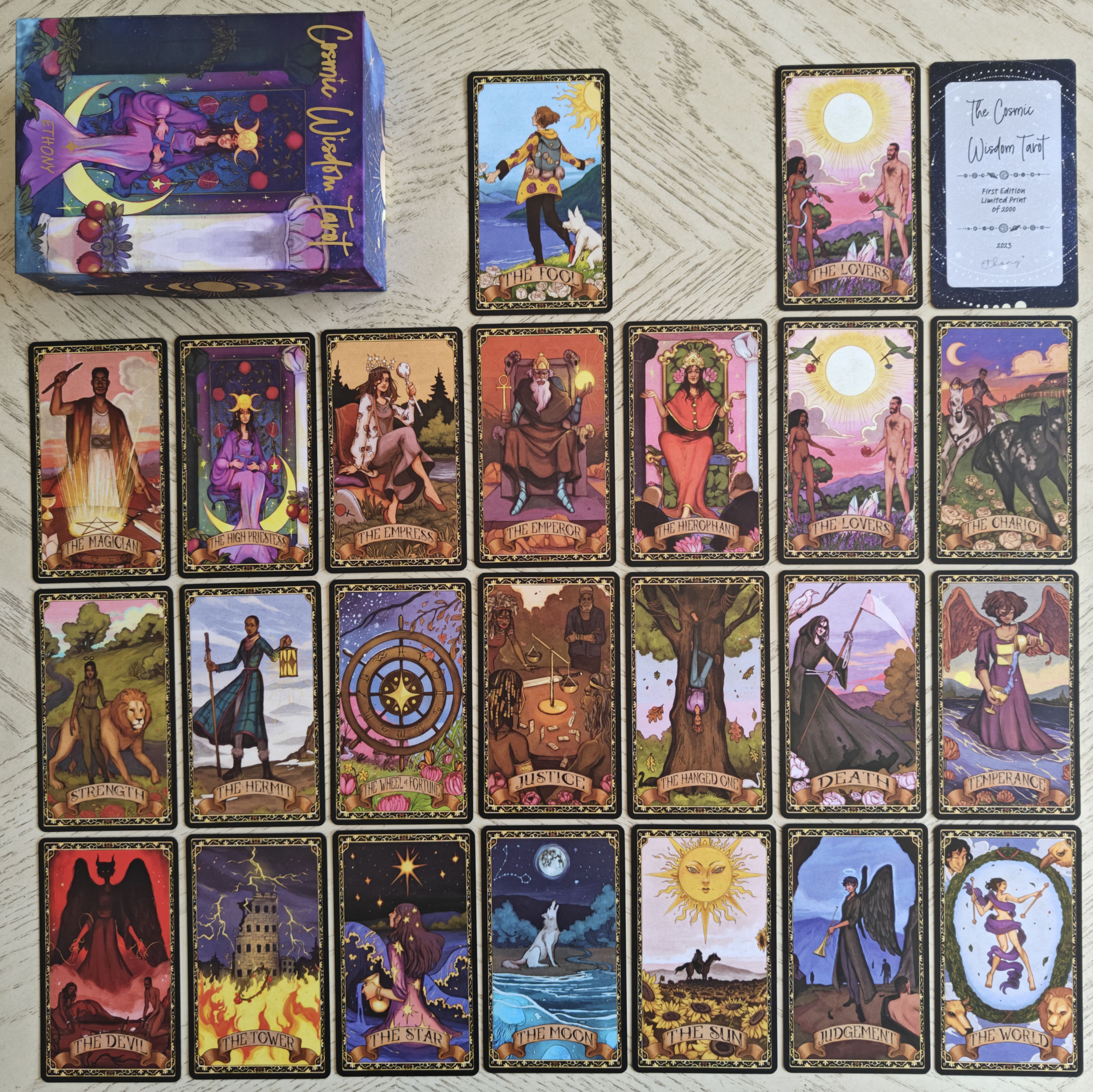
The illustrations for the Cosmic Wisdom Tarot has this nostalgic and heartwarming animations-of-your-childhood storybook style to it that is then paired with one of the coolest tarot card meanings guidebook I’ve come across.
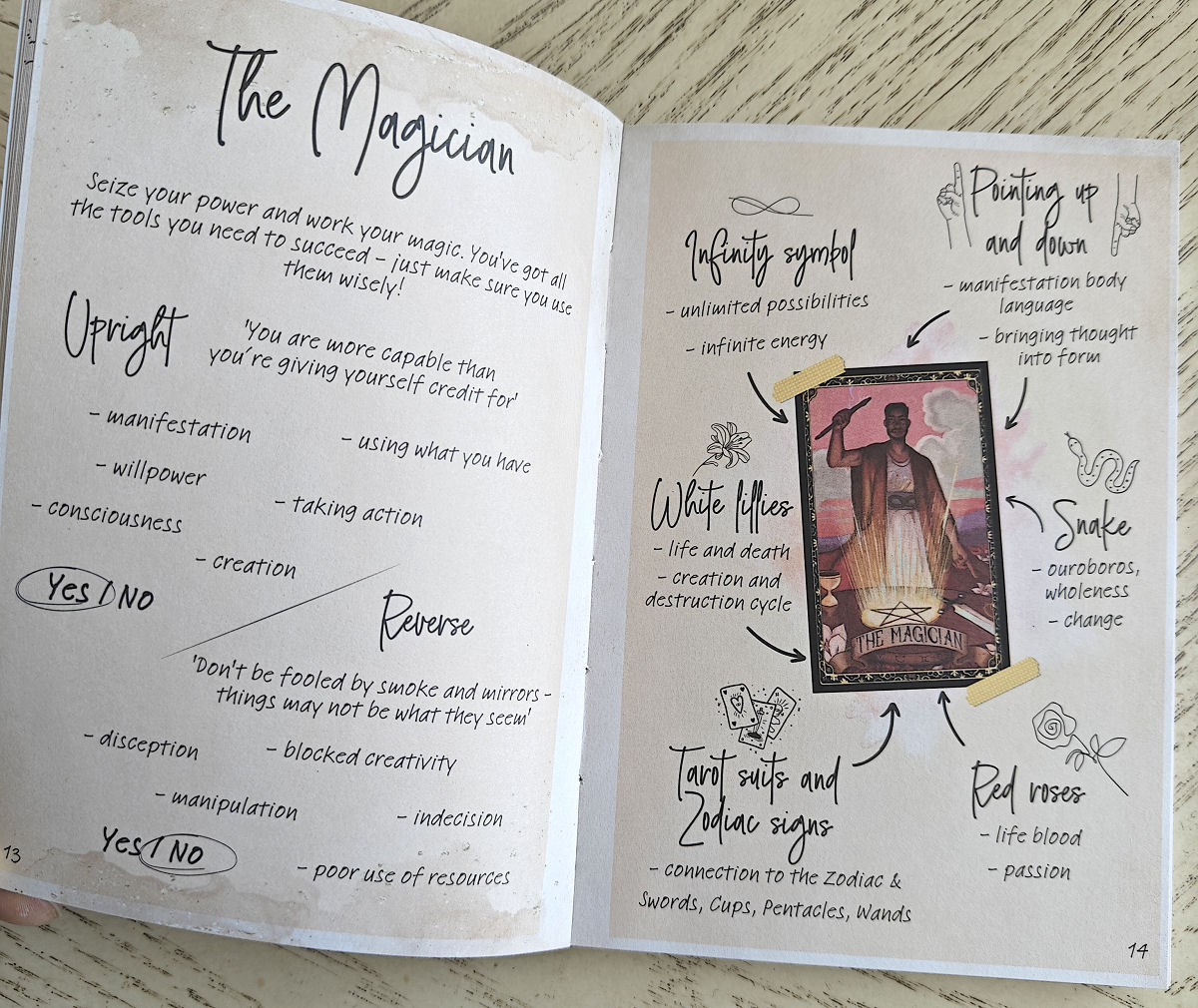
Cosmic Wisdom Tarot Guidebook – page spread for The Magician card
I love the creative mind-map layout for the card meanings. Each card comes with a definitive “this card means yes” or “this card means no” in the case of asking a yes or no question to the cards. I love the bullet points of keywords and single-sentence thesis for each card, upright and reverse, and then the breakdown of symbolism, which is also going to help you learn the RWS system.
The Majors. Click on photo for enlarged close-up view.
The Cosmic Wisdom Tarot is outfitted to be a great beginner’s deck, if you or someone you know is looking for one, because in addition to the RWS-keyed deck art, the guidebook does a great job presenting the tarot as a versatile tool, whether you are interested in learning it for divination, for self-discovery and personal growth, spiritual cultivation, or for inspiring your creativity.
Wisdom of Pooh Tarot. Created by Serefina & Angel Mesa. Illustrated by Kat L. Amsel.
Winnie-the-Pooh is my childhood, and to date remains one of my favorite characters and accompanying series of stories. To see one of the most beautifully produced tarot tributes to Pooh come alive by Rue & Vervain is an incredible honor.
The production quality of this box set is top tier, whether you’re talking indie or traditionally published. Not just production value, but Amsel’s artwork, staying true – simultaneously – to the spirit of what Milne and Shepard created and to the spirit of the RWS tarot is no small feat, and few in the past have achieved it with a themed deck.
Also I just noticed the compass in the map — it spells out POOH!
The Lepus Tarot by Witchy Cauldron, with illustrations by Artem Chernobai, arrived in my mailbox under somewhat mysterious circumstances. I’m not entirely sure how I came to receive it, but I sure am glad I did!
The deck’s namesake, lepus, means hares, or rabbits, and is also a reference to the constellation Lepus, eternally hunted by Orion. I love how the card back design even has constellation map vibes.
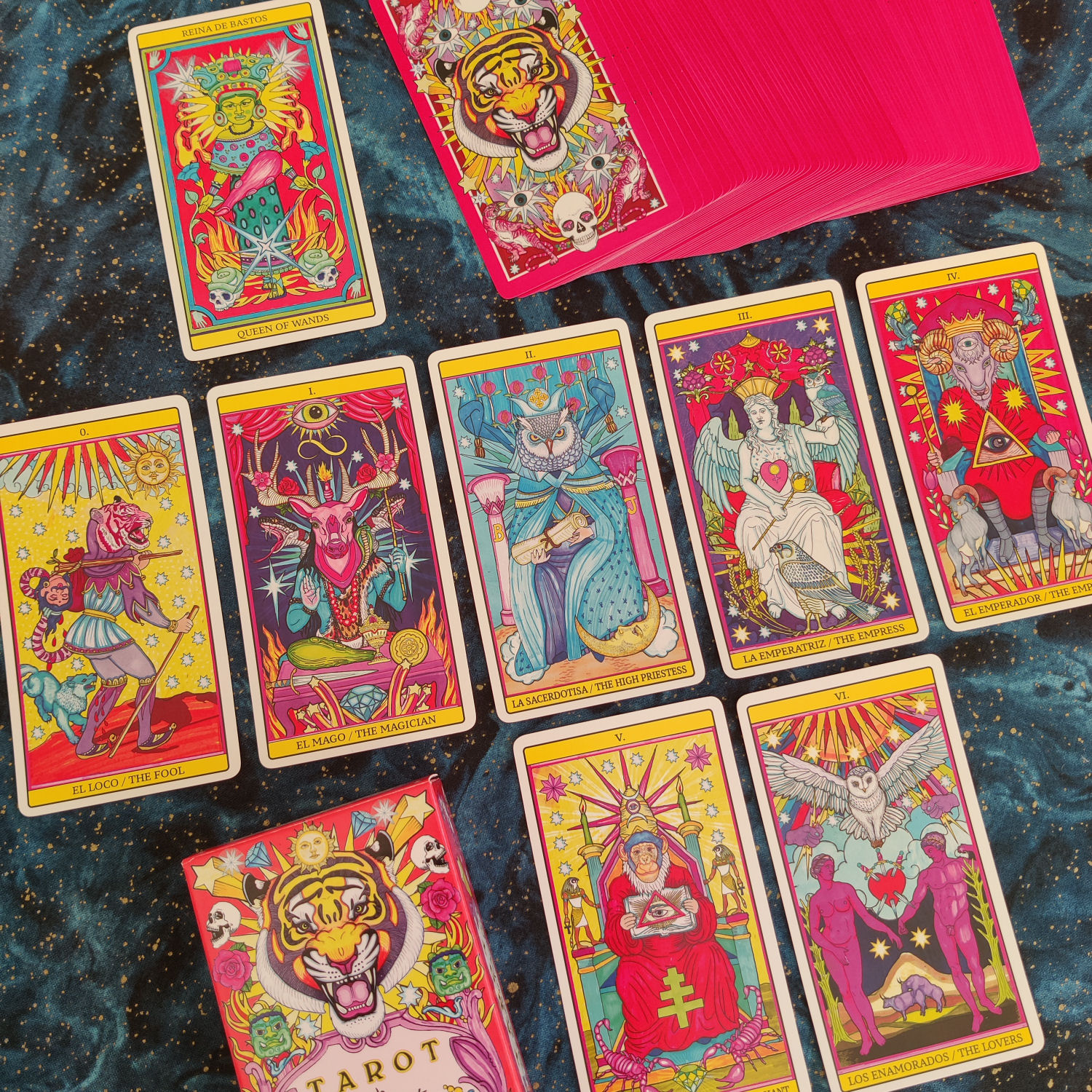
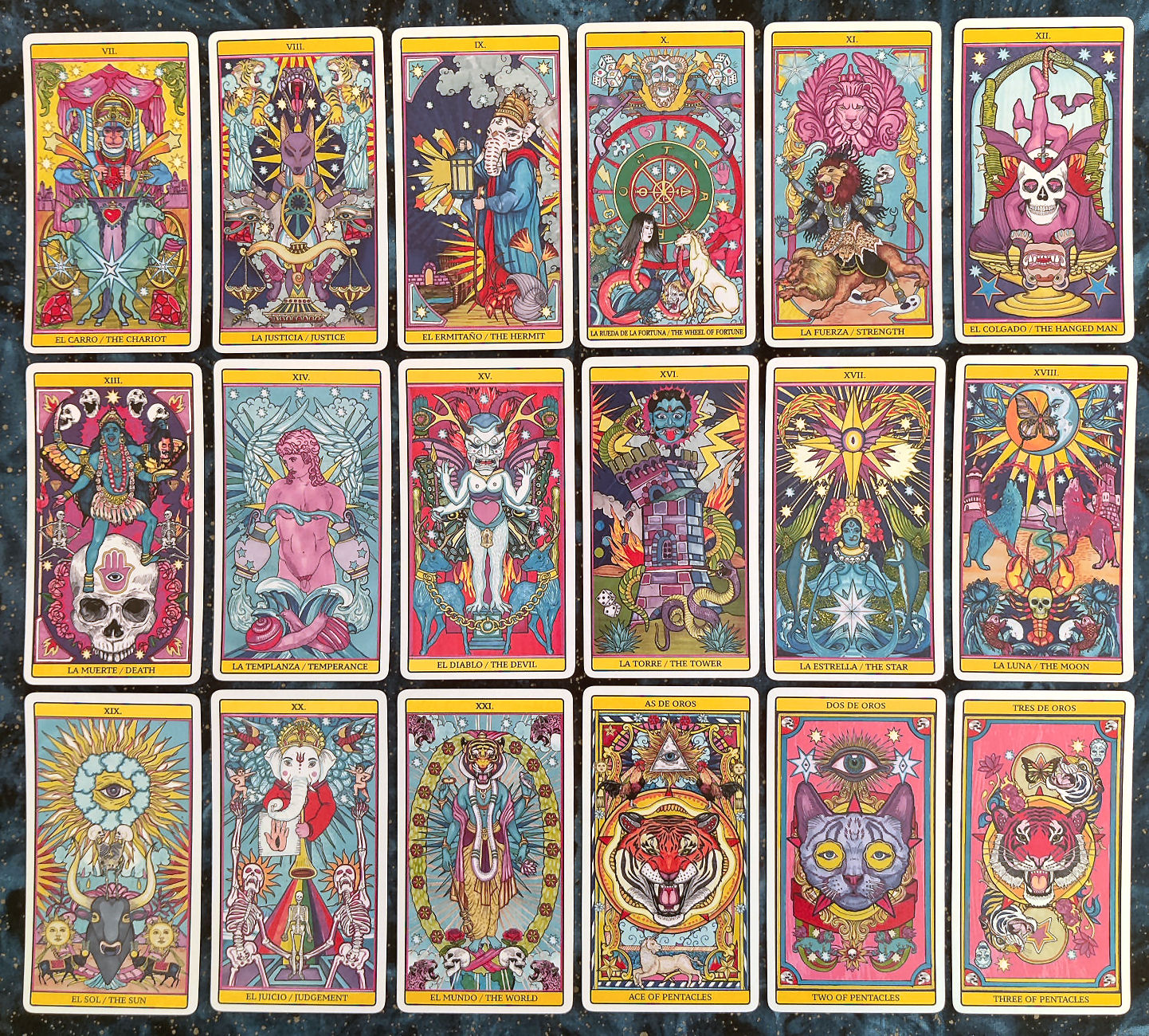
Javier Navarro‘s Tarot de El Dios de los Tres (Tarot of the God of Three) first came out in 2021 and I’ve had my eye on it since. There’s something about it that immediately sets it apart from most tarot decks I’ve come across on the market. It feels counterculture, cheeky, and yet not without depth and substance of thought.
Major Arcana, Chariot through The World; Ace, Two, and Three of Pentacles
Navarro is an Andalusian born artist and illustrator who blends sacred imagery from world religions and pop iconography to design a universe that is energetic, joyful, and liberating.
Four through King of Pentacles; Ace through Seven of Cups
This isn’t a deck review, just a walk-through, as I have not done readings with these cards. For me personally, this is a collector’s deck. It’s a deck I’ve acquired for the artwork, to get to hold a gallery of beautiful illustrations in my hands.
Michele Knight-Waite is a celebrated, award-winning astrologer and psychic. Once voted “UK’s Favourite Psychic,” she is a media personality, best-selling author, and regular astrology columnist at various magazines. These days you can also find her on Instagram and YouTube where her generous spirit is on full display.
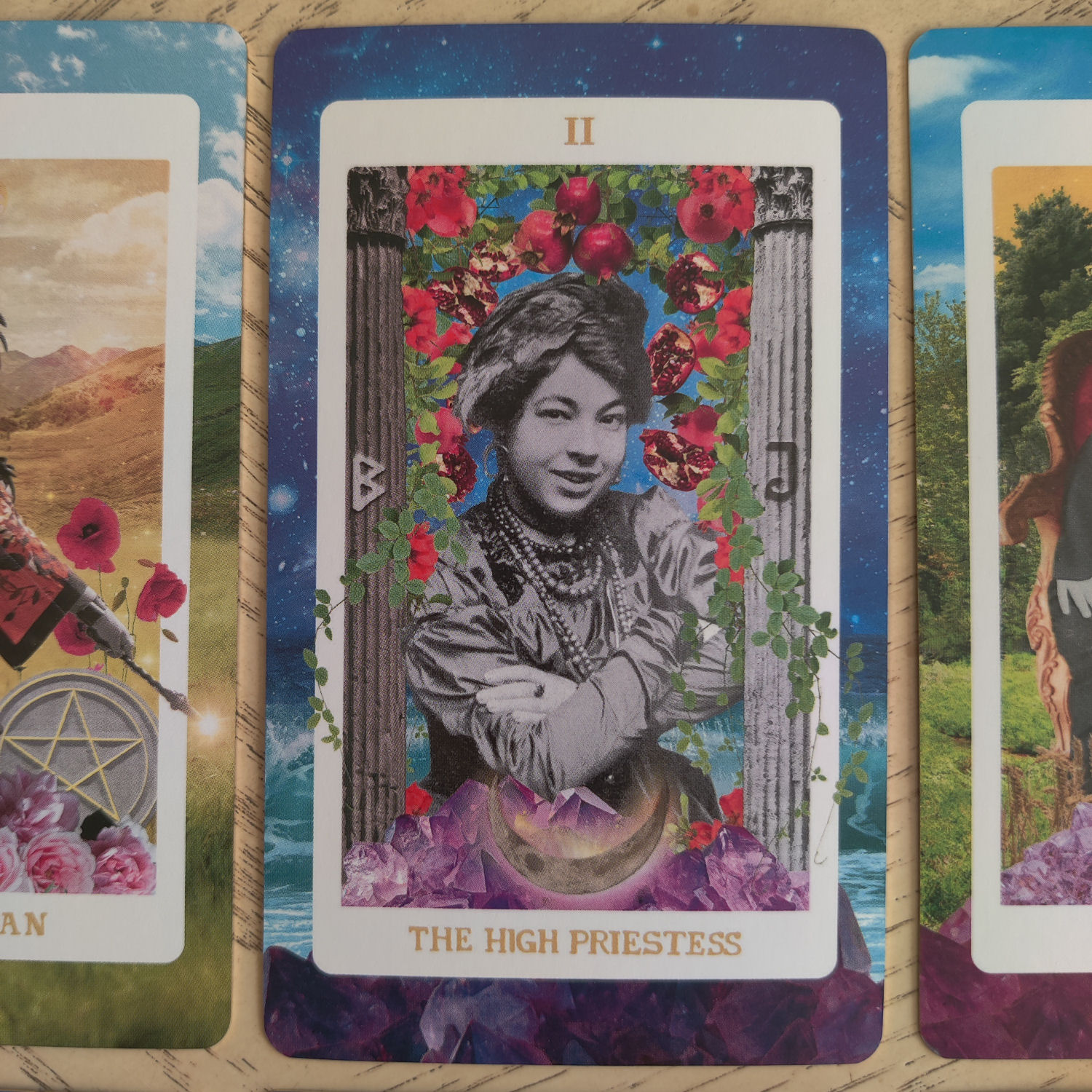
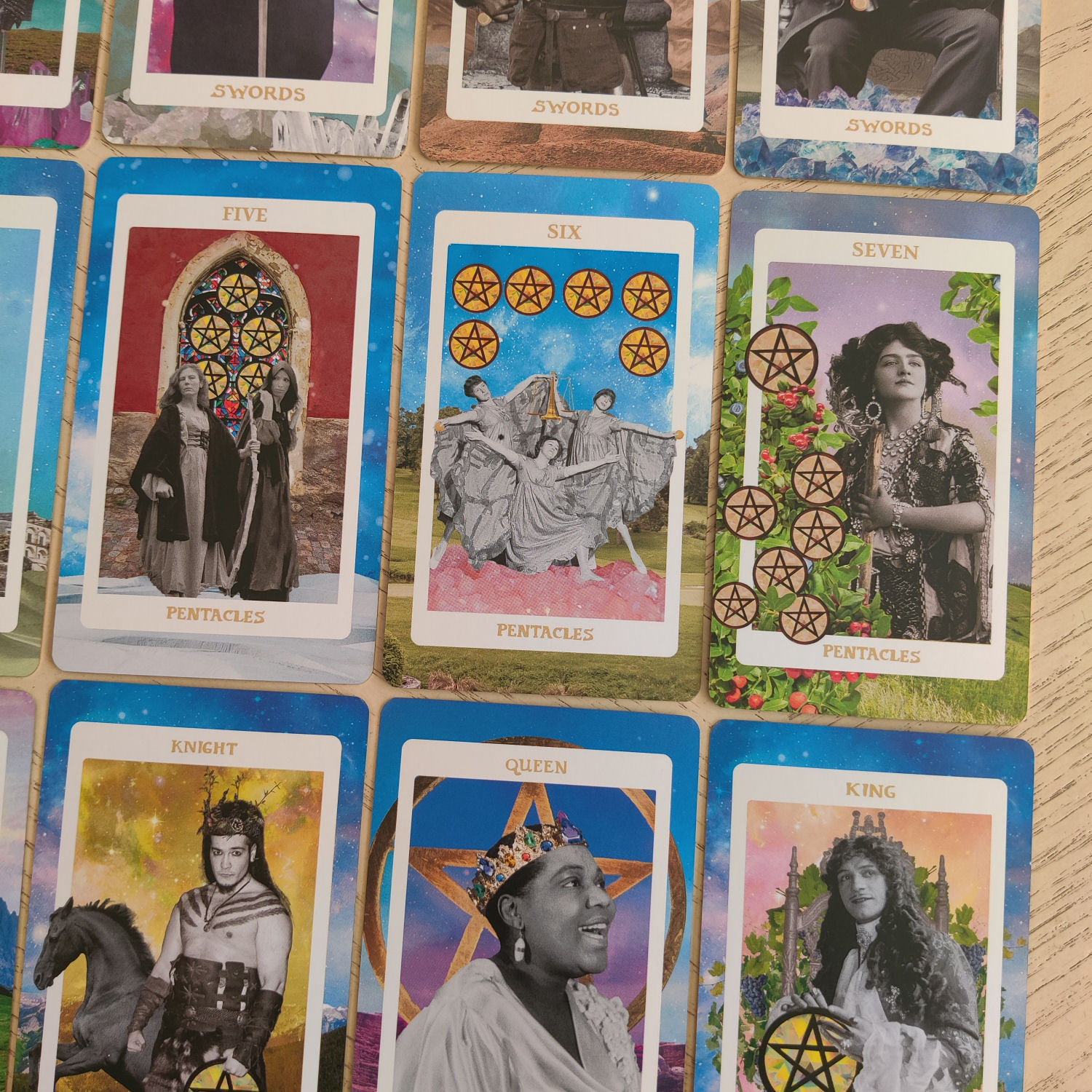
I love that she has channeled her many gifts into creating a modern RWS-based tarot deck that blends together the art of photo collage, with cameos from some of our favorite historical figures, and the familiar iconography of Pamela Colman Smith, who is featured on the High Priestess card.
There are notable graphic design elements here that I really love. Somehow, it’s both borderless and it has a border, where the full composition continues all the way to the edge, but then there is that classic tarot card white margin for the card title. See also how, for instance, in the Seven of Pentacles, the Pentacles “spill” over and out of the border.
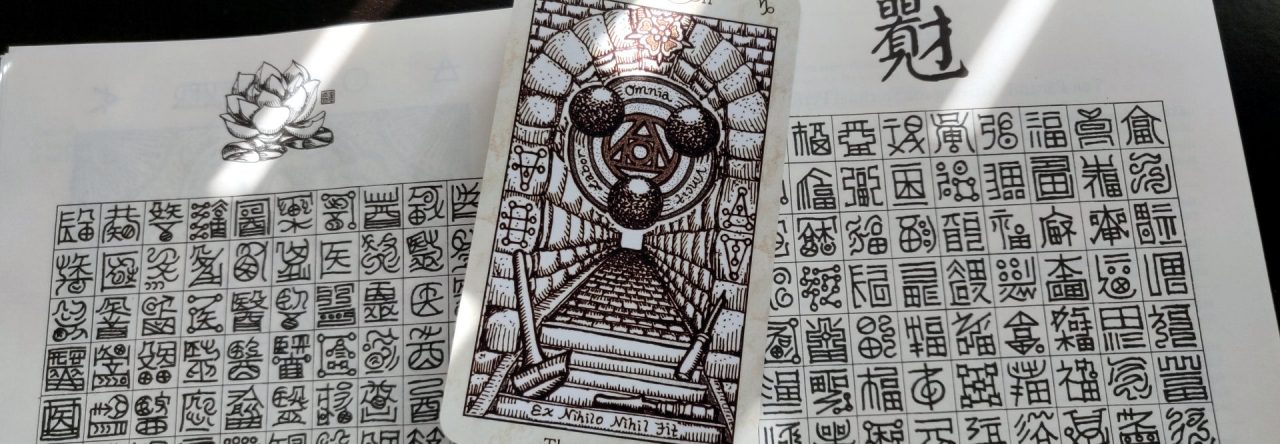
I previously showed the above in a #54321tarot tag. Whether you get the coins or cards, if you’re interested in the 72 angels correspondences, there’s a free download from me at the very end of this walk-through.
The download is so you can do a direct comparison between the 72 angels and tarot correspondences per Christine Payne-Towler’s Tarot of the Holy Light and the tarot correspondences per Frater Setnakh.








 benebell wen